Interbacterial signaling via
Burkholderia
contact-dependent growth inhibition system proteins
Erin C. Garciaa, Andrew I. Peraulta, Sara A. Marlatta, and Peggy A. Cottera,1
aDepartment of Microbiology and Immunology, University of North Carolina at Chapel Hill, Chapel Hill, NC 27599
Edited by Joan E. Strassmann, Washington University in St. Louis, St. Louis, MO, and approved May 23, 2016 (received for review April 21, 2016)
In prokaryotes and eukaryotes, cell–cell communication and recogni-tion of self are critical to coordinate multicellular funcrecogni-tions. Although kin and kind discrimination are increasingly appreciated to shape nat-urally occurring microbe populations, the underlying mechanisms that govern these interbacterial interactions are insufficiently understood. Here, we identify a mechanism of interbacterial signal transduction that is mediated by contact-dependent growth inhibition (CDI) system proteins. CDI systems have been characterized by their ability to de-liver a polymorphic protein toxin into the cytoplasm of a neighboring bacterium, resulting in growth inhibition or death unless the recipient bacterium produces a corresponding immunity protein. Using the model organismBurkholderia thailandensis, we show that delivery of a catalytically active CDI system toxin to immune (self) bacteria results in gene expression and phenotypic changes within the recip-ient cells. Termed contact-dependent signaling (CDS), this response promotes biofilm formation and other community-associated behav-iors. Engineered strains that are isogenic withB. thailandensis, except the DNA region encoding the toxin and immunity proteins, did not display CDS, whereas a strain of Burkholderia dolosaproducing a nearly identical toxin-immunity pair induced signaling inB. thailan-densis. Our data indicate thatbcpAIOBloci confer dual benefits; they direct antagonism toward non-self bacteria and promote cooperation between self bacteria, with self being defined by thebcpAIOBallele and not by genealogic relatedness.
signal transduction
|
sociomicrobiology|
contact-dependent competition|
two-partner secretion|
biofilmB
acteria typically live in complex communities such as biofilms. To do so, they must cooperate and compete with neighboring microbes, which requires that they sense not only environmental conditions but also the neighboring microbes themselves. Understanding the underlying mechanisms that govern microbial community dynamics is critical because biofilms can cause or exacerbate human disease (1) and microbial community com-position can affect immune system development and other aspects of human health (2).Although the importance of diffusible quorum-sensing molecules in interbacterial communication has been established (3), our appreciation of how microbes sense and respond to their neighbors, particularly those with which they are in direct con-tact, is incomplete. In the social amoeba Dictyostelium dis-coideum, kin discrimination and cooperation between self cells is achieved by interactions between matching allelic pairs of sur-face proteins (4, 5). Similarly, allele-specific interactions between surface proteins restrict Myxococcus xanthus outer membrane protein exchange and multicellular activities to occur only be-tween certain individuals (6, 7). Examples also exist of bacterial recognition that involves immunity to a self-produced toxin, in-cluding those delivered via type VI secretion (8, 9) and contact-dependent growth inhibition (CDI) systems (10, 11).
CDI systems are polymorphic toxin delivery systems that function in a contact-dependent manner. They are composed of two-partner secretion (TPS) pathway proteins and are widespread among Gram-negative bacteria (12). Burkholderia-type and Escherichia coli-type CDI systems are encoded by bcpAIOB and cdiBAI operons, re-spectively (13–15). ThebcpB/cdiBgene encodes the outer membrane
TpsB-family protein that translocates BcpA/CdiA, the TpsA-family protein, to the cell surface (16). The N-terminal∼2,800 aa of BcpA/ CdiA proteins are highly conserved whereas the C-terminal∼300 aa (termed the BcpA-CT or CdiA-CT) are variable. A conserved motif, Nx(E/Q)LYN or VENN, delineates the conserved and variable re-gions (12). Most BcpA-CT and CdiA-CT polypeptides function as nucleases in vitro and are sufficient to mediate cell death when produced intracellularly (12–14). According to the current model, BcpA-CT or CdiA-CT toxins are delivered to recipient bacteria upon cell–cell contact, exploiting outer membrane and inner mem-brane proteins on the recipient cell for entry to the cytoplasm (17, 18). CDI+bacteria are protected from autoinhibition by production of an immunity protein, BcpI or CdiI. BcpI/CdiI proteins covary with their cognate BcpA-CT/CdiA-CT toxins, binding to and inactivating only cognate (encoded by the same allele), but not heterologous (encoded by a different allele), toxin (12, 14). CDI systems therefore provide a mechanism for elimination of non-self neighboring bacteria, with self being defined by the specific bcpAIOB (or
cdiBAI) allele.
Emerging evidence suggests that, in addition to mediating interbacterial killing (12–15), CDI systems can promote cooperative behaviors. The CdiA proteins HrpA ofNeisseria meningitidis(19) and HecA ofDickeya dadantii(20), as well as putative CdiA pro-teins in Xyella fastidiosa (21), Xanthomonas fuscans (22), and
Xanthomonas axonopodis(23), are required for biofilm formation and/or virulence. E. coliEC93 CdiA was also recently shown to mediate biofilm formation and interbacterial adhesion, in a manner independent of the CdiA-CTEC93toxin (24).
Significance
How bacteria interact with one another has implications for human health and disease because complex bacterial commu-nities like biofilms can impact agriculture, infection transmission, and disease progression. Contact-dependent growth inhibition systems are proteins produced by many bacteria that deliver toxins to neighboring bacteria, allowing the producing cell to inhibit competitors that do not make the correct antidote. Here, we show that these systems not only antagonize competitors but also mediate communication and cooperation between bacteria that produce identical toxin/antidote pairs. Antidote-containing bacteria that are targeted by toxins change their gene expression to promote biofilm formation. Leading to a more complete understanding of how these antibacterial pro-tein systems function, this study will inform future development of therapeutics, vaccines, and decontaminants.
Author contributions: E.C.G., S.A.M., and P.A.C. designed research; E.C.G. and A.I.P. per-formed research; E.C.G., A.I.P., S.A.M., and P.A.C. analyzed data; and E.C.G. and P.A.C. wrote the paper.
The authors declare no conflict of interest.
This article is a PNAS Direct Submission.
Data deposition: The sequences reported in this paper have been deposited in the Gene Expression Omnibus (GEO) database,www.ncbi.nlm.nih.gov/geo(accession no.GSE83143). 1To whom correspondence should be addressed. Email: [email protected].
We recently demonstrated that Burkholderia thailandensis also requires thebcpAIOBgenes for biofilm formation (25). The BcpA-CT has DNA nickase activity in vitro, and amino acid substitutions that abolished its enzymatic activity also prevented bacteria pro-ducing this inactive protein from killing susceptible recipient cells (14, 25). Interestingly, bacteria producing inactive BcpA were also unable to form a biofilm, indicating that BcpA activity, and not simply the presence of BcpA on the bacterial surface, is required. Bacterial suicide or fratricide contributes to biofilm formation by some organisms (26, 27). However, prevention of interbacterial killing (i.e., CDI) among wild-typeB. thailandensis by constitutive
production of the immunity protein BcpI did not affect biofilm development, indicating that a similar fratricidal mechanism could not explain the requirement for BcpA enzymatic activity (25). De-scribed here, we observed additional phenotypes correlating with BcpA activity and set out to test the hypothesis that CDI systems may also function in interbacterial signaling to mediate cooperative behaviors, such as biofilm development, when interacting with self bacteria (those expressing the samebcpAIOBorcdiBAIallele).
Results
CDI-Independent Phenotypes Require BcpA Activity.In other
organ-isms, affinity for the dye Congo red (CR) often correlates with biofilm formation because CR binds polysaccharides (28), amyloid proteins (29), and other surface structures. Toward investigating the requirement of BcpA catalytic activity in biofilm development, we plated bacteria on medium containing CR. Approximately 20% of the colonies formed by wild-type B. thailandensis bound the dye whereas all colonies formed byΔbcpAIOBbacteria remained white (Fig. 1A). A recombinase-based reporter containing thebcpA
promoter region indicated that CR+, but not CR−, colonies had expressed bcpAIOB to high levels (SI Appendix, Fig. S1), consistent with the fact that high bcpAIOB gene expression is stochastic, occurring in only a small proportion of bacteria grown under laboratory conditions (13). A mutant (BtEKA) that pro-duces wild-type levels of catalytically inactive BcpA due to two amino acid substitutions (E3064A and K3066A) in the putative toxin active site (25) also did not bind CR (Fig. 1A), indicating that the enzymatic activity of the protein is required for this phenotype. However, interbacterial killing was not required because constitutive expression of the immunity-encoding bcpI
(which prevents interbacterial growth inhibition) (13) did not alter CR binding. Constitutive expression of wild-typebcpAIOB
from therpsLpromoter PS12(PS12-WT) resulted in 100% CR+
colonies. Constitutive expression of bcpAIOB containing the toxin-inactivating mutations (PS12-BtEKA) also resulted in 100%
CR+colonies (see, for example, Fig. 3A) although the amount of CR bound by this mutant was significantly less than that bound by PS12-WT (SI Appendix, Fig. S1). These data suggest that CR
binding toB. thailandensisis the sum of direct binding to BcpA Fig. 1. Community-associated behaviors require BcpA catalytic activity
in-dependently of interbacterial growth inhibition. (A) Proportion of CR-binding colonies of wild-type bacteria,ΔbcpAIOBmutant,B. thailandensis pro-ducing catalytically inactive BcpA (BtEKA), wild-type bacteria constitutively expressingbcpI(WT+bcpI), andB. thailandensis constitutively expressing WTbcpAIOB(PS12-WT) orbcpAIOBin whichbcpAcontains toxin-inactivating
mutations (PS12-BtEKA). Lines show the mean of at least three independent
experiments per strain (n=3–6). (B) Aggregation in minimal medium ( Up-per) and pigment production by colony biofilms (Lower) of the strains in A. *P<0.05; ns, not significant.
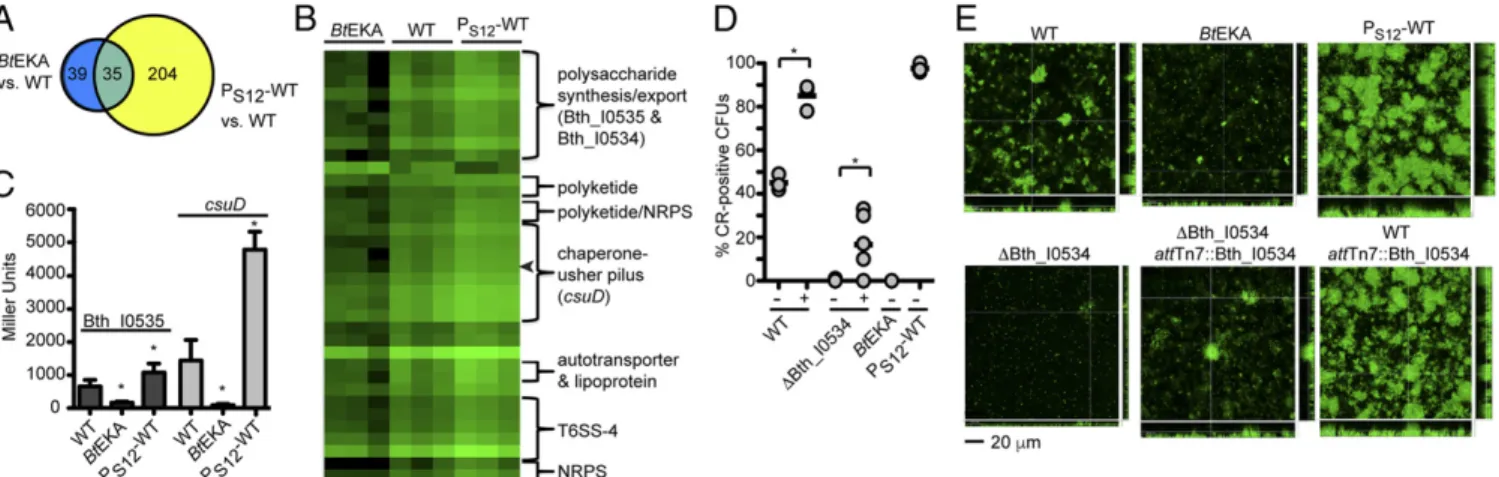
Fig. 2. Catalytically active BcpA affects expression of genes associated with community behaviors. (A) Genes identified by RNA-seq as significantly differ-entially expressed (P<0.05) byBtEKA mutants compared with wild-type bacteria (blue) and PS12-WT mutants compared with the wild-type strain (yellow).
(B) Heat map of RPKMs (reads per kilobase of transcript per million reads mapped) for the 35 genes that were oppositely expressed in PS12-WT andBtEKA
mutants compared with wild-typeB. thailandensis(WT). Shading indicates low (black) and high (green) RPKM values for each of triplicate samples of each strain. Genes are arranged in chromosomal order, and putative operons/multigene loci are annotated to the right. Arrowhead shows position ofcsuD. (C)β-Galactosidase activity (in Miller units) for wild-type,BtEKA, and PS12-WT bacteria carryinglacZreporters within the coding regions of Bth_I0535 (Left,
dark gray bars) orcsuD(Right, light gray bars). Bars represent the mean of three independent experiments, and error bars show the SD. *P<0.05 compared with wild-type cultures. (D) Proportion of CR-binding colonies ofBtEKA, PS12-WT, and WT andΔBth_I0534 mutant bacteria with (+) and without (−) PS12-Bth_I0534 at
a chromosomalattTn7 site. Bars show the mean of three independent experiments (n=3–6 per strain). *P<0.05. (E) Z-stack images of 48-h biofilms formed by GFP-marked bacterial strains shown inD. (Scale bar: 20μm.)
MIC
(independently of its catalytic activity), as well as binding to an unknown structure, perhaps exopolysaccharide, that depends on BcpA activity.
During our studies, we also noticed thatB. thailandensiscolony biofilms developed a yellow-gold color when cultured on LSLB agar for extended periods (Fig. 1B). We refer to this phenotype as
“pigment production”although it is not clear whether the gold color is indeed a pigment. Colony biofilms ofΔbcpAIOB, BtEKA, and PS12-BtEKA mutants remained white, indicating that BcpA catalytic
activity is required for this coloration. Expression of bcpIin wild-type bacteria did not alter pigment production.
Finally, as we previously described (13),bcpAIOBare required for
B. thailandensis to autoaggregate in minimal medium, and consti-tutive expression of the genes results in hyperaggregation (Fig. 1B
andSI Appendix, Fig. S2). Constitutive production of the immunity protein did not affect aggregation of wild-type bacteria, but the catalytic activity of BcpA was required (Fig. 1BandSI Appendix, Fig. S2). These data indicate that three distinct phenotypes—CR binding, pigment production, and aggregation—all require BcpA catalytic activity but not interbacterial growth inhibition.
BcpA Alters Expression of Genes Involved in Biofilm Formation.We
hypothesized that BcpA-CT toxin exchange between wild-type bacteria, although not leading to cell death, triggers a change in gene expression that is responsible for these, and possibly other, phenotypes. To test this hypothesis, we compared transcript levels among triplicate samples of wild-type,BtEKA, and PS12-WT
bac-teria cultured in minimal medium using RNA-sequencing analysis. Transcript abundance was significantly different by more than
twofold for 74 genes when wild-type and BtEKA bacteria were compared (Fig. 2AandSI Appendix, Table S1) and for 239 genes when wild-type and PS12-WT bacteria were compared (Fig. 2Aand
SI Appendix, Table S2). Comparison of PS12-WT andBtEKA
mu-tants (strains displaying maximum and minimum biofilm, CR binding, and pigmentation phenotypes) revealed 841 genes with differential expression—410 that were greater in PS12-WT than in
BtEKA (SI Appendix, Table S3) and 431 that were decreased in PS12-WT compared withBtEKA (SI Appendix, Table S4). To
nar-row our focus, we reasoned that the genes most strongly affected by BcpA activity should be oppositely expressed in PS12-WT and
BtEKA mutants compared with wild-type bacteria, and 35 genes fit these stringent criteria (Fig. 2AandBandSI Appendix, Table S5). The majority of these genes were located within several putative operons and multigene loci that are predicted to encode a type VI secretion system, putative polysaccharide synthesis proteins, non-ribosomal peptide/polyketide synthesis enzymes, and a chaperone-usher pilus (SI Appendix, Fig. S3).
To determine gene expression changes revealed by the RNA-seq analysis using another method, we generated reporter strains by introducing promoterlesslacZgenes within the coding sequence of Bth_I0535, which is predicted to encode a polysaccharide glyco-syltransferase, and Bth_I2677 (csuD), which is predicted to encode a pilus usher protein. Expression of Bth_I0535-lacZandcsuD-lacZ
was significantly higher in PS12-WT and lower inBtEKA than in
wild-typeB. thailandensis(Fig. 2C).
An ortholog of the putative transcriptional regulator Bth_I0534 (69% identity) is required byBurkholderia cenocepaciafor biofilm formation and expression of polysaccharide synthesis genes (30, 31). Deletion of Bth_I0534 abrogated CR binding (Fig. 2D) and biofilm formation in B. thailandensis (Fig. 2EandSI Appendix, Fig. S4). These defects could be partially complemented by reintroduction of Bth_I0534 at a neutral chromosomal site, but not by coinoculation with wild-type bacteria (SI Appendix, Fig. S4). Overexpression of Bth_I0534 in wild-type bacteria led to increased CR binding (Fig. 2D) and biofilm biomass (Fig. 2EandSI Appendix, Fig. S4). Taken together, these data show thatB. thailandensisBcpA catalytic ac-tivity affects expression of many genes, including at least one that is required for biofilm formation.
BcpA Delivered from Neighbor Bacteria Is Sufficient to Alter Gene
Expression.We hypothesized that the gene expression changes
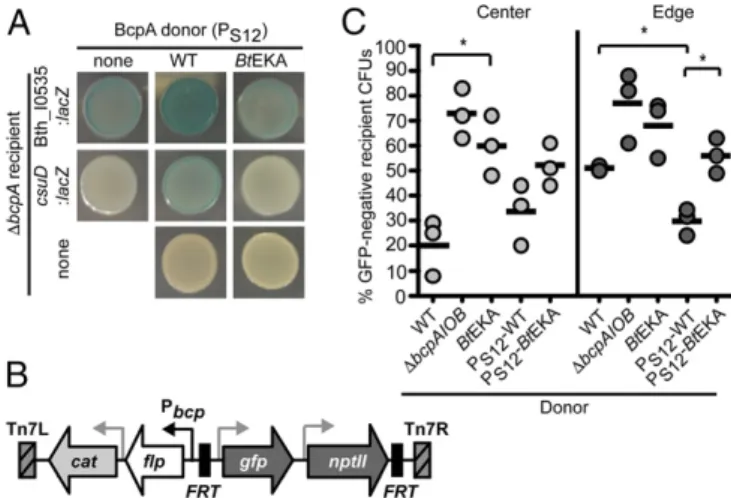
ob-served by RNA-seq were due to the exchange of catalytically active BcpA molecules between bacteria. To test this hypothesis, we constructed aΔbcpAmutant that, as expected, could no longer kill susceptibleΔbcpAIOBtarget cells, but was protected from growth inhibition (SI Appendix, Fig. S5). When incubated on X-gal agar, colony biofilms ofΔbcpAmutant bacteria containing Bth_I0535::
lacZorcsuD::lacZreporters were light colored, indicating that ex-pression of these genes was low in the absence of a BcpA-derived signal (Fig. 3A). When these reporter bacteria were cocultured with
B. thailandensisconstitutively producing wild-type BcpA, the mixed colony biofilms were darker blue, indicating that Bth_I0535 and
csuD expression was greater when the reporter strains were sur-rounded by wild-type neighbors. Coculture of theΔbcpAreporters with a strain producing inactive BcpA did not cause the blue color change. These results indicate that interaction with bacteria pro-ducing active BcpA is sufficient to increase expression of Bth_I0535 andcsuD, suggesting that recipient cells alter their gene expression in response to acquisition of catalytically active BcpA-CT from their neighbors.
BcpA DecreasesbcpAIOB Gene Expression in Neighboring Bacteria.
To further measure gene expression in recipient bacteria during interactions with BcpA-producing neighbors, we used a sensitive recombinase-based reporter system developed in our laboratory (Fig. 3B) (32). In this system, activation of a promoter of interest leads to Flp recombinase production, excision of FRT-flankedgfp
Fig. 3. Catalytically active BcpA acquired from neighboring bacteria affects gene expression in recipients. (A) Expression of Bth_I0535 (Top) andcsuD (Middle) inΔbcpA recipient bacteria containinglacZreporters for these genes after incubation with no BcpA donor (first spot) or coincubation (at a 1:1 ratio) withB. thailandensisconstitutively producing wild-type (PS12-WT,
middle spot) or inactive BcpA (PS12-BtEKA, last spot) on X-gal agar. Donor
(Bottom) and recipient (first column) cells incubated alone are also shown. (B) Diagram of the modified Pbcp-flpreporter cassette. The putativebcpA promoter (black arrow) drives expression offlprecombinase. Gray arrows indicate constitutive promoters. Flp recombinase target (FRT) sites (black boxes) flanknptII(conferring kanamycin resistance) andgfpgenes. Acat gene (conferring chloramphenicol resistance, CmR) is located outside theFRT
sites. Tn7L and Tn7R (hatched boxes) sequences target the cassette to an attTn7 site on one of the twoB. thailandensischromosomes. (C) Proportion of wild-type bacteria carrying the Pbcp-flpreporter (recipients) that expressed
bcpAIOBwhen incubated with the indicated (CmS) mutants (donors) at a 1:100
ratio (recipient:donor) on M63 agar. The fraction of the reporter recipient population having expressedbcpAIOBis shown as the percentage of CmR
andnptIIgenes, and the permanent loss of GFP fluorescence and kanamycin resistance from the bacterium. Although our intention was to measure activation of the Bth_I0534 andcsupromoters, as well as bcpA itself, we were unable to obtain flp reporters for Bth_I0534 and the csu operon in the “promoter off” state—all clones had already excised theirgfpand nptIIgenes. Proceeding with the Pbcp-flpreporter, we tested the effect of BcpA-producing
neighbors on recipient cell gene expression using a coculture assay. Recipients (carrying the Pbcp-flpreporter) were selected from the
center and edge of coculture colony spots (which experience dif-ferent interbacterial killing dynamics) (13) and the resulting colo-nies were analyzed for GFP fluorescence as a measure of the proportion of recipient bacteria that expressed bcpAIOB. After coculture with wild-type bacteria,∼20% of recipient bacteria in the center of the colony spot and∼50% of cells at the edge were GFP− and therefore had expressedbcpAIOB(Fig. 3C). These numbers increased to 70–80% when the same recipient cells were incubated with eitherΔbcpAIOBorBtEKA mutant donors, indicating that significantly more bacteria expressed bcpAIOB when their
neighbors did not produce catalytically active BcpA. During co-culture with PS12-WT, but not PS12-BtEKA, the number of reporter
recipient bacteria having activated PbcpA was significantly less than
during coculture with wild-type bacteria, indicating that fewer re-cipients had expressed theirbcpAIOBgenes when their neighbors produced high levels of enzymatically active BcpA. Although the
bcpAIOB genes were not identified in our RNA-seq analysis and autoregulation of bcpAIOBorcdiBAI has not been reported pre-viously, these data (generated using a highly sensitive reporter) indicate that catalytically active BcpA produced by neighboring bacteria decreasesbcpAIOBgene expression within recipient cells.
Taken together, our data thus far suggest that, in addition to interbacterial inhibition, the BcpAIOB proteins mediate inter-bacterial signaling in B. thailandensis. This process seems to depend on the delivery, likely to the cytoplasm, of a catalytically active enzyme from one bacterium to another. In contrast to interbacterial killing (i.e., CDI), signaling results in gene expres-sion changes in the recipient cell, leading to an increase in community-associated behaviors, such as biofilm formation and the production of a CR-binding structure. To differentiate these outcomes from BcpAIOB-mediated CDI, we will refer to this response as contact-dependent signaling (CDS).
BcpA Toxins Encoded by DifferentbcpAIOBAlleles Do Not Induce CDS
in B. thailandensis. BcpAIOB-mediated signaling could occur in recipient bacteria via several potential mechanisms. Toxin delivery into recipient cells requires translocation across both the outer and inner membranes (18), and one possibility is that the gene expres-sion changes observed represent responses to membrane damage sustained during toxin entry. Indeed, envelope stress is known to trigger biofilm formation in other organisms (33, 34). To test this hypothesis, we examinedB. thailandensis strains that express chi-mericbcpAIOBgenes, differing from wild-type E264 only within the regions encoding the BcpA-CT toxin and BcpI. StrainsBt-Bp1106a-1 and Bt-Bp1106a-2 produce chimeric BcpA proteins containing BcpA-CT (and BcpI) encoded by the alleles Bp1106a-1 and
Bp1106a-2, respectively, ofBurkholderia pseudomalleistrain 1106a (SI Appendix, Fig. S6) (11). BcpA-CT1106a-2contains a putative toxin deaminase domain, but the precise enzymatic activities of both toxins are unknown.
We have previously demonstrated that chimeric strainsBt-Bp1106a-1 andBt-Bp1106a-2 can inhibit the growth of susceptibleB. thailandensis
recipient bacteria, indicating that they must successfully deliver their chimeric BcpA toxins to recipient cells (11). However, whereas they can mediate CDI, chimeric strainsBt-Bp1106a-1 andBt-Bp1106a-2 are defective for biofilm formation (11). Here, we show that these strains were also defective for aggregation (Fig. 4A) and pigment production, and yielded colonies that did not bind CR (SI Appendix, Fig. S6). These phenotypes correlated with low expression of BcpA-responsive genes identified in our RNA-seq analysis: Bth_I0535 (Fig. 4B) and csuD(SI Appendix, Fig. S6). Thus, the BcpA-CT toxins delivered by the chimeric strains are apparently capable of mediating CDI, but not CDS. That is, they are incapable of trig-gering the gene expression and phenotypic changes induced by BcpAE264in B. thailandensis E264. This result indicates that CDS is not a general response of the bacteria to any BcpA toxin, or simply to membrane perturbation or other consequences of protein translocation into the cytoplasm from an extracellular loca-tion. Moreover, these data show that BcpA-CTE264and/or BcpIE264 are required for BcpA-mediated signaling inB. thailandensisE264 and suggest the hypothesis that CDS represents a specific response to a bacterium’s own BcpA toxin.
A Nearly Identical BcpA Toxin Produced by Burkholderia dolosa
Induces CDS in B. thailandensis. We predicted that bacteria
pro-ducing identical CDI system proteins could signal to each other and induce gene expression changes, even if the strains were otherwise genetically dissimilar. The genome ofB. dolosastrain AU0158 Fig. 4. B. thailandensisresponds to self but not non-self BcpA. (A)
Aggrega-tion of wild-type B. thailandensis, BtEKA mutants, and chimeric strains Bt-Bp1106a-1 andBt-Bp1106a-2 (gray bars,“native promoter”) or strains in which thebcpAIOBlocus is driven by the constitutive promoter, PS12(black bars,“PS12”).
The ratio of the OD600of a settled culture to the OD600of the same culture after
vortexing is shown. Dashed line shows an OD600ratio of 1, which indicates no
aggregation. Bars represent the mean of four independent experiments, and error bars denote the SD. *P<0.05 compared with WT or PS12-WT aggregation.
(B)β-Galactosidase activity (in Miller units) for WT andBtEKA bacteria, and chi-meric strainsBt-Bp1106a-1 andBt-Bp1106a-2 carryinglacZreporters within the coding region of Bth_I0535. Bars represent the mean of three independent ex-periments, and error bars show the SD. *P<0.05 compared with WT cultures. (C) Expression of Bth_I0535::lacZ(Top) and csuD::lacZ(Middle) reporters in B. thailandensisΔbcpArecipient bacteria after coincubation (at a 1:5 ratio) withB. dolosawild-type orΔbcpA-1,ΔbcpA-2, orΔbcpA-1ΔbcpA-2mutant bacteria on X-gal agar. Donor (Bottom) and recipient (first column) cells in-cubated alone are also shown.
MIC
contains threebcpAIOBloci, including one,bcpAIOBAU0158-1, that is nearly identical to thebcpAIOBlocus inB. thailandensisE264. The predicted amino acid sequences of the BcpA proteins encoded bybcpAIOBAU0158-1andbcpAIOBE264are 77% identical, with 86% identity within the BcpA-CT region, and the BcpI proteins are 82% identical (SI Appendix, Fig. S7). By contrast, BcpA-CTAU0158-2 shares only 12% identity with BcpA-CTE264. During coculture, wild-type B. dolosa and aΔbcpA-2mutant induced increased B. thai-landensis expression of Bth_I0535::lacZ andcsuD::lacZ reporters whereas mutants lacking bcpA-1 did not (Fig. 4C). This result suggests that both BcpAAU0158-1 delivery to B. thailandensis and BcpAE264exchange amongB. thailandensisbacteria induce similar responses in recipient cells and indicate that BcpA-mediated sig-naling can occur between differentBurkholderiaspecies that express the same bcpA/bcpI allele—bacteria that are somewhat distantly related genealogically, but are“self”as defined bybcpAIOB. The results contrast with the lack of signaling observed between
B. thailandensisstrains that differed only within the region encoding BcpA-CT and BcpI (Fig. 4AandB)—bacteria that are otherwise genetically identical, but“non-self”as defined bybcpAIOB.
Discussion
Contact-dependent growth inhibition was discovered based on the ability of CdiBAI/BcpAIOB proteins to inhibit the growth of neighboring bacteria unless those cells produce an appropriate immunity protein (12, 15). Our new data indicate that protection from growth inhibition is not the only consequence of BcpA toxin delivery to immune bacteria. Perhaps an equally important function, BcpA-CT delivery also leads to changes in gene ex-pression in targeted cells that result in increased group behav-iors, such as biofilm formation and production of a CR-binding structure and a pigment, as well as decreased expression of the
bcpAIOB genes themselves. Thus, BcpAIOB (and possibly CdiBAI) proteins appear to play dual roles: antagonism of non-self cells that do not produce the correct immunity protein and pro-motion of community behaviors among self bacteria that produce identical proteins.
Our data suggest that BcpAIOB proteins enable bacteria to sense and respond to direct contact with sibling cells. In contrast to quo-rum sensing, CDS might allow bacteria to alter their behavior at relatively low cell densities or in high diffusion environments. Moreover whereas quorum-sensing pheromones are generally shared among all members of a bacterial genus or species (35), di-versity amongbcpAIOBalleles occurs within species, suggesting that CDS may relay information about the proximity of only very closely related or sibling neighbors. Because quorum sensing influences expression of both bcpAIOBand biofilm-related genes in B. thai-landensis(36), CDS may function as a fine-tuning mechanism.
Neighbor-acquired BcpA could impact gene expression in BcpI-producing recipient bacteria by several possible mechanisms. It is not due to membrane perturbations associated with BcpA-CT de-livery or a general response to CDI attack because it does not occur when catalytically inactive or B. pseudomallei BcpA-CTs are de-livered. Instead, our data suggest that CDS requires that the BcpA-CT delivered to immune recipient cells performs a specific enzy-matic reaction. One hypothesis is that BcpA-CT has sublethal DNase activity within an immune recipient cell, perhaps due to reversible or incomplete BcpI binding. If so, and the CDS pheno-types we observed (biofilm, CR binding, pigment) are a response to low-level DNA damage, this damage response must be occurring at a very low level because our RNA-seq data did not indicate sig-nificant differences in transcript levels of genes involved in DNA repair or stress responses. Another possibility is that, instead of cleaving DNA, the BcpA-BcpI complex has altered activity. The proteins could change gene expression by binding to a specific DNA site and functioning as a transcriptional repressor or activator. Al-ternatively, the BcpA/BcpI complex may display enzymatic activity
with altered substrate specificity, such as cleavage of a small regula-tory RNA or nucleotide second messenger like c-di-GMP or cAMP. Communication systems evolve only when both the sender and receiver benefit from the communicated information (37). Biofilm production is likely an energetically costly behavior but provides desiccation tolerance, access to nutrients, and protection from an-tibiotics and predation (1). Use of polymorphic proteins like BcpAIOB to trigger biofilm development in only closely related cells (via CDS) and to maintain this community composition (via CDI) would restrict those benefits to kind (or kin) bacteria. Our data suggest that B. thailandensismust be able to both send and receive a BcpA-CT signal to participate in biofilms. Mutants that cannot send a BcpA-CT signal because they do not produce cata-lytically active BcpAE264cannot participate in mixed biofilms with wild-type bacteria (25). A mutant that is partially defective in re-ceiving a signal (ΔBth_I0534) is also unable to persist in biofilms with wild-type bacteria, suggesting that there is selection for re-cipient cells that respond appropriately to a BcpA-generated signal. The system may also elegantly provide its own policing mechanism because potential nonresponding cheaters that have lost BcpAIOB would experience toxicity upon BcpA-CT delivery and would be eliminated from the community.
Cooperative behavior among individuals is often explained by kin selection, in which a genetic allele directs benefits to others who are genealogically related and thus likely to share the same allele, or kind selection, in which an allele (a“greenbeard gene”) causes help to others who share the same allele, regardless of their genealogical relationship (38). This study provides further evidence that
bcpAIOBloci may function as greenbeard alleles (24). Moreover, our data indicate thatbcpAIOBloci may function as both“helping” and“harming”greenbeards, simultaneously decreasing the fitness of non–greenbeard-bearing individuals (via CDI) and increasing the fitness of bacteria that share the samebcpAIOBallele (via CDS).
Rather than representing a cooperative behavior, an alternative theory is that biofilm formation is a response to stress or damage (39). There is increasing evidence that bacteria sense cell damage (40) or molecules associated with threats (41) as indications of ecological competition and respond by deploying counterattack and defense mechanisms, which may include forming biofilms. Antibiotic stress induces biofilm development (42), and biofilm growth is often enhanced when bacteria are cocultured with competitors (39), im-plying that biofilm formation might be a defensive strategy. Lysis of
Pseudomonas aeruginosacells similarly acts as a“danger signal”to the remaining population, inducing antibacterial factor production (43). Therefore, it is alternatively possible that CDS evolved as a mechanism to sense the close proximity of siblings, perhaps as a cue for the presence of more threatening nonkin competitors. The CDS response we observed here may then be interpreted to represent antagonistic (e.g., expression of polyketide- and T6SS-encoding genes) and protective (e.g., biofilm formation) mechanisms, rather than cooperative behaviors among sibling cells. However, at least one antibacterial factor appears to be suppressed by CDS: the CDI system encoded by thebcpAIOBgenes themselves.
It remains to be investigated whether CDS is a function of all or a subset of CDI system proteins. Several groups have observed un-expected phenotypes upon mutation of CdiA homologs, consistent with the possibility that CDS occurs in other bacterial species. For example, mutation of the X. axonopodis cdiAhomolog XacFhaB
consequences of signaling are likely different in different bacterial species, depending on the genetic regulatory pathways present in each organism.
Materials and Methods
Bacterial strains and culture conditions are described inSI Appendix. Plasmids are listed inSI Appendix, Table S6. Bacterial mutants were analyzed for CR binding, autoaggregation, pigment production, and biofilm formation using established methods (SI Appendix). Competition assays were performed as described previously (13). An assay to measurebcpAIOBexpression on a per cell basis was modeled after interbacterial competition assays used forB. thailandensis(13). Recipient wild-type E264 containing Pbcp-flp(CmR) were cocultured at a 1:100 ratio with CmSdonor strains for∼20 h on minimal medium agar and plated on Cm, and the number of resulting GFP+and GFP−cfus was enumerated. For RNA-sequencing analysis, RNA was isolated from triplicate independent M63 cultures of wild-type E264,BtEKA, and PS12-WT bacteria cultured for 18 h at 37 °C with aeration. RNA was isolated as
described (SI Appendix), and cDNA library preparation and sequencing were
performed by the University of North Carolina High Throughput Sequencing Facility. Statistics were performed using Prism 5 (GraphPad Software), and sig-nificance was determined using the unpaired, two-tailed Student’sttest. Addi-tional experimental details are described inSI Appendix.
ACKNOWLEDGMENTS.We thank the University of North Carolina Micros-copy Services Laboratory for microsMicros-copy assistance; John LiPuma (University of Michigan) for providingBurkholderia dolosaAU0158; Joan Mecsas (Tufts University) for a method suggestion; Eric Garcia for RNA isolation expertise and reagents; Eliza Mason for pGFlipCm construction; and Alecia Septer and members of the P.A.C. laboratory for insightful discussion. RNA sequencing was performed by the staff at the University of North Carolina High Throughput Sequencing Facility. This work was supported by the National Institute of Allergy and Infectious Diseases of the National Institutes of Health under Awards R21 AI093154 and R21 AI112764 (to P.A.C.) and F32 AI096728 (to E.C.G.). S.A.M. was supported by Grant K12GM00678 from the Training, Workforce Development, and Diversity division of the National Institute of General Medical Sciences of the NIH.
1. Hall-Stoodley L, Costerton JW, Stoodley P (2004) Bacterial biofilms: From the natural environment to infectious diseases.Nat Rev Microbiol2(2):95–108.
2. Hooper LV, Littman DR, Macpherson AJ (2012) Interactions between the microbiota and the immune system.Science336(6086):1268–1273.
3. Parsek MR, Greenberg EP (2005) Sociomicrobiology: The connections between quorum sensing and biofilms.Trends Microbiol13(1):27–33.
4. Hirose S, Benabentos R, Ho H-I, Kuspa A, Shaulsky G (2011) Self-recognition in social amoebae is mediated by allelic pairs of tiger genes.Science333(6041):467–470. 5. Hirose S, Santhanam B, Katoh-Kurosawa M, Shaulsky G, Kuspa A (2015) Allorecognition, via
TgrB1 and TgrC1, mediates the transition from unicellularity to multicellularity in the social amoebaDictyostelium discoideum.Development142(20):3561–3570.
6. Pathak DT, Wei X, Dey A, Wall D (2013) Molecular recognition by a polymorphic cell surface receptor governs cooperative behaviors in bacteria.PLoS Genet9(11):e1003891. 7. Ostrowski EA, Katoh M, Shaulsky G, Queller DC, Strassmann JE (2008) Kin
discrimi-nation increases with genetic distance in a social amoeba.PLoS Biol6(11):e287. 8. Wenren LM, Sullivan NL, Cardarelli L, Septer AN, Gibbs KA (2013) Two independent
pathways for self-recognition inProteus mirabilisare linked by type VI-dependent export.MBio4(4):e00374–e13.
9. Alteri CJ, et al. (2013) Multicellular bacteria deploy the type VI secretion system to preemptively strike neighboring cells.PLoS Pathog9(9):e1003608.
10. Ruhe ZC, Wallace AB, Low DA, Hayes CS (2013) Receptor polymorphism restricts contact-dependent growth inhibition to members of the same species.MBio4(4):e00480-13. 11. Anderson MS, Garcia EC, Cotter PA (2014) Kind discrimination and competitive exclusion
mediated by contact-dependent growth inhibition systems shape biofilm community structure.PLoS Pathog10(4):e1004076.
12. Aoki SK, et al. (2010) A widespread family of polymorphic contact-dependent toxin delivery systems in bacteria.Nature468(7322):439–442.
13. Anderson MS, Garcia EC, Cotter PA (2012) TheBurkholderia bcpAIOBgenes define unique classes of two-partner secretion and contact dependent growth inhibition systems.PLoS Genet8(8):e1002877.
14. Nikolakakis K, et al. (2012) The toxin/immunity network ofBurkholderia pseudomallei
contact-dependent growth inhibition (CDI) systems.Mol Microbiol84(3):516–529. 15. Aoki SK, et al. (2005) Contact-dependent inhibition of growth inEscherichia coli.
Science309(5738):1245–1248.
16. Mazar J, Cotter PA (2007) New insight into the molecular mechanisms of two-partner secretion.Trends Microbiol15(11):508–515.
17. Aoki SK, et al. (2008) Contact-dependent growth inhibition requires the essential outer membrane protein BamA (YaeT) as the receptor and the inner membrane transport protein AcrB.Mol Microbiol70(2):323–340.
18. Ruhe ZC, Nguyen JY, Beck CM, Low DA, Hayes CS (2014) The proton-motive force is required for translocation of CDI toxins across the inner membrane of target bacteria.
Mol Microbiol94(2):466–481.
19. Neil RB, Apicella MA (2009) Role of HrpA in biofilm formation ofNeisseria meningitidisand regulation of thehrpBAStranscripts.Infect Immun77(6):2285–2293.
20. Rojas CM, Ham JH, Deng W-L, Doyle JJ, Collmer A (2002) HecA, a member of a class of adhesins produced by diverse pathogenic bacteria, contributes to the attachment, aggre-gation, epidermal cell killing, and virulence phenotypes ofErwinia chrysanthemiEC16 on
Nicotiana clevelandiiseedlings.Proc Natl Acad Sci USA99(20):13142–13147.
21. Guilhabert MR, Kirkpatrick BC (2005) Identification ofXylella fastidiosaantivirulence genes: Hemagglutinin adhesins contribute a biofilm maturation toX. fastidiosand colonization and attenuate virulence.Mol Plant Microbe Interact18(8):856–868. 22. Darsonval A, et al. (2009) Adhesion and fitness in the bean phyllosphere and
trans-mission to seed ofXanthomonas fuscanssubsp.fuscans.Mol Plant Microbe Interact
22(6):747–757.
23. Gottig N, Garavaglia BS, Garofalo CG, Orellano EG, Ottado J (2009) A filamentous hemagglutinin-like protein ofXanthomonas axonopodispv.citri, the phytopathogen responsible for citrus canker, is involved in bacterial virulence.PLoS One4(2):e4358. 24. Ruhe ZC, et al. (2015) CdiA promotes receptor-independent intercellular adhesion.
Mol Microbiol98(1):175–192.
25. Garcia EC, Anderson MS, Hagar JA, Cotter PA (2013)BurkholderiaBcpA mediates biofilm formation independently of interbacterial contact-dependent growth inhibition.Mol Microbiol89(6):1213–1225.
26. López D, Vlamakis H, Losick R, Kolter R (2009) Cannibalism enhances biofilm development inBacillus subtilis.Mol Microbiol74(3):609–618.
27. Thomas VC, et al. (2009) A fratricidal mechanism is responsible for eDNA release and contributes to biofilm development ofEnterococcus faecalis.Mol Microbiol72(4): 1022–1036.
28. Wood PJ (1980) Specificity in the interaction of direct dyes with polysaccharides.Carb Res85:271–287.
29. Blanco LP, Evans ML, Smith DR, Badtke MP, Chapman MR (2012) Diversity, biogenesis and function of microbial amyloids.Trends Microbiol20(2):66–73.
30. Fazli M, et al. (2011) The CRP/FNR family protein Bcam1349 is a c-di-GMP effector that regulates biofilm formation in the respiratory pathogenBurkholderia cenocepacia.
Mol Microbiol82(2):327–341.
31. Fazli M, McCarthy Y, Givskov M, Ryan RP, Tolker-Nielsen T (2013) The exopolysaccharide gene cluster Bcam1330-Bcam1341 is involved inBurkholderia cenocepaciabiofilm forma-tion, and its expression is regulated by c-di-GMP and Bcam1349.MicrobiologyOpen2(1): 105–122.
32. Byrd MS, Mason E, Henderson MW, Scheller EV, Cotter PA (2013) An improved re-combination-basedin vivoexpression technology-like reporter system reveals dif-ferentialcyaAgene activation inBordetellaspecies.Infect Immun81(4):1295–1305. 33. Yang X, Ma Q, Wood TK (2008) The R1 conjugative plasmid increasesEscherichia coli
biofilm formation through an envelope stress response.Appl Environ Microbiol74(9): 2690–2699.
34. Dorel C, Lejeune P, Rodrigue A (2006) The Cpx system ofEscherichia coli, a strategic signaling pathway for confronting adverse conditions and for settling biofilm com-munities?Res Microbiol157(4):306–314.
35. Federle MJ, Bassler BL (2003) Interspecies communication in bacteria.J Clin Invest
112(9):1291–1299.
36. Majerczyk C, et al. (2014) Global analysis of theBurkholderia thailandensisquorum sensing-controlled regulon.J Bacteriol196(7):1412–1424.
37. Keller L, Surette MG (2006) Communication in bacteria: An ecological and evolu-tionary perspective.Nat Rev Microbiol4(4):249–258.
38. Gardner A, West SA (2010) Greenbeards.Evolution64(1):25–38.
39. Oliveira NM, et al. (2015) Biofilm formation as a response to ecological competition.
PLoS Biol13(7):e1002191.
40. Cornforth DM, Foster KR (2013) Competition sensing: The social side of bacterial stress responses.Nat Rev Microbiol11(4):285–293.
41. LeRoux M, Peterson SB, Mougous JD (2015) Bacterial danger sensing.J Mol Biol
427(23):3744–3753.
42. Hoffman LR, et al. (2005) Aminoglycoside antibiotics induce bacterial biofilm for-mation.Nature436(7054):1171–1175.
43. LeRoux M, et al. (2015) Kin cell lysis is a danger signal that activates antibacterial pathways ofPseudomonas aeruginosa.eLife4:e05701.
44. Gallagher LA, Manoil C (2001)Pseudomonas aeruginosaPAO1 killsCaenorhabditis elegansby cyanide poisoning.J Bacteriol183(21):6207–6214.
45. Diner EJ, Beck CM, Webb JS, Low DA, Hayes CS (2012) Identification of a target cell permissive factor required for contact-dependent growth inhibition (CDI).Genes Dev
26(5):515–525.
MIC