ORIGINAL ARTICLE
Effectiveness of implementing a dyadic psychoeducational
intervention for cancer patients and family caregivers
Marita G. Titler1&Moira A. Visovatti2&Clayton Shuman1&Katrina R. Ellis3&
Tanima Banerjee4&Bonnie Dockham5,6&Olga Yakusheva1&Laurel Northouse7
Received: 27 January 2017 / Accepted: 16 May 2017 / Published online: 13 June 2017 #The Author(s) 2017. This article is an open access publication
Abstract
Purpose This study examined the effectiveness, feasibility, and satisfaction with implementation of the FOCUS program in two US Cancer Support Community affiliates in Ohio and California as well as the cost to deliver the program. FOCUS is an evidence-based psychoeducational intervention for dyads (cancer patients and caregivers).
Methods A pre-post-intervention design was employed. Eleven, five-session Focus programs were delivered by
li-censed professionals in a small group format (three–four
d y a d s / g r o u p ) t o 3 6 p a t i e n t - c a r e g i v e r d y a d s . A n Implementation Training Manual, a FOCUS Intervention Protocol Manual, and weekly conference calls were used to foster implementation. Participants completed questionnaires prior to and following completion of each five-session FOCUS program to measure primary (emotional distress,
quality of life) and secondary outcomes (benefits of illness, self-efficacy, and dyadic communication). Enrollment and re-tention rates and fidelity to FOCUS were used to measure feasibility. Cost estimates were based on time and median hourly wages. Repeated analysis of variance was used to an-alyze the effect of FOCUS on outcomes for dyads. Descriptive statistics were used to examine feasibility, satisfaction, and cost estimates.
Results FOCUS had positive effects on QOL (p= .014),
emo-tional (p= .012), and functional (p= .049) well-being,
emo-tional distress (p = .002), benefits of illness (p = .013), and
self-efficacy (p = .001). Intervention fidelity was 85% with
enrollment and retention rates of 71.4 and 90%, respectively. Participants were highly satisfied. Cost for oversight and de-livery of the five-session FOCUS program was $168.00 per dyad.
* Marita G. Titler [email protected]
Moira A. Visovatti [email protected]
Clayton Shuman [email protected]
Katrina R. Ellis [email protected]
Tanima Banerjee [email protected]
Bonnie Dockham
Olga Yakusheva [email protected]
Laurel Northouse [email protected]
1
Department of Systems, Populations and Leadership, University of Michigan School of Nursing, 400 North Ingalls Street, Room 4170, Ann Arbor, MI 48109-5482, USA
2 Department of Health Behavior and Biological Sciences, University
of Michigan School of Nursing, 400 North Ingalls Street, Room 2185, Ann Arbor, MI 48109-5482, USA
3
Gillings School of Public Health, Department of Health Behavior, University of North Carolina at Chapel Hill, 302C Rosenau Hall, Chapel Hill, NC 27599-7440, USA
4
Data & Methods Hub, North Campus Research Complex, University of Michigan Institute for Healthcare Policy & Innovation, Building 10, Room No. A193, Ann Arbor, MI 48109, USA
5
Cancer Support Community, 2010 Hogback Road, Suite 3, Ann Arbor, MI 48105, USA
6
University of Michigan School of Social Work, 1080 South University, Ann Arbor, MI 48109, USA
7 University of Michigan School of Nursing, 400 North Ingalls Street,
Conclusions FOCUS is an economic and effective interven-tion to decrease distress and improve the quality of life for dyads.
Keywords Psychoeducational intervention . Dyadic .
Cancer . Costs . Implementation . Caregivers
Introduction
Although cancer patients receive state-of-the-art medical care, they seldom have help coping with the detrimental effects of
the illness on their quality of life (QOL) [1]. Family caregivers
provide complex care in the home with little support, which
reduces caregivers’self-efficacy and increases their distress
[2]. Although interventions have been developed to support
cancer patients and their family caregivers, they seldom move from efficacy testing to implementation in community settings
where people can benefit from them [3].
T h e F O C U S p r o g r a m i s a n e v i d e n c e - b a s e d , psychoeducational intervention that improves patient and care-giver outcomes (e.g., emotional distress, QOL) as demonstrated
in three randomized clinical trials (N= 947 patient-caregiver
pairs) [4–6]. We piloted implementation of FOCUS in one local
Cancer Support Community (CSC) site with demonstrated effec-tiveness when implemented by agency social workers using a
small group format [7]. The purpose of this study was to examine
program outcomes, feasibility, and satisfaction with implementa-tion of FOCUS in two CSC sites outside our local community. We also examined costs of delivering the FOCUS program which has not been evaluated previously.
Study aims were as follows:
1. To determine effects of the FOCUS program on
patient-caregiver dyad’s primary outcomes (emotional distress
and quality of life) and secondary outcomes (benefits of illness, self-efficacy, dyadic communication) at CSC sites in Ohio and California
2. To assess the feasibility of program implementation at
these CSC sites
3. To evaluate program satisfaction
4. To estimate costs of delivering FOCUS
Stress-coping theory [8,9] is an important framework for
understanding how patients and caregivers cope with cancer. According to the theory, a series of personal, social, and
illness-related factors influence how patients’and caregivers’
appraise the illness and cope with demands associated with it.
Figure1illustrates the stress-coping model as it applies to the
FOCUS Program and the potential intervention effects exam-ined in this study. The program provides patients and care-givers with information and support jointly (as unit of care), which helps increase positive appraisal of the illness (i.e.,
benefits of illness/caregiving), enhance coping resources (i.e., self-efficacy), improve quality of life, and reduce emo-tional distress.
Methods
Study design
The study was approved by the University of Michigan Institutional Review Board. A pre-post-intervention design (no control group) was used. Primary and secondary outcomes were completed at baseline (time 1) prior to the intervention and again 5 weeks later (time 2), following program comple-tion. A control group was not used because three prior ran-domized controlled trials demonstrated the efficacy of the FOCUS program with significant findings across studies
[4–6,10].
Sites
FOCUS was implemented at the CSC in Cincinnati, Ohio, and in Santa Monica, California, each serving approximately 1500 patients annually. The CSC is a large network of community agencies in the US that provides professional psychosocial care in a group format at no cost to cancer patients and their family caregivers. The racial mix at the Cincinnati CSC is principally Caucasian (81%) and African-American (11%) whereas the racial mix at the Santa Monica CSC site is Caucasian (69%), Asian (11%), and Hispanic (7%).
Participants
Patient eligibility criteria were (1) age 18 or older; (2) diagno-sis of any cancer type including advanced cancer, currently in treatment or completed treatment in the past 18 months; (3) physically and mentally able to participate as determined by the intake licensed therapist; (4) able to read and speak English; and (5) have a family caregiver willing to participate in the program. Caregiver eligibility criteria were (1) age 18 or older, (2) physically and mentally able to participate, (3) able to speak and read English, (4) identified by the patient as the primary caregiver, and (5) willing to participate in the study. Family caregiver was defined as an individual who provided emotional and/or physical support to the patient, without pay. Caregivers were excluded if they were diagnosed with cancer in the previous year or were receiving active treatment for cancer so all dyads were managing the effects of cancer in the patient, not the caregiver. A sample size of 56 dyads was
planned to provide 80% power [11,12] to detect a medium
effect size (d= .37) with alpha of .05 two tailed, based on the
The FOCUS intervention
FOCUS is a psychoeducational intervention delivered to
patient-caregiver pairs (dyads) that addressesFamily
involve-ment,Optimistic attitude,Coping effectiveness,Uncertainty
reduction, andSymptom management (see Table1) [13]. The
program was delivered by a master’s prepared facilitator
(li-censed social worker, family therapist) employed by each of
the CSC sites, in a group format of three to four dyads (6–8
people), and was comprised of five weekly face-to-face ses-sions of 2 hours each. Eleven five-session FOCUS programs were delivered over 12 months.
Implementation strategies
Implementation was guided by the Translating Research into Practice Model in which implementation is promoted through communication among program developers and program
facil-itators [14–16]. Thus, an Implementation Training Manual and
a FOCUS Intervention Protocol Manual were developed. The training manual was designed to educate CSC program direc-tors and facilitadirec-tors about the efficacy of FOCUS, program components, resources for implementation, and the research components (e.g., informed consent). The FOCUS Intervention Protocol Manual was designed for use by the fa-cilitator to foster delivery and documentation of fidelity to the weekly FOCUS activities. A 1-day training program was held
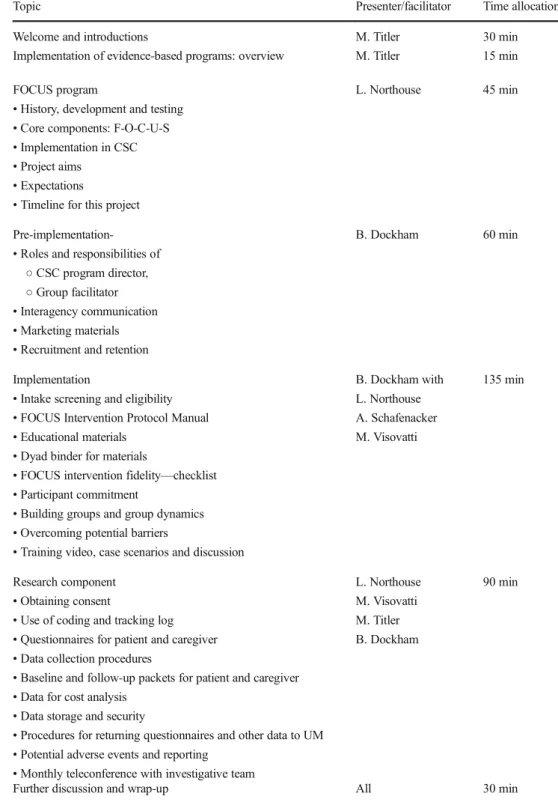
for CSC site program directors and facilitators (see Table2).
Other implementation strategies included (1) providing sets of pre-packaged materials to implement each 5-week FOCUS pro-gram, (2) weekly conference calls with facilitators to provide guidance on issues that arose, and (3) teleconference attendance of the facilitators at monthly investigator team meetings.
Instruments
Primary outcomes
Emotional distress was measured using the Cancer
Support Source Distress Scale (CSSDS) developed by the
Cancer Support Community [17]. Reliability and validity
have been demonstrated [17]. Quality of life was
mea-sured using the Functional Assessment of Cancer
Treatment-General (FACT-G) QOL Scale (version 4) [18]. The FACT-G has demonstrated validity, and both the orig-inal and modified versions have demonstrated reliability in
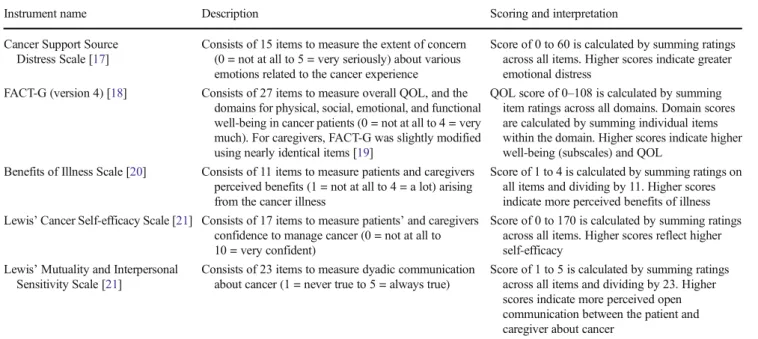
cancer patients and their caregivers [5–7] (see Table 3).
Secondary outcomes
The Benefits of Illness Scale [20] was used to measure
patients’ and caregivers’ perceived benefits arising from
the cancer illness (e.g., led me to be more accepting of things). Validity and reliability have been demonstrated
[20]. The Lewis’ Cancer Self-efficacy Scale(CASE) was
used to measure confidence to manage cancer [21].
Validity and reliability have been demonstrated in
mul-tiple studies [5, 6, 21]. The Lewis’ Mutuality and
Interpersonal Sensitivity Scale (MIS) was used to mea-sure communication between the patient and caregiver
about cancer [21]. Validity and reliability have been
demonstrated in multiple studies [6, 7, 21] (see
Table 3). Demographic questions assessed participants’
age, gender, marital status, race, education, income, and employment status. Medical-related questions assessed
patients’ type and stage of cancer, and whether they
were currently receiving treatment.
Feasibility
Feasibility was measured by (1) enrollment and retention rates and (2) intervention fidelity. Data regarding fidelity to the FOCUS program was collected through the fidelity checklist in the FOCUS protocol manual, completed by the facilitator, for activities to be done during each of the five sessions. Activities to complete across the five sessions were 104 (ses-sion 1 = 25; ses(ses-sion 2 = 17; ses(ses-sion 3 = 18; ses(ses-sion 4 = 19; session 5 = 25).
•Emoonal distress
•Quality of life
FOCUS Program
• Community implementaon • Two CSC sites
INTERVENTION PRIMARY OUTCOMES
SECONDARY OUTCOMES
Appraisal
• Benefits of illness or caregiving
Coping Resources
• Self-efficacy • Dyadic communicaon
Key:
Potenal intervenon effects Theorecal path (not tested)
Satisfaction
Satisfaction was measured by the FOCUS Satisfaction
Instrument[7]. It includes seven items for rating satisfaction with components of the program (1 = not satisfied to 5 = very satisfied); ratings are summed and divided by seven to arrive at overall satisfaction scores. It includes open-ended questions regarding session lengths and FOCUS program length.
Program costs
Program costs were calculated by multiplying hourly time estimates and median hourly wages for healthcare social workers in California and Ohio according to the US Bureau of Labor Statistics, May 2015 (CA: $32.53; OH: $26.01). Costs were estimated for the average total cost to deliver one five-session FOCUS program at each site and across sites.
Table 2 Outline of the training
program for CSC sites Topic Presenter/facilitator Time allocation
Welcome and introductions M. Titler 30 min
Implementation of evidence-based programs: overview M. Titler 15 min
FOCUS program
•History, development and testing
•Core components: F-O-C-U-S
•Implementation in CSC
•Project aims
•Expectations
•Timeline for this project
L. Northouse 45 min
Pre-implementation-•Roles and responsibilities of
○CSC program director,
○Group facilitator
•Interagency communication
•Marketing materials
•Recruitment and retention
B. Dockham 60 min
Implementation
•Intake screening and eligibility
•FOCUS Intervention Protocol Manual
•Educational materials
•Dyad binder for materials
•FOCUS intervention fidelity—checklist
•Participant commitment
•Building groups and group dynamics
•Overcoming potential barriers
•Training video, case scenarios and discussion
B. Dockham with L. Northouse A. Schafenacker M. Visovatti
135 min
Research component
•Obtaining consent
•Use of coding and tracking log
•Questionnaires for patient and caregiver
•Data collection procedures
•Baseline and follow-up packets for patient and caregiver
•Data for cost analysis
•Data storage and security
•Procedures for returning questionnaires and other data to UM
•Potential adverse events and reporting
•Monthly teleconference with investigative team
L. Northouse M. Visovatti M. Titler B. Dockham
90 min
Time estimatesPreparation and wrap-up time for each of the five sessions were estimated as 20 min based on our previous
study [7]. Facilitators at each of the two CSC sites logged the
session time in minutes at the end of each session on the fidelity checklist. We summed across all 11 FOCUS Programs, (1) the logged session times and (2) the preparation and wrap-up times to arrive at the total time to deliver FOCUS; this was then divided by 11 (number of programs delivered) to arrive at the mean time to deliver a five-session FOCUS program. The mean total time across both sites to deliver FOCUS including preparation and wrap-up was 11.2 h (SD =0.3). We also accounted for estimated time for program oversight. These estimates per FOCUS program are
based on our prior study as follows [7]: marketing—1.5 h;
recruiting and outreach—1 h; intake and screening for
eligi-bility—7 h; and organization of education materials—1.5 h.
These oversight estimates (11 h) were added to the mean time to deliver a five-session FOCUS program (11.2 h), as de-scribed above, resulting in an estimated 22.2 h to provide oversight and delivery of one five-session FOCUS program.
Cost estimatesTo calculate cost estimates, the time to provide
oversight and delivery of FOCUS (22.2 h) was multiplied by the median hourly wage for each respective site, resulting in site specific cost estimates. The average cost across sites to provide oversight and deliver one FOCUS program was cal-culated by multiplying the site specific costs by the number of FOCUS programs delivered at each site. These values were then summed and divided by 11, the number of FOCUS pro-grams delivered across sites.
Data collection procedures
Patient and caregiver versions of the baseline (time 1) ques-tionnaires consisting of Cancer Support Source Distress Scale,
FACT-G QOL Scale, Benefits of Illness Scale, Lewis’Cancer
Self-Efficacy Scale, Lewis’ Mutuality and Interpersonal
Sensitivity Scale (see Table 3), and demographic and
medical-related questions were completed prior to beginning the FOCUS program. Questionnaires were mailed or given to participants during the intake visit and collected immediately prior to the first FOCUS program session. Patients and care-givers completed questionnaires independently. Follow-up questionnaires (time 2) included the major scales, noted above, and the Focus Satisfaction Instrument, and were ad-ministered immediately after the last FOCUS session.
Data analysis
For aim 1, repeated measures analysis of variance was used to determine if changes occurred in primary and secondary outcomes from time 1 to time 2 for patients and caregivers as dyads (i.e., pairs). Dyadic analysis was used because
patients’and caregivers’responses to illness are interrelated
[22,23]. Time and role (patient vs. caregiver) were treated
as within-subject variables to control for the interdependent nature of the data. Main effect by time was examined to determine the overall effectiveness of the FOCUS interven-tion on primary and secondary outcomes for patient-caregiver dyads as a unit. Time-by-role interactions were analyzed to determine if there was a differential effect of
the intervention on patients’ and caregivers’ outcomes.
Table 3 Primary and secondary outcome measures
Instrument name Description Scoring and interpretation
Cancer Support Source Distress Scale [17]
Consists of 15 items to measure the extent of concern (0 = not at all to 5 = very seriously) about various emotions related to the cancer experience
Score of 0 to 60 is calculated by summing ratings across all items. Higher scores indicate greater emotional distress
FACT-G (version 4) [18] Consists of 27 items to measure overall QOL, and the domains for physical, social, emotional, and functional well-being in cancer patients (0 = not at all to 4 = very much). For caregivers, FACT-G was slightly modified using nearly identical items [19]
QOL score of 0–108 is calculated by summing item ratings across all domains. Domain scores are calculated by summing individual items within the domain. Higher scores indicate higher well-being (subscales) and QOL
Benefits of Illness Scale [20] Consists of 11 items to measure patients and caregivers perceived benefits (1 = not at all to 4 = a lot) arising from the cancer illness
Score of 1 to 4 is calculated by summing ratings on all items and dividing by 11. Higher scores indicate more perceived benefits of illness Lewis’Cancer Self-efficacy Scale [21] Consists of 17 items to measure patients’and caregivers
confidence to manage cancer (0 = not at all to 10 = very confident)
Score of 0 to 170 is calculated by summing ratings across all items. Higher scores reflect higher self-efficacy
Lewis’Mutuality and Interpersonal Sensitivity Scale [21]
Consists of 23 items to measure dyadic communication about cancer (1 = never true to 5 = always true)
Cancer stage was used as a control variable in the main effect analysis (effect of intervention on outcome) and in-teraction effect analysis (differential effect of intervention
on patients’ and caregivers’ outcomes) for physical and
functional well-being because significant associations
(p < 0.05) were found between cancer stage and these
outcomes for patients (F = 3.46 for physical; F = 2.83
for functional). Intervention effect sizes were examined for specific variables based on conventional standards
(small = 0.20; medium = 0.50; large = 0.80) [11].
Descriptive statistics were used to examine enroll-ment and retention rates and intervention fidelity (aim
2). The enrollment ratewas calculated by the number of
dyads enrolled in the FOCUS program divided by the
number eligible to participate. The retention rate was
calculated by the number of dyads who completed the FOCUS program divided by the number who enrolled. For intervention fidelity, there were 104 total activities to complete across the five sessions per FOCUS pro-gram, and a total of 11 FOCUS programs were deliv-ered. Fidelity for the FOCUS program was calculated by summing the number of activities documented as provided across all sessions for the 11 FOCUS pro-grams delivered divided by total activities possible by programs (104 × 11). This resulted in a mean fidelity for the FOCUS program which had been delivered 11 times.
Descriptive statistics were used to examine patients’and
caregivers’total satisfaction scores (aim 3) with follow-up
exploratory analyses using paired t tests to examine
differences in patients’and caregivers’scores. Calculation of
estimated program costs is described above.
Results
Participant characteristics
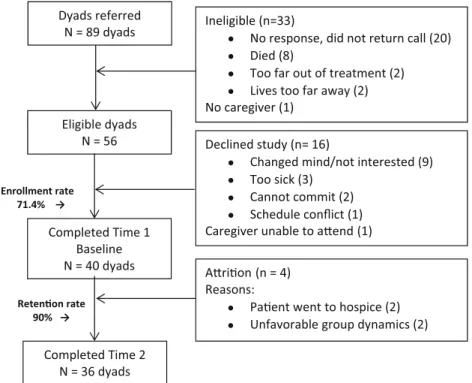
The final sample was 36 dyads (see Fig.2). Patients’mean age
was 60.8 and caregivers’was 55.9 (see Table4). The majority
of participants were female (patients, 52.8; caregivers, 55.6), and most were married or partnered (>85%). The sample was largely white, with a moderate income. Most were well edu-cated with a college education or higher. Most patients had stage II or IV cancer and were currently in treatment (69.4%).
Effectiveness of the FOCUS program intervention
The FOCUS program was effective (see Table5). The
inter-vention had significant positive effects on dyads’primary
out-comes of total QOL (p = .014), emotional (p = .012) and
functional (p = .049) well-being, and emotional distress
(p= .002). The intervention did not have significant effects
on physical and social well-being. The intervention had
sig-nificant positive effects on the dyads’secondary outcomes of
benefits of illness (p= .013) and self-efficacy (p= .001) but
not on dyadic communication regarding cancer. Reliability of
instruments in this study was high (see Table5).
Enrollment rate 71.4% →
Retenon rate 90% →
Dyads referred N = 89 dyads
Completed Time 1 Baseline N = 40 dyads
Completed Time 2 N = 36 dyads
Ineligible (n=33)
No response, did not return call (20) Died (8)
Too far out of treatment (2) Lives too far away (2) No caregiver (1)
Arion (n = 4) Reasons:
Paent went to hospice (2) Unfavorable group dynamics (2) Eligible dyads
N = 56 Declined study (n= 16)
Changed mind/not interested (9) Too sick (3)
Cannot commit (2) Schedule conflict (1) Caregiver unable to aend (1) Fig. 2 FOCUS CSC consort
Table 4 Demographic and medical characteristics of sample
Characteristics Patients (n= 36) Caregivers (n= 36)
Mean SD Range Mean SD Range
Age 60.8 14.2 18–88 55.9 15.1 19–83
n % n %
Gender Male 17 47.2 16 44.4
Female 19 52.8 20 55.6
Marital status Married/partnered 32 88.9 31 86.1
Single 3 8.3 5 13.9
Divorced 1 2.8
Race White 32 88.9 28 77.8
Asian 1 2.8 3 8.3
Black or African-American 1 2.8 1 2.8
Latino or Hispanic 1 2.8 1 2.8
Other 1 2.8 1 2.8
Missing 2 5.5
Education Less than high school 2 5.6
High school grad or GED 1 2.8 1 2.8
Some college, technical or vocational school 6 16.7 7 19.4
College graduate 7 19.4 14 38.9
Some graduate school 3 8.3 1 2.8
Graduate degree 17 47.2 12 33.3
Prefer not to share 1 2.8
Income Less than $39,999 3 8.3 1 2.8
$40,000–$99,999 14 38.9 14 38.9
$100,000 or above 16 44.4 15 41.7
Missing 3 8.3 5 13.9
Employment Full time 5 13.9 17 47.2
Part time 5 13.9 2 5.6
Not employed 9 25.0 5 13.9
Retired 13 36.1 9 25.0
Disabled 4 11.1
Student 1 2.8
Missing 2 5.6
Type of cancer Breast 6 16.7
Pancreatic 4 11.1
Gynecologic 4 11.1
Prostate 4 11.1
Brain 3 8.3
Lung 3 8.3
Lymphoma 3 8.3
Multiple myeloma 2 5.6
Colorectal/GI 2 5.6
Kidney/adrenal 2 5.6
Nose/throat 2 5.6
Skin (non-melanoma) 1 2.8
Stage of cancer I 6 16.7
II 8 22.2
III 6 16.7
IV 13 36.1
Unknown 2 5.6
Missing 1 2.8
Currently in treatment Yes 25 69.4
No 10 27.8
Feasibility
As displayed in Fig.2, the enrollment rate was 71.4% and the
retention rate was 90%. Intervention fidelity was 85%.
Satisfaction
Caregivers and patients reported high satisfaction, and scores did not differ significantly [(patients: 4.4 (SD 0.6); caregivers: 4.5 (SD 0.5)]. The majority of patients (86.1%) and caregivers (80.6%) reported the program helped them cope with cancer. Most reported that the program did not duplicate services pro-vided at their treatment center (85.3% each). When asked about the length of each session (about right; shorter; longer), the majority of patients (86.1%) and caregivers (80.6%) noted the session lengths were about right. When asked about the number of group sessions (about right, fewer, more), 52.8% of the patients and 50% of the caregivers wanted more; 47.2% noted the number was about right. Over 90% of patients and
caregivers noted they would recommend the program to others facing cancer.
Estimated program costs
Due to differing geographic hourly wage rates, California es-timated costs ($722.17) were higher than Ohio ($577.42). Average cost estimates for oversight and delivery of one five-session FOCUS program was $669.45 or $168.00 per dyad, assuming four dyads per group.
Discussion
Program effectiveness
The FOCUS program was effective in improving the primary outcomes of quality of life, emotional and functional well-being, and emotional distress. This is consistent with other couple-based group interventions for cancer patients and their
Table 5 Effectiveness of the FOCUS program intervention (N= 36 dyads)
Mean (SD) pvalues Effect sizesb
Patient Caregiver Main effect Interaction effect Patient Caregiver Dyad
Outcomes Reliabilitiesa Time 1 Time 2 Time 1 Time 2 Time* Role by time** d d d
Quality of life
Total QOL .92; .86 67.24 (17.40)
71.52 (16.91)
72.59 (11.97)
76.11 (15.72)
.014 .826 0.249 0.252 0.309
Physical .84; .73 17.67 (5.47)
18.58 (6.38)
24.29 (2.72)
23.75 (4.86)
.986 .412 0.153 0.137 0.030
Social .84; .71 18.15 (5.85)
19.51 (5.37)
18.08 (4.98)
18.77 (5.11)
.061 .392 0.242 0.136 0.214
Emotional .86; .83 14.92 (5.97)
16.42 (5.04)
13.53 (4.40)
14.64 (5.59)
.012 .695 0.272 0.221 0.341
Functional .79; .84 16.51 (4.89)
17.01 (5.15)
16.57 (4.59)
18.95 (5.34)
.049 .520 0.010 0.477 0.400
Benefits of illness .88; .92 2.88 (.65)
2.97 (.61)
2.80 (.65)
2.98 (.77)
.013 .731 0.143 0.253 0.264
Communication .96; .96 3.52 (.91)
3.62 (.75)
3.49 (.80)
3.64 (.77)
.075 .321 0.120 0.191 0.186
Emotional distress .89; .90 22.61 (11.67) 18.31 (9.38)
20.86 (9.59)
18.58 (10.58)
.002 .236 0.406 0.226 0.411
Self-efficacy .96; .97 113.97 (32.43) 119.11 (29.35)
105.08 (32.31)
122.47 (32.23)
.001 .052 0.166 0.517 0.512
aReliabilities are the average across time points for patients and caregivers
b
Absolute value of effect size (Cohen’sd)d= (mean1−mean 2)/swheres= pooled standard deviation
partners [24]. In qualitative statements, patients and caregivers reported that it was very helpful to have their partner or care-giver attend the group intervention with them. Both patients and caregivers were able to express feelings and learn from others, and this opportunity may have helped improve their QOL and emotional distress. FOCUS also was effective in improving perceived benefits of experiencing cancer (benefits of illness) and level of confidence in managing it (self-effica-cy). Prior research with cancer patients and caregivers has demonstrated that group interventions facilitate positive
reap-praisal of the illness [25] and can increase caregivers’
pre-paredness and competence to provide care [26]. The findings
and effect sizes obtained for the domains of QOL, benefits of illness, and self-efficacy in this study are similar to those ob-tained in our prior randomized trials when FOCUS was
deliv-ered by a nurse to individual dyads at home [4–6,27] and in
our previous implementation study [7]. The magnitude of the
intervention effects in this study are similar to small-medium effect sizes reported in three meta-analyses examining inter-vention effects with patients and caregivers across multiple
studies [3,28,29].
Participants’physical well-being, social well-being, and
dyadic communication did not improve. The lack of improve-ment in physical well-being (e.g., nausea, pain) is not surpris-ing because FOCUS is a psychoeducational intervention and improvements in physical well-being require tailored inter-ventions that address the biological components of cancer. However, there was an improvement in functional well-being (e.g., ability to work; enjoy life). Perhaps, participants learned how to address physical challenges and related symp-toms so that they could function in their daily lives. The lack of improvement in social well-being may be due to higher baseline social well-being scores with less room for improve-ment. Lack of improvement in dyadic communication is dif-ficult to explain. FOCUS may have stimulated beginning communication about cancer that did not carry over into
par-ticipants’daily lives. Additional work regarding how
commu-nication is conceptualized and measured as an outcome of FOCUS may be warranted in future studies (i.e., qualitative approach with participants).
Feasibility
It is feasible to deliver FOCUS in a group format in CSC sites. Enrollment rates were good (71.4%) and higher than those reported in other studies using group interventions with
patient-caregiver dyads (10.4%) [24] or family caregivers
(25–31%) [30,31]. Perhaps this is because agency staff
re-cruited participants and delivered the intervention. Retention rates (90%) were high most likely because of perceived ben-efits from the group and its dyadic approach.
FOCUS was delivered with high intervention fidelity (85%) and was similar to a couple-focused group intervention
with breast cancer patients (88%) [24]. The implementation
strategies were important for providing initial and ongoing support to the group facilitators and helped maintain high intervention fidelity.
Satisfaction
Participants were highly satisfied with the FOCUS program and the overwhelming majority would recommend the pro-gram to others. About half of the participants wanted more sessions, raising the issue of optimal intervention dose. In our prior implementation study, using a six-session group inter-vention, >40% of the participants also reported they would
have liked more sessions [7]. One challenge in planning an
intervention is balance between feasibility (i.e., enrollment, retention) and outcomes (i.e., program effectiveness). Manne
et al. [24] found a low enrollment rate (10.4%) among cancer
patients who were approached for an 8-week group interven-tion, with 15.7% expressing worry about the program length.
Bultz et al. [30] found low enrollment (31%) for a 6-week
group intervention for partners, with 29% stating time was an issue. Determining optimal intervention dose needs further exploration.
Program cost
This study provided the first cost estimate of delivering the five-session FOCUS program; about $168.00 per dyad.
Badger et al. [32] estimated costs of their 8-week dyadic
tele-phone intervention as $164.68 per dyad but omitted oversight and preparation costs included in our estimates. Given the skyrocketing healthcare costs in the US, FOCUS is highly economical to address critical issues of those living with cancer.
Limitations
One limitation is enrollment of 36 rather than 56 dyads as planned. Despite this limitation, the dyadic effects for many variables were >0.30, and we were able to demonstrate the effectiveness of the FOCUS program. Performing cost-effective analyses was not a study aim and requires use of a control group which deprives patients and caregivers from an intervention that has demonstrated efficacy and effectiveness. We did, however, provide a cost estimate for delivery of FOCUS in CSCs.
Conclusions
experiencing cancer, and confidence in managing it. It is time that programs like FOCUS receive national public policy at-tention to effect payment structures for delivery to cancer pa-tients and their caregivers.
Acknowledgments The authors would like to acknowledge the impor-tant contributions of (1) William Kavanaugh, MACP, LMFT, Program Manager, Cancer Support Community–Benjamin Center, Los Angeles, California, and (2) Kelly Schoen, LISW-S, Program Director, Cancer Support Community Greater Cincinnati–Northern Kentucky, Blue Ash, Ohio, who were instrumental in recruitment and program delivery.
Compliance with ethical standards
Conflict of interest The authors declare that they have no competing interests.
Research involving human participants and/or animals
1. Statement of human rights:All procedures performed in studies involving human participants were in accordance with the ethical standards of the institutional and/or national research committee and with the 1964 Helsinki declaration and its later amendments or comparable ethical standards.
2. Statement of welfare of animals. This article does not contain any studies with animals performed by any of the authors.
Informed consent Informed consent was obtained from all participants included in the study.
Funding source This study was funded by the Michigan Institute for Clinical and Health Research Pilot Grant Program, University of Michigan, UL1TR000433.
Open AccessThis article is distributed under the terms of the Creative Commons Attribution-NonCommercial 4.0 International License (http:// creativecommons.org/licenses/by-nc/4.0/), which permits any noncom-mercial use, distribution, and reproduction in any medium, provided you give appropriate credit to the original author(s) and the source, pro-vide a link to the Creative Commons license, and indicate if changes were made.
References
1. Institute of Medicine and National Research Council (2006) From cancer patient to cancer survivor: lost in transition. National Academies Press, Washington, D.C. doi:10.17226/11468
2. van Ryn M, Sanders S, Kahn K, van Houtven C, Griffin JM, Martin M, Atienza AA, Phelan S, Finstad D, Rowland J (2011) Objective burden, resources, and other stressors among informal caregivers: a hidden quality issue? Psychooncology 20:44–52. doi:10.1002/pon. 1703
3. Northouse LL, Katapodi MC, Song L, Zhang L, Mood DW (2010) Interventions with family caregivers of cancer patients: meta-analysis of randomized trials. CA Cancer J Clin 60:317–339. doi:
10.3322/caac.20081
4. Northouse LL, Kershaw T, Mood DW, Schafenacker A (2005) Effects of a family intervention on the quality of life of women with recurrent breast cancer and their family caregivers. Psychooncology 14:478–491. doi:10.1002/pon.871
5. Northouse LL, Mood DW, Schafenacker A, Kalemkerian G, Zalupski M, LoRusso P, Hayes DF, Hussain M, Ruckdeschel J, Fendrick AM, Trask PC, Ronis DL, Kershaw T (2013) Randomized clinical trial of a brief and extensive dyadic interven-tion for advanced cancer patients and their family caregivers. Psychooncology 22:555–563. doi:10.1002/pon.3036
6. Northouse LL, Mood DW, Schafenacker A, Montie JE, Sandler HM, Forman JD, Hussain M, Pienta KJ, Smith DC, Kershaw T (2007) Randomized clinical trial of a family intervention for pros-tate cancer patients and their spouses. Cancer 110:2809–2818. doi:
10.1002/cncr.23114
7. Dockham B, Schafenacker A, Yoon H, Ronis DL, Kershaw T, Titler MG, Northouse LL (2016) Implementation of a psychoeducational program for cancer survivors and family caregivers at a cancer support community affiliate: a pilot effectiveness study. Cancer Nurs 39:169–180. doi:10.1097/NCC.0000000000000311
8. Lazarus RS (2000) Evolution of a model of stress, coping, and discrete emotions. In: Rice VH (ed) Handbook of stress, coping, and health. Sage, Thousand Oaks, pp 195–222
9. Lazarus RS, Folkman S (1984) Stress, appraisal, and coping. Springer, New York
10. Northouse LL, Schafenacker A, Barr KLC, Katapodi M, Yoon H, Brittain K, Song L, Ronis DL, An L (2014) A tailored web-based psychoeducational intervention for cancer patients and their family caregivers. Cancer Nurs 37:321–330. doi:10.1097/NCC. 0000000000000159
11. Cohen J (1988) Statistical power analysis for the behavioral sci-ences, 2nd edn. Lawrence Erlbaum, Hillsdale
12. Hintze JL (2000) PASS 2000 user’s guide. Number Cruncher Statistical Systems, Kaysville
13. Northouse LL, Walker J, Schafenacker A, Mood D, Mellon S, Galvin E, Harden J, Freeman-Gibb L (2002) A family-based pro-gram of care for women with recurrent breast cancer and their family members. Oncol Nurs Forum 29:1411–1419. doi:10.1188/ 02.ONF.1411-1419
14. Rogers EM (2003) Diffusion of innovations. The Free Press, New York
15. Titler MG (2010) Translation science and context. Res Theory Nurs Pract 24:35–55. doi:10.1891/1541-6577.24.1.35
16. Titler MG, Herr K, Brooks JM, Xie X-J, Ardery G, Schilling ML, Marsh JL, Everett LQ, Clarke WR (2009) Translating research into practice intervention improves management of acute pain in older hip fracture patients. Health Serv Res 44:264–287. doi:10.1111/j. 1475-6773.2008.00913.x
17. Buzaglo J, Miller MF, Gayer C, Morris A, Kennedy V, Golant M (2014) CancerSupportSource: validating a 13-item web-based dis-tress screening tool in the community. National Comprehensive Cancer Network 19thAnnual Conference, March 13–15, 2014, Hollywood, FL.http://www.cancersupportcommunity.org/sites/ default/files/uploads/our-research/presentations/distress-screening-referral/nccn_css-13_validation_poster.pdf. Accessed 25 Jan 2017 18. Cella DF, Tulsky DS, Gray G, Sarafian B, Linn E, Bonomi A,
Silberman M, Yellen SB, Winicour P, Brannon J, Eckberg K, Lloyd S, Purl S, Blendowski C, Goodman M, Barnicle M, Stewart I, McHale M, Bonomi P, Kaplan E, Taylor S IV, Thomas CR, Harris J (1993) The functional assessment of cancer therapy scale: development and validation of the gen-eral measure. J Clin Oncol 11:570–579. doi:10.1200/JCO. 1993.11.3.570
recurrent breast cancer and their family members. J Clin Oncol 20: 4050–4064. doi:10.1200/JCO.2002.02.054
20. Tomich PL, Helgeson VS (2004) Is finding something good in bad always good? Benefit finding among women with breast cancer. Health Psychol 23:16–23. doi:10.1037/0278-6133.23.1.16
21. Lewis FM (1996) Family home visitation study final report. National Cancer Institute, National Intitutes of Health, Bethesda 22. Kenny DA, Kashy DA, Cook WL (2006) Dyadic data analysis.
Guilford: New York.
23. Kershaw T, Ellis KR, Yoon H, Schafenacker A, Katapodi M, Northouse LL (2015) The interdependence of advanced cancer pa-tients’and their family caregivers’mental health, physical health, and self-efficacy over time. Ann Behav Med 49:901–911. doi:10. 1007/s12160-015-9743-y
24. Manne SL, Siegel SD, Heckman CJ, Kashy DA (2016) A random-ized clinical trial of a supportive versus a skill-based couple-focused group intervention for breast cancer patients. J Consult Clin Psychol 84:668–681. doi:10.1037/ccp0000110
25. Manne S, Babb J, Pinover W, Horwitz E, Ebbert J (2004) Psychoeducational group intervention for wives of men with pros-tate cancer. Psychooncology 13:37–46. doi:10.1002/pon.724
26. Holm M, Årestedt K, Carlander I, Fürst C-J, Wengström Y, Öhlen J, Alvariza A (2016) Short-term and long-term effects of a psycho-educational group intervention for family caregivers in palliative
h o m e c a r e - r e s u l t s f r o m a r a n d o m i z e d c o n t r o l t r i a l . Psychooncology 25:795–802. doi:10.1002/pon.4004
27. Northouse LL (2005) Helping families of patients with cancer. Oncol Nurs Forum 32:743–750. doi:10.1188/05.ONF.743-750
28. Badr H, Krebs P (2013) A systematic review and meta-analysis of psychosocial interventions for couples coping with cancer. Psychooncology 22:1688–1704. doi:10.1002/pon.3200
29. Hartmann M, Bäzner E, Wild B, Eisler I, Herzog W (2010) Effects of interventions involving the family in the treatment of adult patients with chronic physical diseases: a meta-analy-sis. Psychother Psychosom 79:136–148. doi:10.1159/ 000286958
30. Bultz BD, Speca M, Brasher PM, Geggie PHS, Page SA (2000) A randomized controlled trial of a brief psychoeducational support group for partners of early stage breast cancer patients. Psychooncology 9:303–313. doi:10.1002/1099-1611(200007/08) 9:4<303::AID-PON462>3.0.CO;2-M
31. Cohen M, Kuten A (2006) Cognitive-behavior group intervention for relatives of cancer patients: a controlled study. J Psychosom Res 61:187–196. doi:10.1016/j.jpsychores.2005.08.014
32. Badger TA, Segrin C, Hepworth JT, Pasvogel A, Weihs K, Lopez AM (2013) Telephone-delivered health education and interpersonal counseling improve quality of life for Latinas with breast cancer and their supportive partners. Psychooncology 22:1035–1042. doi: