Variant Discovery and Fine Mapping of
Genetic Loci Associated with Blood Pressure
Traits in Hispanics and African Americans
Nora Franceschini1☯
*, Cara L. Carty2☯
, Yingchang Lu3, Ran Tao4, Yun Ju Sung5,
Ani Manichaikul6, Jeff Haessler7, Myriam Fornage8, Karen Schwander5, Niha Zubair7, Stephanie Bien7, Lucia A. Hindorff9, Xiuqing Guo10, Suzette J. Bielinski11,
Georg Ehret12,13, Joel D. Kaufman14, Stephen S. Rich6, Christopher S. Carlson7, Erwin P. Bottinger3, Kari E. North1, D. C. Rao5, Aravinda Chakravarti12, Paula Q. Barrett15, Ruth
J. F. Loos3, Steven Buyske16, Charles Kooperberg7
1 Department of Epidemiology, University of North Carolina, Chapel Hill, North Carolina, United States of
America, 2 Center for Translational Science, George Washington University and Children’s National Medical Center, Washington, District of Columbia, United States of America, 3 Genetics of Obesity and Related Metabolic Traits Program, The Charles Bronfman Institute for Personalized Medicine, Icahn School of Medicine at Mount Sinai, New York, New York, United States of America, 4 Department of Biostatistics, University of North Carolina, Chapel Hill, North Carolina, United States of America, 5 Division of Biostatistics, Washington University, St. Louis, Missouri, United States of America, 6 Center for Public Health Genomics, University of Virginia, Charlottesville, Virginia, 22908, United States of America,
7 Division of Public Health Sciences, Fred Hutchinson Cancer Research Center, Seattle, Washington,
United States of America, 8 Brown Foundation Institute of Molecular Medicine & Human Genetics Center, University of Texas Health Science Center, Houston, Texas, United States of America, 9 Division of Genomic Medicine, National Human Genome Research Institute, National Institutes of Health, Bethesda, Maryland, United States of America, 10 Institute for Translational Genomics and Population Sciences and Department of Pediatrics, LABiomed at Harbor-University of California at Los Angeles Medical Center, Torrance, California, United States of America, 11 Division of Epidemiology, Department of Health Sciences Research, Mayo Clinic, Rochester, Minnesota, United States of America, 12 Center for Complex Disease Genomics, Johns Hopkins University School of Medicine, Baltimore, Maryland, United States of America,
13 Department of Specialties of Internal Medicine, Geneva University Hospital, Geneva, Switzerland, 14 Department of Environmental and Occupational Health Sciences, Epidemiology, and Medicine,
University of Washington, Seattle, Washington, United States of America, 15 Department of Pharmacology, University of Virginia, Charlottesville, Virginia, United States of America, 16 Department of Statistics and Biostatistics, Rutgers University, Piscataway, New Jersey, United States of America
☯These authors contributed equally to this work. *[email protected]
Abstract
Despite the substantial burden of hypertension in US minority populations, few genetic studies of blood pressure have been conducted in Hispanics and African Americans, and it is unclear whether many of the established loci identified in European-descent populations contribute to blood pressure variation in non-European descent populations. Using the Metabochip array, we sought to characterize the genetic architecture of previously identi-fied blood pressure loci, and identify novel cardiometabolic variants related to systolic and diastolic blood pressure in a multi-ethnic US population including Hispanics (n = 19,706) and African Americans (n = 18,744). Several known blood pressure loci replicated in Afri-can AmeriAfri-cans and Hispanics. Fourteen variants in three loci (KCNK3, FGF5,
ATXN2-SH2B3) were significantly associated with blood pressure in Hispanics. The most
a11111
OPEN ACCESS
Citation: Franceschini N, Carty CL, Lu Y, Tao R, Sung YJ, Manichaikul A, et al. (2016) Variant Discovery and Fine Mapping of Genetic Loci Associated with Blood Pressure Traits in Hispanics and African Americans. PLoS ONE 11(10): e0164132. doi:10.1371/journal.pone.0164132
Editor: Randall Lee Rasmusson, University at Buffalo—The State University of New York, UNITED STATES
Received: March 27, 2016
Accepted: September 12, 2016
Published: October 13, 2016
Copyright: This is an open access article, free of all copyright, and may be freely reproduced, distributed, transmitted, modified, built upon, or otherwise used by anyone for any lawful purpose. The work is made available under theCreative Commons CC0public domain dedication.
Data Availability Statement: Data files for the individual PAGE studies included in these analyses (ARIC, CARDIA, HCHS/SOL, IPM BioMe Biobank and WHI) have been submitted to dbGaP (https:// www.ncbi.nlm.nih.gov/gap). Links for the individual studies and phs numbers for the PAGE components, if applicable, are provided below:
ARIC—https://www.ncbi.nlm.nih.gov/projects/gap/
cgi-bin/study.cgi?study_id=phs000280.v3.p1
(PAGE-CALiCo-ARIC phs000223) CARDIA—
significant diastolic blood pressure variant identified in our analysis, rs2586886/KCNK3 (P = 5.2 x 10⁻⁹), also replicated in independent Hispanic and European-descent samples. African American and trans-ethnic meta-analysis data identified novel variants in the
FGF5, ULK4 and HOXA-EVX1 loci, which have not been previously associated with blood
pressure traits. Our identification and independent replication of variants in KCNK3, a gene implicated in primary hyperaldosteronism, as well as a variant in HOTTIP (HOXA-EVX1) suggest that further work to clarify the roles of these genes may be warranted. Overall, our findings suggest that loci identified in European descent populations also contribute to blood pressure variation in diverse populations including Hispanics and African Americans—popu-lations that are understudied for hypertension genetic risk factors.
Introduction
Blood pressure (BP) is an important predictor of health [1,2], and has a lifetime impact on the risk of coronary heart disease, stroke, and kidney disease, which are conditions that dispropor-tionately burden minority populations including Hispanic and African Americans [3]. The heritability of BP ranges from 30% to 55% [4–6]. Despite this moderate genetic contribution and the identification of a substantial number of genetic variants associated with BP traits, the vast majority of the heritability remains unexplained [6]. Genome-wide association studies (GWAS) have reported over 50 loci influencing BP and hypertension risk [7–12]. Most of these loci were identified in individuals of European ancestry [7–9]. Studies of East Asians [10,13] and individuals with African ancestry [14,15] have provided evidence for additional loci for BP, even though sample sizes were smaller than in studies of European ancestry individuals.
Hispanics are the largest growing minority in the US. Even though the prevalence of hyper-tension in this population is increasing, Hispanics are less likely to be aware of their high BP or seek treatment for hypertension [16,17]. This racial/ethnic subgroup has also been underrepre-sented in GWAS of BP. Both Hispanic and African Americans are admixed populations and the allele frequency of variants and linkage disequilibrium (LD) patterns vary depending on the ancestral background of any individual. However, this diversity in genetic architecture can expedite the discovery of risk variants, as exemplified in a recent study that identify the SLC16A11locus associated with type 2 diabetes risk in Hispanics only [18].
Using the Metabochip array, we characterized and fine-mapped previously reported BP loci in a large multi-ethnic population. We also performed an array-wide analysis to identify novel cardiometabolic genetic variants (available on the Metabochip) associated with BP traits in Hispanic and African Americans. This study was performed as part of the Population Architec-ture using Genomics and Epidemiology (PAGE) Consortium [19] which was funded by the U.S. National Human Genome Research Institute to characterize GWAS-identified variants in ancestrally diverse populations.
Materials and Methods
Populations
This study includes self-reported Hispanic and African American adults with genotyped or imputed Metabochip genetic variants from the Population Architecture using Genomics and Epidemiology (PAGE) Study [19] cohorts and the Family Blood Pressure Program (FBPP) [20]. Samples from the Multi-Ethnic Study of Atherosclerosis (MESA) were used for study.cgi?study_id=phs000285.v3.p2)
(PAGE-CALiCo-CARDIA phs000236) HCHS/SOL—https://
www.ncbi.nlm.nih.gov/projects/gap/cgi-bin/study. cgi?study_id=phs000810.v1.p1 (PAGE-CALiCo-HCHS/SOL phs000555) IPM BioMe Biobank—
https://www.ncbi.nlm.nih.gov/projects/gap/cgi-bin/ study.cgi?study_id=phs000925.v1.p1(authorized
access only) WHI—https://www.ncbi.nlm.nih.gov/
projects/gap/cgi-bin/study.cgi?study_id= phs000200.v10.p3(PAGE-WHI phs000227) PAGE
Study (phs000356) MESA—https://www.ncbi.nlm.
nih.gov/projects/gap/cgi- bin/study.cgi?study_id= phs000209.v13.p3&phv=163181&phd= 1712&pha=&pht=1116&phvf=&phdf=&phaf= &phtf=&dssp=1&consent=&temp=1.
Funding: This work was supported by the Population Architecture Using Genomics and Epidemiology (PAGE) program which is funded by the National Human Genome Research Institute (NHGRI) [U01HG004803 (to the Genetic Epidemiology of Causal Variants Across the Life Course (CALiCo) program, U01HG004798 (to the Epidemiologic Architecture of Genes Linked to Environment (EAGLE)), U01HG004802 (to the Multi-Ethnic Cohort (MEC)), U01HG004790 (to the Women’s Health Initiative (WHI)), and
U01HG004801 (to the PAGE Coordinating Center), and their respective NHGRI ARRA supplements. The contents of this paper are solely the responsibility of the authors and do not necessarily represent the official views of the NIH. The complete list of PAGE members can be found at
http://www.pagestudy.org. The data and materials included in this report result from a collaboration between the following studies. Funding support for the “Epidemiology of putative genetic variants: The Women’s Health Initiative” study is provided through the NHGRI PAGE program (U01HG004790 and its NHGRI ARRA supplement). The WHI program is funded by the National Heart, Lung, and Blood Institute (NHLBI), National Institutes of Health (NIH), U.S. Department of Health and Human Services through contracts
HHSN268201100046C, HHSN268201100001C, HHSN268201100002C, HHSN268201100003C, HHSN268201100004C, and
replication. Study descriptions and methods for BP measurements are included in the Methods A inS1 File. All participants have given consent for genetic studies and data sharing and all studies have Institutional Research Board approval.
To generalize novel findings to individuals of European ancestry, we used summary data from the HapMap II meta-analysis of the International Consortium of Blood Pressure (ICBP), which included a discovery sample of 69,395 European-descent individuals [9]. Summary sta-tistics from meta-analyses are publicly available and were downloaded fromhttp://www.ncbi. nlm.nih.gov/projects/gap/cgi-bin/study.cgi?study_id=phs000585.v1.p1
Genotyping and Outcomes
The Metabochip array design includes approximately 200,000 single nucleotide polymor-phisms (SNPs) selected from GWAS loci as well as dense genotyping for fine-mapping of loci, as previously described [21]. Genotyping on PAGE samples was performed within PAGE [22]. Descriptions of the FBPP and replication study genotyping are summarized in the Methods A inS1 File. Standard QC filters were applied for samples and SNPs in PAGE: SNPs with call rates<95%,>2 replication errors, Hardy-Weinberg Equilibrium p-value<1 x 10⁻⁶, Illumina GenTrain Scores<0.6, Illumina Cluster Separation Scores<0.4 or discordant calls as specified in [22] were excluded. A subset of WHI African Americans had genome-wide data available from the SHARe GWAS; Metabochip genotypes were imputed in this sample, as described in Liu et al. [23]. Imputed genotypes with rsq<0.30 were excluded from analyses. Ancestry princi-pal components were determined using Eigensoft software separately for each study [24]. Ancestry outliers and first-degree relatives were excluded for PAGE studies except for SOL, which adjusted for first degree relatives. Mt. Sinai BioMeused genotypes from the Illumina HumanOmniExpress chip, which were imputed to 1000 Genome (1000G) Phase I integrated haplotype panels (March 2012) using IMPUTE2. Only SNPs with imputation quality>0.4 and available on the Metabochip were examined in Mt. Sinai BioMe.
All studies, except Mt. Sinai BioMe, have standardized measures of BP, including sitting sys-tolic and diassys-tolic BP measured by trained personnel, according to a standardized protocol that specified a rest period of 5 minutes prior to measurement, bias-free instrumentation and timed, repeat measurements (Methods A inS1 File). Mt. Sinai BioMeBP measures were extracted from electronic medical records (EMR). Hypertension was defined by a systolic BP>140 and diastolic BP>90 mm Hg or use of anti-hypertensive medication [25]. To cor-rect for treatment effects, we added constants of 10 and 5 mm Hg to the systolic BP and dia-stolic BP, respectively, for individuals taking a BP lowering medication [7].
Statistical analysis
Each study prepared race/ethnicity-specificsummary models. Genotypes were coded using additive genetic models, or allelic dosage for imputed SNPs. For studies of unrelated individu-als, we used linear regression models to test associations of genotypes with quantitative BP traits. For the studies that included related family members, we used methods to account for the correlation structure due to genetic relatedness. Specifically, in the FBPP studies, we used variance component models for quantitative traits and liability models for hypertension to account for the family-based study design. The HCHS/SOL has approximately 2000 related individuals, and a complex sampling design was used for recruitment. Therefore, we used the W-PS method proposed by Linet al, which is a weighted version of generalized estimation equations, to account for unequal inclusion probabilities and family relationships[26]. All of these models were adjusted for age, sex (except WHI), body mass index (BMI) and principal components of ancestry.
HHSN268201100007C, HHSN268201100008C, HHSN268201100009C, HHSN268201100010C, HHSN268201100011C, and
HHSN268201100012C), R01HL087641, R01HL59367 and R01HL086694; NHGRI contract U01HG004402; and NIH contract
Summary results for Hispanics from each study were combined for an inverse variance weighted fixed-effects meta-analysis of Hispanics only. Similarly, all African American results were combined for an inverse variance weighted fixed-effects meta-analysis of African Ameri-cans. Results from these race-specific meta-analyses are presented. We then conducted trans-ethnic meta-analyses of African Americans and Hispanics by combining all study-specific Afri-can AmeriAfri-can and Hispanic summary results from PAGE and the FBPP using (1) a fixed effects and (2) a random-effects approach described by Han and Eskin [27] as implemented in their software, METASOFT (http://genetics.cs.ucla.edu/meta). Between study/race-ethnicity effect sizes consistency was assessed using the Q test (Chi-squared p-value) and the I2metric, where low I2suggests little between-study/race-ethnicity variability. For the meta-analyses, we filtered out SNPs with a minor allele frequency less than 0.01. Results for all analyses were reported as Betas and standard errors (SE).
We sought to replicate our main findings from the discovery meta-analyses in MESA His-panics and African Americans with the same protocols used in the discovery analysis (see Methods A inS1 File), and validated our findings in European ancestry samples using publi-cally available ICBP data. A conservative SNP discovery significance threshold for the Metabo-chip array,P<2.8 x 10⁻⁷was used to account for the numbers of tests performed in the discovery analyses.
For our replication of previously reported GWAS SNPs (identified mainly in populations of European ancestry) in our multi-ethnic population, we defined nominally significant as ‘p<0.05 and not corrected for multiple testing.’
Given the different recruitment and BP measurement in the Mt. Sinai BioMesample, we performed a sensitivity analysis excluding the study from the Hispanic meta-analysis, and reviewed findings for consistency with the total Hispanic results. In a secondary analysis, we measured associations between hypertension and selected BP-associated SNPs using logistic regression models and reported odds ratios (OR) and 95% confidence intervals (95%CI).
We also fine-mapped 22 published BP loci previously identified in European and East Asian ancestry populations that were available on the Metabochip [Tables D-E inS1 File]. For these analyses, we focused on the African ancestry samples as this population, on average, has greater haplotype diversity and shorter LD blocks compared to Hispanics [28,29]. In other words, a given SNP in a genomic locus of interest will typically have fewer numbers of SNPs highly cor-related with it in African Americans, making it somewhat easier to reduce the size of a genomic locus of interest, and thus the number of potential causal SNP(s). To investigate SNPs in each BP-associated locus, we assessed whether the most significant SNP at each locus in African Americans was distinct from, but correlated (r20.50) with the index (i.e. previously reported GWAS) SNP based on LD information from the 1000 Genomes Project (1000G) European ancestry populations (EUR). Using Locus Zoom plots, we also plotted other candidate func-tional variants in the region. The fine-mapping significance threshold was set at the Bonfer-roni-corrected threshold ofP<0.05/number of Metabochip SNPs at each locus. Other LD estimates in the 1000G populations were obtained using the LDlink tool [30].
Results
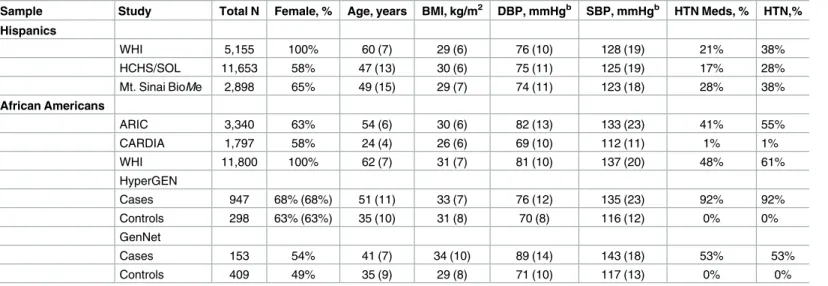
A total of 19,706 Hispanic individuals from three studies and 18,744 African American individ-uals from five studies contributed to the analyses (Table 1).
Discovery and replication in Hispanics
In the discovery analysis, querying all SNPs on the Metabochip, there was little evidence for inflation due to population stratification in the Hispanic samples (Figure A inS1 File).
Meta-UL1TR000124, DK063491, RD831697, and P50 ES015915. Funding for SHARe genotyping was provided by NHLBI Contract N02-HL-64278. Genotyping was performed at Affymetrix (Santa Clara, California, USA) and the Broad Institute of Harvard and MIT (Boston, Massachusetts, USA) using the Affymetrix Genome-Wide Human SNP Array 6.0. The provision of genotyping data was supported in part by the National Center for Advancing Translational Sciences, CTSI grant UL1TR000124, and the National Institute of Diabetes and Digestive and Kidney Disease Diabetes Research Center (DRC) grant DK063491 to the Southern California Diabetes Endocrinology Research Center. The Mount Sinai BioMe Biobank is supported by The Andrea and Charles Bronfman Philanthropies. The funders had no role in the study design, data collection and analysis, decision to publish, or preparation of the manuscript.
analyses of the Hispanic studies identified 14 SNPs in three loci significantly associated with either systolic BP or diastolic BP (Table 2, and Tables A-B inS1 File). These SNPs were all in known BP loci rather than in Metabochip loci linked with other cardiometabolic traits. The most significant SNP (rs2586886/G) located in intron 1 of potassium channel, subfamily K, member 3 (KCNK3) on chromosome 12 was associated with a 0.72 mm Hg increase in diastolic BP (P= 5.2 x 10⁻⁹) (Table 2). This SNP was also associated with increased systolic BP (P= 3.8 x 10⁻⁴), and a 13% increased odds of hypertension (OR = 1.13; 95%CI: 1.06–1.22;P= 4.0 x 10⁻⁴) in 5822 hypertension cases and 13,477 controls. Other SNPs associated with BP in His-panics were located at two previously established loci,FGF5(chromosome 4) and ATXN2-SH2B3(chromosome 12) (Tables A-B, and Figure B inS1 File). AtFGF5, conditional analyses of the most significant SNP, rs1458038, which is also reported in individuals of European ancestry [31], supported the evidence for a single association at the locus (Table A inS1 File). At theATXN2-SH2B3locus, the most significant SNP rs11065979 was in LD with a missense Table 1. Descriptive characteristicsaof the PAGE and FBBP studies by race/ethnicity.
Sample Study Total N Female, % Age, years BMI, kg/m2 DBP, mmHgb SBP, mmHgb HTN Meds, % HTN,%
Hispanics
WHI 5,155 100% 60 (7) 29 (6) 76 (10) 128 (19) 21% 38%
HCHS/SOL 11,653 58% 47 (13) 30 (6) 75 (11) 125 (19) 17% 28%
Mt. Sinai BioMe 2,898 65% 49 (15) 29 (7) 74 (11) 123 (18) 28% 38%
African Americans
ARIC 3,340 63% 54 (6) 30 (6) 82 (13) 133 (23) 41% 55%
CARDIA 1,797 58% 24 (4) 26 (6) 69 (10) 112 (11) 1% 1%
WHI 11,800 100% 62 (7) 31 (7) 81 (10) 137 (20) 48% 61%
HyperGEN
Cases 947 68% (68%) 51 (11) 33 (7) 76 (12) 135 (23) 92% 92%
Controls 298 63% (63%) 35 (10) 31 (8) 70 (8) 116 (12) 0% 0%
GenNet
Cases 153 54% 41 (7) 34 (10) 89 (14) 143 (18) 53% 53%
Controls 409 49% 35 (9) 29 (8) 71 (10) 117 (13) 0% 0%
N, number; BMI, body mass index; DBP, diastolic blood pressure; SBP, systolic blood pressure; HTN, hypertension; Meds, medications
a
Results presented as mean (standard deviation)
b
Summaries based on BP values before correction for hypertension medication use
doi:10.1371/journal.pone.0164132.t001
Table 2. Main findingsafor meta-analysis of diastolic and systolic BP in PAGE Hispanic samples (n~19,706).
SNP Chr Gene Locus Coded/ other allele Coded allele frequency Beta (SE) P-value
Diastolic BP
rs2586886 2 KCNK3 G/A 0.32 0.72(0.12) 5.2 x 10⁻⁹
rs1458038 4 FGF5 A/G 0.23 0.71(0.13) 1.2 x 10⁻⁷
rs11065979b 12 SH2B3-ATXN2 A/G 0.27 -0.73(0.13) 2.5 x 10⁻⁸
rs11066188b 12 HECTD4 A/G 0.26 0.70(0.13) 1.3 x 10⁻⁷
Systolic BP
rs1458038 4 FGF5 A/G 0.23 1.37(0.22) 8.6 x 10⁻¹⁰
Chr, chromosome; SE, standard error
aOnly the lowest p-value SNPs for each locus are shown.
bThese SNPs are in linkage disequilibrium (r2= 0.84 and D’ = 0.98) in the 1000G AMR population
variant rs3184504 (minor allele frequency = 0.28,P= 1. 4 x 10⁻⁷,r2= 0.91) (Table B and Figure B inS1 File) [9]. A nearby intronic SNP inHECTD4(rs11066188) also reached array-wide significance (P= 1.3 x 10⁻⁷) and was in LD with the aforementionedATXN2-SH2B3 vari-ants (r2= 0.74–0.84 in 1000G AMR).
The rs2586886/KCNK3SNP replicated in independent Hispanic samples from MESA for diastolic BP (P= 0.02,β= 0.78) (Table 3). This SNP is also significantly associated with systolic and diastolic BP in the European ancestry GWAS meta-analysis from the ICBP, and with sys-tolic BP in African Americans, but was borderline significant for diassys-tolic BP in African Ameri-cans (Table 2).
In sensitivity analyses excluding Mt. Sinai BioMe, rs2586886/KCNK3remained significantly associated with diastolic BP,P= 3.1 x 10−9.P-values for other diastolic and systolic SNPs increased to values above the significance threshold,P= 2.8 x 10⁻⁷. However, none of the SNPs showed evidence of heterogeneity by study in the meta-analysis of all Hispanics including Mt. Sinai, all heterogeneityP>0.4 and I2~0. Using PAGE Hispanic results, we performed a look-up of previously identified GWAS SNPs in 22 loci (Table C inS1 File). GWAS SNPs from 15 loci replicated in Hispanics at p<0.05.
Replication, fine mapping and discovery in African Americans
We first attempted to replicate the 22 BP loci previously identified in GWAS of BP in European ancestries using African American samples. These meta-analyses identified SNPs inFGF5, ATP2B1,TBX3andLOC339593nominally associated with systolic BP (Table D inS1 File), and SNPs inFGF5,SLC39A8,ARHGAP42,ADM,CPLX3,LOC339593andZNF831nominally asso-ciated with diastolic BP, allP<0.05 (Table E inS1 File). To fully capture the European-ances-try GWAS SNP ‘signal’, we then extended the association analyses in African Americans to include all SNPs in modest LD (r20.5 in 1000G EUR) with each reported GWAS SNP. These analyses identified additional associations in African Americans atMTHFR,EBF1,C10orf107, CYP17A1,NT5C2,CSK, andPLCD3for either diastolic or systolic BP withP-values ranging from 6.9 x 10⁻⁵to 0.04, (Tables D-E inS1 File).
Rs56153133/CLCN6was significantly associated with diastolic BP (P= 6.9 x 10⁻⁵) at the locus-level significance threshold (P<1.4 x 10⁻⁴) in African Americans (Figure C inS1 File). This SNP is in high LD (r2= 0.98 in 1000G EUR) with the previously reported GWAS SNP rs17367504 in theMTHFRlocus. However, rs17367504/MTHFRwas not associated with dia-stolic BP in African Americans (P= 0.24), in spite of its relatively high correlation with rs56153133 (r2= 0.65 in PAGE African Americans). In a model conditioning on rs17367504, rs56153133 remained significantly associated with diastolic BP,P= 1.3x10⁻⁶, providing evi-dence to support its indepenevi-dence from rs17367504. However, the rs56153133-diastolic BP association did not replicate in the independent, though smaller (n = 2550) MESA African American sample,P= 0.88.
Table 3. Validation of the KCNK3 rs2586886 associations with BP in independent multi-ethnic populations.
Study-race BP Trait Coded allele Coded allele frequency Beta(SE) P value Total N
MESA-Hispanics Diastolic G 0.30 0.94(0.37) 0.01 2,108
ICBP-whites Diastolic NA 0.33 NA 0.02 69,395
Systolic NA 0.33 NA 1.9 x 10⁻³
PAGE & FBBP- Diastolic G 0.45 0.23(0.11) 0.04 18,744
African Americans Systolic G 0.45 0.42(0.18) 0.02
BP, blood pressure; N, number; SE, standard error; ICBP, International Consortium of Blood Pressure; NA, not available in publicly available data
The strongest associations in the systolic BP fine mapping were located in the 15q26.1 locus (FURIN), but none of the SNPs reached the fine-mapping significance threshold for the locus (P<5 x 10⁻⁴). The most significant (P= 8.0 x 10⁻⁴) SNP in this locus in African Americans is rs6224, an intronic variant inFURIN. Rs6224/FURIN, is in low LD (r2= 0.08) in African Amer-icans with the prior GWAS SNP in this region, rs2521501/FES, and in modest LD (r2= 0.46) with it in the 1000G EUR (Figure D inS1 File).
In a full Metabochip scan testing for new SNP associations with BP traits in African Ameri-cans, no SNPs reached the discovery (multiple testing-adjusted) significance threshold (P<2.8 x 10⁻⁷).
Trans-ethnic meta-analyses
To increase power to identify associations in the discovery scan, we also performed trans-eth-nic meta-analyses by combining results from Hispatrans-eth-nics and African Americans. We used two approaches for the meta-analyses: a fixed-effects model, and a random-effects model optimized to detect associations under heterogeneity, as implemented in MetaSoft [27]. While no novel loci were identified, there were eight array-wide significant (P<2.8 x 10⁻⁷) SNPs inULK4, and two SNPs in 5`region ofFGF5associated with diastolic BP (Table F inS1 File).
Several SNPs were also significantly associated with systolic BP including rs2023843, a novel intronic SNP inHOTTIP(in theHOXA-EVX1locus) (Figure E inS1 File). This SNP rep-licated in MESA Hispanics,P= 0.038 and was borderline significant in MESA African Ameri-cans,P= 0.064. Rs2023843 is in modest LD (r2= 0.27 in 1000G AFR) with rs11564022/ HOXA-EVX1previously reported in African Americans (and not available on the Metabo-chip), though LD with it in 1000G AMR Hispanics is very low (r2= 0.03). SNPs upstream of FGF5were also significantly associated with systolic BP in the trans-ethnic analysis, and most appear to be mainly driven by the Hispanic American results. The most significant trans-ethnic SNP at theFGF5locus, rs13125101 is in high LD (r2>0.8 in CEU) with the prior GWAS SNPs (rs16998073 and rs11099098) suggesting that it may reflect the same signal (Figure F inS1 File). While this locus is not novel, we identified a significantFGF5intronic SNP not previously associated with BP, rs36034102. However this SNP was not associated with systolic BP
(P= 0.25) in the smaller sample of MESA Hispanics (n = 2106) although the direction and magnitude of the beta coefficient were similar,β= 0.89 in MESA,β= 1.05 in PAGE (data not shown).
All SNPs significant in the fixed-effects trans-ethnic meta-analyses were also significant when using the Han and Eskin (HE) random-effects meta-analysis models with the exception of one systolic BP SNP (rs72656599/5’ ofFGF5), which was borderline significant in the ran-dom-effects model. As expected,P-values for the two models were generally comparable, with fixed effects models having lowerP-values, except in the presence of high heterogeneity (I2
80) between the race/ethnicity groups. In cases of high heterogeneity, the HE random-effects P-values were lower than those from fixed effects models.
Discussion
In addition to diastolic BP, theKCNK3intronic SNP was also significantly associated with systolic BP and associations replicated in European and African ancestry samples. Each copy of theKCNK3rs2586886-Gallele was associated with 13% increased odds of hypertension in Hispanics.KCNK3encodes TASK-1, a member of the superfamily of potassium channel pro-teins, which functions primarily to control the resting membrane potential in many cell types. KCNK3has been previously associated with mean arterial pressure and systolic blood pressure in GWAS of individuals of European and East Asian ancestry, and more recently in candidate gene analyses of African Americans and Hispanics [32–34]. The previously reported associa-tion is for a SNP located at 2kb upstream ofKCNK3(rs1275988) [32,33], which is in LD with rs2586886 in our Hispanic sample (r2= 0.70) and in 1000G EUR (r2= 0.94), and thus likely represent the same association. Using 1000G AMR haplotypes, two SNPs (rs12476527/pro-moter and rs12775923/first intron) fall within putative regulatory elements that serve as bind-ing sites for transcription factors and impact transcription factor bindbind-ing in relevant tissues, suggesting a possible mechanism for the BP association at this locus (Table G inS1 Fileshows sources). Both of these SNPs are in strong LD with our identified SNP rs2586886, with r2= 0.69 and 0.79, respectively, in the 1000G AMR population. The observation that rs1275988 is enriched with DNA methylation sites lends further support to the notion that regulatory path-ways contribute to BP variation [33].
KCNK3protein TASK-1 is highly expressed in the human adrenal cortex in the aldoste-rone-synthesizing layer, the zona glomerulosa, that regulates aldosterone secretion [35]. Female TASK1-/- mice lackingKCNK3develop hypokalemia and low-renin hypertension that is normalized by mineralocorticoid receptor blockade but controlled by ACTH, a consequence of misallocation of aldosterone synthase in the zona fasciculate [36]. TASK-1 (kcnk3) and TASK-3 (kcnk9) double-knockout mice (TASK-1-/-/TASK-3-/-) recapitulate the key features of human primary hyperaldosteronism [37], the most common cause of endocrine hypertension. Specifically, they have elevated aldosterone production despite low plasma renin, and increased aldosterone levels on low-sodium diets that is not normalized by angiotensin-2 receptor block-ade, nor suppressed by a high sodium loading. OurKCNK3SNP, rs2586886, has been recently shown to associate with aldosterone levels by our collaborators, although findings did not repli-cate in an independent sample and may be confounded by use of medications that suppress aldosterone[34]. Overall, our findings that the commonKCNK3variant is associated with hypertension in Hispanics suggest that further work is needed to explore hypertension related salt-sensitivity in this population. These findings may also have clinical implications regarding the choice of medications for hypertension treatment in this population, which should be explored in future studies.
We replicated several GWAS loci in our population, but not necessarily the previously reported GWAS SNPs. These include theFGF5andATXN2- SH2B3loci in Hispanics and CLCN6/MTHFRlocus in African Americans. In total, 16 of the 22 BP loci tested nominally rep-licated in African Americans and GWAS SNPs in 15 of 22 loci nominally reprep-licated in Hispan-ics. Fine-mapping of theCLCN6/MTHFRandFES/FURINloci identified potential causal variants, though these findings should be interpreted cautiously given their lack of robust repli-cation and/or modestP-values.
with the exception of rs11564022, in which r2= 0.27 in African Americans. Rs11564022 was not available in large numbers of our sample, so were unable to test the independence of the HOTTIPassociation.
In general, we observed less significant findings when the Mt. Sinai BioMesample (~15% of the total sample) was excluded from analyses in Hispanics. Discordance between clinic mea-surements, such as those obtained in the Mt.Sinai BioMesample, and research BP measure-ments has been reported to either under- or overestimate BP [39], potentially increasing measurement error and reducing power for SNP associations. Notably, the rs2586886/KCNK3 association in Hispanics was more robust after exclusion of the Mt.Sinai BioMesample. An additional key limitation of our study was that fine-mapping could only be performed in Meta-bochip regions with high density genotyping. For example, we were unable to fine-map the ULK4orHOTTIP(HOXA-EVX) loci due to low density genotyping in these regions on the Metabochip. Furthermore, BP loci for replication and novel SNPs for discovery were limited to SNPs available on the Metabochip array.
In summary, in this first large array scan of BP traits in Hispanics, we identifiedKCNK3and HOTTIP (HOXA-EVX1)as important loci associated with BP variation in Hispanics and Afri-can AmeriAfri-can populations, respectively. We also replicated several BP loci identified in individ-uals of European ancestry in both Hispanics and African Americans supporting the
importance of many common BP genetic loci across diverse populations. Our work demon-strates how studying genetically diverse populations may reveal novel genetic variants that can be used to better refine the location of causal variant(s), and inform research of potential drug targets in affected populations.
Supporting Information
S1 File. Discovery and fine mapping of genetic loci associated with blood pressure traits in Hispanics and African Americans. Q-Q plots of Hispanic Study-Specific Results for Systolic
and Diastolic Blood Pressure (Figure A). Regional plots forSH2B3(A) andTRAFD1(B) loci for diastolic BP in Hispanics (Figure B). Fine-mapping of theMTHFR/CLCN6region in Afri-can AmeriAfri-cans for Diastolic Blood Pressure (Figure C). Fine-mapping regional plots of 15q26.1 SBP Locus in African Americans (Figure D). Trans-ethnic results: fine-mapping regional plots of the SBPHOTTIPLocus (Figure E). Trans-ethnic results: fine mapping regional plots of the SBPFGF5Locus (Figure F). Significant SNPs at theFGF5locus for Dia-stolic and SyDia-stolic BP in Hispanics (Table A). Significant SNPs in theSH2B3locus for Diastolic BP in Hispanics (Table B). Replication of BP Trait GWAS SNPs for Blood Pressure Traits in Meta-analyses of Hispanics from PAGE (Table C). Replication and Fine Mapping of BP Trait GWAS SNPs for Systolic BP in African Americans from PAGE and FBPP (Table D). Replica-tion and Fine Mapping of BP Trait GWAS SNPs for Diastolic BP in African Americans from PAGE and FBPP (Table E). Significant Results from the Trans-ethnic Meta-analysis of Blood Pressure Traits (Table F). Annotation Database/Tool and Websites (Table G). Study Descrip-tion and Blood Pressure Measurements (Methods A).
(PDF)
Acknowledgments
investigators can be found at:https://www.whi.org/researchers/Documents%20%20Write%20a %20Paper/WHI%20Investigator%20Long%20List.pdf. The Mount Sinai BioMe Biobank is supported by The Andrea and Charles Bronfman Philanthropies.
Author Contributions
Conceptualization: NF CLC.
Data curation: YL AM KS XG JH CSC RJFL SJB S. Buyske.
Formal analysis: JH CLC YL RT YJS AM MF NZ S. Bien XG PQB.
Funding acquisition: CK RJFL AC KEN DCR EPB JDK GE S. Buyske.
Writing – original draft: CLC NF.
Writing – review & editing: RT AM MF S. Bien SJB GE JDK SSR KEN LAH CK DCR PQB
XG.
References
1. Lloyd-Jones DM, Hong Y, Labarthe D, Mozaffarian D, Appel LJ, Van Horn L, et al. Defining and setting national goals for cardiovascular health promotion and disease reduction: the American Heart Associa-tion’s strategic Impact Goal through 2020 and beyond. Circulation. 2010; 121(4):586–613. Epub 2010/ 01/22. doi:10.1161/CIRCULATIONAHA.109.192703. PMID:20089546.
2. Lim SS, Vos T, Flaxman AD, Danaei G, Shibuya K, Adair-Rohani H, et al. A comparative risk assess-ment of burden of disease and injury attributable to 67 risk factors and risk factor clusters in 21 regions, 1990–2010: a systematic analysis for the Global Burden of Disease Study 2010. Lancet. 2012; 380 (9859):2224–60. Epub 2012/12/19. doi:10.1016/S0140-6736(12)61766-8. PMID:23245609.
3. Hajjar I, Kotchen TA. Trends in prevalence, awareness, treatment, and control of hypertension in the United States, 1988–2000. JAMA. 2003; 290(2):199–206. Epub 2003/07/10. doi:10.1001/jama.290.2. 199290/2/199PMID:12851274.
4. Snieder H, Harshfield GA, Treiber FA. Heritability of blood pressure and hemodynamics in African- and European-American youth. Hypertension. 2003; 41(6):1196–201. doi:10.1161/01.HYP.0000072269. 19820.0D. PMID:12719445.
5. Vattikuti S, Guo J, Chow CC. Heritability and genetic correlations explained by common SNPs for met-abolic syndrome traits. PLoS Genet. 2012; 8(3):e1002637. doi:10.1371/journal.pgen.1002637. PMID: 22479213; PubMed Central PMCID: PMCPMC3315484.
6. Hopkins PN, Hunt SC. Genetics of hypertension. Genet Med. 2003; 5(6):413–29. PMID:14614392.
7. Levy D, Ehret GB, Rice K, Verwoert GC, Launer LJ, Dehghan A, et al. Genome-wide association study of blood pressure and hypertension. Nature Genetics. 2009. Epub 2009/05/12. doi: ng.384 [pii] doi:10. 1038/ng.384. PMID:19430479.
8. Newton-Cheh C, Johnson T, Gateva V, Tobin MD, Bochud M, Coin L, et al. Genome-wide association study identifies eight loci associated with blood pressure. Nature Genetics. 2009. Epub 2009/05/12. doi: ng.361 [pii] doi:10.1038/ng.361. PMID:19430483.
9. Ehret GB, Munroe PB, Rice KM, Bochud M, Johnson AD, Chasman DI, et al. Genetic variants in novel pathways influence blood pressure and cardiovascular disease risk. Nature. 2011. Epub 2011/09/13. doi:10.1038/nature10405. PMID:21909115.
10. Kato N, Takeuchi F, Tabara Y, Kelly TN, Go MJ, Sim X, et al. Meta-analysis of genome-wide associa-tion studies identifies common variants associated with blood pressure variaassocia-tion in east Asians. Nature Genetics. 2011; 43(6):531–8. Epub 2011/05/17. doi:10.1038/ng.834. PMID:21572416; PubMed Cen-tral PMCID: PMC3158568.
11. Tragante V, Barnes MR, Ganesh SK, Lanktree MB, Guo W, Franceschini N, et al. Gene-centric meta-analysis in 87,736 individuals of European ancestry identifies multiple blood-pressure-related loci. Am J Hum Genet. 2014; 94(3):349–60. Epub 2014/02/25. doi:10.1016/j.ajhg.2013.12.016. PMID: 24560520; PubMed Central PMCID: PMC3951943.
13. Cho YS, Go MJ, Kim YJ, Heo JY, Oh JH, Ban HJ, et al. A large-scale genome-wide association study of Asian populations uncovers genetic factors influencing eight quantitative traits. Nature Genetics. 2009; 41(5):527–34. Epub 2009/04/28. doi:10.1038/ng.357. PMID:19396169.
14. Fox ER, Young JH, Li Y, Dreisbach AW, Keating BJ, Musani SK, et al. Association of genetic variation with systolic and diastolic blood pressure among African Americans: the Candidate Gene Association Resource study. Hum Mol Genet. 2011; 20(11):2273–84. Epub 2011/03/08. doi:10.1093/hmg/ddr092. PMID:21378095; PubMed Central PMCID: PMC3090190.
15. Franceschini N, Fox E, Zhang Z, Edwards TL, Nalls MA, Sung YJ, et al. Genome-wide association analysis of blood-pressure traits in African-ancestry individuals reveals common associated genes in African and non-African populations. Am J Hum Genet. 2013; 93(3):545–54. Epub 2013/08/27. doi:10. 1016/j.ajhg.2013.07.010. PMID:23972371; PubMed Central PMCID: PMC3769920.
16. Sorlie PD, Allison MA, Aviles-Santa ML, Cai J, Daviglus ML, Howard AG, et al. Prevalence of hyperten-sion, awareness, treatment, and control in the Hispanic Community Health Study/Study of Latinos. Am J Hypertens. 2014; 27(6):793–800. Epub 2014/03/15. doi:10.1093/ajh/hpu003. PMID:24627442; PubMed Central PMCID: PMC4017932.
17. AlGhatrif M, Kuo YF, Al Snih S, Raji MA, Ray LA, Markides KS. Trends in hypertension prevalence, awareness, treatment and control in older Mexican Americans, 1993–2005. Ann Epidemiol. 2011; 21 (1):15–25. Epub 2010/08/24. doi:10.1016/j.annepidem.2010.06.002. PMID:20727787; PubMed Cen-tral PMCID: PMC2994956.
18. Williams AL, Jacobs SB, Moreno-Macias H, Huerta-Chagoya A, Churchhouse C, Marquez-Luna C, et al. Sequence variants in SLC16A11 are a common risk factor for type 2 diabetes in Mexico. Nature. 2014; 506(7486):97–101. Epub 2014/01/07. doi:10.1038/nature12828. PMID:24390345.
19. Matise TC, Ambite JL, Buyske S, Carlson CS, Cole SA, Crawford DC, et al. The Next PAGE in under-standing complex traits: design for the analysis of Population Architecture Using Genetics and Epide-miology (PAGE) Study. Am J Epidemiol. 2011; 174(7):849–59. Epub 2011/08/13. doi:10.1093/aje/ kwr160. PMID:21836165; PubMed Central PMCID: PMC3176830.
20. The FBPP Investigators. Multi-center genetic study of hypertension: The family blood pressure pro-gram (FBPP). Hypertension. 2002; 39:3–9. PMID:11799070
21. Voight BF, Kang HM, Ding J, Palmer CD, Sidore C, Chines PS, et al. The metabochip, a custom geno-typing array for genetic studies of metabolic, cardiovascular, and anthropometric traits. PLoS genetics. 2012; 8(8):e1002793. Epub 2012/08/10. doi:10.1371/journal.pgen.1002793. PMID:22876189; PubMed Central PMCID: PMC3410907.
22. Buyske S, Wu Y, Carty CL, Cheng I, Assimes TL, Dumitrescu L, et al. Evaluation of the metabochip genotyping array in African Americans and implications for fine mapping of GWAS-identified loci: the PAGE study. PLoS One. 2012; 7(4):e35651. Epub 2012/04/28. doi:10.1371/journal.pone.0035651. PMID:22539988; PubMed Central PMCID: PMC3335090.
23. Liu EY, Buyske S, Aragaki AK, Peters U, Boerwinkle E, Carlson C, et al. Genotype imputation of Meta-bochip SNPs using a study-specific reference panel of ~4,000 haplotypes in African Americans from the Women’s Health Initiative. Genet Epidemiol. 2012; 36(2):107–17. Epub 2012/08/02. doi:10.1002/ gepi.21603. PMID:22851474; PubMed Central PMCID: PMC3410659.
24. Peterson LE. Partitioning large-sample microarray-based gene expression profiles using principal components analysis. Computer methods and programs in biomedicine. 2003; 70(2):107–19. PMID: 12507787.
25. Chobanian AV, Bakris GL, Black HR, Cushman WC, Green LA, Izzo JL Jr., et al. The Seventh Report of the Joint National Committee on Prevention, Detection, Evaluation, and Treatment of High Blood Pressure: the JNC 7 report. JAMA. 2003; 289(19):2560–72. Epub 2003/05/16. doi:10.1001/jama.289. 19.2560. PMID:12748199.
26. Lin DY, Tao R, Kalsbeek WD, Zeng D, Gonzalez F 2nd, Fernandez-Rhodes L, et al. Genetic associa-tion analysis under complex survey sampling: the Hispanic Community Health Study/Study of Latinos. Am J Hum Genet. 2014; 95(6):675–88. Epub 2014/12/07. doi:10.1016/j.ajhg.2014.11.005. PMID: 25480034; PubMed Central PMCID: PMC4259979.
27. Han B, Eskin E. Random-effects model aimed at discovering associations in meta-analysis of genome-wide association studies. Am J Hum Genet. 2011; 88(5):586–98. Epub 2011/05/14. doi:10. 1016/j.ajhg.2011.04.014. PMID:21565292; PubMed Central PMCID: PMC3146723.
29. Stephens JC, Schneider JA, Tanguay DA, Choi J, Acharya T, Stanley SE, et al. Haplotype variation and linkage disequilibrium in 313 human genes. Science. 2001; 293(5529):489–93. Epub 2001/07/14. doi:10.1126/science.1059431. PMID:11452081.
30. Machiela MJ, Chanock SJ. LDlink: a web-based application for exploring population-specific haplotype structure and linking correlated alleles of possible functional variants. Bioinformatics. 2015; 31 (21):3555–7. doi:10.1093/bioinformatics/btv402. PMID:26139635; PubMed Central PMCID: PMCPMC4626747.
31. Wain LV, Verwoert GC, O’Reilly PF, Shi G, Johnson T, Johnson AD, et al. Genome-wide association study identifies six new loci influencing pulse pressure and mean arterial pressure. Nat Genet. 2011; 43(10):1005–11. Epub 2011/09/13. doi:10.1038/ng.922. PMID:21909110; PubMed Central PMCID: PMC3445021.
32. Ganesh SK, Chasman DI, Larson MG, Guo X, Verwoert G, Bis JC, et al. Effects of long-term averaging of quantitative blood pressure traits on the detection of genetic associations. Am J Hum Genet. 2014; 95(1):49–65. Epub 2014/07/01. doi:10.1016/j.ajhg.2014.06.002. PMID:24975945; PubMed Central PMCID: PMC4085637.
33. Kato N, Loh M, Takeuchi F, Verweij N, Wang X, Zhang W, et al. Trans-ancestry genome-wide associa-tion study identifies 12 genetic loci influencing blood pressure and implicates a role for DNA methyla-tion. Nat Genet. 2015; 47(11):1282–93. Epub 2015/09/22. doi:10.1038/ng.3405. PMID:26390057.
34. Manichaikul A, Rich SS, Allison MA, Guagliardo NA, Bayliss DA, Carey RM, et al. KCNK3 Variants Are Associated With Hyperaldosteronism and Hypertension. Hypertension. 2016. doi:10.1161/
HYPERTENSIONAHA.116.07564. PMID:27296998.
35. Bayliss DA, Barrett PQ. Emerging roles for two-pore-domain potassium channels and their potential therapeutic impact. Trends Pharmacol Sci. 2008; 29(11):566–75. Epub 2008/10/01. doi:10.1016/j. tips.2008.07.013. PMID:18823665; PubMed Central PMCID: PMC2777628.
36. Heitzmann D, Derand R, Jungbauer S, Bandulik S, Sterner C, Schweda F, et al. Invalidation of TASK1 potassium channels disrupts adrenal gland zonation and mineralocorticoid homeostasis. Embo J. 2008; 27(1):179–87. Epub 2007/11/24. doi:10.1038/sj.emboj.7601934. PMID:18034154; PubMed Central PMCID: PMC2206116.
37. Davies LA, Hu C, Guagliardo NA, Sen N, Chen X, Talley EM, et al. TASK channel deletion in mice causes primary hyperaldosteronism. Proc Natl Acad Sci U S A. 2008; 105(6):2203–8. Epub 2008/02/ 06. doi:10.1073/pnas.0712000105. PMID:18250325; PubMed Central PMCID: PMC2538899.
38. Levy D, Ehret GB, Rice K, Verwoert GC, Launer LJ, Dehghan A, et al. Genome-wide association study of blood pressure and hypertension. Nature Genetics. 2009; 41(6):677–87. Epub 2009/05/12. doi:10. 1038/ng.384. PMID:19430479; PubMed Central PMCID: PMC2998712.