The
OHIO
Journal of
Teacher Education
The
OHIO
Journal of
Teacher Education
Spring 2020. VOLUME 34 . NUMBER 1
PUBLISHED BY THE OHIO ASSOCIATION OF TEACHER EDUCATORS
Dr. D. Mark Meyers, Xavier University
Dr. Thomas Knestrict, Xavier University
CONTENTS
Message from the Editors 1
Editorial Board 3
A Call for Editorial Board Membership 4
ARTICLES
STEAM in Early Childhood Education: A Blended Module to Investigate Preservice Teachers’ Conceptualizations of
STEAM Education 5
Lauren Angelone, Ph.D., Xavier University
Educators and Stress: Creating a Healthy Workplace Environment 21 Evonn Welton., University of Akron
Shernavaz Vakil, University of Akron Lynn Kline, University of Akron
Initiative in ESL Student Teaching: Three Perspectives 35
Timothy A. Micek, DA , Ohio Dominican University
Project-Based Learning as a Viable Tier One Strategy Within a Positive Behavioral
Intervention Systems Model 53
Thomas Knestrict, Ed.D., Xavier University Elizabeth Brown, M.Ed., Lakota Local Schools
Mici Eubanks, M.Ed., Indian Hill Exempted Village Schools Lauren Martin, M.Ed. Cincinnati Public Schools
Bringing Climate Change Education to Ohio’s K-12 Classrooms 77 Elizabeth Schwab, B.S. The Ohio State University
The Little Makerspace that Could 96
Sue Corbin, Ph.D. , Notre Dame College
A Look Back to Move Forward: Transforming an Education Department Toward
Multiculturalism 101
Adrienne C. Goss, Ph.D., Rhode Island College Ronald D. Kieffer, Ph.D., Ohio Northern University Diana K. Garlough, Ed.D., University of Findlay Kevin D. Cordi, Ph.D., Ohio University, Lancaster Albert Akyeampong, Ph.D. Ohio Northern University
Publication and Manuscript Guidelines 130
A MESSAGE FROM THE EDITORS
Welcome from the The OHIO Journal of Teacher Education Editorial Team. We are honored and privileged to shepherd this journal for the educational community of Ohio
The OHIO Journal of Teacher Education (OJTE) is an online journal We invite all forms of article formats, as seen in the publication and manuscript guidelines included inside the journal. However, we do invite authors to utilize the online format. The use of links and other interactive devices will allow the online journal to be more than simply a pdf of articles that you can print at your own
workstation. In the future, the hope of the editorial team is to develop a truly functional online journal experience which can open the world of practice to our readership.
We will strive to build upon the solid foundation left by the previous editorial teams and move the OHIO Journal of Teacher Education forward as a resource for pre-service teachers, in-service teachers, and all with an interest in teacher education.
EDITORIAL BOARD
Michele Beery, Ph.D.
Wilmington College
Cynthia Bertelsen, Ph.D.
Bowling Green State University
Sue Corbin, Ph.D.
Notre Dame
College of Ohio
Joy Cowdery, Ph.D.
Muskingum University
Todd Hawley, Ph. D.
Kent State University
Stacey Pistorova, Ph.D.
Heidelberg University
Teresa Young, Ph.D.
Xavier
University
Marlissa Stauffer, Ph.D.
Ohio Dominican University
Nicole Williams, Ph. D.
A CALL FOR EDITORIAL BOARD
MEMBERSHIP
The Ohio Journal of Teacher Education (OJTE) is looking for interested individuals to join the Editorial Board of the journal. We are looking to establish a board that represents the Colleges and Universities of Ohio as well as offers a broad spectrum of
content expertise.
If interested, please submit a one page letter of intent that includes your College or University, your educational background, and your content area of interest
to the co-editors.
Dr. Tom Knestrict at [email protected]
TOPIC HERE
STEAM in Early Childhood Education: A Blended Module to Investigate
Preservice Teachers’ Conceptualizations of STEAM Education
Lauren Angelone, Ph.D.
* Correspondence: Lauren Angelone, PhD Xavier University 3800 Victory Parkway Hailstones 311 Cincinnati, OH 45207 [email protected] 513-745-4222 Full list of author
information is available at the end of the article
Abstract:
This study reports on the development, implementation, and evaluation of a blended STEAM (Science, Technology, Engineering, Art, and Mathematics) module that provided early childhood preservice teachers instruction on STEAM education through an example the early childhood level. The blended STEAM module was developed at the Kindergarten level using the learning cycle, project-based learning, and the engineering design process within a learning management system. Preservice teachers engaged with the STEAM module in a methods course. Their
conceptualizations of STEAM education were measured before and after completing the module. Findings include preservice teachers’ conceptualizations moving toward integration and away from siloed as well as toward a more instructional rather than discipline-focused view, though Math and Science are still viewed as the most important subjects.
Introduction
Since the report Rising Above the Gathering Storm (National
Academy of Sciences, 2007),the focus of efforts to strengthen the American workforce starting with K-12 schools has been on STEM (Science,
Technology, Engineering, and Mathematics). In 2015, the White House launched the Innovate to Educate partnership focused on STEM education and diversifying the STEM talent pool (The White House, 2015).
Additionally, the latest iteration of national science standards, the Next Generation Science Standards (National Research Council, 2014),
incorporate a prominent engineering component in both disciplinary core ideas and practices. “Despite the national movement for K–12 STEM education and its corresponding push to develop STEM educators,
comparatively little attention has been given to the content of STEM teacher preparation or professional development” (Rinke, Gladstone-Brown,
“Simply have positive associations with STEM as a way to teach higher level thinking in
a real world context (Erdogan & Ciftci, 2017; Madden, Beyers, & O’Brien, 2016). However,
conceptualizations of STEM are highly variable and Radloff and Guzey (2016) found that more
work needs to be done both conceptually and instructionally.
STEAM (Science, Technology, Engineering, Art, Math), an iteration of STEM that
incorporates the arts, is newer than STEM and therefore in need of even more work
conceptually. Some conceptual models have been put forth defining STEAM education as
problem-based, integrated, and including problem-solving skills (Quigley, Herro, & Jamil, 2017)
as well as one in which art plays an essential role in catalyzing STEM (Radziwill, Benton, &
Moellers, 2015). With or without research-based conceptual models, STEAM is becoming more
prevalent in early childhood education settings serving as an aesthetic context that naturally
extends engineering and technology experiences (Wynn & Harris, 2012). It is also theorized that,
“by adding the arts into the STEM classroom, increased motivation, engagement, and
achievement may result for wider student audiences (Becker & Park, 2011).” This is a
particularly important role at this level as there is a lack of science instruction in early childhood
classrooms (Lippard, Tank, Walter, Krogh, & Colbert, 2018).
Blended learning is the combination of face-to-face instruction and online learning.
Blended learning has been used in higher education settings and has been shown to increase
student achievement when used as a cognitive support (rather than a presentational tool) or to
increase interaction between the students, teachers, and the content (Bernard, Borokhovski,
Schmid, Tamim, & Abrami, 2014). In this STEAM module, materials will be used in the
face-to-face classroom, but placed online as a way for students to self-pace, but also as a way for
pedagogical approach as well as the content. Using technology to enhance educative curriculum
materials has been tested with elementary preservice science teachers with positive results in
supporting teacher subject matter knowledge and confidence (Donna & Hick, 2017). This study
will further the work on developing technology-enhanced educative curriculum materials.
The goals of this project were as follows:
• To create a quality blended STEAM module that serves as an educative
curriculum material for preservice teachers.
• To understand how preservice teachers conceptualizations of STEAM education
change by participating in a STEAM experience with educative curriculum
materials as support.
The research question guiding the research is:
• How do preservice teachers’ conceptualizations of STEAM education change through
participation in a sample blended STEAM module?
Perspectives
Constructivism (Piaget, 1971; Vygotsky & Cole, 1978) and constructionism (Papert,
1986) guided the design and implementation of the STEAM module. Since the myth of the
tabula rasa has been erased, students should always be participating in their learning experiences,
particularly by constructing materials, and teachers should always be designing the classroom
experience so that students may do so. Constructivism and constructionism guided this project in
that that preservice teachers constructed their own knowledge of STEAM education by
experiencing a sample project with built-in educative curriculum materials (Ball & Cohen, 1996;
Davis and Krajcik, 2005). This sample module had students creating a final product as part of the
The STEAM module was created using several constructivist and constructionist
strategies considered best practice in science, math, and engineering education, and in line with
the current conceptualization of STEAM education. The learning cycle (Bybee, Taylor, Gardner,
Van Scotter, Carlson Powell, Westbrook, & Landes, 2006) is a constructivist inquiry-based
model used science in which students first gain experience with concepts before naming them
and then extend them further. Project-based learning (Krajcik & Shin, 2014) is another
constructionist, student-centered approach in which a driving question is used to target
significant learning goals by using a project to promote learning. The final approach used within
the module was the engineering design process (EIE, 2017), which follows a similar
constructionist approach to project-based learning and supports students in constructing
knowledge through the engineering process.
Figure 1.
The STEAM module designed for use in this study was housed in Canvas (see Figure 1),
a learning management system, and consisted the five components of the learning cycle (Bybee,
2006), a constructivist approach widely used to teach science. The module also included three
reflective discussion boards before during and after the
learning cycle.
The module was created as a sample Kindergarten STEAM module focused on geometry
and engineering concepts through the study of local architecture that preservice teachers
participated in just as Kindergarten students would. In the engage portion of the module,
preservice teachers read a children’s book about architecture and looked for familiar shapes in
the buildings. In the explore portion, preservice teachers used a 360 degree video to explore
buildings in [city] and used shapes to model a building of their choice both two- and
three-dimensionally. In the explain portion, preservice teachers shared their models and the professor
formally introduced three-dimensional shapes. In the extend portion of the module, preservice
teachers were asked to use a project-based learning approach to design a building for their own
neighborhoods. They thought about the needs of their neighborhood and then modeled their
buildings in two- and three-dimensions. They created a final model of their building using a
3Doodler, a pen that allows students to 3D print by hand. To evaluate their understanding of
geometry concepts, students created videos describing the shapes that composed their buildings.
For more detail on this module, see [name removed] (in press).
Methods
This study was conducted using a mixed methods approach, utilizing a survey
examine preservice teachers conceptualization of STEM education (Radloff & Guzey, 2016), the
preservice teachers that participate in this study were asked to fill out a similar survey (See
Appendix A) before and after the STEAM module in order to understand how their
conceptualizations of STEAM education have changed through participation in the module. This
survey included demographic data (only given on the pre-survey) as well as a visual
representation of their conceptualization of STEAM education and their reasoning for the
representation (given both in the pre-survey and post-survey). The visual representation aligns
with the theoretical framework in that visual representations can help to show how preservice
teachers have constructed their knowledge of STEAM education in various ways.
Quantitative data included demographic and background questions (questions 1-7,
only given on pre-survey) as well as one ranking of how related STEAM disciplines were
perceived to be (question 9). To analyze this data, percentage breakdowns were calculated for the
demographic and background information and the ranking of how related STEAM disciplines
were averaged and pre-survey and post-survey responses were compared.
Qualitative data included questions defining and explaining STEAM education
before and after participating in the STEAM module both in words and pictures (questions 8, 10,
11, and 12). These data were analyzed using the constant comparative method as described by
Charmaz (2006) and interrater reliability until reaching at least 88% coder agreement. A priori
theorizing was used to code each written/drawn survey response using the coding scheme of
Radloff and Guzey (2016), which was based on Bybee’s (2013) visualizations of STEM.
Results
Though student conceptualizations of STEAM were varied, through participation
in the STEAM module created for this study, students’ conceptualizations of STEAM education
shifted toward a more integrated and instructional view of STEAM education and away from a
more siloed and discipline-based view. Preservice teachers still tended to see Math and Science
as central to STEAM, however, even as their conceptualization became more integrated.
Demographic information.
Demographic Information
# % # %
Gender Ethnicity
Male 0 0 Caucasian 23 92
Female 25 100 African American 1 4
Asian 1 4
Age Major
18-29 22 88 Early Childhood 25 100
30-49 3 12
Table 1.
This study had a total of 25 participants in two different sections of the same
course. As is commonly seen in Education programs in the United States, preservice teachers
were overwhelmingly female and white. The majority of preservice teachers were also between
the ages of 18-20 as most preservice teachers participating were traditional undergraduates. All
preservice teachers were majoring in early childhood education. Question 5 of the demographic
they had been in undergrad or how many times they had observed in a classroom. See Table 1
for a data summary of this demographic information.
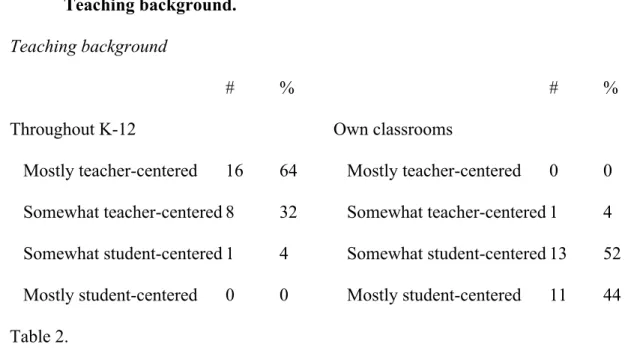
Teaching background.
Teaching background
# % # %
Throughout K-12 Own classrooms
Mostly teacher-centered 16 64 Mostly teacher-centered 0 0
Somewhat teacher-centered 8 32 Somewhat teacher-centered 1 4
Somewhat student-centered 1 4 Somewhat student-centered 13 52
Mostly student-centered 0 0 Mostly student-centered 11 44
Table 2.
Table 2 describes the teaching style that preservice teachers experienced in their
own K-12 education and the teaching style they wish to adopt in their future classroom. There is
a shift from what they experienced in their own education, mostly teacher-centered, to what they
would like to provide in their own classrooms, somewhat to mostly student-centered.
Defining STEAM.
Starting with question 8 on the survey, preservice teachers’ responses in the
pre-survey were compared to their responses in the post-pre-survey. Question 8 asked preservice teachers
to explain what characterizes STEAM from other types of instructional methods. Using Radloff
and Guzey’s (2016) coding scheme, responses were coded as either instruction, discipline,
exclusion, or integration. Responses coded “instruction” were those that mentioned STEAM
teaching in terms of real-world application, critical thinking, hands-on learning, problem-based
mentioned STEAM involving the associated disciplines, which may have been ranked.
Responses coded as “exclusion” focused on subjects being excluded from STEAM, such as
Language Arts. Responses coded as “integration” were those that mentioned the integration of
the STEAM disciplines. In Figure 2, pre-survey data is compared to post-survey data, showing
more responses coded as discipline and integration in the pre-survey, and more coded as
instruction in the post-survey.
Figure 2.
STEAM relatedness.
Questions 9 and 10 asked preservice teachers to explain how related they perceive
STEAM disciplines to be, first numerically and then explaining their response. For question 9,
preservice teachers ranked the STEAM disciplines on a continuum from 1 (not connected) to 10
(well connected). In the pre-survey, the average of preservice teacher response to this question
was 7.16 and in the post-survey, the averaged response was 8.8. Question 10 then asked
preservice teachers explain their ranking in question 9. Again using Radloff and Guzey’s (2016)
coding scheme, responses were coded as specialized, general, and other. Responses coded as
“specialized” were those that mentioned the disciplines as being dependent on one another, even
if ranked, or those that explained that the disciplines were connected by specialized process
generally related or connected, but not dependent. Responses coded as “other” were vague or
absent. In Figure 3, pre-survey data is compared to post-survey data, showing more responses
coded as other and general in the pre-survey, and more responses coded as specialized in the
post-survey.
Figure 3.
STEAM visualizations.
Questions 11 and 12 asked preservice teachers to create a visual representation of
STEAM and question 12 asked preservice teachers to explain those visualizations. For question
11, preservice teachers were asked to create a visualization that incorporated the letters in
STEAM. Again, using Radloff and Guzey’s (2016) coding scheme, responses were coded as
nested, transdisciplinary, interconnected, sequential, overlapping, or siloed. Responses coded as
“nested” were those which suggested a view of STEAM in which there was one overarching
discipline. Responses coded as “transdisciplinary” were those which suggested a focus on the
real-world application-based nature of STEAM. Responses coded as “interconnected” were those
which included double-arrows between the disciplines. Responses coded as “sequential” were
those which represented STEAM as a series of disciplines, typically with single arrows showing
a sequence. Responses coded as “overlapping” were those which showed two overarching
each STEAM discipline in isolation from the other, though they could be related (usually with
straight lines) or stand alone. Examples of each of these coded responses are available in
Appendix B. In Figure 4, pre-survey data is compared to post-survey data, showing more
visualizations coded as siloed and transdisciplinary in the pre-survey and more visualizations
coded as interconnected and overlapping in the post-survey, with responses coded as nested and
sequential remaining the same.
Figure 4.
In question 12, preservice teachers explained the visualizations they created in
question 11. These explanations were coded using Radloff and Guzey’s (2016) coding scheme.
Explanations were coded as application, related, dependent, ranked, processes, instruction,
unique, or some combination. Responses coded as “application” were those which explained
their visualization according to the real-world application of STEAM. Responses coded as
“related” were those which explained that the disciplines were simply related. Responses coded
as “dependent” were those which suggested that the disciplines depended on each other.
Responses coded as “ranked” were those which ranked the STEAM disciplines. Responses
coded as “processes” were those which suggested that the STEAM disciplines were connected
because of necessary thought processes or skills. Responses coded as “instruction” were those
were those that explained that the disciplines could stand alone or together. In Figure 5,
pre-survey data is compared to post-pre-survey data, showing that more preservice teachers explained
their visualizations as related and unique in the pre-survey and more preservice teachers
explained their visualizations as dependent and ranked in the post-survey, with instruction
staying nearly the same and application appearing only in the post-survey.
Figure 5.
Discussion
After participating in this blended STEAM module, preservice teachers’
conceptualizations of STEAM shifted in several ways. Preservice teachers defined STEAM more
instructionally and less disciplinarily. Preservice teachers perceived the disciplines of STEAM to
be more related and explained STEAM as a more specialized, and less general field. Preservice
teachers conceptualized STEAM, in visual form, as more interconnected and overlapping, and
less siloed and transdisciplinary. Preservice teachers then explained those visualizations by
describing STEAM education as more dependent, and less generally related, but still prioritized
Math and Science.
If we continue to conceptualize STEAM as integrated and problem-based, as
described by Quigley, Herro, and Jamil (2017), or with art as a catalyst, as described by
study is helpful in moving them toward a sound understanding of STEAM in a classroom setting.
The ability of preservice teachers to see STEAM instructionally and as more specialized,
integrated, interconnected, and less siloed is in line with the current conceptualization of
STEAM. After participating in this module, preservice teachers moved more toward that
understanding, with a few caveats. Preservice teachers moved away from a transdisciplinary
view of STEAM, which is one in which the content is understood in a real world context.
Preservice teachers also still maintained a nested understanding, placing Math or Science as the
most important, and included these same conceptualizations in their overlapping visualizations.
Conclusion
This study made several contributions to the field of STEAM education. To
further understand how to shift preservice teachers’ conceptualizations of STEAM education, it
is helpful to understand their initial conceptualizations. As the preservice teachers in this study
began to shift their conceptualizations to ones more in line with current research, perhaps this
constructivist, project-based module using the design process is one way to support them in their
understanding and eventual implementation of an integrated STEAM approach. This STEAM
module was also blended, which contributes to the literature on technology-enhanced educative
curriculum materials. Further research should continue the work of module development that can
References
Ball, D. L., & Cohen, D. K. (1996). Reform by the books: What is-or might be-the role of curriculum materials in teacher learning and instructional reform? Educational Researcher, 25(9), 6-8, 14. https://doi.org/10.3102/0013189X025009006
Becker, K. & Park, K. (2011). Effects of integrative approaches among science, technology, engineering, and mathematics (STEM) subjects on students’ learning: A preliminary meta-analysis. Journal of STEM Education, 12(5/6), 23-37. doi: 10.12691/education-2-10-4
Bernard, R.M., Borokhovski, E., Schmid, R.F., Tamim, R.M., & Abrami, P.C. (2014). A meta-analysis of blended learning and technology use in higher education: From the general to the applied. Journal of Computing in Higher Education, 26(1), 87-122.
doi.org/10.1007/s12528-013-9077-3
Bybee, R. W., Taylor, J. A., Gardner, A., Van Scotter, P., Carlson Powell, J., Westbrook, A., & Landes, N. (2006). The BCSC 5E instructional model. Origins, effectiveness and
applications. Colorado Springs, CO: Biological Sciences Curriculum Study.
Bybee, R. (2013). The case for STEM education: Challenges and opportunities. Arlington, VA: NSTA Press.
Charmaz, K. (2006). Constructing grounded theory: A practical guide through qualitative research. London: Sage Publications Ltd.
Davis, E. A., & Krajcik, J. S. (2005). Designing educative curriculum materials to promote teacher learning. Educational Researcher, 34(3), 3014.
doi.org/10.3102/0013189X034003003
Donna, J. D. & Hick, S. R. (2017). Developing elementary preservice teacher subject matter knowledge through the use of educative science curriculum materials. Journal of Science Teacher Education, 28(1), 92-110. doi.org/10.1080/1046560X.2017.1279510
Engineering is Elementary. (2018). The engineering design process. Retrieved from
https://www.eie.org/overview/engineering-design-process.
Krajcik, J. S., & Shin, N. (2014). Project-based learning. In R. K. Sawyer (Ed.), The Cambridge handbook of the learning sciences (2nd ed.) (pp. 275-297). New York, NY: Cambridge University Press.
Lippard, C. N., Tank, K., Walter, M. C., Krogh, J., & Colbert, K. (2018). Preparing early
childhood preservice teachers for science teaching: Aligning across a teacher preparation program. Journal of Early Childhood Teacher Education, 39(3), 193-212.
doi:10.1080/10901027.2018.1457578
Madden, L., Beyers, J., & O’Brien, S. (2016). The importance of STEM education in the elementary grades: Learning from pre-service and novice teachers’ perspectives.
Electronic Journal of Science Education, 20(5), 1-18. http://ejse.southwestern.edu National Academy of Sciences, National Academy of Engineering, and Institute of Medicine.
2007. Rising above the gathering storm: Energizing and employing America for a brighter economic future. Washington, DC: The National Academies Press. https://doi.org/10.17226/11463.
National Research Council. (2014). Next generation science standards. Retrieved from
http://www.nextgenscience.org
Papert, S. (1986). Constructionism: A new opportunity for elementary science education.
Massachusetts Institute of Technology, Media Laboratory, Epistemology and Learning Group: National Science Foundation. Division of Research on Learning in Formal and Informal Settings.
Piaget, J. (1971). Psychology and epistemology: Towards a theory of knowledge. New York: Grossman.
Picciano, Anthony G. (2014). Introduction to Blended Learning: Research perspectives, Volume 2. In A.G. Picciano, C.D. Dziuban, and C.R. Graham (Eds.), Blended Learning: Research perspectives, volume 2 (pp. 1-9). New York: Routledge.
Quigley, C. F., Herro, D., & Jamil, F. M. (2017). Developing a conceptual model of STEAM teaching practices. School Science and Mathematics, 117(1-2), 1-12.
doi.org/10.1111/ssm.12201
Radloff, J., & Guzey, S. (2016). Investigating preservice STEM teacher conceptions of STEM education. Journal of Science Education & Technology, 25, 759-774.
doi.org/10.1007/s10956-016-9633-5
Rinke, C.R., Gladstone-Brown, W., Kinlaw, C.R., & Cappiello, J. (2016) Characterizing STEM teacher education: Affordances and constraints of explicit STEM preparation for
elementary teachers. School Science and Mathematics, 116(6), 300-309. doi.org/10.1111/ssm.12185
The White House. (2015). Educate to innovate. Retrieved from
https://www.whitehouse.gov/issues/education/k-12/educate-innovate\
Vygotsky, L. S., & Cole, M. (1978). Mind in society: Development of higher psychological processes. Cambridge, Mass: Harvard University Press.
Wynn, T., & Harris, J. (2012). Toward a STEM + arts curriculum: Creating the teacher team. Art Education, 65(5), 42–47. doi.org/10.1080/00043125.2012.11519191
Author:
Biographical sketch: Lauren Angelone is an assistant professor of science education and
TOPIC HERE
Educators and Stress: Creating a Healthy Workplace Environment
Evonn Welton, Shernavaz Vakil, and Lynn Kline
* Correspondence: Evonn Welton
Curricular & Instructional Studies
University of Akron Akron, OH 44325 [email protected]
Full list of author
information is available at the end of the article
Abstract:
As schools face increasingly complex mental health issues (academic, emotional or behavioral) with their students, educators are frequently called upon to address these needs. The cumulative and ongoing effects of these academic and emotional or behavioral needs can result in significant stress, anxiety and burn-out for school personnel. While literature often focuses on addressing academic and emotional or behavioral needs of student when creating a safe and healthy environment, the impact experienced by educators is less recognized. There is increasing recognition that education has become a high stress occupation and that educators may experience stress reactions similar to those experienced by law enforcement,
physicians and mental health professionals. This manuscript addresses the impact of vicarious stressors on educators and offers potential methods to address them.
Introduction
Creation of a healthy and safe school environment is essential for student learning and educator morale. The benefits of mental health services in the school setting, early identification of students at risk, and collaboration with outside mental health professionals are now recognized as essential (National Alliance on Mentally Illness, n.d.; Brueck, 2016). The passage of the Every Student Succeeds Act (2015) reflects this recognition and has provided legislative support. While these efforts have been focused upon student mental health and will have the secondary effect of improving school climate, less attention has been focused upon educator mental health. Teachers,
STEAM As society changed, students brought increasingly complex academic and
emotional or behavioral needs into the school. The school, family and community could no
longer function in isolation and improved coordination of services became necessary. It was also
recognized that student mental health services and positive proactive behavioral strategies
benefitted all students. These strategies are now found in districts across the United States.
While student learning and academic achievement continue to be the primary
responsibilities of educators, it is now recognized that students with significant behavioral or
emotional needs cannot learn effectively and educational programming must address the needs of
the entire student. With inclusion, students with learning and behavioral needs receive their
education in the regular education setting resulting in the regular and special education teacher
addressing the students’ needs. Not all students qualify for special education services and
therefore, meeting the needs of all students falls upon all stakeholders. Not addressing these
needs not only impacts learning, but also can put the well-being of students and educators at
significant risk.
Meeting these needs is an arduous task and can take a significant toll on the mental health
and job satisfaction of the educational staff. There is increasing recognition that education has
become a high stress occupation and that educators may experience stress reactions similar to
those experienced by law enforcement, physicians and mental health professionals.
Direct and Indirect Educator Stressors
The American Psychological Association (2016) reported that teacher victimization is a
significant problem with 80% of teachers nationwide reporting that they had been victimized by
students within the past year. This victimization took the form of physical attacks, verbal abuse
or weekly basis. Walker (2013) reported that teachers may be also be victimized in the form of
harassment, objects being thrown at them and physical attacks. In some cases, the physical
attacks are severe enough to warrant medical attention. Property destruction in which their
property is stolen or damaged was also reported.
In Connecticut, teacher victimization has become so significant that a dozen teachers
testified in front of the Connecticut Legislature and more than 100 submitted written testimony
(Rosales, 2019). The Connecticut teachers reported that some incidences were the result of
intentional acts of aggression by students in regular education while others were not intentional
and/or resulted from children who had special education needs. At times, children as young as
five years old demonstrated significant behavioral problems and placed others in danger.
There are other forms of victimization such as teacher victimization by parents or
caregivers and cyberbullying. Morrison (2017) reported that while teachers may become the
subject of cyberbullying by students, there is little they can do about such public attacks. For the
most part, cyberbullying falls under free speech and legal action has a high probability of failure.
In some cases, the teacher simply quits teaching in order to avoid the hostility. Public school
k-12 educators are not alone when it comes to cyberbullying. Higher education faculty are quite
familiar with commercial sites that encourage students publically criticize (or retaliate against for
poor grades) faculty members (Macdonald, 2010).
While there are numerous forms of direct teacher/educator victimization, educators may
also experience indirect or vicarious trauma and stress by witnessing traumatic experiences of
the students in their schools. Howard (2019) reported a significant increase in suicides among
adolescents and young adults. In California, schools are putting the phone numbers for suicide
the probability that an educator may lose a child or adolescent in their class to suicide and
experience the resulting vicarious trauma.
Educators often encounter suspected child abuse and are required to report their
suspicions to child protective services. The National Children’s Alliance (2014) reported that
nearly 700,000 children are abused in the United States annually. Of those children, 1670
children died from abuse in 2014. In the case of suspected abuse, the stress and trauma may
result from two sources. First, the educator becomes aware of the child’s experiences with abuse
or neglect and becomes very concerned for the child’s well-being. Secondly, the educator is a
mandated reporter. The process of mandated reporting may result in a level of fear of retaliation
on the part of the educator. While reporting is anonymous, parents or family members may
nonetheless be aware who has reported the suspected abuse or neglect.
While many factors influence the probability of child abuse or neglect, the opioid crisis
has also impacted innumerable children who routinely face parents and caregivers who are
unable to provide for their basic needs. Mirick and Steenrod (2016) report that parental use of
opioids increases that probability of child maltreatment and there has been a significant increase
in foster care placement. In addition, educators may be faced with parents or students who
overdose in the school setting. The National Association of School Nurses (2015) has
recommended that naloxone be incorporated into school emergency plans. The opioid crisis has
therefore, increased the possibility of educators facing very stressful circumstances in a number
of ways.
Other issues resulting in educator stress and trauma include children with degenerative or
terminal illnesses. The American Cancer Society (2018) estimated that 11,060 children under the
may have a child in class who is facing a life threatening illness. In addition to cancer, there are
other serious, and sometimes terminal, medical conditions that educators may encounter in the
school setting. Although these are not direct threats to educator, safety the teachers and school
may become very involved with such situations and have great difficulty processing through
grief issues.
This is certainly not an exhaustive list of stress inducing situations in the educational
setting; however, it does exemplify the wide array of events that have the potential to produce a
high degree of anxiety and distress whether by an individual event or cumulative effects.
Reactions to Trauma and Stress
Vicarious trauma, secondary traumatic stress, compassion fatigue and burn-out are all
terms that have been utilized to describe the serious reactions of those engaged in mental health
services with victims of trauma (Devilly, Wright and Varker, 2009). These terms are not
officially recognized diagnoses; however, serve to describe various stress reactions as a function
of occupational or personal exposure to the trauma experienced by another. The terms also serve
to facilitate research and recognition that an individual does not have to have a direct threat to
experience severe stress reactions.
Post-traumatic stress disorder is commonly associated with direct exposure to very
serious and life threatening events; however, the American Psychiatric Association (2013) allows
for several different types of stress disorders as a function of how quickly the symptoms first
appear, the severity of the symptoms and the nature of the stressors. For example, an educator
who was exposed to a school shooting and whose symptoms last beyond one month may meet
the criteria for post-traumatic stress disorder. An educator who was also exposed to a serious
stress disorder and an adjustment disorder may be identified if the individual demonstrates
symptoms as a result of a stressor of any severity.
The American Psychiatric Association (2013) provides a great deal of increased detail for
accurate diagnosis of reactions to stressors including how cultural factors, temperament and
pervious experiences may also impact reactions. It is very important to state that any diagnosis
must be made by a qualified professional. What must also be noted is that any time an educator
is experiencing distress that may be related to what the educator perceives as a stressful situation,
the educator may benefit from seeking assistance from a mental health or medical professional.
If stress is left untreated and unaddressed, it can result is debilitating distress or physical
illness (American Institute of Stress, n.d.). The American Psychological Association (2016) lists
a number of costs resulting from teacher victimization including teachers leaving the field
prematurely, lost wages and Bureau of Workman’s Compensation claims. In total, teacher
victimization was reported to cost 2 billion dollars annually.
In the most severe situations, these feelings of depression and discouragement may end
up in suicide. Rappaport (2010) reports that a teacher committed suicide upon learning that he
had been rated as a “less than effective teacher” but a teacher evaluation system. The teacher was
reported to love teaching and while the reasons for suicide are often never identified, Rappaport
attributes this teacher’s death in part due to the performance rating. Specifically, when a teacher
gives so much in the classroom and then is unappreciated, it sets up a very high risk scenario that
may end tragically.
Potential Interventions for Addressing Stressors in the School Setting
The stress experienced by educators is a significant issue and warrants attention. It is
may be helpful for alleviation of the stress experienced by educators in the school setting. These
include strategies at the societal level, educator preparation at the university level, and at the
district level.
Societal Intervention
It is imperative that those who do not directly work in the school setting have an
understanding of stressful educator experiences and the resulting implications and costs. The
responsibilities of the educator must not be minimized and considered similar to those
experienced individuals employed in the medical field, social services/mental health and law
enforcement. While the direct victimization of educators may observable and at times
prosecuted, vicarious trauma has also become a serious, and sometimes, silent problem.
Educators may be expected to demonstrate outward composure and resilience, when internally,
they are in a great deal of unrecognized distress.
The Federal Commission on School Safety (2018) submitted a comprehensive analysis of
issues and recommendations regarding school violence. The focus of that report was on
procedures and processes that would facility the safety of students as well as early identification
of students who were at risk. Should the recommendations made by this Commission be
implemented, they will undoubtedly improve school climate for all stakeholders including
educators. Similarly, ESSA (2015) supports the implementation of School Wide Positive
Behavioral Intervention Support (SW- PBIS) in an effort to improve school climate (Von
Ravensberg and Blakely, 2017). While these are all laudable initiatives that will improve school
climate, concerns remain about whether this will actually address the broader circumstances
involved in educator stress and victimization and are not directly addressed in these broader
Because the serious issues facing educators are very diverse and often go
unacknowledged, it is important for professional organizations such as the National Education
Association, American Association of Colleges for Teacher Education, American Association of
School Administrators, School Superintendents’ Association and the American Psychological
Association and other related educator professional organizations to advocate for the health and
well-being of educators as well as students in the current school setting through education and
policy change. It is important for these various professional organizations to bring this important
issue to the attention of federal and state legislators so that possible strategies might be
considered that will support teachers, administrators and related services staff. It is important to
reframe society’s perception of the educator from a disseminator of academic content to a
broader and more comprehensive identification of the serious issues that educators must address
on a daily basis.
There are many possible solutions to this complex problem; however, funding that would
support mental health strategies for educators in the school setting could be explored. This
funding might initially take the form of research grants that could investigate needs and viable
strategies that would enhance educator feelings of self-efficacy, support and job satisfaction.
There are a number of educational requirements that, while seemingly far removed from
victimization, place undo stressors on educators. Teacher evaluation systems, high stakes student
testing and paperwork compliance are areas that need to be reviewed and considered. Have these
initiatives truly resulted in improvements and if so, are there ways that they might be done such
that there is less pressure on the teachers, administrators and students?
Mental health professions recognize and require the professional to be reflective and
acknowledge when their own well-being might negatively impact the therapeutic relationship
with the client. The American Psychological Association (2017) Ethical Principles of
Psychologists and Code of Conduct requires that psychologists recognize when personal
problems may impact their ability to provide psychological services to their clients and take
appropriate measures to determine the appropriate course of action. While accreditation entities
such as the Council for the Accreditation of Educator Preparation (2015) require that educator
preparation programs establish and monitor attributes and dispositions, direct emphasis upon
maintenance of educator well-being and mental health may not be included in the preparation
programs. Perhaps this is because teacher and administrator preparation programs have not
traditionally addressed these issues and believe it is the responsibility of educators to
independently seek professional assistance when in distress. Unfortunately, the stigma attached
to seeking mental health or medical services for stress plus the perceived weakness on the part of
the educator may prohibit timely intervention. It may be helpful for teacher and administrator
preparation programs to examine the strategies utilized by school counseling and determine if
increased collaboration might be of benefit.
District Level
At the district level, there are a number of existing collaborative teams that offer the
opportunity for educators to consult and collaborate about individual student issues. For
example, schools are expected to implement Multi-Tiered Systems of Support, Response to
Intervention strategies (Fletcher and Vaughn, 2009), and Positive Behavioral Interventions and
Supports (Ohio Department of Education, 2019) that will enhance learning at the district,
IEP’s. A variety of other formal and informal meetings occur at the building level; however, the
meetings are usually focused upon the status of the child rather than providing a safe venue for
teachers to share concerns from their perspectives. In addition, these meetings may not offer a
great deal of support for the teacher and rather add to the responsibilities of an already stressed
educator. To that end, educators must be free to request additional support from building
administrators as needed. This support may take the form of an additional assistant or
consultation with behavior specialists.
Sommer (2008) stated that counselor education has an ethical responsibility to prepare
counselors to recognize vicarious trauma in the counselor during supervision and address this as
needed. Supervision for most mental health professionals consists of weekly time periods during
with the counselor and the supervisor can discuss client issues in a one to one setting. This type
of structured meeting time allows for monitoring and assistance with any issues that may be
influencing client progress. On the other hand, there is no such expected or structured time for
teachers to meet in a one to one setting with administrators or for administrators to meet with
assistant superintendents or other administrators. Individual meetings that take place may not be
framed as learning or growth opportunities for the teacher, but rather as reactive to a specific
difficult situation. Therefore, the stressors that an educator may be experiencing may well go
unnoticed or even be perceived as a weakness on the part of the teacher or administrator.
Admittedly, the ratio of teachers to administrator makes this level of supervision and
communication difficult and even impossible. In addition, the administrator serves as the teacher
evaluator so the teacher may be very reluctant to share concerns; however, it may be possible for
this type of communication or sharing to take place in a different manner with a different
situations and they also need resources and a safe manner to share concerns. In addition, it is
hoped that both administrators and educators would frame these discussions as opportunities as
opposed to vulnerabilities.
At a district level, it may be beneficial if districts would implement specific strategies for
creation of healthy workplace environments. Professional development opportunities and
consultation with human resource and experts in the field of creation of a healthy workplace
environment might be a good initial step. It should be noted that there is research that indicates
that while exposure to stressful or traumatic situations may be inevitable, it can sometimes be
utilized as an opportunity for personal growth and the development of resilience (Pack, 2014).
Educators may need assistance in reframing what seem like very negative experiences into
recognition that their experiences may have contributed to their professional growth and
development.
In summary, it can be stated that educators and related services school personnel may
experience a great deal of stress with limited communication, coping and supports. Limited
attention has been given to this much needed area; however, there are a number of strategies that
may prove to be of benefit to those that find themselves on the front lines of very difficult
References
American Cancer Society. Facts & Figures 2018. American Cancer Society. Atlanta, GA. 2018.
American Institute of Stress (n.d.). Workplace Stress. Weatherford, Tx: Author.
American Psychiatric Association. (2013). Diagnostic and statistical manual of mental disorders (5th ed.). Arlington, VA: Author.
American Psychological Association (2016). A Silent National Crisis: Violence Against Teachers All Educators are at Risk [Brochure]. Washington, D.C. American Psychological Association.
American Psychological Association (2017). Ethical principles of psychologists and code of conduct. Washington, DC: Author.
Brueck, M. (2016). Promoting access to school-based services for children’s mental health.
American Medical Association Journal of Ethics, 18, 1218-1224.
CAEP (2015) Council for the Accreditation of Educator Preparation. Standard 3 Candidate Quality, Recruitment and Selectivity. Washington D.C.: Author.
ESSA (2015). Every Student Succeeds Act of 2015, Pub L., No. 114-95, & 114, Statute 1177 (2015-2016).
Fletcher, J., Vaughn, S. (2009). Response to intervention: preventing and remediating academic difficulties. Child Development Perspectives. 3. 30-37. Retrieved
from 10.1111/j.17508606.2008.00072.x.
Devilly, G., Wright, R., Varker, T. (2009). Vicarious trauma, secondary traumatic stress or simply burnout? Effect of trauma therapy on mental health professionals. Australian and NewZealand Journal of Psychiatry, 43, p. 373-385.
Federal Commission on School Safety (2018). Federal Commission on School Safety Final Report. US Department of Education. Retrieved from
https://www2.ed.gov/documents/school-safety/school-safety-report.pdf.
Macdonald, G. (2010). Ratethisfacultyevaluationsite.com. Academe, July-August 2010. Washington, D.C.: American Association of University Professors. Retrieved from
https://www.aaup.org/article/ratethisfacultyevaluationsitecom#.XXp1eShKjIV.
Mirick, R.G. & Steenrod, S.A. (2016). Child and Adolescent Social Work Journal, 33, 6, 547-557. Retrieved from https://doi.org/10.1007/s10560-016-0449-1.
Morrison, S. (2017, May 15). When teachers are victims of cyberbullying. Vocativ. Retrieved from
https://www.vocativ.com/419694/teachers-victims-cyberbullying-social-media/?wpsrc=theweek.
National Alliance on Mentally Illness. (n.d.). Retrieved from https://www.nami.org/Learn-More/Public-Policy/Mental-Health-in-Schools.
National Association of School Nurses. (2015). Naloxone use in the school setting: The role of the school nurse (Position Statement). Silver Spring, MD: Author.
National Children’s Alliance (2014). National Statistics on Child Abuse (Taken from the Children’s Advocacy Center). CAC Statistics. (2015). Retrieved from
http://www.nationalchildrensalliance.org/cac-statistics.
Ohio Department of Education (2019). Positive behavioral interventions and supports. Retrieved from http://education.ohio.gov/Topics/Student-Supports/PBIS-Resources .
Pack, M. (2014). Vicarious Resilience: A Multilayered Model of Stress and Trauma. Journal of Women and Social Work, 29, 18-29.
Rappaport, N. (October 8, 2010). A Teacher’s Suicide: Lessons Learned. Psychology Today, Sussex Publishers, LLC. Retrieved from https://www.psychologytoday.com/us/blog/we-are-only-human/201010/teachers-suicide-lessons-learned.
Rosales, J. (June 20, 2019). Threatened and Attacked by Students: When Work Hurts. Educators in Action, National Education Association, neaToday. Retrieved from
http://neatoday.org/2019/06/20/student-attacks-on-teachers/ .
Sommer, C. (2008). Vicarious Traumatization, Trauma‐Sensitive Supervision, and Counselor Preparation. Counselor Education and Supervision, 48, p 61-71.
Walker, T. (2013). Violence against teachers: an overlooked crisis? NeaToday, February 19, 2013, http://neatoday.org/2013/02/19/violence-against-teachers-an-overlooked-crisis-2/.
Williams, D. (2019, August 14). California law puts a suicide hotline number on school ID cards. CNN. Retrieved from https://www.cnn.com/2019/08/14/us/california-suicide-hotline-student-id-trnd/index.html.
Authors:
Evonn Welton
Curricular & Instructional Studies University of Akron
Akron, OH 44325 [email protected]
Shernavaz Vakil
Curricular & Instructional Studies University of Akron
Akron, OH 44325 [email protected]
Lynn Kline
Curricular & Instructional Studies University of Akron
TOPIC HERE
Initiative in ESL Student Teaching: Three Perspectives
Timothy A. Micek, DA.
* Correspondence: Timothy A. Micek, DA Ohio Dominican
University/1216 Sunbury Road/Columbus, OH 43219
(614) 251-4675 O; Ohio Dominican University 513-745-4222
Full list of author
information is available at the end of the article
Abstract:
Initiative in ESL student teaching was studied. There were three sets of participants: two student teachers, two cooperating teachers, and two university supervisors. All participants were surveyed before student teaching; student teachers and
cooperating teachers were surveyed afterwards. Results indicate that (a) initiative is seen as (very) important by all stakeholders and (b) its importance increases over time. Although the overall ratings were generally very close, individual ratings were more varied. Participants’ comments (a) help to explain their ratings and (b) reveal differences in their views. Results have implications for ESL teacher educators.
Introduction
The 2019 Ohio TESOL conference has a three-part theme: “Collaborate! Educate! Initiate!” Over the years, a great deal has been written about collaboration, especially between ESL and content teachers (e.g., Davison, 2006; DelliCarpini, 2008; Pawan & Ortlof, 2011). Education, of course, is what TESOL professionals do: they may be in TESOL specifically, but they are in education generally. The third part of the theme, though, may give one pause: what is initiative, and what is its place in TESOL? Assuming from the conference theme that initiative plays a major role in TESOL, one might ask how it is viewed, or experienced, in a critical part of ESL teacher education, student teaching. A study was conducted the address this question.
A web search for the definition of initiative gets “about
595,000,000” results. The first result comes from Lexico “Powered by Oxford,” so it seems a good choice. Lexico list four meanings of
initiative, the first two of which seem most relevant: (a) the ability to assess and initiate things independently and (b) the power or
(we must rely on this one. Not only is there no formal definition or description of
initiative in the literature, but very little has been written about the construct in TESOL or, for
that matter, in education generally. Multiple searches on the topic yielded few results. Included
in the search was the subject professional dispositions, under which the construct might expected
to be found.
Three studies addressed initiative-related themes, two of them involving action or
classroom research. Rinchen (2009) studied effects of “moving teaching and learning from
teacher-centered classes to independent learning” in Bhutan. Participants were 28 first-year
science student teachers, and data were gathered from a variety of sources. Rinchen found that
participants were “more open to discussion and interaction,” and their write-ups and views “more
analytical and reflective,” after the intervention. Roux and Valladares (2014) carried out a
professional development (PD) needs analysis of secondary English language teachers in
northeast Mexico and found that “stand-alone and degree courses” were the only PD activities
that participants had experienced. Although most of the teachers indicated that training courses
had a great impact on teaching, “some of them valued the impact of [PD] practices that involve
autonomy, reflection and collaboration.” In a study of content area (CA) instruction in ESL
student teaching, Micek and Spackman (2018) found initiative to be the single most important
variable in teacher candidates’ preparation to deliver this type of instruction, with half of the
participants indicating that, whether or not their cooperating teacher helped them, they had to
prepare CA lessons on their own (p. 28).
Despite the lack of research into the topic, initiative has played a role in the evaluation of
classroom settings” (CGT&L, 2013). Praxis III has four interrelated domains, including Teacher
Professionalism (ETS, 2000, p. 6). At my institution, education faculty changed that heading to
Personal and Professional Qualities and developed five indicators for it (V. McCormack,
personal communication, October 11, 2019), the second one being “Demonstrated initiative,
responsibility, and self-directedness.” The evaluation was used in both early and methods field
experience
Initiative, per se, is not part of student teaching evaluation in Ohio, but it is relevant. The
Candidate Preservice Assessment of Student Teaching (CPAST) is “a valid and reliable
formative and summative assessment” that is used by many educator preparation programs
(EPPs) in the state. The assessment has two subscales, Pedagogy (13 rows) and Dispositions
(eight rows), and “each of the 21 rows contains detailed descriptors of observable, measurable
behaviors to guide scoring decisions” (TOSU, 2019). Within Dispositions, a number of different
phrases are used to describe those behaviors, but only two of them, “Takes action(s) based upon
identified needs while following district protocols” (part of Exceeds Expectations for T.
Advocacy to Meet the Needs of Learners or for the Teaching Profession), and “Proactively seeks
opportunities for feedback from other professionals” (part of Exceeds Expectations for U.
Responds Positively to Feedback), resonate with the idea of initiative.
Although initiative would seem to be important, then, very little has been written about
the topic. The present study seeks to fill that gap in the literature by addressing the following
questions:
1. How do student teachers, cooperating teachers, and university supervisors view
2. How, if at all, do those views change over the course of the student teaching
experience—and why?
Method
Participants
There were three sets of participants: two licensure candidates, or student teachers (STs);
two cooperating teachers (CTs); and two university supervisors (USs). One candidate, Helen
(like all names, a pseudonym) was a 35-year old female. She was a non-native speaker of
English (NNSE) who had eight years’ experience teaching pre-kindergarten “and even younger
students” and five years “mentoring preschool/prekindergarten teachers.” The other candidate,
Edward, was a 28-year old male. Like the remaining participants, he was a native speaker of
English (NSE) who had 10 years “part-time ESOL teaching, tutoring, and instructional assisting”
experience. Both candidates were excellent students: each carried a GPA of 3.963 into student
teaching. Helen did her student teaching at a suburban middle school, Edward his at an urban
high school. Helen’s CT, Bev, was a 45-year old female who had taught 16 years of middle
school and high school ESL and Spanish. Edward’s CT was a 64 year-old female who had
taught a variety of subjects, including high school Special Education (14 years) and ESL (19
years), for over 33 years. One university supervisor, Michael, was a 64 year-old male with 25
years of experience in ESOL teacher education. The other university supervisor, Angela, was a
70-year old female with 35 years of experience teaching ESL and English and several years
supervising student teachers. Only the former US was supervising student teachers during the
semester studied; the other was included to expand university supervisor views of the topic.
Before student teaching, all participants were surveyed about their views of initiative in
student teaching with a questionnaire. In addition to demographic information, the questionnaire
asked participants to rate the importance of initiative in student teaching generally and on five
individual criteria: Creating the learning environment, Planning for instruction, Delivering
instruction, Assessment, and Professionalism. The individual criteria were drawn from four
relevant TESOL assessments or standards: in alphabetical order, CPAST, edTPA (SCALE,
2016), Praxis III, and the TESOL standards for P-12 ESL teacher education (TESOL, 2010).
(Except for the demographic section, the questionnaire is replicated in Results.) After student
teaching, the STs and CTs were surveyed about the topic. Because only one of the USs was
supervising that semester, no post- student teaching survey was administered to them. Results
were analyzed for both general and individual ratings, including comments.
Results
Student Teachers
ST responses to the pre-student teaching questionnaire varied somewhat according to the
(type of) criterion. On the general criterion, they were one score apart, with Helen giving it a 4
and Edward a 3. Helen’s and Edwards’s comments scores reveal both similarities and
differences in the way they viewed initiative before student teaching. For Helen, student
teaching involved initiative, but it also involved collaboration and transaction. The latter,
however, would not occur without her taking initiative:
This is a bit of a subjective question. I take initiative with everything I do so this is
natural for me. Student teaching is not about following directions and trying to adapt to the
cooperating teacher’s style . . . . Student teaching is also about collaboration and exchange of
teacher will share her classroom experience with me and that is extremely valuable. Without me
taking the initiative to ask questions and offer the latest educational perspectives, this exchange
of knowledge may not happen . . . .
For Edward, student teachers must exercise initiative, but they must also take time to
observe the classroom in which they have been placed:
Student teachers will get the most out of the experience if they take the initiative in
asking questions of their CT and other school personnel, and initiating instructional activities
with students, starting with one-on-one and small group activities, and eventually moving on to
full classroom teaching . . . .
However . . . , as someone who has done a fair deal of teaching without much
observation, direction, or coaching from other experienced professionals, I am most eager to sit
back and observe effective instruction from my CT . . . .
Differences between candidate ratings of initiative are reflected in their views of the
construct.
On the individual criteria, the candidates were closer, with Helen averaging 3.4 and
Edward 2.9 (a difference of 0.5), yet they were two scores apart on two of those criteria, Creating
the learning environment and Professionalism. (Edward gave both a 2 and Helen both a 4.)
Candidate differences on Creating the learning environment reflect their different understandings
of the construct. “Without a question,” Helen commented, “I want to make the students feel
positive and willing to learn when I am in their classroom.” Edward, on the other hand, includes
physical aspects of the environment in his response:
If learning environment primarily means the classroom space and layout, then I believe I
If learning environment includes other things, such as fostering positive student attitudes
towards learning, or facilitating cooperation and inclusivity in group activities, then I believe I
have a far greater responsibility to exercise greater initiative in these areas . . . .
It is not surprising that the ratings of the two STs were so far apart (two scores) on this
criterion, given the different meanings they attached to the construct.
Because Helen made no comment, it is impossible to explain the difference between
candidate ratings of Professionalism (two scores), but Edward’s comment explains why he gave
it a 2:
I do not personally have much knowledge of how I can work on advocacy,
communication, and professional development during my student teaching. I will initiate in
asking questions of the CT and other school personnel about this, but at this time, I am unaware
of what I can do to initiate professionalism. Of course, I have the full intention of fulfilling my
responsibility to maintain professional standards of appearance, demeanor, and communication
throughout my student teaching.
Clearly, lack of knowledge was responsible for Edward’s low rating of this criterion.
Results of the post-student teaching questionnaire were somewhat different. On the
general rating, candidates were one-half score apart, with Helen checking 4 and Edward 3.5.
Comments indicate that the value of initiative depends on the CT. For Helen, it was productive:
Practicing initiative during student teaching is helpful and necessary. At the beginning, it
helped me build rapport with my cooperating teacher and gain her trust. Seeing my confidence
and independence in the classroom gave my CT reassurance that I am a partner she can trust and
rely on. Having this type of relationship is important when you know that there is a whole