18
Using Computers to Promote
Concurrent & terminal Feedback in
Freestyle Swimming Learning
Mazin Abid Al Hadi Ahmad, Sawssan
Hedood, Jalal khdhr Ahmed
College of physical education, Babylon University, Iraq College of physical education, Babylon University, Iraq College of physical education, Sulaymaniyah University
[email protected] [email protected]
Article Info
Received: January 12, 2014
Accepted:February 11, 2014
Published online: March 01, 2014
ABSTRACT
Swimming learning is different from other events because of the learner deals with water, so the coach has to explain, state and access information to the learners through many methods, so as to guarantee the successful of swimming learning, the information which learner gain them through or after or before corresponding are called feedback, there are many types of methods to introduce feedback, the researchers used two types of feedback, concurrent feedback that is provided during performance and terminal feedback which is delivered after performance, computer users in the promotion of this information provided by the teacher through a system of three-dimensional which shows freestyle movements and explains the strengths and weakness points during learning. The number of subject was 30 students from secondary school students with age 14 years who participated in swimming learning classes that is prepared by physical education college in summer holiday (July 2012), in which researchers used experimental approach for suitability to the study problem, the subject was divided into two groups, concurrent feedback group with performance and second group used the terminal feedback with watching a three dimensional program which explains the freestyle swimming skill in sections with illustrates the strengths and weakness points in performance technique, this group can watch the program after performance. The researchers also used freestyle swimming test for a distance of 25m and they found out that introduce of terminal feedback through using computer programs was better than using concurrent feedback during performance because it effects negatively on learner performance, the results of freestyle swimming test for a distance of 25m for terminal feedback group were best than concurrent feedback group, in addition, the researcher discovered that all kinds of feedback provide corrective information to the learners helped to learn freestyle skill speedily.
19 1. Introduction
Feedback is one of the most important and basic factors which have a priority in learning procedures because it gives a chance to the learner to gain the information about his performance through trying to learn or information that gives the learner about his performance after completion of phase learn a skill.
The importance of feedback is demonstrated in motor learning because it is working in two important functions, first of all is explanation or media function where provides the learner some information in which helps him to direct his performance toward positive goals and achieve them, the second function promotion, referring to strengthen motor responses (Abid Al Azeez, 1998), however, Scientifics, experts, and researchers have to give priority to the feedback in learning process because it is a very important factor in the control of the adjustment path of movement and motor behavior of the learner, as well as if the learner informed of the results of learning will help him to be successful in learning and increase its production in terms quality, quantity, and speed.
The person who knows the extent of its progress and its success will advance faster than the person who trained without this knowledge especially in practical swimming lesson which has specific natural because it is doing in water, it is an environment deferent from environment of land which practiceson it other sport activities, the aquatic environment needs to match between the learner and water and for this reason the swim teacher needs to increase burden to take into account individual differences among learners and work to create a psychologist field leads to raise interest of learners toward learning and mastering the skills of swimming and interacting with different performance stages (Nuha, 2000).
As a result of the importance of current study to determine the impact of the external feedback ofall kinds of terminal and concurrent on the process of freestyle learning for students aged (14) years, because this type of skills less using of self-feedback to the learner and relaying on the teacher mainly in giving the necessary information about the performance and corrective errors through learning process.
2. Methodology
The researchers used experimental approach because it is suitable to the nature of the study and its goals.
2.1Subject
The researchers chose subjects randomly from participants in swim learning lessons aged (14) years within courses of the sport consulting office\ Babylon University during the summer holidays, where the number of subject was (30) students distributions into (10 concurrent group) and (10 terminal group) and (10 pupils for the control group).
20
2.2Procedures
The researcher prepared a form to determine the suitable method in giving the concurrent and terminal feedback which is suitable to the pupils aged (14) years, the form was given to number of experts and then the researchers pulled out the suitable instrument where results showed a percentage agreement of specialists and experts about using of concurrent feedback during learn and through performance and corrective of performance errors verbally as they occur during the time of performance, either in terms terminal feedback, it was given to students by using of a 3 dimensional system through computer which displayed the basic skills for a freestyle, so that the pupil reads the instructions and choose the correct movements and diagnose errors through a computer with video imaging of the student movement to compare them with optimal performance, whereas the third group the control group depended on approach that prepared by swim teacher, the researchers didn’t intervenient the program, also the researchers prepared a questionnaire to evaluate pre and post-tests to the three groups.
The researchers have done pre-test on 24\6\2012 in Babylon Olympic Swimming Pool, the testing characteristics demonstrate below:
-Testing characteristic: (Buoyancy test on the belly and front gliding). - Testing goal: spend the longest distance of front gliding on the belly.
- Performance characteristic: the pupil stand up and his back directed to the pool edge and then take the buoyancy position on the belly and sliding into front without stopping until the legs start to land on the level of the surface of the water.
- Record: The researchers measured the distance that the pupil is spent from moment of enter the water until the legs start to land on the level of the surface of the water by account the spend distance to closer (cm).
The researchers carried out the learning unites which included (8) learning unites, two units weekly, the duration from 1\7\2012 to 30\8\2012, the time of the learning unite is (90) minutes. After completion the learning approach by subject of the study, the researchers determined the date of doing post-test which was on 2\9\2012, the researchers merged the three groups together during evaluation so as not to be partial to pupils by referees, the researchers used freestyle test for a distance (25m), each mistake results in take out one degree from the pupil, the maximum degree is (10) degree and the minimum degree is (0) degree, the spend distance is measured by (m)
2.3 Statistical analysis
21 3. Results & Discussion
Table (1)
Illustrates means, standard deviation and T value for pre and post-test of the performance in freestyle swimming for a three groups
Groups Pre test Post-test The
relative of T value
The tabular of
T value
Significant
Mean Standard
deviation
Mean Standard
deviation
Concurrent 1.52 1.25 5.38 1.17 9.67 S
Final 1.72 1.29 7.58 0.78 5.45 2.26 S
Control 1.35 1.27 3.21 1.29 6.54 S
Level of the significant is (0.05).
The results which are shown in table (1) confirm there is a significant different between pre and post-test and in favor of post-test to the three groups. Whereas table (2) shows the test of Variance analysis between three groups and in favor of post-test to know the significant of differences between three groups by used (LSD) and then identify the less significant differ between research groups and more effect to learn freestyle swimming.
Table (2)
Demonstrates results of F test of variance analysis between three groups for post-test of performance for freestyle swimming
Source of variance
Total of square
Freedom degree
Average squares
The calculate
of F value
The tabulate
of F value
Level of significant
Significant of differences
Between groups
154.74 2 78.53 6.82 3.35 0.05 S
Inside groups
37.84 27 12.32
Total 192.58 29
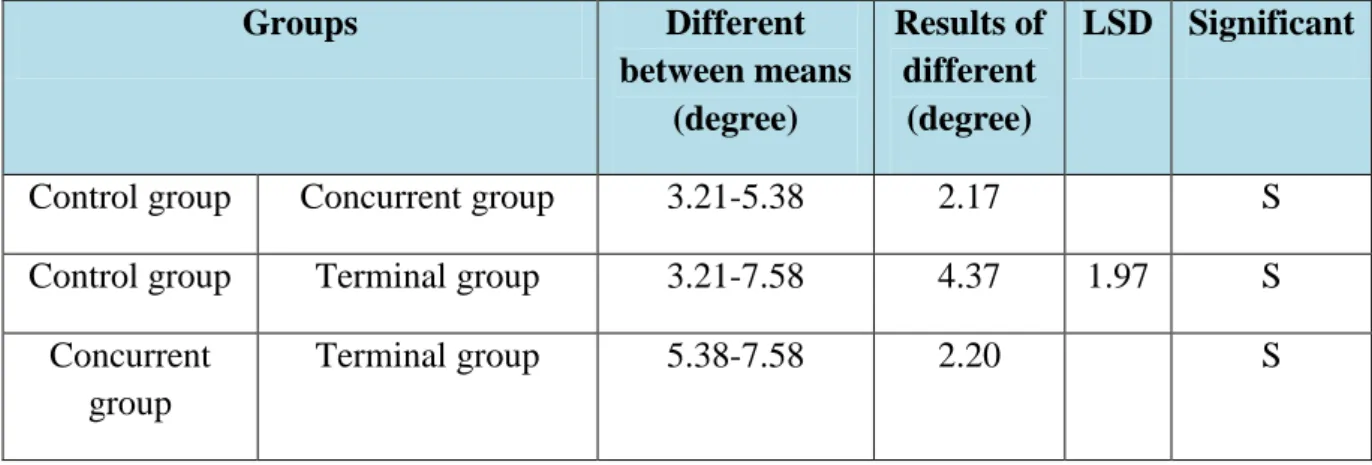
22 Table (3)
Illustrates results of LSD test to know the less of significant different between three groups of performance for a freestyle swimming
Groups Different
between means (degree)
Results of different
(degree)
LSD Significant
Control group Concurrent group 3.21-5.38 2.17 S
Control group Terminal group 3.21-7.58 4.37 1.97 S
Concurrent group
Terminal group 5.38-7.58 2.20 S
After compare of a value of less significant different under significant level (0.05) which is (1.97) where shown there is a different between two means for control and concurrent group and in favor of concurrent group, whereas the variance between control group and terminal group was significant and in favor of terminal group, the difference between two means of the concurrent group and terminal group was (2.20) and it is larger than value of less significant difference, this means the difference is significant between them and in favor of terminal group.
Table (4) shows the results of (25m) test that confirm there is a significant variance between pre and post-tests in favor of post-test of three groups, also the researchers used (F) test to analysis of variance between study groups and for post-test of the spend distance to make sure significance of difference between study groups in 25 m test.
Table (4)
Illustrates means, standard deviation and F value for pre and post-test in freestyle swimming for three groups
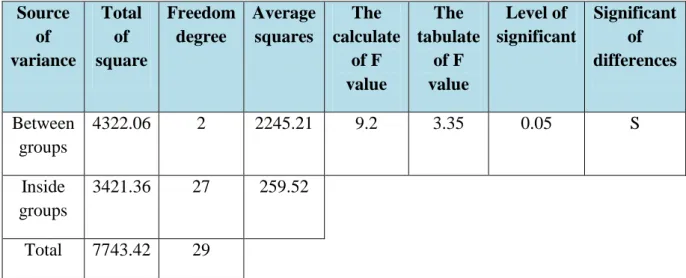
Whereas table (5) shows the differences between groups because F value is (9.22), it is larger than tabulate F value which is (3.35), this refer to variance in results of post 25 m test of freestyle swimming, to know which of groups are got the best of results and developed in freestyle swimming learning through the time that the student spend it to swim 25 m.
Groups Pre test Post-test The
relative of F value
The tabular of
F value
Significant
Mean Standard
deviation
Mean Standard
deviation
Concurrent 1.68 0.74 10.12 1.23 9.21 S
Final 1.74 0.54 15.7 1.27 11.07 2.26 S
23 Table (5)
Demonstrates results of F test of variance analysis between three groups for post-test for freestyle swimming of 25 m
Source of variance Total of square Freedom degree Average squares The calculate of F value The tabulate of F value Level of significant Significant of differences Between groups
4322.06 2 2245.21 9.2 3.35 0.05 S
Inside groups
3421.36 27 259.52
Total 7743.42 29
Table (6) shows that there is not a significances in results between control and concurrent groups, whereas shows in other results there is a significance different in favor of terminal group which used terminal feedback by computer and video and this refers to be the terminal feedback group is the best group in freestyle swimming learning.
Table (6)
Illustrates results of LSD test to know the less of significant different between three groups for 25 m in freestyle swimming
Groups Different
between means (degree)
Results of different
(degree)
LSD Significant
Control group
Concurrent group 6.8-10.12 3.32 No S
Control group
Terminal group 6.8-15.7 8.9 4.16 S
Concurrent group
Terminal group 10.12-15.7 5.58 S
24
The best results were for terminal experimental group which got the information by terminal feedback through computer and video show and follow of terminal group the concurrent group and then control group. The results of performance are shown exceed the terminal feedback group which used the computer especially baser 3D system and video to discover and corrective the errors after performance completion. The researchers promote that each type of used feedback in this study has impact to learning process, Singer confirmed that feedback is qualitative information about errors of performance which has correlation to the successful and failed of movement, it considers the main thing to determine the learning procedure (Singer and Robert 1980). The control group had a learning but the development was very little when compare with other two groups,
Terminal feedback showed to be more effect in learning of freestyle swimming skill than concurrent feedback because the learner was aware of the movement which explained and showed by teacher and then performance it and view it after completion of performance, the learner started to compare with his performance through photography.
Terminal feedback gives to the learner the chance to increase fast of learning because the development and using of computer provide to the learners full information about their performance, the best feedback shows methods of information given which are suitable and accurate to the learner (Dafer., 1990). As demonstrated from results, there is a significant difference between three groups in 25 m test and in favor of terminal feedback group and then concurrent group and control group, this refer to that the practice is not enough but must support with feedback (Singer and Robert., 1980).
4. Conclusion
The researchers concluded that feedback has positive effect in freestyle swimming learning generally, also found out that development was to the three groups but in varying degrees of learning, the researchers discovered that terminal feedback with computer using and video has huge impact to increase the level of freestyle swimming learning, in addition, using of the computer to promote the feedback play an important role in learning process and fast of performance, at the end, the terminal feedback group was best and more fast in freestyle swimming learning than concurrent and control group.
References
Abdul A. A., (1998).The importance of feedback in learning the children's motor skills, research publication, scientific conference at United Arab Emirates University, China, 320-335.
Dafer J. (1990).The effect of using different types of feedback to learn some basic skills in tennis, Unpublished Master Thesis, Faculty of Physical Education, University of Baghdad, 90-105.
Hussein. A. H., (1990). A proposed approach for the development of the most important physical attributes to effectively jump higher education, Unpublished Master Thesis, Faculty of Education, University of Babylon, 80-94.
25
Mohammad. H. A, & Mohamed N. R. (1988). Technical skills and psychological tests in the field of sports, Cairo, 136-151.
Noha H. (2000). The effect of concurrent feedback and to learn the terminal pool back Unpublished Master Thesis Faculty of Physical Education for Girls, Baghdad, 210-225. Schmidt. A. R. & Carig. A. W. (2000). Motor Learning and performance, Haman kinetics,
320-331.