Evolution of star clusters on eccentric orbits
Maxwell Xu Cai (
),
1,2ܠ
Mark Gieles,
3†
Douglas C. Heggie
4and Anna Lisa Varri
41National Astronomical Observatories of China, Chinese Academy of Sciences, 20A Datun Rd, Chaoyang District, Beijing 100012, P. R. China 2Kavli Institute for Astronomy and Astrophysics, Peking University, Yi He Yuan Lu 5, Haidian District, Beijing 100871, P. R. China
3Department of Physics, University of Surrey, Guildford GU2 7XH, UK
4School of Mathematics and Maxwell Institute for Mathematical Sciences, University of Edinburgh, Kings Buildings, Edinburgh EH9-3JZ, UK
Accepted 2015 October 5. Received 2015 September 29; in original form 2015 August 3
A B S T R A C T
We study the evolution of star clusters on circular and eccentric orbits using directN-body simulations. We model clusters with initiallyN=8k and 16k single stars of the same mass, orbiting around a point-mass galaxy. For each orbital eccentricity that we consider, we find the apogalactic radius at which the cluster has the same lifetime as the cluster with the sameN
on a circular orbit. We show that then, the evolution of bound particle number and half-mass radius is approximately independent of eccentricity. Secondly, when we scale our results to orbits with the same semimajor axis, we find that the lifetimes are, to first order, independent of eccentricity. When the results of Baumgardt and Makino for a singular isothermal halo are scaled in the same way, the lifetime is again independent of eccentricity to first order, suggesting that this result is independent of the galactic mass profile. From both sets of simulations, we empirically derive the higher order dependence of the lifetime on eccentricity. Our results serve as benchmark for theoretical studies of the escape rate from clusters on eccentric orbits. Finally, our results can be useful for generative models for cold streams and cluster evolution models that are confined to spherical symmetry and/or time-independent tides, such as Fokker–Planck models, Monte Carlo models, and (fast) semi-analytic models.
Key words: methods: numerical – galaxies: star clusters: general.
1 I N T R O D U C T I O N
The evolution of star clusters is driven by internal factors, such as two-body relaxation, stellar and binary evolution, and external factors such as the galactic tidal field (see e.g. Heggie & Hut2003). As a result, star clusters gradually dissolve and eventually lose all their stars to the galactic field.
The escape rate from clusters in a static tidal field, as applies to cluster on circular orbits in a time-independent external potential, has been topic of extensive theoretical (e.g. H´enon1961; King1966; Gieles, Heggie & Zhao2011) and numerical work (e.g. Chernoff & Weinberg1990; Oh & Lin1992). A consensus picture for the dependence of the dissolution time-scaleτdisson the properties of the cluster and its orbit has emerged.
When approximating the tidal limitation by a simple cut-off ra-dius, beyond which stars are considered unbound,τdissscales with the half-mass relaxation time-scaleτrhof the cluster, which itself depends on the number of stars in the clusterN, the crossing time of stars within the clusterτcrasτrh∝(N/log)τcr, where logis the Coulomb logarithm, which slowly varies withN. For Roche-filling
Also known as: Maxwell Tsai.
†E-mail:[email protected](MXC);[email protected](MG)
clusters on circular orbits in a scale-free galactic potential,τcr is a constant fraction of the period of the galactic orbit, hence for these clustersτcr∝−1(Lee & Ostriker1987), withthe angular frequency of the orbit.
If a tidal field is included, the escape of stars is delayed (Fukushige & Heggie2000), and this effect changes theNdependence ofτdiss to (Baumgardt2001)
τdiss(RG, =0)∝
N
log
3/4
−1. (1)
Here,is the orbital eccentricity andRGis the galactocentric radius, which for the circular orbit relates toas=Vcirc/RG, withVcirc the circular velocity atRG.
For compact clusters that underfill the Roche volume, the fraction of escapers perτrhis lower because the tides are weaker, and because
τrh itself is shorter, the fraction of escapers per unit of physical time is approximately independent of the half-mass radiusrhof the cluster and the result forτdiss of equation (1) is, therefore, almost independent of the initialrh(Gieles & Baumgardt2008).
due to a singular isothermal galactic halo. For eccentric orbits, they find that theNdependence inτdiss is the same as for the circular orbits, and they show thatτdiss can be expressed in terms of the scaling for the circular orbits as
τdiss(Ra=RG, )=τdiss(RG,0)(1−). (2)
Here Ra is the apogalactic radius of the orbit, which in BM03 was kept the same as the galactocentric radiusRGof the circular orbit.
Along an eccentric orbit, the tidal field strength varies and it is, therefore, often assumed that the evolution of clusters on eccentric orbits is determined by the perigalactic radiusRp, where the tidal field is strongest (King1962; Innanen, Harris & Webbink1983). This is indeed true for collisionless systems (Pe˜narrubia, Navarro & McConnachie2008), but it is not what follows from theBM03 result for collisional systems on eccentric orbits. Taken together, equations (1) and (2) suggest that the ‘effective radius’Reff
G, i.e. the radius of the circular orbit on which a cluster has the same lifetime as a cluster on the given elliptic orbit, is given byReff
G =
Rp(1+)=Ra(1−), i.e. the effective radius lies between Rp and Ra. The different dependence of τdiss on the external tides as compared to the collisionless case, suggests that the combined influence of two-body relaxation and the (time-dependent) tides, result in a different overall evolution of (globular) clusters than what is found for (collisionless) dwarf galaxies that get tidally stripped in the host potential (see also the discussion in Amorisco2015, on differences in the escape mechanisms in collisional and collisionless systems).
In this study, we want to establish whether it is possible to ap-proximate the evolution of a cluster on an eccentric orbit, by that of a cluster on a circular orbit. Whether possible, or not, the answer helps to identify the dominant mechanism that drives the escape from clusters on eccentric orbits. If possible, it would greatly sim-plify the treatment of eccentric orbits in dynamical models of cluster evolution that are limited to spherical symmetry/circular orbits and in (fast) semi-analytic models of clusters and cold tidal streams. Secondly, we aim to shed light on the scaling forτdiss(Ra,) for clusters on eccentric orbits.
We run a series of directN-body integrations of idealized systems, without the effect of stellar evolution, which can be scaled and compared to the result ofBM03. This paper is organized as follows: the details of theN-body experiments are described in Section 2. Our results are presented in Section 3 and our conclusions are presented in Section 4.
2 N- B O DY S I M U L AT I O N S
2.1 N-body integrator and units
For all simulations, we used theN-body code NBODY6, which is a fourth-order Hermite integrator with Ahmad & Cohen (1973) neighbour scheme (Makino & Aarseth1992; Aarseth1999,2003), with accelerated force calculation on NVIDIA Graphical Processing Units (GPUs; Nitadori & Aarseth2012). All our models are scaled to the conventional H´enonN-body units (H´enon1971), in which
G=M= −4E=1, whereGis the gravitational constant andM
andEare the total mass and energy of the cluster, respectively. Our models are initially in virial equilibrium, such that the gravitational energyW=2Eand the virial radiusrv= −GM2/(2W)=1.
2.2 Initial conditions
We model clusters with N = 8k and 16k point particles of the same mass, without primordial binaries, with initial positions and velocities sampled from a Plummer (1911) model, truncated at 10 scale radii.1For this model,r
h0.78rv. The galactic potential is that of a point mass and the differential forces due to the galaxy are added in a non-rotating frame that is initially centred on the centre of mass of the cluster.
We adopt this simplified set of initial conditions because (i) we want to focus on one single physical ingredient (i.e. the tidal field), explored within the simplest possible choice of galactic mass model, (ii) some of the key results of the paper are based on three different scaling of the simulations, which must therefore be performed in the absence of any factor imposing a physical scale (e.g. stellar evolution), (iii) we wish to provide some ‘empirical’ evidence of the process underlying the escape of stars from clusters on elliptic orbits, for which a proper theory is still lacking, therefore we decided to explore first very idealized models, and to increase the complexity of the systems under consideration only in a second phase of the investigation.
For eachN, we consider seven different orbital eccentricities:
=[0.0, 0.1, 0.2, 0.3, 0.4, 0.6, 0.8]. For the circular orbits, we choose an orbit such thatrh/rJ=0.1, whererJis the Jacobi radius, which for the point-mass galaxy and=0 depends onRGand the mass of the galaxyMGas
rJ=
M
3MG
1/3
RG. (3)
The initial conditions ofNBODY6need to be fed in physical units. We chooseMG= 1010M, rv= 1 pc and ¯m=M/N=1 M. The remaining parameter to choose isRG, which given the con-straint of the initial rh/rJ and equation (3) is RG = 7.86(3 × 10¹⁰/N)1/3pc, which isR
G=1211 pc(962 pc) for the circular orbit of the N = 8k(16k) cluster.2 All models started with the same
rh = 0.78 in N-body units. The physical units are only used in the input of the code, and they are not relevant for our re-sults and we report all our rere-sults in the internal N-body units (Section 2.1).
We defineτdissas the time when 10 per cent of the initial number of stars remains bound. We then need to define bound. For a cluster on a circular orbit, in a coordinate system centred on the cluster and corotating with the galactic orbit, bound is defined as having a Jacobi energy smaller than the critical energy of escape. For ec-centric orbits, there is no conserved integral of motion; hence, we need to find another way to separate bound from unbound stars. We consider a star as bound when the sum of its specific kinetic energy, computed from the velocities corrected for the centre-of-mass velocity, is less than its specific potential energy due to the
N−1 other stars, withNbeing determined iteratively until conver-gence (as in Renaud, Gieles & Boily2011).
For each value of we aim to find theRa that results in the sameτdissas for the circular orbit atRG, i.e.τdiss(Ra,)=τdiss(RG, 0). This is different from the approach ofBM03, who started all
1In principle, the Plummer model has no truncation radius; in practice, it is truncated at 10 scale radii inNBODY6.
Table 1. Apogalactic radiiRafor theN=8k and 16k simulations that result in the sameτdissas the circular model. The values ofRafor eachwere found by iteration, see the text in Section 2.2 for details.
N τdiss Ra()
0 0.1 0.2 0.3 0.4 0.6 0.8
8k 5060 1212 1362 1516 1798 2043 2934 4834
16k 8230 962 1081 1245 1420 1677 2502 4126
their eccentric orbits at the sameRa() = RG( =0), which re-sults in shorter lifetimes for the eccentric orbits. In Section 3, we scale results for comparison. Because we do not know the scal-ing ofRa(RG,) a priori for clusters with the samerh, we findRa by iteration: in the first attempt, we adopt the scaling of BM03 (equation 2) and run a model withRa=RG/(1−)2/3(note that the index of 2/3 is because for a point-mass galaxy∝RG−3/2). At this stage we could adapt the scalingτdiss(Ra)∝R−a3/2to find
Ra that results in the correct lifetime. However, scaling will not keep the initial half-mass radius fixed, which is our intention in this study, and we therefore proceed by finding the correctRa by iteration.
Ifτdiss of the first attempt is shorter (longer) than that of the circular orbits, we run an additional model with Ra 20 per cent larger (smaller). We continue this, until we have two models whose
τdiss(Ra, ) bracket the result for the circular orbit. We then ap-ply a linear interpolation to get the final Ra and run a model at that Ra. The final interpolated Ra values are summarized in Table1.
The corresponding initialrh/rJat apocentre for all models with different orbital eccentricitiesare shown in Fig.1, whererJwas computed using equation 7 in King (1962). For comparison, we present also the ratiorh/rJthe cluster would have if we would have started the evolution at pericentre. We also show the values forrh/rJ of theN=32k models ofBM03, which we will later compare our results against, using the King (1962) definition forrJ(note that the equation used byBM03is slightly different).
Figure 1. Initialrh/rJfor all models as a function of orbital eccentricities
. the values corresponding to the apocentre are connected with full lines; the values corresponding to the pericentre are connected with dashed lines. Results for theN=32k models ofBM03are also plotted in the same way for comparison.
3 R E S U LT S
3.1 Evolution ofNandrh: can the evolution on an eccentric orbit be compared to the evolution on a circular orbit?
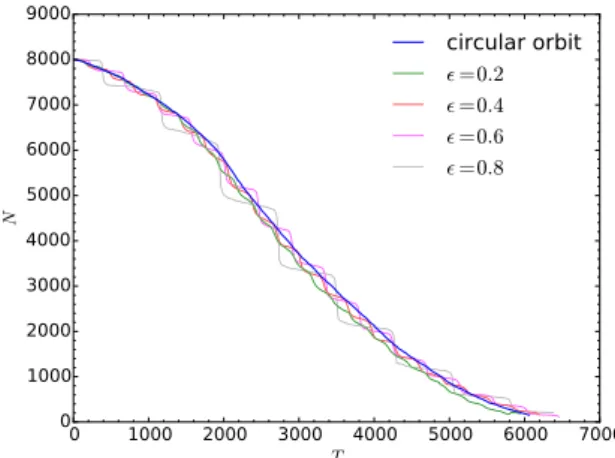
Figs2and3show the evolution of the boundNfor our models with differentand initialN=8k and 16k, respectively. TheN(T) curves of the models on eccentric orbits display a ‘staircase’ shape, with a frequency that corresponds to the orbital period. The amplitude of the ‘stairs’ depends on the number of particlesNand the orbital eccentricity. The steps correspond to pericentre, where stars are removed fastest, and the fractional number of escapers at each step is larger in the small-Nmodel because of two effects: (i) the lifetime of the small-Nmodel is smaller (Figs2and3), while (ii) the time between pericentre passages in the small-Nmodel (which can be inferred from the values ofRain Table1) is larger. Therefore, the number of pericentre passages is smaller in the small-Nmodel than in the corresponding large-Nmodel. The rapid mass loss during the pericentre passages implies that dissolution is almost bound to hap-pen around the pericentre, and for this reason the dissolution time of the high-eccentricity models is not really a continuous function of
. This is important to keep in mind for the forthcoming comparison of lifetimes for differentN.
We note that the removal of stars at pericentre does not imply that pericentre crossings are the sole mechanism that unbinds stars. For alternative definitions of bound, for example, being withinrJ, theN(T) curves display an oscillating behaviour, whereN(T) goes
Figure 2. Evolution of the number of bound stars for the 8k models with different orbital eccentricities.
up after a pericentre passage (see e.g. fig. 2 inBM03). This should also not be interpreted as mass gain of the cluster. Both the staircase pattern, and the oscillations, are artefacts of the definition of bound for clusters and illustrate that it is not possible to have a unique definition of the number of bound stars in a cluster on an eccentric orbit. However, the differences betweenN(T) for different defini-tions of bound are small and it is safe to interpret the general trend ofN(T) as the evolution of the number of stars in the cluster.
Comparing the overall shape of theN(T) curves of the different orbits, we see that there are similarities. Core collapse is reached at approximatelyT=0.3τdiss, after which the escape rate approx-imately doubles (Lamers, Baumgardt & Gieles2010). For equal-mass models without equal-mass-loss as the result of stellar evolution, the escape rate increases in the pre-collapse phase and this manifests in all curves as a convex curvature (a negative second derivative). After core collapse the escape rate goes as ˙N∝N1/4(equation 1, and Baumgardt2001), which manifests as a concave curveN(T) (positive second derivative, note that a constant ˙N would result in linearN(T) curves). The curvature in pre-collapse and post-collapse evolution is similar for models of different, though it may be com-plicated by the ‘steps’ caused by pericentre passages. This trend is not known to apply universally for all galactic tidal fields, but a discussion of the shapes ofN(t) curves is beyond the scope of this paper.
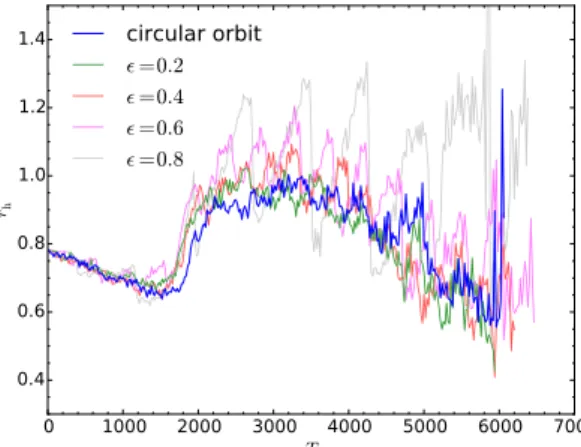
In Figs4and 5, we show the evolution ofrh(T) of the bound stars for theN=8k and 16k models, respectively. As for theN(T),
Figure 4. Half-mass radiusrhevolution of the 8k models with different and the sameτdiss.
Figure 5. Same as Fig.4but for 16k models.
there is general agreement in shape of therh(T) curves. All models start with the same initialrh 0.78, and until core collapse,rh shrinks as the result of escapers and the absence of a central energy source (Gieles et al.2014). During the gravothermal catastrophe,rh increases by about 50 per cent, after which it gradually decreases as
N1/3(H´enon1961). Similar to theN(T) curves, ther
h(T) curves also exhibit oscillation behaviour and the amplitudes depend on bothN
and. During pericentrerhdecreases sharply and then slowly grows until the next pericentre. We note that this behaviour depends on our definition of bound. For example,rhof all the stars withinrJ also oscillates, but has a maximum atRa.
We recognize similar overall behaviour ofrh(T) in all models, and combined with the similarity between theN(T) curves, we conclude that it is possible to describe the evolution of a cluster on an eccentric orbit, by the evolution of a clusters on a circular orbit with the same
τdiss.
3.2 Scaling ofτdiss(Ra,)
3.2.1 Results for constantτdiss
In Fig.6, we show the ratio ofRa() (Table1) overRa(0)=RGof the circular orbit, for allconsidered. For constantRa,τdissmust be a decreasing function of, and so for increasing,Ramust increase to keepτdissof the eccentric orbit the same as the circular orbit, and this is indeed what we find. The wayRa() increases with increasing
contains information about howτdissdepends on.
In a forthcoming study, Bar-Or et al. (in preparation) derive the dependence ofτdissonusing perturbation theory. They find that, to first order,τdissis independent offor orbits with the same semi-major axisa(Bar-Or, private communication). To test this result we plot a lineRa()=Ra(0)(1+), corresponding to orbits with the samea, becauseRa() =a(1+ ) and for the circular orbit
RG=a. We see that this relation follows the results of our simula-tions for0.3 quite well, independently ofN, and confirming the first order result of Bar-Or et al. (in preparation). But we also con-sider eccentricities that are much higher than the regime to which the perturbation theory applies. These empirical results thus serve to quantify the higher order dependence ofτdiss(a,) on, which is the topic of the next sections.
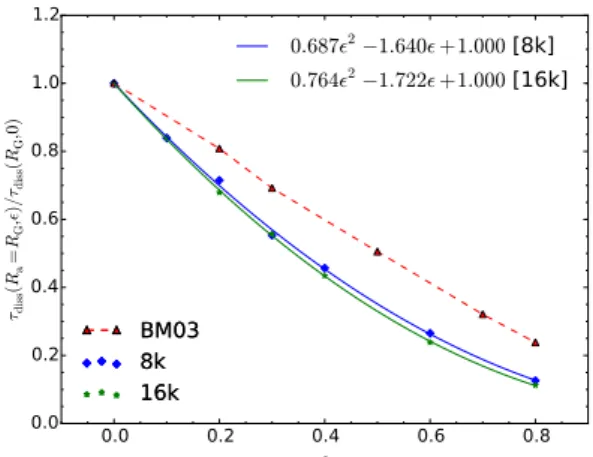
Figure 7. Dissolution times for all models scaled to the sameRa, normalized toτdissof the circular orbit. Solid lines denote polynomial fits to the data (for details, see Section 3.2.2). Also shown are the results for theN=32k models ofBM03.
3.2.2 Results scaled to constant Ra
We first want to directly compare our results to the scaling for
τdiss(Ra,) reported byBM03(equation 2). To make the comparison, we need to scale our results such that all our models have the same
Ra. We, therefore, need to multiply all our galactic radii by a scale factor R∗ = Ra(0)/Ra(). Because for the point-mass galaxy the radial scale of the cluster is proportional to the galactic radial scale (equation 3), the scale factor for the cluster’s length scale isr∗= R∗and the scale factor for time can be related to the galactic scale factor ast∗=R3/2
∗ . In Fig.7, we show the results forτdissscaled to the sameRa, combined with the results ofBM03. Thedependence seems to be stronger in our models, which is suggestive that the mass profile of the galaxy is important in settingτdiss().
However, the difference can be understood (at least for small) by adopting the hypothesis thatτdissis independent offor fixed
a=RG, as in Section 3.2.1, i.e. thatτdiss(Ra =RG(1+),) =
τdiss(RG, 0). Sincet∗=R3∗/2for the point-mass galaxy, we deduce
thatτdiss(Ra=RG,)=τdiss(RG, 0)/(1+)3/2τdiss(RG, 0)(1− 1.5). For the singular isothermal model ofBM03, however,t∗= R∗, and so the corresponding result isτdiss(Ra=RG,)τdiss(RG, 0)(1−). Our hypothesis therefore explains why the dependence onin Fig.7is steeper for our models than inBM03, for small, and unifies the results of the two studies in this regime.
Fig.7also gives second-order polynomial fits3 to our results, and the foregoing argument approximately explains the first-order coefficient of in these fits. BM03 themselves showed that the factor 1− gave a satisfactory fit to their models for the entire range of. By reversing the above argument we easily see that this result is consistent with a hypothesis thatτdiss(Ra=RG(1+),) =τdiss(RG, 0)(1−2), which we discuss further in the next section, where we scale all results to orbits with the samea.
3.2.3 Results scaled to constant semimajor axis a
To be able to compare all results to the theoretical prediction by Bar-Or et al. (in preparation), we present all results scaled to orbits
3It could be argued that the lifetime should be zero for =1, and the quadratic fits provided in Fig.7are inconsistent with this, but those in Fig.8 accommodate this idea. On the other hand, the lifetime of the model can hardly be less than the time taken to reach perigalacticon.
Figure 8. Dissolution timeτdissfor different, normalized to the result for the circular orbit, for the models discussed in this paper andBM03(32k models). All results have been scaled to orbits with the same semimajor axis a. Simple even polynomial functions, up to fourth order in, are shown for comparison (for details, see Section 3.2.3).
with the samea. We note that the results of this exercise for the BM03 models should be interpreted with caution, because their models include the effect of stellar evolution, which imposes a fixed physical time-scale. Bearing this word of caution in mind, we scale the galactic orbits withR∗=(1+)Ra(0)/Ra(). The radial scale factor of the cluster itself is dependent on the mass profile: for the point-mass galaxyr∗=R∗as before, while for the singular isothermal halor∗=R2/3
∗ . The scale factors for time for the two
galaxy mass models are related toR∗ast∗=R3/2
∗ and t∗ =R∗,
respectively.
In Fig. 8, we present the results of all models, scaled to the sameaand normalized to the circular orbit. We note that Webb et al. (2014) studied eccentric orbits with directN-body models with similar properties asBM03, and they compared a model with high eccentricity ( = 0.9) to a model on a circular orbit with approximately the same lifetime. Applying the same scaling to their values ofRawe find that their=0.9 data point would extend the trend of theBM03scaling. Our results are slightly below the results ofBM03. It is tempting to explain this offset to the difference in galactic mass model: the point-mass model has stronger tidal forces at peri-centre and, therefore, one way of interpreting the difference in Fig.8is that clusters on eccentric orbits dissolve faster in such haloes.
However, the small difference can perhaps also be explained by differences in how the clusters were setup relative to the tides and the differences in treatment of stellar evolution.BM03 consider King models with Roche-filling initial conditions for the models on circular orbits, which means that the truncation radius of the King model equalsrJ. For their models on circular orbits the initial ratio
rh/rJ0.19 (Fig.1), which is somewhat larger than what is adopted here (rh/rJ=0.1).
In addition, their models consider stellar evolution mass loss, and for the clusters on circular orbits, a fraction of the stars is pushed over the tidal boundary as the result of the expansion due to stellar mass loss (Lamers et al.2010), shortening the lifetimes of the models on circular orbits by a mechanism that is not included in our models (for a discussion on the sensitivity of the Roche-filling models ofBM03to stellar mass-loss, see Contenta, Varri & Heggie 2015).
rJis time dependent, but motivated by our earlier finding, we can definerJfor the eccentric orbit as the Jacobi radius of an identical cluster on a circular orbit with the sameτdiss. Using that definition, theBM03models initially haverh/rJ∝(1+)−2/3, whereas in our modelsrh/rJ =0.1, for all. Therefore, theBM03 models with highare more compact with respect to the tides than our models, which could result in slightly largerτdiss compared to our models at the same. We are therefore cautious with interpreting the small difference between theBM03 results, and ours, as being due to difference in galactic mass profile.
In order to quantify the higher order dependence ofτdisson, we plot two simple functions in Fig.8. The functional formy=1−2 is motivated by the results ofBM03, because this relation is what follows when scaling the result reported byBM03(equation 2) to orbits with constanta(Section 3.2.2). As expected, this relation describes theBM03results very well. However, it overpredictsτdiss of our models, with a maximum difference of about 20 per cent at
=0.6.
Motivated by our empirical findings, and the theoretical work of Bar-Or et al. (in preparation), we speculatively propose a charac-terization of the higher order dependence ofτdisson, on the basis of a simple symmetry argument. Indeed, it can be argued that the quantityτdiss(a,)/τdiss(a, 0) should naturally be an even function of, which implies that, in a series expansion in, the odd terms of any order must vanish. This expectation on the parity of the function follows if we assume that the lifetime is independent of the initial phase on the galactic orbit, as reversing the sign ofsimply corre-sponds to starting at perigalacticon instead of (as in our models) at apogalacticon. We therefore consider an even, polynomial function such thaty()=0 for=1:y(x)=(1−2)(1+(c+1)2), in which the constant term is imposed to be 1 by virtue of the chosen normalizationτdiss(a,)/τdiss(a, 0). We have then determined the best-fitting value of the free coefficientcfor the two sets of models withN=8k and 16k, as depicted in Fig.8.
In consideration of the simplicity of our argument, based on a reasonable but unproven assumption, we encourage the reader to accept the values resulting from the fitting process only for empirical guidance, as the full perturbation analysis of the escape problem, which is needed to constrain analytically the coefficientc, is beyond the scope of this article (see Bar-Or et al., in preparation).
In addition, given the relatively lowNof our models compared to theBM03simulations, and other differences in the initial con-ditions between the two sets of models (see the discussion above on differences in the initialrh/rJ), we are cautious with concluding that these different scalings as being due to the different galactic mass models.
These results serve as benchmarks for future theoretical work on the dissolution of clusters on eccentric orbits in different galactic potentials.
4 C O N C L U S I O N S
We model star clusters on circular and eccentric orbits with direct
N-body simulations in order to gain insight in the evolution of cluster properties at different eccentricities, and the scaling relations for the dissolution time-scale (τdiss) as a function of. We deploy direct
N-body simulations to model idealized systems ofN=8k and 16k stars of the same mass, on orbits around a point-mass galaxy. For the models on eccentric orbits, we iteratively find the apogalactic radiusRaon which the clusterτdissis the same as for the circular orbit.
When scaling our results to orbits with the same semi-major axis
a, we find thatτdissis, to first order, independent of. We show that this scaling agrees with results presented byBM03, who modelled clusters with a mass spectrum and the effects of stellar mass loss in singular isothermal galactic haloes. Their results suggest slightly longerτdiss at higherthan found here, which can be explained by differences in the initialrhwith respect to the tidal truncation. Alternatively, there may be a dependence on galactic mass profile, in the sense thatτdissis more sensitive toin the case of point-mass galaxies. This explanation has theoretical support, because the heat-ing at perigalactic passages in a point-mass model is more severe than in the extended singular isothermal model (Gnedin, Hernquist & Ostriker 1999). Because of the many differences between our models and theBM03we are cautious with interpreting the small difference between our results andBM03in either direction.
Finally, we quantify the higher order dependence ofτdiss(a,) on . A relation of the form τdiss(a, ) = f()τdiss(a, 0), with
f() =1− 2 describes the results of BM03very well. For the models presented here, a functional form off()=(1−2)(1−
c2), withc0.5, is more accurate. These data serve as benchmark for future theoretical work on the dissolution of clusters on eccentric orbits.
We find that clusters with the same initialN, rhand τdiss, but different, have similar evolution of the number of bound stars and half-mass radiusrh. This implies that we can approximate the evo-lution of properties of clusters on eccentric orbits by that of clusters on circular orbits. This is useful for modelling techniques that are not able to include orbital eccentricity, such as the Fokker–Planck method, or the Monte Carlo method and/or time-dependent galactic tides. For example, Heggie & Giersz (2008) present Monte Carlo models of the galactic globular cluster M4, which is on an eccentric orbit. The authors model M4 on a circular orbit, with approximately the sameτdissas M4 has on its eccentric orbit. Our results confirm that this approach is valid and results in a representative evolution ofNandrhin these models. Another application of our result can be found in semi-analytic models of cluster evolution (e.g. Gnedin, Ostriker & Tremaine2014). The fast cluster evolution code Evolve Me A Cluster of StarS (EMACSS; Alexander & Gieles2012; Gieles et al.2014; Alexander et al.2014) solves a set of coupled differ-ential equations for the rate of change ofrh,rJandN. The method requires an expression for ˙N that depends on the tidal field. The results in this study can be used to include orbital eccentricity in EMACSSby using the functional form forτdiss(a,) to includein the ˙Nterm.
Finally, several models for generating tidal tails of globular clus-ters have recently been developed (K¨upper, Lane & Heggie2012; Bovy 2014; Amorisco 2015). These models require as input an escape rate of stars from the cluster. Our analytic expression for
τdiss(a,) can be used to obtain expressions for the average escape rate from clusters on eccentric orbits.
AC K N OW L E D G E M E N T S
of Sciences Grant Number 2009S1-5, and through the ‘Thousand Talents’ (Qianren) programme of China (R. Spurzem). MG ac-knowledges financial support from the Royal Society (University Research Fellowship) and the European Research Council (ERC-StG-335936, CLUSTERS), and ALV from the Royal Commission for the Exhibition of 1851. All authors are grateful to Keigo Nitadori and Sverre Aarseth for makingNBODY6and its GPU-enabled version publicly available and to Dave Munro of the University of Surrey for his support of the GPU cluster at the University of Surrey.
R E F E R E N C E S
Aarseth S. J., 1999, PASP, 111, 1333
Aarseth S. J., 2003, Gravitational N-Body Simulations. Cambridge Univ. Press, Cambridge
Ahmad A., Cohen L., 1973, J. Comput. Phys., 12, 389 Alexander P. E. R., Gieles M., 2012, MNRAS, 422, 3415
Alexander P. E. R., Gieles M., Lamers H. J. G. L. M., Baumgardt H., 2014, MNRAS, 442, 1265
Amorisco N. C., 2015, MNRAS, 450, 575 Baumgardt H., 2001, MNRAS, 325, 1323
Baumgardt H., Makino J., 2003, MNRAS, 340, 227 (BM03) Bovy J., 2014, ApJ, 795, 95
Chernoff D. F., Weinberg M. D., 1990, ApJ, 351, 121
Contenta F., Varri A. L., Heggie D. C., 2015, MNRAS, 449, L100 Fukushige T., Heggie D. C., 2000, MNRAS, 318, 753
Gieles M., Baumgardt H., 2008, MNRAS, 389, L28 Gieles M., Heggie D. C., Zhao H., 2011, MNRAS, 413, 2509
Gieles M., Alexander P. E. R., Lamers H. J. G. L. M., Baumgardt H., 2014, MNRAS, 437, 916
Gnedin O. Y., Hernquist L., Ostriker J. P., 1999, ApJ, 514, 109 Gnedin O. Y., Ostriker J. P., Tremaine S., 2014, ApJ, 785, 71 Heggie D. C., Giersz M., 2008, MNRAS, 389, 1858
Heggie D., Hut P., 2003, eds, The Gravitational Million-Body Problem: A Multidisciplinary Approach to Star Cluster Dynamics. Cambridge Univ. Press, Cambridge, p. 372
H´enon M., 1961, Ann. Astrophys., 24, 369 H´enon M. H., 1971, Ap&SS, 14, 151
Innanen K. A., Harris W. E., Webbink R. F., 1983, AJ, 88, 338 King I., 1962, AJ, 67, 471
King I. R., 1966, AJ, 71, 64
K¨upper A. H. W., Kroupa P., Baumgardt H., Heggie D. C., 2010, MNRAS, 407, 2241
K¨upper A. H. W., Lane R. R., Heggie D. C., 2012, MNRAS, 420, 2700 Lamers H. J. G. L. M., Baumgardt H., Gieles M., 2010, MNRAS, 409, 305 Lee H. M., Ostriker J. P., 1987, ApJ, 322, 123
Makino J., Aarseth S. J., 1992, PASJ, 44, 141 Nitadori K., Aarseth S. J., 2012, MNRAS, 424, 545 Oh K. S., Lin D. N. C., 1992, ApJ, 386, 519
Pe˜narrubia J., Navarro J. F., McConnachie A. W., 2008, ApJ, 673, 226 Plummer H. C., 1911, MNRAS, 71, 460
Renaud F., Gieles M., Boily C. M., 2011, MNRAS, 418, 759
Webb J. J., Leigh N., Sills A., Harris W. E., Hurley J. R., 2014, MNRAS, 442, 1569