Child Discipline
in Times of Conflict
Michael Malcolm
1, Vidya Diwakar
2,
and George Naufal
3Abstract
Using a unique pairing of household survey data and geolocational conflict data, we investigate the relationship between conflict intensity and the disciplinary methods employed by Iraqi households. We find that parents in high-conflict areas are more likely to use moderate and severe corporal punishment and are less likely to use constructive parenting techniques like redirection. A corresponding difference-in-differences analysis confirms the nature of this association. While there is a general sense that war has profound long-term impacts on the psychological health of children, research on transmission mechanisms remains limited. Given the per-sistence of early childhood outcomes into adulthood, these results are potentially an important piece of assessing and mitigating the long-term costs of war on civilian populations.
Keywords
Iraq war, child discipline, mental health, Middle East, household interactions
The Iraq war has imposed large costs on the Iraqi population. For example, Stiglitz and Bilmes (2008) note that Iraqi gross domestic product basically flatlined in the years following the second Gulf War, despite a more than 100 percent increase in the
1
Department of Economics and Finance, West Chester University, PA, USA
2
Chronic Poverty Advisory Network, Overseas Development Institute, London, UK
3
Public Policy Research Institute, Texas A&M University, College Station, TX, USA
Corresponding Author:
Michael Malcolm, Department of Economics and Finance, West Chester University, 700 S High St., West Chester, PA 19382, USA.
Email: [email protected]
Journal of Conflict Resolution 2020, Vol. 64(6) 1070-1094
price of oil. The human cost has also been large. As of May 2019, the Iraq Body Count (IBC) database has recorded at least 183,535 civilian deaths related to vio-lence during and after the war (IBC 2019).
The impact of war-related violence on households can be devastating. War leads to long-term reductions in income and economic growth, in addition to permanent increases in risk for both physical and mental health–related disorders (Blattman and Miguel 2010; Levy and Sidel 2008). These stresses can spill over to the way in which families interact, and there is a small but growing literature on the effects of war on family violence (Saile et al. 2014; Sriskandarajah, Neuner, and Catani 2015b). In this article, we use data from Iraq to study the relationship between conflict intensity and the disciplinary practices employed by Iraqi households.
The limited data that are available suggest that child maltreatment in Iraq is serious. A 2013 report issued by Iraq’s Ministry of Labor and Social Affairs claims that as many as five of six children in Iraq are exposed to domestic violence in some form and notes serious inadequacies in the legal infrastructure for addressing domes-tic violence (Al Monitor 2013). Similarly, United Nations (UN) reporting shows that Iraqi children suffer from high levels of domestic violence but that lack of good data makes the extent of the problem “difficult to ascertain” (Office of the High Com-missioner for Human Rights 2011). Findings are similar for other countries in the region, including 92 percent support for corporal punishment of children among Syrian parents and a 46 percent incidence rate of harsh physical discipline among Egyptian parents (Akmatov 2010; Runyan et al. 2010). Work that exists on child maltreatment in the context of conflict in other areas of the world also suggests that the problem can be serious. Catani, Schauer, and Neuner (2008) documented high levels of child maltreatment during conflict periods in Afghanistan and Sri Lanka but commented at that time that analyzing the impact of war was difficult because of a lack of comparable pre- and post-conflict data. More recently, a number of studies employ interviews with war-affected parents and children to conclude that exposure to war and to other forms of mass trauma is a predictor of violent parenting practices. For example, Saile et al. (2014) reached this finding using data from Uganda and Sriskandarajah, Neuner, and Catani (2015b) for Sri Lanka. There also appears to be a link between war and intimate partner violence (Clark et al. 2010; Haj-Yahia and Clark 2013).
for policy makers as they attempt to address the long-term costs of this continuing conflict (Kesternich et al. 2014).
The article proceeds as follows. The related literature section reviews existing literature that connects war-related violence and household violence, identifying our contribution. The section on transmission mechanisms explores the underlying cau-sal links between the two. The data and Methods section discusses data and methods, and the results follow. The paper concludes with a discussion of the results and brief closing remarks.
Related Literature
A number of studies document prolonged and harmful impacts on children from exposure to war violence, with researchers often suggesting that impaired parenting and relationships with caregivers may underlie these effects at least in part (Al-Sabah et al. 2015; Betancourt et al. 2012). There is also an extensive literature on the co-occurrence of post-traumatic stress disorder (PTSD) and child abuse (Black, Heyman, and Smith Slep 2001; Catani 2010). However, work that directly connects conflict exposure with violent parenting remains limited. Haj-Yahia and Abdo-Kaloti (2003) find that experiences of parental aggression among Palestinian ado-lescents are correlated with the family’s exposure to political violence. Usta and Farver (2010) find an increase in child sexual abuse during the 2006 war in Lebanon and Catani, Schauer, and Neuner (2008) document extensive domestic violence against children in the context of wars in Sri Lanka and Afghanistan, although these papers lack empirical analysis of the association between the two. Catani (2010) speculates on deep etiological links between child abuse and war trauma but noted a paucity of empirical work that existed at that time. More recently, Saile et al. (2014) and Sriskandarajah, Neuner, and Catani (2015b) find, in Uganda and Sri Lanka, respectively, that exposure to mass trauma is a significant predictor of family vio-lence against children. The former finds that exposure to war viovio-lence among female caretakers is associated with higher rates of child maltreatment; the latter finds that exposure to traumatic events, including war violence and the 2004 tsunami, among both mothers and fathers, is associated with higher rates of child-reported maltreat-ment. Timshel, Montgomery, and Thorup Dalgaard (2017) review existing literature on child abuse among refugee families and identify premigration trauma as an important risk factor.
potentially unique mental health profile associated with the co-occurrence of polit-ical violence and intimate partner violence. It is worth noting that, while these studies focus on spousal violence, there is a direct link to child welfare, both because exposure to spousal violence is itself commonly regarded to be a form of child abuse and additionally because of the strong correlation between spousal maltreatment and child maltreatment (Ali and Khuwaja 2014; Appel and Holden 1998). Moreover, Dubow et al. (2012) find that, among Palestinian and Israeli children, the impact of exposure to both domestic and war-related violence on the mental health of children is cumulative and progressive—in other words, compounding household violence on top of political violence intensifies the PTSD-like symptoms that many exposed children suffer from.
Our article adopts this same general approach of using survey data to explore the link between domestic violence and exposure to conflict. Like Saile et al. (2014) and Sriskandarajah, Neuner, and Catani (2015b), we also study a wide range of parenting practices—not just unequivocal child abuse—to offer a more complete picture into the impact of war on typical households. Overall, our work complements the bur-geoning literature on the long-term consequences of war for the health and produc-tivity of civilian populations, especially for war-exposed children. Again, while there is a general understanding that these effects can be very serious, our under-standing of the underlying causal mechanisms remains limited. However, there is a growing consensus that a link between war violence and household violence may be an important component of this landscape.
Transmission Mechanisms
In this section, we document a number of mechanisms through which war violence can lead to household violence and to deleterious changes to parenting in particular. We will then briefly explore the implications for child well-being.
harmful for the mental health of adults. In turn, the link between psychopathologies among parents, especially PTSD-like symptoms, and maltreatment of children is well established: Parents with these disorders appear to be at elevated risk of abusing their children (Black, Heyman, and Smith Slep 2001; Stith et al. 2009). Gewirtz et al. (2010), for conflict-exposed refugee mothers in the Netherlands, and van Ee, Kle-ber, and Mooren (2012), for US veterans returning from Iraq, identify specific negative parenting behaviors associated with post-trauma stress, including hostile interactions, inconsistent discipline, and low levels of parent–child involvement. Samper et al. (2004) report lower levels of parental satisfaction among PTSD-affected Vietnam veterans. For deep causal channels that underlie this link, Gar-barino and Kostelny (1996) argue that punitive parenting can be a way of adapting to external dangers, while Ajdukovic (1996) argues that conflict-related stress inhibits maternal affection. Other researchers emphasize the “numbing” effect of PTSD (Ruscio et al. 2002). Finally, alcohol abuse appears to be an important mediating factor (Ertl et al. 2016).
Third, a recent strain of literature explores the possibility that psychopathologies among war-affectedchildrencan mediate the relationship between trauma and child maltreatment, as children with mental health issues may be at higher risk for mal-treatment (Catani 2018). Saile et al. (2016) find that exposure to trauma predicts psychopathological symptoms among children, mediated in part by elevated family violence. Sriskandarajah, Neuner, and Catani (2015a) find conversely that, while exposure to mass trauma is associated with child mental health problems, good parental care can alleviate attendant behavior problems.
Fourth, war can devastate labor markets and drain family income and assets, leading to impoverishment. Barber (2008) emphasizes that these economic tensions disrupt caregiving and familial relationships, again inhibiting constructive parenting practices, and notes that effects can persist well after the cessation of violent con-flict. Akmatov (2010) finds generally that, across multiple countries and cultures, reductions in income are associated with higher rates of child maltreatment. Whether low income itself is a direct causative factor for abuse or whether the association between income and child maltreatment operates via stress associated with low income is a hotly debated question (Mayer 1997), but the existence of a correlation is uncontroversial. Levy and Sidel (2008) argue that loss of housing is especially destructive to economic security, and there are still more than 2.6 million displaced Iraqis (UN n.d.).
“numerous loopholes and defects in Iraqi laws” that are designed to protect children from abuse and found that applying civil law in the context of traditional power structures is especially problematic (Al Monitor 2013). In other words, informal enforcement among family or community units is important for reducing child abuse, but war and dislocations can disrupt these ties.
Sixth, war leads to parental absences—either because of death or because of dislocations. For example, a parent might leave to seek work elsewhere because of a depressed economy. Rentz et al. (2007) find using US data on Iraq war veterans that their absences are associated with increases in child abuse. This includes both abuse perpetrated by PTSD-inflicted veterans upon returning home and abuse by nonmilitary family while the deployed parent was absent. Dekel and Goldblatt (2008) emphasize the mediating effect of stress imposed on the entire family unit, particularly on the nonmilitary parent.
As to the impact of unhealthy parenting on children, the effects of child maltreat-ment are long-lasting and multifaceted. They include an elevated risk of suicide, risky behavior, alcoholism, a variety of mental disorders, and even physical prob-lems like heart disease, cancer, and bone fractures (Norman et al. 2012; Felitti et al. 2019). There are also sharp economic costs for abused children, with lower levels of education, income, and employment well into adulthood (Currie and Widom 2010). Our study does consider a wide range of parenting behaviors and, while we will not explore this assertion in detail, there appears to be near-consensus among child psychologists that any corporal punishment is harmful for child development (Straus 2001). All of these are important considerations for policy makers, as they suggest that war-related child maltreatment can affect the health and productivity of affected populations for decades into the future.2In particular, while other researchers such as Al-Sabah et al. (2015) document extensive long-term consequences of war on affected children, research on the causal channels underlying this association remains limited. Our results contribute to a small body of literature suggesting that disruptions to healthy parenting practices may represent an important part of war’s impact on children.
Data and Methods
Sample
households, respectively. The response rates for the two survey waves are 98.6 percent and 99.5 percent, respectively.
Each sampled household was asked to list all children between two and fourteen years of age. For households with eligible children, one child was chosen at random by the survey administrator, and this child is the subject of the child discipline questions. Our sample ultimately consists of 13,003 children from the 2006 survey wave and 27,919 children from the 2011 survey wave.
Variables
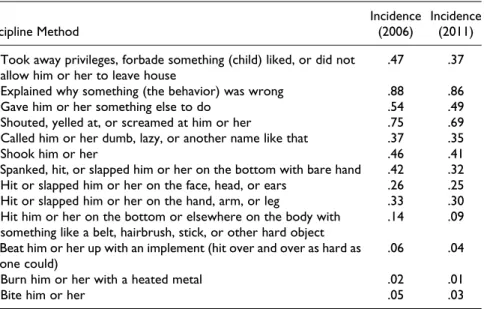
Dependent variables.Our outcome variables take advantage of a number of questions asked of the mother or the primary caretaker of the children in our sample. The survey lists a series of thirteen disciplinary methods and asks respondents whether “you or anyone else in your household has used this method with (child) in the past month.” Table 1 provides the exact language (in translation from the Arabic) and the overall incidence rates from the 2006 and 2011 survey waves.
The Conflict Tactics Scale (CTS) was developed by Straus et al. (1998) for grading child disciplinary practices and was employed by Saile et al. (2014) and Sriskandarajah, Neuner, and Catani (2015b) in their studies of conflict and child discipline. The MICS survey does not provide sufficient information to fully imple-ment the CTS, but we group several disciplinary practices together to develop metrics along similar lines. Specifically, we operationalize our analysis of disciplin-ary methods by defining four bindisciplin-ary outcome variables as follows:
Table 1.Incidence of Discipline Methods.
Discipline Method
Incidence (2006)
Incidence (2011)
1. Took away privileges, forbade something (child) liked, or did not allow him or her to leave house
.47 .37
2. Explained why something (the behavior) was wrong .88 .86 3. Gave him or her something else to do .54 .49 4. Shouted, yelled at, or screamed at him or her .75 .69 5. Called him or her dumb, lazy, or another name like that .37 .35
6. Shook him or her .46 .41
7. Spanked, hit, or slapped him or her on the bottom with bare hand .42 .32 8. Hit or slapped him or her on the face, head, or ears .26 .25 9. Hit or slapped him or her on the hand, arm, or leg .33 .30 10. Hit him or her on the bottom or elsewhere on the body with
something like a belt, hairbrush, stick, or other hard object
.14 .09
11. Beat him or her up with an implement (hit over and over as hard as one could)
.06 .04
12. Burn him or her with a heated metal .02 .01
1. Only constructive discipline used—equal to 1 if household usesonly restric-tion of privileges, verbal explanarestric-tion, and/or redirecrestric-tion (lines 1–3 on Table 1).
2. High-intensity verbal discipline used—equal to 1 if household uses yelling and/or calling names (lines 4–5 on Table 1).
3. Low-intensity physical discipline used—equal to 1 if household uses any of the following: shaking, spanking on bottom with bare hand, slapping on face, slapping on hand or leg (lines 6–9 on Table 1).
4. High-intensity physical discipline used—equal to 1 if household uses any of the following: hitting with an object, beating with an implement, burning, or biting (lines 10–13 on Table 1).
Independent variables.Our primary explanatory variable of interest is a measure of the level of conflict in the governorate in which the respondent lives. Specifically, for each observation in our sample, MICS records the governorate in which the child lives. The IBC database, in turn, maintains time-stamped records of conflict-related civilian deaths that have occurred in Iraq since 2003 and identifies each death by governorate. We merged the two data sets to construct, for each household in our sample, a measure of conflict-related casualties in the governorate in which the household resides. Specifically, we use the rate of civilian war-related casualties per 1,000 persons, lagged by one year, as our proxy for conflict intensity.3Importantly for our analysis, there was substantial variation in conflict intensity across governor-ates in the period under study. For example, in the Kurdish Dohuk region, there was only one conflict-related casualty in 2006, while in Baghdad, there were almost 18,000 (2.61 per thousand people). As for using casualty rates as a proxy for conflict intensity, generally, this is common in quantitative studies of international conflict (e.g., Looney 2006; Berman, Shapiro, and Felter 2011, both dealing with Iraq). One reason is availability of consistent data. Fox and Sandler (2014) argue that the level of violence is the best measure of the impact of conflict on the civilian population and that the number of deaths is a good proxy for the intensity of violence.
We use a number of other independent variables from MICS to study the deter-minants of family disciplinary methods: the child’s sex and age, the head of house-hold’s sex and educational attainment (whether he or she finished primary and secondary school), the primary caretaker’s age and educational attainment, and whether the domicile is in an urban area. These are standard kinds of controls for research on determinants of parental corporal punishment (see, e.g., Straus and Stewart 1999). The family’s economic status is also an important covariate, but unfortunately, only the 2011 survey collects data on household wealth (an indicator by quintile). Specific to this setting, we also used dummy variables for whether the respondent lives in a majority Sunni, Shia, or Kurdish governorate to control for unobserved cultural and religious differences across Iraq’s main regions.4
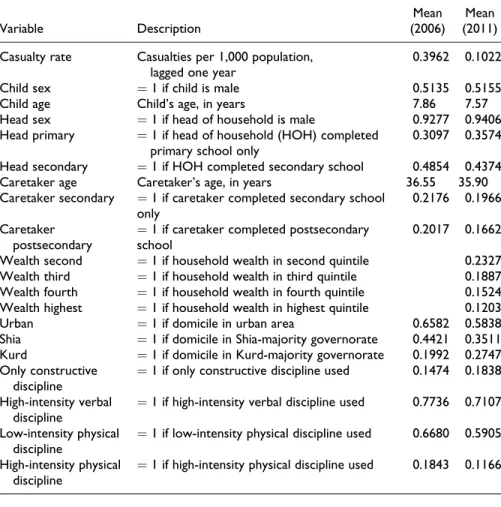
statistics both for the 2006 and 2011 subsamples. The data are reasonably represen-tative, with approximately equal numbers of boys and girls, split about evenly among Sunni, Shia, and Kurdish areas. The sample also spans the whole wealth distribution, and with considerable variation in education levels, both of the head of household and of primary caretakers.
Statistical Procedures
Probit model.Throughout, we use probit regressions to study the determinants of our binary dependent variables reflecting child discipline. In the probit model, the prob-ability that an outcomeYis equal to one is:
Table 2.Variable Definitions and Summary Statistics.
Variable Description
Mean (2006)
Mean (2011)
Casualty rate Casualties per 1,000 population, lagged one year
0.3962 0.1022
Child sex ¼1 if child is male 0.5135 0.5155
Child age Child’s age, in years 7.86 7.57
Head sex ¼1 if head of household is male 0.9277 0.9406 Head primary ¼1 if head of household (HOH) completed
primary school only
0.3097 0.3574
Head secondary ¼1 if HOH completed secondary school 0.4854 0.4374 Caretaker age Caretaker’s age, in years 36.55 35.90 Caretaker secondary ¼1 if caretaker completed secondary school
only
0.2176 0.1966
Caretaker postsecondary
¼1 if caretaker completed postsecondary school
0.2017 0.1662
Wealth second ¼1 if household wealth in second quintile 0.2327 Wealth third ¼1 if household wealth in third quintile 0.1887 Wealth fourth ¼1 if household wealth in fourth quintile 0.1524 Wealth highest ¼1 if household wealth in highest quintile 0.1203 Urban ¼1 if domicile in urban area 0.6582 0.5838 Shia ¼1 if domicile in Shia-majority governorate 0.4421 0.3511 Kurd ¼1 if domicile in Kurd-majority governorate 0.1992 0.2747 Only constructive
discipline
¼1 if only constructive discipline used 0.1474 0.1838
High-intensity verbal discipline
¼1 if high-intensity verbal discipline used 0.7736 0.7107
Low-intensity physical discipline
¼1 if low-intensity physical discipline used 0.6680 0.5905
High-intensity physical discipline
PrðYi¼1Þ ¼F b½ 0þb1Ciþb2Xiþui:
Here,Yiis the respective disciplinary outcome for childi.Ciis our measure of conflict intensity experienced by the household in which childiresides, andXiis the vector of household and child controls outlined in the Independent variables sub-section.F½ is the cumulative distribution function of the standard normal distribu-tion, which is the linking function for the probit model, designed to ensure that probability estimates fall in the 0½ ;1interval. We implement this probit regression for all four disciplinary outcome variables described in the Dependent variables subsection. All statistical analysis was done in Stata v. 14.
Because the model is nonlinear, the coefficientb1does not have a simple inter-pretation as a marginal effect. Thus, we also report calculated marginal effects for the variable of interest, which give the impact on the probability that the respective disciplinary outcome is equal to one associated with a one-unit increase inCi. These marginal effects are evaluated at the mean values of the independent variables.
We present these probit regressions for both the 2011 sample and for the 2006/ 2011 pooled sample. The former is a smaller sample size and has less variation in conflict levels, but it allows us to control for household wealth, which is not avail-able in the 2006 data set. We also ultimately dropped the control variavail-ables measuring the caretaker’s level of education as there was a substantial amount of missing data for this variable that reduced the sample size by about a third. We discuss the implications of the inclusion or noninclusion of these controls in the Results section.
Difference in differences.The general approach of the models described in the previ-ous subsection is to exploit geographical and time differences in conflict levels to estimate the relationship between conflict levels and child disciplinary practices. It is important to note that these results are statistical associations and that our ability to draw causal inferences from the coefficient estimates is limited by the structure of the data. Households are not placed in governorates at random, and there could be governorate-specific factors correlated with conflict levels that influence child-rearing practices. In brief, people living in high-conflict areas might be different from their counterparts in low-conflict areas even in the absence of war. However, the structure of the data presents the possibility of a difference-in-differences quasi-experimental analysis.
that experienced a large decline in casualties and a control group that did not experience these declines.5 This structure allows us to implement a probit difference-in-differences analysis.
PrðYi¼1Þ ¼F½b0þb1Treatmentiþb2Postyeariþb3ðTreatmentiPostyeariÞ
þb4Xiþui:
As before,Yiis the respective disciplinary outcome for childiandXiis the vector of household and child controls. Treatment is equal to 1 for observations in the treatment group—the governorates that experienced large declines in casualties. Postyear is equal to 1 for observations from 2011—the low-conflict year. Thus, b3is our coefficient of interest, and it indicates whether there was a larger change in child disciplinary practices in the governorates experiencing large declines in con-flict than in the control governorates that did not experience these large declines.
In essence, difference-in-differences analysis identifies the association between conflict and child-rearing practices not by comparing across governorates at a given period in time, but by contrasting thechangesin these practices in areas that expe-rience large declines in conflict with the changes in areas that did not expeexpe-rience these declines. This approach reduces concerns about selection effects, namely that our results are driven by endogeneity and by intrinsic differences between high-conflict and low-high-conflict areas that would have existed even in the absence of conflict.
Results
Main Results
We begin with a brief descriptive analysis of discipline practices among households in our sample. Intensive verbal reprimand and low-intensity corporal punishment are relatively common. For example, 75 percent of caretakers in 2006 reported yelling and 42 percent reported spanking on the bottom. High-intensity physical punishment is relatively uncommon, with 14 percent of caretakers in 2006 reporting hitting with an object and fewer than 10 percent reporting any of the other behaviors. Overall, the use of all physical discipline declined from 2006 to 2011.
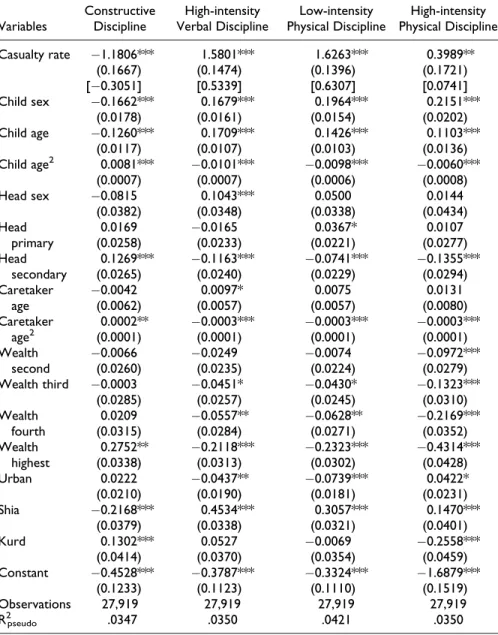
Table 3.Determinants of Discipline Outcomes—2011 Sample. Variables Constructive Discipline High-intensity Verbal Discipline Low-intensity Physical Discipline High-intensity Physical Discipline
Casualty rate 1.1806*** (0.1667) [0.3051]
1.5801*** (0.1474) [0.5339] 1.6263*** (0.1396) [0.6307] 0.3989** (0.1721) [0.0741] Child sex 0.1662***
(0.0178) 0.1679*** (0.0161) 0.1964*** (0.0154) 0.2151*** (0.0202) Child age 0.1260***
(0.0117) 0.1709*** (0.0107) 0.1426*** (0.0103) 0.1103*** (0.0136) Child age2 0.0081***
(0.0007) 0.0101*** (0.0007) 0.0098*** (0.0006) 0.0060*** (0.0008) Head sex 0.0815
(0.0382) 0.1043*** (0.0348) 0.0500 (0.0338) 0.0144 (0.0434) Head primary 0.0169 (0.0258) 0.0165 (0.0233) 0.0367* (0.0221) 0.0107 (0.0277) Head secondary 0.1269*** (0.0265) 0.1163*** (0.0240) 0.0741*** (0.0229) 0.1355*** (0.0294) Caretaker age 0.0042 (0.0062) 0.0097* (0.0057) 0.0075 (0.0057) 0.0131 (0.0080) Caretaker age2 0.0002** (0.0001) 0.0003*** (0.0001) 0.0003*** (0.0001) 0.0003*** (0.0001) Wealth second 0.0066 (0.0260) 0.0249 (0.0235) 0.0074 (0.0224) 0.0972*** (0.0279) Wealth third 0.0003
(0.0285) 0.0451* (0.0257) 0.0430* (0.0245) 0.1323*** (0.0310) Wealth fourth 0.0209 (0.0315) 0.0557** (0.0284) 0.0628** (0.0271) 0.2169*** (0.0352) Wealth highest 0.2752** (0.0338) 0.2118*** (0.0313) 0.2323*** (0.0302) 0.4314*** (0.0428) Urban 0.0222 (0.0210) 0.0437** (0.0190) 0.0739*** (0.0181) 0.0422* (0.0231) Shia 0.2168***
(0.0379) 0.4534*** (0.0338) 0.3057*** (0.0321) 0.1470*** (0.0401) Kurd 0.1302*** (0.0414) 0.0527 (0.0370) 0.0069 (0.0354) 0.2558*** (0.0459) Constant 0.4528***
(0.1233) 0.3787*** (0.1123) 0.3324*** (0.1110) 1.6879*** (0.1519)
Observations 27,919 27,919 27,919 27,919
R2pseudo .0347 .0350 .0421 .0350
Note: Probit regression used throughout. Casualty rate measures conflict-related casualties per 1,000 population in governorate in which respondent lives, lagged by one year. Child sex¼1 for male; head sex¼1 for male; lowest wealth quintile is the omitted dummy; urban¼1 if respondent lives in urban area; Sunni majority is the omitted region dummy. Standard errors appear in parentheses. Marginal effects, evaluated at the mean, appear in square brackets.
probability that a child experiences harsh verbal correction, with a 6.31-ppt increase in the probability that a child experiences low-intensity physical discipline, and with a 0.74-ppt increase in the probability that a child experiences high-intensity physical Table 4.Determinants of Discipline Outcomes—Pooled Sample.
Constructive Discipline High-intensity Verbal Discipline Low-intensity Physical Discipline High-intensity Physical Discipline
Casualty rate 0.3330*** (0.0419) [0.0838]
0.4864*** (0.0376) [0.1595] 0.2946*** (0.0340) [0.1135] 0.1479*** (0.0373) [0.0285] Child sex 0.1648***
(0.0149) 0.1599*** (0.0135) 0.1980*** (0.0128) 0.1839*** (0.0159) Child age 0.1266***
(0.0098) 0.1610*** (0.0089) 0.1496*** (0.0085) 0.1241*** (0.0107) Child age2 0.0082***
(0.0006) 0.0097*** (0.0005) 0.0104*** (0.0005) 0.0072*** (0.0006) Head sex 0.0787**
(0.0312) 0.0689** (0.0286) 0.0621** (0.0272) 0.0485 (0.0335) Head primary 0.0107 (0.0217) 0.0056 (0.0196) 0.0337* (0.0185) 0.0097 (0.0221) Head secondary 0.1379*** (0.0213) 0.1345*** (0.0193) 0.1054*** (0.0183) 0.2010*** (0.0223) Caretaker age 0.0032 (0.0045) 0.0057 (0.0042) 0.0011 (0.0041) 0.0015 (0.0052) Caretaker age2 0.0001* (0.0001) 0.0002*** (0.0001) 0.0002*** (0.0001) 0.0001 (0.0001) Urban 0.1013*** (0.0158) 0.1113*** (0.0143) 0.1407*** (0.0135) 0.0702*** (0.0164) Shia 0.1241***
(0.0239) 0.2979*** (0.0215) 0.1191*** (0.0201) 0.1622*** (0.0243) Kurd 0.2410*** (0.0242) 0.1554*** (0.0219) 0.2389*** (0.0210) 0.2251*** (0.0273) Year is 2011 0.0534***
(0.0200) 0.0460** (0.0182) 0.1315*** (0.0171) 0.2460*** (0.0200) Constant 0.8046***
(0.0933) 0.0475 (0.0857) 0.1885** (0.0829) 1.2293*** (0.1038)
Observations 40,922 40,922 40,922 40,922
R2pseudo .0335 .0380 .0436 .0349
Note: Probit regression used throughout. Casualty rate measures conflict-related casualties per 1,000 population in governorate in which respondent lives, lagged by one year. Child sex¼1 for male; head sex¼1 for male; lowest wealth quintile is the omitted dummy; urban¼1 if respondent lives in urban area; Sunni majority is the omitted region dummy. Standard errors appear in parentheses. Marginal effects, evaluated at the mean, appear in square brackets.
discipline. All of these coefficients are significant at the 1 percent level, except in the regression for high-intensity physical discipline, where the coefficient on conflict intensity is significant at the 5 percent level. Using the results from Table 4, with the pooled 2006 and 2011 observations, each 0.1-unit increase in the casualty rate is associated with an 0.84-ppt decline in the probability that a child experiences con-structive discipline exclusively, with a 1.60-ppt increase in the probability of harsh verbal correction, with a 1.14-ppt increase in the probability of low-intensity phys-ical discipline, and with a 0.29-ppt increase in the probability of high-intensity physical discipline. All of these coefficients are significant at the 1 percent level. In summary, across specifications, increases in the intensity of local conflict are associated with reductions in the use of exclusively constructive discipline and with increases in the use of harsh verbal reprimand and both low-intensity and high-intensity physical discipline.
Figure 1 shows scatterplots of the probit regression estimates for our four disci-pline outcome variables, against the casualty rate. These estimates use the 2011 results given in Table 3, and we have substituted the mean values from 2011 for the other control variables. Increases in the casualty rate are associated with higher likelihood of intensity verbal discipline and both low-intensity and high-intensity physical discipline and with reductions in constructive discipline.
We also ran parallel regressions that included controls for the caretaker’s level of education. As discussed earlier, including these controls reduced the sample size by about a third because of missing data issues, but results were qualitatively similar. The main coefficient estimates are positive and significant for harsh verbal correc-tion and for both high- and low-intensity physical discipline and negative for con-structive discipline.
Figure
1.
Casualty
rates
and
discipline
outcomes.
Figure
shows
estimated
probability
of
discipline
outcomes
using
probit
results
Table
3.
Casualty
rate
is
conflict-related
casualties
per
1,000
population
in
governorate
in
which
respondent
lives,
lagged
by
one
Estimates
use
mean
values
of
all
other
independent
variables
in
the
regression
from
the
2011
sample.
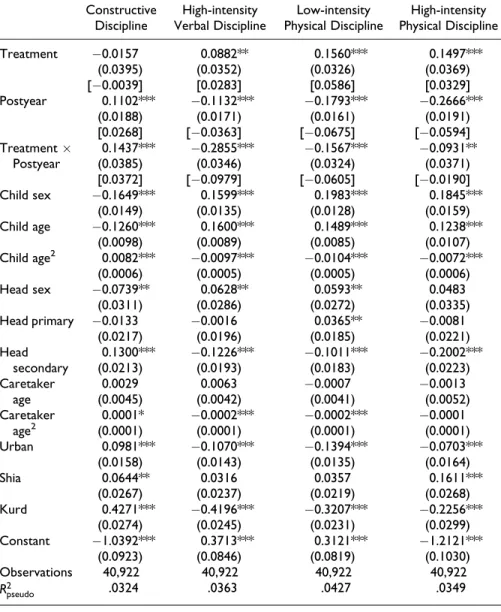
Table 5.Determinants of Discipline Outcomes—Difference in Differences. Constructive Discipline High-intensity Verbal Discipline Low-intensity Physical Discipline High-intensity Physical Discipline
Treatment 0.0157 (0.0395) [0.0039]
0.0882** (0.0352) [0.0283] 0.1560*** (0.0326) [0.0586] 0.1497*** (0.0369) [0.0329] Postyear 0.1102*** (0.0188) [0.0268] 0.1132*** (0.0171) [0.0363]
0.1793*** (0.0161) [0.0675]
0.2666*** (0.0191) [0.0594] Treatment Postyear 0.1437*** (0.0385) [0.0372] 0.2855*** (0.0346) [0.0979]
0.1567*** (0.0324) [0.0605]
0.0931** (0.0371) [0.0190] Child sex 0.1649***
(0.0149) 0.1599*** (0.0135) 0.1983*** (0.0128) 0.1845*** (0.0159) Child age 0.1260***
(0.0098) 0.1600*** (0.0089) 0.1489*** (0.0085) 0.1238*** (0.0107) Child age2 0.0082***
(0.0006) 0.0097*** (0.0005) 0.0104*** (0.0005) 0.0072*** (0.0006) Head sex 0.0739**
(0.0311) 0.0628** (0.0286) 0.0593** (0.0272) 0.0483 (0.0335) Head primary 0.0133
(0.0217) 0.0016 (0.0196) 0.0365** (0.0185) 0.0081 (0.0221) Head secondary 0.1300*** (0.0213) 0.1226*** (0.0193) 0.1011*** (0.0183) 0.2002*** (0.0223) Caretaker age 0.0029 (0.0045) 0.0063 (0.0042) 0.0007 (0.0041) 0.0013 (0.0052) Caretaker age2 0.0001* (0.0001) 0.0002*** (0.0001) 0.0002*** (0.0001) 0.0001 (0.0001) Urban 0.0981*** (0.0158) 0.1070*** (0.0143) 0.1394*** (0.0135) 0.0703*** (0.0164) Shia 0.0644** (0.0267) 0.0316 (0.0237) 0.0357 (0.0219) 0.1611*** (0.0268) Kurd 0.4271*** (0.0274) 0.4196*** (0.0245) 0.3207*** (0.0231) 0.2256*** (0.0299) Constant 1.0392***
(0.0923) 0.3713*** (0.0846) 0.3121*** (0.0819) 1.2121*** (0.1030)
Observations 40,922 40,922 40,922 40,922
R2
pseudo .0324 .0363 .0427 .0349
Note: Probit regression used throughout. Treatment¼1 if respondent lives in governorate in the top quartile of declines in casualty rates from 2005 to 2010; postyear¼1 if observation is from 2011; child sex¼1 for male; head sex¼1 for male; urban¼1 if respondent lives in urban area; Sunni majority is the omitted region dummy; 2006 observations are the omitted time dummy. Standard errors appear in parentheses. Marginal effects, evaluated at the mean, appear in square brackets.
Robustness Check—Difference in differences
Table 5 shows the results of our difference-in-differences analysis. Directionally, the results are consistent with our main results. Examining the coefficient on the inter-action term, the treatment governorates, those that saw large declines in casualties, experienced larger increases in the use of exclusively constructive discipline between 2006 and 2011, accompanied by larger declines in the use of harsh verbal correction and both low-intensity and high-intensity physical punishment. We again rely on the marginal effects, shown in square brackets, to interpret the magnitude of these associations. The probability that a child experienced exclusively constructive discipline rose by 3.72 ppt more in the treatment governorates than in the control governorates. The probability that a child experienced harsh verbal punishment, low-intensity physical punishment, and high-intensity physical punishment fell by 9.79 ppt, 6.05 ppt, and 1.90 ppt more in the treatment governorates than in the control governorates, respectively. The coefficient on the interaction term is signif-icant at conventional levels for all regressions. Thus, these quasi-experimental results confirm the association between conflict and unhealthy parenting. Large declines in conflict within a governorate are associated with elevated declines in violent parenting.
Discussion and Conclusions
Al-Sabah et al. (2015) recorded a persistent and long-term impact of the Bosnian conflict on the psychological health of adolescents. While it is generally understood that war is particularly damaging to children, empirical work on the nature of the link remains limited. In this article, we have provided additional evidence for a link that operates via parenting. The association between exposure to local conflict and parenting that we have identified includes harsh verbal correction as well as both moderate and severe physical punishment, with larger percentage point increases in moderate phys-ical discipline. Conversely, there is a decline in healthy discipline strategies like redir-ection and restriction of privileges. These associations are consistently significant across specifications, including a difference-in-differences analysis that exploits het-erogeneity in the evolution of conflict rates across governorates in our sample.
(2014) report significant correlations ofr¼0:25 andr¼0:22 between aggressive parenting and the number of war-related events experienced by female and male guardians, respectively. These studies benefited from targeted surveys that provided a continuous parenting aggressiveness score taking advantage of the well-validated CTS. Due to data limitations, our measures of parenting are more discrete, but a potential advantage of our study is that our sample is much larger and is designed to be nationally representative across Iraq. Furthermore, while previous studies use a self-reported count of exposure to traumatic events, we rely on IBC data for a direct and continuous measure of local conflict exposure. Finally, the literature is begin-ning to recognize the importance of war-related psychopathologies among both parents and children as risk factors (Saile et al. 2016; Catani 2018), and our measure of conflict exposure is relevant at the level of the household.
Our results are also consistent with the somewhat more extensive literature on intimate partner violence, which also points to a link between external political violence and family violence (Haj-Yahia and Clark 2013; Clark et al. 2010; Saile et al. 2013). The cumulative effect of political violence on top of family violence and the unique mental health sequelae that it creates for affected children and families is especially troubling, and other researchers have explored these effects among fam-ilies in the Middle East (Dubow et al. 2012; Sousa et al. 2018).
Our discussion of transmission mechanisms provides a number of plausible explanations for this result. High rates of PTSD among Iraqi civilians, along with large income and property losses, create mental distress, which is known to be associated with aggressive parenting (Steel et al. 2006; Gewirtz et al. 2010). In a more direct sense, acclimatization to violence, especially to local violence as we measure in this article, can lead to a paradigm shift that leads to the exercise of more violence at home (Lansford and Dodge 2008). Many families have suffered a death in the family, or there are long parental absences for other reasons, for example, emigration to find stable employment, and these absences are associated with increases in child maltreatment in other settings (Rentz et al. 2007). Finally, violent conflict in Iraq has decimated the health-care infrastructure there, especially in high-conflict areas (Guerrero Serdan 2009). A poorly functioning psychological health system reduces the ability to intervene or to provide services that ameliorate child maltreatment.
associated with even moderate corporal punishment, including antisocial behavior, violent behavior, and reduced earnings later in life. The specter of long-term per-sistence of negative youth experiences is especially concerning given the population configuration of the Middle East, which demographers describe as a “youth bulge” (Dhillon 2008), and the likelihood of continuing conflict there.
We echo Catani (2010), who points to an urgent need for investment in counseling and psychological services for civilians who are impacted by violent conflict, espe-cially children and caretakers. Recent randomized field studies among war-affected and displaced families in the Democratic Republic of the Congo and in Sierra Leone point to the value of targeted psychological interventions like cognitive behavioral therapy in improving a variety of child outcomes, including reducing display of PTSD symptoms and increasing school attendance and school performance (O’Callaghan et al. 2014; Betancourt et al. 2014). Puffer et al. (2017) find, among displaced Bur-mese families in Thailand, that family-based treatment interventions improve care-giver–child relations and reduce the use of harsh punishments. While the effect sizes were modest, this is a potentially promising path for addressing the specific issues identified in this article.6Unfortunately, Betancourt et al. (2013) noted a paucity of policy evaluation for family-based treatment interventions targeted to conflict-exposed children (much of the literature at that time focused on school-based inter-ventions), and indeed, Catani, Schauer, and Neuner (2008) commented that there is “virtually no literature addressing the effects of mass trauma on the family and community systems.” The literature has grown somewhat since then, but we hope that policymakers can draw on results related to war and parenting outcomes and on field research that studies interventions to address these growing needs, especially in light of well-documented and severe consequences of war for exposed children.
War devastates children directly, but also because it impairs the well-being of the adults on whom they rely for guidance and support. Fostering a climate of nurturing child-rearing is a compelling public interest and an understudied aspect of the consequences of war.
Declaration of Conflicting Interests
The author(s) declared no potential conflicts of interest with respect to the research, author-ship, and/or publication of this article.
Funding
The author(s) received no financial support for the research, authorship, and/or publication of this article.
ORCID iD
Michael Malcolm https://orcid.org/0000-0003-2389-8872
Supplemental Material
Supplemental material for this article is available online.
Notes
1. We refer interested readers to Murthy and Lakshminarayana (2006), who provide an extensive review of empirical work on mental health–related consequences associated with a whole host of global conflicts.
2. These effects could even carry across generations, if there is a “cycle of abuse.” However, evidence for this hypothesis is mixed (Thornberry, Knight, and Lovegrove 2012). 3. We tried a number of alternative specifications for conflict, including lagging casualty
rates by two years, averaging several previous years of casualty rates, and using logs instead of rates, and the results were qualitatively similar. Interestingly, one thing that does appear to matter is the use oflaggedcasualty rates; our models do not fit as well if we use contemporaneous casualty rates. This is consistent with previous literature suggesting that the impact of conflict-related stress, especially to the degree that it operates through the mental health channel, is cumulative and progressive over time (Dubow et al. 2012). 4. The motivation for the regional controls is important in the context of our findings. Prior to the rise of the Islamic State of Iraq and the Levant, the Kurdish region specifically was comparatively very stable, with a well-functioning security apparatus and public institu-tions. The Kurds had been essentially self-governing since sanctions following first Gulf War severely limited Saddam Hussein’s ability to exercise any authority in the region. See Viviano (2006) for an account of successful Kurdish self-governance. The Education Policy and Data Center reports that school completion rates in the Kurdish governorates far outstrip those in any other area (Buckner 2012).
6. We also note the importance of reconstructing a well-functioning social services infra-structure following wartime conflict, especially inasmuch as locational displacement and deaths can upend the more informal family and community-based support systems that complement formal public institutions (Belsky 1980).
References
Ajdukovic, Marina. 1996. “Mothers’ Perception of their Relationship with their Children during Displacement: A Six Month Follow-up.”Child Abuse Review5 (1): 34-49. Akmatov, Manas K. 2010. “Child Abuse in 28 Developing and Transitional Countries—
Results from the Multiple Indicator Cluster Surveys.”International Journal of Epidemiol-ogy40 (1): 219-27.
Ali, Niloufer Sultan, and Ali Khan Khuwaja. 2014. “Magnitude and Factors Associated with Child Abuse in a Mega City of Developing Country Pakistan.”Iranian Journal of Pedia-trics24 (2): 140-46.
Al Monitor. 2013. “Iraqi Children Face Poverty, Violence, Exploitation.” Accessed May 28, 2019. https://www.al-monitor.com/pulse/originals/2013/11/iraq-children-torn-instability.html. Al-Sabah, Reem, John-Paul Legerski, Christopher M. Layne, Brian Isakson, Ranka
Kata-linski, Hafiza Pasalic, Nina Bosankic, and Robert S. Pynoos. 2015. “Adolescent Adjust-ment, Caregiver-adolescent Relationships, and Outlook towards the Future in the Long-term AfLong-termath of the Bosnian War.”Journal of Child & Adolescent Trauma8 (1): 45-60. Appel, Anne E., and George W. Holden. 1998. “The Co-occurrence of Spouse and Physical
Child Abuse: A Review and Appraisal.”Journal of Family Psychology12 (4): 578. Barber, Brian K. 2008.Adolescents and War: How Youth Deal with Political Violence.
Oxford, UK: Oxford University Press.
Belsky, Jay. 1980. “Child Maltreatment: An Ecological Integration.”American Psychologist
35 (4): 320-35.
Berman, Eli, Jacob N. Shapiro, and Joseph H. Felter. 2011. “Can Hearts and Minds Be Bought? The Economics of Counterinsurgency in Iraq.”Journal of Political Economy
119 (4): 766-819.
Betancourt, Theresa S., Ryan McBain, Elizabeth A. Newnham, Adeyinka M. Akinsulure-Smith, Robert T. Brennan, John R. Weisz, and Nathan B. Hansen. 2014. “A Behavioral Intervention for War-affected Youth in Sierra Leone: A Randomized Controlled Trial.”
Journal of the American Academy of Child & Adolescent Psychiatry53 (12): 1288-97. Betancourt, Theresa S., Sarah E. Meyers-Ohki, Alexandra P. Charrow, and Wietse A. Tol.
2013. “Interventions for Children Affected by War: An Ecological Perspective on Psy-chosocial Support and Mental Health Care.”Harvard Review of Psychiatry21 (2): 70-91. Betancourt, Theresa S., Elizabeth A. Newnham, Christopher M. Layne, Soeun Kim, Alan M. Steinberg, Heidi Ellis, and Dina Birman. 2012. “Trauma History and Psychopathology in War-affected Refugee Children Referred for Trauma-related Mental Health Services in the United States.”Journal of Traumatic Stress25 (6): 682-90.
Blattman, Christopher, and Edward Miguel. 2010. “Civil war.”Journal of Economic Liter-ature48 (1): 3-57.
Buckner, Elizabeth. 2012. “Education and Conflict in Iraq.” Accessed May 28, 2019. http:// www.epdc.org/epdc-data-points/education-and-conflict-iraq.
Carpenter, Dustin, Tova Fuller, and Les Roberts. 2013. “WikiLeaks and Iraq Body Count: The Sum of Parts May Not Add Up to the Whole—A Comparison of Two Tallies of Iraqi Civilian Deaths.”Prehospital and Disaster Medicine28 (3): 223-29.
Catani, Claudia. 2010. “War in the Home: A Review of the Relationship between Family Violence and War Trauma.”Verhaltenstherapie20 (1): 19-27.
Catani, Claudia. 2018. “Mental Health of Children Living in War Zones: A Risk and Protec-tion Perspective.”World Psychiatry17 (1): 104-05.
Catani, Claudia, Elisabeth Schauer, and Frank Neuner. 2008. “Beyond Individual War Trauma: Domestic Violence against Children in Afghanistan and Sri Lanka.”Journal of Marital and Family Therapy34 (2): 165-76.
Clark, Cari Jo, Susan A. Everson-Rose, Shakira Franco Suglia, Rula Btoush, Alvaro Alonso, and Muhammad M. Haj-Yahia. 2010. “Association between Exposure to Political Vio-lence and Intimate-partner VioVio-lence in the Occupied Palestinian Territory: A Cross-sectional Study.”The Lancet375 (9711): 310-16.
Currie, Janet, and Cathy Spatz Widom. 2010. “Long-term Consequences of Child
Abuse and Neglect on Adult Economic Well-being.” Child Maltreatment 15 (2):
111-20.
De Jong, Joop T. V. M., Ivan H. Komproe, and Mark Van Ommeren. 2003. “Common Mental Disorders in Postconflict Settings.”The Lancet361 (9375): 2128-30.
Dekel, Rachel, and Hadass Goldblatt. 2008. “Is there Intergenerational Transmission of Trauma? The Case of Combat Veterans’ Children.”American Journal of Orthopsychiatry
78 (3): 281-89.
Dhillon, Navtej. 2008. “Middle East Youth Bulge: Challenge or Opportunity?” Accessed May 28, 2019. http://www.brookings.edu/research/speeches/2008/05/22-middle-east-youth-dhillon.
Dubow, Eric F., Paul Boxer, L. Rowell Huesmann, Simha Landau, Shira Dvir, Khalil Shikaki, and Jeremy Ginges. 2012. “Cumulative Effects of Exposure to Violence on Posttraumatic Stress in Palestinian and Israeli Youth.”Journal of Clinical Child & Adolescent Psychol-ogy41 (6): 837-44.
Ember, Carol R., and Melvin Ember. 2005. “Explaining Corporal Punishment of Children: A Cross-cultural Study.”American Anthropologist107 (4): 609-19.
Ertl, Verena, Regina Saile, Frank Neuner, and Claudia Catani. 2016. “Drinking to Ease the Burden: A Cross-sectional Study on Trauma, Alcohol Abuse and Psychopathology in a Post-conflict Context.”BMC Psychiatry16 (1): 202.
Felitti, Vincent J., Robert F. Anda, Dale Nordenberg, David F. Williamson, Alison M. Spitz, Valerie Edwards, Mary P. Koss, and James S. Marks. 2019. “Relationship of Childhood Abuse and Household Dysfunction to Many of the Leading Causes of Death in Adults: The Adverse Childhood Experiences (ACE) Study.”American Journal of Preventive Medicine
Fox, Jonathan, and Shmeul Sandler. 2014.Religion in World Conflict. Chicago, IL: Routledge. Garbarino, James, and Kathleen Kostelny. 1996. “The Effects of Political Violence on Pales-tinian Children’s Behavior Problems: A Risk Accumulation Model.”Child Development
67 (1): 33-45.
Gewirtz, Abigail H., Melissa A. Polusny, David S. DeGarmo, Anna Khaylis, and Christopher R. Erbes. 2010. “Posttraumatic Stress Symptoms among National Guard Soldiers Deployed to Iraq: Associations with Parenting Behaviors and Couple Adjustment.” Jour-nal of Consulting and Clinical Psychology78 (5): 599.
Guerrero Serdan, Gabriela. 2009. “The Effects of the War in Iraq on Nutrition and Health: An Analysis Using Anthropometric Outcomes of Children.” Accessed March 13, 2010. https://papers.ssrn.com/sol3/papers.cfm?abstract_id=1359161.
Haj-Yahia, Muhammad M., and Rula Abdo-Kaloti. 2003. “The Rates and Correlates of the Exposure of Palestinian Adolescents to Family Violence: Toward an Integrative-holistic Approach.”Child Abuse & Neglect27 (7): 781-806.
Haj-Yahia, Muhammad M., and Cari Jo Clark. 2013. “Intimate Partner Violence in the Occupied Palestinian Territory: Prevalence and Risk Factors.”Journal of Family Violence
28 (8): 797-809.
Heckman, James J., and Dimitriy V. Masterov. 2007. “The Productivity Argument for Investing in Young Children.”Applied Economic Perspectives and Policy29 (3): 446-93.
Horn, Rebecca, Eve S. Puffer, Elisabeth Roesch, and Heidi Lehmann. 2014. “Women’s Perceptions of Effects of War on Intimate Partner Violence and Gender Roles in Two Post-conflict West African Countries: Consequences and Unexpected Opportunities.”
Conflict and Health8 (1): 12.
Iraq Body Count. 2019. “Iraq Body Count.” Accessed May 28, 2019. https://www.iraqbody count.org/.
Kesternich, Iris, Bettina Siflinger, James P. Smith, and Joachim K. Winter. 2014. “The Effects of World War II on Economic and Health Outcomes across Europe.”Review of Economics and Statistics96 (1): 103-18.
Lansford, Jennifer E., and Kenneth A. Dodge. 2008. “Cultural Norms for Adult Corporal Punishment of Children and Societal Rates of Endorsement and Use of Violence.” Par-enting: Science and Practice8 (3): 257-70.
Levy, Barry S., and Victor W. Sidel, Eds. 2008.War and Public Health. New York: Oxford University Press.
Looney, Robert. 2006. “Economic Consequences of Conflict: The Rise of Iraq’s Informal Economy.”Journal of Economic Issues40 (4): 991-1007.
Malcolm, Michael. 2012. “Can Buy Me Love: The Effect of Child Welfare Expenditures on Maltreatment Outcomes.”Applied Economics44 (28): 3725-36.
Mayer, Susan E. 1997.What Money Can’t Buy: Family Income and Children’s Life Chances. Cambridge, MA: Harvard University Press.
Murthy, R. Srinivasa, and Rashmi Lakshminarayana. 2006. “Mental Health Consequences of War: A Brief Review of Research Findings.”World Psychiatry5 (1): 25-30.
Naufal, George, and Ismail Genc. 2012.Expats and the Labor Force: The Story of the Gulf Cooperation Council Countries. New York: Palgrave Macmillan.
Nickerson, Angela, Richard A. Bryant, Zachary Steel, Derrick Silove, and Robert Brooks. 2010. “The Impact of Fear for Family on Mental Health in a Resettled Iraqi Refugee Community.”Journal of Psychiatric Research44 (4): 229-35.
Norman, Rosana E., Munkhtsetseg Byambaa, Rumna De, Alexander Butchart, James Scott, and Theo Vos. 2012. “The Long-term Health Consequences of Child Physical Abuse, Emotional Abuse, and Neglect: A Systematic Review and Meta-analysis.”PLoS Medicine
9 (11): e1001349.
O’Callaghan, Paul, Lindsay Branham, Ciar´an Shannon, Theresa S. Betancourt, Martin Demp-ster, and John McMullen. 2014. “A Pilot Study of a Family Focused, Psychosocial Inter-vention with War-exposed Youth at Risk of Attack and Abduction in North-eastern Democratic Republic of Congo.”Child Abuse & Neglect38 (7): 1197-207.
Office of the High Commissioner for Human Rights. 2011. “Report on Human Rights in Iraq: 2011.” Accessed May 28, 2019. http://www.ohchr.org/Documents/Countries/IQ/IraqU NAMI-OHCHR_HR_Report2011_en.pdf.
Puffer, Eve S., Jeannie Annan, Amanda L. Sim, Carmel Salhi, and Theresa S. Betancourt. 2017. “The Impact of a Family Skills Training Intervention among Burmese Migrant Families in Thailand: A Randomized Controlled Trial.”PLoS One12 (3): e0172611. Rentz, E. Danielle, Stephen W. Marshall, Dana Loomis, Carri Casteel, Sandra L. Martin, and
Deborah A. Gibbs. 2007. “Effect of Deployment on the Occurrence of Child Maltreatment in Military and Nonmilitary Families.”American Journal of Epidemiology165 (10): 1199-206. Runyan, Desmond K., Viswanathan Shankar, Fatma Hassan, Wanda M. Hunter, Dipty Jain, Cristiane S. Paula, Shrikant I. Bangdiwala, et al. 2010. “International Variations in Harsh Child Discipline.”Pediatrics126 (3): e701-11.
Ruscio, Ayelet Meron, Frank W. Weathers, Lynda A. King, and Daniel W. King. 2002. “Male War-zone Veterans’ Perceived Relationships with their Children: The Importance of Emotional Numbing.”Journal of Traumatic Stress15 (5): 351-57.
Saile, Regina, Verena Ertl, Frank Neuner, and Claudia Catani. 2014. “Does War Contribute to Family Violence Against Children? Findings from a Two-generational Multi-informant Study in Northern Uganda.”Child Abuse & Neglect38 (1): 135-46.
Saile, Regina, Verena Ertl, Frank Neuner, and Claudia Catani. 2016. “Children of the Postwar Years: A Two-generational Multilevel Risk Assessment of Child Psychopathology in Northern Uganda.”Development and Psychopathology28 (2): 607-20.
Saile, Regina, Frank Neuner, Verena Ertl, and Claudia Catani. 2013. “Prevalence and Pre-dictors of Partner Violence against Women in the Aftermath of War: A Survey among Couples in Northern Uganda.”Social Science & Medicine86:17-25.
Samper, Rita E., Casey T. Taft, Daniel W. King, and Lynda A. King. 2004. “Posttraumatic Stress Disorder Symptoms and Parenting Satisfaction among a National Sample of Male Vietnam Veterans.”Journal of Traumatic Stress17 (4): 311-15.
Sriskandarajah, Vathsalan, Frank Neuner, and Claudia Catani. 2015a. “Parental Care Protects Traumatized Sri Lankan Children from Internalizing Behavior Problems.”BMC Psychia-try15 (1): 203.
Sriskandarajah, Vathsalan, Frank Neuner, and Claudia Catani. 2015b. “Predictors of Violence against Children in Tamil Families in Northern Sri Lanka.”Social Science & Medicine
146:257-65.
Steel, Zachary, Derrick Silove, Robert Brooks, Shakeh Momartin, Bushra Alzuhairi, and I. N. A. Susljik. 2006. “Impact of Immigration Detention and Temporary Protection on the Mental Health of Refugees.”The British Journal of Psychiatry188 (1): 58-64.
Stiglitz, Joseph E., and Linda J. Bilmes. 2008.The Three Trillion Dollar War: The True Cost of the Iraq Conflict. New York: WW Norton.
Stith, Sandra M., Ting Liu, L. Christopher Davies, Esther L. Boykin, Meagan C. Alder, Jennifer M. Harris, Anurag Som, Mary McPherson, and J. E. M. E. G. Dees. 2009. “Risk Factors in Child Maltreatment: A Meta-analytic Review of the Literature.”Aggression and Violent Behavior14 (1): 13-29.
Straus, Murray A. 2001.Beating the Devil Out of Them: Corporal Punishment in American Families and Its Effects on Children. Piscataway, NJ: Transaction.
Straus, Murray A., Sherry L. Hamby, David Finkelhor, David W. Moore, and Desmond Runyan. 1998. “Identification of Child Maltreatment with the Parent-child Conflict Tac-tics Scales: Development and Psychometric Data for a National Sample of American Parents.”Child Abuse & Neglect22 (4): 249-70.
Straus, Murray A., and Julie H. Stewart. 1999. “Corporal Punishment by American Parents: National Data on Prevalence, Chronicity, Severity, and Duration, in Relation to Child and Family Characteristics.”Clinical Child and Family Psychology Review2 (2): 55-70. Thornberry, Terence P., Kelly E. Knight, and Peter J. Lovegrove. 2012. “Does Maltreatment
Beget Maltreatment? A Systematic Review of the Intergenerational Literature.”Trauma, Violence, & Abuse13 (3): 135-52.
Timshel, Isabelle, Edith Montgomery, and Nina Thorup Dalgaard. 2017. “A Systematic Review of Risk and Protective Factors Associated with Family Related Violence in Refu-gee Families.”Child Abuse & Neglect70:315-30.
United Nations. n.d. “Iraq Refugee Crisis.” Accessed May 22, 2019. https://www.unrefugees. org/emergencies/iraq/.
Usta, Jinan A., and Jo Ann Farver. 2010. “Child Sexual Abuse in Lebanon during War and Peace.”Child: Care, Health and Development36 (3): 361-68.
van Elisa Ee, Rolf J. Kleber, and Trudy T. M. Mooren. 2012. “War Trauma Lingers On: Associations between Maternal Posttraumatic Stress Disorder, Parent–child Interaction, and Child Development.”Infant Mental Health Journal33 (5): 459-68.
Vinck, Patrick, and Phuong N. Pham. 2013. “Association of Exposure to Intimate-partner Physical Violence and Potentially Traumatic War-related Events with Mental Health in Liberia.”Social Science & Medicine77:41-49.