Special Publication 800-64
Security Considerations in the
Information System Development Life
Cycle
Recommendations of the National Institute of
Standards and Technology
Tim Grance
Joan Hash
Marc Stevens
NIST Special Publication 800-64
Security Considerations in the
Information System
Development Life Cycle
Tim Grance, Joan Hash, and Marc Stevens
C O M P U T E R S E C U R I T Y
Computer Security Division
Information Technology Laboratory
National Institute of Standards and Technology Gaithersburg, MD 20899-8930
October 2003
U.S. Department of Commerce Donald L. Evans, Secretary Technology Administration
Phillip J. Bond, Under Secretary for Technology National Institute of Standards and Technology Arden L. Bement, Jr., Director
Acknowledgements
The authors, Tim Grance and Joan Hash of the National Institute of Standards and Technology (NIST), and Marc Stevens of Booz Allen Hamilton, wish to thank their many colleagues who reviewed drafts of this document and contributed to its technical content. We also gratefully acknowledge and appreciate the many comments we received from readers of the public and private sectors, whose valuable insights improved the quality and usefulness of this document. The authors would like to specifically acknowledge some key organizations whose extensive feedback substantially contributed to the
development of the document. These organizations include: MITRE, Environmental Protection Agency, Department of Treasury, Social Security Administration, General Accounting Office, Internal Revenue Service, Corbett Technologies, National Archives and Records Administration, and the Tennessee Valley Authority. The authors would also like to acknowledge some key persons for their extensive review and comments: Ron Ross for his review on the certification and accreditation, Common Criteria, and assurance sections; Bill Burr, Tim Polk, Ron Tencati, and Annabelle Lee for their reviews of the
cryptography section; Ramaswamy Chandramouli for his review of the access control section; Marianne Swanson, Gary Stoneburner, Curtis Barker, and Shirley Radack for their extensive and detailed review of the document; Marshall Abrams and Joseph Veoni of MITRE for providing insight into the use of the document for very large IT acquisitions; Harold Podell of the General Accounting Office for his
assistance in clarifying the enterprise IT implications during IT acquisitions; and Alexis Feringa of Booz Allen Hamilton for her keen and insightful assistance throughout the development of the document.
Any mention of commercial products or reference to commercial organizations is for information only; it does not imply recommendation or endorsement by NIST nor does it imply that the products mentioned are necessarily the best available for the purpose.
EXECUTIVE SUMMARY
Including security early in the information system development life cycle (SDLC) will usually result in less expensive and more effective security than adding it to an operational system. This guide presents a framework for incorporating security into all phases of the SDLC process, from initiation to disposal. This document is a guide to help agencies select and acquire cost-effective security controls by explaining how to include information system security requirements in appropriate phases of the SDLC.
A general SDLC is discussed in this guide that includes the following phases: initiation,
acquisition/development, implementation, operations/maintenance, and disposition. Each of these five phases includes a minimum set of security steps needed to effectively incorporate security into a system during its development. An organization will either use the general SDLC described in this document or will have developed a tailored SDLC that meets their specific needs. In either case, NIST recommends that organizations incorporate the associated IT security steps of this general SDLC into their
development process:
Initiation Phase –
–
Security Categorization – defines three levels (i.e., low, moderate, or high) of potential impact on organizations or individuals should there be a breach of security (a loss of confidentiality, integrity, or availability). Security categorization standards assist organizations in making the appropriate selection of security controls for their information systems.–
Preliminary Risk Assessment – results in an initial description of the basic security needs of the system. A preliminary risk assessment should define the threat environment in which the system will operate. Acquisition / Development Phase –
–
Risk Assessment – analysis that identifies the protection requirements for the system through a formal risk assessment process. This analysis builds on the initial risk assessment performed during the Initiation phase, but will be more in-depth and specific.–
Security Functional Requirements Analysis – analysis of requirements that may include the following components: (1) system security environment, (i.e., enterprise information security policy and enterprise security architecture) and (2) security functional requirements–
Security Assurance Requirements Analysis – analysis of requirements that address the developmental activities required and assurance evidence needed to produce the desired level of confidence that the information security will work correctly and effectively. The analysis, based on legal and functional security requirements, will be used as the basis for determining how much and what kinds of assurance are required.–
Cost Considerations and Reporting – determines how much of the development cost can be attributed to information security over the life cycle of the system. These costs include hardware, software, personnel, and training–
Security Planning – ensures that agreed upon security controls, planned or in place, are fully documented. The security plan also provides a complete characterization or description of the information system as well as attachments or references to key documents supporting the agency’s information security program (e.g., configuration management plan, contingency plan, incident response plan, security awareness and training plan, rules of behavior, risk assessment,security test and evaluation results, system interconnection agreements, security authorizations/accreditations, and plan of action and milestones).
–
Security Control Development – ensures that security controls described in the respective security plans are designed, developed, and implemented. For information systems currently in operation, the security plans for those systems may call for the development of additional security controls to supplement the controls already in place or the modification of selected controls that are deemed to be less than effective.–
Developmental Security Test and Evaluation – ensures that security controls developed for a new information system are working properly and are effective. Some types of security controls (primarily those controls of a non-technical nature) cannot be tested and evaluated until the information system is deployed—these controls are typically management and operational controls.–
Other Planning Components – ensures that all necessary components of the development process are considered when incorporating security into the life cycle. These components include selection of the appropriate contract type, participation by all necessary functional groups within an organization, participation by the certifier and accreditor, and development and execution of necessary contracting plans and processes. Implementation Phase –
–
Inspection and Acceptance – ensures that the organization validates and verifies that the functionality described in the specification is included in the deliverables.–
Security Control Integration – ensures that security controls are integrated at the operational site where the information system is to be deployed for operation. Security control settings and switches are enabled in accordance with vendor instructions and available securityimplementation guidance.
–
Security Certification – ensures that the controls are effectively implemented through established verification techniques and procedures and gives organization officials confidence that the appropriate safeguards and countermeasures are in place to protect the organization’s information system. Security certification also uncovers and describes the known vulnerabilities in the information system.–
Security Accreditation – provides the necessary security authorization of an information system to process, store, or transmit information that is required. This authorization is granted by a senior organization official and is based on the verified effectiveness of security controls to some agreed upon level of assurance and an identified residual risk to agency assets or operations. Operations / Maintenance Phase –
–
Configuration Management and Control – ensures adequate consideration of the potential security impacts due to specific changes to an information system or its surrounding environment. Configuration management and configuration control procedures are critical to establishing an initial baseline of hardware, software, and firmware components for the information system and subsequently controlling and maintaining an accurate inventory of any changes to the system.–
Continuous Monitoring – ensures that controls continue to be effective in their application through periodic testing and evaluation. Security control monitoring (i.e., verifying the continued effectiveness of those controls over time) and reporting the security status of the informationsystem to appropriate agency officials is an essential activity of a comprehensive information security program.
Disposition Phase –
–
Information Preservation – ensures that information is retained, as necessary, to conform to current legal requirements and to accommodate future technology changes that may render the retrieval method obsolete.–
Media Sanitization– ensures that data is deleted, erased, and written over as necessary.–
Hardware and Software Disposal – ensures that hardware and software is disposed of as directed by the information system security officer.After discussing these phases and the information security steps in detail, the guide provides
specifications, tasks, and clauses that can be used in an RFP to acquire information security features, procedures, and assurances.
Table of Contents
1. INTRODUCTION...1 1.1 Authority... 1 1.2 Purpose... 1 1.3 Scope... 1 1.4 Audience ... 22. INCORPORATING SECURITY INTO THE INFORMATION SYSTEM DEVELOPMENT LIFE CYCLE ...3
2.1 Key Roles and Responsibilities for Development Initiatives ... 3
2.1.1 Key Roles ...3
2.1.2 Other Participants...4
2.2 Expressing Security Properties ... 5
2.3 IT Security in the SDLC ... 6
2.3.1 Initiation ...8
2.3.2 Acquisition / Development ...10
2.3.3 Implementation ...22
2.3.4 Operations and Maintenance ...23
2.3.5 Disposition...24 Appendix A— Federal Government Request for Proposals ... A-1 Appendix B— Specifications, Clauses, and Tasks... B-1 Appendix C— Glossary ... C-1 Appendix D— References ... D-1 Appendix E— Frequently Asked Questions ... E-1
1. INTRODUCTION
1.1 Authority
The National Institute of Standards and Technology (NIST) have developed this document in furtherance of its statutory responsibilities under the Federal Information Security Management Act (FISMA) of 2002, Public Law 107-347.
NIST is responsible for developing standards and guidelines, including minimum requirements, for providing adequate information security for all agency operations and assets, but such standards and guidelines shall not apply to national security systems. This guideline is consistent with the requirements of the Office of Management and Budget (OMB) Circular A-130, Section 8b(3), Securing Agency Information Systems, as analyzed in A-130, Appendix IV: Analysis of Key Sections. Supplemental information is provided A-130, Appendix III.
This guideline has been prepared for use by federal agencies. It may be used by nongovernmental organizations on a voluntary basis and is not subject to copyright though attribution is desired by NIST. Nothing in this document should be taken to contradict standards and guidelines made mandatory and binding on federal agencies by the Secretary of Commerce under statutory authority. Nor should these guidelines be interpreted as altering or superseding the existing authorities of the Secretary of Commerce, Director of the OMB, or any other federal official.
1.2 Purpose
The need to provide protection for federal information systems has been present since computers were first used. Congress has passed several laws relevant to information system security, including the FISMA and the Information Technology Reform Act, also known as the Clinger-Cohen Act of 1996. The OMB develops executive agency policy on information system security in accordance with existing law and Executive order(s). Federal information system security policy is contained in OMB Circular A-130, Appendix III. OMB Circular A-130 and the Federal Acquisition Regulation (FAR) require security specifications for information system acquisitions. To meet these policies and legal requirements, federal organizations must consider information system security in all phases of information system management, including the acquisition phase.
Including information system security early in the acquisition process for an information system will usually result in less expensive and more effective security than adding security to an operational system. This guide presents a framework for incorporating security into all phases of the information system development life cycle (SDLC) process, from initiation to disposal.
1.3 Scope
This document is a guideline to help agencies select and acquire cost-effective security controls by explaining how to include information system security requirements in the SDLC. This document supersedes NIST Special Publication (SP) 800-4, Computer Security Considerations in Federal Procurements: A Guide for Procurement Initiatiors, Contracting Officers, and Computer Security Officials, March 1992. This document is not a substitute for organization acquisition or security
regulations, policy, and guidance. It should be used in conjunction with these and other NIST documents. For more information regarding the fundamentals of information system security, refer to NIST SP 800-12, An Introduction to Computer Security: The NIST Handbook.
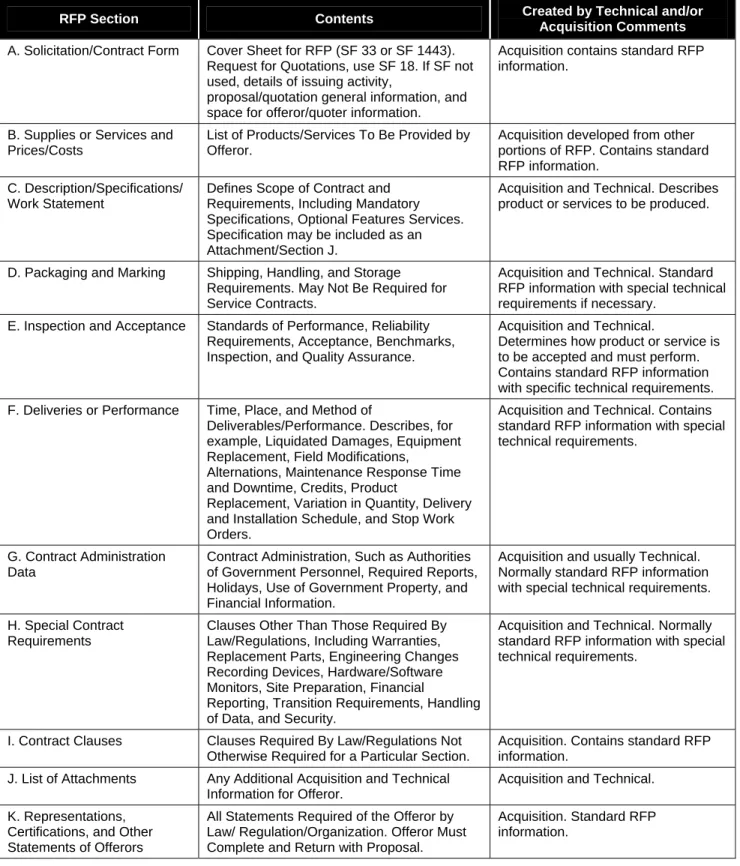
This document has two parts. The first part, Section 2, explains the integration of information security into the SDLC. Appendixes A and B contain resource material that can be used during the system acquisition process. Appendix A provides the standard format for a Request for Proposals and Appendix B contains specifications and contract language for specific information security measures that can be included in information system acquisitions.
NIST has prepared the following separate document to address information system security service issues: NIST SP 800-35, Guide to Information Technology Security Services. Performance based contracting has emerged, in many cases, as a preferred method of acquiring services. The following web site provides a comprehensive overview of the performance based contracting process:
http://oamweb.osec.doc.gov/pbsc/index.html
The number and types of appropriate security controls may vary throughout a particular SDLC and acquisition cycle. The relative maturity of an organization’s security architecture may influence the types of appropriate security controls. The blend of security controls is tied to the mission of the organization and the role of the system within the organization as it supports that mission. One way to identify the ideal mix of management, operational, and technical security controls is with the risk management process. NIST has prepared the following document to address these issues: NIST SP 800-30, Risk Management Guide for Information Technology Systems.
This document uses the following words interchangeably: offeror, developer, manufacturer, and
contractor. Each of these words refers to a commercial entity that participates at various times throughout a system development. The applicability of each word depends on the phase of the SDLC and the type of system being developed.
1.4 Audience
This document is intended for the use of acquisition initiators (e.g., user, program manager, or contracting officer’s technical representative [COTR]), contracting officers, and information system security officials.
2. INCORPORATING
SECURITY
INTO THE INFORMATION SYSTEM
DEVELOPMENT LIFE CYCLE
To be most effective, information security must be integrated into the SDLC from its inception. This guide focuses on the information security components of the SDLC. First, a description of the key security roles and responsibilities that are needed in most information system developments is provided. Second, sufficient information about the SDLC is provided to allow a person who is unfamiliar with the SDLC process to understand the relationship between information security and the SDLC.
However, this guide does not provide an exhaustive description of the development and acquisition processes. (See the FAR and organization-specific policies and procedures for detailed information system acquisition information).
Many methods exist that can be used by an organization to effectively develop an information system. A traditional SDLC is called a linear sequential model. This model assumes that the system will be
delivered near the end of its life cycle. Another SDLC method uses the prototyping model, which is often used to develop an understanding of system requirements without actually developing a final operational system. More complex systems require more iterative development models. More complex models have been developed and successfully used to address the evolving complexity of advanced and sometimes-large information system designs. Examples of these more complex models are the: spiral model, component assembly model, and concurrent development model.
The expected size and complexity of the system, development schedule, and length of a system’s life will affect the choice of which SDLC model to use. In most cases, the choice of SDLC will be defined by an organization’s acquisition policy.
This guide incorporates security into the SDLC using the linear sequential model as an example. Because this model is the simplest of the various models, it is an appropriate platform for this discussion.
However, the concepts discussed in this section are applicable to any SDLC model.
2.1 Key Roles and Responsibilities for Development Initiatives
Many participants can have a role in information system developments depending on the nature and scope of the system. The names for the roles and titles will vary among organizations. Not every participant works on every activity within a phase. The determination of which participants need to be consulted in each phase is as unique to the organization as the development. With any development, it is important to involve the information security program manager and information system security officer (ISSO) as early as possible, preferably in the initiation phase.
2.1.1 Key Roles
A list of key roles is provided below. This list includes roles that are important to many information system acquisitions. In some small organizations, a single individual may hold multiple roles.
Chief Information Officer (CIO) – The CIO is responsible for the organization’s information system planning, budgeting, investment, performance and acquisition. As such, the CIO provides advice and assistance to senior organization personnel in acquiring the most efficient and effective information system to fit the organization’s enterprise architecture.
Contracting Officer1 – The Contracting Officer is the person who has the authority to enter into, administer, and/or terminate contracts and make related determinations and findings
Contracting Officer’s Technical Representative – The COTR is a qualified employee appointed by the Contracting Officer to act as their technical representative in managing the technical aspects of a particular contract.
Information Technology Investment Board (or equivalent) – The Information Technology (IT) Investment Board, or its equivalent, is responsible for managing the capital planning and investment control process defined by the Clinger-Cohen Act of 1996 (Section 5)
Information Security Program Manager – The Information Security Program Manager is responsible for developing enterprise standards for information security. This individual plays a leading role in introducing an appropriate, structured methodology to help identify, evaluate, and minimize information security risks to the organization. Information security program managers coordinate and perform system risk analyses, analyze risk mitigation alternatives, and build the business case for the acquisition of appropriate security solutions that help ensure mission
accomplishment in the face of real-world threats. They also support senior management in ensuring that security management activities are conducted as required to meet the organization’s needs.
Information System Security Officer – The Information System Security Officer is responsible for ensuring the security of an information system throughout its life cycle.
Program Manager (owner of data)/Acquisition Initiator/Program Official – This person represents programmatic interests during the acquisition process. The program manager, who has been involved in strategic planning initiatives of the acquisition, plays an essential role in security and is, ideally, intimately aware of functional system requirements
Privacy Officer2 – responsible for ensuring that the services or system being procured meet existing privacy policies regarding protection, dissemination (information sharing and exchange) and
information disclosure.
Legal Advisor/Contract Attorney – responsible for advising the team on legal issues during the acquisition process.
2.1.2 Other Participants
The list of roles in an information system development can grow with the complexity involved in
acquiring and managing information systems. It is vital that all development team members work together to ensure that a successful development is achieved. Because the system certifier and accreditor must make critical decisions throughout the development process, they should be included as early as possible in the process. System users may assist in the development by helping the program manager to determine the need, refine the requirements, and inspect and accept the delivered system. Participants may also include personnel who represent IT, configuration management, design and engineering, and facilities groups.
1 Federal Acquisition Regulation Section 2.101
2
In some organizations, there may not be a formal designation of a privacy officer. However, the responsibilities of the
2.2 Expressing Security Properties
Articulation of the desired system security properties is necessary to integrating security into the SDLC depends on. When an organization determines a system’s security properties, the security properties are referred to as “security requirements.”
As explained below, the first phase in the SDLC is Initiation. During this phase, an organization determines its information security
requirements. Often, the requirements are developed by successive refinement. The articulation of requirements starts at a high level of abstraction, often centered on the security objectives for the system. The high-level security requirements for the
organization may include an information security policy and enterprise security architecture.
High-level requirements are the basis for more detailed functional requirements. Additional specificity is then added to the high-level security requirements.
There are many ways to express high-level security requirements. One way to express these requirements is to use the concepts described in the Common Criteria for Information Technology Common Criteria Security Evaluation, International Organization for Standardization (ISO) 15408, known as the CC. The CC can provide a standard vocabulary and format for expressing the security requirements of a system. The specific document described in the CC to express security requirements for a product is the Protection Profile (PP)3. Although the intent of the CC is to use the PP to express product security requirements, the same concepts can be extended to express system security requirements. This extension of the CC has shown promise for large system developments. The concepts of the CC are extended4 in this document to provide an example of how system security requirements can be developed, but the CC is just one of many methods that can be used to develop and express security requirements and
specifications. An organization should use a process for expressing security requirements that is useful for that organization.
An enterprise security architecture is composed of a top-down set of identified trust modules that define network infrastructure domains and their
countermeasures or mitigation. The prioritized risks for each of these levels enable the selection of the appropriate level of mitigation per module. Further, enterprise security architecture may implement layered protections and define common security services that can be implemented across a network, e.g., integrity (including nonrepudiation and authenticity), confidentiality, and availability
requirements. Common security services also include access control and monitoring by intrusion detection systems and security information systems.
When an organization’s requirements are developed during the Acquisition/Development phase, the organization’s requirements regarding system performance are expressed as “specifications.” Because the CC does not observe the subtle difference between specification and requirement, some modification is necessary.
Some large system developments use more sophisticated acquisition strategies on the assumption that large system acquisitions using classic linear strategies (as discussed in this document) have experienced
3
The Common Criteria describes a protection profile as defining an implementation-independent set of security requirements and objectives for a category of products or systems, which meet similar consumers, needs for information security. A protection profile is intended to be reusable and to define requirements, which are known to be useful and effective in meeting the identified objectives.
4
unsatisfactory results. Strategies such as the spiral model5 are sometimes used in response to this challenge. Depending on the organization’s needs, the security aspects of acquisition and system development could also follow similar models, strategies, and processes.
Because a SDLC can extend 20 years or more, different project personnel and supporting service providers will fulfill each role over the cycle. The security characteristics of the system will evolve over this system lifecycle, along with most other system characteristics. The system requirements
documentation should be placed under configuration management as part of the total set of system documentation that evolves over the lifecycle.
2.3 IT Security in the SDLC
This section describes a number of steps that will help integrate IT security into the SDLC. This section explains each IT security step in each phase of the SDLC with the technical and security requirements being advanced together.
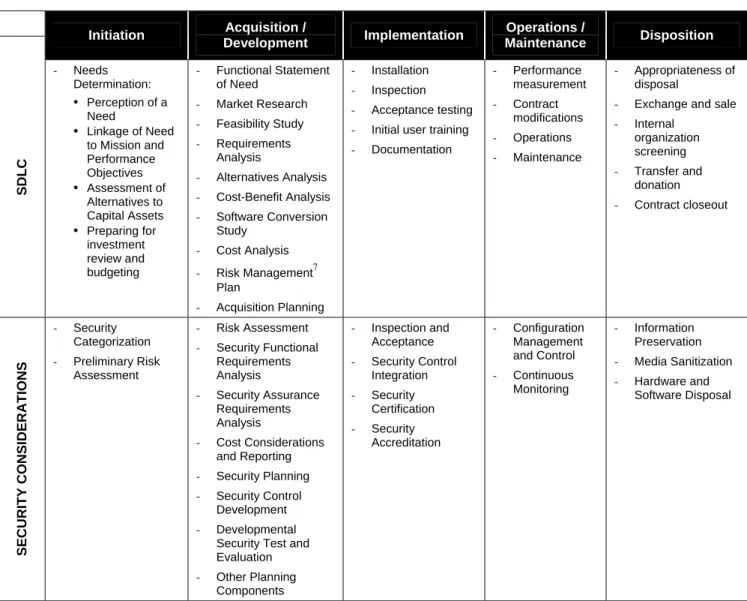
Table 2-1 shows how security fits into the SDLC. The security steps in this section describe analyses and processes to be accomplished. These steps define a conceptual framework for security planning during the SDLC. This framework should be used only as an example, not as a definitive methodology. The
framework contains descriptions of a core set of planning considerations that will lead to the production of information security acquisition specifications. Organizations can use other methodologies or modify the one presented here. It is also important to note that certain critical security activities may be
specifically performed by the organization acquiring the information system. For instance, certification and accreditation (C&A) is an activity performed by the organization integrating the information system into its operational environment. This activity can occur outside the bounds of the SDLC. In addition, an initial information security plan could be developed outside of the acquisition process. Other non-security activities include acceptance testing and installation.
The five basic phases of the SDLC as defined by NIST SP 800-18, Guide for Developing Security Plans for Information Technology Systems are:
Initiation Development/acquisition Implementation Operation/maintenance Disposition6. 5
Abrams, Marshall D., “Security Engineering in an Evolutionary Acquisition Environment,” ACM, Proceedings of New
Security Paradigms Workshop, 1998.
6
In evolutionary acquisition strategies like the spiral model, this phase may not be present. With the spiral model, the life cycle acquisition management process is organized into a series of phases and decision points. The circular representation of this process conveys the idea that a mission need is defined and translated into an advantageous solution, which goes through a continuous loop of evolution and improvement until it is retired. New products should have open architecture, modular design, standard interfaces, and portable software so they can evolve over time as additional capability is needed and when obsolete components must be replaced.
Table 2-1. IT Security in the SDLC Initiation Acquisition / Development Implementation Operations / Maintenance Disposition SDLC - Needs Determination: • Perception of a Need • Linkage of Need to Mission and Performance Objectives • Assessment of Alternatives to Capital Assets • Preparing for investment review and budgeting - Functional Statement of Need - Market Research - Feasibility Study - Requirements Analysis - Alternatives Analysis - Cost-Benefit Analysis - Software Conversion Study - Cost Analysis - Risk Management7 Plan - Acquisition Planning - Installation - Inspection - Acceptance testing - Initial user training - Documentation - Performance measurement - Contract modifications - Operations - Maintenance - Appropriateness of disposal
- Exchange and sale - Internal organization screening - Transfer and donation - Contract closeout SECURITY CONSIDERATIONS - Security Categorization - Preliminary Risk Assessment - Risk Assessment - Security Functional Requirements Analysis - Security Assurance Requirements Analysis - Cost Considerations and Reporting - Security Planning - Security Control Development - Developmental
Security Test and Evaluation - Other Planning Components - Inspection and Acceptance - Security Control Integration - Security Certification - Security Accreditation - Configuration Management and Control - Continuous Monitoring - Information Preservation - Media Sanitization - Hardware and Software Disposal 7
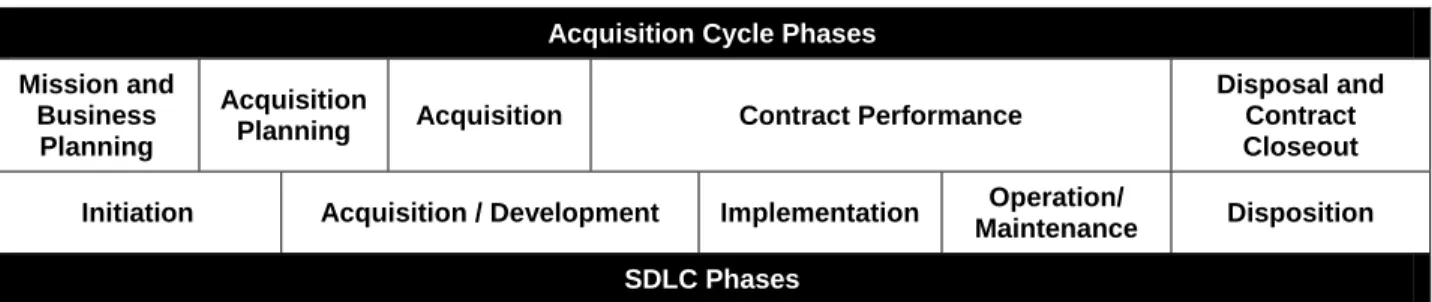
Table 2-2 is intended to assist system developers to better understand the relationship between the acquisition cycle8 and the five basic steps of the SDLC. A more detailed description of security planning of IT systems is presented in NIST SP 800-18.
Table 2-2. Relationship of Acquisition and IT System Development Phases Acquisition Cycle Phases
Mission and Business
Planning
Acquisition
Planning Acquisition Contract Performance
Disposal and Contract Closeout Initiation Acquisition / Development Implementation Operation/
Maintenance Disposition SDLC Phases
The steps described in this guide present a conceptual framework for information security planning and should be used as a guide, an example, or a roadmap. Other ways to organize the steps needed in the information security planning process may be acceptable. Security requirements should be selected to address the security objectives defined as a result of the preliminary risk assessment. Therefore, a complete mapping of security requirements can be made to counter the numerous threats to security.
2.3.1 Initiation
The first phase in the SDLC is Initiation. This section addresses the needs determination component of this phase.
2.3.1.1 Needs Determination
Needs determination is an initial definition of a problem that might be solved through automation. Traditional components of the needs determination are establishing a basic system idea, preliminary requirements definition, feasibility assessment, technology assessment, and some form of approval to further investigate the problem.
The acquisition / development phase can begin only after an organization has determined that a need exists. A need may have been determined during strategic or tactical planning. The needs determination phase is at a very high level in terms of functionality. No specifics of a system are defined here. The idea for a new or substantially upgraded system and the feasibility of the idea are explored. During this early phase of the development, the definition of the security requirement should begin with the security categorization and preliminary risk assessment.
Needs determination is an analytical activity that evaluates the capacity of an organization’s assets to satisfy existing and emerging demands. The security part of needs determination will result in a high-level description of the security controls in the proposed system and the assurance requirements. This material will be used to support the derivation of a cost estimate that addresses the entire life cycle. Total life-cycle costs, including implementation costs and in-service management costs, should be estimated. There may be a balance such that increased expenditures during acquisition may result in savings during system operation. The security implications of alternative architectures and technologies should be considered.
8
GSA publication, A Guide to Planning, Acquiring, and Managing Information Technology Systems, Version 1, December 1998.
Some of the considerations associated with needs determination may be security and acquisition sensitive and must be safeguarded appropriately. For example, threat analysis and efficacy of countermeasures should be safeguarded. In addition, certain enterprise security architecture and process specifics for multinode architectures should be safeguarded.
Investment analysis generates the information needed for determining the best overall solution for satisfying a mission need. Investment
analysis is defined as the process of managing the enterprise information system portfolio and determining an appropriate investment strategy. For example, an appropriate investment strategy may be to optimize mission need within budget constraints. The intent of investment analysis is to not only define in functional and performance terms that the capability the agency must have to satisfy mission need, but also determine and baseline the best overall solution(s) and associated costs for achieving that capability. Investment analysis is structured to translate mission need into high-level performance, assurance, and supportability requirements; conduct a thorough market analysis, alternatives analysis, and affordability assessment to
determine the best solution for obtaining needed capability; and quantify the cost, schedule, performance, and benefit baselines for that solution. An investment analysis will help to define, in functional and performance terms, the capability that the agency must have to satisfy mission need, to determine and baseline the best
overall solution(s) for achieving that capability, and to provide corresponding cost information.
Information security needs should address the appropriate level of assurance, because this is a significant cost driver.
The system PP format can be used for presenting the results of the needs determination and requirements analysis. As the system PP concept becomes more recognized throughout the security community, improved communication among stakeholders can occur because a more standardized approach is in use. In particular, communication of security
specifications to potential offerors can be greatly enhanced.
Further, a system PP acts as a record of the security analysis performed during this specification generation process. It provides a place to record the threats that are being considered, the security objectives that are being pursued, and the actual security specifications as they are created. Therefore, a system PP should be viewed as an evolving
document that is not simply the “result” of the initial security analysis, but is the full record of the security analysis performed during the course of the
specification generation process. Its creation is part of the initial analysis and its completion is realized when the full scope of the system is understood and specific security specifications are acknowledged. The completed security specification should be included by reference in the system Request for Proposal (RFP) or applicable acquisition document and later used in the risk management activity performed as part of the security C&A.
2.3.1.2 Security Categorization
FIPS Publication 199, Standards for Security Categorization of Federal Information and Information Systems, provides a standardized approach for establishing security categories for an organization’s information and information systems. The security categories are based on the potential impact on an organization should certain events occur which jeopardize the information systems needed by the organization to accomplish its assigned mission, protect its assets, fulfill its legal responsibilities, maintain its day-to-day functions, and protect individuals. Security categories are to be used in
conjunction with vulnerability and threat information in assessing the risk to an organization by operating an information system. FIPS Publication 199 defines three levels (i.e., low, moderate, or high) of potential impact on organizations or individuals should there be a breach of security (a loss of confidentiality, integrity, or availability). The security categorization standards assist organizations in making the appropriate selection of security controls for their information systems.
2.3.1.3 Preliminary Risk Assessment
The preliminary risk assessment should result in a brief initial description of the basic security needs of the system. In practice, the need for information security protection is expressed in terms of the need for integrity, availability, and confidentiality and other security needs that may be applicable (e.g.,
accountability, nonrepudiation). Integrity can be examined from several perspectives. From a user’s or application owner’s perspective, integrity is the quality of data that is based on attributes such as accuracy and completeness. From a system’s or operation’s perspective, integrity is the quality of data that it is only changed in an authorized manner or that the system/software/process does what it is supposed to do and nothing more. Like integrity, availability also has a multipart definition. Availability is the state when data or a system is in the place needed by the user, at the time the user needs it, and in the form needed by the user. Confidentiality is the privacy, secrecy, or nondisclosure of information except to authorized individuals.
A preliminary risk assessment should define the threat environment in which the product or system will operate. This assessment is followed by an initial identification of required security controls that must be met to protect the product/system in the intended operational environment. The risk-based approach to information security is defined in NIST SP 800-30, Risk Management Guide for Information Technology Systems. A source for the derivation of required security controls is the forthcoming NIST SP 800-53,
Recommended Security Controls for Federal Information Systems. This step does not require an elaborate assessment scheme.
2.3.2 Acquisition / Development
The second phase in the SDLC is Acquisition / Development. This section addresses one specific SDLC component (requirements analysis) and security considerations unique to this second phase.
Although this section presents the information security components of the requirements analysis in a sequential top-down manner, the order of completion is not necessarily fixed. Any starting point that is appropriate for the acquisition can lead to successful completion. Security analysis of complex systems will need to be iterated until consistency and completeness is achieved.
2.3.2.1 Requirements Analysis
Agencies establish and document requirements for information system resources in the Acquisition / Development phase by conducting a requirements analysis commensurate with the size and complexity of the need. The requirements analysis is an in-depth study of the need. The requirements analysis draws on and further develops the work performed during the Initiation phase.
2.3.2.2 Risk Assessment
The first step in analyzing the security functional requirements is to identify the protection requirements for the system through a formal risk assessment process. The analysis will build on the initial risk assessment performed during the Initiation phase, but will be more in-depth and specific.
The periodic assessment of risk to agency assets or operations resulting from the operation of an information system is an important activity required by FISMA. The risk assessment brings together important information for agency officials with regard to the protection of the information system and generates essential information required for the security plan. The risk assessment includes: (i) the identification of threats to and vulnerabilities in the information system; (ii) the potential impact or magnitude of harm that a loss of confidentiality, integrity, or availability would have on agency assets or
operations (including mission, functions, image, or reputation) should there be a threat exploitation of identified vulnerabilities; and (iii) the identification and analysis of security controls for the information system. Agencies should consult NIST Special Publication 800-30, Risk Management Guide for
Information Technology Systems, or other similar publications for guidance on conducting risk assessments.
In addition to considering the security perspective of the system being acquired, organizations should also consider that the system might affect other systems to which it will be directly or indirectly connected. One way to incorporate the context is to have an enterprise security architecture. Without an enterprise perspective, the acquisition could be suboptimal, even to the extent of introducing vulnerabilities. If the enterprise context is not considered, there is a possibility that the system being acquired could
compromise the other enterprise systems. The system being acquired may have a trust relationship with other enterprise systems, increasing the consequences of a compromise.
Each enterprise system should address several enterprise-wide security objectives:
A specific enterprise system should not create vulnerabilities or unintended interdependencies in other enterprise systems.
A specific enterprise system should not decrease the availability of other enterprise systems.
The security posture of the set of all the enterprise systems should not be decreased because of this specific enterprise system.
External domains not under enterprise control should be considered potentially hostile entities. The systems connected to such external domains must analyze and attempt to counter hostile actions originating from these domains.
Security specifications should be appropriate for the given state of the system environment.
Security specifications should be stated clearly to convey the desired functions and assurances to the enterprise system product team and the developers.
Implemented specifications should sufficiently reduce the risks to the enterprise system and to the enterprise mission that the system supports.
The security risk assessment should be conducted before the approval of design specifications. In addition, a security risk assessment can provide justification for specifications. This risk assessment will not necessarily be a large and complex document. This security risk assessment should take into
consideration existing controls and their effectiveness. This security risk assessment will require participation by people who are knowledgeable in the disciplines within the system domain (e.g., users, technology experts, operations experts, etc.).
The selection of appropriate types of safeguards or countermeasures should take into consideration the results of the security assurance requirements analysis. The security risk assessment, in turn, may identify deficiencies in the analysis of integrity, confidentiality, and availability requirements or the security assurance requirements analysis by demonstrating the logical conclusion of the analyses. The analysis should be iterated until consistency is achieved.
2.3.2.3 Security Functional Requirements Analysis
The security functional requirements analysis may include the two sources of system security
requirements: (1) system security environment, (i.e., enterprise information security policy and enterprise security architecture) and (2) security functional requirements.
This process should include an analysis of laws and regulations, such as the Privacy Act, FISMA, OMB circulars, agency enabling acts, NIST Special Publications and FIPS, and other legislation and federal regulations, which define baseline security requirements. After a review of mandated requirements, agencies should consider functional and other security requirements.
The legal, functional, and other IT security requirements should be stated in specific terms. For complex systems, more than one iteration of the requirements analysis may be needed.
Because most systems have at least minimal integrity and availability requirements, care should be taken to clearly address these areas. Information security is more than confidentiality. Even systems with low confidentiality requirements need security to meet integrity and availability requirements.
2.3.2.4 Security Assurance Requirements Analysis
The correct and effective use of information security controls is a fundamental building block of information security. Assurance is the grounds for confidence that an entity will meet its security objectives. Assurance supports the confidence that the security controls being acquired will operate correctly and will be effective in the operational environment.
This analysis should address the developmental activities required and assurance evidence needed to produce the desired level of confidence that the information security will work correctly and effectively. The analysis, based on legal and security functional requirements, will be used as the basis for
determining how much and what kinds of assurance are required. As with other aspects of security, the goal should be cost-effective assurance that meets the requirements for protection of an organization’s information assets. In each situation, a balance should exist between the benefits to mission performance from system security and the risks associated with operation of the system.
Some methods of obtaining information about a system’s quality through testing and evaluation include the following:
Common Criteria. The CC uses security requirements, such as the evaluation assurance levels [EAL] to provide assurance based on an evaluation (active investigation) of the product or
information system that is to be trusted. The assurance requirements can be found in Part 3 of the CC. The components prescribe specific developer action elements, content and presentation elements, and evaluator action elements.
The National Information Assurance Partnership (NIAP) CC Evaluation and Validation Scheme (CCEVS) assesses the security features and assurances of commercial off-the-shelf (COTS) products. The NIAP CCEVS uses a network of private sector, accredited testing laboratories called CC Testing Laboratories (CCTL) to independently evaluate a range of commercial products against the CC in a variety of key technology areas. These include operating systems, database systems, firewalls, smart cards, biometrics devices, routers, gateways, browsers, middleware, virtual private networks (VPN), and public key infrastructure (PKI) components. These products are evaluated against a set of security requirements and specifications from the International Organization for Standardization/International Electrotechnical Commission (ISO/IEC) 15408, Common Criteria for IT Security Evaluation.
Member nations of the CC Recognition Arrangement (CCRA) have agreed to recognize the results of the evaluations performed in all member nations and to identify government-evaluated IT products and PPs on their respective validated products lists (VPL). The NIAP VPL can be accessed at:
–
http://niap.nist.gov–
http://commoncriteria.org Validation testing for Cryptographic Modules and Algorithms. The NIST Cryptographic Module Validation Program (CMVP) uses independent, accredited, private-sector laboratories that perform conformance testing of cryptographic modules against Federal Information Processing Standard (FIPS) 140-2, Security Requirements for Cryptographic Modules, and related federal cryptographic algorithm standards. NIST accredits these labs to ensure that the security standards are being applied correctly and consistently. In the case of cryptographic modules, when agencies have determined the need to protect information via cryptographic means they may only select CMVP validated
cryptographic modules.
Third-Party Evaluations. Government agencies evaluate products for use in their environments. These evaluations may or may not be published and are normally not considered to be endorsements by the agencies. Trade and professional organizations are possible sources of independent
evaluations. Commercial organizations may offer product assurance testing and evaluations. When using third-party evaluations, the independence and objectivity of the evaluation should be
considered. Offerors should be asked to provide information about evaluations that they consider pertinent to their proposal.
Accreditation of a System to Operate in a Similar Situation. These accreditations are not usually published. It is important to ask offerors to supply the accreditation results. These, even more so than evaluations, are not usually endorsements. Accreditations are environment and system specific. Because accreditation balances risk against benefits, the same product may be accredited for one environment but not for another.
Test and Evaluation Following a Formal Procedure. A vendor self-certification does not rely on the work of an impartial or independent reviewer. It is a vendor’s technical evaluation of a system to see how well it meets an internally stated security requirement. Even though this method does not provide an impartial review, it can still provide some assurance. The certification report can be read to determine if the security requirement was defined and if a meaningful review was performed.
Test and Evaluation Under the Auspices and Review of an Independent Organization. This method may be able to combine the lower cost and greater speed of a self-certification with the impartiality of an independent review. The review, however, may not be as thorough as a formal evaluation or testing process.
The concept of assurance is further described in NIST SP 800-23, Guidelines to Federal Organizations on Security Assurance and Acquisition/Use of Tested/Evaluated Products.
2.3.2.5 Cost Considerations and Reporting
Most new acquisitions are evaluated in a department or agency’s capital planning process—the systematic approach to managing the risks and returns of IT investments for a given mission. A key component of this process is determining how much the acquisition will cost over its life cycle. These costs include hardware, software, personnel, and training. Another critical area often overlooked is security.
The task of identifying costs attributable to security can be complex. The best input for this task comes from the risk management process. As previously described, the first step, risk assessment, results in recommended controls that will mitigate the identified vulnerabilities. In the second step, risk mitigation, organizations conduct a cost-benefit analysis on the recommended controls to determine whether they are cost effective given the likelihood of an incident and the potential impact. Once the controls are selected, the cost of each can be totaled for an overall security cost.9
To ensure that adequate attention is paid to security, OMB has included it as a specific line item in several separate budget reports. The first report is Exhibit 300, the Capital Asset Plan. This report is described in OMB Circular A-11, Part 3, “Planning, Budgeting, and Acquisition of Capital Assets,” and is required for each new and ongoing major acquisition included in the agency’s capital asset portfolio. Information security is a key component in this document; indeed, an entire section is devoted to demonstrating that security and privacy have been adequately considered. Specific security dollar amounts for the budgeted fiscal year must be included with the Exhibit 300 submissions. Criteria for determining whether a project requires an Exhibit 300 submission are provided in the circular.
Funding information is provided in the related Exhibit 53, “Agency Information Technology Investment Portfolio.” Information regarding security costs must be provided in this exhibit in the form of a
percentage of the overall funding.
Finally, the costs for security are aggregated into the agency’s annual FISMA report, which is submitted each fall with the budget submission.
Including security at the beginning of the SDLC is often considered the most cost effective approach for two reasons: (1) it is usually more difficult to add functionality into a system after it has been built; and (2) it is frequently less expensive to include the preventive measures to deal with the cost of a security incident. Further information about this topic can be found in OMB Memorandum 00-07, “Incorporating and Funding Security in Information Systems Investments.”1011
2.3.2.6 Security Planning
FISMA requires agencies to have plans for information security programs to assure adequate information security for networks, facilities, information systems, or groups of information systems, as appropriate. The preparation of a security plan for an information system ensures that required security controls (planned or in place) are fully documented. The security plan also provides a complete characterization or description of the information system. Attachments may include references to key documents supporting the agency’s information security program (e.g., configuration management plan, contingency plan, incident response plan, security awareness and training plan, rules of behavior, risk assessment, security test and evaluation results, system interconnection agreements, security authorizations/accreditations, and plan of action and milestones12). Agencies should consult NIST Special Publication 800-18, Guide for Developing Security Plans Information Technology Systems, or other similar publications for guidance on creating security plans. Agencies should also consult NIST Special Publication 800-53, Recommended
9
The cost of some security functionality will not be able to be determined as a discrete cost. These costs are the costs associated with built-in security elements or features of an application or service, such as password functionality. In addition, many applications or systems will rely upon the security provided by the network.
10
http://www.whitehouse.gov/omb/memoranda/m00-07.html
11
Additional information can be found at: http://csrc.nist.gov/roi/
12
The results of security testing and evaluation may uncover deficiencies in the security controls employed to protect an information system. A detailed plan of action and milestone schedule are required to document the planned corrective measures needed to increase the effectiveness of the security controls and provide the requisite security for the information system prior to security authorization. The authorizing official normally reviews and must approve the plan of action and milestone schedule prior to authorizing operation of the information system.
Security Controls for Federal Information Systems, (Initial public draft projected for publication, Fall 2003), and similar publications for guidance on selecting security controls.
2.3.2.7 Security Control Development
For new information systems, the security controls described in the respective security plans are designed, developed, and implemented. The security plans for information systems currently in operation may call for the development of additional security controls to supplement the controls already in place or the modification of selected controls that are deemed to be less than effective.
2.3.2.8 Developmental Security Test and Evaluation
The security controls developed for a new information system must be tested and evaluated prior to deployment to ensure that the controls are working properly and are effective. Some types of security controls (primarily those controls of a non-technical nature) cannot be tested and evaluated until the information system is deployed—these are typically management and operation level controls. For those security controls that can be assessed prior to deployment, a security test and evaluation plan is developed. This plan guides the developmental security testing and evaluation of the security controls and provides important feedback to information system developers and integrators.
2.3.2.9 Other Planning Components
Several other parts of the Acquisition / Development phase contribute to IT security.
Type of Contract
The type of contract (for example, firm fixed price, time and materials, cost plus fixed fee, etc.) can have significant security implications. The IT security technical experts developing the specifications and the contracting officer should work together to select the contract type that will be most
advantageous to the organization.
Review by Other Functional Groups
Depending on the size and scope of the system, a team or group of participants from various
functional groups (for example, legal, human resources, information security, physical security, etc.) may be useful. Even for small systems, it may be helpful to obtain assistance from the information security staff. These functional groups should have insight into the integrity, availability,
confidentiality and assurance requirements. Involving these groups early in the planning process is important because it may result in reduced life-cycle costs, and it is easier to change requirements in the early stages. The information security staff can –
- Demonstrate that the security plan for the system includes security controls that are consistent with the agency’s IT architecture
- Ensure that the security plan manages risks, protects privacy and confidentiality, and explains variance from NIST security guidance.
Review by Certifier and Accreditor
OMB Circular A-130, Appendix III, requires that systems be approved, or authorized, to process data in specific environments. Management and operational security controls should be employed to protect the system. Additionally, the technical security functional and assurance security
specifications must be contained in the contract with the developer. These security controls should be factored into the development of the technical specifications. The accreditor can take these
assumptions13 into account when deciding on the adequacy of the total set of security controls for reducing the residual risks to an acceptable level.
The management and operational security controls can sometimes be outside the scope of the contract. In particular, the developer obviously cannot be responsible for the organization’s implementation of these security controls.
In contrast, C&A testing also includes management and operational security controls implemented by the organization. Determination of the efficacy of these organization-implemented security controls is part of C&A testing. C&A processes should confirm that the assumptions in the system security requirements have been implemented as assumed and that the total set of security controls are adequate to reduce the residual risks to an acceptable level. Acceptance testing of the security properties of the contractor-developed system is a prerequisite to security testing as part of the C&A process.
Because the accreditor is responsible for accepting the risk of operating the system, the accreditor can advise the development team if the risks associated with eventual operation of the system appear to be unacceptable. Specifications can impose excessive burden and costs if the acceptable residual risks are not known. The involvement of the accreditor is required for this determination of acceptable residual risks. It is easier to incorporate requirement changes during the planning stage of a system acquisition than during the solicitation, source selection, or contract administration stages.
The development team and the accreditor should also discuss the forms of evidence that the accreditor needs to make a decision. This evidence may include system test results and other data. In addition, the acquisition initiator and the accreditor should discuss how changes to the system and its
environment would be addressed. The possibility of establishing a security working group should be discussed. Such a group may consist of personnel, such as users, program managers, and application sponsors; system, security, or database administrators; security officers or specialists, including the C&A representatives; and system or application analysts. Section 3.6, Contract Performance and Closeout, presents specifications for this group.
For further information about C&A, see the forthcoming NIST SP 800-37, Guidelines for the Security Certification and Accreditation of Federal Information Systems.
Cyclical Nature of the Process
The security steps in the Acquisition / Development phase may need to be addressed cyclically. These steps interrelate and build on each other. Depending on the size and complexity of the system, these steps may be performed often as ideas are refined.
Evaluation and Acceptance
The system evaluation plan and appropriate acceptance criteria are developed in the Acquisition / Development phase. The solicitation should be designed for evaluation, which should include testing and analysis. Specifications should be written in a way to make it easy to clearly determine if the implemented system complies with the specification. In general, two separate activities require security testing – contract acceptance and C&A.
13
One advantage of using the system PP format is that a well-defined place exists for assumptions about the system environment, including such management and operational security controls.
Contract acceptance usually addresses only the functional and assurance security specifications contained in the contract with the developer. C&A testing also includes management and operational security controls implemented by the organization. The existence and correct operation of controls, which may be assumed by the developer, may have been included as assumptions in the system security requirements. An adequate determination of the organization’s security controls as
implemented is part of C&A testing. Acceptance testing of the security properties of the developed system is a prerequisite to security testing under the C&A process.
Request for Proposal Development
An RFP enables the Government to make a best value decision based on an offeror’s proposal. A strength of the RFP process is the flexibility it provides the Government and offeror to negotiate a contract that best meets the Government’s needs.
The Government can identify needed IT security features, procedures, and assurances in many ways. An RFP can be a flexible document. Guidance on acquisition alternatives should be obtained from the organization acquisition office or the contracting officer.
Security Specifications and Statement of Work Development
Specifications and the SOW are based on the requirements analysis. The specifications provide detail of what the system is supposed to do. Specifications should also be written independently of the implementation mechanisms, strategy, and design. In other words, the specifications should state
what the system is to do, not how.
The security functional requirements in a system PP based on the CC are excellent examples of security specifications. The choice of words in the PP as “functional requirements” should not be confusing; for contracting purposes, these are actually specifications.
The developer’s implementation of the system in conformance with the specifications can and should be tested. This implies that well written specifications are those that can be tested.
The SOW details what the developer must do in the performance of the contract. Any deliverable that is not part of the system is specified in the SOW. Documentation developed under the contract, for example, is specified in the SOW. The security assurance requirements in a system PP based on the CC are excellent examples of SOW tasking. The security assurance requirements detail many aspects of processes the developer follows and what evidence must be provided to assure the organization that the processes have been conducted correctly and completely. The list of all deliverables that are not parts of the system is called the Contract Data Requirements List (CDRL). The specification of what a deliverable must contain is called the Data Item Description (DID). It is important that the security specifications in the SOW are instantiated in corresponding CDRLs and DIDs.14
There is an exception to the general rule that security functional requirements map into security specifications. Selection of mechanisms to implement security functions may occur during the system operation life cycle rather than during proposal preparation. Such decisions may be deferred to the system operational life cycle to respond to changes in technology or the security environment. For example, the authentication mechanism may change from memorized reusable password to token to biometric technique during the life cycle. The acquiring organization may deal with selection of mechanisms to implement security functions during the system operation life cycle by tasking the
14
developer in the SOW to perform a study and to recommend a mechanism or combination of mechanisms. The selection of the mechanism or combination of mechanisms remains the procuring organizations function.
Where possible, the organization should support interoperability by specifying mechanisms that comply with open standards at an appropriate level.
Experience has shown that if the specifications, SOW, CDRLs, and DIDs do not delineate the
security properties of the system completely and unambiguously, then the system may not achieve the desired level of security.
The following sections describe two sources for information security specifications: general
specifications and federally mandated specifications. The acquisition initiator should focus on what is required and work with the contracting officer to determine the best way to ask for it.
- General Specifications
Many sources of general information security specifications are available and include NIST guidance documents and guidance from other federal agencies, commercial sources, and trade organizations.
General information security specifications should be reviewed for applicability to the system being procured. These specifications may provide information about overlooked areas. They can also save time because they provide language that can be used directly. However, care should be taken when selecting features, procedures, and assurances from these sources. The items may be grouped in these documents based on interdependencies among the items. It is necessary to understand the features, procedures, assurances, and groupings before specifying them separately. Each specification must be justified from the requirements analysis, specifically from the risk assessment. Safeguards recommended by a general source should be considered, but they should not be included in an RFP if the risk assessment does not support them.
- Federally Mandated Specifications
Agencies must also include additional specifications in the RFP, as required by law. These are often referred to as directed specifications. All federal agencies must ensure that systems comply with applicable FIPS publications. Agencies must also comply with OMB Circular A-130. Agencies may require directed specifications, which are official policies issued with the concurrence of organization’s legal and acquisition officials.
Directed specifications must be incorporated in an RFP or other applicable acquisition document if the system being acquired matches the criteria in the directed specification. It is very important to be aware of directed specifications.
It is the acquiring agency’s responsibility to incorporate applicable law, regulations, and policy in the RFP. In addition to mandates affecting the entire Executive Branch, each department and independent agency has its own set of directives, orders, and standards.
Merely citing the requirements separately from technical specifications has proven to be