3.
QUALITY ASSURANCE REQUIREMENTS
3.1 General
This section covers the Kaipara District Council requirements for monitoring and testing of physical asset construction to ensure that the final asset delivered to the future owners is a quality product and that statutory obligations are met.
3.2 General Construction and Monitoring Requirements 3.2.1 Independent Qualified Persons
All investigation, calculations, design, supervision and certification of the works referred to in these Engineering Standards shall be carried out by persons who:
Have the appropriate experience in the relevant areas;
Hold appropriate qualifications and membership of professional bodies; Have professional indemnity insurance to the value of at least $1,000,000.
3.2.2 Contractors
All construction works carried out in any development shall be done by persons who: Have the appropriate experience in the relevant areas;
Have the appropriate equipment;
Meet the requirements of the Health and Safety in Employment Act 1992; Have public liability insurance to the value of at least $2,000,000.
3.2.3 Liability
(a) The approval of engineering plans under the requirements of these Engineering Standards means that, subject to any consent conditions specified, the design of infrastructure systems and development works is deemed to meet the minimum design requirements for these services and structures.
(b) It remains the Consent Holder‟s responsibility to comply with all statutes, regulations, bylaws, requirements, and obligations, give all notices, obtain all necessary consents and provide for the protection of other property from damage resulting from the development.
(c) The maintenance and repair period for any asset vested in Council or communally owned private asset shall be 12 months (3 years for landscaping work) from the date of issue of the s224(c) Certificate, or as specified in conditions of a resource consent. During this period the Consent Holder is responsible for remedying, replacing or repairing any non-complying or non functioning asset arising from defective materials or construction. The Consent Holder is not responsible for fair wear and tear.
3.2.4 Insurances
(a) The Consent Holder's Contractor shall have public liability insurance in the joint names of the Consent Holder and the Council, for a minimum sum amount of $2,000,000.
(b) IQPs shall have professional indemnity insurance to a minimum value of $1,000,000. All personnel under the IQP‟s control shall also be covered by professional indemnity insurance to this level.
(c) The Consent Holder shall provide evidence of insurance cover with the Supporting Documentation.
Guidance Note:
Higher sums may be required for larger projects. This will be agreed between the Consent Holder‘s representative and Council prior to lodgment of the resource consent application.
3.2.5 Health and Safety in Employment Act
(a) Where work is being undertaken on Council controlled land, the Consent Holder, their representative, their contractors and any subcontractors shall comply with all the requirements of the Health and Safety in Employment Act 1992, including any Regulations made pursuant to section 21 of that Act.
(b) The contracts for construction of the works shall include a requirement for the contractor to provide a health and safety plan for construction and nominate a health and safety supervisor.
(c) The Consent Holder shall ensure that their contractors submit to Council site specific health and safety plans for any part of the works on or adjoining public land (including Roads) or private property not in the ownership of the Consent Holder for verification prior to the commencement of works.
(d) The plans shall address all known hazards and other health and safety aspects that are particular to the places of work involved. Such aspects include the work practices and work methods that a contractor proposes to use to execute the works as they affect both the contractor‟s employees and the public in general. The plan shall include traffic management and control procedures to be implemented on adjacent road land and site access points. The plans shall be updated as works progress to incorporate hazards unforeseen at the commencement of the project.
(e) The Council reserves the right to inspect the place(s) of work from time to time to monitor the Consent Holders/contractors compliance with the Act. The inspection and the outcomes there from shall be appropriately recorded. The Consent Holder and contractor shall be represented at such inspections and shall provide the Council, upon request, with the accident/incident reports and statistics maintained for the place(s) of work. The Consent Holder shall be liable for any costs incurred in complying with the Health and Safety in Employment Act following such inspections.
3.2.6 Traffic Management
(a) The Consent Holder shall be responsible for the provision of watchmen/flagmen and the provision, erection, maintenance and, when no longer required, the removal of all barricades, fencing, temporary roadways and footpaths, signs and lighting necessary for the effective protection of property, for control of traffic and for the safety of others.
(b) Traffic management plans are required for all work carried out on a Council Road, including the construction or upgrading of Vehicle Crossings. The traffic management plans shall be submitted to Council for approval and approved prior to construction commencing.
(c) The Council‟s minimum requirements for traffic control are those standards and rules set out in the New Zealand Transport Agency publication “Code of Practice for Temporary Traffic Management” and its revisions. When relevant, requirements in excess of these will be set out in the consent conditions or the engineering plan approval.
3.2.7 Protection of Existing Assets
(a) Any damage caused by the Consent Holder's works shall be the responsibility of the Consent Holder and shall be repaired as soon as possible to Council's satisfaction. If remedial work is not commenced within 48 hours of the written instruction to do so by Council, the Council may carry out the work at the Consent Holder's cost. This requirement includes the removal of mud and debris from Council Roads. This may be required daily in the interest of traffic safety and protection of road seal.
(b) Where the Council has had to carry out work on behalf of the Consent Holder from an emergency point of view, the cost of the work will be recovered from the Consent Holder.
3.2.8 Hours of Work
Unless otherwise approved by Council‟s Asset Manager or the conditions of a resource consent, all construction work shall be restricted to the hours of 7.00 am to 7.30pm Monday to Friday and 7.30am to 6.00pm on Saturdays, and during daylight. For the purposes of this clause daylight is defined as the period commencing at the official time of sunrise and ending at the official time of sunset.
3.3 Construction Management Plan
A Construction Management Plan shall be prepared and submitted to Council for approval, for all earthworks and roading works associated with a subdivision or land use consent. As a minimum the Construction Management Plan shall cover the following details:
(i) Details of the site manager including full contact details;
(ii) Construction methodology including proposed plant and machinery to be utilised;
(iii) Proposed procedures for controlling sediment runoff and dust generation; (iv) Programme of works;
(v) Proposed hours of work on the site;
(vi) Details of the number and timing of truck movements on the access route to the site;
(vii) Details of any proposed materials storage areas; (viii) Traffic management plans;
(ix) Proposed communication strategy to advise members of the public of the construction works;
(x) For all road construction works, the Consent Holder shall give Council‟s Asset Manager at least 10 working days notice of commencement of any works on any Council Road.
3.4 Quality Documentation
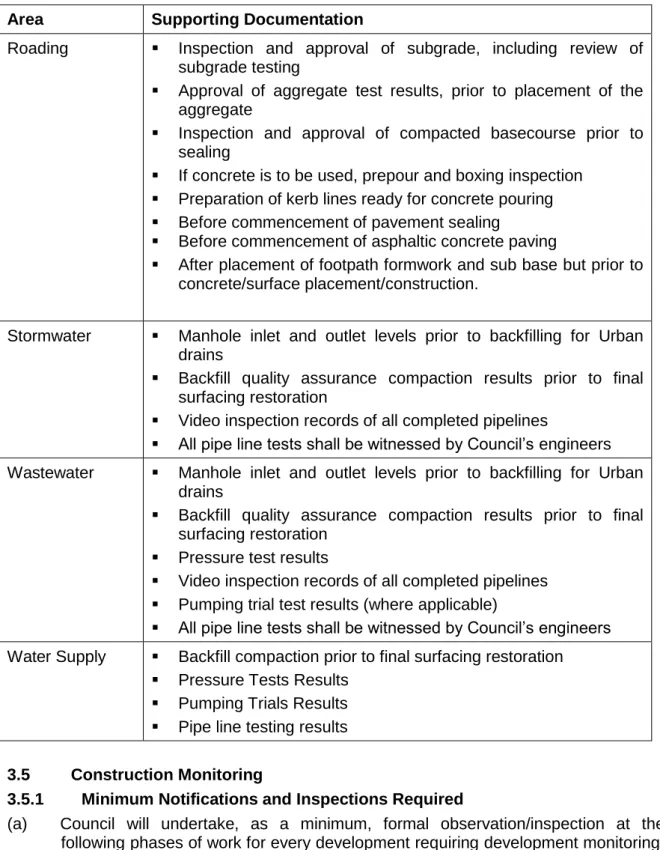
(a) A quality plan shall be provided detailing all testing to be undertaken during the design and construction phases including location and frequency.
Table 3.1: Construction Quality Documentation Requirements
Area Supporting Documentation
Roading Inspection and approval of subgrade, including review of subgrade testing
Approval of aggregate test results, prior to placement of the aggregate
Inspection and approval of compacted basecourse prior to sealing
If concrete is to be used, prepour and boxing inspection Preparation of kerb lines ready for concrete pouring Before commencement of pavement sealing
Before commencement of asphaltic concrete paving
After placement of footpath formwork and sub base but prior to concrete/surface placement/construction.
Stormwater Manhole inlet and outlet levels prior to backfilling for Urban drains
Backfill quality assurance compaction results prior to final surfacing restoration
Video inspection records of all completed pipelines
All pipe line tests shall be witnessed by Council‟s engineers Wastewater Manhole inlet and outlet levels prior to backfilling for Urban
drains
Backfill quality assurance compaction results prior to final surfacing restoration
Pressure test results
Video inspection records of all completed pipelines Pumping trial test results (where applicable)
All pipe line tests shall be witnessed by Council‟s engineers Water Supply Backfill compaction prior to final surfacing restoration
Pressure Tests Results Pumping Trials Results Pipe line testing results
3.5 Construction Monitoring
3.5.1 Minimum Notifications and Inspections Required
(a) Council will undertake, as a minimum, formal observation/inspection at the following phases of work for every development requiring development monitoring. In some cases additional inspections may be required. These additional inspections/tests will be outlined in the engineering plan approval.
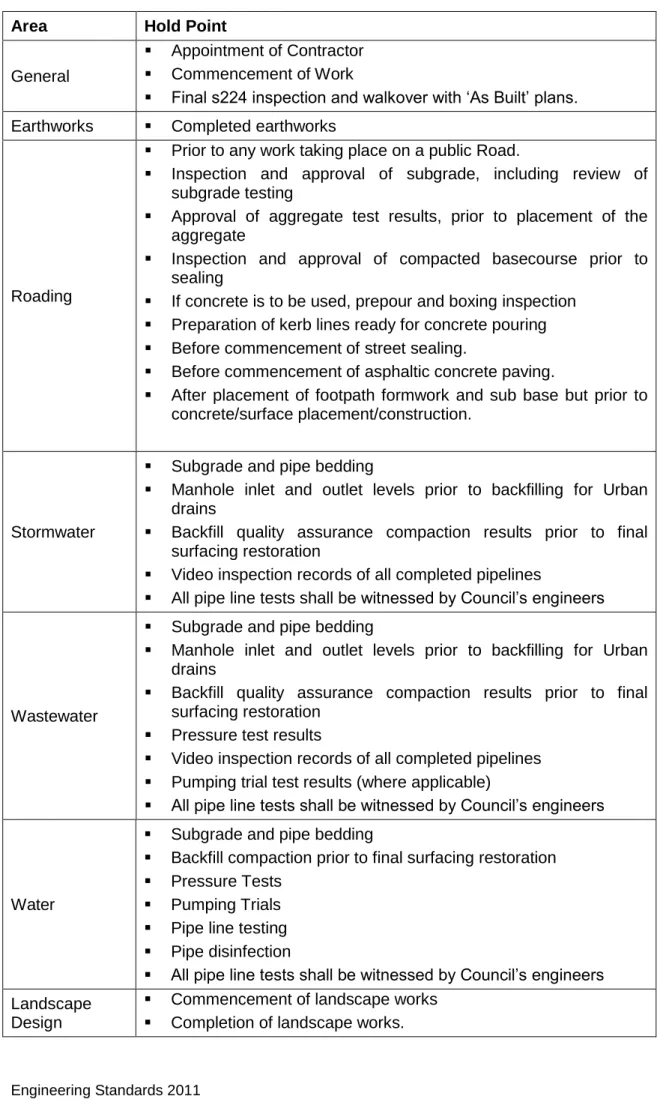
(b) The Consent Holder‟s representative shall notify Council in writing (email included) when the Hold Points specified in Table 3.2 have been reached;
Table 3.2: Hold Points
Area Hold Point
General
Appointment of Contractor Commencement of Work
Final s224 inspection and walkover with „As Built‟ plans. Earthworks Completed earthworks
Roading
Prior to any work taking place on a public Road.
Inspection and approval of subgrade, including review of subgrade testing
Approval of aggregate test results, prior to placement of the aggregate
Inspection and approval of compacted basecourse prior to sealing
If concrete is to be used, prepour and boxing inspection Preparation of kerb lines ready for concrete pouring Before commencement of street sealing.
Before commencement of asphaltic concrete paving.
After placement of footpath formwork and sub base but prior to concrete/surface placement/construction.
Stormwater
Subgrade and pipe bedding
Manhole inlet and outlet levels prior to backfilling for Urban drains
Backfill quality assurance compaction results prior to final surfacing restoration
Video inspection records of all completed pipelines
All pipe line tests shall be witnessed by Council‟s engineers
Wastewater
Subgrade and pipe bedding
Manhole inlet and outlet levels prior to backfilling for Urban drains
Backfill quality assurance compaction results prior to final surfacing restoration
Pressure test results
Video inspection records of all completed pipelines Pumping trial test results (where applicable)
All pipe line tests shall be witnessed by Council‟s engineers
Water
Subgrade and pipe bedding
Backfill compaction prior to final surfacing restoration Pressure Tests
Pumping Trials Pipe line testing Pipe disinfection
All pipe line tests shall be witnessed by Council‟s engineers Landscape
Design
Commencement of landscape works Completion of landscape works.
Guidance Notes
1. Confirmation from Council that a phase of work has passed an inspection/test and that work may continue does not free or indemnify the Consent Holder‘s representative from ensuring the works comply with the requirements of the Engineering Standards and resource consent conditions.
2. The Council will undertake random observations of the development works at any stage during construction. For large scale developments random inspections will occur, on average, on a weekly basis.
3.5.2 Procedures for Notification
(a) The Consent Holder‟s representative shall notify Council in writing (email included), two working days prior to the inspection being required, to attend a formal inspection or test observation. The request to undertake a formal inspection shall confirm that the work requiring inspection or testing has been inspected/pre-tested and has passed the required test and is ready for inspection/testing.
(b) The request for a formal inspection to be undertaken shall be made to Council‟s Regulatory Manager.
(c) All equipment required for the formal inspection/test shall be on-site and ready for use in the inspection. This includes any equipment required for confined space inspections.
(d) Council will not attend any formal inspections/tests where the work to be inspected/tested has not been pretested and confirmed by the Consent Holder‟s representative as ready for the formal inspection/test.
(e) Work shall not proceed until the formal inspection has been undertaken by Council, in conjunction with the Consent Holder‟s representative and that phase of work has passed inspection/test.
(f) Council will advise in writing to the Consent Holder‟s representative whether the inspection/testing meets the requirements of these Engineering Standards and whether the works may proceed.
(g) Where Council is unable to attend a formal inspection/test then Council may engage a third party to attend the inspection on its behalf or alternatively arrange for the Consent Holder‟s representative to inspect the work on Council‟s behalf subject to any specific requirements Council may stipulate. Where this occurs the Consent Holder‟s representative will be notified in writing, confirming what arrangements/reporting Council may require certifying that this phase of works meets the required testing/inspection. Once the required reporting has been received by Council, Council will notify the Consent Holder‟s representative in writing that the works may proceed.
(h) All testing documentation shall be submitted to Council regardless of whether a test has been witnessed or not.
3.6 As-Built Documentation
The following section details the requirements for As-built information supplied to Council by Consent Holders. Council will make available information on the location of Council owned or controlled assets on written request to Council‟s Assets Department. Council has information regarding the location of roading, stormwater, water supply and wastewater assets. In some cases a charge will apply.
3.6.1 As-Built Requirements
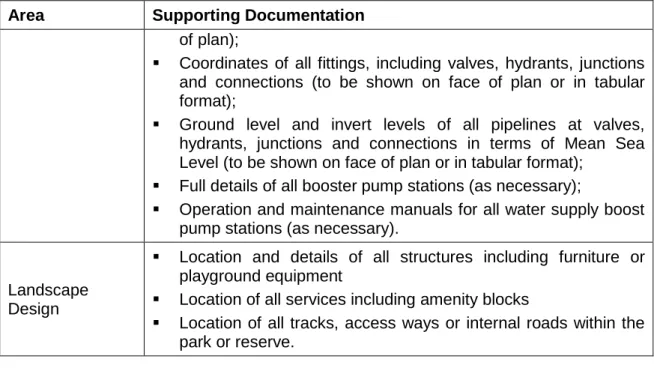
The Consent Holder shall provide the following as-built information:
Area Supporting Documentation
Roading
Details of all changes to Council Roads (width or alignment, edge treatment, drainage)
Construction details of Roads to vest
Construction details of all internal private shared access (rights of way and jointly owned access lots)
RAMM database information.
Stormwater
Details of all pipe materials, diameters and classes (to be shown on face of plan);
Locations of manholes, junctions and connections by measurement from adjacent boundaries (to be shown on face of plan);
Coordinates of all manholes, junctions and connections (to be shown on face of plan or in tabular format);
Ground level and invert levels of all pipelines at manholes, junctions and connections in terms of Mean Sea Level (to be shown on face of plan or in tabular format);
Gradients of all pipelines (to be shown on face of plan or in tabular format);
Cross sections and longitudinal sections of all Swale Drains and secondary flow paths;
Full details of all stormwater detention and/or treatment ponds; Operation and maintenance manuals for all stormwater
detention and/or treatment ponds.
Wastewater
Details of all pipe materials, diameters and classes (to be shown on face of plan);
Locations of maintenance shafts, junctions and connections by measurement from adjacent boundaries (to be shown on face of plan);
Coordinates of all maintenance shafts, junctions and connections (to be shown on face of plan or in tabular format); Ground level and invert levels of all pipelines at maintenance
shafts, junctions and connections in terms of Mean Sea Level (to be shown on face of plan or in tabular format);
Gradients of all pipelines (to be shown on face of plan or in tabular format);
Hydraulic grade lines at design flows, invert level & ground level for all rising mains, to be shown in section format including location of any valve connections.
Full details of all pump stations; including Plan details (to scale),
Section details (to scale);
Process and instrumentation diagram (if required);
Operation and maintenance manuals for all pump stations and treatment plants
Water
Details of all pipe materials, diameters and classes (to be shown on face of plan);
Area Supporting Documentation
of plan);
Coordinates of all fittings, including valves, hydrants, junctions and connections (to be shown on face of plan or in tabular format);
Ground level and invert levels of all pipelines at valves, hydrants, junctions and connections in terms of Mean Sea Level (to be shown on face of plan or in tabular format);
Full details of all booster pump stations (as necessary);
Operation and maintenance manuals for all water supply boost pump stations (as necessary).
Landscape Design
Location and details of all structures including furniture or playground equipment
Location of all services including amenity blocks
Location of all tracks, access ways or internal roads within the park or reserve.
3.6.2 Drawing Standards
(a) All drawings shall be prepared in accordance with the requirements of AS/NZS1100:1992 and shall contain all the information listed in the As Built requirements listed in each section.
(b) All drawings shall be submitted on standard A3 or A4 drawing sheets. In addition they shall be suitable for photo reduction and microfilming. Lines shall not be finer than 0.25mm. Printing should be spaced sufficiently to retain clarity when reduced. Letters shall not be less than 2.5mm in height (but generally 3.5mm or larger) before reduction.
(c) The standard systems shown in drawing S1 shall be used in all drawing to ensure uniformity. Existing services shall be shown in faint lines (0.25mm and proposed services in heavy bold lines (min 0.5mm)
(d) Electronic copies of the drawings shall also be submitted in Drawing (.dwg) or Digital Exchange (.dxf) format, compatible with Council‟s GIS system.
(e) For new streets and significant extension of services the following scales shall be used (A3 drawings).
Table 3.4: Drawing Scales
Drawing Type Option 1 Option 2
Plans 1000 500
Longitudinal Sections - Horizontal - Vertical
1000 200
500 100
Cross Sections / Elevation 200 100
(f) Details shall be presented at scales of 1:5, 1:10, 1:20 or 1:50. The scale of all details shall be correct at A3 size. If the original size of the sheet was not A3, then the scales at both original size and the A3 size shall be shown.
(g) In addition, graphic scales shall be shown on all plan views, and sufficient dimensions shown on all components so the scaling off drawings is not necessary.
(h) All engineering surveys for as-builts and all subdivision survey parcel boundary elements shall be in terms of a LINZ approved coordinate system.
(i) Coordinates shall be in terms of Transverse Mercator 2000. Levels or elevations shall be Orthometric Reduced Levels to the LINZ/DOSLI datum (One Tree Point 1964 Datum).
(j) The location of significant features shall be marked from an existing permanent physical feature such as bridges or kerbs where possible. However, physical features shall not be relied upon for reference marks because of the possibility of them being altered in the future.
3.7 Operations and Maintenance Manuals
Operations and maintenance manuals shall be provided for all new or upgraded assets (other than reticulation items) that require ongoing maintenance. This includes but is not limited to, wastewater pump stations, booster pump stations, treatment plants and stormwater treatment ponds.
3.8 Maintenance
3.8.1 Construction Maintenance Requirements
(a) The Consent Holder shall maintain the construction works after the issue of a Practical Completion certificate for a minimum period of 12 months, to allow for the remedy, where required, of design or construction defects and the stabilisation of grassed surfaces, Swale Drains and water channels.
(b) At the end of the maintenance period the Consent Holder shall arrange for the mowing of Berms and batters, the cleaning of Watertable drains, sweeping of kerb and channel, reinstatement of traffic facilities, clean out of sumps, drop structures and the removal of temporary works associated with silt runoff control as well as the repair of other construction defects before the release of the maintenance bond.
(c) The maintenance period shall not apply to the construction of unsealed Rural Vehicle Crossings and rights-of-way unless specified in the consent conditions. (d) Subsequent damage caused by builders, Developers and road users or through
fair wear and tear would not be subject to the Consent Holder‟s maintenance obligations provided that evidence of such damage is demonstrated as being beyond the control of the Consent Holder.
3.8.2 Landscaping Maintenance Requirements
Landscape work, including any street tree planting, shall be maintained for a period of 3 years.
3.8.3 Construction Maintenance Bond
The value of the construction maintenance bond for both Urban and Rural developments shall be equal to 5% of the value of the construction work based on the contract value (except that this value shall increase to 10% for Rural roading where cut or fill batters exceed 4.5m in height).
The Consent Holder‟s representative shall present evidence from the contract schedule in support of the bond value submitted
The maintenance bonds shall take the form of a cash payment refundable at the completion of the maintenance period.
3.8.4 Landscaping Maintenance Bonds
Bonds to cover landscaping maintenance shall be held for a period of three years and shall be assessed on current KDC contract rates by Council.
The 3 years landscape maintenance bond shall also include a sum to cover the replacement of plants, trees and other landscape components that are missing at the end of the maintenance period.
3.8.5 Contractors Obligations
It is recommended that the Consent Holder incorporates in contract documents for the development construction work that the contract maintenance period is for the same duration as the periods quoted in Sections 3.8.1 and 3.8.2.