Functional Requirements for Authority Data
A Conceptual Model
IFLA Working Group on
Functional Requirements and Numbering of Authority Records (FRANAR)
Final Report
December 2008
Approved by the Standing Committees of the
IFLA Cataloguing Section and IFLA Classification and Indexing Section
March 2009
As amended and corrected through
July 2013
CONTENTS
Introduction i
1. Purpose 1
2. Scope 1
3. Entity-Relationship Diagram and Definitions 2
3.1 Entity-Relationship Methodology 2
3.2 Diagramming Conventions 3
3.3. Entity-Relationship Diagram 3
3.4 Entity Definitions 8
4. Attributes 16
4.1 Attributes of a Person 17
4.2 Attributes of a Family 18
4.3 Attributes of a Corporate Body 19
4.4 Attributes of a Work 20
4.5 Attributes of an Expression 21
4.6 Attributes of a Manifestation 23
4.7 Attributes of an Item 23
4.8 Attributes of a Concept 24
4.9 Attributes of an Object 24
4.10 Attributes of an Event 24
4.11 Attributes of a Place 24
4.12 Attributes of a Name 24
4.13 Attributes of an Identifier 25
4.14 Attributes of a Controlled Access Point 25
4.15 Attributes of Rules 28
4.16 Attributes of an Agency 29
5. Relationships 30
5.1 Authority Relationships in the Context of the Model 30
5.2 Relationships Depicted in the High-Level Diagrams 30
5.3 Relationships between Persons, Families, Corporate Bodies, and Works 31
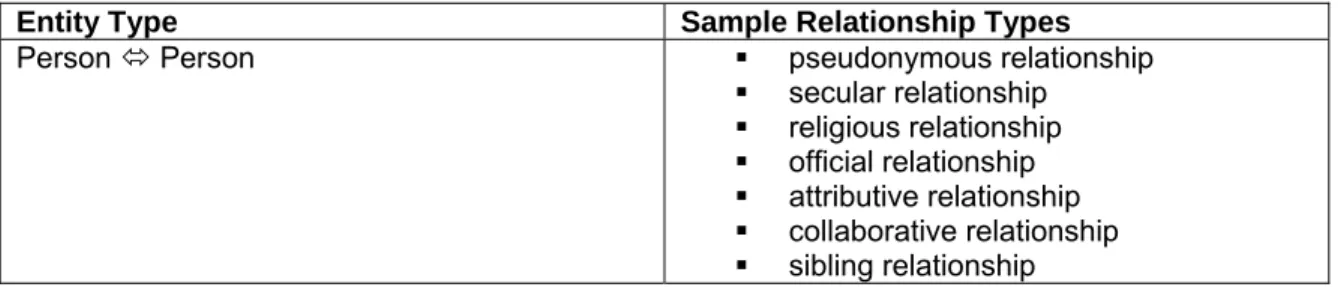
5.3.1 Relationships between Persons 32
5.3.2 Relationships between Persons and Families 34
5.3.3. Relationships between Persons and Corporate Bodies 35
5.3.4 Relationships between Families 35
5.3.5 Relationships between Families and Corporate Bodies 35
5.3.6 Relationships between Corporate Bodies 36
5.3.7 Relationships among Works, Expressions, Manifestations and, Items 38 5.4 Relationships between the Various Names of Persons, Families, Corporate
Bodies, and Works 40
5.4.1 Relationships between Names of Persons 41
5.4.2 Relationships between Names of Families 42
5.4.3 Relationships between Names of Corporate Bodies 42
5.4.4 Relationships between Names of Works 43
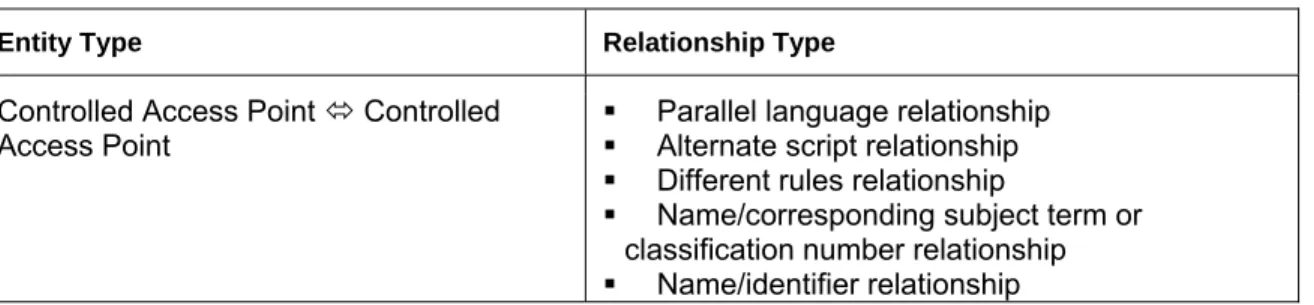
5.5 Relationships between Controlled Access Points 44
6. User Tasks 46
References Error! Bookmark not defined.52
Introduction
The Working Group on Functional Requirements and Numbering of Authority Records (FRANAR) was established in April 1999 by the IFLA Division of Bibliographic Control and the IFLA Universal Bibliographic Control and International MARC Programme (UBCIM). Following the end of the UBCIM Programme in 2003, the IFLA-CDNL Alliance for Bibliographic Standards (ICABS) took over joint responsibility for the FRANAR Working Group with the British Library as the responsible body.
The Working Group has three terms of reference:
1) To define functional requirements of authority records, continuing the work that the “Functional requirements of bibliographic records" for bibliographic systems initiated; 2) To study the feasibility of an International Standard Authority Data Number (ISADN), to
define possible use and users, to determine for what types of authority records such an ISADN is necessary, to examine the possible structure of the number and the type of management that would be necessary;
3) To serve as the official IFLA liaison to and work with other interested groups concerning authority files: <indecs>(Interoperability of Data in E-Commerce Systems), ICA/CDS (International Council on Archives Committee on Descriptive Standards; later, International Council on Archives Committee on Best Practices and Professional Standards), ISO/TC46 for international numbering and descriptive standards, CERL (Consortium of European Research Libraries), etc.
This document fulfills the first of these terms of reference and represents one portion of the extension and expansion of the Functional Requirements for Bibliographic Records model that
was envisioned by the IFLA Study Group on the Functional Requirements for Bibliographic Records. The second term of reference, dealing with numbering, was dealt with by the Working Group in a separate document. The third of the terms of reference represents an ongoing task that has produced many valuable contacts, which have enriched this document and other aspects of this group’s work and have provided the opportunity for the group to review a number of other documents about authority data that have been produced during the time of the group’s work. Because the Functional Requirements for Authority Data is indeed an extension and expansion of
the FRBR model, the Working Group has identified potential improvements to the FRBR model itself as well as to definitions, etc. These will be proposed to the IFLA FRBR Review Group for their consideration. In addition, the group has identified other IFLA publications relating to authority data that may require revisions. Those potential revisions will also be submitted to the relevant groups for consideration.
The IFLA FRBR Study Group noted the need for further analysis of the “entities that are the centre of focus for subject authorities, thesauri, and classification schemes, and of the
relationships between those entities.” While the Working Group has included some aspects of subject authorities in the authorities model, it has not undertaken the full analysis that the FRBR Study Group envisioned. Since the FRANAR Working Group began its work, a new working group, Working Group on Functional Requirements for Subject Authority Records (FRSAR),1 has
been charged with that task.
Members of the IFLA Working Group on Functional Requirements and
Numbering of Authority Records
Françoise Bourdon (Chair, 1999-2002)
Bibliothèque nationale de France Christina Hengel-Dittrich
Deutsche Nationalbibliothek, Germany Olga Lavrenova
Russian State Library Andrew MacEwan The British Library Eeva Murtomaa
National Library of Finland
Glenn E. Patton (Chair, 2002-2009)
OCLC, USA Henry Snyder
University of California, Riverside, USA Barbara Tillett
Library of Congress, USA Hartmut Walravens
International ISBN Agency, Germany Mirna Willer
University of Zadar, Croatia
Secretariat
Marie-France Plassard (1999-2003)
IFLA UBCIM Programme
Consultant
Tom Delsey
Functional Requirements for Authority Data
1. Purpose
In libraries, in museums, or in archives, a catalogue is a set of organized data describing the information content managed by an institution. Authority data represents the controlled access points and other information that institutions use to collocate works by a specific person, family, or corporate body, or the various editions of a title. Controlled access points include authorized forms and variant forms of name assembled by cataloguers to identify an entity. For the purposes of this study, only name and title entities are addressed fully; however, subject terms within catalogues are among the other entities commonly subjected to authority control. Authority control, which means both the identification of entities represented by controlled access points and the ongoing management of them, is integral to the functioning of a catalogue. Authority control is beneficial to cataloguers able to identify and distinguish between the controlled access points within a catalogue. More importantly, authority control benefits end users enabling them to search any controlled form of an author’s name or of a title to retrieve bibliographic resources within catalogues.
The primary purpose of this conceptual model is to provide a framework for the analysis of functional requirements for the kind of authority data that is required to support authority control and for the international sharing of authority data. The model focuses on data, regardless of how it may be packaged (e.g., in authority records).
More specifically, the conceptual model has been designed to:
provide a clearly defined, structured frame of reference for relating the data that are recorded by authority record creators to the needs of the users of that data;
assist in an assessment of the potential for international sharing and use of authority data both within the library sector and beyond.
2. Scope
The functional scope of the study was intentionally limited to the library sector, but the study has been conducted with a view to comparative analysis with other sectors.
For the purposes of this model, the users of authority data include both the authority data creators who create and maintain authority data and end users who use authority information either through direct access to authority data or indirectly through the controlled access points and reference structures in library catalogues, national bibliographies, etc.
For the purposes of this study, authority data is defined as the aggregate of information about a person, family, corporate body, or work whose name is used as the basis for a controlled access point for bibliographic citations or for records in a library catalogue or bibliographic database. Conventionally, authority data is structured in accordance with guidelines and specifications, such as those set out in IFLA’s Guidelines for Authority Records and References (GARR)2 and/or
cataloguingrules. In current practice, the authority record normally contains the authorized access point for the entity as established by the cataloguing agency as the default form for displays in its catalogue, as well as access points for variant forms of name and authorized access points for related entities. The authority record will also normally include information identifying the rules under which the controlled access points were established, the sources consulted, the cataloguing agency responsible for establishing the controlled access point, etc. For the purposes of this study, however, there are no a priori assumptions made about the
physical structure of authority data, nor are there any assumptions made as to whether the data are stored in an authority file that is separate from the catalogue or bibliographic file per se, or fully integrated with it.
At a high level, the conceptual model encompasses authority data of all types. The entity relationship diagram (section 3.3) and the entity definitions (section 3.4) are intended to reflect authority data for persons, families, corporate bodies, and geographic entities, or for entities represented in catalogues by title authority data (of the type of titles of work or work/expression and collective titles of works or works/expressions) or creator-title authority data, for subject authority data (subject terms, thesauri terms, and classification indicia), and authority data for various types of names and identifiers (standard numbers, codes, etc.) associated to those entities. However, the detailed analysis of entity attributes (section 4) and relationships (section 5) focuses only on library authority data for name controlled access points associated with persons, families, and corporate bodies, and for creator-title and title controlled access points associated with works, expressions, manifestations, and items. In those sections, attributes and relationships associated exclusively with other types of authority data (such as subject authority data) are not included. Management information that may be maintained as part of authority data, such as version control information or treatment decisions about the management of the resource described by the data, is also not included.
3. Entity-Relationship Diagram and Definitions
3.1 Entity-Relationship MethodologyThe methodology used to build this conceptual model is the same entity analysis technique used in the Functional Requirements for Bibliographic Records (FRBR)3. As described in section 2.3
of FRBR, the first step is the identification of the key objects that are of interest to users of
information in a particular domain. Each of these key objects, or entities, then serves as the focal point for a cluster of data. A model developed using these techniques also depicts the
relationships between one type of entity and another type of entity.
Once the high-level structure for the model has been laid out by identifying the entities and the relationships between those entities, the next step is to identify the primary characteristics or
attributes of each entity. At a more detailed level, the model can also depict the relationships that
may exist between instances of entities.
The entity-relationship model described in the following section has been used in this study to assess the relevance of each attribute and relationship to the set of user tasks defined later in this document.
Entity versus Attribute: In designing any conceptual model, a key decision involves whether to
make something an attribute or a separate entity. The outcome of this decision depends on the future use that is to be made of the attribute or entity. The developers of the FRBR model saw significant advantages in declaring persons and corporate bodies to be separate entities that could then be related to the other entities laid out in that model. Cataloguers have traditionally thought of controlling the names for persons and corporate bodies through authority data.
Declaring persons and corporate bodies as entities enables much more flexibility in the controlled naming and eliminates redundancies that would occur if they were modeled as attributes. The names for these entities can then be controlled in an authority record and linked to other authority records or to bibliographic records or holdings records as needed. The FRBR decision to treat these as entities rather than as attributes has been carried over into this conceptual model of authority data. In addition, in this model, declaring names and identifiers as entities allows more clarity in showing the relationships between the entities on which authority data are focused and the names and/or identifiers by which those entities are known and on which the controlled access points for those entities will be based.
3.2 Diagramming Conventions
A rectangle represents an entity (i.e., an object of interest to users of authority data).
A dotted-line rectangle surrounding a group of two or more entities indicates that a relationship represented by an arrow contiguous with the dotted line may apply to any and/or all of the entities represented within the rectangle.
A single-headed arrow on a line represents a relationship in which any given instance of the entity at the opposite end of the line may be associated with only one instance of the entity to which the arrow is pointing.
A double-headed arrow on a line represents a relationship in which any given instance of the entity at the opposite end of the line may be associated with one or more instances of the entity to which the arrow is pointing.
3.3 Entity-Relationship Diagram
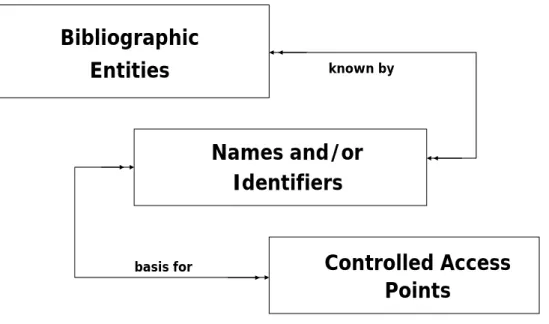
The fundamental basis for the conceptual model is illustrated in Figure 1. The model can be
simply described as follows: Entities in the bibliographic universe (such as those identified in the
Functional Requirements for Bibliographic Records) are known by names and/or identifiers. In
the cataloguing process (whether it happens in libraries, museums, or archives), those names and identifiers are used as the basis for constructing controlled access points.
known by
Bibliographic
Entities
Names and/or
Identifiers
Controlled Access
Points
basis for
Figure 1: Fundamental Basis for the Conceptual Model
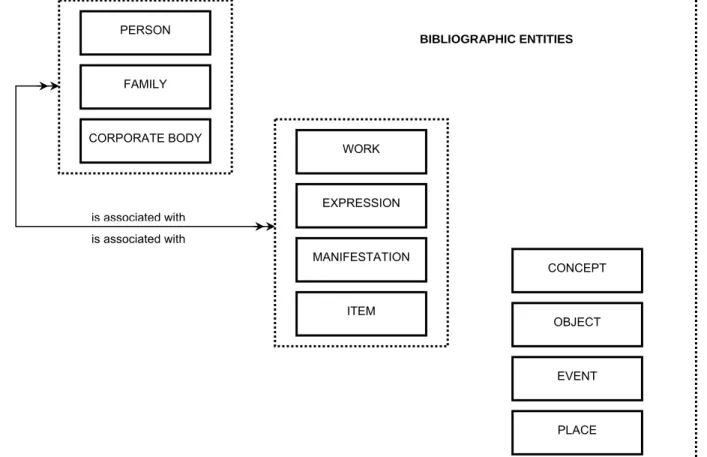
A fuller form of the conceptual model for authority data is presented graphically in the diagram in
Figure 2. The entities depicted in the diagram are defined in section 3.4.
Entities: The entities depicted in the diagram represent the key objects of interest to the users of
authority data. The resulting diagram represents a model of the relationships between those entities, not a model for an authority record, which is a specific application of authority data. The entities on which authority data are focused (i.e., the ten entities defined in Functional Requirements for Bibliographic Records— person, corporatebody, work, expression,
manifestation, item, concept, object, event, and place — plus one additional entity — family) are
depicted in the upper part of the diagram. The lower part of the diagram depicts the names by
which those entities are known, the identifiers assigned to the entities, and the controlled access points based on those names and identifiers that are registered as authority data. The diagram also highlights two entities that are instrumental in determining the content and form of access points—rules and agency.
It is essential to note that the entities depicted in the upper part of the diagram (person, family,
corporatebody, work, expression, manifestation, item, concept, object, event, and place) are
bibliographic entities. As such, they reflect intellectual constructs or concepts that are integral to the rules used to create library catalogues, and what is perceived as a specific instance of a particular entity type may vary from one set of rules to another.
Under some cataloguing rules, for example, authors are uniformly viewed as real individuals, and consequently specific instances of the bibliographic entity person always correspond to
individuals. Under other cataloguing rules, however, authors may be viewed in certain circumstances as establishing more than one bibliographic identity, and in that case a specific
instance of the bibliographic entity person may correspond to a persona adopted by an individual
rather than to the individual per se.
Similarly, most cataloguing rules require the establishment of a new authorized form for a corporate body each time the body changes its name. In those cases, each specific instance of the bibliographic entity corporate body corresponds to the associated body only in relation to the
period of time during which the body used that particular name. Consequently, the body as such (e.g., a legally incorporated enterprise, a government agency, a musical group) may be viewed as two or more instances of the bibliographic entity corporate body.
Rules for the construction of subject terms, on the other hand, may require the creation of a single authorized form to represent the body throughout the course of its existence. In that case, the specific instance of the bibliographic entity corporate body corresponds to the body per se.
Likewise, cataloguing rules may vary with respect to the treatment of works, expressions, manifestations, and items. The boundaries of a specific instance of the bibliographic entity work
as defined by one set of cataloguing rules may differ from those defined by another set of rules. Hence, the two resulting instances of the bibliographic entity work may not be directly equivalent.
Similarly, the application of one set of cataloguing rules may result in the recognition of a specific instance of the bibliographic entity expression that is not precisely the same as that recognized by
the application of a different set of rules, etc.
Cataloguing rules and coding conventions may also differ in their treatment of fictional characters, supernatural or legendary beings, imaginary places, etc. In some cases, those entities will be viewed as persons, families, places, etc., but in other cases, they will be viewed as concepts.
Similarly, certain events (ad hoc meetings, sporting events, etc.) may be viewed as corporate bodies under one set of cataloguing rules but simply as events under another set of rules.
Relationships between entities: The relationships depicted in the diagram (Figure 2) reflect
the inherent associations between the various entity types. The lines and arrows connecting the entities in the upper part of the diagram with those in the lower part represent the relationships between name and identifier and the bibliographic entities with which they are associated
(person, family, corporatebody, work, expression, manifestation, item, concept, object, event,
and place). A specific instance of any of those bibliographic entities may be known by one or
more names (“has appellation” relationship), and conversely any name may be associated with
one or more specific instance of any of the bibliographic entities (“is appellation of” relationship). Similarly, a specific instance of any one of the bibliographic entities may be assigned one or more
identifiers (“is assigned” relationship), but an identifier may be assigned to only one specific
instance of a bibliographic entity (“is assigned to” relationship).
It should be noted that the diagram (Figure 2) also depicts a relationship (“is associated with”
relationship) that may apply between a person, a family, or a corporatebody, on the one hand,
and a work, expression, manifestation, or item on the other hand. The entity-relationship diagram in FRBR reflects the high-level relationships between entities work, expression, manifestation,
and item (a work is “realized through” expression, etc.). It also depicts a number of specific
relationships between person and corporatebody, on the one hand, and work, expression, manifestation, and item on the other hand (a work may be “created by” a person, etc.). Those
same relationships are conceptually valid for the FRBR entities that are represented in the conceptual model for authorities.
The relationships depicted in the lower part of the diagram (Figure 2) represent the associations
between the entities name and identifier and the formal or structural entity controlled access point, and the association between that entity and the entities rules and agency. A specific name
or identifier may be the basis for a controlled access point (“is basis for” relationship), and
conversely a controlled access point may be based on a name or identifier (“is based on” relationship).
A controlled access point may be based on a combination of two names and/or identifiers, as in the case of a creator/title access point representing a work that combines the name of the author
with the name (i.e., the title) of the work. The controlled access point will be centred on an instance of the work entity. However, in order to function effectively, the access point will need to
reflect the relationship of that work not only to instances of the name entity (i.e., to the various
titles by which the work is known) but its relationship to instances of the other entities depicted in the upper part of the diagram as well (most notably the person, family, or corporate body
responsible for the work). The result is a creator/title access point.
Controlled access points may be governed by rules (“is governed by/govern” relationships), and
those rules in turn may be applied by one or more agencies (“are applied by/applies”
relationships). Likewise, controlled access points may be created by, or modified by one or more agencies (“is created by/creates” and “is modified by/modifies” relationships).
These relationships are further described in section 5.2.
Relationships between instances of an entity: Other types of relationships that may operate
between a specific instance of one bibliographic entity type and a specific instance of either the same or a different bibliographic entity type (e.g., a collaborative relationship between two specific persons or a membership relationship between a person and a corporate body) are not shown in the entity-relationship diagram. Relationships of that kind are discussed in section 5.3. Other types of relationships that may operate between specific instances of the entities depicted in the upper part of the diagram (person, family, corporate body, work, expression, manifestation, item, concept, object, event, and place) and specific instances of the entity name are discussed in
section 5.4.
Other types of relationships that may operate between specific instances of the entity controlled access point (e.g., a parallel language or alternate script relationship between two specific access
points) are not shown in the entity-relationship diagram. Relationships of that kind are discussed in section 5.5.
Relationships versus attributes: For the purposes of this study, certain types of association
between a specific instance of one entity type and a specific instance of another entity type are treated simply as an attribute of the first entity. For example, in the case of an association between a corporate body and a place associated with the body that is implicit in the construction
of a controlled access point for that body, it was deemed sufficient to treat the place associated with the body simply as an attribute of corporatebody. That does not preclude the possibility of
developing the model further in order to reflect that type of association more formally as a relationship between the two entities.
BIBLIOGRAPHIC ENTITIES
is associated with is associated with
has appellation
is based on
EVENT OBJECT CONCEPT
PLACE
NAME
IDENTIFIER
Figure 2: Conceptual Model for Authority Data
is appellation of is assigned
FAMILY
CORPORATE BODY PERSON
WORK
EXPRESSION
MANIFESTATION
ITEM
RULES is governed by
AGENCY are applied by
CONTROLLED ACCESS POINT is basis for
is created/modified by creates/modifies is assigned to
govern
3.4 Entity Definitions
The entity definitions have been derived largely from two sources: Functional Requirements for Bibliographic Records (FRBR); and Guidelines for Authority Records and References(GARR).
Each definition is followed by examples of instances of that entity; these lists are neither prescriptive nor exhaustive.
As an aid to relating the entities and their definitions, readers may wish to make a copy of Figure 2 and refer to it when reading the following definitions.
Person An individual or a persona or identity established or adopted by an
individual or group. [FRBR, modified] Includes real individuals.
Includes personas or identities established or adopted by an individual through the use of more than one name (e.g., the individual’s real name and/or one or more pseudonyms).
Includes personas or identities established or adopted jointly by two or more individuals (e.g., Ellery Queen — joint pseudonym of Frederic Dannay and Manfred B. Lee).
Includes literary figures, legendary figures, divinities, and named animals as literary figures, actors, and performers.
Includes personas or identities established or adopted by a group (e.g., Betty Crocker).
Includes appellations established by research (e.g., Bedford Meister, Meister E.S.)
May include clusters of individuals who bear the same name, whenever it is not possible to establish a differentiated identity for each individual within the cluster.
Note: Cataloguing rules vary in their treatment of personas (i.e., bibliographic identities) established or adopted by the same individual. Some cataloguing rules recognize pseudonyms used by an individual as separate personas and an authorized form will be established for each persona with see also references connecting the resulting authorized forms of names for those personas. Other cataloguing rules recognize only one persona for an individual and the pseudonyms used by the person; one persona is the authorized form and the names of other personas are treated as variant forms of name for the individual.
Family Two or more persons related by birth, marriage, adoption, civil union,
or similar legal status, or who otherwise present themselves as a family.
Includes royal families, dynasties, houses of nobility, etc. Includes patriarchies and matriarchies.
Includes groups of individuals sharing a common ancestral lineage. Includes family units (parents, children, grandchildren, etc.).
Includes the successive holders of a title in a house of nobility, viewed collectively (e.g., Dukes of Norfolk).
Corporate Body An organization or group of persons and/or organizations identified by
a particular name acting as a unit. [FRBR, modified]
Includes occasional groups and groups that are constituted as
meetings, conferences, congresses, expeditions, exhibitions, festivals, fairs, etc.
Includes musical performing groups, groups of visual artists, and dance companies producing collective work.
Includes organizations that act as territorial authorities, exercising or claiming to exercise government functions over a certain territory, such as a federation, a state, a region, a local municipality.
Includes organizations and groups that are defunct as well as those that continue to operate.
Includes fictitious organizations or groups of persons.
Note: Cataloguing rules may differ with respect to the treatment of meetings, etc., depending on whether or not they are formally convened at a pre-determined date, whether or not they result in the issuance of a publication, etc. In some instances they may be treated as corporate bodies when they act as a group, but in other instances they may be treated simply as events (see also the entity definition for event).
Note: Cataloguing rules generally treat distinctive identities of corporate bodies established through usage of different names over time as though they represented different but related corporate bodies.
Work A distinct intellectual or artistic creation (i.e., the intellectual or artistic
content). [FRBR, as modified in the ICP Glossary4]
Includes works that are expressed in words, musical works, graphic works, photographic works, moving image works, cartographic works, three-dimensional works, data, computer programs, etc.
Includes legal works (laws, regulations, constitutions, treaties, court rules, court decisions, etc.), religious works (sacred scriptures, creeds, liturgical works, papal communications, etc.).
Includes collections and compilations of works, as well as individual works.
periodical or the panels of an altarpiece).
Note: The concept of what constitutes a work and where the line of demarcation lies between one work and another may differ from one culture to another, from one discipline to another or from one cataloguing agency to another. Consequently, bibliographic conventions established by various cultures, national groups, or cataloguing agencies may differ with respect to the criteria they use for determining the boundaries between one work and another. The specifics of cataloguing rules may also have a bearing on what is recognized as a work.
Expression The intellectual or artistic realization of a work in the form of
alpha-numeric, musical, or choreographic notation, sound, image, object, movement, etc.,or any combination of such forms. [FRBR]
Includes the specific words, sentences, paragraphs, etc., that result from the realization of a work in the form of a text (e.g., through translation).
Includes the particular notes, phrasing, etc., resulting from the realization of a musical work (e.g., through performance).
Includes the specific sequences of moving images, combined with sounds or not, that are available in a given version of a cinematic work. Excludes aspects of physical form, such as typeface and page layout, unless they are integral to the intellectual or artistic realization of the work as such.
Note: The degree to which bibliographic distinctions are made between variant expressions of a work will depend to some extent on the nature of the work itself, and on the anticipated needs of users. Variations that would be evident only from a detailed analysis and comparison of expressions would normally be reflected in authority data only if the nature or stature of the work warranted such analysis, and only if it was anticipated that the distinction would be important to users.
Note: Controlled access points incorporating additions that reflect attributes of an expression (e.g., language of expression, form of expression) normally serve to collocate related expressions of the work as distinct from differentiating between individual expressions of the work.
Manifestation The physical embodiment of an expression of a work. [FRBR]
Includes manifestations in the form of books, periodicals, maps, posters, sound recordings, films, video recordings, DVDs, CD-ROMs, multimedia kits, PDF files, MP3 files, etc.
Note: If the physical embodiment of an expression of a work involves the production of only a single artifact (e.g., an author’s manuscript or an original oil painting), the manifestation comprises only that single
artifact. However, if the embodiment involves the production of multiple copies (e.g., in the publication of a book or the commercial production of a sound recording) the manifestation encompasses the entire set of physical copies produced. In the latter case, the entity described for cataloguing purposes is, in effect, an abstraction derived from characteristics of a single copy that are presumed to be shared by all copies in the set that comprises the manifestation.
Item A single exemplar of a manifestation. [FRBR]
Includes items comprising a single physical object (one volume, cassette, etc.).
Includes items comprising more than one physical object (two or more volumes, compact discs, etc.) and electronic resources on the Web in multiple files.
Concept An abstract notion or idea. [FRBR]
Includes fields of knowledge, disciplines, schools of thought (philosophies, religions, political ideologies, etc.), etc. Includes theories, processes, techniques, practices, etc.
Note: The entity, Concept, is defined as in FRBR without any extensions or clarification pending the work of the FRSAR Working Group.
Note: For the purposes of this study, entities that are categorized as concepts are relevant only in the context of subject authority data.
Object A material thing. [FRBR]
Includes animate and inanimate objects occurring in nature. Includes fixed, movable, and moving objects that are the product of human creation.
Includes objects that no longer exist.
Note: The entity, Object, is defined as in FRBR without any extensions or clarification pending the work of the FRSAR Working Group.
Note: For the purposes of this study, entities that are categorized as objects are relevant only in the context of subject authority data.
Event An action or occurrence. [FRBR]
Includes historical events, epochs, periods of time.
Note: The entity, Event, is defined as in FRBR without any extensions or clarification pending the work of the FRSAR Working Group.
Note: Cataloguing rules may differ with respect to the treatment of meetings, etc. In some instances they may be treated simply as events, but in other instances they may be treated as corporate bodies (see also the entity definition for corporate body).
Note: For the purposes of this study, entities that are categorized as events but do not function as corporate bodies are relevant only in the context of subject authority data.
Place A location. [FRBR]
Includes terrestrial and extra-terrestrial locations. Includes historical as well as contemporary locations. Includes geographic features.
Includes geo-political jurisdictions
Note: The entity, Place, is defined as in FRBR without any extensions or clarification pending the work of the FRSAR Working Group.
Name A character, word, or group of words and/or characters by which an
entity is known. [FRBR, modified]
Includes names by which persons, families, and corporate bodies are known.
Includes titles by which works, expressions, and manifestations are known.
Includes names and terms by which concepts, objects, events, and places are known.
Includes real names, pseudonyms, religious names, initials, and separate letters, numerals, or symbols.
Includes forenames (or given names), matronymics, patronymics, family names (or surnames), dynastic names, etc.
Includes given names of sovereigns, popes, etc., with associated roman numerals.
Includes names of families, clans, dynasties, houses of nobility, etc. Includes names representing the successive holders of a title in houses of nobility, etc., viewed collectively (e.g., Dukes of Norfolk). Includes names used by a corporate body at various periods in its history.
Includes names of associations, institutions, business firms, not-for-profit enterprises, etc.
Includes names of governments, government agencies, projects, programmes, government officials, delegations, legislative bodies, armed forces, etc.
Includes names of religious bodies, local churches, etc., religious councils, religious officials, provinces, dioceses, synods, etc., papal diplomatic missions, etc.
Includes names of conferences, congresses, meetings, etc. Includes names of exhibitions, athletic contests, expeditions, fairs, festivals, etc.
Includes names of subordinate and related bodies.
Includes numbers that form an integral part of the name of a corporate body or event.
Includes trade names.
Includes titles of content, parts of content, compilations of content, etc. Includes titles by which a work has become known.
Includes the title proper of the original manifestation of a work. Includes titles by which a work is identified in reference sources. Includes titles under which a work has been published.
Includes titles by which manifestations of an expression have become known.
Includes the title proper of the original manifestation of an expression. Includes titles by which manifestations of an expression are identified in reference sources.
Includes titles under which manifestations of an expression have been published.
Includes the title proper of the original edition of a manifestation. Includes titles by which a manifestation is identified in reference sources.
Includes variant titles appearing on or in a manifestation.
Includes names and terms for events, objects, concepts, and places.
Note: Cataloguing rules may mandate the use of a place name to represent both the geographic territory per se and the government that has jurisdiction over that territory (e.g., the use of the name
Massachusetts to represent both the territory covered by the state and the government of the state, the official name of which is The
Note: Cataloguing rules may differ with respect to the elements they consider as integral parts of the name as distinct from elements they consider as additions to the name for the purposes of constructing controlled access points.
Identifier A number, code, word, phrase, logo, device, etc., that is associated
with an entity, and serves to differentiate that entity from other entities within the domain in which the identifier is assigned. An identifier can consist of an identifier string (i.e., a sequence of numeric and/or alphabetic characters assigned to an entity to serve as a unique identifier within the domain to which the identifier is assigned) and a prefix and/or suffix (a character or set of characters (numeric and/or alphabetic) appearing before or after an identifier string).
Includes identifiers such as social insurance numbers assigned by a government authority.
Includes personal identifiers assigned by other registration authorities. Includes business registration numbers, registration numbers for charitable organizations, etc., assigned by a government authority. Includes corporate body identifiers assigned by other registration authorities (e.g., ISBN publisher’s prefix).
Includes standard identifiers assigned by registration authorities identifying content (e.g., ISRC, ISWC, ISAN).
Includes standard identifiers assigned by registration authorities identifying manifestations (e.g., ISBN, ISSN).
Includes thematic index numbers assigned to a musical work by the publisher, or a musicologist.
Includes catalogue raisonné numbers.
Includes identifiers for items assigned by repositories (e.g., shelf number).
Includes classification numbers referencing specific entities (e.g., a classification number assigned to a particular painting).
Includes registered trademarks.
Note: Some of these identifiers may be included in authority data but kept confidential for reasons of privacy.
Note: These identifiers are limited to those associated with entities and do not include record numbers assigned to authority records.
Controlled Access Point
A name, term, code, etc., under which a bibliographic or authority record or reference will be found. [GARR, modified]
of names (i.e., authorized access points) as well as those designated as variant forms of name (i.e., variant access points).
Includes access points based on personal, family, and corporate names.
Includes access points based on titles (i.e., names) for works, expressions, manifestations, and items.
Includes access points consisting of a combination of two access points, as in the case of a creator/title access point for a work which consists of an authorized access point for the name of the creator combined with an authorized access point for the name (i.e., the title) of the work.
Includes access points based on names and terms for events, objects, concepts, and places.
Includes access points based on identifiers, such as standard numbers, classification indicia.
Note: Elements added to the name per se (e.g., dates) form an integral part of the controlled access point.
Rules A set of instructions relating to the formulation and/or recording of
controlled access points (authorized forms, variant forms or references, etc.).
Includes cataloguing rules and interpretations of those rules. Includes coding conventions.
Agency An organization responsible for creating or modifying a controlled
access point. The agency is responsible for application and
interpretation of the rules it creates and/or uses. The agency may also be responsible for the creation and maintenance of identifiers within its domain.
Includes libraries, national bibliographic agencies, bibliographic utilities, consortia, museums, archives, rights management organizations, etc.
4. Attributes
Attributes for each of the entities defined above are listed and defined in sections 4.1 through 4.16 below.
The attributes listed and defined below were derived from an examination of data identified and/or defined in FRBR, GARR, UNIMARC Manual – Authorities Format5, Mandatory Data Elements for Internationally Shared Resource Authority Records6 (MLAR), as well as in the International Standard Archival Authority Record for Corporate Bodies, Persons and Families7 (ISAAR(CPF)).
Thus, they may represent a broader list of possible attributes than may traditionally be recorded in library authority data. There is no intended implication that the attributes are mandatory or required for any application.
Other models, such as the Encoded Archival Context8, have emerged more recently and have not
been fully evaluated. This may be a topic for future investigation.
For the purposes of this model, attributes are defined at a “logical” level (i.e., as characteristics of the entities to which they pertain, not as specifically defined data elements). In certain cases, the characteristics of a given entity may change over time (e.g., the field of activity in which a person is engaged). The model does not make an explicit distinction between attributes that may change over time and those that are not subject to change. If attributes were defined at the data element level, they would be noted as being either repeatable or non-repeatable data elements,
respectively.
Some of the attributes defined in the model could be considered as components of the entity rather than attributes of the entity. Considering them as components would be justified if it were necessary to define attributes for the components that differ from those of the aggregate entity or if the mapping of user tasks to the components differs from the mapping of user tasks to the aggregate entity. For purposes of this model, neither of these cases was deemed to apply. In certain instances, the model treats an association between one entity and another simply as an attribute of the first entity. For example, the association between a person and the place in which the person was born could be expressed logically by defining a relationship (“born in”) between
person and place. However, for the purposes of this study, it was deemed sufficient to treat place
of birth simply as an attribute of person. That does not preclude the possibility of developing the
model further in order to reflect that association more formally as a relationship between the two entities.
If the model were extended to treat such associations as relationships between defined entities, it would be possible, in turn, to define attributes applying to the relationships themselves. For example, if the association between a person and a place in which the person resides were
defined as a relationship (“resides in”), it would be possible then to define an attribute of the relationship to reflect the dates during which the relationship applied (i.e., the period during which the person resided in that place). Again, however, for the purposes of this study, it was deemed unnecessary to define that level of detail.
Note that because name and identifier have been defined in this model as entities in their own
right, and have been linked through the “appellation” and “assigned” relationship, respectively, to the entities person, family, corporatebody, work, expression, manifestation, item, concept, object, event, and place, the corresponding attributes (e.g., name of person, identifier for person) are not
listed under the associated entity. For example, the FRBR attribute “Title of work” is, in this model, treated as an attribute of the name by which that work is known. Through the relationship,
however, the attributes of name and identifier function in the same way as if they were defined as
attributes of the associated entity.
4.1 Attributes of a Person
Dates associated with the person
A date or dates associated with the person. [FRBR] Includes year or year/month/day of birth, death, etc. Includes year, period, or century of activity.
Title of person Rank, office, nobility, honour, etc., associated with the person.
[FRBR]
Includes titles of rank or office (e.g., Major, Premier, Governor General).
Includes titles of royalty and nobility, ecclesiastical titles, courtesy titles and titles of honour (e.g., Queen, Duke, Pope, Sir, Dame).
Includes secular or religious information elements (e.g., Mrs., Swami, Professor).
Gender* A gender by which the person is identified (e.g., male, female,
unknown, other).
Place of birth* The town, city, province, state, and/or country in which the
person was born.
Place of death* The town, city, province, state, and/or country in which the
person died.
Country* A country with which the person is identified.
Place of residence* A country, state/province, city, etc., in which the person
resides or has resided.
Affiliation* A group with which the person is affiliated or has been
affiliated through employment, membership, cultural identity, etc.
Address* The current or former address of the person’s place of
residence, business, or employer.
Includes street address, postal address, telephone number, e-mail address, etc.
Includes the address of a World Wide Web site operated by the person, about the person or related to the person.
Language of person* A language the person uses when creating an expression for
publication, broadcasting, etc.
Field of activity* A field of endeavour, area of expertise, etc., in which the
person is engaged or was engaged.
Profession/occupation* A profession or occupation in which the person works or
worked.
Biography/history* Information pertaining to the life or history of the person.
Other information
associated with the person
Information elements other than title by which a person is known or identified.
Includes elements, such as “Saint”, “Spirit”, etc.
Includes elements, such as “Jr.”, “III”, etc., when associated with a person whose name includes a surname.
Includes information associating the person with a particular work (e.g., “Author of Early Impressions”).
Includes information associating the person with another person (e.g., “Follower of Rembrandt”)
*Attributes marked with an asterisk represent additions to those identified in Functional Requirements for Bibliographic Records.
4.2 Attributes of a Family
Type of family A categorization or generic descriptor for the type of family.
Includes categorizations, such as clan, dynasty, family unit, patriarchy, matriarchy, etc.
Places associated with family
Information pertaining to places where the family resides or resided or had some connection.
Language of family A language associated with the family.
Field of activity A field of endeavour, area of expertise, etc., in which the
family is engaged or was engaged.
History of family Information pertaining to the history of the family.
4.3 Attributes of a Corporate Body
Place associated with the corporate body
A geographic place at any level associated with the corporate body.
Includes countries, states, provinces, counties, cities, towns, regional municipalities, etc.
Includes a location in which a meeting, conference, exhibition, fair, etc., is held.
Includes location of headquarters.
Dates associated with the corporate body
A date or range of dates on which a meeting, conference, exhibition, fair, etc., is held, or a date with which the corporate body is otherwise associated.
Includes dates of establishment of organizations, business firms, etc.
Includes dates of existence of an organization, government, etc.
Language of the corporate
body*
A language that the corporate body uses in its communications.
Address* The current or former address of the corporate body’s
office(s).
Includes addresses for the corporate body’s headquarters and/or other offices.
Includes street address, postal address, telephone number, e-mail address, etc.
Includes the address of a World Wide Web site operated by the corporate body, about the corporate body or related to the corporate body.
Field of activity* A field of business in which the corporate body is engaged, its
area of competence, responsibility, jurisdiction, etc.
History* Information pertaining to the history of the corporate body.
Includes historical information pertaining to an organization, institution, etc.
Other information associated with the corporate body
Information as to incorporation or legal status of the body, or any term serving to differentiate the body from other corporate bodies, persons, etc. [FRBR]
Includes types of incorporation, etc. (e.g., GmbH). Includes types of bodies or types of jurisdictions (e.g., Fraternal Order, County, Musical Group).
Includes other characteristics distinctive to the corporate body (e.g., the name of the denomination of a local church).
*Attributes marked with an asterisk represent additions to those identified in Functional Requirements for Bibliographic Records.
4.4 Attributes of a Work
Form of work A class to which the work belongs. [FRBR]
Includes forms, genres, etc. (e.g., novel, play, poem, essay, biography, symphony, concerto, sonata, map, drawing, painting, photograph)
Date of the work The first date (normally the year) associated with the work.
[FRBR, modified]
Includes single dates and ranges of dates. Includes date of creation.
Includes date of first publication or release, in the absence of an ascertainable date of creation.
Medium of performance The instrumental, vocal, and/or other medium of performance
for which a musical work was originally conceived. [FRBR] Includes individual instruments, instrumental ensembles, orchestras, etc.
Includes individual voices, vocal ensembles, choirs, etc. Includes other objects to be used in the performance of the work (e.g., spoons, washboard).
Subject of the work* The subject aspects of the work and its content.
Includes information about the subject of the work. Includes classification numbers.
Numeric designation A number assigned to the work. [FRBR, modified]
Includes serial numbers, opus numbers assigned by the composer of a musical work, etc.
Key The set of pitch relationships that establishes a single pitch
class as a tonal centre for a musical work. [FRBR]
Includes the key in which the work was originally composed.
Place of origin of the work* The country or other territorial jurisdiction or cultural area from
which the work originated. Includes area of origin, etc.
History* Information pertaining to the history of the work.
Includes historical information pertaining to a work, including title changes for continuing resources.
Other distinguishing characteristic
Any characteristic that serves to differentiate the work from another work with the same title. [FRBR]
Includes parts of intellectual or artistic content. Includes musical incipits.
*Attributes marked with an asterisk represent additions to those identified in Functional Requirements for Bibliographic Records.
Note: The attributes of a work listed above include only those that are normally reflected in controlled access points or in other data elements recorded in authority records. They do not include other attributes of a work that may be reflected in bibliographic records, as identified in Functional Requirements for Bibliographic Records.
Form of expression The means by which the work is realized. [FRBR]
Includes mode or medium of expression (e.g., alpha-numeric notation, musical notation, movement notation, sound, image, or any combination thereof).
Date of expression The date the expression was created. [FRBR]
Includes single dates and ranges of dates.
Includes date of writing, typing, inscribing a text, translation, etc.
Includes date of performing a dramatic work, a musical work, etc.
Medium of performance of expression
The instrumental, vocal, and/or other medium of performance represented in the expression of a musical work. [FRBR]
Includes individual instruments, instrumental ensembles, orchestras, etc.
Includes individual voices, vocal ensembles, choirs, etc. Includes other objects to be used in the performance of the work (e.g., spoons, washboard).
Language of expression A language in which the work is expressed. [FRBR]
Includes language(s) of the expression as a whole. Includes languages of individual components of the expression.
Technique The method used to visualize a graphic image (e.g.,
engraving) or to realize motion in a projected image (e.g., animation, live action, computer generation, 3D) [FRBR] Includes statements of technique used to distinguish expressions of a work.
Other distinguishing characteristic
Any characteristic of the expression that serves to differentiate the expression from another expression of the same work. [FRBR]
Includes names associated with variant versions of a work (e.g., King James version).
Includes “edition” and version designations relating to the intellectual content of the expression (e.g.,Version 2.1; abridged ed.).
Note: The attributes of an expression listed above include only those that are normally reflected in controlled access points or in other data elements recorded in authority records. They do not include other attributes of an expression that may be reflected in bibliographic records, as identified in Functional Requirements for Bibliographic Records.
4.6 Attributes of a Manifestation
Edition/issue designation An information element appearing in the manifestation that
normally indicates a difference either in content or in form between the manifestation and a related manifestation previously issued by the same publisher/distributor (e.g., second edition), or simultaneously issued by either the same publisher/distributor or another publisher/distributor (e.g., large print edition, British edition). [FRBR]
Place of publication/ distribution
A city, town, or other locality associated in the manifestation with the name of the publisher/distributor. [FRBR]
Publisher/distributor An individual, group, or organization named in the
manifestation as being responsible for the publication, manufacturing, distribution, issuing, or release of the manifestation. [FRBR]
Date of
publication/distribution
The date (normally a year) of public release of the
manifestation. In the absence of a date designated as the date of publication or release, a copyright date or a date of printing or manufacture may serve as a substitute. [FRBR]
Form of carrier The specific class of material to which the physical carrier of
the manifestation belongs (e.g., sound cassette, videodisc, microfilm cartridge). [FRBR]
Numbering The designation of volume/issue, etc., and/or date appearing
in a serial. [FRBR]
Note: The attributes of a manifestation listed above include only those that are normally reflected in controlled access points or in other data elements recorded in authority records. They do not include other attributes of a manifestation that may be reflected in bibliographic records, as identified in Functional Requirements for Bibliographic Records.
4.7 Attributes of an Item
stored, or made available for access.
Custodial history of item* The record of previous ownership of an item.
Immediate source of acquisition of item*
The source from which an item was directly acquired and the circumstances under which it was acquired.
*Attributes marked with an asterisk represent additions to those identified in Functional Requirements for Bibliographic Records.
Note: The attributes of an item listed above include only those that are normally reflected in controlled access points or in other data elements recorded in authority records. They do not include other attributes of an item that may be reflected in bibliographic records, as identified in Functional Requirements for Bibliographic Records, or in holdings records.
4.8 Attributes of a Concept
Note: No attributes are defined for the entity, Concept,
pending the work of the FRSAR Working Group
4.9 Attributes of an Object
Note: No attributes are defined for the entity, Object, pending the work of the FRSAR Working Group
4.10 Attributes of an Event
Note: No attributes are defined for the entity, Event, pending the work of the FRSAR Working Group
4.11 Attributes of a Place
Note: No attributes are defined for the entity, Place, pending the work of the FRSAR Working Group
4.12 Attributes of a Name
Type of name The category of a name.
Includes personal names, corporate names, names of families, trade names, and titles of works and manifestations.
Includes names of concepts, objects, events, and places.
Name string A sequence of numeric and/or alphabetic characters or
symbols that represents the name of an entity.
Scope of usage The form of work associated with a particular name for a
persona.
Includes forms, genres, etc., (e.g., literary works, critical works, works on mathematics, detective novels) associated with a name used by an author.
Dates of usage Dates associated with the use of a particular name
established by a person, corporate body, or family.
Language of name The language in which the name is expressed.
Script of name The script in which the name is rendered.
Transliteration scheme of name
The scheme used to produce the transliterated form of the name.
4.13 Attributes of an Identifier
Type of identifier A code or other designation indicating the type of identifier
(i.e., the domain in which the identifier is assigned).
Includes alphabetic strings identifying the numbering system (e.g., “ISBN”, “ISSN”, “ISRC”)
Includes symbols designating the type of identifier (e.g., ®)
4.14 Attributes of a Controlled Access Point
Type of controlled access point
A categorization or generic descriptor for the controlled access point.
Includes terms and/or codes designating the type of access point (e.g., personal name access point, family name access point, corporate name access point, meeting name access point, territorial name access point, title access point, collective title access point or access points consisting of a combination of names, such as creator/title access points).
Status of controlled access point
An indication of the level of establishment of the authorized access point for the entity (e.g., provisional).
Designated usage of controlled access point
An indication of whether the rules under which the controlled access point was constructed designate it as an authorized (or preferred) form (i.e., authorized access point) or as a variant (or non-preferred) form (i.e., variant access points).
Undifferentiated access point
An indication that the controlled access point for the authorized form of name (i.e., authorized access point) is insufficiently precise to differentiate between two or more entities identified by the same name.
Language of base access point
The language in which the base access point is recorded.
Language of cataloguing The language in which additions to the base access point are
recorded.
Script of base access point The form of graphic characters in which the data in the base
access point are recorded.
Script of cataloguing The form of graphic characters in which any additions to the
base access point are recorded.
Transliteration scheme of base access point
An indication of the scheme used in transliterating the base access point.
Transliteration scheme of cataloguing
An indication of the scheme used in transliterating any additions to the base access point.
Source of controlled access point
The publication or reference source used in establishing the form of name or title on which the controlled access point is based.
Includes the title, publisher, date, etc., of the resource for which the controlled access point was originally created.
Includes the title, edition, etc., of the reference source(s) used to establish the conventional name or title.
Base access point All elements in a controlled access point that are integral to the name or identifier that forms the basis for the access point. Includes the name element in a controlled access point
beginning with the name of a person, family, or corporate body. Includes the phrase element in a controlled access point beginning with a phrase associated with a person that is used in lieu of a name as such when the name of the person is unknown (e.g., A Physician, Author of Early Impressions). Includes the name element for a subordinate or related body in a controlled access point beginning with the name of a superior body.
Includes the name element for a government agency, official, legislative body, court, etc., in a controlled access point beginning with the name for the territorial authority. Includes the name element for a religious council, official, province, synod, etc., in a controlled access point beginning with the name for the religious body.
Includes the title element in a controlled access point for a work.
Includes a term designating form at the beginning of the title element of a controlled access point for a musical work or expression (e.g., Symphony, Concerto).
Includes conventional and collective titles at the beginning of the title element of a controlled access point for a work or expression (e.g., Treaties, Laws, Works, Selections, Piano music).
Includes the additional element(s) in a collective title controlled access point (i.e., a subsequent term or terms used to
subdivide the collective uniform title)
Addition A name, title, date, place, number, or other designation added
to the base access point.
Sometimes referred to as a “qualifier.”
Includes the fuller form of name added to the base access point.
Includes the title of nobility, title of royalty, or ecclesiastical title added to the base access point.
Includes dates added to the base access point.
added to the base access point.
Includes a number associated with a corporate body or a musical work added to the base access point.
Includes a title of an adaptation or version of a work added to the base access point.
Includes the name and/or number of a section or part of a work added to the base access point.
Includes a term designating the form of a work added to the base access point.
Includes a term designating language of expression added to the base access point.
Includes a term designating the key in which a musical work was originally composed added to the base access point. Includes a term designating the medium of performance for which a musical work was originally conceived added to the base access point.
Includes other designations associated with persons and corporate bodies added to the base access point.
Note: For the purposes of this study, terms indicating the role of the entity represented by the controlled access point in relation to a work, expression, manifestation or item described in a bibliographic record to which the access point is appended (e.g., editor, translator, illustrator) are excluded from the scope of additions to controlled access points as they are recorded in authority data.
4.15 Attributes of Rules
Citation for rules A citation for the cataloguing code, set of rules, instructions,
etc.
Includes the title of the rules, etc., and, as necessary, the name of the body responsible for the rules, the edition designation, date, etc.
Note: The citation may also include a reference to a specific rule or rules within the cataloguing code, etc.
Rules identifier An acronym or initials or alphanumeric code identifying the
4.16 Attributes of an Agency
Name of agency The name by which the agency is commonly known.
Includes the name of an agency responsible for creating the record (i.e., the originating source), an agency responsible for transcribing the record into machine-readable form, an agency responsible for modifying the record, or an agency responsible for issuing the record.
Includes acronyms or initials used in place of the agency’s full name.
Agency identifier An alphanumeric code identifying the agency.
Includes standard codes used as agency identifiers (e.g., ISO 15511, International Standard Identifier for Libraries and Related Organizations (ISIL) and MARC 21 Organization Codes).
Location of agency The country, state/province, city, etc., in which the agency is