Document Number: DSP2034 2 Date: 2013-03-20 3 Version: 1.0.0a 4
Network Services Management Use Cases
5
Document Type: White Paper 6
Document Status: Work in Progress 7
Document Language: en-US 8
9
Information for Work-in-Progress version:
IMPORTANT: This document is not a standard. It does not necessarily reflect the views of the DMTF or all of its members. Because this document is a Work in Progress, it may still
change, perhaps profoundly. This document is available for public review and comment until the stated expiration date.
It expires on: 2013-07-15
Provide any comments through the DMTF Feedback Portal: http://www.dmtf.org/standards/feedback
Copyright Notice 10
Copyright © 2013 Distributed Management Task Force, Inc. (DMTF). All rights reserved. 11
DMTF is a not-for-profit association of industry members dedicated to promoting enterprise and systems 12
management and interoperability. Members and non-members may reproduce DMTF specifications and 13
documents, provided that correct attribution is given. As DMTF specifications may be revised from time to 14
time, the particular version and release date should always be noted. 15
Implementation of certain elements of this standard or proposed standard may be subject to third party 16
patent rights, including provisional patent rights (herein "patent rights"). DMTF makes no representations 17
to users of the standard as to the existence of such rights, and is not responsible to recognize, disclose, 18
or identify any or all such third party patent right, owners or claimants, nor for any incomplete or 19
inaccurate identification or disclosure of such rights, owners or claimants. DMTF shall have no liability to 20
any party, in any manner or circumstance, under any legal theory whatsoever, for failure to recognize, 21
disclose, or identify any such third party patent rights, or for such party’s reliance on the standard or 22
incorporation thereof in its product, protocols or testing procedures. DMTF shall have no liability to any 23
party implementing such standard, whether such implementation is foreseeable or not, nor to any patent 24
owner or claimant, and shall have no liability or responsibility for costs or losses incurred if a standard is 25
withdrawn or modified after publication, and shall be indemnified and held harmless by any party 26
implementing the standard from any and all claims of infringement by a patent owner for such 27
implementations. 28
For information about patents held by third-parties which have notified the DMTF that, in their opinion, 29
such patent may relate to or impact implementations of DMTF standards, visit 30
http://www.dmtf.org/about/policies/disclosures.php. 31
CONTENTS
32 Foreword ... 5 33 Introduction... 6 34 1 Scope ... 7 35 2 References ... 7 363 Terms and Definitions ... 7 37
4 Overview of Virtualized Networking ... 9 38
4.1 Challenges of Virtualized Networking ... 9 39
4.2 Virtualized Networking Components ... 9 40
4.2.1 Network Entities ... 10 41
4.2.2 Virtualized Network Entities (vNEs) ... 10 42
5 Network Services Management Use Cases... 11 43
5.1 Use Case 1 (UC-1): Pre-defined Template-based Network Configuration ... 11 44
5.1.1 Short Description of the Use Case ... 11 45
5.1.2 Assumptions and Pre-Conditions ... 11 46
5.1.3 Goal(s) and Desired Outcome(s) ... 12 47
5.1.4 Primary, Secondary, and other Supporting Actors ... 12 48
5.1.5 Triggers and Implementation / Executions Steps (Interactions) ... 13 49
5.1.6 Failure Condition (s) and Recovery ... 14 50
5.1.7 Possible Extensions/variations ... 14 51
5.1.8 Non-functional requirements, if applicable ... 14 52
5.1.9 Known Issues ... 14 53
5.2 Use Case 2 (UC-2): Network Configuration based on Existing Physical Network 54
Topology of User’s Data Center ... 14 55
5.2.1 Short Description of the Use Case ... 14 56
5.2.2 Assumptions and Pre-Conditions ... 14 57
5.2.3 Goal(s) and Desired Outcome(s) ... 15 58
5.2.4 Primary, Secondary, and other Supporting Actors ... 15 59
5.2.5 Triggers and Implementation / Executions Steps (Interactions) ... 15 60
5.2.6 Failure Condition (s) and Recovery ... 16 61
5.2.7 Possible Extensions/variations ... 17 62
5.2.8 Non-functional requirements, if applicable ... 17 63
5.2.9 Known Issues ... 17 64
5.3 Use Case 3 (UC-3): Network Configuration Modification ... 17 65
5.3.1 Short Description of the Use Case ... 17 66
5.3.2 Assumptions and Pre-Conditions ... 17 67
5.3.3 Goal(s) and Desired Outcome(s) ... 18 68
5.3.4 Primary, Secondary, and other Supporting Actors ... 18 69
5.3.5 Triggers and Implementation / Executions Steps (Interactions) ... 18 70
5.3.6 Failure Condition (s) and Recovery ... 19 71
5.3.7 Possible Extensions/variations ... 19 72
5.3.8 Non-functional requirements, if applicable ... 19 73
5.3.9 Known Issues ... 19 74
6 Relationships with DMTF Specifications ... 20 75
6.1 OVF ... 20 76
6.2 CIMI... 20 77
6.3 Network Related Profiles ... 20 78
7 Impact to the existing DMTF Specifications ... 20 79
ANNEX A (Normative) IETF/IRTF Standards and Specifications ... 23 80
ANNEX B (Informative) (Inter-Provider Use Case) ... 24 81
B.1 Use Case B1 (UC-B1): Location Aware Hosting of Virtual Desktop ... 24 82
B.1.2 Assumptions and Pre-Conditions ... 24 84
B.1.3 Goal(s) and Desired Outcome(s) ... 25 85
B.1.4 Primary, Secondary, and other Supporting Actors ... 25 86
B.1.5 Triggers and Implementation / Executions Steps (Interactions) ... 25 87
B.1.6 Failure Condition (s) and Recovery ... 26 88
B.1.7 Possible Extensions/variations ... 27 89
B.1.8 Non-functional requirements, if applicable ... 27 90
B.1.9 Known Issues ... 27 91
B.2 Impact to the existing DMTF Specifications... 27 92
ANNEX C (Change Log) ... 29 93
94
Figures
95
Figure 1 – Network Entities (Resources and Services) Abstraction, Virtualization and Management ... 10 96
Figure 2 – Pre-Condition for Network Service Management Use Case 1 (UC-1) ... 12 97
Figure 3 – High-level Network Service Management Use Case 1 (UC-1) ... 13 98
Figure 4 – Pre-Condition for Network Service Management Use Case 2 (UC-2) ... 15 99
Figure 5 – High-level Network Service Management Use Case 2 (UC-2) ... 16 100
Figure 6 – Pre-Condition for High-level Network Service Management Use Case 3 (UC-3) ... 18 101
Figure 7 – High-level Network Service Management Use Case 3 (UC-3) ... 19 102
Figure 8 – Pre-Condition for High-level Network Service Management Use Case B1 (UC-B1) ... 24 103
Figure 9 – High-level Network Service Management Use Case B1 (UC-B1) ... 25 104
105
Tables
106
Table 1 – Potential Impact to the DMTF Specifications ... 21 107
Table 2 – Impact to DMTF Specifications for an Inter-Provider Use Case ... 27 108
Foreword
110
The Network Services Management Use Cases (DSP2034) contains macros that can be used when
111
authoring DMTF documents. Use this macros template in conjunction with DSP1000_m.n.u, which 112
contains instructions for how to use the template and the necessary boilerplate text. 113
Acknowledgments 114
The authors acknowledge the contributions from the members of the DMTF Network Services 115
Management Work Group. The following persons have been instrumental in the development of this 116
white paper. 117
Editor(s): 118
Khasnabish, Bhumip - ZTE Corporation 119
Zhdankin, Aleksandr - Cisco 120
Contributors: 121
Shah, Hemal – Broadcom 122
Neely, Steven – Cisco 123
Pardikar, Shishir – Citrix 124
Parchem, John – Microsoft 125
Lamers, Lawrence - VMware Inc. 126
Ali, Ghazanfar - ZTE Corporation 127
Chu, Junsheng - ZTE Corporation 128
Hu, Jie - ZTE Corporation 129
Khasnabish, Bhumip - ZTE Corporation 130
Meng, Yu - ZTE Corporation 131
Wang, Wei - ZTE Corporation 132
Introduction
133
Abstract 134
This document describes the problem of the network services management in virtualized and hybrid 135
network environments and presents a set of network service-specific use cases applicable to such 136
environments. The whitepaper discusses the applicability of the existing DMTF specifications, and 137
identifies the target areas where the improvements of the existing or development of the new information 138
models and management interfaces may be required. 139
Goals and Scope 140
Network Services Management (NSM) Work Group in DMTF is focused on the Network Services Profiles 141
for the Routed Protocols (and routing protocols where needed) – IP (v4, v6) and layer-2 (or L2) 142
connectivity as it relates to the services provided by the network infrastructure to the applications running 143
in a cloud. 144
This white paper lists the use cases where these Network Service Profiles are needed, and provides 145
analysis on how these Network Service Profiles will impact on the network models, including open 146
virtualization format (OVF), Cloud Infrastructure Management Interface (CIMI), and Network Port Profile 147
(NPP) XML Schema, currently defined by DMTF. 148
Network Services Management Use Cases
149
1 Scope
150
This document describes the problem of the network services management in virtualized and hybrid 151
network environments. One of the objectives is to determine the features and functions of network 152
infrastructure required to implement a set of high-priority network service-specific use cases applicable to 153
such environments. The whitepaper also provides the analysis on applicability of the existing DMTF 154
specifications, such as the OVF, CIMI, and NPP XML Schema. We achieve this by analyzing the gaps 155
between the currently available OVF, CIMI, and NPP capabilities and the features and functions required 156
from management models and interfaces. We then identify the target areas where the improvements of 157
the existing or development of the new information models and management interfaces may be needed. 158
2 References
159
DMTF DSP2025, Virtual Networking Management White Paper 1.0
160
http://www.dmtf.org/standards/published_documents/DSP2025_1.0.pdf 161
DMTF DSP0263, Cloud Infrastructure Management Interface (CIMI) Model and REST Interface over
162
HTTP 1.0
163
http://www.dmtf.org/standards/published_documents/DSP0263_1.0.pdf 164
DMTF DSP0243, Open Virtualization Format Specification 2.0
165
http://www.dmtf.org/standards/published_documents/DSP0243_2.0.pdf 166
DMTF DSP2013, CIM System Virtualization Model White Paper
167
http://www.dmtf.org/sites/default/files/standards/documents/DSP2013_1.0.0.pdf 168
DMTF DSP2017, Open Virtualization Format White Paper
169
http://www.dmtf.org/sites/default/files/standards/documents/DSP2017_1.0.0.pdf 170
DMTF DSP8049, Network Port Profile Schema Specification
171
http://schemas.dmtf.org/ovf/networkportprofile/1/dsp8049_1.0.1.xsd 172
DMTF DSP2029, Cloud Management for Communications Service Providers 1.0
173
http://www.dmtf.org/sites/default/files/standards/documents/DSP2029%20_1.0.0a.pdf 174
DMTF DSP-IS0103, Use Cases and Interactions for Managing Clouds
175
http://www.dmtf.org/standards/published_documents/DSP-IS0103_1.0.pdf 176
3 Terms and Definitions
177
In this section we define the terms that are used throughout this document. When applicable we use or 178
update the definition from an existing DMTF specification. 179
3.1 Cloud 180
Cloud computing is a model for enabling ubiquitous, convenient, on-demand network access to a shared 181
pool of configurable computing resources (e.g., networks, servers, storage, applications, and services) 182
that can be rapidly provisioned and released with minimal management effort or service provider 183
interaction (based on NIST definition, http://csrc.nist.gov/publications/nistpubs/800-145/SP800-145.pdf). 184
3.2 Cloud Service 185
Cloud service is a service that utilizes shared computing, communications, and other resources over 186
open or ubiquitous network based access to the resources (adapted from DSP-IS0103 and DSP2029). 187
3.3 Cloud Service Provider 188
Cloud Service provider is an organization that delivers cloud services to the Cloud Service Consumers, 189
both internal and external (adapted from DSP-IS0103 and DSP2029). 190
3.4 Cloud Service Consumer or Cloud Consumer 191
Cloud service consumer is an entity that uses Cloud service from a Cloud Service Provider (adapted from 192
DSP-IS0103 and DSP2029). 193
3.5 Cloud Consumer (or Cloud Service Consumer) Administrator 194
Cloud consumer Administrator is an entity that is responsible for administering the requests for resources 195
and services from Cloud service consumer (based on information available in DSP-IS0103 and 196
DSP2029). 197
3.6 Network 198
Network is a set of interconnected nodes capable of exchanging information. 199
3.7 Network Node 200
Network node is an addressable device in a network. 201
3.8 Network Policy 202
Network policy refers to a set of rules applied to the network. The rules are utilized for processing 203
(security, quality of service, etc.) traffic. 204
3.9 Network Policy Enforcement Point 205
Identifies the entity where the Network Policies are applied 206
3.10 Network Policy Service 207
Network policy service enables application of network policies to various network components. 208
3.11 Network Policy Management Service 209
Network policy service enables management of network policies. 210
3.12 Network Policy Template 211
Network policy template is a set of Network Policy configuration parameters that can be used to create 212
Network Policy instances. 213
3.13 Network Service 214
Network Service is a capability offered by a Service provider to its consumers that facilitates the transfer 215
of the consumers’ information. Network service can be realized via virtual, physical or a combination of 216
both types of network elements. 217
3.14 Network Service Template 218
Network Service template is a set of Network Service configuration parameters that can be used to create 219
Network Service instances. 220
3.15 Network Topology Template 221
Network topology template is a topology configuration pattern that can be used to describe a network 222
topology that can be instantiated. 223
3.16 Network Template 224
Network template is a combination of network service template and network topology template. 225
3.17 Virtual Machine 226
A virtual machine is a full encapsulation of the virtual hardware (including the CPU, controllers, Ethernet 227
devices, and disks), virtual disks, and the metadata associated with it (adapted from DSP0243). 228
3.18 Virtual Computer System 229
A virtual system as applied to a computer system, e.g., a Virtual Machine, Hosted Computer, Child 230
Partition, Logical Partition, Domain, Guest, and Container (DSP2013). 231
3.19 Virtual Desktop 232
Virtual desktop refers to delivery of the presentation of a desktop such as display, keyboard, mouse etc. 233
on to another desktop or a thin client over a network. 234
3.20 Virtual Appliance 235
A virtual appliance is a set of pre-packaged virtual system(s) with guest operating system and 236
applications (adapted from Section 1.2 of DSP2017). 237
3.21 Virtual Network Appliance 238
A virtual network appliance is a special type of virtual appliance that can be used for network connectivity 239
and services, for example DNS, DHCP, load balancer, firewall, etc. or combination thereof. 240
3.22 Virtual System 241
A system that can be managed as described in DSP1042. 242
3.23 Virtual System Collection 243
A virtual system collection is a group of virtual systems related to each other in some manner. 244
3.24 Virtualized Network Entity 245
A virtualized network entity is an entity that facilitates creation or maintenance of a virtualized network. 246
4 Overview of Virtualized Networking
247
This section presents an overview of the virtualized networking concepts and principles. 248
4.1 Challenges of Virtualized Networking
249In modern Data Centers, multiple network and service elements like Firewalls, Routers, AAA servers, 250
DNS, QoS managers, Load balancers, etc. exist in LAN and SAN, which can be used to provide 251
advanced network services. These elements may be implemented as virtual appliances as well as 252
traditional dedicated devices and applications. In order to provide the unified management access to such 253
network and service elements we are introducing the concept of Virtualized Networking, where we are 254
looking at the externally manageable functionality of such entities abstracted from their actual realization. 255
NSM WG is focusing on developing specifications that help present a unified management view of the 256
virtualized networking, services and their components to both Cloud service consumers and Cloud 257
service providers. 258
Several challenging network related problems exist in virtualized networking environment: 259
Configuration for network topology and network service deployment. 260
Configuration for physical network hosting in virtualized networking environment. 261
Rapid adaptation of network configuration for network service deployment. 262
Network-Aware Hosting of content-aware applications such as Virtual Desktop (VD). 263
4.2 Virtualized Networking Components
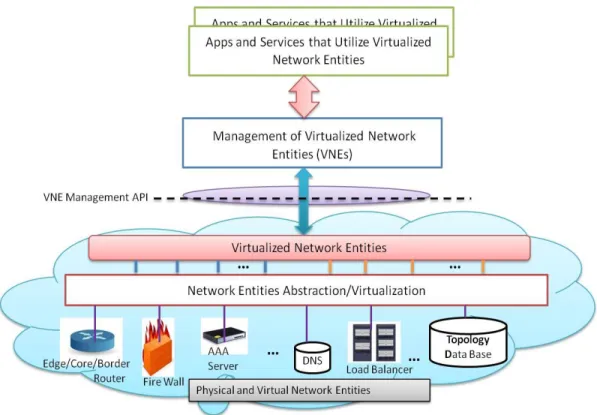
264Figure 1 shows a high-level schematic for abstraction of the network elements in order to expose them as 265
the virtualized network entities (vNEs) for management. 266
268
Figure 1 – Network Entities (Resources and Services) Abstraction, Virtualization and Management 269
As shown in Figure 1, the followings are the main components of virtualized networking: 270
Physical and virtual network elements/entities 271
Virtualized network entities (vNEs) 272
Application programming interface (API) for vNE management. 273
4.2.1 Network Entities
274
The network entities include various network components, such as routers, firewalls, AAA servers, DNS, 275
load balancers, etc. These network components can be interconnected to support network services. Such 276
network entities can be realized both as physical devices or virtual appliances. 277
A common mechanism for virtualization of these generic network entities is required in order to achieve 278
seamless interoperability. Once virtualization is done, the vNEs can be exposed through open API for 279
management and utilization by various applications and services. 280
281
4.2.2 Virtualized Network Entities (vNEs)
282
The virtualized network entities are the abstraction of the physical network entities and the network 283
entities realized as virtual appliances. The vNEs can be combined flexibly to support virtualized 284
networking services. 285
These virtualized network entities can be exposed via a management API to the upper management 286
layers. The management API can be used to create, assign, monitor, update, and release the vNEs. 287
The following sections describe the Use Cases that can be used to derive the management model and 288
required API functions. 289
5 Network Services Management Use Cases
290
This section presents the details of a sample of network services management use cases. The details of 291
each use case are presented using the following format. 292
The Use case Number and Title are mentioned first. This is followed by steps and description per the 293
format shown below. . 294
i. Short Description 295
ii. Assumptions (pre-conditions) 296
iii. Goal(s) / Desired Outcome(s) or post-conditions 297
iv. Primary, Secondary, and Supporting Actors 298
v. Triggers and Implementation / required steps for execution (interactions) 299
vi. Failure Condition(s) and Recovery 300
vii. Possible Extensions/variations 301
viii. Non-functional requirements, if applicable 302
ix. Known issues 303
5.1 Use Case 1 (UC-1): Pre-defined Template-based Network Configuration
304Use case (UC-1) describes pre-defined template-based network configuration. 305
5.1.1 Short Description of the Use Case
306
In this use case the end users are not concerned with the details of network topology. The network 307
service required by VMs can be predefined in network templates. For example, the cloud service provider 308
can define standard network topology and network service for a three-tier website. 309
To build a web site in the cloud, users can select the predefined three-tier website and assign roles, such 310
as front-end web server, application server or database server, to VMs. Once the VM roles are assigned, 311
the high-level network services can be automatically provisioned to these VMs. For example, Firewalls 312
may be setup between web servers and application servers or between application servers and database 313
servers to enforce access control of these servers. Furthermore, load balancer acting as front-end web 314
servers can be automatically configured to distribute external requests to VMs. 315
From network providers’ view, the network template and role assignment information provided by users 316
should be mapped to configurations on physical network devices and VMs (when network services are 317
provided by software). Cloud service provider should have capability to manage network 318
topology/flows/services so that the most frequently utilized network architectures can be deployed inside 319
the virtual network environment. 320
5.1.2 Assumptions and Pre-Conditions
321
It is assumed that cloud service providers have developed predefined network topology and service 322
templates, e.g., two-tier website, three-tier website, computing clusters. 323
324
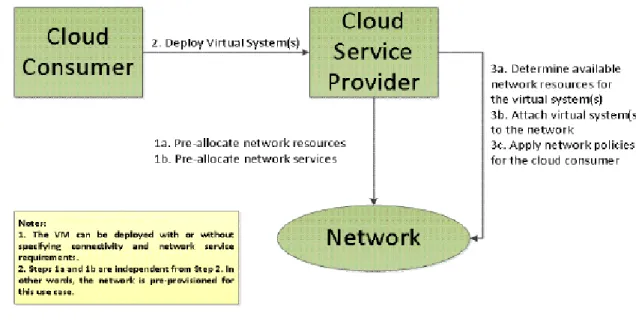
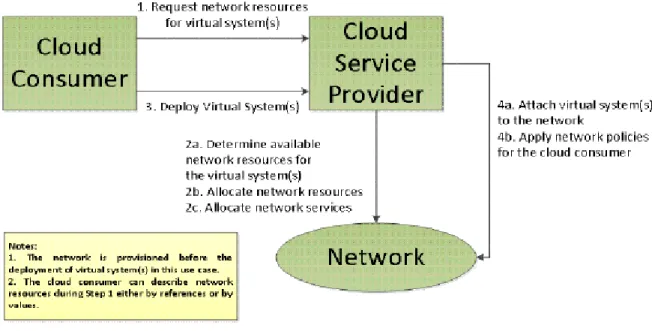
Figure 2 – Pre-Condition for Network Service Management Use Case 1 (UC-1) 325
Figure 2 shows one possible way the Cloud Service Providers can prepare and configure their network 326
and services for utilization by the Cloud Consumers for this use case. 327
5.1.3 Goal(s) and Desired Outcome(s)
328
The objective is to provide on-demand virtual network to support the cloud consumer application. 329
5.1.4 Primary, Secondary, and other Supporting Actors
330
Primary Actor: Cloud Consumer (End User), as defined in the DMTF CIMI spec. and in the definition 331
section (Section 1). 332
Secondary Actor: Cloud Service Provider 333
5.1.5 Triggers and Implementation / Executions Steps (Interactions)
334
Virtual resource management
Cloud Service provider
Computational resources Networking resources 4. VM allo cation and role assig nment 2. Netw
ork resource allocation 1. Select network template 4. Network configuration VMs VMs VMs VMs 3. Attach VMs to networks 335
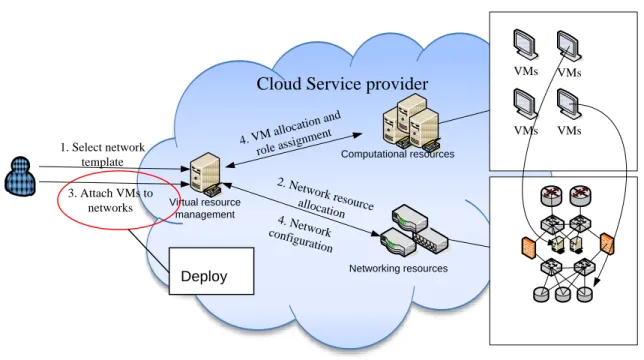
Figure 3 – High-level Network Service Management Use Case 1 (UC-1) 336
UC-1 is invoked by the cloud consumer (end user): 337
1) End user browses the network templates (a topology with connectivity and services) provided by 338
cloud service provider and selects one of the templates. End user sends commands to service provider, 339
requesting a network to be deployed based on the selected template. Specific template configurations 340
may be set by the end user. 341
2) Cloud service provider deploys the requested network along with the network services based on the 342
predefined network template selected by user. Cloud service provider associates VMs to network ports on 343
the virtual network. 344
3) End user deploys VMs on the network or associates existing VMs to the network. 345
4) Cloud service provider associates VMs to Network services configured in the template (or 346
automatically provisioned to the VM based on the role of VM). 347
The requirements related to UC-1 include the following ones: 348
• UC-1: Req.-1: Service provider should be able to configure the network based on network service 349
requirements. 350
• UC-1: Req.-2: Service provider should provide network templates for users which can be easily 351
mapped to popular network topologies. 352
• UC-1: Req.-3: Service provider may define common network policy services, e.g., Load balancer, 353
FW, on the network templates. 354
• UC-1: Req.-4: Service provider may scale the capability of network services, e.g., bandwidth/packet 355
processing capability, based on user network requirements. 356
5.1.6 Failure Condition (s) and Recovery
357
Failure occurs when the Cloud Service Provider cannot meet the consumer requirements or the request 358
is in violation of one of the business agreement requirements. Failure may also occur when the Service 359
Provider can’t fulfill any one of the implementation steps or triggers discussed in the previous section. In 360
some situations, failure may also occur when the alternatives suggested by the Cloud Service Provider 361
are not acceptable to the Cloud Consumer. 362
5.1.7 Possible Extensions/variations
363
Focus on provider-defined pre-configured templates only. The consumer can pick and choose but not 364
modify the templates. For now the consumer-defined templates are out of scope. 365
5.1.8 Non-functional requirements, if applicable
366
None, for this version of this document. 367
5.1.9 Known Issues
368
None, for this version of this document. 369
5.2 Use Case 2 (UC-2): Network Configuration based on Existing Physical
370Network Topology of User’s Data Center
371Use case (UC-2) discusses Network configuration based on existing physical network topology of user’s 372
data center. 373
5.2.1 Short Description of the Use Case
374
Cloud consumer may have already deployed their own private network and server clusters. When users 375
move their existing IT infrastructures to the cloud, network services in the existing physical networks 376
should also be moved to the virtual network so that VMs migrated from existing physical servers can work 377
properly. In this use case, users should first extract network service configurations, such as ACLs in 378
Firewall and policy settings in Load balancer, from the deployed physical network. 379
To facilitate the network migration, users may map their network configurations to a standardized format 380
or template, e.g., network service model in CIMI interface or OVF 2 package. After the virtual network is 381
setup by the cloud service provider, user can “plug-in” the VMs seamlessly to the virtual network 382
interfaces mapped to their existing physical network. 383
5.2.2 Assumptions and Pre-Conditions
384
Cloud consumer (end user) has already deployed enterprise network. 385
Cloud consumer (end user) has tools to extract network topology and configurations from existing 386
network. 387
Cloud consumer Administrator (Admin on the consumer side) has the necessary tools and capability to 388
administer the network and service requests from the Cloud consumer. 389
390
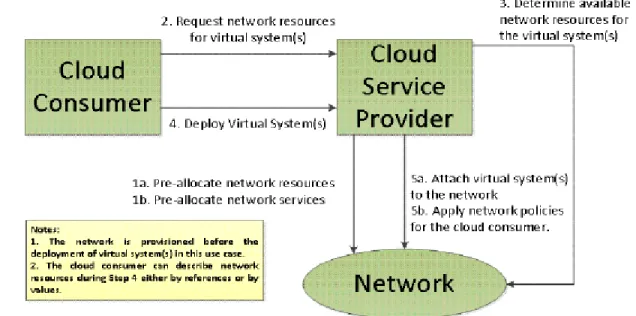
Figure 4 – Pre-Condition for Network Service Management Use Case 2 (UC-2) 391
Figure 4 shows one possible way the Cloud Service Providers can prepare and configure their network 392
and services for utilization by the Cloud Consumers for this use case. 393
5.2.3 Goal(s) and Desired Outcome(s)
394
The objective is to support effortless migration from an existing network to a virtual network by extracting 395
the required network topology and configuration information. The cloud service provider essentially 396
“clones” the existing networking functions and services for seamless migration of resources from one 397
provider domain to another. 398
5.2.4 Primary, Secondary, and other Supporting Actors
399
Primary Actor: Cloud Consumer (End User) 400
Secondary Actor: Cloud Service Provider 401
Supporting Actor: Cloud Consumer Administrator (Admin) 402
5.2.5 Triggers and Implementation / Executions Steps (Interactions)
403
From the cloud service providers’ view, they should get network topology and service configuration 404
information from users. Then they should configure network services (on physical network devices or on 405
VMs) to mimic the network as in the way described by the user. If the service cannot be configured as 406
requested by the users, the cloud service provider should return the reason for the failure and the 407
difference between the configuration of the virtual network and the network requested by the user. 408
Virtual resource management
Cloud Service provider
Computational resources Networking resources 5. VM allo cation and role assig nment
3. Network reso urce allocation 2. Network configurations 5. Network configuration VMs VMs VMs VMs 1. Network configuration extaction 4. Attach VMs to networks 409
Figure 5 – High-level Network Service Management Use Case 2 (UC-2) 410
UC-2 is invoked by the Cloud Consumer Admin: 411
1) Cloud Consumer Admin exports network topology and configuration from the existing network. The 412
network configuration for specific network services should be mapped to standardized network services. 413
2) Cloud Consumer Admin imports the network topology and configuration to the cloud service provider. 414
3) Cloud service provider configures network devices, servers or VMs to setup virtual network and 415
network services which meet the end user’s requirements. 416
4) Cloud Consumer Admin deploys VMs on the network or associates existing VMs to the network. 417
5) Cloud service provider associates VMs to network ports on the virtual network. 418
The requirements related to UC-2 include the following ones: 419
• UC-2: Req.-1: as defined in UC-1: Req.-1. 420
• UC-2: Req.-2: Service provider should provide interfaces for user to import network topology and 421
configurations. 422
• UC-2: Req.-3: Service provider should meet user’s network requirements by allocating network 423
resources and configure them as requested by the user. If user’s requirements cannot be fulfilled, service 424
provider may return the difference between user’s requirements and the allocated network resources. 425
• UC-2: Req.-4: Service provider may provide a set of network services, e.g., routers/FW/LB. 426
• UC-2: Req.-5: Service provider may enable configuration mechanisms to allow user to migrate 427
configuration data. The configuration may include network services policies, e.g. ACLs in firewall or 428
policies in Load Balancer. 429
5.2.6 Failure Condition (s) and Recovery
430
Failure occurs when the Cloud Service Provider cannot meet the consumer requirements or the request 431
is in violation of one of the business agreement requirements. Failure may also occur when the Service 432
Provider can’t fulfill any one of the implementation steps or triggers discussed in the previous section. In 433
some situations, failure may also occur when the alternatives suggested by the Cloud Service Provider 434
are not acceptable to the Cloud Consumer. 435 Export network configuration Import network configuration Deploy…
5.2.7 Possible Extensions/variations
436
Cloud service provider may return the difference between available virtual network capability and user 437
request when any significant parts of user’s requirements cannot be fulfilled. 438
5.2.8 Non-functional requirements, if applicable
439
Users may request for specific capacity for a given network service, e.g., a Firewall may need to have 440
black list size larger than 10,000 entries and should be able to process 1M packets per second. These 441
types of features are commonly supported. 442
5.2.9 Known Issues
443
None, for this version of this document. 444
5.3 Use Case 3 (UC-3): Network Configuration Modification
445Use case 3 (UC-3) illustrates network configuration modification during run time. 446
5.3.1 Short Description of the Use Case
447
A cloud consumer administrator may need to modify the network configuration while their virtual systems 448
are running. 449
For example, changes may be needed to the ACLs in firewall or scaling the network based on workload 450
demand. 451
The cloud consumer administrator can use the CIMI interface to request changes in the network 452
configuration. 453
5.3.2 Assumptions and Pre-Conditions
454
The cloud service provider has deployed the virtual network as requested by the cloud consumer 455
administrator. 456
The cloud consumer administrator has the necessary tools to effect changes. 457
458
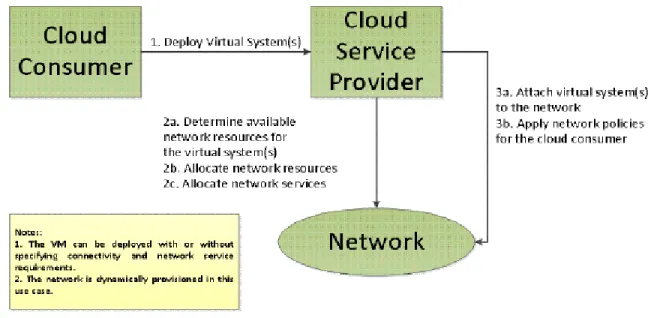
Figure 6 – Pre-Condition for High-level Network Service Management Use Case 3 (UC-3) 459
Figure 6 shows one possible way the Cloud Service Providers can prepare and configure their network 460
and services for utilization by the Cloud Consumers for this use case. 461
5.3.3 Goal(s) and Desired Outcome(s)
462
The objective is to achieve an on-demand update of the network configuration. This facilitates dynamic 463
addition/removal/modification of network capacity, service quality, and capabilities of the services. 464
5.3.4 Primary, Secondary, and other Supporting Actors
465
Primary Actor: Cloud Consumer 466
Secondary Actor: Cloud Service Provider 467
Supporting Actor: Cloud Consumer Administrator 468
5.3.5 Triggers and Implementation / Executions Steps (Interactions)
469
From the cloud service providers’ view, they must provide automatic network service reconfiguration, in 470
addition to user requested configuration changes. Such automatic network service reconfiguration 471
includes: automatically relocate network services when there is a network failure, automatically scale up 472
network service capacities when more VMs or computational resources are allocated to the user. 473
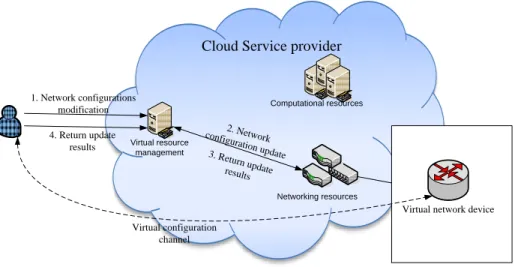
Virtual resource management
Cloud Service provider
Computational resources Networking resources 2. Network configuration u pdate 1. Network configurations modification 3. Retur n update results
Virtual network device 4. Return update
results
Virtual configuration channel
474
Figure 7 – High-level Network Service Management Use Case 3 (UC-3) 475
UC-3 is invoked by the cloud customer administrator: 476
1) The cloud consumer administrator sends a request to the cloud service provider to modify a network 477
service configuration. 478
2) The cloud service provider modifies the network service configuration. 479
3) The cloud service provider returns the status of the network service configuration change to the cloud 480
consumer administrator. 481
4) The cloud consumer administrator verifies that the requested modification has been made. 482
The requirements related to UC-3 include the following ones: 483
• UC-3: Req.-1: The cloud service provider is able to accept requests for network service configuration 484
changes from the cloud consumer administrator. 485
5.3.6 Failure Condition (s) and Recovery
486
A failure occurs if the cloud service provider cannot support the requested network service configuration 487
change. 488
5.3.7 Possible Extensions/variations
489
None, for this version of this document. 490
5.3.8 Non-functional requirements, if applicable
491
None, for this version of this document. 492
5.3.9 Known Issues
493
None, for this version of this document. 494
496
6 Relationships with DMTF Specifications
497
In this section, a short overview of the DMTF specifications and models related to networking is 498
presented. 499
6.1 OVF
500Open Virtualization Format Specification (DSP0243) 501
OVF describes an open, secure, portable, efficient and extensible format for the packaging and 502
distribution of software to be run in virtual machines. The OVF package contains Network Section which 503
describes logical networks used in the package. Connections to Networks are specified through 504
configurations on Ethernet Adaptors. 505
506
6.2 CIMI
507Cloud Infrastructure Management Interface (CIMI) Model and REST Interface over HTTP specification 508
(DSP0263) 509
CIMI focuses on the model and protocol for management interactions between a cloud Infrastructure as a 510
Service (IaaS) Provider and the Consumers of an IaaS service. Among other resources, such as 511
Machines and Volumes, CIMI also provides management for Networking resources, which include 512
Network, Network Template, Network Configuration, Network Port, Network Port Template, Network Port 513
Configuration, Address, Address Template, Forwarding Group, Forwarding Group Template and their 514
respective collections. 515
CIMI needs to be able to support implementing the subset of the requirements of the use cases described 516
in this white paper as applicable to the Provider/Consumer interface. 517
6.3 Network Related Profiles
518DMTF defined network related management profiles include: Virtual System Profile (DSP1057), Ethernet 519
Port Profile (DSP1014), Resource Allocation Profile (DSP1041), Allocation Capabilities Profile 520
(DSP1043), Ethernet Port Resource Virtualization Profile (DSP1050), and Virtual Ethernet Switch Profile 521
(DSP1097). 522
Network management is an important component for the management task. The current DMTF standards 523
mostly focus on network aspects of L2 and below networks, which mainly involves with network ports, 524
adaptors, L2 switches, etc. For a more complete view of networking management, L3 and above network 525
services should be considered. 526
527
7 Impact to the existing DMTF Specifications
528
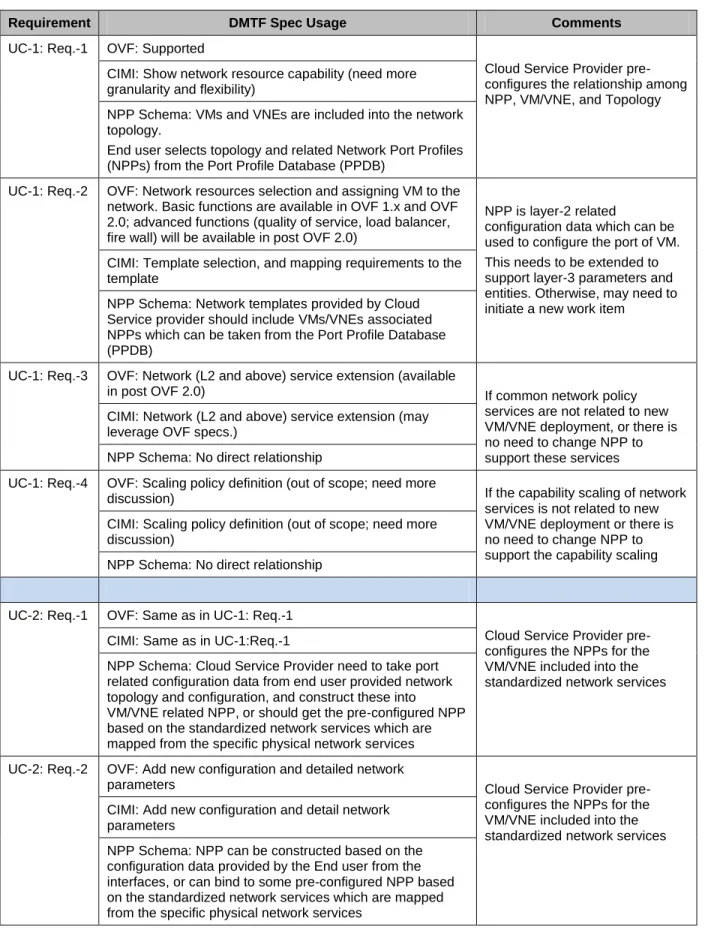
Table 1 shows the potential impact on the CIMI interface, OVF, and NPP based on the requirements 529
developed above. 530
531 532
Table 1 – Potential Impact to the DMTF Specifications 533
Requirement DMTF Spec Usage Comments
UC-1: Req.-1 OVF: Supported
Cloud Service Provider pre-configures the relationship among NPP, VM/VNE, and Topology CIMI: Show network resource capability (need more
granularity and flexibility)
NPP Schema: VMs and VNEs are included into the network topology.
End user selects topology and related Network Port Profiles (NPPs) from the Port Profile Database (PPDB)
UC-1: Req.-2 OVF: Network resources selection and assigning VM to the network. Basic functions are available in OVF 1.x and OVF 2.0; advanced functions (quality of service, load balancer, fire wall) will be available in post OVF 2.0)
NPP is layer-2 related
configuration data which can be used to configure the port of VM. This needs to be extended to support layer-3 parameters and entities. Otherwise, may need to initiate a new work item
CIMI: Template selection, and mapping requirements to the template
NPP Schema: Network templates provided by Cloud Service provider should include VMs/VNEs associated NPPs which can be taken from the Port Profile Database (PPDB)
UC-1: Req.-3 OVF: Network (L2 and above) service extension (available
in post OVF 2.0) If common network policy
services are not related to new VM/VNE deployment, or there is no need to change NPP to support these services CIMI: Network (L2 and above) service extension (may
leverage OVF specs.)
NPP Schema: No direct relationship
UC-1: Req.-4 OVF: Scaling policy definition (out of scope; need more
discussion) If the capability scaling of network
services is not related to new VM/VNE deployment or there is no need to change NPP to support the capability scaling CIMI: Scaling policy definition (out of scope; need more
discussion)
NPP Schema: No direct relationship
UC-2: Req.-1 OVF: Same as in UC-1: Req.-1
Cloud Service Provider pre-configures the NPPs for the VM/VNE included into the standardized network services CIMI: Same as in UC-1:Req.-1
NPP Schema: Cloud Service Provider need to take port related configuration data from end user provided network topology and configuration, and construct these into VM/VNE related NPP, or should get the pre-configured NPP based on the standardized network services which are mapped from the specific physical network services UC-2: Req.-2 OVF: Add new configuration and detailed network
parameters Cloud Service Provider
pre-configures the NPPs for the VM/VNE included into the standardized network services CIMI: Add new configuration and detail network
parameters
NPP Schema: NPP can be constructed based on the configuration data provided by the End user from the interfaces, or can bind to some pre-configured NPP based on the standardized network services which are mapped from the specific physical network services
UC-2: Req.-3 OVF: Supported
If the port profiles can’t be supported per End User’s network requirements, Cloud service provider should return the difference at network service level CIMI: Return differences when user requirements cannot be
met (outside the scope)
NPP Schema: Cloud Service Provider needs to check whether the platform can support the required port configuration data based on End User’s network requirements
UC-2: Req.-4 OVF: Define standard network services (limited support)
If a standard network service is supported by VM/VNE, the affected port configuration data related to the network service should be reflected into NPP CIMI: Define standard network services (not available as an
API; only through OVF import)
NPP Schema: Cloud Service Provider should provide mapping of standard network services to some port configuration data of NPP
UC-2: Req.-5 OVF: Network device configuration parameters (limited
support) None
CIMI: Network device configuration parameters (not available as an API; only through OVF import)
NPP Schema: Migration of configuration data has no direct influence on the content of NPP, but impact the location only
UC-3: Req.-1 OVF: Not Supported, Runtime features to be supported in
future version. If some network capability is
auto-scaled by Cloud Service provider, the affected port configuration data in NPP should be modified CIMI: Supported.
May provide network service configuration interface through CIMI
NPP Schema: Cloud Service Provider should provide mapping of network capability to some port configuration data of NPP.
NPP should be modified to support the network services configured by the End User
CIMI: May return network service configuration interface through CIMI
NPP Schema: NPP should be modified to support the network services configured by the End User
ANNEX A
534
(Normative)
535 536
IETF/IRTF Standards and Specifications
537
The following three active IETF (http://datatracker.ietf.org/wg/) and IRTF (http://www.irtf.org/groups) 538
working groups may be most relevant to the DMTF NSM WG: 539
Network Virtualization Overlays (NVO3) in the Routing Area (RA) of IETF 540
System for Cross-domain Identity Management (SCIM) in the Applications Area (AA) of IETF 541
Software Defined Networking Research Group (SDN-RG) in IRTF 542
A brief description of each of the above groups is presented below. 543
NVO3: It is noted that support for multi-tenancy has become a core requirement of data centers (DCs), 544
especially in the context of data centers supporting virtualized hosts and virtual machines (VMs). The 545
NVO3 WG will investigate the interconnection of the DC virtual private network (VPNs) and their tenants 546
with non-NVO3 Internet protocol-based network(s) to determine if any specific work is needed. Further 547
details about the charter of NVO3 can be found at the following Website: 548
http://datatracker.ietf.org/wg/nvo3/charter/. 549
SCIM: SCIM working group will standardize methods for creating, reading, searching, modifying, and 550
deleting user identities and identity-related objects across administrative domains, with the goal of 551
simplifying common tasks related to user identity management in services and applications. Further 552
details about the charter of NVO3 can be found at the following Website: 553
http://datatracker.ietf.org/wg/scim/charter/. 554
SDN-RG: SDN-RG provides a forum for researchers to investigate key and interesting problems in the 555
Software Defined Networking (SDN) field. It investigates SDN from various perspectives with the goal of 556
identifying the approaches that can be defined, deployed and used in the near term as well identifying 557
future research challenges. Key areas of interest include solution scalability, abstractions, and 558
programming languages and paradigms particularly useful in the context of SDN. Further details about 559
the charter of SDN-RG can be found at the following Website: 560
http://trac.tools.ietf.org/group/irtf/trac/wiki/sdnrg. 561
ANNEX B
562
(Informative)
563 564
(Inter-Provider Use Case)
565 566
B.1 Use Case B1 (UC-B1): Location Aware Hosting of Virtual Desktop
567This is an Inter-Provider use case. This use case (UC-B1), describes location aware hosting of Virtual 568
Desktop (VD). 569
B.1.1
Short Description of the Use Case
570
Implementation of this use case facilitates accessing of the features and services by a roaming virtual 571
desktop (VD) without directly using a virtual machine (VM) in a host of the original home/Enterprise Data 572
center. 573
B.1.2
Assumptions and Pre-Conditions
574
A virtual desktop (VD) client is installed in a device (Tablet, Mobile phone, Laptop, phablet, etc.) that can 575
travel with the user, and the user can get all of the services and features seamlessly irrespective of the 576
location through generic network (Internet) access. 577
In general, the VD is hosted in a virtual machine (VM) in the Enterprise (private) Data Center (DC). When 578
the user is roaming, another VM in a visited DC may host the VD 579
580
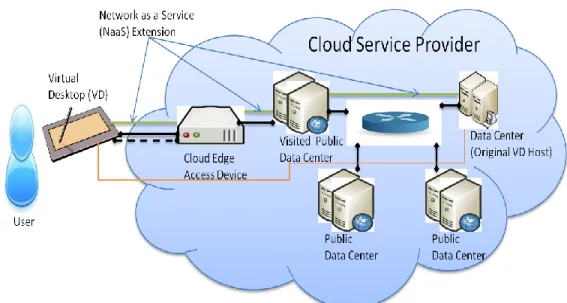
Figure 8 – Pre-Condition for High-level Network Service Management Use Case B1 (UC-B1) 581
582
Figure 8 shows one possible way the Cloud Service Providers can prepare and configure their network 583
and services for utilization by the Cloud Consumers for this use case. 584
B.1.3
Goal(s) and Desired Outcome(s)
585
The objective is to achieve on-demand hosting and mobility support for virtual desktop. The virtual 586
desktop features and host (in VM) location are adapted based on network and service access location. 587
This helps achieve the desired performance to the visited location. It is required to share cross-domain 588
topology and resource utilization information in order to achieve the desired optimization. 589
B.1.4
Primary, Secondary, and other Supporting Actors
590
Primary actors: Cloud consumers who have Virtual desktop (VD) client, VD host, Networking as a Service 591
(NaaS) proxy, etc. 592
Secondary actors: Cloud service provider with the capability to support Networking as a Service (NaaS) 593
server, virtual machine, Host, Data center, etc. 594
Supporting actors: Service monitoring/management/logging/auditing tools, and associated infrastructure. 595
B.1.5
Triggers and Implementation / Executions Steps (Interactions)
596
597
Figure 9 – High-level Network Service Management Use Case B1 (UC-B1) 598
An implementation of UC-B1 can be invoked by any cloud customer (end user) who has a VD installed in 599
a network (Internet) access capable device, e.g., tablet, laptop, mobile phone, etc. The following are 600
possible high-level steps: 601
1) Turn on the device and activate the virtual desktop (VD). 602
2) Enable network (Internet) access. 603
3) Start the Web Browser, and Type-in the URL for accessing the VM in the Enterprise Data center that 604
is hosting the VD. 605
4) Provide the valid LogIn credentials for access verification/challenge, and then allow successful Login 606
or report mis-handling of the system, unauthorized access attempts, etc. 607
5) Enterprise Data center recognizes the current roaming location of the VD and locates a nearby guest 608
Data Center and a VM in that DC that can host the VD. 609
6) The guest DC then establishes back-end Network as a Service (NaaS) extension to the VM in the 610
original Enterprise DC 611
7) The VD which is now hosted in a VM in the guest DC, and it can have all of the service and features 612
as in the original DC without having direct access to the VM in the original Enterprise DC 613
8) Service usages are monitored and recorded for logging, auditing and QoS/QoE maintenance 614
purposes 615
9) When the user logs off, the VM, NaaS, and associated resources form eth guest DC are released, 616
and all of the recorded service logging and auditing related data are transferred back to the original 617
Enterprise DC. 618
The requirements related to UC-B1 include the following ones: 619
• UC-B1: Req.-1: The device that contains a valid/registered VD should be able to establish a VPN or 620
layer-2 tunnel to the Enterprise Data Center (DC) where the original VM that hosts the VD resides. 621
• UC- B1: Req.-2: Based on the physical location of the VD, the Original DC (in collaboration with the 622
VM that is Hosting the VD) should be able to determine -- based on many criteria, and one of these may 623
be the geographical proximity of the VD-device – a guest/visited DC, and must locate a VM (within the 624
DC) which can host the VD temporarily (for the duration of the session). Note that a federation of VMs 625
may be used to locate a feasible VM to Host the VD as well (cross-domain resources discovery and 626
topology sharing may be required for this purpose). 627
• UC- B1: Req.-3: Original VM should be able to negotiate for the desired features and services of the 628
VD with the VM in the guest/visited DC. If the negotiation passes, a VM is located in the desired DC to 629
Host the VD. If not, the Enterprise DC should be able to locate an alternative DC within a given set of 630
constraints, and a VM is located in it to host the VD (cross-domain resources discovery and topology 631
sharing may be required for this purpose). 632
• UC- B1: Req.-4: VM in the guest/visited DC should be able to establish VPN or Layer-2 tunnel (back-633
end networking as a service or NaaS extensions) to the VM in the original Enterprise DC VM (VD-host). 634
• UC- B1: Req.-5: Back-end NaaS extensions should be able to allocate, monitor and enforce the 635
features and services including QoS/QoE, privacy and security requirements, and must facilitate logging 636
and auditing data collection throughout the session. The features may utilize virtualized computing, 637
communications, storage, transcoding, etc. resources. 638
• UC- B1: Req.-6: The VD should now be able to access the VM (Host) in the guest/visited DC and 639
must have access to all of the features and functions as if the VD (VM) is in the original Enterprise DC 640
that hosts the VD. 641
• UC- B1: Req.-7: It is required to support the abstraction of cross-DC (among the VMs that are 642
Hosting the VD) communications. 643
• UC- B1: Req.-8: It is required to support the abstraction of cross-DC (among the VMs that are 644
Hosting the VD) co-ordination of VD features and services. 645
• UC- B1: Req.-9: It is required to support the availability of Topology and Cost (delay, jitter, loss, price, 646
etc. matrix) data across the desired DC domains. 647
B.1.6
Failure Condition (s) and Recovery
648
In general, failure occurs when the Cloud service provider cannot support the desired network-aware 649
hosting of virtual desktop. In addition, failure may occur when the Cloud Service Provider cannot satisfy 650
any one of the implementation steps or triggers discussed in the previous section. This may include 651
regulatory restrictions, and lack of availability of VM features/functions/capability in the visited hosts. 652
B.1.7
Possible Extensions/variations
653
The roaming user may provide some preference regarding the location of the guest DC. Similarly, the 654
Enterprise DC may have a set of pre-selected list of globally distributed DCs from which the guest DC can 655
be selected. 656
It is possible that service-specific QoS/QoE and security profile will be invoked either by the VD or by the 657
VM or by both. 658
If desired, logging of auditable service usage may be flexible as well. 659
B.1.8
Non-functional requirements, if applicable
660
The non-functional requirements for this use case may include the following: (a) personalization of VD 661
and VM profiles, (b) service granularity and quality, and (c) service usage capacity including bandwidth 662
and volume/size of downloaded/uploaded data. 663
B.1.9
Known Issues
664
None, for this version of this document. 665
666
B.2 Impact to the existing DMTF Specifications
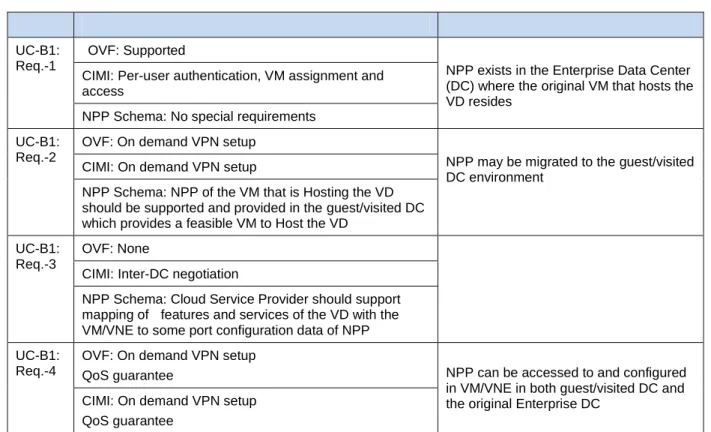
667Table 2 shows the potential impact on the CIMI interface, OVF, and NPP based on the requirements 668
developed above for this Inter-Provider use case. 669
670
Table 2 – Impact to DMTF Specifications for an Inter-Provider Use Case 671
UC-B1: Req.-1
OVF: Supported
NPP exists in the Enterprise Data Center (DC) where the original VM that hosts the VD resides
CIMI: Per-user authentication, VM assignment and access
NPP Schema: No special requirements UC-B1:
Req.-2
OVF: On demand VPN setup
NPP may be migrated to the guest/visited DC environment
CIMI: On demand VPN setup
NPP Schema: NPP of the VM that is Hosting the VD should be supported and provided in the guest/visited DC which provides a feasible VM to Host the VD
UC-B1: Req.-3
OVF: None
CIMI: Inter-DC negotiation
NPP Schema: Cloud Service Provider should support mapping of features and services of the VD with the VM/VNE to some port configuration data of NPP UC-B1:
Req.-4
OVF: On demand VPN setup
QoS guarantee NPP can be accessed to and configured
in VM/VNE in both guest/visited DC and the original Enterprise DC
CIMI: On demand VPN setup QoS guarantee
NPP Schema: No special requirements UC-B1:
Req.-5
OVF: Supported
None CIMI: Extension on metering
NPP Schema: Cloud Service Provider should support mapping of the features and services of the NaaS extensions to some port configuration data of NPP UC-B1:
Req.-6
OVF: Supported
NPP can be accessed to and configured in VM/VNE in both guest/visited DC and the original Enterprise DC
CIMI: Supported
NPP Schema: No special requirements UC-B1:
Req.-7
OVF: Supported
NPP can be accessed to and configured in VM/VNE in both guest/visited DC and the original Enterprise DC
CIMI: On demand VPN setup
NPP Schema: No special requirements UC-B1:
Req.-8
OVF: Supported
The port profiles can be coordinated between the guest/visited DC and the original Enterprise DC
CIMI: Inter-DC coordination
NPP Schema: Cloud Service Provider should provide mapping of the features and services of the VD with the VM to some port configuration data of NPP
UC-B1: Req.-9
OVF: Supported
The supported port profiles across the desired DC domains need to be checked CIMI: Inter-DC data sharing
NPP Schema: Cloud Service Provider should support checking and mapping of the Topology and Cost data to some port configuration data of NPP
672 673 674 675 676 677 678
ANNEX C
679
(Change Log)
680
Version Date Description
wgv0.1.0- 2012-08-11 Early Template and Outline
wgv0.1.1- 2012-08-17 Initial Draft
wgv0.1.2- 2012-08-26 Updated with Use Case Details
wgv0.2.0- 2012-09-07 Updated with Edits and Use Case Details wgv0.2.1- 2012-09-07 Updated with Edits/Clarification
wgv0.2.2- 2012-09-10 Updated with Edits/Clarification
wgv0.2.3- 2012-09-19 Updated to address the comments from face-to-face mtg. and discussion
wgv0.3.0- 2012-09-28 Updated pre-condition and definition section wgv0.4.0- 2012-10-03 Edits and updates
wgv0.4.1- 2012-10-12 Edits and updates
wgv0.5.0- 2012-10-16 Converted to DMTF template
wgv0.5.1 2012-10-19 Worked on terms and definitions
wgv0.5.2 2012-10-24 Added DSP number and some formatting
wgv0.5.3-9 2012-10-25 Edits and updates wgv 0.6.0 2012-01-16 WIP release candidate
1.0.0a
wgv 0.6.1 2012-01-17 WIP release candidate with footer, front, page, references fixed. 1.0.0a 2013-03-20 WIP release
681 682