Robot Learning Assembly Tasks from
Human Demonstrations
Zuyuan Zhu
Supervisor: Prof. Huosheng Hu
School of Computer Science and Electronic Engineering
University of Essex
This thesis is submitted for the degree of
Doctor of Philosophy
Declaration
I hereby declare that except where specific reference is made to the work of others, the contents of this dissertation are original and have not been submitted in whole or in part for consideration for any other degree or qualification in this, or any other university. This dissertation is my own work and contains nothing which is the outcome of work done in collaboration with others, except as specified in the text and Acknowledgements. This dissertation contains fewer than 80,000 words excluding appendices table of contents/figures, abstract, acknowledgements, references, bibliography and footnotes.
Zuyuan Zhu July 2020
Acknowledgements
First and foremost, I would like to express my unique appreciation and thanks to my super-visor Professor Huosheng Hu who has been a tremendous mentor for me. I would like to sincerely thank him for encouraging my research, giving instant feedback, and allowing me to grow as a researcher. His constant and attentive guidance on my academic skills has been invaluable.
I especially thank my supervisory panel member, Dr. Vishwanathan Mohan, for his encouragement, support, excellent advice during my panel meetings. My thanks also go to Prof. Dongbing Gu for his useful suggestions on my early research. Besides, I would like to thank Mr. Robin Dowling who supports my PhD research, open day demos and GLA labs warm-hearted. Thanks to Mr. Ian Dukes for helping my English at the early stage.
I am grateful to all my colleagues and friends, namely Yaser N. Ibrahem Alothman, Penelope Roberts, Aakash Soni, Dingtian Yan, Shengnan Li, David Liao, Kai Zhang, Junpeng Shi, Geleite Xu, Wentong Liu, Jiejun Hu, Binxgin Cai, Lili Yan, Mingchen Sun, Tianyu Li, Yufan Lu and many academic visitors of Essex robotics lab during my PhD. My special appreciation goes to Qiang Liu for his help on my GLA teaching and career development, Jianjun Gui for his help on my research and settling down at Essex, Ruihao Li for his help on my research and gym workout.
Last but not least, I sincerely thank my parents, my brother and sister. They always have been loving, supporting and trusting me throughout my studies. Without their support, I wouldn’t have made it.
Abstract
The industry robots are widely deployed in the assembly and production lines as they are efficient in performing highly repetitive tasks. They are mainly position-controlled and pre-programmed to work in well-structured environments. However, they cannot deal with dynamical changes and unexpected events in their operations as they do not have sufficient sensing and learning capabilities. It remains a big challenge for robotic assembly operations to be conducted in unstructured environments today.
This thesis research focuses on the development of robot learning from demonstration (LfD) for the robotic assembly task by using visual teaching. Firstly, the human kinesthetic teaching method is adopted for robot to learn an effective grasping skill in unstructured envi-ronment. During this teaching process, the robot learns the object’s SIFT feature and grasping pose from human demonstrations. Secondly, a novel skeleton-joint mapping framework is proposed for robot learning from human demonstrations. The mapping algorithm transfers the human motion from the human joint space to the robot motor space so that the robot can be taught intuitively in a remote place. Thirdly, a novel visual-mapping demonstration framework is built for robot learning assembly tasks, in which, the demonstrator is able to teach the robot with feedback in real-time. Gaussian Mixture Model and Gaussian Mixture Regression are used to encode the learned skills for the robot. Finally, The effectiveness of the approach is evaluated with practical assembly tasks by the Baxter robot.
The significance of this thesis research is on its comprehensive insight of robot learning from demonstration for assembly tasks. The proposed LfD paradigm has the potential to
effectively transfer human skills to robots both in industrial and domestic environments. It paves the way for general public to use the robots without the need of programming skills.
Table of contents
List of figures xv
List of tables xxiii
1 Introduction 1 1.1 Motivation . . . 1 1.2 Research Questions . . . 2 1.3 Research Objectives . . . 6 1.4 Research Methodology . . . 8 1.5 Thesis Contributions . . . 9 1.6 Thesis Outline . . . 10
2 Background and Related Research 13 2.1 Introduction . . . 13
2.1.1 Robotic assembly . . . 13
2.1.2 Learning from demonstration . . . 15
2.2 Research Problems in Robotic Assembly . . . 18
2.2.1 Pose estimation . . . 18
2.2.2 Force estimation . . . 20
2.2.3 Assembly sequence . . . 21
2.3 Demonstration Approach . . . 23
2.3.1 Kinesthetic demonstration . . . 23
2.3.2 Motion-sensor demonstration . . . 25
2.3.3 Teleoperated demonstration . . . 27
2.4 Feature Extraction . . . 31
2.4.1 Hidden Markov models . . . 34
2.4.2 Dynamic movement primitives . . . 36
2.4.3 Gaussian mixture models . . . 39
2.5 Metric of Imitation Performance . . . 40
2.5.1 Weighted similarity measure . . . 42
2.5.2 Generic similarity measure . . . 43
2.5.3 Combination of metrics . . . 43 2.6 Summary . . . 47 3 Peg-in-Hole Assembly 51 3.1 Introduction . . . 51 3.2 Background . . . 53 3.2.1 Related work . . . 53
3.2.2 Robot operating system . . . 55
3.2.3 ROS for controlling a Baxter robot . . . 58
3.3 Learning from Kinesthetic Teaching . . . 59
3.3.1 Teaching . . . 59
3.3.2 Reproduction . . . 65
3.3.3 Pseudocode . . . 67
3.4 Experimental Results . . . 67
3.4.1 Experimental setup . . . 69
Table of contents xiii
3.4.3 Lego blocks assembly task . . . 71
3.5 Summary . . . 74
4 Human Movement Mapping 79 4.1 Introduction . . . 79
4.2 Human Skeleton Tracking Mechanism . . . 81
4.3 Human-Robot mapping mechanism . . . 85
4.4 Holt’s Two Parameter Exponential Smoothing . . . 90
4.5 Experiment Results . . . 91
4.5.1 Experiment setup . . . 91
4.5.2 Software implementation . . . 92
4.5.3 Joints smoothing experiments . . . 95
4.5.4 Joint mapping experiments . . . 100
4.6 Discussion . . . 102
4.7 Summary . . . 105
5 Robotic Assembly 107 5.1 Introduction . . . 107
5.2 Robotic Assembly Experiment Scenario . . . 108
5.2.1 What robot sees . . . 108
5.2.2 What robot learns . . . 114
5.2.3 What robot does . . . 119
5.3 Experimental Results . . . 121
5.3.1 Experiment setup . . . 121
5.3.2 Software implementation . . . 122
5.3.3 Model generalisation . . . 125
5.3.5 Discussion . . . 141
5.4 Summary . . . 148
6 Conclusion and Future Work 149 6.1 Research so far . . . 149
6.2 List of Publications . . . 151
6.3 Discussion . . . 152
6.4 Future work . . . 154
Appendix A Supplementary Figures of Chapter 4 155 A.1 Double Exponential Smoothing Applied on Human Joints . . . 155
A.2 The MSE Distribution of Smoothed Human Joint Trajectories . . . 167
Appendix B Supplementary Code of Chapter 4 175 B.1 cob_body_trackernode . . . 175
B.2 kinect2_launch_joint_pubnode . . . 178
B.3 kinect2_launch_joint_subnode . . . 181
B.4 baxter_arm_controlnode . . . 182
Appendix C Supplementary Code of Chapter 5 185 C.1 find_object_3dnode . . . 185
C.2 kinect2_launch_joint_pubnode . . . 187
C.3 model_generalisationnode . . . 189
C.4 robot_assemblynode . . . 190
List of figures
1.1 The technical details of Baxter robot . . . 4 2.1 The three main phases in imitation learning . . . 16 2.2 Human demonstrator teaches the Kuka LWR arm to learn peg-in-hole
opera-tions by kinesthetic guiding [2]. . . 24 2.3 The motion sensor is integrated in the glove at the back of the hand [65]. . . 26 2.4 A tactile glove is used to reconstruct both forces and poses from human
demonstrations, enabling the robot to directly observe forces used in demon-strations so that the robot can successfully perform a screwing task: opening a medicine bottle [41]. . . 27 2.5 Human demonstrator performs the Peg-in-Hole task in teleoperation mode . 28 2.6 Experimental setups for the slide-in-the-groove assembly task and
bolt-screwing task [98]. . . 29 2.7 An example of showing how to extract the features of the demonstration and
how the features are used for robot learning . . . 32 2.8 The hierarchical architecture of teaching robots the use of human tools in an
LfD framework [78]. The solid arrow means the demonstration flow and the dashed arrow means the reproducing flow. . . 38
2.9 An example of illustrating how to use three different displacements (rel-ative displacement, absolute position, and rel(rel-ative position) to evaluate a reproduction attempt and find an optimal controller for the reproduction of a task . . . 42 2.10 Example of the movement reproduction and generalisation in a new
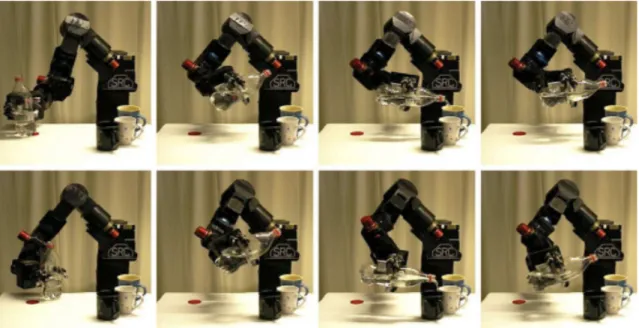
environ-ment with the Sarcos Slave Arm. The top row shows that the robot executes a pouring task by pouring water into the inner cup. The bottom row is the reproduction of a pouring task with a new goal, the outer cup [96]. . . 45 2.11 Example of placing a red cup on a green coaster. The top row shows that the
robot places the cup in a fixed position. The middle row shows that the robot places the cup on a goal position which changes location during placing. The bottom row shows that the robot places the cup with the same goal as the middle row, while accounting for the interference of a blue ball [96]. . . 46 3.1 The structure of ROS messages . . . 56 3.2 The ROS flowchart for robot learning from demonstration. Credit to Rethink
Robotics. . . 60 3.3 The flowchart of human teaching stage from the operating view . . . 61 3.4 The mapping of the object, from teaching to reproducing, under the
information-flow view. . . 61 3.5 Object detection of YellowLegoBlock in different views: the discrepancy
view shows differences between the observed scene and the background, i.e., the object; the standard deviation view of the object shows the edges of the object; the predicted views are the learned example found by the KNN. Each predicted view corresponds to multiple effective grasping poses that learned from human teaching. . . 63
List of figures xvii
3.6 Object detection of RedBlueLegoBlock in different views: the discrepancy view shows differences between the observed scene and the background, i.e., the object; the standard deviation view of the object shows the edges of the object; the predicted views are the learned example found by the KNN. Each predicted view corresponds to multiple effective grasping poses that learned from human teaching. . . 64 3.7 The flowchart of robot reproducing stage . . . 66 3.8 Evaluation objects from left to right: Yellow Lego block, Red Lego block,
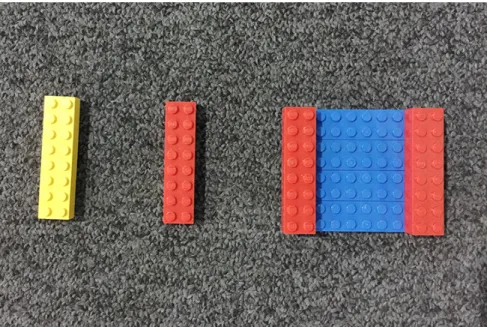
and RedBlue Lego block. . . 69 3.9 The experiment hardware setup. . . 70 3.10 The picking process of RedBlueLegoBlock from the robot’s wrist camera view 72 3.11 The picking process of RedLegoBlock from the robot’s wrist camera view . 73 3.12 Robot learns the skill of picking. . . 75 3.13 Robot learns the skill of assembly . . . 76 4.1 The definition of the camera coordinates of the Kinect sensor. Source:
msdn.microsoft.com . . . 82 4.2 Human skeleton joints tracked by Kinect V2 sensor . . . 83 4.3 GUI for Kinect skeleton tracking. The left corner is the human demonstrator
who is being tracked. The green human frame in the middle is the tracked body from Kinect point cloud view. . . 84 4.4 The human skeleton joints tracked by the Kinect sensor . . . 86 4.5 The arm joints of Baxter. . . 87 4.6 The experiment hardware setup, including a Kinect sensor, a ROS
worksta-tion and a Gazebo simulator installed in the ROS. . . 92 4.7 ROS implementation for human skeleton-joint mapping. . . 94
4.8 The flowchart of human-robot skeleton mapping. The human demonstrator demonstrates in front of the Kinect. The human’s skeleton positions are then tracked by the robot. Next, the human skeleton positions are transferred into robot joint values through theskeleton-joint mappingafter being smoothed.
Then the robot imitates human motions from the transferred joint values. . . 96
4.9 Double exponential smoothing applied on human hand joint data with differ-entα,α ∈ {0.10,0.30,0.80}, and fixedγ,γ =0.85. . . 98
4.10 Double exponential smoothing applied on human hand joint data with differ-entγ,γ ∈ {0.65,0.75,0.85}, and fixedα,α =0.30. . . 99
4.11 The MSE distribution of human hand joint after being smoothed based on different smoothing factors. Top: Global distribution,α,γ ∈ {0.01,0.95}, iteration step ∆α =0.005,∆γ =0.005. The minimum MSE =1.082e− 04,whereα =0.61,γ=0.69. Bottom: Local distribution,α ∈ {0.10,0.30}, γ ∈ {0.60,0.85}, iteration step ∆α =0.005,∆γ =0.005. The minimum MSE=1.5256e−04,whereα=0.30,γ =0.85. . . 101
4.12 Skeleton mapping from human to robot with a Gazebo simulator. Left column: human demonstrator shows various of poses. Middle column: skeleton joints information observed by Kinect camera. Right column: Baxter imitates demonstrator’s gestures through the mapping algorithm. . . 103
5.1 MEGA blocks used for robotic assembly experiments. . . 108
5.2 The framework of the LfD experiment . . . 109
5.3 The flowchart of the human teaching assembly skill . . . 111
5.4 The manipulated object is tracked using HSV range . . . 113
List of figures xix
5.6 The flowchart of robot reproducing assembly skill. To further validate the skeleton-joint mapping in teaching robots, a robotic assembly task was experimented with Baxter robot. In the assembly task, the robot first finds the object and pick it up, then use the learned model GMR to reproduce the assembly skill. During the last step of assembly, the force detection is used
to control the assembly process. . . 120
5.7 The overall experiment sequence for the robotic assembly task. . . 121
5.8 ROS implementation for robotic assembly framework. . . 124
5.9 Optimise the GMM with EM algorithm . . . 127
5.10 Top left: Encode the demonstrated trajectory with initial GMM without optimising; Top right: Reproducing the demonstrated trajectory with GMR based on the top left GMM; Bottom left: Encode the demonstrated trajectory with EM-optimised GMM; Bottom right: Reproducing the demonstrated trajectory with GMR based on GMM at the bottom left. . . 129
5.13 Optimise the number of clustering centre for GMR . . . 133
5.15 Time used by GMR to make trajectory planning under different nbStates . . 136
5.16 Learning trajectory by GMM and regenerate by GMR . . . 136
5.17 Multi-demonstrations are generalised by GMM model and regenerated by GMR . . . 138
5.18 Human demonstrates the two blocks assembly in front of Kinect 3D sensor. 140 5.19 The robot imitates the assembly movements using the skills learned from human demonstration in Figure 5.18. . . 141
5.20 Robot demonstrates the learned skill of picking and assembly . . . 142
A.1 Double exponential smoothing applied on human elbow joint data with differentα,α ∈ {0.10,0.30,0.80}, and fixedγ,γ =0.85. . . 157
A.2 Double exponential smoothing applied on human elbow joint data with differentγ,γ ∈ {0.65,0.75,0.85}, and fixedα,α =0.30. . . 158
A.3 Double exponential smoothing applied on human right shoulder joint data with differentα,α ∈ {0.10,0.30,0.80}, and fixedγ,γ =0.85. . . 159
A.4 Double exponential smoothing applied on human right shoulder joint data with differentγ,γ ∈ {0.65,0.75,0.85}, and fixedα,α =0.30. . . 160
A.5 Double exponential smoothing applied on human left shoulder joint data with differentα,α ∈ {0.10,0.30,0.80}, and fixedγ,γ =0.85. . . 161
A.6 Double exponential smoothing applied on human left shoulder joint data with differentγ,γ ∈ {0.65,0.75,0.85}, and fixedα,α =0.30. . . 162
A.7 Double exponential smoothing applied on human torso joint data with differ-entα,α ∈ {0.10,0.30,0.80}, and fixedγ,γ =0.85. . . 163
A.8 Double exponential smoothing applied on human torso joint data with differ-entγ,γ ∈ {0.65,0.75,0.85}, and fixedα,α =0.30. . . 164
A.9 Double exponential smoothing applied on human head joint data with differ-entα,α ∈ {0.10,0.30,0.80}, and fixedγ,γ =0.85. . . 165
A.10 Double exponential smoothing applied on human head joint data with differ-entγ,γ ∈ {0.65,0.75,0.85}, and fixedα,α =0.30. . . 166
A.11 The MSE distribution of human elbow joint after being smoothed based on different smoothing factors. Top: Global distribution,α,γ ∈ {0.01,0.95},
iteration step ∆α =0.005,∆γ =0.005. The minimumMSE =7.3166e−
04,whereα =0.62,γ=0.57. Bottom: Local distribution,α ∈ {0.10,0.30}, γ ∈ {0.60,0.85}, iteration step ∆α =0.005,∆γ =0.005. The minimum
List of figures xxi
A.12 The MSE distribution of human right shoulder joint after being smoothed based on different smoothing factors. Top: Global distribution, α,γ ∈ {0.01,0.95}, iteration step∆α =0.005,∆γ=0.005. The minimumMSE=
4.6028e−06,whereα =0.95,γ=0.385. Bottom: Local distribution,α ∈ {0.10,0.30},γ ∈ {0.60,0.85}, iteration step∆α =0.005,∆γ =0.005. The
minimumMSE=8.8919e−06,whereα =0.30,γ =0.85. . . 170
A.13 The MSE distribution of human left shoulder joint after being smoothed based on different smoothing factors. Top: Global distribution, α,γ ∈ {0.01,0.95}, iteration step∆α =0.005,∆γ=0.005. The minimumMSE=
5.111e−06,where α =0.95,γ =0.35. Bottom: Local distribution, α ∈ {0.10,0.30},γ ∈ {0.60,0.85}, iteration step∆α =0.005,∆γ =0.005. The
minimumMSE=1.0029e−05,whereα =0.30,γ =0.85. . . 171
A.14 The MSE distribution of human torso joint after being smoothed based on different smoothing factors. Top: Global distribution,α,γ ∈ {0.01,0.95},
iteration step ∆α =0.005,∆γ =0.005. The minimumMSE =2.1853e−
06,whereα =0.95,γ =0.20. Bottom: Local distribution,α ∈ {0.10,0.30}, γ ∈ {0.60,0.85}, iteration step ∆α =0.005,∆γ =0.005. The minimum
MSE=4.2919e−06,whereα =0.30,γ =0.665. . . 172
A.15 The MSE distribution of human head joint after being smoothed based on different smoothing factors. Top: Global distribution,α,γ ∈ {0.01,0.95},
iteration step ∆α =0.005,∆γ =0.005. The minimumMSE =3.5854e−
06,whereα=0.765,γ=0.185. Bottom: Local distribution,α∈ {0.10,0.30}, γ ∈ {0.60,0.85}, iteration step ∆α =0.005,∆γ =0.005. The minimum
List of tables
3.1 Object Recognition and Picking Experiments . . . 71 4.1 Double exponential smoothing applied on human joint data with differentα
andγ . . . 100
5.1 k-Means clustering algorithm parameters for initialising GMM. . . 126 5.2 EM algorithm parameters for optimising GMM . . . 128 5.3 A feature comparison between the existed demonstrating methods and the
Chapter 1
Introduction
This thesis focuses on the development of robot learning from demonstration (LfD) for robotic assembly task by using visual teaching. This chapter presents research motivations, questions, objectives, methodologies, thesis contributions and outline.
1.1
Motivation
Traditionally, the robot manipulators are widely used in the assembly lines and production lines in the industry as they are precise and robust, especially in highly repetitive tasks. However, the industrial robots are pre-programmed and operated in a well-structured envi-ronment. They are designed for specific tasks and unable to deal with dynamical changes in the production lines autonomously. Their programming processes can be both challenging and time-consuming when the tasks or environments change.
Inspired by the way humans acquire and learn skills from their observation of others, researchers have started to investigate how the robots can learn skills from observing human demonstrators performing complex manipulations. This kind of learning from demonstration (LfD) paradigm allows robots to master manipulating capabilities, like assembly skill in manufacturing. More importantly, LfD or imitation learning allows the general public to
teach the robot new skills without tremendous programming. Anyone could buy a robot and teach it by practical demonstration, such as cleaning a room or cutting grass in a garden. LfD is a powerful and practical alternative to reinforcement learning (RL) for learning sequential decision-making policies. Different from RL which means the robot has to learn from the sparse rewards or manually specified reward function, LfD involves a supervisor that provides data to the learner. The robot then tries to learn the optimal policy by following and imitating the demonstrator’s decisions. By this way, LfD speeds up the learning process for robots.
In the context of human demonstration, a policy of how to transfer the human skill to the robot is required. That is, the robot should have a way to see or feel the examples shown by the human demonstrator using cameras or other sensors. Furthermore, the demonstrating policy should be simple for the human to perform so that it can be easily deployed at home or in the industry. Therefore, an effective demonstrating strategy must be developed for the LfD paradigm.
Considering the assembly task, the objects to be assembled could be in various kinds of shapes. The picking pose of a robotic manipulator is fundamental in the assembly task, especially when the object is long. As human beings, we can use in-hand manipulation to adjust the pose of picked objects. However, for the robot, in-hand manipulation would introduce very complicated computing and mechanical problems which are challenging to be achieved. Therefore, it is necessary to investigate how to prompt robots to learn an effective and efficient picking strategy before starting the assembly task.
In summary, the motivation for this research is to develop and analyse novel efficient robot learning system for robotic assembly using learning from demonstration paradigm.
1.2
Research Questions
Baxter robot will be used in this thesis research. It is an industrial dual-arm robot, and each arm has 7 degrees of freedom. Rethink Robotics builds the robot in the USA. The robot has
1.2 Research Questions 3
an animated face for interacting with human users. It is 3 feet tall and weighs 165 lbs without its pedestal. After fitted with its pedestal, its height is 5’10"–6’3" and its weight is 306 lbs. The Baxter robot can move smoothly and has force feedback to work with humans closely. Each wrist has a camera to monitor and guide the manipulation tasks. Figure 1.1 shows some detailed components and functions.
(1) What kind of demonstration method is suitable with Baxter?
Up to now, three main demonstration methods could be used for the Baxter robot, namely kinesthetic demonstration, motion-sensor demonstration, and tele-operation demonstration. More specifically, the kinesthetic demonstration is the most common method deployed on Baxter robots. In kinesthetic teaching, the robot directly records its movements which are guided by human demonstrator hand-by-hand. Hence, the data of motion trajectories are collected directly in Cartesian space or robotic joint space. In this way, the corresponding problem between the demonstrator and the imitator is avoided.
However, in some situations such as hand-by-hand is not available or not safe to operate, remote teaching would be a better choice to achieve a general and accurate demonstration. The other two demonstration methods have advantages on the point of remote teaching. The first method, tele-operation demonstration, uses a control box or delivers hints to present the examples to the robot but at the cost of additional tele-operation devices or vocal controlling system. Besides, the vocal method has its limitation which relies on the high intelligence of the vocal model. The second method, motion-sensor demonstration uses marker-based tracking devices to capture human motions, but the defects are apparent. The markers can not work alone. They need a complementary detecting device which usually takes big space. Furthermore, the markers are not convenient for the demonstrator to equip themselves.
It should be noted that Baxter robot is used as a benchmark to evaluate the proposed LfD paradigm. The proposed paradigm is not limited to the specific robot. In fact, any robotic
1.2 Research Questions 5
manipulator with multiple joints which enable the robot to explore in their workspace is eligible to use the proposed LfD paradigm.
(2) How to demonstrate without cutting the corresponding mechanism?
As the demonstrator’s body differs from the robot’s body in architecture, the demonstrator’s body scheme does not match with the robot’s body scheme, which results in the corre-sponding problem. This correspondence problem may make the robot fail to understand the demonstrator’s motions. Besides, the direct imitation of human motions can also be used for the robot to imitate human dances. To build a map between the human skeleton joints and robot motor joints, a new transformable mechanism need to be proposed.
(3)How to teach the robot effective grasping pose without using
addi-tional assistant devices in the robotic assembly task?
In the robotic assembly task, the robot needs to grasp the object from the desk before assembling motion. As adult human beings, we have no difficulties in grasping objects around us, because we have learned how to grasp the object from the right position. For example, to pick up a mug, we choose to grasp the cup handle; to pick up a pen, we choose to grasp the middle of the pen. Similarly, the robot needs to learn a strategy to pick objects from effective poses like the human just use the visual sensor and hand-eye coordination ability. Baxter robot comes with a camera embedded in each wrist. It is worth to investigate how to teach the robot the effective grasping ability for robotic assembly task without introducing additional assistant devices.
(4) How to improve the quality of demonstrating with few
demonstra-tion times?
In a robot learning from demonstration system, the human demonstrator performs the skills as examples for robot learning. The number of examples used for training the robot should not be enormous as the LfD requires. Therefore, the quality of the demonstrated examples should be emphasized. A real-time feedback mechanism can be considered to help the demonstrator guide and correct their actions. Then, we consider what kind of sensor and algorithm can be used for real-time tracking and feedback. Besides, we need to consider how to incorporate the sensor information with the learning paradigm.
1.3
Research Objectives
Based on the motivation and research questions described in the previous sections, this thesis research aims to develop a novel robot learning system for robotic assembly tasks. It also provides comprehensive insights on the system’s performance by conducting theoretical and experimental analyses of learning from demonstration. The proposed research will focus on the following specific objectives:
• To develop an effective human demonstration mechanism for robot imitation (In
chapter 3 and 5).
In LfD, the way that the human demonstration conducted plays a key role for the robot to learn from the human demonstrator effectively. In the learning of grasping pose research, the thesis focuses on the end position (palm or hand) of the human arm. In this way, the correspondence issue between demonstrator and robot is avoided, only the kinematic information of endpoint joint of demonstrator’s hand is taught to the robot. During the human visual demonstration, the human teacher stands in front of the robot, his or her arm joint position, velocity, and acceleration are captured by
1.3 Research Objectives 7
Kinect 3D camera. To further improve the efficiency of teaching, the robot repeats the motion following the human demonstrator, the teacher gives feedback immediately and improves the demonstration, such as slow down the motion, restrict the motion within robot’s workspace, try a promoted motion trajectory and so on, according to the learning performance of the robot.
• To develop a demonstrating method via visual teaching (In chapter 4).
In order to teach the robot from a remote position without wearing additional assisting tracking devices, a new demonstrating method needs to be developed. The new teaching method does not rely on the controller to deliver the human’s motion as the existed tele-operation demonstration does. This kind of simplicity and wireless features improve the efficiency of the teaching process and extend the application scope of the robot learning from human demonstrations. The motion of human upper limbs will be tracked and extracted as features for robot learning. The elbow and shoulder motions will also be captured, not only the hand’s motions. The goal is to keep the corresponding relationship between the demonstrator and the robot, while the robot still can learn from the human teacher.
• To develop a new performance metric to evaluate the autonomous learning system
(In chapter 5).
The developed autonomous skill learning system needs to be tested on a specific task, such as an assembly task. The learning system has the potential to be used in real industry assembly production, such as assembly a chair. However, this research focuses on developing an autonomous learning system for the Baxter robot to conduct assembly tasks in the world of MEGA blocks. The Baxter robot uses the skills learned from a human demonstrator to complete an assembly task. The skills include approach/retreat, grasp, and insertion. A metric function based on the generalized joint angle trajectories, the generalized hand path will be used to evaluate the performance of the Baxter robot.
1.4
Research Methodology
In order to realize the research objectives outlined in the previous section, the thesis research has adopted the following research methodologies:
• Kinesthetic guiding
Kinesthetic guiding is a simple way to conduct the robot learning from human demon-strations. It maintains the advantages of LfD and also significantly reduces the system cost in terms of both demonstrating and learning. For solving the problem of find-ing an appropriate pickfind-ing pose in the robotic assembly task, the proposed method learns the best picking pose by extracting the object’s SIFT (scale-invariant feature transform) features from the human kinesthetic demonstration. Differing from the traditional kinesthetic teaching that records the whole demonstrated trajectory, the proposed method learns the key point of the trajectory in a robotic assembly example, i.e. the assembly location of the two piece works. In addition, the assembly process is assured by the force sensor embedded in the robot hand, which is controlled by a force threshold.
• Visual mapping:
Visual mapping is another way to conduct the robot learning from human demonstra-tions. Visual sensors are deployed to allow a robot to watch and learn the assembly skills demonstrated by a human. Since the obtained visual demonstrating data contains noise and latency, Holt’s two parameter exponential smoothing algorithm is used to reduce the noise and latency. As mentioned before, human movements can not be directly transferred to the robot motions. A skeleton-joint mapping algorithm is proposed to transfer the motion from human joint space to robot task space. Moreover, an object tracking algorithm is deployed to segment the demonstrating trajectories and assist in the implementation of robotic assembly tasks.
1.5 Thesis Contributions 9
• Imitation learning:
Imitation learning means the robot imitates the human teacher and learns the specific skill demonstrated by the teacher. The observed examples are converted from the human task space to the robot joint space. In another word, the human motions are transferred to robot trajectories. Gaussian distributions are used to build models of the learned skills, and Gaussian Mixture Regression (GMR) built upon the previous distributions are used for robot motion planning in the reproducing stage.
• Experimental verification:
The development of a novel autonomous skill learning system allows an industrial robot to conduct assembly tasks. This is a potentially fruitful research endeavour with a strong science base for skill learning, as well as wide real-world applications such as assembly or similar manipulative applications. Experiments are carried out in both simulation and real robot in order to validate the proposed approaches. The results could provide a better understanding of the feasibility and performance of the proposed solutions, as well as how they surpass traditional solutions in both industrial and domestic applications.
1.5
Thesis Contributions
The research work presented in this thesis contributes to a number of new solutions for Learning from Demonstration (LfD), with a particular focus on applications of robotic assembly tasks. The following list highlights the most important contributions:
• A LfD paradigm is proposed based on key positions and object features. Instead of traditionally imitating the trajectories demonstrated by a human, the robot learns the effective grasping poses and assembly positions of the Peg-in-Hole (PiH) task through the kinesthetic teaching. Compared with the existing works that use predefined objects
for robotic assembly tasks, the proposed method improves the robot’s adaptive ability by learning from human demonstration with unstructured objects in PiH task.
• A teaching method is proposed for the robot to observe human demonstrations by a visual sensor so that the assembly skill demonstrated by a human can be effectively mapped from task space to configuration space for robot learning. Compared with existing works that use low-accuracy computer-vision-based human tracking method or marker-based tracking with additional devices, the proposed method uses a Kinect-based skeleton-joint mapping with improved accuracy of human motion tracking and without additional markers attached to human demonstrator.
• A real-time feedback feature is introduced for the robot to learn assembly skill from ob-serving human demonstrating the manipulating skills. Compared with the existing works that requires multiple or enormous demonstrations for robot learning assembly tasks, the proposed LfD paradigm improves the demonstrating quality by using the real-time simulating robot to provide feedback. Furthermore, the proposed method has comprehen-sive advantages over kinesthetic, motion-sensor, and teleoperated demonstration in robot learning assembly tasks.
1.6
Thesis Outline
This thesis is organised into 6 chapters. Chapter 1 is an overview of the thesis. Chapter 2 is the background of the research work. Chapter 3, 4, and 5 are the main research work conducted in this thesis research. Finally, Chapter 6 concludes the thesis. The details of the individual chapters are outlined here:
• Chapter 2 reviews some previous work related to this research. The main focus is placed on how to demonstrate the example behaviours to the robot in assembly operations, and how to extract the manipulation features for robot learning and the generation
1.6 Thesis Outline 11
of imitative behaviours. Various metrics are analysed to evaluate the performance of robot imitation learning. Specifically, the application of LfD in robotic assembly is a focal point in this chapter.
• Chapter 3 presents a novel algorithm for Peg-in-Hole operations by robot learning from human demonstration. The learning of robotic assembly task is divided into two phases: teaching and reproduction.The human demonstrator teaches a robot to grasp an object from the effective positions and orientations. During the reproduction phase, the robot uses the learned knowledge to reproduce the grasping manipulation autonomously. The robustness of the robotic assembly system is evaluated through a series of grasping trials. A dual-arm Baxter robot is used to perform the Peg-in-Hole tasks, and the results are given to verify the proposed approach.
• Chapter 4 proposes a demonstration method based on human skeleton mapping. A smoothing algorithm based on Holt’s two parameter exponential is designed for reduc-ing the latency of human skeletons data. Holt’s model uses three separate equations that work together to generate a final forecast. Moreover, a mapping algorithm is designed for demonstration teaching. The human’s hands joints, torso joint, and head joint are used to calculate the angles between them. A series of equations are proposed to map these angles into the robot’s motors. The mapping algorithm is tested by some basic gestures, such as lateral raise, front up raise, and front low raise.
• Chapter 5 shows the experimental results on the robotic assembly task based on the visual teaching. The experimental environment and testing platforms are introduced. Then the scenario of the robotic assembly experiments is presented. The modelling process of GMM and GMR is investigated and analysed. The visual-based teaching is tested with robotic assembly tasks on the Baxter robot.
• Chapter 6 summarizes the research work conducted in this thesis research, includ-ing significant research achievements so far, the discussion of pros and cons on the proposed research, and some brief ideas for the future work.
Chapter 2
Background and Related Research
2.1
Introduction
2.1.1
Robotic assembly
The industrial robots that are currently deployed in assembly lines are position-controlled and programmed to follow desired trajectories for conducting assembly tasks [63, 47]. These position-controlled robots can handle known objects within the well-structured assembly lines very well, achieving highly accurate position and high velocity. However, they cannot deal with any unexpected changes in assembly operations, and need tedious reprogramming to adapt to new assembly tasks.
Knepper et al. investigated a multi-robot coordinated assembly system for furniture assembly [57]. The geometry of individual parts was listed in a table so that a group of robots can conduct parts delivery or parts assembly collaboratively. For the modelling and recognition of the furniture parts, the object’s representation was predefined in CAD files so that the correct assembly sequence can be deduced from geometric data. Suárez-Ruiz and Pham proposed a taxonomy of the manipulation primitives for bi-manual pin insertion, which was only one of the critical steps in the autonomous assembly of an IKEA chair [119].
In general, a typical robot-assembly operation involves operating with two or more objects/parts. Each part is a subset of the assembly. Assembly aims to compute an ordering of operations that brings individual parts so that a new product appears. Examples of assembly tasks can be summarised below.
• Peg-in-hole: A robotic gripper grabs the peg and inserts it in a hole. Peg-in-hole is the most essential and representative assembly task that has been widely researched [135, 61, 56, 62, 94, 53, 2, 122, 109, 91, 139].
• Slide-in-the-groove: A robot inserts a bolt fitting inside a groove and slides the bolt to the desired position where the bolt is to be fixed [98].
• Bolt screwing: A robot screws a self-tapping bolt into a material of unknown properties, which requires driving a self-tapping screw into an unstructured environment [98, 72, 71, 84].
• Chair assembly: A robot integrates chair parts together with a fastener [39, 88, 116]. • Pick-and-place: A robot picks up an object as the base and places it down on a fixture
[132, 71, 70].
• Pipe connection: A robot picks and places two union nuts on a tube [71].
As typical robot-assembly operations need to contact the workpieces to be assembled, it is crucial to estimate the accompanying force–torque profiles besides position and orientation trajectories. To learn the execution of assembly operations, a robot needs to estimate the pose of the workpieces first, and an assembly sequence is then generated by learning from human demonstration. For some particular objects appearing in the assembly workspace, some specialised grippers should be designed to grab these parts with various shapes and acquire force–torque data. In particular, during a screwing task, the material to be screwed is unstructured, which makes the control of rotating angles more complicated.
2.1 Introduction 15
Considering these challenges, robotic assembly remains one of the most challenging problems in the field of robotics research, especially in unstructured environments. In contrast, humans have excellent skills to perform assembly tasks that require compliance and force control. This motivates us to review the current research of learning from demonstration (LfD) in robotics assembly and its potential future directions.
2.1.2
Learning from demonstration
Traditional robots require users to have programming skills, which makes robots beyond the reach of the general public. Nowadays, robotics researchers have worked on a new generation of robots that could learn from demonstration and have no need of programming. In other words, these new robots could perceive human movements using their sensors and reproduce the same actions that humans do. They can be used by the general public who have no programming skills at all.
The term of learning from demonstration (LfD), or learning by imitation, was analysed in depth by Bakker and Kuniyoshi [11], who defined what imitation is and what robot imitation should be. From a psychological point of view, Thorndike defined imitation as learning to do an act being witnessed [124]. Based on this, Bakker indicated that imitation takes place when an agent learns a behaviour from observing the execution of that behaviour by a teacher [11]. This was the starting point for establishing the features of robot imitation: (i) adaptation; (ii) efficient communication between the teacher and the learner; (iii) compatibility with other learning algorithms; and (iv) efficient learning in a society of agents [105].
In addition, three processes in robot imitation have been identified, namely sensing, understanding and doing. In other words, they can be redefined as: observe an action, represent the action and reproduce the action. Figure 2.1 shows these three main issues and all the associated current challenges in robot imitation.
Observation
Execution
Encoding • Motivation to observe
• Which actions to observe • Perceiving teacher actions • Relevant context
• Motivation to reproduce • When to reproduce • Adaptation of the action
• Representation of actions • Mapping observed actions
Fig. 2.1 The three main phases in imitation learning according to [11].
Mataric et al. defined the imitation learning from a biological perspective, that is, a behaviour-based control [85]. They indicated that key challenges are how to interpret and understand observed behaviours and how to integrate the perception and motion-control systems to reconstruct what is observed. In other words, there are two essential tasks in imitation learning: (i) to recognise the human behaviour from visual or sensory input; (ii) to find methods for structuring the motor-control system for general movements and imitation learning capabilities. Current approaches to representing a skill can be broadly divided into two trends: (i) trajectories encoding–a low-level representation of the skill, taking the form of a nonlinear mapping between sensory and motor information; (ii) symbolic encoding–a high-level representation of the skill that decomposes the skill in a sequence of action–perception units [12].
In general, to achieve robot learning from demonstration, we need to address three challenges: the correspondence problem, generalisation, and robustness against perturbation [96]. Firstly, the correspondence problem means how to map links and joints from a human to a robot. Secondly, learning by demonstration is feasible only if a demonstrated movement can be generalised, such as different goal positions. Finally, we need robustness
2.1 Introduction 17
against perturbation: exactly replaying an observed movement is unrealistic in a dynamic environment, in which obstacles may appear suddenly.
Most assembly tasks can be represented as a sequence of individual movements with specific goals, which can be modelled as dynamic movement primitives (DMPs, explained in Section 2.4.2), where DMPs are the fundamental blocks of the LfD architecture. Besides, LfD has been suggested recently as an effective means to speed up the programming of learning processes from the low-level control to the high-level assembly planning [64]. Therefore, LfD is a preferable approach for robotic assembly.
Recently, LfD has been applied to robotic assembly [5, 118, 114]. Takamatsu et al. introduced LfD to robotic assembly and proposed a method for recognising assembly tasks by human demonstration [121]. They defined sufficient sub-skills and critical transition-assembly tasks, and implemented a peg-insertion task on a dual-arm robot with a real-time stereo–vision system. The assembly task is completed with two rigid polyhedral objects recognised by a conventional 6-DOF (degree of freedom) object-tracking system. The assembly tasks are encapsulated into chains of two-object relationships, such as maintaining, detaching and constraining. In order to make the process of assembly task smooth, critical transitions are also defined.
The human–robot cooperation in assembly tasks reduces the complexity of impedance control. Rozo et al. worked one step forward to achieve a multimodal LfD framework, in which a robot extracted the impedance-based behaviour of the teacher recording both force patterns and visual information in a collaborative table-assembly task [104]. It should be noted that the experiments did not take into account the independence and autonomy of the robot. For the modelling of assembly task, Dantam et al. transferred the human demonstrations into a sequence of semantically relevant object-connection movements [33]. Then, the sequence of movements is further abstracted as motion grammar, which represents the demonstrated task. It should be noted that the assembly task is implemented in simulation.
Different from the previous survey of learning from demonstration [8], this thesis research is mainly focused on the applications of LfD techniques in robotic assembly. The rest of the chapter is organised as follows. Section 2.2 outlines the major research problems in robotic assembly, which are classified into four categories. The key issue of how to demonstrate the assembly task to a robot is explained in Section 2.3, and how to abstract the features of the assembly task is illustrated in Section 2.4. Then, we examine the question of how to evaluate the performance of the imitator in Section 2.5. Finally, a brief conclusion and discussion on the open research areas in LfD and robotic assembly are presented in Section 2.6.
2.2
Research Problems in Robotic Assembly
Robotic assembly needs a high degree of repeatability, flexibility and reliability to improve the automation performance in assembly lines. Therefore, many specific research problems have to be resolved in order to achieve automated robotic assembly in unstructured environments. The robot software should be able to convert the sequences of assembly tasks into individual movements, estimate the pose of assembly parts, and calculate the required forces and torques. As there are many challenges in robotic assembly, this section will be focused on four categories which are closely related to LfD: pose estimation, force estimation, assembly sequences, and assembly with screwing.
2.2.1
Pose estimation
In assembly lines, it is often indispensable that the position and orientation of workpieces are predetermined with high accuracy. The vision-based pose estimation is a low-cost solution to determine the position and orientation of assembly parts based on point cloud data [135]. The texture projector could also be used to acquire high-density point clouds and help the
2.2 Research Problems in Robotic Assembly 19
stereo matching process. Abu-Dakka et al. used a 3D Kinect for capturing 3D scene data, and the pose of the objects could be estimated based on the point cloud data [2].
Before pose estimation, an object should be recognised by using local features, as this is an effective way for matching [81]. Choi et al. developed a family of pose-estimation algorithms that use boundary points with directions and boundary line segments along with the oriented surface points to provide high accuracy for a broad class of industrial parts [30]. However, in the cluttered environments where the target objects are placed with self-occlusions and sensor noise, assembly robots require a robust vision to recognise and locate the objects reliably. Zeng et al. used a fully convolutional neural network to segment and label multiple views of a scene, and then fit predefined 3D object models to the segmentation to obtain the 6D object pose (3D position: x, y, z; and orientation: yaw, pitch, roll) rather than 3D location [137].
However, the vision-based pose estimation has limitations due to the limited resolution of the vision system. Also, in the peg-in-hole task, the peg would usually occlude the hole when the robot approaches the hole. Therefore, vision-based pose estimation is not sufficient for the high-accuracy assembly tasks in which two parts occlude each other. If the camera is mounted on the robotic arm, the occlude problem can be eliminated. However, additional sensory data is needed to estimate the camera pose [111].
To correct the pose of assembly parts, Xiao et al. devised a nominal assembly-motion sequence to collect data from exploratory complaint movements [108]. The collected data are then used to update the subsequent assembly sequence to correct any errors in the nominal assembly operation. Nevertheless, the uncertainty in the pose of the manipulated object should be further addressed in future research.
2.2.2
Force estimation
In assembly tasks, force control could provide stable contact between the manipulator and the workpiece [118, 80, 131, 55, 135, 115, 61, 56, 117]. As human operators perform compliant motions during assembly, the robot should acquire the contact forces that occur in the process of assembly. During the task execution, the robot learns to replicate the learned forces and torques rather than positions and orientations from the trajectory. The force information may also be used to speed up the subsequent operations of assembly tasks [62, 94, 90, 98, 122, 109, 91].
The force applied to the workpiece is usually detected by using the force sensor on the robot end-effector, or using force sensors on each joint of the robot arm, for example, in the DLR (German Aerospace Centre) lightweight arm. The problem of using inside force sensors is that the measured forces must be compensated for disturbance forces (for example, gravity and friction) before use. The feedback force is then introduced to the control system that generates a corresponding transnational/rotational velocity command on the robot manipulator to push the manipulated workpiece.
To enable a robot to interact with the different stiffness, Peternel et al. used the impedance-control interface to teach it some assembly tasks [97]. The human teacher impedance-controlled the robot through haptic and impedance-control interfaces. The robot was taught to learn how to perform a slide-in-the-groove assembly task where the robot inserted one part fitted with a bolt into another part. However, the low movement variability did not necessarily correspond to the high impedance force in some assembly tasks such as slide-in-the-groove tasks.
The dedicated force–torque sensors can easily acquire the force, but may not be easily able to mount to the robot hand. Alternatively, Wahrburg et al. deployed motor signals and joint angles to reconstruct the external forces [131]. It should be noted that force/torque estimation is not a problem and has been successful in the traditional robotic assembly in structured environments. However, it is a problem for robotic assembly in unstructured
2.2 Research Problems in Robotic Assembly 21
environments. Force/torque estimation is not only about acquiring force/torque data but also about using these data for a robot to accommodate its interaction with the different stiffness.
2.2.3
Assembly sequence
As an appropriate assembly sequence helps minimise the cost of assembly, the assembly sequences are predefined manually in the traditional robotic assembly systems. However, the detailed assembly sequence defined in [115] significantly holds back the automation of next-generation assembly lines. In order to achieve an efficient assembly sequence for a task, an optimisation algorithm is required to find the optimum plan. Bahubalendruni et al. found that assembly predicates, i.e. some sets of constraints, have a significant influence on optimal assembly-sequence generation [10].
Wan and Harada presented an integrated assembly and motion-planning system to search the assembly sequence with the help of a horizontal surface as the supporting fixture [132]. Kramberger et al. proposed two novel algorithms that learned the precedence constraints and relative part-size constraints [62]. The first algorithm used precedence constraints to generate previously unseen assembly sequences and guaranteed the feasibility of the assembly sequences by learning from human demonstration. The second algorithm learned how to mate the parts by exploratory executions, i.e. learning-by-exploration.
Learning assembly sequences from demonstration can be tailored for general assembly tasks [70, 62, 114, 135, 79, 118]. Mollard et al. proposed a method to learn from the demonstration to automatically detect the constraints between pairs of objects, decompose sub-tasks of the demonstration, and learn hierarchical assembly tasks [88]. In addition, the learned sequences were further refined by alternating corrections and executions. It should be noticed that the challenge in defining assembly sequence is how to automatically extract the movement primitives and generate a feasible assembly sequence according to the manipulated workpieces.
2.2.4
Assembly with screwing
Screwing is one of the most challenge sub-tasks of assembly and requires robust force control so that the robot could screw a self-tapping bolt into a material of unknown properties. The self-tapping screw driving task consists of two main steps. The first step is to insert the screwdriver into the head of a bolt. The contact stiffness is kept at a constant value such that the screwdriver keeps touching the head of the bolt. The second step is to fit the screwdriver into the screw head and rotate it for a specific angle to actuate the bolt into the unstructured objects.
To measure the specific force and angle needed for actuating the screwdriver, Peternel et al. used a human demonstrator to rotate the screwdriver first and captured the correspondence angle by a Haptic Master gimbal device [98]. The information was then mapped to the end-effector rotation of the robot. It should be noted that the torque used to compensate the rotational stiffness is unknown, so the demonstrator manually commands high rotational stiffness through the stiffness control to make the robot exactly follow the demonstrated rotation.
There are significant uncertainties that existed in the screwing task, such as the screwdriver may not catch the head of the bolt correctly. In fact, as the complexity of the task increases, it becomes increasingly common that tasks may be executed with errors. Instead of preventing errors from happening, Laursen et al. proposed a system to automatically handle certain categories of errors through automatic reverse execution to a safe status, from where forward execution can be resumed [72]. The adaptation of an assembly action is essential in the execution phase of LfD, as presented in Figure 2.1. Besides, the adaptation of uncertainties in robotic assembly still needs further investigation.
In summary, pose estimation, force estimation, assembly sequence, and assembly with screwing have been partially resolved in limited conditions, but are still far away from the industrial application. Most of the current assembly systems are tested in relatively simple
2.3 Demonstration Approach 23
tasks, like peg-in-hole. In addition, a more robust and efficient control strategy is needed to deal with complicated assembly tasks in an unstructured environment.
2.3
Demonstration Approach
Robot learning from demonstration requires the acquisition of example trajectories, which can be captured in various ways. Alternatively, a robot can be physically guided through the desired trajectory by its operator, and the learned trajectory is recorded proprioceptively for demonstration. This method requires that the robot is back drivable [44, 99] or can compensate for the influences of external forces [86, 4, 49]. The following subsections discuss various works that utilise these demonstration techniques.
2.3.1
Kinesthetic demonstration
The advantage of kinesthetic guiding is that the movements are recorded directly on the learning robot and do not need to be first transferred from a system with different kinematics and dynamics. During the demonstration movement, the robot’s hands are guided by a human demonstrator [26, 22, 136, 84]. It should be noted that kinesthetic teaching might affect the acquired forces and torques, especially when joint force sensors are used to estimate forces and torques for controlling of assembly tasks on real robots. Besides, if the manipulated objects are large, far apart, or dangerous to deal with, kinesthetic guiding can be problematic.
Figure 2.2 shows that the robot was taught through kinesthetics in gravity-compensation mode, i.e. by the demonstrator moving its arm through each step of the task. To achieve this, the robot motors were set in a passive mode so that the human demonstrator could move each limb. The kinematics of each joint motion were recorded at a rate by proprioception during the demonstration. The robot was provided with motor encoders for every degree-of-freedom. By moving its limb, the robot "sensed" its motion by registering the joint-angle data provided
by the motor encoders. The interaction with the robot was more playful than using a graphical simulation, as the interacting enabled the user to feel the robot’s limitation in its real-world environment implicitly.
In [78], example tasks were provided to the robot via kinesthetic demonstration, in which the teacher physically moved the robot’s arm in the zero-gravity mode to perform the task, and used the button on the cuff to set the closure of the grippers. By pushing the button on the arm, the recording began, and the teacher started to move the same arm to perform manipulation. When the manipulation was done, the teacher pressed the button again to pause the recording. The teacher simply repeated the steps to continue the manipulation with another hand and the recording.
Fig. 2.2 Human demonstrator teaches the Kuka LWR arm to learn peg-in-hole operations by kinesthetic guiding [2].
Figure 2.2 shows that a human demonstrator teaches the Kuka LWR arm to learn peg-in-hole operations by kinesthetic guiding [2]. The signals of arm activation and the grippers’ state during the demonstration were recorded to segment the tool-use process into sequential manipulation primitives. Each primitive was characterised by using a starting pose, an ending
2.3 Demonstration Approach 25
pose of the actuated end-effector, and the sequence of the poses. The primitives are learned via the DMPs framework. These primitives and the sequencing of the primitives constitute the model for tool use. The decomposed primitives are used to infer the underlying sequential structure of the demonstrated task [84]. The related sensory data of the end-effector, like position, orientation and force, are used for sequencing. By linking DMPs with expected sensory data and comparing current sensory values with expected ones, the best match will be chosen.
2.3.2
Motion-sensor demonstration
The limb movements of a human demonstrator are very complex and challenging to cap-ture. Computer vision could be used in capturing human-demonstrator motion with a low accuracy[87]. In contrast, the optical or magnetic marker-based tracking systems can achieve high accuracy and avoid visual overlapping of computer vision [103, 101, 128, 106]. There-fore, marker-based tracking devices are deployed to track the manipulation movements of a human demonstrator for assembly tasks.
Skoglund et al. presented a method for imitation learning based on fuzzy modelling and a next-state-planner in the learning-from-demonstration framework [113]. A glove with LEDs at its back and a few tactile sensors on each fingertip was used in the impulse motion-capturing system. The LEDs were used to compute the orientation of the wrist, and the tactile sensors were to detect contact with objects. Alternatively, a motion sensor can be used for tracking instead of LEDs.
Colour markers are a simple and effective motion tracking technique used in the motion-sensor demonstration. Acosta-Calderon and Hu proposed a robot-imitation system, in which the robot imitator observed a human demonstrator performing arm movements [3]. The colour markers on the human demonstrator were extracted and tracked by the colour-tracking system. The obtained information was then used to solve the correspondence problem as
described in the previous section. The reference point used to achieve this correspondence is the shoulder of the demonstrator, which corresponded to the base of the robotic arm.
To capture human movement with whole-body motion data, a total of 34 markers were used in a motion-capture setup [67]. During the data-collection process, a sequence of continuous movement data was obtained, for example, a variety of human walking motions, a squat motion, kicking motions and raising arm motions. Some of the motions are discrete, and others are continuous. Therefore, the learning system should segment the motions automatically. The segmentation of full-body human-motion patterns was studied in [66]. The human also observed the motion sequence, manually segmented it and then labelled these motions. Note that the motions segmented by the human were set as ground truth, and no further criteria were used.
In Figure 2.3, a motion sensor mounted in the glove is used for tracking the 6D pose (the position and orientation) relative to the transmitter; the robot then receives a transformed pose on a 1:1 movement scale. The peg-in-hole experiments show that the data glove is inefficient compared with using an external device during the teleoperation process. In Figure 2.4, both hand-pose and contact forces are measured by a tactile glove. In the robotic assembly, the force sensor is essential as the task requires accurate control of force. Therefore, the motion sensor and force sensor are usually combined.
2.3 Demonstration Approach 27
Fig. 2.4 A tactile glove is used to reconstruct both forces and poses from human demonstra-tions, enabling the robot to directly observe forces used in demonstrations so that the robot can successfully perform a screwing task: opening a medicine bottle [41].
2.3.3
Teleoperated demonstration
During the teleoperated demonstration, a human operator uses a control box or delivers hints to control a robot to execute assembly tasks, and the robot keeps recording data from its own sensors, see Figure 2.5. Similar to the kinesthetic demonstration, the movements performed by the robot are recorded directly on the robot, that is, the mapping is direct, and no corresponding issue exists. Learning from teleoperated demonstrations is an attractive approach to controlling complex robots.
Teleportation has the advantage of establishing an efficient communication and operation strategy between humans and robots. It has been applied in various applications, including remote control of a mobile robotic assistant [127, 31, 83], performing an assembly task [65, 28, 16], performing a spatial-positioning task [7], demonstrating grasp pre-shapes to the robot [120], transmitting both dynamic and communicative information on a collaborative task [24], and picking and moving tasks [40].
In assembly tasks, when a human demonstrator performs the assembly motions, the pose information is fed into a real-time tracking system so that the robot can copy the movements of the human demonstrator [109]. The Robonaut, a space-capable humanoid robot from NASA, was controlled by a human through full-immersion teleoperation [100]. Its stereo
Fig. 2.5 Human demonstrator performs the peg-in-hole task, in teleoperation mode, as the robot copies the movements of the human [109].
camera and sound sensor transmit vision and auditory information to the teleoperator through a helmet worn on his or her head. Although the full-immersion teleoperation is a good strategy for the Robonaut, its dexterous control is very tedious and tiring.
During teleoperation, the human operator usually manipulates the robot through a con-troller, standing far away from the robot. Figure 2.6 shows that the human demonstrator teaches the robot to perform the slide-in-the-groove task, as shown in the middle of Fig-ure 2.6a, and then the robot autonomously repeats the learned skill, as shown in the right of Figure 2.6a. For the bolt-screwing task, as shown in Figure 2.6b, DMPs are used to encode the trajectories after demonstrations. Sometimes the controller can be a part of the robot itself.
Tanwani et al. applied teleoperation in the robot- learning process where the robot is required to do the tasks of opening/closing a valve and pick–place an object [123]. The human operator held the left arm of the robot and controlled its right arm to receive visual feedback
2.3 Demonstration Approach 29
(a) Experimental setups for the slide-in-the-groove assembly task, the human demonstrator teleoperates using a remote controller (left and middle) and the robot learns to repeat the slide-in-the-groove task (right).
(b) For the bolt-screwing task, DMPs are used to encode the tra-jectories after demonstrations.
Fig. 2.6 Experimental setups for the slide-in-the-groove assembly task and bolt-screwing task [98].
from the camera mounted on the end of the right arm. In the teleoperation demonstration, the left arm of the robot plays the role of the controller, and the right arm plays as an effector.
Delivering hints to robots is another way of teleoperation. Human operators deliver hints to the robot by repeating the desired tasks many times, or by pointing out the important elements of the skill. The hints can be addressed in various ways throughout the whole learning procedure. One of the hints is vocal deixis, that is, an instruction from a human operator. Pardowitz et al. used vocal comments given by a demonstrator while demonstrating the task to speed up the learning of robots [95]. The vocal elucidations are integrated into the weight function, which determines the relevance of features consisted in manipulation segments.
Generally speaking, the acoustic of speech consists of three main bits information: the identification of the speaker, the linguistic content of the speech, and the way of speaking. Instead of focusing on the linguistic content of the vocal information, Breazeal et al. proposed an approach to teach the robot how to understand the speaker’s affective communicative intent [17]. In the LfD paradigm, to understand the intention of the human demonstrator through HRI (Human-Robot Interaction) is the critical point for the robot to learn. Demonstrations are goal-directed, and the robot is expected to understand the human’s intention and extract the goal of the demonstrated examples [25].
The vocal or visual pattern could be used in non-anthropomorphic robots [92]. The understanding of the human intention could be transferred from the standpoint of movement matching [35, 89] to joint motion replication [9, 20, 50, 14, 96, 110, 129, 22]. Recent research works believe that robots will need to understand the human’s intention as socially cognitive learners, even if the examples are not perfectly demonstrated [18, 36, 19]. However, to keep track of intentions to complete desired goals, the imitating robots need a learning method. The solution could be building a cognitive model of the human teacher [54, 27], or using simulations of perspective [125].
2.4 Feature Extraction 31
2.4
Feature Extraction
When a dataset of demonstration trajectories, i.e. state-action examples, has been collected by using the demonstration approaches mentioned above, we need to consider how to map these data into a mathematical model. There are thousands of position data points distributing along a demonstration trajectory, and no need to record every point as the movement trajectories are hardly repeatable. Also, direct replication of the demonstrated trajectories may lead to poor performance because of the limited accuracy of the vision system and uncertainties in the gripping pose. Therefore, learning a policy to extract and generalise the key features of the assembly movements is the fundamental part of LfD.
Hidden Markov models (HMMs) are a popular methodology to encode and generalise the demonstration examples [102, 133, 46, 73, 126, 134, 107, 130, 52, 38, 51, 74, 75, 23, 76, 93]. HMM is a robust probabilistic method to encapsulate human motion, which contains spatial and temporal variables, through numerous demonstrations [68]. Initially, the training of HMMs is learned offline, and the sample data are manually classified into groups before learning. To make HMMs become online, Kulic et al. developed adaptive hidden Markov chains for incremental and autonomous learning of the motion patterns, which were extracted into a dynamic stochastic model [67].
The probabilistic approach can also be integrated with other methods to learn robust models of human motion through imitation. Calinon et al. combined HMM with Gaussian mixture regression (GMR) and dynamical systems to extract redundancies from a set of examples [23]. The original HMMs depend on a fixed number of hidden states and model the observation as an independent state when segmenting continuous motion. To fix the two major drawbacks of HMMs, Niekum et al. proposed the beta process auto-regressive hidden Markov model, in which the modes are easily shared among all models [93].
Based on Gaussian mixture models (GMMs), Chernova and Veloso proposed an inter-active policy-learning strategy that reduces the size of training sets by allowing an agent to
![Fig. 2.1 The three main phases in imitation learning according to [11].](https://thumb-us.123doks.com/thumbv2/123dok_us/1291234.2673153/40.892.118.757.181.456/fig-main-phases-imitation-learning-according.webp)
![Fig. 2.2 Human demonstrator teaches the Kuka LWR arm to learn peg-in-hole operations by kinesthetic guiding [2].](https://thumb-us.123doks.com/thumbv2/123dok_us/1291234.2673153/48.892.109.762.525.883/human-demonstrator-teaches-kuka-learn-operations-kinesthetic-guiding.webp)
![Fig. 2.3 The motion sensor is integrated in the glove at the back of the hand [65].](https://thumb-us.123doks.com/thumbv2/123dok_us/1291234.2673153/50.892.113.762.835.1016/fig-motion-sensor-integrated-glove-hand.webp)
![Fig. 2.5 Human demonstrator performs the peg-in-hole task, in teleoperation mode, as the robot copies the movements of the human [109].](https://thumb-us.123doks.com/thumbv2/123dok_us/1291234.2673153/52.892.113.762.181.528/human-demonstrator-performs-teleoperation-robot-copies-movements-human.webp)
![Fig. 2.6 Experimental setups for the slide-in-the-groove assembly task and bolt-screwing task [98].](https://thumb-us.123doks.com/thumbv2/123dok_us/1291234.2673153/53.892.131.786.174.506/fig-experimental-setups-slide-groove-assembly-task-screwing.webp)
![Fig. 2.8 The hierarchical architecture of teaching robots the use of human tools in an LfD framework [78]](https://thumb-us.123doks.com/thumbv2/123dok_us/1291234.2673153/62.892.129.745.603.997/fig-hierarchical-architecture-teaching-robots-human-tools-framework.webp)