and Management Studies
ISSN(E) : 2313-7401 ISSN(P) : 2518-0096 Vol. 3, No. 3, 214-221, 2016
http://www.asianonlinejournals.com/index.php/AJSSMS
214
Implications
of
Correlation
between
Demographic
Dynamics to Public Trust in Administration of Pakistan
Ali Abdullah Bajwa
1Zhou Lu Lin
2Naveed Ahmed Wahla
31,2,3
School of Management, Jiangsu University, Zhenjiang, China
( Corresponding Author)
Abstract
This paper highlights the issues facing the public administration of the Government of Pakistan by correlating public trust with multiple demographic variables. The aim was to determine the strength of the relationship between trust and demographic variables. A questionnaire distributed to the general public was used to judge the strength of the relationship between trust in government and different demographic indicators. Cross tabulation was used to give a better description of the data. Different measures of cross tabulation were used to determine the strength of the relationship between the variables. The performance on each variable was correlated with trust not only to determine the strength of the relationship between each demographic variable and trust, specifically for Pakistan but also to highlight areas where administrative performance was lacking. The results showed that similar to research done in other countries most of the factors mentioned in literature, such as income and religion did have a strong relationship with trust, however, age seemed not to have a significant relationship with trust in Pakistan. The research provides a general framework which will help increase trust of the public in the government, which is of utmost important to improve the ability of the Pakistani public administration to deliver goods and services to the general public.
Keywords: Public trust, Demographics, Income, Age, Education, Religion, National pride, Administration, Cross tabulation, Pakistan.
Contents
1. Introduction ... 215
2. Methodology... 216
3. Results and Analysis of Data ... 217
References ... 220
Citation | Ali Abdullah Bajwa; Zhou Lu Lin; Naveed Ahmed Wahla (2016). Implications of Correlation between Demographic Dynamics to Public Trust in Administration of Pakistan. Asian Journal of Social Sciences and Management Studies, 3(3): 214-221.
DOI: 10.20448/journal.500/2016.3.3/500.3.214.221
ISSN(E) : 2313-7401
ISSN(P) : 2518-0096
Licensed:
Contribution/ Acknowledgement:
This work is licensed under a Creative Commons Attribution 3.0 License All authors contributed to the conception and design of the study.
Funding: This study received no specific financial support.
Competing Interests: The authors declare that they have no conflict of interests.
Transparency: The authors confirm that the manuscript is an honest, accurate, and transparent account of the study was reported; that no vital features of the study have been omitted; and that any discrepancies from the study as planned have been explained.
Ethical: This study follows all ethical practices during writing.
History: Received: 5 May 2016/ Revised: 18 May 2016/ Accepted: 25 May 2016/ Published: 2 June 2016
215
1. Introduction
The term governance refers to the formal and informal processes that determine how public decisions are made and how administrative actions are carried out from the perspective of maintaining a country‘s constitutional values. Public administration is considered a constituent pillar of governance.
Good administration is a model of administration. As a principle, good administration summaries the margins inside which the public administration activity should take place, by establishing, on the one hand, a set of ethical rules of behavior, and on the other hand, standards to be taken into account by the public administration activity
(Matei and Băieşiu, 2014). Therefore, the public administration activity should be developed efficiently, effectively and economically.
Good governance is focused on creating a consensus through negotiations and mediations among different stakeholders mainly the public. Good Governance has a major impact on administration by providing equity (i.e. all men and women have equal opportunities to improve or sustain their well-being and growth), effectiveness and efficiency (i.e. it achieves results that meet the need of the public while making the best use of the available resources) and last but definitely not the least accountability (i.e. all the decision makers in government administration, the private sector and the civil society are answerable to the general public and to the institutional stakeholders.)
Good governance has been suggested to lead to a more efficient division of labor, higher productivity of investment, and efficient implementation of social and economic policies. The results of study point to the importance of taking into account different segments of the public into confidence.
In the past public administration has mainly used so-called ‗hard indicators‘, such as resources and outputs, to monitor performance (Bouckaert and Van, 2003). However, the increased attention on accountability and issues around social impacts and outcomes have stimulated the introduction of ‗soft‘ indicators—e.g. citizen and user satisfaction targets. Moreover, there is a greater demand for information on performance in relation to ‗governance‘ as a whole, including multiple indicators such as quality of life. Bouckaert and van de Walle found that trust can be considered a sufficiently strong indicator of good governance. This study aims to pursue this line of analysis to determine the administrative performance of the government of Pakistan.
A study on administration (Matei and Băieşiu, 2014) found that it is useful that the administration to have the initiative in setting a trust based relation with the citizens. As this will give the administration greater stability. Furthermore, a study on corruption and trust in Asian countries (Chang and Chu, 2006) found that there is a strong trust-eroding effect of political corruption in Asian democracies. Therefore, corruption as an indicator of trust in the Pakistani administration has been used in this study.
Multiple studies talk about the influence of demographic variables on trust in public institutions. One study illustrated that female show greater support for public institutions compared to men (Lægreid, 1993). Another found that, older people normally have greater trust in government institutions compared to the younger generation of people (Christensen and Per, 2005). In another research (Bouckaert and Steven, 2001) found that the higher a person‘s education level, the more trust he or she will have in the government. The role of media in shaping public‘s attitudes, including their trust in government has also been illustrated by researchers (Miller et al., 1979). In addition to this, academics have also found that the extent of an individual‘s national pride is directly proportional with the trust in the political institutions (Klingemann, 1999). Therefore, in our study these dynamics will be taken as the independent variables while determining public support. Discriminatory social institutions are also a major factor in gender disparities in the formal and informal sectors of the economy in countries likes Pakistan. Female enrolment in school for countries like Pakistan is similar to the condition of the USA in 1810 (Jawad and Edwina, 2013).
A lot of academics have come to the conclusion that trust in government represents an evaluation of government performance, demonstrating whether performance is in accordance with the normative expectations held by the public (Miller and Ola, 1999; Levi and Laura, 2000). This provides us with the basis of using public perception of performance as an indicator of performance.
A study on the causal relationships between quality of governance and economic growth (Wilson, 2016) at the provincial level in China during the post-Mao reform era found that the observed positive association between governance and growth reflects the ability of provincial governments to harness the potential created by economic growth to implement subsequent governance improvements. Both potential directions of causality between quality of governance and economic performance have support in the prior theoretical and empirical literature. Looking first at the effect of governance on economic growth, there are several potential channels through which causality may operate. Professionalization of the bureaucracy provides bureaucrats with predictable, merit-based career paths within the civil service, creating stability and longer time horizons that encourage investment in public infrastructure with long-term payoffs rather than present consumption. Furthermore, the systematic rule-based decision-making should also increase the effectiveness of major infrastructure projects that involve collaboration between different government agencies (Evans and Rauch, 1999). A stable and trusted bureaucracy can promote long-term investment by private businesses, by reducing the perceived risk associated with changing government policies and bureaucratic turnover (Evans and Rauch, 1999).
A study on the dynamics of public support for government policies in the US after 9/11 found that support from the public for allocating resources to address issues such as homeland security will be greater if increased trust in government can be sustained (Chanley, 2002). Therefore, the results of the research point to the significance of the level of public support and the importance of maintaining it. This indicated that to successfully tackle the outstanding administrative issues facing Pakistan trust in the administration has to be developed to successfully overcome the problems facing the country.
216
there is a very real need to invest in communication. The presentation of macroeconomic policy and the method of implementation for e.g. the time frame has a direct impact on the perceptions of policy stakeholders i.e. the public, and this directly determines whether a certain policy would be successful or not. Hence, it is clear that the view of the public on this issue will have a direct impact on the success of any administrative action.
A study on co-governance and accountability (Ackerman, 2004) found that the best way to tap into the potential of society and to energize them is through ―co-governance,‖ which involves inviting social actors i.e. the civil society to participate in the core activities of the state. Participation of society is mostly seen as a way to decrease cost of government usually through outsourcing tasks and jobs, an example of which would be NGO‘s and other organizations within communities and societies. However, this is not the true participation as has been envisioned by the UNDP and the World Bank (UNDP, 2002; World Bank, 2003). Active engagement and participation is still rare in practice and would implementation of this principal would go a long way in ensuring effective administration. This can only be achieved by governments if they are aware of how best to interact with different sections of society by making polices to counter problems certain demographics face.
In a paper on social impact assessment (SIA) and public participation in China (Tang, 2008) the importance of SIA was discussed in great detail. The study highlighted the significance of SIA‘s as a tool of measuring the impact of development and other such administrative efforts. The paper studied in detail how SIA helps to address the social issues that arise out of planned administrative efforts and that this helps to maintain, sustain and develop an environment of contentment. SIA in essence protects and helps involve the public in a dialogue, which has a direct effect on their future. All this highlights the importance of building public trust for effective governance and administration and this will be kept in mind while conducting this study.
An article on the Governance and conflict relapse (Hegre and Nygard, 2015) shows that the risk of conflict in countries characterized by good governance drops rapidly after a conflict has ended or after independence. In countries with poor governance, this process takes much longer. This only adds to the importance of building trust between the government and the citizens since Pakistan is marred by conflict. Furthermore, a study on trust in governments (Suh, 2012) pointed to the possibility of interpersonal trust ―spilling up‖ to trust in institutions and the likelihood that trust in one institution ―spills over‖ to trust in other related institutions. Therefore, build-up of trust between the government and the people will lead to a build-up of trust between the armed forces and the citizens, which will facilitate the military establishment to successfully tackle the problems it faces.
In a study on reform in the public administration (Aoki, 2015) it was recommended at a study of administrative reform must take into account how to best determine the priority of reforms, the outcomes of which must be identified. This leads to the conclusion that the sequences in which administrative reforms evolve have a direct bearing on the results. Therefore, any reform should be subjective and based on the results of the demographic dynamics applicable to that particular area. Keeping in mind the findings of this research, the results from the study will be used to determine the demographics that need to special attention and prioritize their reform in order to address the root cause of the problems of the people.
2. Methodology
Results from the first part of the research, which involved collecting data from survey helped us build a clear picture of the situation. It is important to keep in mind that the factors used for this to determine administrative performance were mined from literature and they were chosen as such because all these factors were shown to have a significant relationship with trust in the federal government in research done by experts in the field in other developing countries. Kendall tau-b and Spearmen Correlation Coefficient were used to show the degree/strength of the relationship between trust the dependent variable and the independent variables. Here we will breakdown the results and look at some statistical outliers. In order to determine, which issues are of pressing importance for the Pakistani administration.
Hypothesis:
H1: There is significant correlation between age of individual and his trust in federal government H2: There is significant correlation between income of individual and trust in federal government H3: There is significant correlation between education of individual and trust in federal government H4: There is significant correlation between religion of individual and trust in federal government H5: There is significant correlation between national pride of individual and trust in federal government
The following measures were used in the study to determine the strength of the relationship between demographic variables and trust.
2.1. Correlation Coefficients
The following correlation coefficient was used to determine the strength of the relationship between the two variables.
Kendall’s tau-b:
White and Korotayev (2004) define this coefficient as a, ―Bifunctional correlation between two ordinal variables based on the number of agreements (P) and inversions (Q) in the rankings. It discounts the number ‗To‘ of ties (which are allowed in functional correlations) so that a value of -1 or +1 can only be obtained from square tables. Its square measures the proportion of variance explained in the ordinal rankings.
tau-b = (P - Q)/ SQRT[((P + Q + Y0)(P + Q + X0))]
|1.0| determinate
> |0.7| very strong217
|0.3| – |0.5| medium
|0.2| – |0.3| weak*
|0.1| – |0.2| very weak
< |0.1| extremely weakThe above written scale provides us with a guideline to determine strength of the relationship between variables after the analysis has been done.
2.2. Measurement Issues
The performance of a demographic indicator can be judged by three criteria: validity, reliability, and precision
(Johnston, 2008). However, the process of approximating the unobserved dimensions is riddled with many issues and problems. To start with, there is the complicated problem of translating opinions and perception into measurable, mathematical quantities. This issue is further complicated by the fact that perceptions may or may not reflect the objective reality i.e. the opinion of the public and its perceptions regarding governance cannot be taken as the actual state of governance. There is a considerable difference between computing something and assessing the perceptions regarding the issue.
Firstly, public opinion can lag behind reality in a fluid and changing economic context, when the framework and policies of an economy are undergoing rapid changes. In conclusion, reliability remains an enormous issue: it is difficult for anyone other than the producers of these indicators to replicate the results, as many of the surveys with which these studies were carried out are not available to outsiders. Thus, the problem of reliability increases as the number of surveys increases. Finally, all demographic indicators are particularly vulnerable to various measurement errors as they are collected from many different types of data—surveys of different sizes with dissimilar contents. Many of the surveys are seldom revised, whereas, many others are revised regularly every year. Some indicators for a country are grounded on one or two sources of information while others are based on multiple sources of information. Due to the heterogeneity of data, demographic measures tend to suffer from large errors in measurement, especially, in countries with low-incomes with very few sources of information.
Therefore, for the purpose of this research emphasis was put on using the most appropriate demographic indices for Pakistan and to determine their significance using cross tabulation.
2.3. Ethical Issues in Research
Research in the field of social science examines multifaceted problems which encompass cultural, legal, economic, and political phenomena (Freed‐Taylor, 1994). This means that research in the field of social science must concern itself with ―moral integrity‖ to ensure that research process and findings are ―trustworthy‖ and valid (Biber, 2005). Firstly, fitness for intended use is a consideration, which is of great significance, relates to the degree to which the data conforms to the essential requirements of the research for which it was carried out. Sampling error has to be accounted for and is a big issue in this form of research. Survey population which describes the actual population from which the survey data are collected is of great importance in order to obtain a clear picture of the issue at hand.
3. Results and Analysis of Data
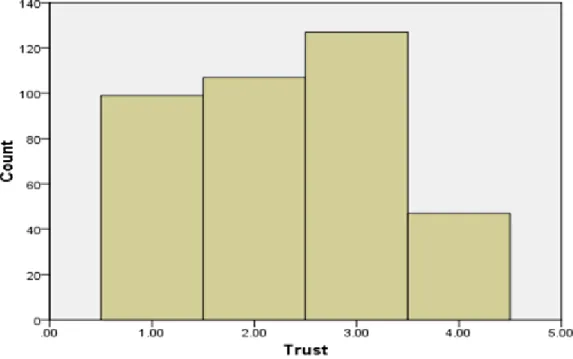
This section highlights the findings from the data collected from survey respondents using the
Figure-1. Histogram showing trust distribution
Source: SPSS
218
Table-1. Crosstab Count
Age Total
18-25 25-32 32-39 39 and above
Trust Very low trust 75 11 13 0 99
low trust 40 33 0 34 107
enough trust 57 34 33 3 127
very high trust 15 16 16 0 47
Total 187 94 62 37 380
Source: SPSS
Table-1a. Symmetric Measures
Value Asymp. Std. Errora Approx. Tb Approx. Sig.
Ordinal by Ordinal Kendall‘s tau-b .173 .041 4.261 .000
Spearman Correlation
.207 .048 4.109 .000C
Interval by Interval Pearson‘s R .163 .043 3.214 .001C
N of Valid Case 380
a. Not assuming the null hypothesis.
b. Using the asymptotic standard error assuming the null hypothesis. c. Based on normal approximation.
Table 2 shows the breakdown of income levels and trust in the administration. Those with low level of income exhibit very or low trust and those with higher income exhibit more trust. However, a significant majority with relatively higher earning exhibit enough trust. The Kendall tau-b value for this measure is .627 the implications of which have been discussed later on.
Table-2. Crosstab Count
Income
5,000-15,000 15,000-25000 25,000- 35,000 35,000 and above Total
Trust Very low trust 75 11 13 0 99
low trust 76 31 0 0 107
enough trust 12 33 67 15 127
very high trust 0 0 32 15 47
Total 163 75 112 30 380
Source: SPSS
Table-2a. Symmetric Measures
Value Asymp. Std. Errora Approx. Tb Approx. Sig.
Ordinal by Ordinal Kendall‘s tau-b .627 .028 20.987 .000
Spearman Correlation
.705 .031 19.303 .000C
Interval by Interval Pearson‘s R .697 .028 18.896 .000C
N of Valid Case 380
a. Not assuming the null hypothesis.
b. Using the asymptotic standard error assuming the null hypothesis. c. Based on normal approximation.
Table 3deals with level of education of respondents and trust. It shows that those with higher education tend to have greater trust in the administrative machinery of the state. The Kendall tau-b measure for this is .458, a detailed analysis of the implications has been done in the final section of this paper.
Table-3. Crosstab Count
Education Total
No education Primary Education High School University
Trust Very low trust 28 58 13 0 99
low trust 16 76 15 0 107
enough trust 6 39 33 49 127
very high trust 0 16 16 15 47
Total 50 189 77 64 380
219
Table-3a. Symmetric Measures
Value Asymp. Std. Errora Approx. Tb Approx. Sig.
Ordinal by Ordinal Kendall‘s tau-b .458 .032 13.503 .000
Spearman Correlation
.533 .035 12.251 .000C
Interval by Interval Pearson‘s R .526 .033 12.036 .000C
N of Valid Case 380
a. Not assuming the null hypothesis.
b. Using the asymptotic standard error assuming the null hypothesis. c. Based on normal approximation.
Table 4 deals with religion and trust. As Muslims are a majority the column was divided into Muslims and non-Muslims grouping the other non-Muslim denominations together to gather a clearer understanding of the dynamics of trust. Non-Muslims without exception showed a lack of trust in the administration. The Kendall tau-b measure for this is -.573, the reasons for the lack of trust shown by non-Muslims and the implications of the significance of relationship have been discussed in the succeeding section
Table-4. Crosstab Count
Religion Total Muslim Non- Muslim
Trust Very low trust 29 70 99
low trust 89 18 107
enough trust 127 0 127
very high trust 47 0 47
Total 292 88 380
Source: SPSS
Table-4a. Symmetric Measures
Value Asymp. Std. Errora Approx. Tb Approx. Sig.
Ordinal by Ordinal Kendall‘s tau-b -.573 .0277 -13.676 .000
Spearman Correlation
-.623 .029 -15.480 .000C
Interval by Interval Pearson‘s R -.617 .029 -15.249 .000C
N of Valid Case 380
a. Not assuming the null hypothesis.
b. Using the asymptotic standard error assuming the null hypothesis. c. Based on normal approximation.
Table 5 deals with the correlation of national pride and trust. The table shows that those with enough trust in the administration also happen to have greater national pride. However, those with very low trust also happen to be very proud. The reason for such a disparity has been discussed below. The Kendall- tau b measure for these variables was .418.
Table-5.
Crosstab Count
National Pride Total
Not Proud Proud Very Proud
Trust Very low trust 12 74 13 99
low trust 1 44 62 107
enough trust 2 11 114 127
very high trust 15 0 32 47
Total 30 129 221 380
Source: SPSS
Table-5a. Symmetric Measures
Value Asymp. Std. Errora Approx. Tb Approx. Sig.
Ordinal by Ordinal Kendall‘s tau-b .418 .049 8.881 .000
Spearman Correlation
.448 .056 9.742 .000C
Interval by Interval Pearson‘s R .347 .065 7.197 .000C
N of Valid Case 380
a. Not assuming the null hypothesis.
b. Using the asymptotic standard error assuming the null hypothesis. c. Based on normal approximation.
3.1. Conclusion
220
policies targeting a specific age group while ignoring their income, education or religious affiliations will not lead to an increase in trust in the administration. At a time when trust is at an alarming low point among the youth it would be prudent to focus on their demographic dynamics that have strong linkages to trust, otherwise the administration and the public‘s trust deficit is bound to fall further. Moving on to income it shows ‗strong‘ linkages to trust meaning that an individual income can be seen as a determinant of trust. This implies that economic policies aimed at improving the overall economic situation will have a strong impact on the level of trust individuals have in the administration. Focusing on economic welfare by increasing minimum wage will lead to an increase in trust the public has in the administration. This in turn based on the results of previous studies will increase the administration‘s ability to make reforms and move towards the ideal of good governance. Education showed ‗medium‘ strength relationship meaning that while education level of individual has an effect on trust it is not as pronounced as the level of income, this shows that individuals on both ends of the education spectrum have large levels of mistrust. However, a medium strength relationship is of enough significance for it to be taken seriously by the administration. Policies have to be developed catering to individuals on both ends of the education spectrum, furthermore, the administration has to establish specifically designed outreach programs in order to better explain their policies to people from differing backgrounds. Religion showed ‗strong‘ linkages on the Kendall tau-b measure implying that religious affiliation of the respondent has great effect on the level of trust in the administration. From the results of the measure it can be concluded that Muslims have greater trust in the administration than non-Muslims. This is an alarming situation as protecting the rights of minorities is of tantamount importance for a progressive state in the 21st century. Furthermore, in terms of numbers minorities in Pakistan are in millions, therefore, the government has to ensure they are well integrated into the social fabric of society. As literature points out united public support for the administration allows for the administration to function freely (Chanley, 2002)
therefore, the Pakistani administration should look to placate the minorities to get support across the board public support for its reforms and policies. Lastly, national pride was shown to have a relationship of medium significance.
In a review of Lee's tactics in the 1913–1914 rate campaign (St. John Iii, 2006)and the researchers made a case for
ethical propaganda, which presents researchers with the opportunity to move beyond the progressive critique of propaganda and ask new questions about how propaganda can ethically contribute to dialogue and resolution within a democracy. Keeping in mind that national pride of an individual was shown to have an effect on an individual‘s level of trust in the administration, it can be recommended that the government pay heed to the national morale and level
of pride the public has in the country and to initiate campaigns and devise policies aimed at boosting national pride
and subsequently the public trust in the administration.
Many scholars argue that citizens with higher levels of trust in the political establishment are more likely to grant bureaucratic discretion to public administrators than citizens with lower levels of trust. Trust, therefore, can alleviate the friction between managerial flexibility and political accountability in the modern administrative state (Cooper, 2008) and this is of utmost importance to Pakistan which is marred by bureaucratic inefficiency as exhibited by the performance variable in this research.
The degree of maneuverability political leaders have in the reform process is influenced by environmental factors
(Christensen, 2002). Therefore, focusing on areas of weakness and improving performance standards and empowering citizens while allowing them express themselves freely will foster the building of trust in the Pakistani government, which will facilitate an environment conducive to reform and development in the troubled region.
Overall, it can be said that the lack of trust in the government of Pakistan especially within specific demographics like non-Muslims, is a worrying indicator of poor administration. The government needs a cohesive response to counter all outstanding issues in order to build trust between different segments of the public and the government, which as history has taught us is the bedrock of a successful administration.
References
Ackerman, J., 2004. Co-governance for accountability: Beyond exit and voice. World Development, 32(3): 447-463.
Aoki, N., 2015. Let's get public administration right, but in what sequence?: Lessons from Japan and Singapore. Public Administration and Development, 35(3): 206-218.
Biber, H., 2005. The ethics of social research. London: Longman.
Bouckaert, G. and V.D.W. Steven, 2001. Government performance and trust in government. Paper Presented at the Annual Conference of the European Group for Public Administration, September 5–8, Vaasa, Finland.
Bouckaert, G. and D.W.S. Van, 2003. Comparing measures of citizen trust and user satisfaction as indicators of good governance: Difficulties in linking trust and satisfaction indicators. International Review of Administrative Sciences, 69(3): 329-343.
Brinkerhoff, D.W. and A.A. Goldsmith, 2003. How citizens participate in macroeconomic policy: International experience and implications for poverty reduction. World Development, 31(4): 685-701.
Chang, E.C.C. and Y.H. Chu, 2006. Corruption and trust: Exceptionalism in Asian democracies? Journal of Politics, 68(2): 259-271. Chanley, V.A., 2002. Trust in government in the aftermath of 9/11: Determinants and consequences. Political Psychology, 23(3): 469-483. Christensen, T., 2002. Transforming administrative policy. Public Administration, 80(1): 153-178.
Christensen, T. and L. Per, 2005. Trust in government: The relative importance of service satisfaction, political factors, and demography. Public Performance and Management Review, 28(4): 487–511.
Cooper, C.A., 2008. The importance of trust in government for public administration: The case of zoning. Public Administration Review, 68(3): 459-468.
Evans, P. and J.E. Rauch, 1999. Bureaucracy and growth: A cross-national analysis of the effects of Weberian state structures on economic growth. American Sociological Review, 64(5): 748-765.
Freed‐Taylor, M., 1994. Ethical considerations in European cross‐ national research. International Social Science Journal, 142: 523-532. Hegre, H. and H.M. Nygard, 2015. Governance and conflict relapse. Journal of Conflict Resolution, 59(6): 984-1016.
Jawad, S. and P. Edwina, 2013. Rediscovering Anekta mein ekta or kasrat mein wahdat: South Asian management through unity in diversity. Equality, Diversity and Inclusion: An International Journal, 32(3): 236-244.
Johnston, M., 2008. Assessing the progress of anticorruption efforts: Actionable indicators of reform. In Nurul Islam and M. Asaduzzaman, Eds. Ship Adrift: Governance and development in Bangladesh. Dhaka: Bangladesh Institute of Development Studies.
Klingemann, H.-D., 1999. Mapping political support in the 1990s: A global analysis. In critical citizens: Global support for democratic government. Edited by Pippa Norris. Oxford: Oxford University Press. pp: 31–56.
221
Levi, M. and S. Laura, 2000. Political trust and trustworthiness. Annual Review of Political Science, 3(1): 475–507.
Matei, A. and R. Băieşiu, 2014. Good administration and performance of local public administration. Procedia - Social and Behavioral Sciences, 109: 684-687.
Miller, A. and L. Ola, 1999. Political performance and institutional trust. In critical citizens: Global support for democratic government, edited by Pippa Norris. Oxford: Oxford University Press. pp: 204–216.
Miller, A.H., G.N. Edie and E. Lutz, 1979. Type-set politics: Impact of newspapers on public confi dence. American Political Science Review, 73(1): 67–84.
North, D., 1990. Institutions, institutional change and economic performance. Cambridge: Cambridge University Press.
St. John Iii, B., 2006. The case for ethical propaganda within a democracy: Ivy Lee's successful 1913–1914 railroad rate campaign. Public Relations Review, 32(3): 221-228.
Suh, C.S., 2012. Spill-up and spill-over of trust: An extended test of cultural and institutional theories of trust in South Korea1. Sociological Forum, 27(2): 504-526.
Tang, B.S., 2008. Social impact assessment and public participation in China: A case study of land requisition in Guangzhou. Environmental Impact Assessment Review, 28(1): 57-72.
UNDP, 2002. Human development report 2002: Deepening democracy in a fragmented world. New York: Oxford University Press. White and Korotayev, 2004. Statistical analysis of cross tabs. Available from http://eclectic.ss.uci.edu/~drwhite/courses.
Wilson, R., 2016. Does governance cause growth? Evidence from China. World Development, 79: 138-151.
World Bank, 2003. World development report 2004: Making services work for poor people. New York: Oxford Universit y Press.