Integration of Access Control in Information Systems: From Role Engineering
to Implementation
Thion Romuald and Coulondre Stéphane LIRIS / INSA University of Lyon 20 Av. Albert Einstein
69621 Villeurbanne Cedex, France
[email protected] and [email protected]
Keywords:role-based access control, object-oriented models, role engineering, security
Received:November 11, 2005
Pervasive computing and proliferation of smart gadgets lead organizations to open their information sys-tems, especially by extensive use of mobile technology: information systems must be available any-time, any-where, on any media. This cannot be done reasonably without thorough access control policies. Such access control must be able to deal with user profile, time and even with more complex contexts including geographical position. This paper shows that it is possible to take into account confidentiality constraints straight into the logical data model in a homogeneous way, for various aspects generally treated indepen-dently (user profile, time, geographical position, etc.). We propose a language called RAPOOL which allows the expression of authorizations at the class level. We first present the syntactical aspects, then the semantics of the language, based on the object-oriented paradigm.
Povzetek: ˇClanek opisuje mobilne informacijske sisteme.
1 Introduction
Companies and general public interest for new technolo-gies keeps growing, either for mobile use (laptops, Wi-fi, pocket-PC, GPS, UMTS, Java technology in GSM, etc..) or for legacy use. Information Systems (IS) now become open and online. Therefore, security is in great demand, par-ticularly for IS containing confidential data. New mobile and pervasive technologies introduce the concept of con-text. The need to include it in access control mechanisms arises [16, 13]. Thus, from now on, access control tends towards integration of user profile, time, state of the com-puting environment and even geographical position [8].
1.1 Motivations
Security is considered as a non-functional requirement in software engineering. Contrary to other non-functional re-quirements, such as efficiency, modularity or usability, con-fidentiality has been unconsidered for long. Thus, access control management is often postponed until the end of the design cycle and is implemented at the very end of the de-sign process. The software is therefore developed without taking confidentiality constraints into account. This usual approach often leads to serious design challenges (e.g. in-tegration of roles) and problems (e.g. software vulnerabili-ties, information leakage) [17].
In this paper, we show how to take into account general context data (user roles, spatio-temporal environment, etc.) in a homogeneous way, straight in the object data model
(and more generally in Information Systems, Objects, Web Services, etc) to provide an object-oriented language which allows the expression of authorizations at the class level. We do think that security must be present throughout the whole development cycle. Our proposal describes a logical data model in which contextual role-based access control is integrated. We thus provide a support to upstream design methods [9, 14] which can rely on it.
1.2 Our approach
We do think that security concerns must be considered all the development cycle long. As user interface is incorporated in software architecture (e.g. the model-view-controller architecture separates an application’s data model, user interface and its control logic), we argue that access control, and in a broader sense security, must be considered in the software development cycle, and not ne-glected until the very end of this process.
within an IS. Section 3 details syntactical aspects of the RAPOOL (for Role-based Authorizations Policies Object-Oriented Language) language we propose. Section 4 de-tails functional aspects with an illustrative example in the medical area. This section also describes how to imple-ment RAPOOL. Section 5 surveys attempts in integrat-ing the role concept in object data models and compare our approach to related work on security integration within object-oriented models. Section 6 finally concludes the pa-per and discusses some pa-perspectives on security integration within the software design process.
2 Modelling authorizations with
roles
Role modelling has been introduced into many computer sciences areas: databases, programming languages, ontolo-gies or agent oriented modelling. For security purposes, roles have been introduced to make access control policies administration easier: this is the main idea of the Role-Based Access Control(RBAC) model.
2.1 An Access Control model
Access control denotes the fact of determining whether a user (not necessarily an human user: process, computer, etc.) is able to perform anoperation(read, write, execute, delete, search, etc.) on anobject(more generally: a tuple in a database, a table, an object, a file, etc.). An operation right on an object is calledpermission. An access control model define how to organize the permissions of users.
The RBAC Model [21] was defined in the 90’s and has been extended in many ways (temporal, geographical ex-tensions, etc. [8, 13]). It was introduced in order to tackle the weaknesses of DAC (Discretionary Access Control) and MAC (Mandatory Access Control) models: the former is difficult to implement with a large number of users, and the latter is too rigid for modern applications. We focused on RBAC rather than other recent access control models because it is currently the most seducing access control paradigm, as shown by its use in major databases man-agement systems such as Oracle Enterprise Server v.8 or Sybase Adaptive Server v.11.5. Even for legacy systems which are not role- based, the use of RBAC may simplify management [18].
The basic RBAC philosophy is based on the observation that most of the access permissions are determined by a person authority or function, inside an organization. This defines the central concept of role. The introduction of role
a certain number of roles [20], each of them representing a set of actions and responsibilities within the system (roles can be seen as a collection of permissions). Thus in the RBAC model (figure 1):
– no permission is granted directly to the user, permis-sions are only granted to roles,
– the users endorse the roles which are given by the ad-ministrator (it is only possible to specify positive au-thorizations, no prohibitions),
– roles are defined and organized in a hierarchy: a child role has the permissions granted to his/her parents.
In OO systems, the concept of permission is related to objects methods. A permission is an access privi-lege on a ressource. In OO systems, ressources are jects (or attributes of objects) and access privileges are ob-jects methods (e.g. getAttribute()is a read-access,
setAttribute()is a write-access). Thus, granting an access privilege to an object consists in authorizing the ob-ject method call. The rules defining permission assign-ments to roles areaccess control policies.
2.2 Access control policies
Access control policies define the users rights on ob-jects, in order to enforce the security of an organization. In the RBAC model, policies define which permissions are granted to roles (permission-role assignment in fig-ure 1). Thus users are granted permissions through role-assignment (user-role assignmentin figure 1).
An example of role-oriented access control policies in health sector would be:
– a nurse can only read the patient prescriptions. But she can write the last care date and time, provided it takes place during her working time,
– a doctor can only prescribe if he/she is geographically located in the hospital. He has access to the whole medical record, but he/she cannot write the last care date and time,
– a head nurse has read access to prescriptions and cares history without conditions of time.
Figure 1: The RBAC Model
patient records. According to RBAC principle “permis-sions are only granted to roles", our proposal do not in-clude policies related to individuals. Thus is is not possible to specify that onlyDr. Johnsonhas access toMr. Rabot record. The RBAC roles, their hierarchical organization and the associated permissions make up the organization confidentiality policy.
The language we chose to express access control poli-cies has been heavily influenced by [8] which formalize authorization policies, including temporal aspects, in first-order logic (FOL). Thus we use a tractable fragment of FOL (no function symbol, no negation, only conjunctive and disjunctive connectors) suitable to express role-based authorization policies at the class level.
2.3 A suitable subset of RBAC
Our approach intends to include role-based authorizations into class models. Thus, authorizations policies are com-mon to every objects instantiated from a class. As classes are most-of-the-time static in OO systems, we are not able to express dynamic aspects of RBAC. The session concept for example, cannot be included into the class model: each session is related to exactly one user, and it represents the roles its user is actually endorsing.
Moreover, our proposal is an OO language designed for secured software. Its goal is not to integrate the whole RBAC model into class models, but only a subset describ-ing authorizations policies related to the application which is to be developed. Thus user-role assignments, sessions or delegations are outside the scope of this work: we only model the authorization policies related to the application. For example, let us suppose that a hospital is developing an intranet web-portal. User-role assignments are stored in a dedicated directory (which is used by other applica-tions), not in web-portal itself. Only the policies describing “which role can access a given method of a given class of the web-portal" are included straight into the code.
Thus, the concepts of user, user-role assignment,
ses-sions and context retrieval are not included in our proposal and will be referred asuser profile(section 4).
3 The RAPOOL Language
In order to tackle the problems of RBAC integration within object data models, we propose a generic language RAPOOL allowing the expression of RBAC authorizations and integrating an access control mechanism. The declara-tive part of the language is composed of:
– the body, which relies on C++ syntax (on a purely illustrative basis, as any class-based language could have been used: Java, Python, etc.) while adding ac-cess authorizations formulae to methods,
– the header, which defines the roles which are to be used within the definition of access authorizations.
3.1 The Header
The header is used to specify (BNF grammar is given in annex):
– various categories of roles to be taken into account. In the example we included the categories of [3] which are adapted to organizations:functional,seniorityand context. These categories, freely chosen by the devel-oper, form groups of roles. These groups represent transverse role aspects, which are combined to form complex roles. It would be possible to add some other groups such asward (ex: cardiology, radiology, etc. which remains static), orsensitivity(ex: white, grey, black information according to the sensitivity of data) which can be used to simulate a MAC access control,
(by using the predicateposition) or temporal (with the predicatehour). We suppose that the position of the user is obtained by reliable mechanisms which are not in the scope of this paper. We suppose we can get an absolute reference as a couple of (X, Y) co-ordinates, indicating the user position from where he/she invokes the service. In practice, space modelling by mean of linear constraints is sufficient for many cases [7]. Within the header we can for example restrict access only if the user is located within the hospital or the building.
All simple roles defined in the header are combinable via conjunctions and disjunctions, in order to create com-plex roles, modelling access control constraints based on the transverse aspects of the profile, time and space at the same time.
Functional Roles {
Roles : nurse, doctor, day_nurse, night_nurse; Hierarchy : day_nurse << nurse, night_nurse << nurse; }
Seniority Roles {
Roles : manager, head, assistant; Hierarchy : manager << head << assistant; }
Contextual Roles {
Hospital_enclosure = (position(X,Y) and X>10 and X<50 and Y<10 and Y>30); First_shift = (hour(H) and H>=4 and H<12); Second_shift = (hour (H) and H>=12 and H<20); Third_shift = ((hour (H) and H>=20)
or (hour(H) and H<4)); }
3.2 The Body
In RAPOOL, the body part allows the expression of access authorizations at the method level. This is made possible using theauthkeyword, followed by an appropriate logi-cal formula. The authorization logilogi-cal formulae are used to condition access to each method, according to the roles de-fined in the header. These access authorizations model ac-cess control rules defined in the confidentiality policy (sec-tion 2.2).
Class CElectronicPatientRecord { Public:
contact getPatientContact() auth (doctor or nurse); string getLastPrescription()
auth (doctor or nurse); string getPrescriptionHistory()
auth (doctor or (nurse and head)); string getCareHistory()
auth (doctor or (nurse and head)); void setPrescription(string prescription)
auth (doctor and Hospital_enclosure); void setLastCare(hour h, string care)
4 Functional aspects
As the access control we propose is defined at the class level, the following statements hold:
– for confidentiality-critical applications, access control authorizations should be taken into account from the very beginning of an information system design cy-cle [17]. We do think that it does not have to be post-poned until the end of the cycle,
– roles must be defined as soon as the requirement engi-neering stage [20, 11],
– roles and authorizations can only be static [3], as the class structure is modified, therefore recompiling is necessary. We consider that this is not necessarily a major problem, as the set of information defined in the header and authorizations are very static (ex: hierarchical levels, internal organization, administra-tive responsibilities, etc.). However, no recompiling is necessary for dynamic user role assignment or revo-cation. Moreover, privilege delegation is possible be-tween users. In the case of developing a wrapper (for accessing legacy application through web services for instance), recompilation does only involve the wrap-per, not the wrapped applications.
4.1 The authorization decision
The principle of access control decision is as follows: when a method call is detected, the RAPOOL engine checks if the dynamic user profile fulfills the method authorization policy. As described in section 2.3, our proposal does not include the management of user profiles: we suppose that a system storing role assignments, running sessions and pro-viding contextual information (e.g. time) exists. Once this information is retrieved (a cache mechanism can be used to improve retrieval efficiency), the RAPOOL engine can check if the requested access is granted. An architecture for such a context repository is described in [16].
The basic idea of the access control decision is based on logical implication. The user profile and the authorization policy of the requested method needs to be translated into first-order logic formulae:
1. each role is replaced by itself and the conjunction of all its parents roles. If two roles are set to be mutually inherited, they are considered as a same role,
3. if a role is equivalent to a formula, then it is replaced by this formula,
Once theses transformations are applied to both user pro-file and requested authorization formula, we need to add contextual information to the user profile. This informa-tion is obtained by mean of software/hardware tools such as LDAP, GPS, time clock, etc. and are also translated into atoms. E.g.hour(18)orposition(10,23). Then if the user profile (plus context) implies the authorization formula of the requested method, the method is invoked, otherwise a catchable exception is raised.
4.2 Example of authorization decision
Let us suppose that a user, John, wants to ac-cess the setLastCare() method from his mobile de-vice. John, who has previously identified himself on the information system, has the following pro-file: f unctional(nurse)∧f unctional(night_nurse)∧ position(150,45)∧hour(23)The functional part can be extracted from a LDAP directory for example, and the spatio-temporal part can be added by a time and position server.
The authorization policy associated with the set-LastCare() method is specified within the RAPOOL body, as ((day_nurse∧f irst_shif t)∨(day_nurse∧ second_shif t) ∨ (night_nurse ∧ third_shif t)) The RAPOOL engine replaces these role names by logical pred-icates, as defined in the header:
– day_nurse is replaced by f unctional(nurse) ∧ f unctional(day_nurse). Indeed,day_nursehas at least all the privileges ofnurse. The same hold for night_nurse,
– f irst_shif t is replaced by hour(H) ∧H ≥ 4 ∧ H < 12. The same holds for second_shif t and third_shif t.
The resulting formula (under disjunctive form) is: (f unctional(nurse) ∧ f unctional(night_nurse) ∧ hour(H) ∧ H < 4) ∨ (f unctional(nurse) ∧ f unctional(night_nurse) ∧ hour(H) ∧ H ≥ 20)∨(f unctional(nurse)∧f unctional(day_nurse)∧ hour(H)∧H ≥4∧H < 12)∨(f unctional(nurse)∧ f unctional(day_nurse)∧hour(H)∧H≥12∧H <20) The RAPOOL engine checks if the dynamic user file logical formula implies this formula. As the user pro-file isf unctional(nurse)∧f unctional(night_nurse)∧ position(150,45)∧hour(23). Implication holds, therefore access is granted.
4.3 Implementation in an object-oriented
framework
The first approach to implement RAPOOL is to add a layer over an existing object-oriented language. Such a layer
has to retrieve user profile and contextual information from role-assignment database. This layer needs to implement the profile and authorization policy transformation into log-ical formulae. This framework allows software designers to integrate access control in a declarative manner, without worrying about the mechanisms involved in authorization decision.
A proof-of-concept pre-processor RAPOOL to C++ has been implemented. For a developer, the RAPOOL to C++ pre-processor is a black-box transforming his code into C++. The basic steps of the pre-processor are:
– the input is a RAPOOL source file, as written by de-velopers according to RAPOOL grammar,
– the pre-processor includes the C++ framework files to the source code,
– the pre-processor parse the header of RAPOOL (ac-cording to its grammar) and suppress it from the source file,
– the pre-processor analyse the body of RAPOOL and transform authorization policies into logical formu-lae (section 4.1) according to the previously parsed header,
– the pre-processor add a call to the authorization deci-sion mechanism (included from C++ framework files) at the beginning of each method,
– the output is a C++ source file, obtained from RAPOOL source file once header and authorization policies are translated into calls to the framework.
4.4 Implementation in a role-based
object-oriented model
In many class-based object-oriented systems the associa-tion between an instance and a class is exclusive and per-manent. Therefore these systems have serious difficulties in representing dynamic evolution of objects over time. The problem is the most severe for OO databases in which objects are stored over long periods during which the enti-ties evolve. Object-role oriented models intend to fill this shortcomings of object-oriented models by adding an or-thogonal concept to classes: roles.
The authors of [23] describe an RBAC framework orga-nized into 7 layers, as the OSI (Open Systems Interconnect) network stack is (fromphysicallayer #1 to abstract appli-cationlayer #7). The least abstract layer is theobjectlayer, used by the directly higher one:objects handles. This sec-ond layer is used to keep the association between objects and roles. An object-role oriented model integrate directly such a layer: handles are no more needed, associations be-tween roles and objects are handled in declarative manner in the object-role oriented paradigm.
existing object-oriented language.
Section 5.2 survey previous works on integration of role mechanisms into object-oriented models. According to previous surveys [2, 10], Samovar is the most suitable model for hosting the RAPOOL language. This model re-spects the ODMG standard and integrate roles into object-oriented model. In this model, class can be seen asabstract role containers: no method is directly associated to a class. Attributes are only associated to roles or combinations of roles (including conjunction and disjunction). These com-binations are expressed in first-order logic formulae (the same fragment of FOL used to express authorization poli-cies in RAPOOL).
Thus, to implement RAPOOL in a role-based object-oriented model, we must carry a prior transformation step on access control policies. In RAPOOL, each authorization is associated to an object method, roughly said as “policies are organized by permissions". In order to implement our language, we must infer on these policies to organize them by roles, rather than by permissions. Note that this process can be performed automatically without human interven-tion.
For example, assuming we are working with the example from section 3.2. Policies of the
CElectronicPatientRecordclass are organized by permissions:
– permissiongetPatientContact()is granted to roles(doctor or nurse),
– permissiongetLastPrescription()is granted to roles(doctor or nurse),
– permission getPrescriptionHistory()
is granted to roles
(doctor or (nurse and head)).
In order to be implemented in a role-based object-oriented model, policies must be organized by roles. Thus, the above example will be organized as follows:
– role (doctor) is granted ac-cess to getPatientContact(),
getLastPrescription() and
getPrescriptionHistory(),
– role (nurse) is granted access to getPatientContact() and
getLastPrescription()
– role (nurse and head) is granted access to
getPrescriptionHistory().
Very few work focused on integrating of access control models within logical data models. This section survey re-lated work on introduction of security in object-oriented models and on the role-object oriented paradigm.
5.1 Integration of access control in
object-oriented systems
Many papers have described how to implement security mechanisms involving roles and contexts (e.g. [16, 3]) in a oriented system. Our goal is not to describe how role-based access control can be implementedwithclasses, but is to describe how (and which subset of) role-based access control mechanisms can be implementedinclasses.
Integration of access control into OO systems has al-ready been studied. The authors of [24] describe how to implement Mandatory Access Control (MAC) in OO database systems. Roughly stated, MAC is a military-oriented model, in which users and resources are associated to labels. Access is granted if and only if the user label is as least as high as the requested resource label. Commonly used labels are unclassified, confidential, secret and top-secret. However, MAC has been shown to be too rigid for current applications, particularly when multiple users with different profiles are working on the system.
A more recent approach in [5] integrate MAC to UML diagrams. Their framework bridges the gap between soft-ware engineers and an organization security. A very inter-esting contribution which is not limited to class diagram and intends to integrate MAC in use cases and sequence diagrams. This paper describes a logic data model, but we are working on a conceptual model integrating role-based authorizations (section 6).
5.2 Extending object-oriented systems with
roles
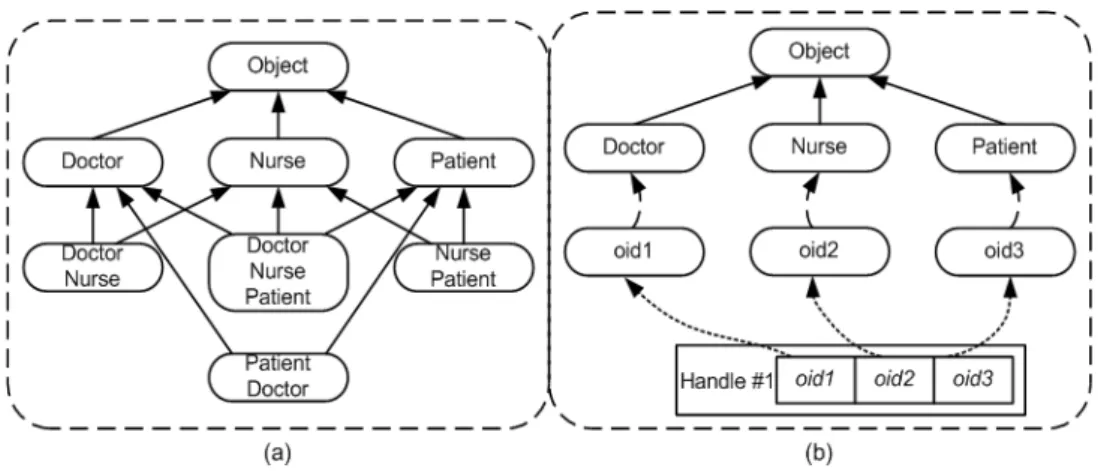
The object paradigm is a very expressive framework, largely used. According to [22], implementing object roles is a difficult task. Indeed, the multiplicity of roles and their lifecycle (creation, deletion) is incompatible with the hard constraints of class-based models: object identity, strong typing, etc.
solution is to create a structure ofhandles[23] (figure 2b) which corresponds to the desired multiple-role instances. The handle references several OIDs, each of them corre-sponding to a role played by this instance. This leads to a referencing problem and involves the use of message dele-gation. Moreover,Jacqueswould be only ahandle, loosing its encapsulation, and therefore not an object anymore.
The implementation of RBAC models in OO systems clearly points out that maintaining association between roles and classes can be a tough design challenge, par-ticularly when dealing with role hierarchies. For exam-ple, [3, 4] describes a, UML class-diagram to implement RBAC. Their framework includes role and role instance classes. Thus, software designers have to implement a mechanism to ensure that an object instance of role is linked with another object instance ofrole instance.
A review of role-based object models in the program-ming and database areas can be found in [10, 2, 6]. How-ever, these models are intended mainly to take into account the dynamic part of the objects during their life, but either they do not propose in general any access control primi-tive or they do not totally respect the standard paradigms of object programming (e.g. [25]).
5.3 Integration of security in role-oriented
systems
To the best of our knowledge, the closest paper to our is [25]. This approach intends to integrate a subset of RBAC into a role-oriented system: DOOR. This model permits modelling an owner relationship between roles and objects, but this approach does not entirely respect the stan-dard paradigms of object programming. Section 5.2 ex-plains how RAPOOL can be implemented in role-object oriented systems, nevertheless in such implementation, roles can still be used for non role-based authorization pur-poses. The Samovar model [2] is well suited to include a basic form of RBAC because it includes role definition in a logical manner. These role formulae can easily capture permission-role assignments of RBAC.
The aspect-oriented paradigm can be seen as an alterna-tive to the role-oriented one. Both of them aim at a more flexible use of objects in OO systems. The authors of [19] describe their approach based on an “aspect-oriented mod-elling (AOM) technique that allows system developers to isolate cross-cutting design structures in aspects to support controlled evolution of the structures". In this approach, design structures that represent access control policies are treated as aspects. Policies are integrated into system by merging aspects with the system design model in which acces control concerns are not adresses. This composition results in awoven model. This approach is interesting for its dynamic perspectives on access control modelling but do not consider role hierarchy. We chosed to exclude dy-namic concerns in our approach to provide a less flexible but easier to use language. In our approach the basic subset of RBAC is incorporated directly, thus do not impose the
composition of two models. We are investigating whether RAPOOL can be as easily implemented in an aspect-based model as it is in a role-based model.
6 Discussion
Our proposal makes possible to take into account RBAC access control straight into the logical object data model. We presented the generic RAPOOL language, which con-tains two parts. The header allows specification of roles categories and hierarchies. The body part allows specifi-cation of authorizations at the method level, by mean of logical connectors in order to build more complex ones. We also presented the functional part of RAPOOL, which relies on a first-order logic engine.
Security is often divided into confidentiality, reliability and integrity. Confidentiality is the least considered non-functional requirements of security. Access control mod-els, and nowadays role-based ones, are designed to en-hance confidentiality. Integration of Mandatory Access Control [5] in UML diagrams and security extensions for UML [12, 14] are promising. They will bridge the gap be-tween a security will and its implementation. These con-ceptual and logical propositions can be core models for methodologies considering security as in integral part of the whole software design process such as [17]. We are currently working on automatic translation into RAPOOL of UML diagrams expressed in specific security models. RAPOOL can indeed be used as a target language for a CASE supporting a RBAC-based design method, such as SecureUML. We currently plan to validate this approach using our prototype, a RAPOOL to C++ pre-processor, with the Foundstone SecureUML Visio template [1].
References
[1] R. Araujo and S. Gupta (2005) Design authorisation systems using SecureUML, Foundstone, Technical report.
[2] S. Coulondre and T. Libourel (2002) An integrated object-role oriented database model, Data Knowl. Eng., 42(1):113–141.
[3] R. Crook, D. C. Ince, and B. Nuseibeh (2003) Mod-elling access policies using roles in requirements engineering, Information & Software Technology, 45(14):979–991.
[4] J. P. Davis and R. D. Bonnell (1999) Role-playing: A mechanism for bridging the object-oriented design-level gap, OOPSLA-97: Workshop on Object Tech-nology, Architectures and Domain Analysis.
Figure 2: Empirical solutions for role implementation
on Formal methods in security engineering, ACM Press, 75–85.
[6] G. Gottlob, M. Schrefl, and B. Rock (1996) Extend-ing object-oriented systems with roles, ACM Trans. Inf. Syst., 14(3):268–296.
[7] S. Grumbach, P. Rigaux, and L. Segoufin (2001) Spatio-temporal data handling with constraints, GeoInformatica, 5(1):95–115.
[8] J. Joshi, E. Bertino, U. Latif, and A. Ghafoor (2005) A generalized temporal role-based access control model, IEEE Transactions on Knowledge and Data Engineering, 17(1):4–23.
[9] J. Jürjens (2002) UMLsec: Extending UML for se-cure systems development, UML 2002 - The Unified Modeling Language. Model Engineering, Languages, Concepts, and Tools. 5th International Conference, Springer, Dresden Germany, 412–425.
[10] G. Kappel, W. Retschitzegger, and W. Schwinger (1998) A comparison of role mechanisms in object-oriented modeling, Modellierung CEUR Workshop Proceedings, CEUR-WS.org.
[11] A. Kern, M. Kuhlmann, A. Schaad, and J. D. Mof-fett (2002) Observations on the role life-cycle in the context of enterprise security management,SACMAT, 43–51.
[12] D.-K. Kim, I. Ray, R. B. France, and N. Li (2004) Modeling role-based access control using parameter-ized uml models, FASE, Lecture Notes in Computer Science, 180–193.
[13] A. Kumar, N. Karnik, and G. Chafle (2002) Con-text sensitivity in role-based access control, SIGOPS Oper. Syst. Rev., 36(3):53–66.
[14] T. Lodderstedt, D. A. Basin, and J. Doser (2002) Se-cureuml: A uml-based modeling language for model-driven security, UML ’02: Proceedings of the 5th
International Conference on UML, Springer-Verlag, London UK, 426–441.
[15] J. D. Moffett and E. Lupu (1999) The uses of role hi-erarchies in access control, ACM Workshop on Role-Based Access Control, 153–160.
[16] G. K. Mostéfaoui and J. Pasquier-Rocha (2003) Deterministic context-based security policies: An object-oriented approach,SNPD, ACIS, 160–165.
[17] H. Mouratidis, P. Giorgini, and G. A. Manson (2003) Integrating security and systems engineering: To-wards the modelling of secure information systems, CAiSE, Lecture Notes in Computer Science, 63–78.
[18] S. L. Osborn, Y. Han, and J. Liu, (2003) A methodol-ogy for managing roles in legacy systems, SACMAT, ACM, 33–40.
[19] I. Ray, R. B. France, N. Li, and G. Georg (2004) An aspect-based approach to modeling access con-trol concerns, Information & Software Technology, 46(9):575–587.
[20] H. Roeckle, G. Schimpf, and R. Weidinger (2000) Process-oriented approach for role-finding to imple-ment role-based security administration in a large in-dustrial organization,ACM Workshop on Role-Based Access Control, 103–110.
[21] R. S. Sandhu, E. J. Coyne, H. L. Feinstein, and C. E. Youman (1996) Role-based access control models, IEEE Computer, 29(2):38–47.
[22] F. Steimann (2000) On the representation of roles in object-oriented and conceptual modelling, Data Knowl. Eng., 35(1):83–106.
[24] M. B. Thuraisingham (1989) Mandatory security in object-oriented database systems, OOPSLA ’89: Conference proceedings on Object-oriented program-ming systems, languages and applications, ACM Press, New York USA, 203–210.
[25] R. K. Wong (1997) Rbac support in object-oriented role databases,RBAC ’97: Proceedings of the second ACM workshop on Role-based access control, ACM Press, New York USA, 109–120.
Annex: BNF Grammar of RAPOOL
header
Note: grammar of non–terminal symbol logical_formula is not included.
RAPOOL_header := groups_list groups_list := groups_list group |
group := group_identifier ’Roles’ ’{’ definitions_list ’}’ group_identifier := IDENTIFIER
definitions_list := definitions_list definition |
definition := role_definition |hierarchy_definition |equivalency_definition
role_definition := ’Roles’ ’:’ roles_list ’;’ roles_list := role_identifier roles_list_suite roles_list_suite := ’,’ role_identifier roles_list_next |
role_identifier := IDENTIFIER
hierarchy_definition := ’Hierarchy’ ’:’ hierarchi-cal_relations_list ’;’
hierarchical_relations_list := hierarchical_relation hierar-chical_relations_list_suite
hierarchical_relations_list_suite := ’,’ hierarchical_relation hierarchical_relations_list_suite
|
hierarchical_relation := role_identifier ’<<’ role_identifier
equivalency_definition := equivalency_identifier ’:=’ logical_formula ’;’