Vol. 2, No. 1, 2009, (21-57)
ISSN 1307-5543 – www.ejpam.com
From right
PP
monoids to restriction semigroups: a survey
Christopher Hollings
∗Centro de Álgebra da Universidade de Lisboa
Av. Prof. Gama Pinto 2
1649-003 Lisboa
Portugal
Abstract. Left restriction semigroups are a class of semigroups which generalise inverse semigroups
and which emerge very naturally from the study of partial transformations of a set. Consequently,
they have arisen in a variety of different contexts, under a range of names. One of the various guises
under which left restriction semigroups have appeared is that ofweakly left E-ample semigroups, as
studied by Fountain, Gomes, Gould and Lawson, amongst others. In the present article, we will survey
the historical development of the study of left restriction semigroups, from the ‘weakly leftE-ample’
perspective, and sketch out the basic aspects of their theory.
AMS subject classifications: 01 A 60, 20-03, 20 M 20.
Key words: rightPPmonoid, left ample semigroup, weakly leftE-ample semigroup, restriction
semi-group, partial transformation.
Introduction
In the mid-twentieth century, the study of systems of partial one-one mappings (partial bijections) of a set yielded the abstract notion of aninverse semigroup, as introduced (inde-pendently) by Wagner [78, 79] and Preston [60–62]. Let X be a nonempty set and let IX ∗Corresponding author.Email address:
dh500ii.f.ul.pt
denote the collection of all partial bijections of X. ThenIX forms a monoid, termed a sym-metric inverse monoid, under the following composition (performed from left to right†): for
α,β∈ IX,
domαβ= (imα∩domβ)α−1 (∗)
where α−1 denotes the preimage underα, and, for x in this domain, x(αβ) = (xα)β. It is clear that any partial bijectionαis invertible on its image, with inverseα−1: imα→domα. Any inverse semigroup may be regarded as a subsemigroup of someIX that is closed under
the unary operation−1. There are a number of different approaches to the study of inverse semigroups, and these may be embodied in a sequence of structure theorems (for example, Theorems 1.12, 1.13, 1.17 and 1.19).
More generally, we can study systems ofarbitrarypartial transformations of a set, not just the injective ones. At least initially, the study of such systems was guided by analogy with the above case of partial bijections. It was discovered that if we are to obtain satisfactory analogues of various results for inverse semigroups, then we must consider so-calledleft re-striction semigroups. If we denote byP TX thepartial transformation monoidof a setX, i.e.,
the collection of all partial transformations of X, under the (left-to-right) composition (∗), then a left restriction semigroup may be characterised as a subsemigroup of someP TX that is closed under the unary operationα7→Idomα, whereIdomα denotes the identity mapping on the domain ofα. On the other hand, letP T∗X denote thedual partial transformation monoid of X: the collection of all partial transformations ofX, composedfrom right to left. Aright re-striction semigroupis a subsemigroup of someP T∗X that is closed under the unary operation
α7→Idomα. A semigroup that is both a left and a right restriction semigroup, with respect to
the same semilattice (see Section 3), is called atwo-sided restriction semigroup.
So natural is the notion of a left restriction semigroup that it has appeared in a variety of different contexts, under a range of different names, to wit:
(1973) in the work of Trokhimenko[76], as a special case of theMenger function systemsstudied
†We sound a note of caution: the convention in this article will be to compose functions from left to right. However,
by Schweizer and Sklar[66–69], which arose from attempts to axiomatise semigroups with additional operations embedded in someP TX (see[40, 64]);
(1981) as thetype SL2γ-semigroupsof Batbedat[2, 3], which arose as a generalisation of in-verse semigroups whereby the unary operation x 7→ x x−1 was formally replaced by a functionγ:S→E(S);
(1991) as the idempotent-connected Ehresmann semigroups of Lawson [47], who was draw-ing connections between semigroup theory and the category-theoretic work of Ehres-mann [14], with the goal of applying techniques from category theory to semigroup theory;
(2001) as thetwisted LC-semigroupsof Jackson and Stokes[39], which arose from considera-tions of closure operators;
(2006) as theguarded semigroupsof Manes[51], which arose via theoretical computer science from therestriction categoriesof Cockett and Lack[6].
The term restriction semigroup, inspired by the nomenclature of Cockett and Lack for cate-gories, is a recent attempt to streamline and harmonise the terminology, and was first used in[7].
restriction semigroups.
The structure of the article is as follows. We begin with an historical survey of the develop-ment of these semigroups; since this survey is quite lengthy, we break it down into two parts: Section 1 deals with left ample semigroups, via rightPPmonoids, whilst Section 2 completes the story by describing the work leading to the eventual definition of weakly left E-ample semigroups. Sections 3–5 collate the work of a number of authors, but of El-Qallali [15], Fountain [22, 24] and Lawson [43, 47] in particular. Much of this material is ‘folklore’, in that it is difficult to determine where and when it first appeared in print; we have drawn heavily on the notes of Gould[30]. In Section 3, we expand upon the comments made at the beginning of this Introduction by defining restriction semigroups by means of partial trans-formations. We will focus our attention onleftrestriction semigroups; the right-hand version may be defined dually. In Section 4 we present the abstract definition of a weakly left E-ample semigroup and prove that this is in fact equivalent to the concrete description of a left restriction semigroup, as given in Section 3. We record some of the basic results in the theory of left restriction semigroups, before moving on to Section 5, where we consider the special case of left ample semigroups. Since the nomenclature which we will have occasion to wade through in Sections 1 and 2 can be somewhat torturous, we conclude the article by providing the reader with an appendix summarising this terminology.
We note that left restriction semigroups form a variety of algebras of type (2,1) and can therefore be defined by a system of identities first presented in[39]; full left restriction (see Section 3) and left ample semigroups form quasi-varieties of type (2,1). However, this is not an approach we will take in the present article; we hope to do so in a future article, as well as drawing further connections with left restriction semigroups in their various other guises. For the present, we note that the equivalence of the classes of type SL2γ-, weakly left E-ample, leftLC-, and guarded semigroups is demonstrated in[35, §2.6].
when making a statement which applies equally well to left, right and two-sided restriction semigroups.
For later use, the uninitiated reader should bear in mind the definition ofGreen’s (equiva-lence) relationR in a semigroupS: two elements a,b∈S areR-related if they generate the same principal right ideal. Any idempotent is a left identity for its R-class. Green’s relation
L may be defined as the left-right dual ofR; the relationH is defined byH =R ∩ L. Any other unexplained semigroup-theoretic terminology or notation may be found in[37].
1. Historical development I: left ample semigroups
We begin by giving a two-part historical survey of the origins of restriction semigroups, from the point of view of the ‘York’ school. In this section, we deal with left ample semigroups; weakly left E-ample semigroups follow in Section 2. The present section is based upon the similar introductory chapters of the D.Phil. theses of El-Qallali[15]and Lawson [43]. An-other invaluable source, both for this section and the next, was Ample and Left Ample Semi-groups[26], the extended abstract of a survey talk given by John Fountain in Calgary in June 2006.
As indicated in the Introduction, the most natural way to introduce restriction semigroups is via the partial transformations of a set. Indeed, this is what we will do in Section 3. How-ever, our historical summary begins in a rather different place, with thehomological classifica-tion of monoids. We first require the definiclassifica-tions of bothS-actsandS-morphisms:
Definition 1.1. [37, §8.1] Let S be a monoid. A set X is called a right S-act (or S-set or S-system) ifSacts onX on the right, i.e., if there is a mappingX×S→X, written(x,s)7→x·s and such that(x·s)·t = x·st, for all x ∈X ands,t ∈S, and x·1= x, for all x ∈X. (Left S-acts are defined dually.)
LetX andY be two rightS-acts. A functionϕ:X →Y is called anS-morphismif(x·s)ϕ= xϕ·s, for all x∈X ands∈S.
Just as rings may be studied via their actions on modules [33], so too can monoids be studied via their S-acts, a study taken up in [71], for example. In the case of rings, two properties which prove useful are the categorically definedinjectivityandprojectivity(see[41, pp. 7, 10]). We define the ‘S-act’ versions of these properties, bearing in mind that in the category of S-acts and S-morphisms, S-epimorphisms are onto and S-monomorphisms are one-one:
Definition 1.2. [21] Let S be a monoid and let X be an S-act. We say that X is injective if, for anyS-acts Y andZ with Z ⊆ Y, anyS-morphism ϕ : Z → X may be extended to an S-morphismϕ′:Y →X such that the following diagram commutes:
Y
Z i
6
ϕ
- X
ϕ′
-wherei:Z→Y is inclusion.
Definition 1.3. [22, p. 285] Let S be a monoid and let X be an S-act. We say that X is projective if, for any pair of S-acts Y and Z, any S-epimorphism ψ : Y → Z and any S-morphismϕ:X →Z, there exists anS-morphismπ:X →Y such that the following diagram commutes:
Y
Z
ψ
?
ϕ X
π
A monoid for which every right S-act is injective is called a completely right injective monoid. If, in addition, everyleft S-act is injective, then the monoid is said to becompletely
Fur-ther necessary and sufficient conditions for a monoid to be completely right injective were obtained by Shoji[70].
The study of monoids whose every S-act is projective, on the other hand, is far less fruit-ful; Isbell [38]showed that the only such monoid is trivial. If one is to study monoids with projective S-acts, then one must relax the conditions somewhat. For example, one can con-sider monoids in which all right ideals (regarded as rightS-acts) are required to be projective; these monoids are termed right hereditary monoids and were studied by Dorofeeva[10]. If we relax the conditions even further and consider those monoids for which only theprincipal right ideals are projective as rightS-acts, then we obtain so-calledright principally projective (orright PP)monoids. Left PP monoidsare defined dually; a monoid which is both right and leftP Pis called simplyP P. Any regular monoid is necessarilyP P, as we will see shortly.
The study of P P monoids was intiated by Kilp in[42], where the commutative case was considered; Kilp obtained a characterisation of commutative P P monoids as strong semilat-tices‡of commutative cancellative monoids. This result was generalised to the case of right P P monoids with central idempotents by Fountain [23]; such a monoid is exactly a strong semilattice of left cancellative monoids. A left cancellative monoid is therefore rightP P.
It is in fact possible to give a characterisation of rightP P monoids which makes no refer-ence toS-acts. For this, we need a notion introduced by Skornjakov[71]and Dorofeeva[10]: Definition 1.4. Let S be a monoid and let e ∈ E(S). An element a ∈ S is said to be left e-cancellableifeis a right identity foraand
a x=a y=⇒e x=e y,
for allx,y∈S.
Then, from[42], we have:
Proposition 1.5. A monoid S is right P P if, and only if, for each element a ∈S, there is an ea∈E(S)such that a is left ea-cancellable.
The notion of left e-cancellability, and hence the definition of a right P P monoid, were recast once more by Fountain[22]. Before we describe this important development, however, let us take a step back and consider a definition of Lyapin[50]:
Definition 1.6. [50, Chapter X, §4.2] LetS be a semigroup. A potential propertyin S is a property which holds in some oversemigroup T ofS.
For example, in[50], Lyapin consideredpotential invertibilityof elements in semigroups. A range of other potential properties were studied by Šutov in[72–75]. In particular, Šutov investigated the notion ofpotential divisibilityof elements[73]: elementsa,bof a semigroup S potentially divideeach other (on the right) if, and only if, there exist an oversemigroup T of S and elements s,t ∈ T such that as = b and bt = a in T. In other words, a and b potentially divide eachother if, and only if, they areR-related in some oversemigroup. Dually for potential left division.
The notion of potential divisibility arose again in work of both Pastijn [59] and McAlis-ter[54], though not under that name. In [54], McAlister arrived at the following definition of a potential property via the study of partial right translations:
Definition 1.7. [54, Definition 1.6]Let S be a semigroup and let a,b∈S. We define the equivalence relation R∗on S by saying that aR∗bif, and only if, aand bareR-related in some oversemigroupT ofS.
Through a generalisation of a construction of Schützenberger, Pastijn arrived at the defi-nition of the dual relation L∗ [59, p. 239].§ The relationsR∗ andL∗ may be regarded as generalisations of Green’s relationsR andL; it is clear thatR ⊆ R∗andL ⊆ L∗. We note that the formulation ofR∗which will appear later as our equation (5.1), namely,
aR∗b⇐⇒ ∀x,y∈S1[x a= y a⇔x b= y b], (1.1) is implicit both in[8]and in[50, Chapter X, §1.6].
Returning to right P Pmonoids, we first have the following, from[22]:
§Pastijn denotedL∗byLf— this should not to be confused with theLfof the subsequent theory of weakly right
Lemma 1.8. [22, p. 286]Let S be a semigroup and let a,b∈S. Then aL∗b if, and only if, there is an e∈E(S)such that a and b are both left e-cancellable.
Consequently:
Proposition 1.9. [22, p. 286]A monoid S is right P P if, and only if, every element isL∗-related to an idempotent.
One thing which is immediately apparent from this characterisation of right P P monoids (and, indeed, from that in Proposition 1.5) is the fact that the presence of an identity is no longer required. We can therefore define right P P semigroups. Notice also that there is no longer any reference to S-acts or projectivity. For this reason, right P P semigroups were renamed right abundant semigroups, since “such a semigroup has a plentiful supply of idempotents” [25, p. 103]. Similarly, left P P semigroups (in which every element is R∗ -related to an idempotent) became left abundant semigroups; a semigroup which is both left and right abundant is called simply abundant. Such semigroups were studied extensively in[15]and[25].
We have already commented that every regular semigroup is abundant. To see this, we recall thatR ⊆ R∗andL ⊆ L∗, and note the following characterisation of a regular semi-group:
Proposition 1.10. [37, Proposition 2.3.2]A semigroup S is regular if, and only if: (i) everyR-class contains an idempotent;
(ii) everyL-class contains an idempotent.
We see then that everyR∗-class and everyL∗-class of a regular semigroupS contains an idempotent; S is therefore abundant. Indeed, in a regular semigroup, we haveR∗=R and
L∗=L; we will provide a proof of this in Section 4 (Lemmas 4.1 and 4.14).
Theorem 1.11. A semigroup S is a Clifford semigroup if, and only if, it is a strong semilattice of groups.
We see then that the result of Fountain [23] which states that every right abundant monoid with central idempotents is a strong semilattice of left cancellative monoids provides a one-sided analogue of this last theorem. Furthermore, in the two-sided case, abundant semigroups with central idempotents are strong semilattices of cancellative monoids; abun-dant semigroups with central idempotents may therefore be regarded as analogues of Clifford semigroups. More generally, abundant semigroups are analogous to regular semigroups. The validity of this analogy is demonstrated if we compare Proposition 1.9 with Proposition 1.10. The initial study of abundant semigroups was therefore guided by the existing results for regular semgroups. One important point to note at this stage is that for regular semigroups, each of conditions (i) and (ii) in Proposition 1.10 implies the other. The ‘starred’ versions of these conditions, however, are completely independent. This is why we have one-sided as well as two-sided analogues of regular semigroups. A left cancellative semigroup which is not right cancellative is an example of a right abundant semigroup which is not left abundant.
Two special classes of regular semigroups which have seen extensive study are so-called or-thodox semigroups[37, §6.2], in which the idempotents form a subsemigroup, and, of course, inverse semigroups, in which the idempotents form a semilattice. This hints at two spe-cial classes of abundant semigroups whose study may be fruitful. Abundant semigroups in which the idempotents form a subsemigroup have been studied under the name of quasi-adequate semigroups[15–17], and a theory has been developed for these which mirrors that of Hall [34] for orthodox semigroups. An abundant semigroup in which the idempotents form a subsemilattice is termed an adequate semigroup, “since it contains a sufficient supply of suitable idempotents”[24, p. 113]. Left adequateand right adequatesemigroups are also easily defined. The study of right adequate semigroups was initiated in [22]; the two-sided case was considered in[24].
inverse semigroups:
Theorem 1.12(McAlister’s Covering Theorem). [49, Theorem 2.2.4]Every inverse semigroup is the image of a proper inverse semigroup under an idempotent-separating morphism.
Theorem 1.13(McAlister’sP-Theorem). [49, Theorem 7.2.15]Every E-unitary inverse semi-group is isomorphic to a ‘P-semisemi-group’, constructed from a semi-group, a poset and a semilattice.
Fountain determined that if right adequate analogues are to be developed for these theo-rems, then we must restrict our attention to a particular subclass of right adequate monoids, which he termedright type A monoids. A right adequate monoidS isright type Aif, and only if,
eS∩aS=eaS, fora∈S ande∈E(S). (1.2) Similarly, a left adequate monoidS isleft type Aif, and only if,
Se∩Sa=Sea, fora∈S ande∈E(S); (1.3)
a monoid which is both left and right type A is called simplytype A.¶We note that every inverse semigroup is (left/right) type A (see Section 5). The terminology ‘type A’ was subsequently replaced by the term ‘ample’, as we will see.
We have the following analogue of McAlister’s Covering Theorem:
Theorem 1.14. [22, Theorem 3.3]Every right type A monoid is the image of a proper right type A monoid under anL∗-morphism, where anL∗-morphism is a morphismθ for which
sθ =tθ =⇒sL∗t.
Recall that an inverse semigroup S is E-unitary if, and only if, it is proper [37, Proposi-tion 5.9.1]. However, after defining an appropriate notion of ‘proper’, Fountain observed that an E-unitary right type A monoid need not be proper in this sense — see[22, Example 3]. Fountain went on to construct a generalisation of McAlister’sP-semigroups, which he termed McAlister monoids. Using these, we have the following analogue of theP-Theorem:
Theorem 1.15. [22, Theorem 4.3]Every proper right type A monoid is isomorphic to a McAl-ister monoid.
These theorems are easily adapted to the semigroup case. Two-sided versions appear in[44]as Theorems 3.8 and 2.11, respectively.
There are two other major approaches to the study of inverse semigroups: that which connects inverse semigroups with inductive groupoids, and that via the notion of a Munn semigroup. Each of these methods may be extended to the study of type A semigroups. We
first consider the analogue of Munn’s work[57].
Definition 1.16. [37, p. 162]Let E be a semilattice. The Munn semigroup TE of E is the inverse subsemigroup ofIE which consists of all isomorphisms between principal ideals ofE.
We note thatE(TE)is isomorphic toE[37, Theorem 5.4.1]. Munn’s major result was the following:
Theorem 1.17. [37, Theorem 5.4.4]For any inverse semigroup S, there is a morphism S → TE(S)which maps E(S)isomorphically onto E(TE(S))and which induces the maximum
idempotent-separating congruence on S.
In [24], Fountain investigated the generalisation of this result to the case of adequate semigroups. He observed, however, that an adequate semigroup need not have a largest idempotent-separting congruence. It was therefore necessary to pursue the generalisation down a slightly different path. As determined by Munn [56], the maximum idempotent-separating congruence on an inverse semigroup is the largest congruence contained in Green’s relation H. Fountain therefore investigated the largest congruence contained in H∗ =
R∗∩ L∗; any congruence contained in H∗ is idempotent-separating, but the converse is not necessarily true. Moreover, it once again transpired that if one is to develop a suitable analogue of Theorem 1.17, then one must once again restrict one’s attention to type A semi-groups:
Theorem 1.18. [24, Proposition 4.5]For any type A semigroup S, there is a morphism S→ TE(S) which maps E(S) isomorphically onto E(TE(S)) and which induces the largest congruence
As commented above, another major approach to the study of the structure of inverse semigroups is that via the notion of aninductive groupoid: a type of small, ordered category in which all arrows are invertible. Inverse semigroups and inductive groupoids are two solutions to the problem of finding an abstract version of the pseudogroupsof Veblen and Whitehead [77, p. 38]. The inductive groupoid approach was pioneered by Ehresmann[11, 13], whilst inverse semigroups were introduced independently by Wagner and Preston, as we have seen. Thus, given that inverse semigroups and inductive groupoids share a common origin, it is not surprising that their respective theories can be connected in an extremely natural way. This linking of theories was pieced together by a number of authors[11, 12, 58, 63, 65]and is enshrined in the following result, named the Ehresmann-Schein-Nambooripad Theorem to reflect its disparate origins:
Theorem 1.19. [49, Theorem 4.1.8]The category of inverse semigroups and∨-premorphisms is isomorphic to the category of inductive groupoids and ordered functors; the category of inverse
semigroups and morphisms is isomorphic to the category of inductive groupoids and inductive
functors.
(Anordered functoris simply an order-preserving functor; aninductive functoris a special type of ordered functor. A∨-premorphismis a functionθ :S→T between inverse semigroups such that(st)θ ≤(sθ)(tθ).)
Further details on the Ehresmann-Schein-Nambooripad Theorem can be found in [49], for which book it provides the main focus.
two-sidedtype A semigroups which must be studied in this context.
The first of the generalisations of Theorem 1.19 is due to Armstrong [1]and is rooted firmly in the work of Meakin [55]. Meakin had studied the structure of an inverse semi-groupSby means of so-called ‘structure mappings’, that is, mappings betweenR-classes ofS. Armstrong generalised this approach to the study of type A semigroups by considering map-pings betweenR∗- andL∗-classes. In her Theorem 3.9, Armstrong extended the Ehresmann-Schein-Nambooripad Theorem to the case of type A semigroups and inductive cancellative categories:
Theorem 1.20. [1]The category of type A semigroups and(2, 1, 1)-morphisms is isomorphic to the category of inductive cancellative categories and inductive functors.
Note, however, that Armstrong did not give such a category-theoretic formulation. Since the definition of an inductive cancellative category is somewhat complicated, we will not go into further detail here; a summary appears in[35, Chapter 7].
In[24, p. 115], Fountain gave an alternative characterisation of (left/right) type A semi-groups; this is the definition which is most often used in current papers (and which will appear in Section 5). It should also be noted that type A semigroups are now known as am-plesemigroups, a term which was introduced in [31]; as interest in these semigroups grew, it was decided that they needed a more exciting name — the name ‘ample’ was chosen not only for its alliterational value, but also because such semigroups contain an ‘ample’ supply of idempotents. We will consider left ample semigroups in more detail in Section 5.
2. Historical development II: weakly left
E
-ample semigroups
aL∗e (aR∗e) if, and only if, a∈Se (a ∈eS) and Se (eS) is contained in every
idempotent-generated left (right) ideal which contains a.
Inspired by this last result, El-Qallali investigated a more general class of semigroups in which every element is contained in a minimum idempotent-generated left (right) ideal. Such semigroups are termedsemiabundant semigroups. El-Qallali introduced equivalence relations
f
L andRewith L∗⊆LfandR∗⊆Re, and demonstrated that a semigroup is semiabundant if, and only if, each element is both Lf- and Re-related to an idempotent. It is therefore clear that any abundant semigroup is semiabundant.Left semiabundantsemigroups are easily defined as semigroups in which every element isRe-related to an idempotent. Dually forright semiabundantsemigroups.
By analogy with abundant semigroups, El-Qallali [15]investigated semiabundant semi-groups in which the idempotents form a subsemigroup (Q-semisemi-groups), and in which the idempotents form a subsemilattice (semiadequate semigroups). Pursuing the analogy further, El-Qallali realised that whilstL∗is always a right congruence andR∗is always a left congru-ence,LfandReneed not be right and left congruences, respectively. Since these are particu-larly useful properties to have, El-Qallali restricted his attention to those Q- and semiadequate semigroups in which
(CL) Reis a left congruence, and (CR) Lfis a right congruence.
In Chapter VIII of[15], a structure theory was obtained for Q-semigroups which mirrored that already obtained for quasi-adequate semigroups in Chapter V. Towards the end of the thesis, El-Qallali obtained structural results for so-called idempotent-connectedsemiadequate semigroups with (CL) and (CR), ortype T semigroups, as he called them. The ‘idempotent-connected’ conditions are equivalent to the conditions (1.2) and (1.3) previously imposed on an adequate semigroup in order to make it type A. Thus type T semigroups generalise type A semigroups. El-Qallali proved an analogue of Theorem 1.18 for type T semigroups[15].
to (1.3)), and by only insisting that (CL) hold. Dually forright type T semigroups. (Left/right) type T semigroups came to be known asweakly (left/right) ample semigroups, owing to their being a generalisation of ample semigroups. Weakly left ample analogues of McAlister’s Cov-ering andP-Theorems were developed in[27–29], whilst Lawson[43]obtained the following generalisation of Theorem 1.20:
Theorem 2.2. [43]The category of weakly ample semigroups and (2, 1, 1)-morphisms is iso-morphic to the category of inductive unipotent categories and inductive functors.
(Aunipotentcategory is a category whose only idempotents are its identities.)
Note that, just like Armstrong, Lawson did not formulate the above theorem in category-theoretic terms.
In [47], Lawson began to follow up on the earlier work in his thesis [43] by drawing connections between the study of semiabundant semigroups and the category-theoretic work of Ehresmann [14]. The goal of this linking of theories was the application of techniques from category theory to semigroup theory; Lawson gave such an approach for inverse semi-groups in[45, 48]. A significant innovation introduced by Lawson was the realisation that the relations LfandReneed not be defined with respect to the whole set of idempotents of a semigroup. Recall that El-Qallali defined a semigroup to be semiabundant if every element is contained in a minimum idempotent-generated left (right) ideal; Lawson, inspired by some work of de Barros[9], extended this definition by insisting that every element be contained in a minimum left (right) ideal generated not by an arbitrary idempotent, but by an idempotent from some distinguished subsetU ⊆E(S). Such a semigroup was termed aU-semiabundant semigroup [47, p. 425]. These semigroups first appeared in[46], in which a certain special class of U-semiabundant semigroups, calledRees semigroups, provided an abstract model for Rees matrix semigroups over an arbitrary monoid. It is clear that a U-semiabundant semi-group withU =E(S)is semiabundant. Lawson wrote down new versions of the relations of
f
L and Re, which were defined in terms ofU; we will denote these byLfU andReU. Thus a semigroup isU-semiabundant if every element is bothLfU- andReU-related to an idempotent
whichU forms a subsemilattice were calledU-semiadequate[47, p. 434].
As has been observed, Lawson’s goal was to draw connections between particular classes of semigroups and small ordered categories. To this end, he defined an Ehresmann category to be a small category equipped with two partial order relations, satisfying certain conditions. He then showed that every such category gives rise to a particular type of semigroup, which was given the appropriate name ofEhresmann semigroup. Furthermore, he demonstrated the converse: that to every Ehresmann semigroup there is associated an Ehresmann category[47, §4]. Ehresmann semigroups are, in fact, precisely thoseU-semiadequate semigroups in which (CL) and (CR) hold. Lawson generalised the ‘morphisms’ part of Theorem 1.19 to give an isomorphism between the category of Ehresmann semigroups and certain morphisms, and the category of Ehresmann categories and certain functors.
In the final section of [47], Lawson considered a number of special cases of Ehresmann semigroups. Amongst these wereidempotent-connectedEhresmann semigroups; these, in fact, were none other than (two-sided) weakly E-ample semigroups, where we have exchanged Lawson’s ‘U’ for the subsequently more usual ‘E’. It is very easy to write down the one-sided definitions forweakly left E-ample(left restriction) andweakly right E-ample(right restriction) semigroups. Lawson specialised the above isomorphism of categories (for Ehresmann semi-groups) to this special case, thereby providing the following generalisation of Theorem 1.20, a ‘weaklyE-ample’ version of the ‘morphisms’ part of Theorem 1.19:k
Theorem 2.3. [47] The category of weakly E-ample semigroups and (2, 1, 1)-morphisms is isomorphic to the category of inductive categories and inductive functors.
In[47, Example 3.21], Lawson presented a number of examples of the various classes of U-semiabundant semigroups. Amongst these appeared the example of the partial transforma-tion monoidP TX on a setX, which, as we have seen, is a left restriction semigroup. In fact, as we have also seen,anyleft restriction semigroup arises in an extremely natural way as a (2,1)-subalgebra of some P TX; in the following section, we will introduce the specifics of the theory of left restriction semigroups via partial transformation monoids.
3. Partial transformations
Restriction semigroups arise very naturally from partial transformation monoids in much the same way that inverse semigroups arise from symmetric inverse monoids. We therefore begin by expanding upon our comments on partial transformations in the Introduction.
A partial transformationof a set X is a functionA→B, whereA,B ⊆ X. The collection of all partial transformations of X is denoted P TX. Under the (left-to-right) composition
(∗) from the Introduction, P TX forms a monoid — thepartial transformation monoid on X. The partial mapping with domain;, called the empty transformation, is denoted byǫ. It is clear thatIX, the symmetric inverse monoid onX, is an inverse submonoid ofP TX. The full transformation monoidTX is also a submonoid ofP TX, since any mappingX →X qualifies
as a ‘partial transformation’ ofX.
Amongst the elements of P TX, there are certain idempotents which will be vital to our
definition of restriction semigroups. These are the idempotents of the formIZ, forZ⊆X, i.e., those idempotents which are identities on their domains. We will refer to such idempotents aspartial identities. LetEX ⊆ E(P TX)be the set of partial identities ofP TX. We note that E(IX) = EX. We stress, however, that, in general, P TX will have idempotents other than
those in EX. For example, for any fixed element x ∈ X, the constant mapping cx : X → X which sends every element ofX tox, is an idempotent ofP TX which is not a partial identity.
We consider the following unary operation on partial transformations:
α7→Idomα.
InP TX, we will denote this operation by+, whilst inP T∗X, it will be denoted by∗. LetS be
a subsemigroup ofP TX. We put
S+={α+:α∈S} ⊆E(S).
Definition 3.1. LetSbe a subsemigroup of someP TX. IfS is closed under+, i.e., ifS+⊆S, then we callS aleft restriction semigroup with respect to S+.
Definition 3.2. LetT be a subsemigroup of someP T∗X. IfTis closed under∗, i.e., ifT∗⊆T, then we callT aright restriction semigroup with respect to T∗.
Definition 3.3. LetSbe a semigroup. IfSis simultaneously isomorphic to a subsemigroup of someP TX that is closed under+, and to a subsemigroup of someP T∗Y that is closed under ∗, and if, in addition, the (images of the) semilattices S+ andS∗ coincide, then we callS a two-sided restriction semigroup with respect to S+=S∗.
A semigroupS that forms a left/right/two-sided restriction semigroup with respect to the whole of E(S)will be termed afullleft/right/two-sided restriction semigroup.
It is clear that P TX is a left restriction semigroup. Furthermore, a left restriction
semi-group may be regarded as a (2,1)-subalgebra ofP TX.
Observe that in anyIX,+can be expressed as follows, forα∈ IX:
α+=αα−1. (3.1)
Therefore, the fact thatIX is closed under composition and inverses ensures that it is closed
under+. Furthermore, (IX)+ =EX. Thus,IX is a full left restriction semigroup. Moreover, by the Wagner-Preston Representation Theorem[49, Theorem 1.5.1],anyinverse semigroup is a full left restriction semigroup. In the following section, we will prove this explicitly in an abstract setting.
Note thatIX is left-right dual and must therefore also be a fullrightrestriction semigroup, hence a full two-sided restriction semigroup. InIX, the unary operation∗can be written as
α∗=α−1α. (3.2)
By way of concluding this section, we note that a partial transformation monoid possesses an obvious partial order:
α≤β⇐⇒α=β|domα. (3.3)
This partial order isnatural, in the sense that it is compatible with composition and restricts to the usual partial order on EX. InTX, the ordering of (3.3) becomes trivial. Note also that
4. The abstract characterisation
We have seen that restriction semigroups arise very naturally from partial transformation monoids; they also have a useful abstract characterisation. Harking back to the terminology we saw unfold in Section 2, we will introduce the abstract definition under the nameweakly left E-ample semigroupand then prove that these are in fact precisely theleft restriction semi-groupsthat we defined via partial transformations in the previous section. Note that we will focus our attention on the left-hand versions of these semigroups; the right-hand version is dual.
LetS be a semigroup and letE⊆E(S)be a distinguished subset of idempotents ofS. We define the relationReE onSby the rule that
aReE b⇐⇒ ∀e∈E[ea=a⇔e b=b], (4.1)
fora,b∈S. Thus, two elementsa,b areReE-related if, and only if, they have the same left identities inE. It is easy to see thatReEis an equivalence relation. IfE=E(S), then we denote
e
RE byRe. Note thatR ⊆e ReE, for any E.
As indicated in Section 2, the relation ReE is a generalisation of Green’s relationR; we
now prove that this is the case. We also take this opportunity to make the connection between
e
RE and the relationR∗ which we saw in Section 1 (as equation (1.1)) and will see again in
the following section.
Lemma 4.1. If S is a semigroup with subset E⊆E(S), thenR ⊆ R∗⊆R ⊆e ReE in S.
Proof. Suppose that aRbin S1. Then there existc,d ∈S with a = bc and b=ad. For any x,y ∈S1, it is clear that if x a= y a, then x ad= y ad, whence x b = y b. Similarly, the converse, henceaR∗b.
Now suppose thataR∗b. We can set y=1 andx =ein (1.1), for anye∈E(S), to obtain
ea=a⇔e b=b.
We note the following simpler condition for an element a ∈ S to be ReE-related to an idempotente∈E:
aReEe⇐⇒ea=aand∀g∈E[ga=a⇒ge=e]. (4.2)
Harking back to the discussion of minimal idempotent-generated ideals in Section 2, we note that (4.2) tells us that aReEe if, and only if, aS1 ⊆ eS1, where eS1 is the smallest principal
right ideal to be generated by an idempotent fromEand to containaS1.
Lemma 4.2. Let S be a semigroup with subset E⊆E(S). Then eReE f if, and only if, eRf . Proof. Let e,f ∈S and suppose that eReE f. Then, by (4.2), e f = f and f e= e, hence eRf. The converse follows from Lemma 4.1.
In the special case where E is a semilattice, we have the following easy consequence of Lemma 4.2:
Lemma 4.3. Let S be a semigroup with subsemilattice E⊆E(S). Each element of S isReE-related
to at most one idempotent from E.
Indeed, we are most interested in the case when Eis a semilattice.
We now give an abstract definition for aweakly left E-ample semigroup; we will ultimately prove that this is equivalent to a left restriction semigroup.
Definition 4.4. A semigroupS with subsemilattice E ⊆ E(S) is called aweakly left E-ample semigroupif
1. every elementaisReE-related to an idempotenta+∈E; 2. ReE is a left congruence;
3. for alla∈S and alle∈E, ae= (ae)+a.
Thus, in a weakly leftE-ample semigroup,aReEbif, and only if,a+=b+. The idempotent a+is well-defined, thanks to Lemma 4.3, and is a left identity fora. It is also clear thate+=e and (a+)+ = a+, for any e ∈ E and any a ∈ S. A weakly left E-ample semigroup may be regarded (and, indeed, defined[32]) as an algebra of type (2,1).
The identity in condition (3) of Definition 4.4 will be referred to throughout as the ‘left ample identity’. This identity is equivalent to the ‘idempotent connected’ condition of (1.3).
With regard to the last part of Definition 4.4, we note that if S is a weakly leftE-ample semigroup and we adjoin an identity 1 toS, thenS1is a weakly left E1-ample monoid.
A semigroup S which is weakly left E-ample for E = E(S) is called simply aweakly left ample semigroup; in this instance, Definition 4.4 can of course be rewritten in terms of Re. Once we have completed the proof that weakly left E-ample semigroups are precisely left restriction semigroups, we will see as an easy corollary that weakly left ample semigroups are preciselyfullleft restriction semigroups.
Our first step towards proving that Definitions 3.1 and 4.4 are equivalent is the following: Proposition 4.5. A partial transformation monoidP TX is weakly left EX-ample.
We first note the following lemma: Lemma 4.6. Forα,β∈ P TX,
αReEXβ⇐⇒domα=domβ. (4.3)
Proof. From (4.1), we have
αReEXβ⇐⇒ ∀IY ∈EX[IYα=α⇔IYβ=β].
We observe that domIYα=Y∩domα, so that
αReEXβ⇐⇒ ∀Y ⊆X[domα⊆Y ⇔domβ⊆Y].
The result now follows.
Proof. [Proof of Proposition 4.5]Letα∈ P TX. It follows immediately from Lemma 4.6 thatαReEX Idomα. By Lemma 4.3,Idomαis theonlyidempotent inEX to whichαisReEX-related. The ‘weakly leftE-ample’+of Defintion 4.4 therefore coincides with the ‘left restriction’+of Definition 3.1.
Now suppose that αReEXβ, i.e., domα = domβ, and letγ ∈ P TX. We will show that
γαReEXγβ by using (4.3). We have
domγα= (imγ∩domα)γ−1= (imγ∩domβ)γ−1=domγβ. ThusReEX is a left congruence.
It only remains to verify that the left ample identity holds. Let α∈ P TX and IA ∈ EX. Then
domαIA= (imα∩domIA)α−1= (imα∩A)α−1⊆domα. Note also that im(αIA)+=dom(αIA)+=domαIA. We have
dom(αIA)+α=
im(αIA)+∩domα
(αIA)+
−1
=domαIA∩domα=domαIA,
as required. For any x in this domain: x(αIA)+α= xα= xαIA.
It is clear that the details of the proof of Proposition 4.5 apply equally well to any sub-semigroup ofP TX that is closed under+, i.e., to any left restriction semigroup.
Corollary 4.7. Let S be a left restriction semigroup with respect to a subsemilattice E⊆ E(S). Then S is weakly left E-ample.
It remains to show that a given weakly leftE-ample semigroupSis a left restriction semi-group with respect toE. Before we do so, however, we first record some additional properties of weakly left E-ample semigroups, including the following useful characterisation of condi-tion (2) of Definicondi-tion 4.4:
Lemma 4.8. Let S be a semigroup in which every element a isReE-related to an idempotent a+∈
E, for some subsemilattice E⊆E(S). ThenReEis a left congruence if, and only if,(st)+= (st+)+,
Proof. Suppose thatReE is a left congruence. It then follows immediately fromtReEt+that stReEst+, i.e.,(st)+= (st+)+.
Conversely, suppose that (st)+ = (st+)+, for all s,t ∈S. ThenstReEst+. For anyu∈S withuReEt, we have(st+)+= (su+)+= (su)+, hence
st ReE st+ReE su+ReE su.
ThusReE is a left congruence.
A weakly left E-ample semigroup possesses a (natural) partial order analogous to that in an inverse semigroup; this is, of course, an abstract version of the ordering of (3.3):
a≤b⇐⇒a=e b, (4.4)
for somee∈E. Equivalently,
a≤ b⇐⇒a=a+b.
To see this equivalence, we start witha=e band use Lemma 4.8 to obtain
a+= (e b)+= (e b+)+=e b+,
so thata=e b=e b+b=a+b, as required. The converse is clear.
The partial order in a weakly left E-ample semigroup is compatible with multiplication (thanks to the left ample identity) and, in E, restricts to the ‘usual’ ordering of idempotents: e≤ f if, and only if,e=e f.
Lemma 4.9. Let S be a weakly left E-ample semigroup with partial order≤. If s∈S and e∈E, then se≤s.
Proof. If we apply the left ample identity, then we havese= (se)+s≤s, by (4.4).
We observed earlier thata+is a left identity forain a weakly leftE-ample semigroup; we can now say a little more:
Proof. This follows from (4.2).
Lemma 4.11. [24, Proposition 1.6]Let S be a weakly left E-ample semigroup with partial order≤, and let s,t ∈S. Then(st)+≤s+.
Proof. We make the easy observation thats+is a left identity forst. The result then follows from Lemma 4.10.
The following representation theorem, which first appeared in[76], completes the proof that left restriction and weakly left E-ample semigroups are indeed one and the same by providing a representation of a given weakly leftE-ample semigroup as a (2,1)-subalgebra of a partial transformation monoid. We note that if we regard a weakly leftE-ample semigroup as a subsemigroup of P TX, as per the following theorem, then Lemmas 4.9–4.11 follow easily from (3.3).
Theorem 4.12. Let S be a weakly left E-ample semigroup, regarded as an algebra of type (2,1). Then the mappingφ:S→ P TS given by
domsφ=Ss+ and x(sφ) =x s, ∀x∈domsφ,
is a representation of S as a (2,1)-subalgebra ofP TS.
Proof. We must show thatφis an injective (2,1)-morphism. Note that the ‘1’ part of ‘(2,1)-morphism’ indicates thatφ should send the ‘weakly leftE-ample’+ to the ‘left restriction’ +. We first show thatφrespects+ in this way. Fors∈S, we have(sφ)+=Idomsφ, so
dom(sφ)+=domsφ=Ss+=S(s+)+=doms+φ. Let x belong to this domain. Thenx = ys+, for some y∈S, so
x(s+φ) = x s+= ys+s+= ys+=x =x(sφ)+.
We now show thatφrespects multiplication. Lets,t ∈S. Then dom(sφ)(tφ)is the set of all those elementsx ∈domsφsuch thatx(sφ) =x s∈domtφ:
Let x∈dom(sφ)(tφ). We deduce from (4.5) that
x s+= x; (4.6)
x st+=x s. (4.7)
Then
x = x s+, by (4.6)
= (x s+)+x, by the left ample identity = (x s)+x, by Lemma 4.8
= (x st+)+x, by (4.7) = (x st)+x, by Lemma 4.8 = (x(st)+)+x, by Lemma 4.8
= x(st)+, by the left ample identity. Hence x∈S(st)+=dom(st)φ.
Conversely, suppose that x ∈dom(st)φ=S(st)+. Then
x(st)+= x, (4.8)
so
x s+ = x(st)+s+
= x(st)+, by Lemma 4.11 = x,
in which case,x ∈Ss+=domsφ. Next,
x(sφ) = x s = x(st)+s, by (4.8) = x(st+)+s, by Lemma 4.8
= x st+, by the left ample identity.
Thusx(sφ)∈S t+=domtφ. We conclude thatx ∈dom(sφ)(tφ). Therefore, dom(sφ)(tφ) = dom(st)φ. It is clear thatx(sφ)(tφ) =x(st)φ, forxin this domain, hence(sφ)(tφ) = (st)φ.
s+L t+. It follows thats+=t+. Finally, we haves+=t+∈domsφ=domtφ, so
s+(sφ) =t+(tφ)⇒s+s=t+t⇒s=t,
as required. Thus:
Theorem 4.13. Weakly left E-ample semigroups are precisely left restriction semigroups; weakly left ample semigroups are precisely full left restriction semigroups.
From here on, we will use the term ‘left restriction semigroup’.
In the previous section, we observed that left restriction semigroups generalise inverse semigroups. We now prove this explicitly in the abstract setting. First note the following: Lemma 4.14. In a regular semigroup,R=Re.
Proof. LetS be a regular semigroup. We know from Lemma 4.1 that R ⊆Re. It remains to show the reverse inclusion. Let a,b∈S and suppose that aReb. SinceS is regular, there exists a′ ∈ S with aa′a = a, so that aa′ is a left identity for a. Consequently, aa′ is a left identity for balso: aa′b= b, whenceb≤R a. Similarly, there exists a b′∈S with b b′a=a. We conclude thataRb.
Lemma 4.15. Every inverse semigroup is a full two-sided restriction semigroup with a+=aa−1 and a∗=a−1a, for each a∈S.
Proof. Let S be an inverse semigroup. We will show that S is a left restriction semi-group; the proof that S is a right restriction semigroup (as per the abstract description in Definition 4.16 below, where, moreover, ∗ is defined) is dual. We know that E(S) forms a semilattice and thataRaa−1. It therefore follows from Lemma 4.14 that every elementaof S isRe-related to an idempotent, namelyaa−1. We also know thatR is a left congruence. It therefore only remains to show that the left ample identity holds:
as required.
Note that any monoid can be regarded as a left restriction monoid with respect to {1}, with a+ =1, for all elementsa. A unipotent monoid (i.e., a monoid whose only idempotent is its identity) is therefore a full left restriction monoid.
By way of concluding this section, and for completeness, we record the definition of the dual equivalence relationLfE and, consequently, that of aright restriction semigroup(weakly right E-ample semigroup).
Definition 4.16. LetSbe a semigroup and let E⊆E(S)be a distinguished subsemilattice of S. We define the relationLfE onSby the rule that
aLfE b⇐⇒ ∀e∈E[ae=a⇔be=b],
fora,b∈S. We callS aright restriction semigroup with respect to E if 1. every elementaisLfE-related to an idempotenta∗∈E;
2. LfE is a right congruence;
3. for alla∈S and alle∈E, ea=a(ea)∗.
All the results of this section have right-hand analogues in terms ofLfE and∗.
5. Left ample semigroups
As we saw in Sections 1 and 2, left restriction semigroups generalise theleft ample semi-groups of Fountain[22, 24]. As in the more general case, left ample semigroups have both a characterisation as semigroups of partial transformations (this time,one-onepartial transfor-mations), and also an abstract description. We present both points of view here, but we do not prove their equivalence; the proof is easily achieved by adapting those of Corollary 4.7 and Theorem 4.12.
inversionα7→α−1. LetSbe a subsemigroup ofIX. We know that ifSis closed under−1, then S is an inverse semigroup, which may be regarded as a (2,1)-subalgebra of IX, with unary
operation−1. In contrast, ifSis closed under+, say, then we callSaleft ample semigroup. It is clear that such anS is also a (2,1)-subalgebra ofIX, this time with unary operation+. Since IX ⊆ P TX, it is immediate that a left ample semigroup is a full left restriction semigroup. Right amplesemigroups may be defined in a similar way by considering closure under∗. Note that there is no need to introduce the intermediate notion of a ‘leftE-ample’ semigroup’: such a semigroup is necessarily left ample, since it can contain idempotents only fromEX.
Just as we did for left restriction semigroups, we now provide an abstract characterisation of left ample semigroups. Recall from Section 1 that the equivalence relation R∗ is defined on a semigroupS by saying thataR∗bif, and only if,aRbin some oversemigroup T. Con-sequently,R ⊆ R∗. Fountain[24, Lemma 1.1]proved thatR∗has the following equivalent description:
aR∗b⇐⇒ ∀x,y∈S1[x a= y a⇔x b= y b]. (5.1) It is clear thatR∗is a left congruence. As withReE, we have a simpler condition for an element
aof a semigroupS to beR∗-related to an idempotente∈E(S):
aR∗e⇐⇒ea=a and∀x,y∈S1[x a= y a⇒x e= y e].
(Cf. Definition 1.4.)
Lemma 5.1. Let S be an arbitrary semigroup. For e,f ∈E(S), eR∗f if, and only if, eRf . Proof. Similar to Lemma 4.2.
The following is an immediate consequence of Lemma 5.1:
Lemma 5.2. Let S be a semigroup whose idempotents form a subsemilattice E(S). Each element of S isR∗-related to at most one idempotent.
1. every elementaisR∗-related to an idempotent, denoted bya†; 2. for alla∈S and alle∈E(S),ae= (ae)†a.
By Lemma 4.1 and the fact thatR∗ is a left congruence, it is easy to see that every left ample semigroup is a full left restriction. Indeed, we have the following:
Lemma 5.4. In a left ample semigroup, a†=a+, for all elements a.
Proof. Observe that ifaR∗e∈E(S), thenaRee, by Lemma 4.1. It follows that a†=a+. From here on, we will drop the notation ‘a†’ in favour of ‘a+’.
Lemma 5.5. Let S be a left restriction semigroup with respect to some E⊆ E(S). Then S is left ample if, and only if,R∗=ReE.
Proof. LetS be a left ample semigroup. We know thatR∗⊆ReE, so we prove the reverse
inclusion. LetaReE b, fora,b∈S. Thena+= b+. HenceaR∗a+= b+R∗b. Conversely, suppose thatR∗=ReE. ThenS is clearly left ample.
Lemma 5.6. Let S be a left restriction semigroup with respect to some E ⊆ E(S), and let φbe the function of Theorem 4.12. Then S is left ample if, and only if,imφ⊆ IS.
Proof. Let S be a left ample semigroup. Let x,y ∈domsφ, for somes∈S, and suppose that x(sφ) = y(sφ), i.e., x s= ys. By Lemma 5.5, R∗ =ReE, so x s+ = ys+, sincesR∗s+. Then
x s+= ys+⇔ x(s+φ) = y(s+φ)⇔x(sφ)+= y(sφ)+⇔ x= y.
Thereforesφis one-one, i.e.,sφ∈ IS.
Conversely, suppose that imφ⊆ IS. Then, sinceφ is a (2,1)-morphism, imφis a
(2,1)-subalgebra ofIS. By the remarks in the opening paragraphs of this section,S is left ample. We see from Lemmas 4.1 and 4.14 that R=R∗ =Rein a regular semigroup. It is clear from Lemmas 4.15 and 5.6 that every inverse semigroup is left ample. It is also clear that a right cancellative semigroup is left ample.
Definition 5.7. We define the equivalence relationL∗on a semigroupS by the rule that
aL∗b⇐⇒ ∀x,y∈S1[a x =a y⇔ b x=b y],
fora,b∈S. We callS right ampleif
1. every elementaisL∗-related to an idempotent, denoted bya∗; 2. for alla∈S and alle∈E(S),ea=a(ea)∗.
All the results of this section have right-hand analogues in terms ofL∗and∗.
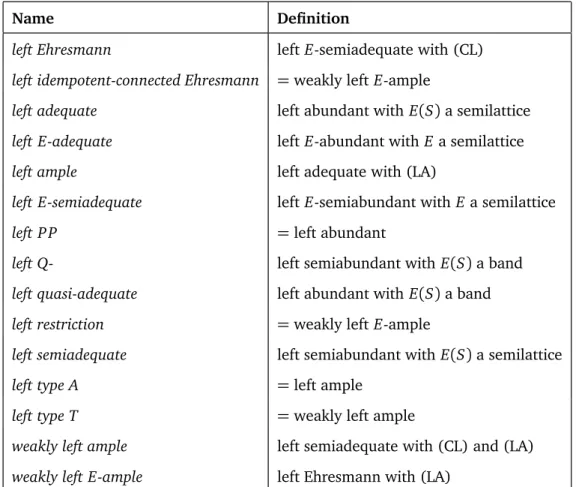
Appendix: Summary of terminology
As we saw in Sections 1 and 2, when approached from the point of view of S-acts, the terminology associated with the class of semigroups which we are now calling ‘left restriction semigroups’ has had a somewhat torturous history, with a number of changes along the way. Unfortunately, if one is to study the earlier papers on this subject, then one must be familiar with all of the former names of these semigroups. We therefore provide a short summary of the various terms found in this area of study. We will restrict our attention to the left-hand versions of these various classes of semigroups; the right-hand version may be defined dually. LetSbe a semigroup with a distinguished subsetE⊆E(S). We will callS
• left E-semiabundantif every element isReE-related to an idempotent from E, and • left E-abundantif every element isR∗-related to an idempotent from E.
In either case, if E = E(S), then we will omit the ‘E’. These terms will serve as our basic terminology: everything else will be defined in terms of these. Let (CL) denote the condition that ReE be a left congruence, and (LA) denote the left ample identity: ae = (ae)+a, for
been signified by the inclusion of the word ‘weakly’. The latter convention is the more recent. At the risk of causing further confusion, leftE-semiabundant semigroups, for example, would probably now be called ‘weakly leftE-abundant semigroups’!
As a final comment, we note that Lawson’s Ehresmann semigroups appear only in their two-sided form in[47]but it is easy to see that we can write down one-sided versions also. We have omitted Lawson’s Rees semigroups [46] from Table 1, as they cannot be defined in a single line; suffice it to say that they are a special class of (two-sided) E-semiabundant semigroups.
Name Definition
left Ehresmann leftE-semiadequate with (CL) left idempotent-connected Ehresmann =weakly leftE-ample
left adequate left abundant with E(S)a semilattice left E-adequate leftE-abundant withEa semilattice left ample left adequate with (LA)
left E-semiadequate leftE-semiabundant withEa semilattice left P P =left abundant
left Q- left semiabundant withE(S)a band left quasi-adequate left abundant with E(S)a band left restriction =weakly leftE-ample
left semiadequate left semiabundant withE(S)a semilattice left type A =left ample
left type T =weakly left ample
weakly left ample left semiadequate with (CL) and (LA) weakly left E-ample left Ehresmann with (LA)
ACKNOWLEDGEMENTS. This article was completed at CAUL under FCT post-doctoral re-search grant SFRH/BPD/34698/2007. My thanks are due to Victoria Gould for many useful comments.
References
[1] S. Armstrong. The structure of type A semigroups.Semigroup Forum, 29:319–336, 1984.
[2] A. Batbedat. γ-demi-groupes, demi-modules, produit demi-direct. In Semigroups Proceedings:
Oberwolfach 1979, Lecture Notes in Mathematics 855, pages 1–18. Springer-Verlag, 1981.
[3] A. Batbedat and J. B. Fountain. Connections between left adequate semigroups and γ
-semigroups. Semigroup Forum, 22:59–65, 1981.
[4] A. H. Clifford. Semigroups admitting relative inverses. Ann. Math. (2), 42:1037–1049, 1941.
[5] A. H. Clifford and G. B. Preston. The Algebraic Theory of Semigroups, volume 1 ofMathematical
Surveys, No. 7. American Mathematical Society, Providence, RI, 1961.
[6] J. R. B. Cockett and S. Lack. Restriction categories I: categories of partial maps.Theoret. Comput.
Sci., 270:223–259, 2002.
[7] J. R. B. Cockett and E. Manes. Boolean and classical restriction categories. submitted.
[8] P. M. Cohn. Embeddings in semigroups with one-sided division. J. London Math. Soc., 31:169–
181, 1956.
[9] C. M. de Barros. Sur les catégories ordonnées régulières.Cah. Topol. Géom. Différ. Catég., 11:23–
55, 1969.
[10] M. P. Dorofeeva. Hereditary and semi-hereditary monoids.Semigroup Forum, 4:301–311, 1972.
[11] C. Ehresmann. Gattungen von lokalen Strukturen. Jahresbericht der Deutschen
Mathematiker-Vereinigung, 60:49–77, 1957.
[12] C. Ehresmann. Catégories inductives et pseudogroupes. Annales de l’Institut Fourier, Grenoble,
10:307–336, 1960.
[13] C. Ehresmann.Catégories et Structures. Dunod, Paris, 1965.
[14] C. Ehresmann. Oeuvres complètes et commentèes. In A. C. Ehresmann, editor,Supplements to
Cahiers de Topolgie et Géométrie Différentielle. Amiens, 1980-83.
[15] A. El-Qallali. Structure Theory for Abundant and Related Semigroups. PhD thesis, University of
York, 1980.
[17] A. El-Qallali and J. B. Fountain. Quasi-adequate semigroups. Proc. Roy. Soc. Edinburgh Sect. A,
91:91–99, 1981.
[18] E. H. Feller and R. L. Gantos. Completely injective semigroups. Pacific J. Math., 31:359–366,
1969.
[19] E. H. Feller and R. L. Gantos. Completely injective semigroups with central idempotents.Glasgow
Math. J., 10:16–20, 1969.
[20] E. H. Feller and R. L. Gantos. Completely right injective semigroups that are unions of groups.
Glasgow Math. J., 12:43–49, 1971.
[21] J. Fountain. Completely right injective semigroups.Proc. London Math. Soc. (3), 28:28–44, 1974.
[22] J. Fountain. A class of rightPPmonoids. Quart. J. Math., Oxford (2), 28:285–300, 1977.
[23] J. Fountain. RightPPmonoids with central idempotents.Semigroup Forum, 13:229–237, 1977.
[24] J. Fountain. Adequate semigroups. Proc. Edinburgh Math. Soc. (2), 22:113–125, 1979.
[25] J. Fountain. Abundant semigroups.Proc. London Math. Soc. (3), 44:103–129, 1982.
[26] J. Fountain. Ample and Left Ample Semigroups: Extended Abstract. Categories and Semigroups
Workshop, Calgary, June 2nd 2006.
http://pages.cpsc.ucalgary.ca/∼robin/FMCS/FMCS_06/amplesurvey2.pdf.
[27] G. M. S. Gomes and V. Gould. Proper weakly left ample semigroups.Internat. J. Algebra Comput.,
9:721–739, 1999.
[28] G. M. S. Gomes and V. Gould. Graph expansions of unipotent monoids.Comm. Algebra, 28:447–
463, 2000.
[29] G. M. S. Gomes and V. Gould. Finite proper covers in a class of finite semigroups with commuting
idempotents. Semigroup Forum, 66:433–454, 2003.
[30] V. Gould. (Weakly) leftE-ample semigroups.
http://www-users.york.ac.uk/∼varg1/finitela.ps.
[31] V. Gould. Graph expansions of right cancellative monoids. Internat. J. Algebra Comput., 6:713–
733, 1996.
[32] V. Gould and C. Hollings. Restriction semigroups and inductive constellations. submitted.
[33] W. H. Gustafson. The history of algebras and their representations. InRepresentations of Algebras,
Lecture Notes in Mathematics 944, pages 1–28. Springer, 1982.
[34] T. E. Hall. Orthodox semigroups.Pacific J. Math., 39:677–686, 1971.
[35] C. Hollings.Partial Actions of Semigroups and Monoids. PhD thesis, University of York, 2007.
[37] J. M. Howie. Fundamentals of Semigroup Theory. LMS Monographs No. 12. Clarendon Press,
Oxford, 1995.
[38] J. R. Isbell. Beatific semigroups.J. Alg., 23:228–238, 1972.
[39] M. Jackson and T. Stokes. An invitation toC-semigroups.Semigroup Forum, 62:279–310, 2001.
[40] M. Jackson and T. Stokes. Algebras of partial maps. InProceedings of the Special Interest
Meet-ing on Semigroup Theory and Related Mathematics (Sydney, 2005). Sydney University Press, To
appear.
[41] J. P. Jans.Rings and Homology. Holt, Rinehart and Winston, 1964.
[42] M. Kilp. Commutative monoids all of whose principal ideals are projective. Semigroup Forum,
6:334–339, 1973.
[43] M. V. Lawson. The Structure Theory of Abundant Semigroups. PhD thesis, University of York,
1985.
[44] M. V. Lawson. The structure of type A semigroups. Quart. J. Math., Oxford (2), 37:279–298,
1986.
[45] M. V. Lawson. The geometric theory of inverse semigroups I:E-unitary inverse semigroups. J.
Pure Appl. Alg., 67:151–177, 1990.
[46] M. V. Lawson. Rees matrix semigroups.Proc. Edinburgh Math. Soc., 33:23–37, 1990.
[47] M. V. Lawson. Semigroups and ordered categories I: the reduced case. J. Alg., 141:422–462,
1991.
[48] M. V. Lawson. The geometric theory of inverse semigroups II:E-unitary covers of inverse
semi-groups. J. Pure Appl. Alg., 83:121–139, 1992.
[49] M. V. Lawson. Inverse Semigroups: The Theory of Partial Symmetries. World Scientific, 1998.
[50] E. S. Lyapin.Semigroups. Translations of Mathematical Monographs, Volume 3. American
Math-ematical Society, Providence, R.I., 1963.
[51] E. Manes. Guarded and banded semigroups.Semigroup Forum, 72:94–120, 2006.
[52] D. B. McAlister. Groups, semilattices and inverse semigroups.Trans. Amer. Math. Soc., 192:227–
244, 1974.
[53] D. B. McAlister. Groups, semilattices and inverse semigroups II. Trans. Amer. Math. Soc.,
196:351–370, 1974.
[54] D. B. McAlister. One-to-one partial right translations of a right cancellative semigroup. J. Alg.,
43:231–251, 1976.