7.
Storage and distribution
7.1
Introduction
The following storage and distribution systems are described in the Fact Sheets:
Storage
— concrete-lined earthen reservoir; — reinforced concrete reservoir; — elevated steel reservoir; — ferrocement tank.
Distribution
— public standpost; — domestic connection; — small flow meter.
These lists are not exhaustive, but have been selected as being most relevant to small, community water-supply systems. Of the storage options reviewed, the concrete-lined earthen reservoir is the only system that is suitable for storing raw water, and the O&M of such a system should consider the possibility that a raw water source will be used. A water-lifting method to get the raw water to the storage reservoir may be necessary and this should also be considered in the O&M implications. In many cases, a concrete-lined earthen reservoir can be used instead of open concrete reservoirs.
Flow meters are only discussed in general, and no comparison is made between types and brands, because this is outside the scope of this manual. However, the decision to install flow meters has important operational and organizational implications.
Material selection
The type of material chosen for the pipes and accessories will determine the mainte-nance activities that will be needed. Both polyvinyl chloride (PVCu) and polyethylene (PE) are used in drinking-water networks, but PE is more commonly used for smaller diameter pipes and with lower water pressures. It comes in rolls that are 50 m or 100 m long and is more flexible than PVCu. PVCu comes as pipes 6 m in length and up to 300 mm in diameter (sometimes more). Commonly, more accessories are available for PVCu
than for PE, but PVCu is more easily fractured by poor handling and laying techniques. However, when properly installed, PVCu pipes need hardly any maintenance, except for controlling leaks.
Asbestos cement pipes are made with external diameters from 100 mm to over 1000 mm. They are not suitable for use with high water pressures, but they are relatively cheap. Asbestos cement pipes cannot be installed in aggressive soils, since they are susceptible to corrosion. Because of their rigidity, asbestos cement pipes require careful handling when they are installed, to avoid damaging them.
In areas with high water pressure (above the local standard pressure), pressure-re-ducing valves should be considered to reduce the amount of water lost to leakage. For water pressures greater than 1.25 Mpa (about 127-m head of water) metal pipes should
be used. Metal pipes should also be used if they are to be laid on the surface and exposed to sunlight. The following are some features of metal piping and accessories:
— metal pipelines are generally sensitive to corrosion;
— galvanized-iron pipes are supplied in diameters of up to 4 inches (100 mm nomi-nal bore), and steel pipes are supplied in larger diameters;
— ductile iron pipes are similar to steel pipes, but they are more resistant to corro-sion;
— cast iron has good resistance to corrosion and is used for accessories, such as con-nectors and valves, but it is hard and breaks more easily than ductile iron. Galvanization gives some protection against corrosion, but most metal pipes need to have internal and external protection. Examples of internal protective linings are epoxy resin and cement mortar. Bituminous lining should be avoided because of possible health risks. All internal coatings must be carried out during the manufacturing process, but relinining or replacing the piping should be part of O&M activities. External protective coating is beneficial when pipes are laid in corrosive soil conditions. Examples of materi-als used in external coating include zinc oxide, bitumen paint and polythene sleeving. External coating is usually applied during manufacture, but polythene sleeving can be applied when laying the pipe.
7.2
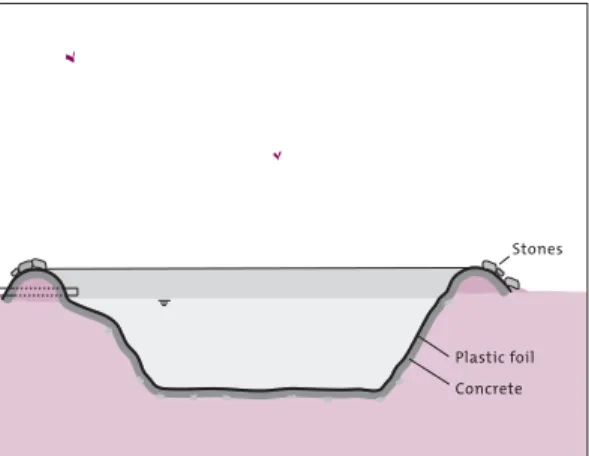
Concrete-lined earthen reservoir
1 7.2.1 The technologyLined earthen reservoirs can be built in natural depressions, or constructed by excavating and building a dam around the reservoir. If possible, the quantities of excavation and refill are kept nearly identical, to minimize the amount of work. The inner and outer walls of such a reservoir are always sloped, and inlets and outlets are installed during the earthwork. The walls and bottom of the reservoir must be compacted, especially the parts made by refilling. The inside of the reservoir is waterproofed by a lin-ing of concrete, which is usually poured on-site in large slabs. The slab size is
lim-ited by the ability of the concrete slab to support its own weight when it is moved into place during construction of the reservoir. Once in place, the slabs are connected by a sealing of waterproof material. More recently, reservoirs have been constructed using a single slab of concrete, using ferrocement technology. Linings can also be made of clay, loam or plastic.
Volume of reservoir: From a few cubic metres to many thousands.
Uses: De-silting and storing raw water.
Figure 7.2 Concrete-lined earthen reservoir
1The IFFIC/AIT has good information on ferrocement and related technologies. Contact FFIC/AIT, P.O.
7.2.2 Main O&M activities
Operation of a reservoir consists of opening and closing the inlet and outlet valves and sluices, according to water need in the system and water quality at the inlet. The valves and sluices should be opened and closed at least every two months to prevent them sticking. At least once a year, the reservoir should be emptied of sediment and cleaned, and the lining inspected and disinfected with chlorine. Cracks or other damage to the lining should be repaired. Usually, the cleaning of a reservoir is a communal activity, which can be organized by a water committee that coordinates all the activities related to the system. An individual living near the reservoir can be assigned the job of caretaker. 7.2.3 Actors and their roles
Actors Roles Skills required
Water user. Assist in major maintenance and repair activities. ☺
Caretaker. Open and close the valves, check the water quality at intake,
keep a logbook of O&M activities.
Water committee. Coordinate activities.
☺ Simple (often requires gender-specific awareness-raising, and training activities to change behaviour and build capacity);
Basic skills.
7.2.4 O&M technical requirements
Activity and frequency Materials and spare parts Tools and equipment
Daily
— check the water quality at intake; — operate the valves and sluices.
Occasionally
— repair the valve; Washer, spare valve. Wrench, spanner, screwdriver.
— repair the lining. Clay, loam, plastic sheeting, cement, Wheelbarrow, spade, hoe, chisel,
sand, gravel, etc. hammer, trowel, bucket, etc.
Annually
— inspect the lining.
7.2.5 Potential problems
— the reservoir may rapidly fill with silt;
— cracks may appear in the reservoir lining, which will need to be repaired;
— in regions with prolonged water shortages, the size of the reservoir needed to meet water demand may be too big to be financed by the community.
7.3
Reinforced concrete reservoir
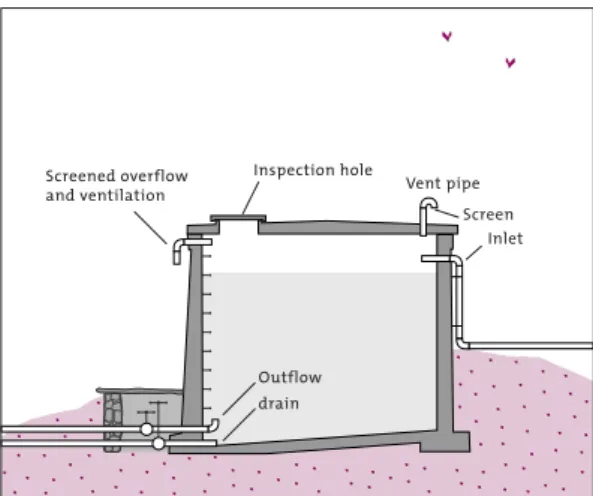
1 7.3.1 The technologyReinforced concrete reservoirs are used to store clean water for release on de-mand. They are usually made of concrete reinforced with steel bars or steel mesh, although some low-cost construction techniques use bamboo or other mate-rials to reinforce the concrete. Reservoirs may also be made of masonry, or ferrocement. Chemical additives are of-ten mixed with the concrete to make it more impermeable to water. Reinforced concrete reservoirs are built at the site on a solid foundation. If the base is not solid enough, another site should be chosen, or arrangements made to stabi-lize the construction.
To protect the water from contamination, the reservoir is covered with a roof, usually made of reinforced concrete, but other materials can be used. In the top of the tank an aeration pipe with a screen allows fresh air to circulate in the tank, but keeps rodents and insects out. A manhole in the roof allows access to the tank for cleaning and repairs. Water flows into the reservoir through an inlet pipe above the water level in the reservoir. This prevents back-flow and allows the water to be heard entering the tank. At this point, a chlorine solution is often added for disinfection. Outlets are built a little above the floor of the reservoir, which has a slope pitched down towards one point with a washout pipe for flushing.
Range of depth: Usually between 1.5–3.0 m.
Expected useful lifetime: 30 years.
Use: For reservoirs larger than about 3 m3 where sand, cement, gravel and reinforcing
materials are available. 7.3.2 Main O&M activities
Operation consists of opening and closing the valves, and managing a chlorinator, if provided. If the reservoir does not deliver directly to a tap, water distribution is usually carried out by a caretaker.
A well-designed and well-built reservoir needs very little maintenance. The surround-ings must be kept clean on a regular basis; every two months the valves must be closed and opened to prevent them from sticking, and the screens must be checked. Occasion-ally, a screen or tap may need to be repaired. Once a year, or sooner if contamination is suspected, the reservoir must be drained, de-silted, cleaned with a brush and disinfected with chlorine. Any leaks or cracks in the concrete have to be repaired as soon as possible. If needed, a caretaker can be appointed to regulate the inflow and outflow. A con-crete reservoir has few other organizational requirements.
Figure 7.3 Reinforced concrete reservoir
7.3.3 Actors and their roles
Actors Roles Skills required
Water user. Assist in reservoir cleaning. ☺
Caretaker. Regulate water inflow and outflow, organize cleaning, and warn
if repairs are needed.
Water committee. Supervise the caretaker, organize repairs.
Mason. Perform repairs.
External support. Check water quality, motivate and guide local organization.
☺ Simple (often requires gender-specific awareness-raising, and training activities to change behaviour and build capacity);
Basic skills. Technical skills. Highly qualified.
7.3.4 O&M technical
Activity and frequency Materials and spare parts Tools and equipment
Regularly
— clean the surrounding area. Broom, machete, hoe, etc.
At least monthly
— open and close the valves. Occasionally
— repair the valve; Washer, spare valve. Wrench, spanner, screwdriver.
— repair the screen; Plastic or copper screen, wire. Pliers, wrench, tin cutter.
— repair the concrete lining. Cement, sand, gravel, additives. Trowel, spade, bucket, wheelbarrow,
ladder, rope. Annually
— clean and disinfect the reservoir. Chlorine. Brush, broom, bucket, ladder.
7.3.5 Potential problems
— cracks and leaks form owing to a poor foundation, design or construction; — exposed metallic components become corroded;
— the water becomes contaminated owing to a poorly-covered manhole or broken screens;
— reinforced concrete is expensive;
— reinforced concrete is also heavy, and the soil beneath the reservoir may settle if the foundation is inadequate.
7.4
Elevated steel reservoir
7.4.1 The technology
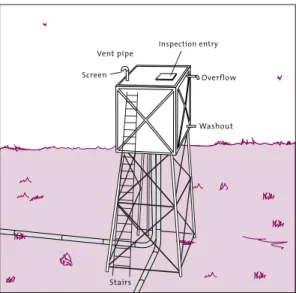
An elevated steel reservoir stores clean water in a steel tank on a raised stand or tower. The elevation of the tank provides the water pressure to all points in the pressure zone of the distribution system. Tanks may be cylindrical, rectangular or any other convenient shape. For family use, the tank can be made of an old oil drum (duly coated), and the tower of bamboo. For communal needs, elevated steel tanks are often constructed from factory-made galvanized steel elements bolted or welded together. However, even with galvanization, steel tanks are generally more sensitive to corrosion than concrete
reser-voirs. On the other hand, steel tanks can be built faster and the cost of transport-ing the material is generally lower, espe-cially when concrete aggregates are not locally produced. Several pipes are con-nected to the tank, including ones for inlet, outlet, overflow and washout, and a screened vent hole or pipe maintains atmospheric pressure in the tank. There is also an entryway in the cover of the reservoir to allow the reservoir to be in-spected. The entryway is normally kept closed with a lid. If an electric pump is used to pump water into the reservoir, the water level in the reservoir can be regulated by sensor electrodes in the tank. Alternatively, a float valve may be used to cut off the inflow when the maxi-mum level has been reached.
The tanks may be placed on steel, wooden or reinforced-concrete towers, and special attention must be given to the foundation structure. Big elevated steel tanks are typically used by major water users, such as agricultural enterprises and communities.
Initial cost: Prices vary considerably between countries and tank quality. In 1991, in Tan-zania, a circular above-ground tank made of galvanized iron cost US$ 125 for a 1 m3 tank
(US$ 125 per m3) and US$ 550 for a 10 m3 tank (US$ 55 per m3) (Mayo, 1991).
7.4.2 Main O&M activities
Operation consists of opening and closing the valves, and managing a chlorinator if one is used. This is usually done by a caretaker who lives nearby.
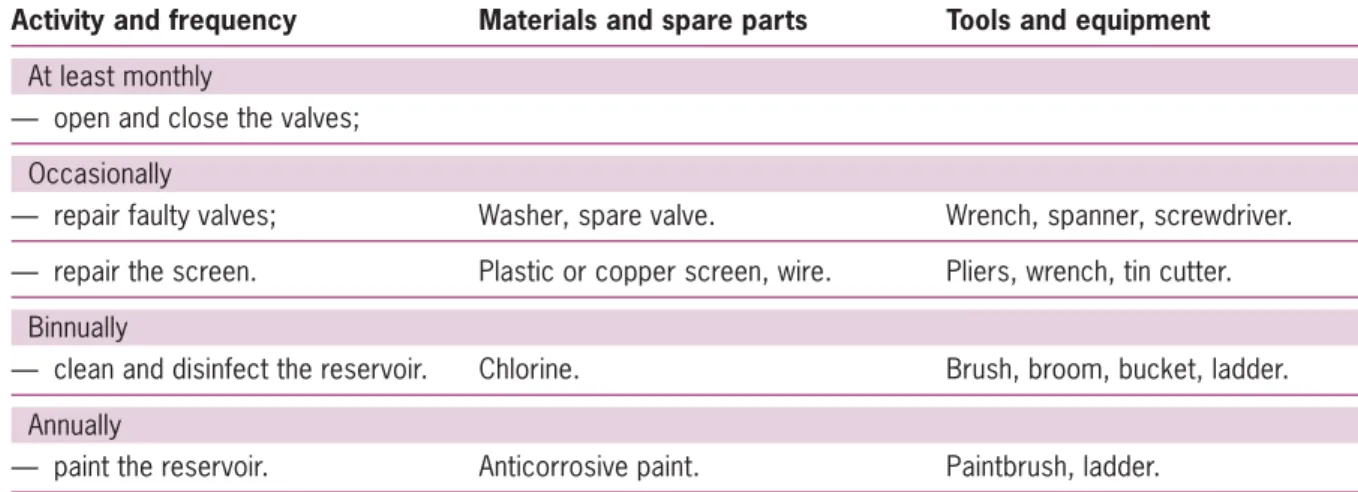
For maintenance, the valves must be opened and closed every two months to prevent them from sticking. Some valves need lubricating. The screens must also be checked, and occasionally a screen or valve may need to be repaired. The inside of the reservoir should be cleaned at least every six months and disinfected using a chlorine solution. The tank and the stand should be painted once a year – epoxy-paint coatings should need little maintenance. Any leaks should be repaired immediately.
7.4.3 Actors and their roles
Actors Roles Skills required
Caretaker. Check controlling devices, organize cleaning, and warn if
repairs are needed.
Water committee. Supervise the caretaker.
Welder. Repair steel parts of the tank.
Plumber. Repair the valves and pipes.
External support. Check the water quality, motivate and guide local organization.
Basic skills. Technical skills. Highly qualified.
7.4.4 O&M technical requirements
Activity and frequency Materials and spare parts Tools and equipment
At least monthly
— open and close the valves; Occasionally
— repair faulty valves; Washer, spare valve. Wrench, spanner, screwdriver.
— repair the screen. Plastic or copper screen, wire. Pliers, wrench, tin cutter.
Binnually
— clean and disinfect the reservoir. Chlorine. Brush, broom, bucket, ladder.
Annually
— paint the reservoir. Anticorrosive paint. Paintbrush, ladder.
7.4.5 Potential problems
— the reservoir may become corroded and leak;
— steel reservoirs normally require cathodic protection;
— steel reservoirs need relatively more maintenance than those made of concrete, ferrocement or even wood.
7.5
Ferrocement tank
1 7.5.1 The technologyFerrocement water tanks are made of steel mesh and wire, covered on the in-side and outin-side with a thin layer of ce-ment-and-sand mortar. The walls may be as thin as 2.5 cm. The tanks can be used for individual households or for whole communities, and they provide a rela-tively inexpensive and easy-to-maintain storage method. To avoid bending forces in the material, most ferrocement tanks have curved walls, in the form of a cylin-der, a globe or an egg. Compared to con-crete reservoirs, ferrocement tanks are relatively light and flexible. To protect the water from contamination, the tank is covered with a lid or a roof that can be made of various materials, but is usually ferrocement. In this case, an aeration
pipe with a screen is needed to allow fresh air to circulate in the tank, while keeping out rodents and insects. A manhole in the roof gives access to the tank for cleaning and repairs. Water flows into the reservoir through an inlet pipe, which is normally above the water level.
Often, a chlorine solution is added to the stored water for disinfection. Outlets are built a little above the floor of the reservoir, which slopes down towards a washout pipe for flushing into a drain. The site is fenced, to keep out cattle that can damage the thin walls of the reservoir.
Figure 7.5 Ferrocement tank
Initial cost: In Kenya in 1993, a 20 m3 tank with a roof cost US$ 420 (US$ 21 per m3;
Cumberlege & Kiongo, 1994). In the South Pacific Islands in 1994, 5.5–12 m3 tanks cost
an average of US$ 50 per m3 (Skoda & Reynolds, 1994). Range of volume: From 1 m3 to over 80 m3.
Range of depth: Usually, between 1.5–3.0 m.
Area of use: Anywhere that inexpensive storage is needed.
Manufacturers: Ferrocement tanks are built on-site by many organizations, craftsmen and building contractors, and can even be factory made.
7.5.2 Main O&M activities
Operation consists of opening and closing the valves, and managing a chlorinator, if provided. A ferrocement tank that is well-designed and well-built needs very little main-tenance. The surroundings, including the drain, must be kept clean on a regular basis; every two months, the valves must be opened and closed to prevent them sticking, and the screens must be checked. Occasionally the fence, a screen or tap may need repair. Every six months, or when contamination is suspected, the reservoir must be drained, de-silted, cleaned with a brush, and disinfected with chlorine. Any leaks have to be re-paired immediately. Repair involves some special techniques using wire and mesh, ce-ment, sand and water, but they are easy to learn.
Ferrocement tanks can be used at the family or communal level. If used by communi-ties, a caretaker can be appointed, preferably someone who lives close to the reservoir. 7.5.3 Actors and their roles
Actors Roles Skills required
Caretaker. Clean the reservoir and its surroundings, open and close taps and valves.
Water committee. Supervise the caretaker, organize repairs.
Mason. Repair the ferrocement.
External support. Check water quality, motivate and guide local organization.
Basic skills. Technical skills. Highly qualified.
7.5.4 O&M technical requirements
Activity and frequency Materials and spare parts Tools and equipment
Regularly
— clean the surroundings. Broom, machete, hoe, etc.
At least monthly
— open and close the valves. Occasionally
— repair the valve; Washer, spare valve. Wrench, spanner, screwdriver.
— repair the screen; Plastic or copper screen, wire. Pliers, wrench, tin cutter.
— repair the ferrocement. Wire, mesh, cement, sand, additives. Chisel, hammer, steel brush, trowel,
spade, bucket, pliers. Biannually
7.5.5 Potential problems
— cracks and leaks appear, owing to poor design and construction;
— the water becomes contaminated, owing to a poorly-fitted cover, unsafe form of water abstraction, or broken screens;
— exposed metallic parts become corroded;
— ferrocement is less suitable for rectangular structures;
— in regions without ferrocement technology, it may take time for the community to accept the different concept of construction – generally, people do not trust the thin walls and think they include too much steel.
7.6
Public standpost
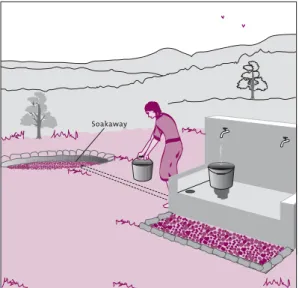
1 7.6.1 The technologyA public standpost or tapstand distrib-utes water from one or more taps to many users. Because it is used by many people it is often not looked after, and the design and construction must be sturdier than used in similar domestic connections. A standpost includes a serv-ice connection to the supplying water pipeline, a supporting column or wall made of wood, brick, dry stone masonry, concrete, etc, and one or more 0.5 inch (1.25 cm) taps that protrude far enough from the column or wall to make it easy to fill the water containers. The taps can be a globe or a self-closing type.
The residual pressure head of the water at the standpost should be 10–30 m, and some standposts have a
regulat-ing valve in the connection to the mains that can be set and locked to limit the maximum flow. A water meter may also be included (see Fact Sheet 7.8 Domestic water meters). A solid stone or concrete apron under the taps, and a drainage system, lead spilled water away and prevent muddy pools from forming. A fence may be needed to keep cattle away. The location and design of a public standpost should be determined in close cooperation with future users.
7.6.2 Main O&M activities
Water users clean and fill their containers at the tap (bathing and washing clothes are not usually permitted at the standpost itself). At all times, pools of water must be pre-vented. The tap site should be cleaned daily and the drain inspected. The drain must be cleaned at least once a month. Occasionally, a rubber washer or other tap part may have to be replaced, and the fence may need to be repaired. If the standpost structure be-comes cracked, it must be repaired, and when wood rots it must be treated or replaced. Occasionally, the piping may leak and need to be replaced. For maintenance of a water meter, see Fact Sheet 7.8 Domestic water meters.
A caretaker or tap committee may be appointed to keep the tap functioning and the surroundings clean, and to regulate the amount of water used. Committee members may
Figure 7.6 Public standpost
also collect the fees for water use. Sometimes, water vendors are allowed to fill their tanks at public standposts at special rates, for resale to people living farther away.
7.6.3 Actors and their roles
Actors Roles Skills required
User. Keep the site clean. ☺
Caretaker or Clean the site, perform small repairs, collect fees.
tap committee.
Communal water Organize major repairs, collect fees.
committee.
Mason Repair the standpost and apron
Plumber Repair the piping and taps
External support Monitor hygiene, train committee members
☺ Simple (often requires gender-specific awareness-raising, and training activities to change behaviour and build capacity);
Basic skills. Technical skills. Highly qualified.
7.6.4 O&M technical requirements
Activity and frequency Materials and spare parts Tools and equipment
Daily
— test the tap; Jar, bucket, can, etc.
— clean the site; Broom or brush.
— inspect and clean the drain. Hoe, spade.
Occasionally
— repair or replace the tap valve; Rubber or leather washer, gland seal, Spanners, screwdriver, pipe wrench.
Teflon tape, flax, spare valve.
— repair the fence; Wood, steel wire, nails. Machete, pliers, hammer.
— repair the tapstand, apron or drain; Wood, nails, cement, sand, water, etc. Hammer, saw, trowel, bucket, etc.
— repair the piping. Pipe nipples, connectors, elbows, oil, Pipe wrench, pipe cutter, saw, file,
Teflon tape, flax or plumbing putty. pipe threader.
7.6.5 Potential problems
— if social problems remain unsolved, or if the standpost is not conveniently located, this can lead to the tapstand not being maintained properly, or even vandalised; — often, the taps are not closed after use, or even left open on purpose to irrigate a
nearby plot, which can lead to water accumulation at the tapstand site; — standposts at the end of a piped system often have insufficient water pressure; — special attention should be given to how water is handled after collection at the
7.7
Domestic connection
1 7.7.1 The technologyWhen enough water and funds are avail-able, the best option is to connect every house or yard to a piped water system. This is more convenient for water users, generally increases water use, and im-proves hygiene. A service pipe, usually made of PE or PVCu, leads from the dis-tribution network to the house or yard. The domestic connection can consist of a single tap on a post, or a system of pipes and taps in a house. A gate valve and a water meter are normally installed at the entry to the premises. Drainage must also be provided. The residual head of water (pressure) at household connec-tions should be 10–30 m.
Initial cost: Depends on factors, such as
whether the domestic connection extends into a house, the type of piping material used, whether PE or PVCu pipes are available locally, etc.
Users per connection: Usually, one family.
Yield: Depends on the pressure of the public main, diameter of the household connec-tion, and demand.
7.7.2 Main O&M activities
Taps are used throughout the day. They should not be left open or leak, otherwise mud and pools will form, which must be avoided. The tap and site must be cleaned regularly and the drain inspected. In case of leakage, a rubber washer or other part of the tap may need to be replaced. Any structure on the tap site and drainage system may need to be repaired. Occasionally, the service pipe, fittings and accessories may leak and need to be repaired or replaced. O&M of the domestic connection are carried out by the household itself, or by a community water committee. When water is scarce, or if the pressure is too low in part of the network, the water committee has to motivate users to limit their water use, or create conditions that will induce users to reduce water consumption (e.g. a tariff structure that discourages excessive water use).
7.7.3 Actors and their roles
Actors Roles Skills required
User. Keep the site clean. ☺
Mason. Repair the standpost and apron.
Plumber. Repair the piping and taps.
Water committee. Monitor hygiene habits, train household members.
External support. Check the water quality, train members of the water committee.
☺ Simple (often requires gender-specific awareness-raising, and training activities to change behaviour and build capacity);
Basic skills. Technical skills. Highly qualified.
Figure 7.7 Household connection
7.7.4 O&M technical requirements
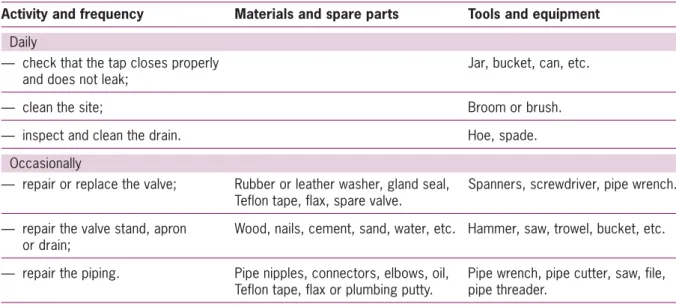
Activity and frequency Materials and spare parts Tools and equipment
Daily
— check that the tap closes properly Jar, bucket, can, etc.
and does not leak;
— clean the site; Broom or brush.
— inspect and clean the drain. Hoe, spade.
Occasionally
— repair or replace the valve; Rubber or leather washer, gland seal, Spanners, screwdriver, pipe wrench.
Teflon tape, flax, spare valve.
— repair the valve stand, apron Wood, nails, cement, sand, water, etc. Hammer, saw, trowel, bucket, etc.
or drain;
— repair the piping. Pipe nipples, connectors, elbows, oil, Pipe wrench, pipe cutter, saw, file,
Teflon tape, flax or plumbing putty. pipe threader.
7.7.5 Potential problems
— leaks may not be repaired and water will be wasted;
— if too much water is lost from the system, or if water becomes scarce, it may be difficult to ensure that everyone has water, which could lead to the inequitable distribution of water;
— initial costs for household connections are higher, and it is complicated to main-tain the distribution network.
7.8
Domestic water meter
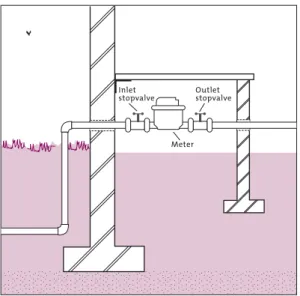
1 7.8.1 The technologyWater meters, in combination with pub-lic standposts or domestic connections, provide the means to charge fees accord-ing to the volume of water delivered, and to regulate water use via tariffs. Water meters consist of a device to measure flow, and a protective housing with an inlet and an outlet. A strainer over the inlet keeps larger particles out of the system. There are many types of water meter, but for ordinary domestic or pub-lic standpipe use, turbine meters are most common. The vane wheel and the counting device of a water meter can be
coupled magnetically or directly. Magnetic coupling has the advantage that the counting device can be completely sealed and no water, silt or algae will get in. A shut-off valve is normally installed on both sides of the meter to allow for servicing.
Initial cost: From US$ 10–25 or more, not including installation costs.
Flow range: 0.005–1.5 litres/s for domestic use.
Area of use: Piped public water distribution systems.
Manufacturers: Biesinger; Bosco; Kent; Schlumberger; Spanner Pollux; Valmet, etc. Figure 7.8 Caption? Water meter
7.8.2 Main O&M activities
On a regular basis (e.g. every month), the water meter should be read by an appointed person who writes down the new meter count in a book. The difference between two readings of the same meter is the amount of water used, and consumers will be billed accordingly. The reader must check that the meter is in good condition and has not been tampered with. Meter counts can also serve to regulate consumption, by raising tariffs as more water is used. The fee for a meter reader increases the operational costs of the system, but the costs may be partly offset because the domestic water meters (and distribution network water meters) help to control leaks and the wasting of water.
When the water is free of silt, a good-quality water meter needs very little mainte-nance; however, a specialized workshop is needed for repairs. It is advisable to clean the strainer at least once a year, depending on the meter and water quality. When the meter no longer functions well, it should be replaced or recalibrated. Water meters lose accu-racy with time, and about every five years a meter should be cleaned and recalibrated regardless of its status (defined according to the nature of the water and the meter type). To recalibrate it, the meter should be sent to a specialized workshop for inspection, repair and calibration.
A water meter is often owned by the water users themselves, who guarantee that it is treated well. Even when the external parts of a water meter belong to a water committee or project, the users may still be responsible for the condition of the parts. A water com-mittee will need to keep a stock of water meters for replacing defective ones. To reduce costs, the number of different models should be kept to a minimum.
7.8.3 O&M requirements
Activity Materials and spare parts Tools and equipment
Monthly
— read the meter; Notebook, pencil.
— check the condition of the meter. Annually
— clean the strainer. Spanners, screwdriver.
Occasionally
— replace the meter; Spare meter, Teflon tape or flax. Spanners, pipe wrench.
— check the accuracy of the meter; Water. Spanners, piper wrench, calibrated
meter, nipples.
— repair the meter and calibrate it. Depends on the model of water meter. Meter workshop with calibration rig.
7.8.4 Potential problems
— the meter may become inaccurate, tampered with, stolen, damaged by cattle, or damaged by grit in the water;
— grit or soft debris may clog the strainer;
— the initial cost and operational costs of a water meter are relatively high; — domestic water meters should not be used with water with a high silt load; — some meter counters are more difficult to read than others, which can be a
prob-lem for both user and meter reader, and may require good skills on the part of the reader.