Maintenance Management Framework
Building Condition Assessment
The suite of Maintenance Management Framework documents is available online (www.hpw.qld.gov.au):
1. the Maintenance Management Framework policy document contains the policy requirements and general information for Queensland Government departments about relevant asset management principles and practices
2. Guidelines complement the policy by giving a more detailed explanation of a subject 3. Policy advice notes discuss emerging policy issues or topical maintenance matters.
Building Condition Assessment
Second EditionQueensland Department of Housing and Public Works Revised October 2012
(First published in June 2004) ISBN 978-0-9804681-7-5 © The State of Queensland
(Department of Housing and Public Works)
Enquiries should be directed to:
The Principal Policy Manager Building Policy Unit
Strategic Asset Management
Department of Housing and Public Works
Telephone 07 322 45482 Fax 07 322 45498 GPO Box 2457 Brisbane Qld 4001
Contents
1.0 Introduction ... 2
1.1 Definitions ...2
1.2 Scope ...2
2.0 Condition assessments... 3
3.0 Other building inspections or audits ... 3
4.0 Condition assessment process... 4
4.1 Scoping of services...5
4.2 Procurement of services...8
4.3 Planning the implementation...8
4.4 Implementation ...9
4.5 Reporting on the condition assessment...12
Appendix 1: Definitions...15
Appendix 2: List of other building inspections or audits...18
Appendix 3: MMF Tables 1, 2 and 3 ...21
Appendix 4: Example schedule of maintenance works in a condition assessment
report ... 24
1.0 Introduction
This guideline forms part of the Maintenance Management Framework (MMF). The MMF is the whole-of-Government policy for managing building maintenance. It was approved by Executive Government on 28 June 1999 and came into effect on 1 July 1999. The second edition of the MMF policy document, incorporating enhancements resulting from a comprehensive whole-of-Government review, was approved on 17 December 2007 and further updated in 2011.
The MMF defines the minimum policy requirements for the maintenance of Queensland Government buildings. One of these requirements is that departments assess the condition of their buildings by site inspection at least every three years. Depending on the nature of the facility, more frequent assessments may be deemed necessary.
The MMF states that “departments should decide on the appropriate interval in terms of criticality to service delivery and complexity of the building asset”. In addition, the MMF specifies the type of information that should result from the condition assessment process. Condition assessments are an important aspect of effective maintenance planning. The
incorporation of condition assessments as part of maintenance processes ensures that there is a structured, objective process for identifying the demand for condition-based maintenance works to meet strategic and operational priorities. Such works should form part of any comprehensive program of maintenance in conjunction with preventative, statutory and reactive (unplanned) maintenance work, over the immediate, medium and long term.
In addition to condition assessment information, departments require a range of other asset management information, which is also obtained through inspections or surveys of buildings. Section 3.0 and Appendix 2 provide further details in relation to other building inspections and audits that can be coordinated with the MMF condition assessment process.
1.1 Definitions
Definitions of the key terms used in this guideline are outlined in Appendix 1.
1.2 Scope
This guideline provides guidance on the process to be adopted for the planning and
implementation of condition assessments. It also defines the scope of condition assessments required by the MMF.
The development of an annual condition-based maintenance works program from condition assessment reports is outside the scope of this guideline.
2.0 Condition
assessments
Condition assessments are technical inspections by competent assessors (refer to Appendix 1 for a definition of competent assessor) to evaluate the physical state of building elements and services and to assess the maintenance needs of the facility.
Reliable and objective knowledge of the physical state of their buildings and the impacts on service delivery will enable departments to develop appropriate strategies and actions for maintenance, major replacements, refurbishments and investment.
A lack of such knowledge could result in:
• unnecessary exposure to legal, social and other risks associated with deteriorated facilities, statutory non-compliance and hazardous materials
• premature asset failures, shorter useful asset lives, higher repair and replacement costs, all of which ultimately affect service delivery capacity and quality.
Condition assessment generally comprises:
• physical inspection of a building to assess the actual condition of the building and its individual elements and services (e.g. air conditioning, fire protection), in comparison to the asset owner’s specified condition standard
• identification of maintenance works required to bring the condition of the building and its services up to, or maintain it at, the specified condition standard 1
• ranking of maintenance works in order of priority
• determination by the assessor of actions to mitigate any immediate risk until remedial works (or other actions) can be taken to address problems.
3.0 Other building inspections and audits
Departments require a broad range of information in addition to that produced by building condition assessments for effective asset management of their buildings. Much of this
information can be obtained through the building inspections and audits explained in Appendix 2.
1 Where condition standards are specified at overall building level, detailed descriptions of what is meant by the S1 to S5 ratings (see Appendix 3, MMF Table 1) should be articulated in terms of condition standards of key building elements most critical to delivery of services. This is because more complex and critical building elements will generally have specific performance requirements and these elements may therefore need to be maintained above the standards required of the overall building.
Given the variety of inspections associated with buildings, appropriate Service Level Agreements (or other suitable instruments) need to be established between departments and their service providers undertaking these inspections and audits (as applicable - some departments use in-house personnel for these tasks). This will ensure that condition assessments (as required by the MMF) are clearly differentiated from other data gathering audits and inspections. Prior to the finalisation of Service Level Agreements (or other suitable instruments), departments need to consider how best to integrate or coordinate such services/activities to ensure that opportunities for efficiency and effectiveness are maximised.
4.0 Condition assessment process
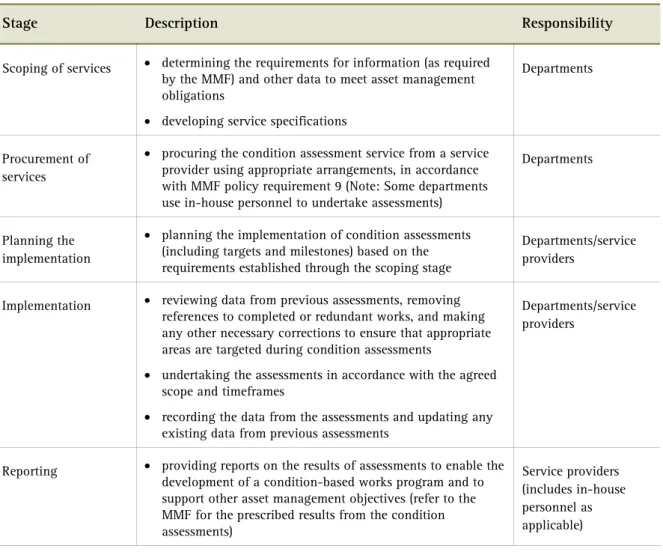
Table 1 explains the five distinct stages of the condition assessment process which will assist departments to establish/refine their existing maintenance planning procedures
Table 1: Stages of the condition assessment process
Stage Description Responsibility
Scoping of services • determining the requirements for information (as required by the MMF) and other data to meet asset management obligations
• developing service specifications
Departments
Procurement of services
• procuring the condition assessment service from a service provider using appropriate arrangements, in accordance with MMF policy requirement 9 (Note: Some departments use in-house personnel to undertake assessments)
Departments
Planning the implementation
• planning the implementation of condition assessments (including targets and milestones) based on the requirements established through the scoping stage
Departments/service providers
Implementation • reviewing data from previous assessments, removing references to completed or redundant works, and making any other necessary corrections to ensure that appropriate areas are targeted during condition assessments
• undertaking the assessments in accordance with the agreed scope and timeframes
• recording the data from the assessments and updating any existing data from previous assessments
Departments/service providers
Reporting • providing reports on the results of assessments to enable the development of a condition-based works program and to support other asset management objectives (refer to the MMF for the prescribed results from the condition assessments)
Service providers (includes in-house personnel as applicable)
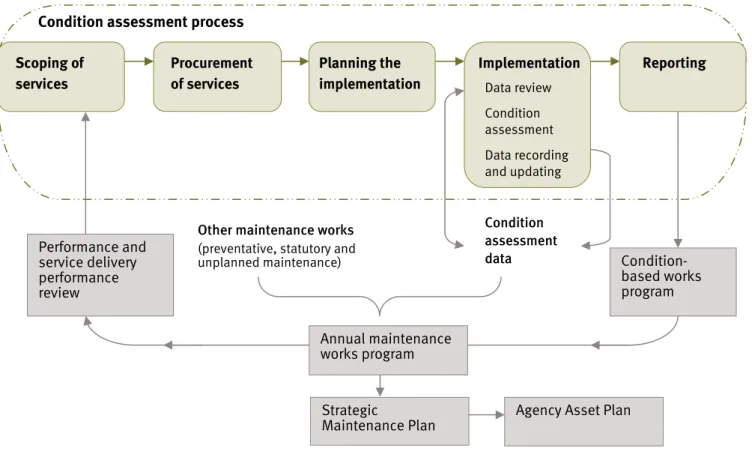
The stages of the condition assessment process are represented in Diagram 1, together with the associated maintenance planning activities.
Diagram 1: Condition assessment process
4.1 Scoping
of
services
During this stage, departments identify and articulate requirements and develop service specifications to provide guidance to service providers on the department’s objectives, expectations and constraints. Departments should ensure that:
• appropriate inputs are used in the scoping process, including the:
departmental maintenance policy (refer to MMF policy requirement 1) Strategic Maintenance Plan (refer to MMF policy requirement 4) desired condition standards2 (refer to MMF policy requirement 2)
• condition assessment and other data requirements (for example asbestos inspection data) are carefully considered and defined so that service providers are able to offer and provide the full scope of services required
2 Guidance for departments on establishing condition standards is provided in the MMF guideline: Building Maintenance Policy, Standards and Strategy Development.
Other maintenance works (preventative, statutory and unplanned maintenance) Condition assessment data Condition-based works program Performance and service delivery performance review Annual maintenance works program
Agency Asset Plan Strategic Maintenance Plan Reporting Scoping of services Procurement of services Planning the implementation Condition assessment process
Implementation Data review Condition assessment Data recording and updating
• the opportunity for efficiency is explored to ensure coordination with other maintenance tasks (including tasks of other departments in the same location or region) or assessment programs/data gathering services, particularly when the services are undertaken in remote locations.
Departments should determine the objective and scope of service(s) required in terms of the following elements:
• outputs required from the assessments: data to meet MMF requirements
data to meet the requirements of other policies, such as the Asbestos Management and Control Policy for Government Buildings and the Strategic Energy Efficiency Policy for Queensland Government Buildings
any other asset management data to be collected • reporting requirements for the results of assessments • buildings to be assessed in the relevant period.
The buildings to be assessed in any particular year are determined by the size of the portfolio, departmental priorities and the frequency of assessments, provided that the 3 year requirement of the MMF is satisfied. Complex and service-critical buildings3 where workplace health and safety and risk issues may be present, may require more frequent and thorough assessments, while other buildings may be inspected less frequently and in less detail.
Buildings which have been impacted by a natural disaster should be fully assessed as soon as practical after the event.
The frequency of assessments is also determined by building elements. Dynamic elements such as electrical and mechanical building services and fire services may require more frequent assessments than more stable elements such as building fabric and structural elements. Such assessments may be undertaken as part of preventative maintenance routines or other tasks and the results integrated into the overall program of condition assessments for other building elements.
Departments should determine the frequency of assessments (subject to the minimum policy requirements of the MMF, which includes this guideline) by considering the following risk factors:
• likelihood of workplace health and safety risks to occupants and residents • nature of the building and its associated engineering services
• criticality and volatility of the assessment information required • age of the building and its essential components
• actual state and rate of deterioration of the building and the associated risks
• operating environment and its impact on the rate of deterioration • cost and value to the department of more frequent assessments.
Where more frequent assessments are undertaken, departments should ensure that, if not during each assessment then at least every three years, their condition assessment processes allow for the identification of maintenance works using the MMF condition assessment priority ranking scale (rankings 1 - 4), which enables identification of longer term maintenance needs.
The frequency of assessments should be determined, where appropriate, with the assistance of suitably qualified or technical persons. This way, the condition assessments can be coordinated with other periodic inspections or monitoring of buildings that may be required such as the inspection of hazardous materials in the building (e.g. asbestos containing material).
The outcome of the scoping stage contributes to service specifications used for any procurement arrangements for the provision of condition assessments, and any other inspections or data collection services which might be undertaken concurrently.
A service specification should: be outcomes focussed, include performance requirements, and enable a service provider to respond with an effective, innovative and value-for-money approach. The service specification may be part of a Service Level Agreement or other suitable instrument which complies with government policy.
Departments should institute appropriate arrangements for service providers to access building asset data and/or any associated information required to enable the service provider to respond to the service specification. The data could be provided as part of the service specification
documentation or made accessible through other means (e.g. through direct electronic access to a database).
The standard of service will generally be measured against the requirements of the service specification. As a minimum, a service specification should detail the following:
• the scope of the condition assessment and any other data gathering tasks
• the frequency and level of detail of the condition assessment (subject to the minimum requirement of the MMF, which includes this guideline) and other assessments
• the outputs and outcomes expected, including the level of detail and format of reports • the desired implementation strategy
).
e in-s possible in the coordination of their programs with other departments
the following: nts to be assessed
phical location, seasonal weather
es (i.e. coordination between departments ble)
nd systems allows for knowledge and patterns to be extracted from past maintenance records.
4.2 Procurement of services
This stage should be based on Service Level Agreements or other instruments which comply with the MMF (as applicable - some departments use in-house personnel to undertake assessments). MMF policy requirement 9 requires departments to enter into appropriate arrangements with the Department of Housing and Public Works or other maintenance service providers in accordance with government policy.
Departments not using the Department of Housing and Public Works can obtain condition assessment services from:
• in-house maintenance personnel (subject to competency requirements being satisfied) or • other service providers4 that meet the criteria for a competent assessor (refer to Appendix
1
4.3
Planning the implementation
This is a key task undertaken by departments/service providers (Note: Some departments us house personnel to undertake assessments). A service provider engaged by more than one department will be expected to coordinate condition assessments with other planned/periodic assessments and across other departments’ condition assessments, where applicable. Department should participate where
to achieve efficiencies.
Planning of condition assessment programs should consider • type of buildings and building eleme
• availability of competent resources
• access to information such as asset data, drawings, technical manuals, and data from previous assessments, including new information from handover and commissioning • accessibility and logistical issues in relation to geogra
conditions and departmental operational constraints
• data collection methods and the use of appropriate technology • opportunities for whole-of-Government efficienci
for the scheduling of activities, where possi • targets and milestones for implementation • achievement of performance requirements.
The local on-site knowledge and cooperation of building occupants and other facility
management staff is a valuable aid to the personnel undertaking condition assessments because it improves the cost effectiveness of the assessments, particularly the data gathering aspects. In addition, appropriate access to the relevant department’s maintenance information a
4 When engaging external service providers, departments should be aware of the provisions of the State Procurement Policy.
Departments are responsible for providing building and other information (e.g. from computerised maintenance management systems) that might impact on the delivery of the condition assessment service and for ensuring that the service provider is able to deliver the service as efficiently and effectively as possible.
4.4 Implementation
The key activities associated with implementation of condition assessments include: • reviewing data from previous condition assessments
• undertaking the condition assessment
• recording and updating condition assessment data.
Departments participate in the implementation stage in a facilitating/monitoring capacity and are responsible for:
• monitoring and reviewing the progress and the performance of the condition assessment program
• monitoring and reviewing performance of the service provider (linked to the performance criteria outlined in the service specification, Service Level Agreement or other suitable instrument)
• liaising and coordinating at regional and local facility level to assist the service provider to undertake the assessments efficiently and effectively
• providing access to facilities, including the provision of security and appropriate escorts where necessary (e.g. for secure or sensitive facilities).
Equivalent arrangements should be established where in-house personnel are used.
Departments need to manage the risks and determine the appropriate course of action to address critical maintenance items/issues brought to their attention by condition assessors and/or as a consequence of natural disasters as soon as possible.
Achieving effective implementation of condition assessments depends on the work management procedures and resources, including the appropriate level of access to maintenance information and systems.
Key success factors in the implementation of condition assessments are explained below. Procedures
• Condition assessments should be professionally managed and delivered using appropriate procedures for work planning, resource allocation, scheduling, coordination and monitoring. Competencies
• Integrity and quality of outcomes from the condition assessments depends, amongst other things, on the ability to match, where possible, the appropriate competency of assessors with the building elements being assessed.
• A competent assessor is a person who has relevant training, qualifications, ability, aptitude, experience and where required by law, the appropriate licence or registration, to undertake a building condition assessment as defined by the MMF.
Supporting information and systems
• Condition assessments can be carried out more efficiently and cost effectively with access to local knowledge. Service providers need a wide range of information from departments, as asset owners, in order to provide a quality service that meets departmental needs. Effective implementation of condition assessments requires access to:
information on the assets to be inspected, including site and building plans, photographs, and engineering drawings of building services
condition and asset performance standards and benchmarks
operations and maintenance manuals, maintenance log books and other technical documentation
maintenance history and records from previous condition assessments capital investment, refurbishment and asset disposal plans
building management plans deferred maintenance data.
• Condition assessments should be implemented based on an appropriate computerised maintenance management system that adequately facilitates planning, implementation and reporting.
4.4.1 Reviewing existing condition assessment data
The review of condition assessment data from previous assessments enables identification and removal of any data related to works made redundant by capital improvements and other programs. Such culling of information ensures that data on deferred maintenance works are not duplicated and can be updated during the next round of assessments in terms of relevance, scope, and priorities.
4.4.2 Undertaking the condition assessment
Undertaking a condition assessment involves evaluating the physical condition of building assets and determining the maintenance works required to bring the condition of the building up to, or maintain it at, the condition standard (see Appendix 3, MMF Table 1) specified by the building owner. Any actions deemed necessary by the assessor to mitigate immediate risks until remedial works (or other actions) can take place, must be communicated promptly to departments. The key criterion for decision-making on any corrective works identified is the comparison of the actual condition of the building against the desired condition standard rating specified by the building owner.
An itemised recommended schedule of maintenance work necessary to bring each building up to the desired condition standard should be developed using the condition assessment priority ranking scale (refer to Appendix 3, MMF Table 3). Priority rankings to be used by the assessor are defined through the assessment of risks associated with defects and potential failures. When preparing a recommended schedule of maintenance work in remote locations, the assessor should identify (where practical) opportunities for integrating and leveraging of works with other departments.
In addition, the assessor should provide an assessed overall condition index for each building (refer to Appendix 3, MMF Table 2) as a means to communicate the general state of buildings to the building owner.
Defects and risks
Defects include the effects of physical deterioration and other factors (refer to Appendix 1 for a more detailed definition of defect) and represent the gap between the desired condition standard and the actual condition. Such defects may have led to the complete or partial failure of the building element in performing its designated function. Potential failures include anticipated failures arising from deterioration of elements/components reaching the end of their foreseeable useful life.
The assessment of risk and priority ranking for the remedial work is subject to the technical knowledge and experience of a competent assessor. Data collected on defects should include appropriate information on the cause of defects in a form that will enable analysis of trends and trigger appropriate action or remedial work. Understanding and addressing the causes of defects is as important as rectifying them in order to avoid a repetition of the problem.
Remedial work generally consists of:
• corrective maintenance to repair and restore physical condition and operational effectiveness
• preventative maintenance to prevent further deterioration leading to failure
• replacements and upgrades to comply with standards and regulations, to avoid future failure (e.g. end of useful life)
• actions to avoid or mitigate the impact of natural disasters
• investigative work where the full extent of defects and their remedial actions cannot be readily assessed on site by the assessor and further expert engineering investigations are required (which could lead to any of the above remedial actions).
Cost estimates of remedial work
The cost estimates for remedial work should be reviewed and updated as part of the condition assessment process to allow for cost escalation and changed circumstances. Care should be taken with this process because at any given time, such estimates may need to be relied upon by departments to formulate their annual maintenance works programs and forecast future liabilities for anticipated replacements or upgrades.
The estimation of costs should be undertaken by competent personnel with adequate estimating skills and knowledge about regional differences in building costs and other factors. For example, cost estimates should include all foreseeable work associated with the remedial work (e.g.
scaffolding, presence of asbestos containing material, removal and reinstatement of furniture, and alternative accommodation for building occupants).
The interpretation of cost estimates will often require access to contextual data. This enables the development of work programs to be viewed in a broader perspective. As such, the cost estimates should be accompanied by:
• an indication of the degree of confidence in the estimate • an allowance for contingency (where appropriate)
• a cash flow forecast that addresses budgetary and maintenance program requirements, including consideration of work that extends over more than one financial year
• appropriate allowance for cost escalation, calculated using the Building Price Index (BPI) available from the Department of Housing and Public Works.
Longer term maintenance needs
Condition assessments should also identify future remedial works in sufficient detail to enable their associated priorities and cost estimates to be developed. Forecasts of future major repairs, replacements, natural disaster mitigation and upgrades are essential for departments to plan future maintenance or capital commitments and make the necessary funding arrangements for work to be undertaken in a timely manner. Such forecasts contribute to effective strategic asset planning. Reliability of forecasts decreases as timeframes are extended. Estimates for future work should be revised after each condition assessment.
Longer term maintenance needs should be reflected in a department’s Strategic Maintenance Plan. For information on developing a Strategic Maintenance Plan, refer to the MMF guideline: Building Maintenance Policy, Standards and Strategy Development.
4.4.3 Recording and updating the condition assessment data
Recording and updating all assessment data in a computerised maintenance management system should occur after condition assessments are completed to ensure that the data can be used for reporting purposes and development of a maintenance works program. The associated process may include re-assessment of previous indicative priorities of recommended maintenance work, aggregation of works, and adjustments of cost estimates (to include escalation, where
appropriate, in line with the BPI - available from the Department of Housing and Public Works).
4.5
Reporting on the condition assessment
The results from the condition assessment should be presented in a report which includes: • the desired condition standard rating for each building as specified by the department (refer
to MMF policy requirement 2)
• a condition index determined by the assessor for each building, which communicates the general state of the department’s buildings
• an itemised schedule of recommended maintenance work necessary to bring each building up to, or maintain it at, the condition standard as nominated by the asset owner (refer to Appendix 4 for an example schedule of maintenance works that would form part of a building condition assessment report)
• cost estimates for the remedial work identified (at a level of detail agreed with individual departments)
• advice about the longer term maintenance needs of the building to assist in planning and decision-making (e.g. any anticipated major replacements or upgrades).
The condition assessment report is the primary output of the condition assessment process and provides the information necessary for the development of a condition-based maintenance program5 within a comprehensive maintenance plan. The report must be analysed by departments in the context of other building data, such as functionality, utilisation rate, remaining life and operational cost efficiency; departmental and government priorities (e.g. environmental sustainability, workplace health and safety commitments and community service obligations), and budget imperatives.
A condition assessment report should enable a department to:
• form an objective view of the relative condition of its buildings compared to the desired condition necessary for service delivery, and to undertake any further analysis to refine that knowledge
• understand the scope, cost and priority of maintenance work required to rectify the defects identified or to maintain the building to the required condition standard
• plan for future funding requirements for major replacements, natural disaster mitigation, repairs and upgrades
• develop a maintenance program for the following financial year and beyond, and a longer term strategic plan by facility and portfolio
• seek and allocate funding for implementation of the maintenance program
• initiate engineering and other investigations, as required, to further define the scope and severity of defects.
At times, the nature or intent of the work (or parts of the work) identified may extend beyond restoring an asset to its original condition, capacity or function. In these cases, the expenditure may be more appropriately classified as a “capital outlay” (i.e. that increases the value of the asset on which the expenditure is incurred) and should be either separately identified, together with a cost estimate, in the report, or further investigations recommended.
5 The condition-based maintenance works program, combined with the anticipated preventative maintenance works, statutory maintenance works and condition assessments, form the total annual maintenance works program. In turn, this will inform the development of a Strategic Maintenance Plan, which should reflect the maintenance needs of a department’s portfolio of buildings over the immediate, medium and long term. The Strategic Maintenance Plan should link to the department’s Asset Plan (refer to the Strategic Asset Management Framework guideline: Asset Planning for Buildings).
Further guidance on determining whether it is more appropriate to classify work as maintenance expenditure or capital expenditure is provided in the MMF policy advice note Capital or
Expense?: A Guide for Asset and Maintenance Managers.
Depending on the specific services commissioned by the department, the condition assessment report may also contain information and other data collected in addition to that required for maintenance purposes.
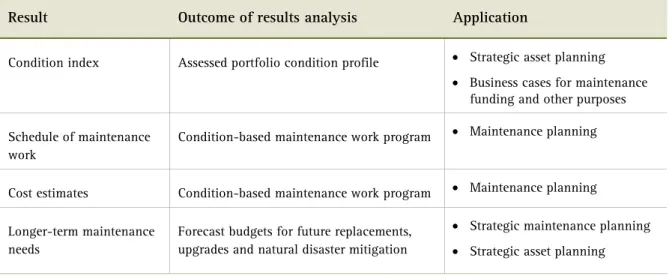
Table 2 summarises the key results from the condition assessment process and their application. Table 2: Building condition assessment results
Result Outcome of results analysis Application
Condition index Assessed portfolio condition profile • Strategic asset planning
• Business cases for maintenance funding and other purposes Schedule of maintenance
work
Condition-based maintenance work program • Maintenance planning
Cost estimates Condition-based maintenance work program • Maintenance planning Longer-term maintenance
needs
Forecast budgets for future replacements, upgrades and natural disaster mitigation
• Strategic maintenance planning
Appendix 1:
Definitions
Building
Refers to all government buildings, including residences, and includes: • building structures, exterior and foundations
• building interiors and finishes
• site improvements around a building (e.g. sculptures, driveways, footpaths, retaining walls, car parks, recreational facilities, fences)
• fire detection and other safety systems
• heating, ventilation and air conditioning systems
• electrical power systems, including emergency power generation facilities • building data and communication facilities
• plumbing and sewerage (above and below ground) • elevators, escalators and people movers
• enclosed/unenclosed walkways and corridors • building management and control systems • access control and surveillance systems • stage and performance-related facilities • built-in artworks and sculptures.
Competent assessor
A person that has the relevant training, qualifications, ability, aptitude, experience and, where required by law, the appropriate licence or registration, to undertake a building condition assessment as defined by the MMF. These must be relevant to the specific building elements being assessed (e.g. electrical and mechanical systems, lifts, hydraulics, building structural elements) or to particular aspects of interest such as asbestos, environmental pollution and workplace health and safety.
There may be instances where more than one assessor will be required to conduct a full
condition assessment of a building. Where assessments are undertaken on facilities with a low complexity of services, it may be possible for a person to be trained/upskilled to competently assess a range of building services, rather than using a number of trade-specific assessors. However, it is expected that this person will have relevant prior knowledge, skills and licenses (where required), or will be registered in at least one building-related trade or profession.
Condition assessment
A technical inspection by a competent assessor to evaluate the physical state of building elements and services and to assess the maintenance needs of the facility. The process may include the following:
• visual inspections and assessment of straightforward building elements
• review of on-site building asset management plans to identify building information relevant to the conduct of condition assessments (e.g. the presence of asbestos containing material on the site)
• gathering information from maintenance records and communicating with maintenance personnel and building users to understand the complexity of the facilities to be assessed and any maintenance issues
• capture of visual images on electronic or other media
• physical measurements of a building, building elements and site elements • inspections by closed circuit television (e.g. of underground services) • taking of non-destructive samples for testing
• review of disaster recovery plans, flood lines etc to determine the likely effect of a natural disaster on the building and its services
• infrared scanning for thermal stress (e.g. of electrical services) • recordings of sound level, vibration and other operating parameters
• taking location coordinates using a satellite-based global positioning system • collection or confirmation of asset data
• undertaking load measurements of electrical and other services • indoor air quality measurements
• determining actions to mitigate any immediate risk until remedial works (or other actions) can be taken to address problems.
Defect
Refers to:• the extent of physical deterioration of building elements and services, including the decline in operational effectiveness, aesthetic appearance and general presentation to occupants, residents, visitors and the community, compared to the accepted standards appropriate to the building elements and services
• the presence, deterioration or unintended discharge of materials that present a hazard to building occupants, residents, visitors and the environment
• signs of distress indicating diminished performance (e.g. excessive heat, vibration or noise) or the potential for imminent failure
• breaches of workplace health and safety and other regulatory requirements • illegal or unauthorised construction and installations.
Department
Has the meaning expressed in s8 of the Financial Accountability Act 2009.
Service provider
Refers to:
• an in-house maintenance unit of a department
• a commercial business unit of the Department of Housing and Public Works • a private sector organisation capable of providing building condition assessments.
Appendix 2:
List of other building inspections and audits
The following is a list of other building inspections and audits that can be coordinated with the MMF condition assessment process.
Asbestos surveys
1 Refers to:• asbestos audits undertaken to comprehensively identify the actual location, type, quantity and condition of asbestos containing material in a building facility
• asbestos inspections into the physical state of asbestos containing material (after it has been identified), including the validation and updating of existing asbestos containing material records.
Building asset register data collection
Refers to and includes the review, validation and/or collection of building asset data for the purpose of asset registration in asset management systems or computerised maintenance management systems.
Building reviews
Refers to any of the following:
• building code audits – review of existing building facilities for compliance with the current building code (including the minimum standards under the Building Code of Australia for the provision of mandatory equitable access to buildings for people with disabilities), identification of areas of non-compliance, and development of strategies and
recommendations to either comply with the code or seek exemption
• fire safety audits – review of existing building facilities for compliance with current legislation pertaining to fire safety, identification of areas of non-compliance, and development of strategies and recommendations to comply
• town planning code audits – review of existing building facilities for compliance with current legislation pertaining to planning and development, identification of areas of non-compliance, and development of strategies and recommendations to either comply or seek exemption
• health and amenity audits – review of existing building facilities for compliance with current legislation pertaining to health and amenity, identification of areas of
non-compliance and development of strategies and recommendations to either comply or seek exemption
1 The Asbestos Management and Control Policy for Government Buildings (Queensland Government’s policy for managing asbestos risks in government buildings) provides a framework for identifying, documenting, managing and controlling (including the safe removal of) asbestos containing material in a building.
• functionality audits2 - review of existing building facilities in terms of their suitability for current or future functions. This includes identification of options for refurbishment, redevelopment, or change in usage. Functionality audits can be done for components as well as whole or parts of buildings, sites and campuses
• utilisation audits2– review of existing building facilities to assess the current utilisation levels, identification of areas of non-compliance with performance targets, development of strategies/options and recommendations to address over/under utilisation
• post-occupancy evaluations3 - a range of post-project reviews for measurement against set performance criteria, from small project reviews to comprehensive post-occupancy
evaluations. Recommendations resulting from these reviews can inform and influence future projects, future use of current building facilities, and strategic directions in the delivery of building facilities.
Data collection for life cycle planning
The collection of data to develop a long term funding plan for facilities by identifying all costs and other impacts associated with each phase of the asset’s life cycle.
Energy management audit
A review carried out based upon current energy usage and operational practices, including the development of options for savings based on improved consumption practices and operational, maintenance and systemic changes.
2 The Building Asset Performance Framework (whole-of-Government best practice guideline) specifies a range of performance indicators for assessing building asset performance, such as “functionality”, “utilisation rate”, “extent of non-compliance”. The results of audits outlined above, where relevant to the purpose of analysis, should provide input in the application of building asset performance
management necessary for achieving the effective management of buildings.
3 The Capital Works Management Framework (Queensland Government’s key policy for managing risks in the planning and delivery of government building projects) provides further information on post-occupancy evaluations as part of building performance reviews.
Engineering investigations
Refers to:• geotechnical investigations - geotechnical and other survey services to identify potential issues with ongoing management and development of the site
• structural integrity investigations - a review of assets, including testing of structural members for any sign of deterioration, failure or corrosion. Service includes preparation of a report identifying any recommendations for rectification, review or replacement
• electrical/mechanical investigations - specific investigations of electrical or mechanical service installations in relation to operating performance, failure, upgrading/enhancement, additions etc.
Environmental audit
A review of existing building facilities for compliance with current legislation pertaining to environmental protection, identification of areas of non-compliance and development of strategies and recommendations to either comply or seek exemption.
Risk management audit
A review of existing building facilities5 for identification and prioritisation of risk associated with the use of the facilities as well as the facility itself. The review can include the audit of risks to the health and safety of occupants and visitors, the environment and the surrounding community. Recommendations are provided on how to eliminate, mitigate or manage the risks.
Water management audit
A review carried out based upon current water usage and operational practices, including the development of options for savings based on improved consumption practices and operational, maintenance and systemic changes.
Appendix 3:
MMF Tables 1, 2 and 3
MMF Table 1: Condition standardsDepartments should use this table to determine the appropriate standard required at facility level or individual building level.
Functional Purpose Specified Standard Rating
Highly sensitive purpose with critical results (e.g. hospital operating theatre) or high profile public building (e.g. Parliament House).
Building to be in the best possible condition. Only minimal deterioration will be allowed.
S5
Good public presentation and a high quality working environment are necessary (e.g. modern multi-storey CBD building).
Building to be in good condition operationally and aesthetically, benchmarked against industry standards for that class of asset.
S4
Functionally-focused building (e.g. laboratory). Building to be in reasonable condition, fully meeting operational requirements.
S3
Ancillary functions only with no critical operational role (e.g. storage) or building has a limited life.
Building to meet minimum operational requirements only.
S2
Building is no longer operational - it is dormant, pending disposal, demolition, etc.
Building can be allowed to deteriorate, however, must be marginally maintained to meet minimum statutory requirements.
S1
Where standards are specified at overall building level, detailed descriptions of what is meant by the S1 to S5 ratings should be articulated in terms of condition standards of key building
elements most critical to delivery of services. This is because more complex and critical building elements will generally have specific performance requirements and these elements may
therefore need to be maintained above the standards required of the overall building. Such descriptions should be used to establish a common understanding and agreement with condition assessors by focusing on building elements most likely to warrant immediate repair or further assessments. These descriptions can also be used to monitor change in general condition over time.
MMF Table 2: Condition index
This table sets out the ratings to be used by the assessor to represent the general condition of building assets.
Rating Status Definition of rating/condition of building asset
5 Excellent • no defects
• as new condition and appearance
4 Good • minor defects
• superficial wear and tear
• some deterioration to finishes
• major maintenance not required
3 Fair • average condition
• significant defects are evident
• worn finishes require maintenance
• services are functional but need attention
• deferred maintenance work exists
2 Poor • badly deteriorated
• potential structural problems
• inferior appearance
• major defects
• components fail frequently
1 Very poor • building has failed
• not operational
• not viable
• unfit for occupancy or normal use
This table sets out the rankings to be used by the assessor undertaking condition assessments to provide an indication of recommended maintenance work.
MMF Table 3: Condition assessment priority ranking scale
Priority
ranking Definition
1 Works needed to:
• meet maintenance related statutory obligation and due diligence requirements
• ensure the health and safety of building occupants and users
• prevent serious disruption of building activities and/or may incur higher costs if not addressed within 1 year.
2 Works that:
• affect the operational capacity of the building
• are likely to lead to serious deterioration and therefore higher future repair costs if not addressed between 1 to 2 years.
3 Works that:
• have minimal effect on the operational capacity of the building but are desirable to maintain the quality of the workplace
• are likely to require rectification within 3 years.
4 Works that:
• can be safely and economically deferred beyond 3 years and reassessed at a future date. Do not program critical maintenance items which require immediate rectification. These items warrant urgent actioning as unplanned maintenance.
1 2 3 4 5 6 7 8 9 10 11 12 13 14
Building
ID Building Cond.Std. Actual. Cond. Building asset/ element
Defect description Work to rectify
defect Recomm. mth/yr Est.cost ($) Comments on estimates Cause code Category Reference code Priority 04 Teaching
Block C S3 S2 IFAB Ceiling grid near entry is sagging. Students at risk if ceiling falls.
Repair sagged
ceiling to entry area. 2010 $4,800 Needs measure and full estimate
C WH&S B123456 1
Column Legend:
1. Building ID – Building identification code (e.g. WIC number)
2. Building – Building description
3. Condition Standard – MMF condition standard (MMF Table 1) established for the building asset or the key building element
4. Actual Condition – Assessed MMF condition index (MMF Table 2) rating
5. Building asset/element – Building asset or key building element group in which the defect is located (e.g. IFAB = Internal Fabric, ELEC = Electrical, VENT =
Mechanical Ventilation)
6. Defect description – Description of the defect, associated risk and any other additional information to assist the owner to develop work programs
7. Work to rectify defect – Description of the task required to rectify the defect
8. Recomm. mth/yr – Recommended time frame for rectification
9. Est. cost ($) – Estimated cost (inclusive of GST) to rectify the defect, including estimated cost escalation for the recommended year of execution
10. Comments on estimates – Information on the estimated cost, such as the level of confidence, relevant references, date of estimation etc.
11. Cause code – Code to indicate cause of defect (e.g. A=Design fault, B=Overload, C=Age deterioration, D=Hostile environment)
12. Category – Category of the work (e.g. WH&S = Workplace Health and Safety, IAPP = Image and Appearance, BC&S = Building Codes and Standards)
13. Reference code – Service provider’s work reference code (e.g. Work Order Number)
14. Priority – Priority of work as per MMF condition assessment priority ranking scale (1-4) (MMF Table 3). Do not program critical maintenance items that require
immediate rectification! These items warrant urgent action as unplanned maintenance!
Note: The above schedule is a guide only. Departments should choose a format that suits their requirements, however, it should as a minimum include or map to items 3, 4, 6, 7, 8, 9, 10 and 14. Other items may be considered and adapted to suit the operating methods of departments. The full report provided by a service provider would contain other information that complements the schedule above to assist the building owner in using the report for maintenance planning.