O T C d e r i vaT i v e s
a n d p O s T- T r a d i n g i n f r a s T r u C T u r e s
OTC DERIVATIVES
AND POST-TR ADING
INFR ASTRUCTURES
S E P T E M B E R 2 0 0 9
In 2009 all ECB publications feature a motif taken from the €200 banknote.
© European Central Bank 2009 Address Kaiserstrasse 29 60311 Frankfurt am Main Germany Postal address Postfach 16 03 19 60066 Frankfurt am Main Germany Telephone +49 69 1344 0 Website http://www.ecb.europa.eu Fax +49 69 1344 6000
All rights reserved. Reproduction for educational and non-commercial purposes is permitted provided that the source is acknowledged.
C O N T E N T S
ABBREVIATIONS 4
EXECUTIVE SUMMARY 5
1 INTRODUCTION 7
2 GENERAL MARKET CHARACTERISTICS 7
2.1 General product types
and features 7
2.2 Market participants 11
2.3 Systemic relevance 12
3 SIZE AND LOCATION OF THE MARKET 13
3.1 Overall size and development 13 3.2 Share of euro-denominated
transactions 16
3.3 Share of transactions involving at least one EU counterparty 18
4 POST-TRADING INFRASTRUCTURES
AND MARKET ARRANGEMENTS 19
4.1 Pre-clearing and life-cycle
management 19
4.2 Clearing 22
4.3 Settlement 24
5 POLICY IMPLICATIONS 27
ATS automated trading system(s)
BIS Bank for International Settlements
CCP central counterparty
CDO collateralised debt obligation
CDS credit default swap(s)
CSD central securities depository
CPSS Committee on Payment and Settlement Systems
FpML Financial products Markup Language
FSF Financial Stability Forum
GC general collateral
ICMA International Capital Market Association
ICSD international central securities depository
IOSCO International Organisation of Securities Commissions ISDA International Swaps and Derivatives Association
IRS interest rate swap(s)
OTC over the counter
PPS Protected Payments System
repo repurchase agreement
SC special collateral
SWIFT Society for Worldwide Interbank Financial Telecommunications
TARGET2 Trans-European Automated Real-time Gross settlement Express Transfer system
TIW Trade Information Warehouse
A N D P O S T - T R A D I N G I N F R A S T R U C T U R E S EXECUTIVE SUMMARY
Concerns regarding the limited development of post-trading infrastructures for OTC derivatives intensifi ed in the context of the recent fi nancial market turmoil. The fi nancial market turbulence illustrated that the absence of adequate post-trading infrastructures contributes to weaknesses in operational and counterparty risk management, as well as to a lack of transparency and oversight in OTC derivatives markets, with negative implications for overall fi nancial market functioning and fi nancial stability. Against this background, in 2008 the Eurosystem launched an analysis of the markets and market infrastructures for OTC derivatives, including interest rate swaps, equity derivatives, credit default swaps and foreign exchange derivatives, focusing on the euro-denominated segment and corresponding systemic risk implications for the euro area.1 In addition, the Eurosystem also
assessed the markets and infrastructures for repos, given their systemic relevance for the euro area, and the fact that some repos are intertwined with derivatives transactions.2
This report presents the main fi ndings of this work, relating to (i) general market characteristics, (ii) the size and location of the market, (iii) post-trading infrastructures and market arrangements, and (iv) possible policy implications.
The report discusses the different product characteristics, the main market participants and the corresponding systemic risk implications. It highlights the fact that OTC derivatives are of systemic relevance particularly because of the large risk exposures of a small number of major fi nancial institutions. In addition, the inherent opacity of OTC derivatives markets and the limited development of post-trading infrastructures hamper effective risk management and market discipline. As a result, major initiatives are currently under way to improve the safety, effi ciency and resilience of OTC derivatives markets.
The size of the OTC derivatives market has signifi cantly increased during the past decade. While the implied payment fl ows vary depending on the particular product specifi cation, and in general represent a small fraction of the market, they are still substantial. Moreover, although market volumes have recently declined, namely as a result of portfolio compression efforts, this has not been the case for the payment fl ows at risk, which have actually increased. The euro-denominated share of OTC derivatives markets is very substantial, with the euro being either the most important or the second most important currency in all fi ve markets under consideration. Furthermore, while only limited information on geographical counterparty breakdowns is available, the existing evidence suggests that euro area counterparties play an important role in the business.
Although the majority of transactions in the OTC derivatives market are still traded, cleared and settled bilaterally, a number of clearing and settlement infrastructures do exist for most of the markets under consideration. However, the availability of euro area infrastructures for OTC derivatives is still limited. A major euro area clearing infrastructure is the German-based Eurex Clearing AG, which serves OTC equity derivatives as well as certain types of repo transaction. For OTC foreign exchange derivatives settlement, CLS is the main infrastructure (with a 53% market share); however, about 35% of OTC foreign exchange transactions are still cleared and settled through correspondent banking arrangements. In addition, Eurex Clearing has recently established a CCP for CDS and another euro area CCP for
The analysis was conducted by a task force (see also the Annex) 1
composed of Alexander Al-Haschimi and Corinna Freund (European Central Bank), Steven Van Cauwenberge (Nationale Bank van België/Banque Nationale de Belgique), Roland Neuschwander (Deutsche Bundesbank), J. Ignacio Becerril Sánchez (Banco de España), Anne-Laure Roche (Banque de France), Barbara Lupi (Banca d’Italia) and Lars Groenhuijse (De Nederlandsche Bank).
For example, a repo can be used to obtain a security temporarily 2
CDS is currently under development by the French clearing house LCH.Clearnet SA.
The report points to two main policy implications. First, given the importance of adequate post-trading infrastructures for the safe, effi cient and transparent functioning of OTC derivatives markets and the particular systemic relevance of these markets for the euro area, there is a strong Eurosystem interest in further developing these infrastructures, especially in the euro area. At the present juncture, a key priority in this regard is the effective implementation of CCP for CDS within the euro area. Second, the development of post-trading infrastructures for OTC derivatives markets should be accompanied by enhanced cross-border cooperation among authorities. Such cooperation should aim to achieve a consistent regulatory framework for different infrastructures, a comprehensive analysis of the risks in this systemically relevant industry, and adequate oversight arrangements in line with the systemic implications of OTC post-trading infrastructures and related service providers for different jurisdictions and currencies.
A N D P O S T - T R A D I N G I N F R A S T R U C T U R E S 1 INTRODUCTION
There are growing concerns that the development of post-trading infrastructures for OTC derivatives has not kept pace with the rapid growth of OTC derivatives markets during the past decade. Clearing and settlement arrangements in these markets are still organised on a predominantly bilateral, non-standardised basis and continue to require a considerable degree of manual intervention. Post-trading infrastructures for OTC derivatives have therefore struggled to cope with the growing volume and complexity of OTC derivatives trades in recent years. The heightened market activity and volatility during the fi nancial market turbulence presented additional challenges. Furthermore, the financial market turmoil illustrated that the limited development of OTC derivatives market infrastructures not only implies operational ineffi ciencies and risks, but also hampers effective counterparty risk management and market transparency. Owing to a lack of information about where risks related to OTC derivatives arise and are distributed throughout the fi nancial system, the large size of OTC derivatives markets and their close linkages with cash markets, OTC derivatives markets seem to have acted as a contagion channel during the fi nancial market turbulence. Against this background, measures to strengthen post-trading infrastructures for OTC derivatives and the respective oversight arrangements have gained momentum during the past year, in line with the mandate of the Financial Stability Forum.3
From a Eurosystem perspective, the availability of adequate post-trading infrastructures for the euro-denominated segment of OTC derivatives markets is a particular priority. Given the large size of OTC derivatives markets and the systemic importance of clearing and settlement systems for securities and derivatives, any malfunctioning of the post-trading infrastructures for euro-denominated OTC derivatives trades could have negative repercussions for fi nancial stability and market infrastructures in the euro area, with direct implications for the Eurosystem’s
responsibilities for monetary policy, fi nancial stability and market infrastructure oversight. Against this background, in 2008 the Eurosystem launched an analysis of the markets and market infrastructures for OTC derivatives, including interest rate swaps, equity derivatives, credit default swaps and foreign exchange derivatives, focusing on the euro-denominated segment. In addition, the Eurosystem also assessed the repo markets and infrastructures, given the close linkages between repo and derivatives markets. This report presents the main fi ndings of the analysis. Section 2 describes the general characteristics of the markets for the fi ve products under consideration. Section 3 provides an overview of the size and location of these markets, while Section 4 examines the associated post-trading infrastructures. Section 5 discusses possible policy implications.
2 GENERAL MARKET CHARACTERISTICS
2.1 GENERAL PRODUCT TYPES AND FEATURES Derivatives are fi nancial contracts which are fulfi lled at a future point in time and whose value is based on the development of an underlying asset price, rate, index or event. The term “derivative” refers to the fact that the price of the contract is derived from the price of the underlying product. Derivatives contracts are typically customised to meet the specifi c needs of the counterparties involved. As a consequence, derivatives are largely traded over the counter (OTC), with OTC markets taking a variety of forms. Traditionally, the market involves dealers as market-makers, who maintain bid and offer quotes and negotiate execution prices, usually over the phone or via an electronic bulletin board. These dealer markets represent bilateral trading because only the counterparties involved in the trade observe the prices at the time of trade execution. The electronic brokering market constitutes an alternative OTC derivatives See “Report of the Financial Stability Forum on Enhancing 3
Market and Institutional Resilience”, 7 April 2008, available at: http://www.fsforum.org/publications/r_0804.pdf
market. While the electronic brokering market operates similarly to the electronic trading platforms used by exchanges, it has a non-public nature and is characterised by a lower level of contract standardisation, as the contract terms are set not by trading platforms but by the counterparties. Moreover, unlike regulated markets, the brokering market does not provide for the clearing of the derivatives transactions. The following sub-sections consider the fi ve products under consideration in more detail. INTEREST RATE SWAPS (IRS)
An interest rate swap is an agreement between two counterparties to exchange two streams of interest payments denominated in the same currency. The payment fl ows are calculated based on the relevant interest rate multiplied by the principal, or notional, amount agreed in the contract. The most common interest rate swaps are fi xed-for-fl oating swaps under which cash fl ows of a fi xed rate loan are exchanged for those of a fl oating rate loan. These are called “vanilla” interest rate swaps. Among these, the most common use a three-month or six-month EURIBOR rate (if the currency is the euro) as their fl oating rate. As they are OTC instruments, a wide variety of interest rate swaps exist, which can be structured to meet the specifi c needs of the counterparties. For example, there is also a liquid market for fl oating-fl oating interest rate swaps, which are known as basis swaps. IRS maturities range from overnight to 30 years. In the euro market, IRS with a maturity of up to three months are referenced against the EONIA as the reference fl oating rate.
OTC EQUITY DERIVATIVES
An OTC equity derivative is an instrument with underlying assets based on equity securities or equity indices. The most common are equity options, which account for approximately 75% of the global OTC equity derivatives market. An equity option offers the right but not the obligation to buy or sell a specifi c equity, or basket of equities, at an agreed price and an agreed time in the future.
Contracts with maturities of one year or less account for 45% of all option contracts, whereas medium-term maturities (one to fi ve years) have a 44% share and longer-term maturities (more than fi ve years) have an 11% share.4
The other major types of equity derivative comprise equity forwards, which represent a contract to buy or sell an equity, or group of equities, at an agreed price at a future date, and equity swaps, which involve the exchange of one equity or equity index return for another. Equity forwards and equity swaps make up approximately 25% of the global OTC equity derivatives market.
CREDIT DEFAULT SWAPS (CDS)
A credit default swap is a credit derivatives contract in which one party (the protection buyer) pays a periodic fee to another party (the protection seller) in return for compensation for default (or a similar credit event) by a reference entity, which itself is not party to the credit default swap.5 According
to the 2003 credit derivatives defi nitions of the International Swaps and Derivatives Association (ISDA), the main types of possible credit event include bankruptcy;6 obligation default;7 failure to
pay;8 repudiation/moratorium 9 and restructuring.10 “OTC derivatives market activity in the second half of 2008”, 4
BIS, May 2009.
See the ISDA product defi nitions at
5 www.isda.org.
The reference entity becomes insolvent or is unable to pay its debts. 6
It should be noted that “bankruptcy” is defi ned in a wide sense so as to be triggered by a variety of events associated with bankruptcy or insolvency proceedings under English law and New York law, as well as analogous events under other insolvency laws.
A situation, other than a failure to pay, where the relevant obligation 7
becomes capable of being declared due and payable as a result of a default by the reference entity before the time when such obligation would otherwise have been capable of being so declared. A sub-set of obligation default is obligation acceleration.
The failure of the reference entity to meet, when and where due, 8
any payments under one or more obligations.
A situation where the reference entity or a government authority 9
disaffi rms, disclaims or otherwise challenges the validity of the relevant obligations.
Events as a result of which the terms, as agreed by the reference 10
entity or government authority and the holders of the relevant obligation, governing the relevant obligation have become less favourable to the holders than they would otherwise have been. Such events include, for example, a reduction in the principal amount or interest payable under the obligation, a postponement of payment, a change in ranking in priority of payment or any other composition of payment.
A N D P O S T - T R A D I N G I N F R A S T R U C T U R E S It is not necessary for the protection buyer to suffer
an actual loss to be eligible for compensation if a credit event occurs.
There are two main types of CDS, single-name
and multi-name instruments. Whereas the former are set up with respect to a single reference entity, such as a company or a government, the latter – including trades based on CDS indices and index tranches – relate to a pool of reference names. The main CDS indices are the CDX and iTraxx series, which are compiled, managed and owned by Markit, a fi nancial services information company with a specifi c focus on credit derivatives pricing. The most widely used reference points for global CDS markets are the iTraxx Europe index (comprising the 125 most liquid European investment-grade corporate names) and the DJ CDX IG index (composed of the 125 most liquid North American investment-grade corporate names). CDS index tranches are linked to synthetic collateralised debt obligations (CDOs) based on a CDS index, with each tranche referencing a different segment of the loss distribution of the underlying index.11
A key difference between single-name and multi-name CDS products is the degree of standardisation: whereas the standardisation of CDS index products in particular is already highly advanced, single-name CDS still contain more bespoke elements and are less frequently traded electronically.
CDS were initially developed as a form of insurance against the default of corporate borrowers. The protection buyer gives up the risk of default by the reference entity, and takes on the (lower) risk of simultaneous default by both the protection seller and the reference entity. The protection seller takes on the (higher) risk of default by the reference entity, which is similar to the risk of a direct loan to the reference entity. However, CDS subsequently developed quickly into a much wider tool for managing credit risk. In particular, as markets for both single-name and index CDS markets have become generally more liquid than the underlying bond markets, participants have increasingly used CDS as
a tool to adjust their overall credit exposures more quickly and at lower cost. Moreover, CDS have also been used increasingly for purely
speculative purposes, as they can be bought and sold without any ownership in the entity or obligations underlying the respective CDS contract. In this way, CDS can be used to create synthetic positions with regard to the reference entity for market-making or proprietary trading activities.
As CDS markets have matured in recent years,
progress in standardisation has been achieved, as a result of, for example, ISDA templates, standards in FpML (Financial products Markup Language) and increased use of Markit’s reference entity database. Standardisation has in turn fostered increasing migration towards electronic trading on interdealer platforms. Increased effi ciency of both trading and post-trading processes is one of the benefi ts of electronic trading. Most platforms provide the ability to transfer trade data directly from the e-trading platform to fi rms’ internal data capture systems through upload/download linkages. The acceptance of electronic trading varies by region; European traders have embraced electronic trading platforms more than their US counterparts. Electronic trading is also crucial for smooth and safe post-trading processes, as it provides the basis for the swift and correct capture and further processing of trade details with no (or very limited) manual intervention, ultimately achieving straight-through processing throughout the life cycle of the products. OTC FOREIGN EXCHANGE DERIVATIVES
The main instruments in the OTC foreign exchange derivatives market are outright forward contracts and foreign exchange swap contracts, which together comprise half of the OTC foreign exchange derivatives market. An outright forward transaction represents a single exchange of one currency for another, which is delivered at a pre-agreed future date.
See
11 http://www.markit.com/information/products/category/ indices.html
The exchange rate used in an outright forward transaction is agreed at the outset. Payments are typically not exchanged until the transaction is executed, although dealers may require customers to provide collateral in advance. A foreign exchange swap transaction involves an exchange of one currency for another for a given time period, after which the currencies are returned or re-exchanged. The rate at which the currencies are re-exchanged at the future date is agreed in advance. Thus, a foreign exchange swap transaction allows a party to temporarily move from one currency into another without incurring the exchange rate risk of temporarily holding the second currency.
A third category of foreign exchange derivative includes currency swaps, which are conceptually similar to IRS transacted across two or more currencies. In a currency swap, counterparties exchange equal principal amounts of two currencies at the prevailing exchange rate, and subsequently exchange a stream of interest rate payments in their swapped currencies for a pre-agreed period of time. At the end of this period, the principal amount is re-exchanged at the initial spot exchange rate. Finally, foreign exchange derivatives also comprise foreign exchange options, which give the buyer the right, but not the obligation, to buy (or sell) a specifi ed amount of one currency for another at a pre-agreed price and time.
REPOS
A repo, or “repurchase agreement”, is a type of collateralised loan, where one party posts a security as collateral for a cash loan. A repo transaction thus entails an exchange of collateral for cash, while a reverse repo implies the provision of cash in exchange for securities. While the repo market is not typically considered an OTC derivatives market, there is a relationship between the repo and derivatives markets through arbitrage opportunities between repo rates and rates on derivatives contracts.12
In addition, repos can be used to acquire securities to deliver at the maturity dates of securities futures contracts.
The type of collateral posted for a repo materially affects the associated risk. When non-specifi c government securities are used, the repo is called a general collateral (GC) repo. As the associated risk is considered low, the corresponding interest rate on a GC repo with an overnight maturity is close to the relevant overnight policy rate. More generally, repos that are used to obtain short-term funding have maturities from overnight up to one year. Another type of repo is transacted to obtain a specifi c security temporarily, and these repos are called “special” or “special collateral” (SC) repos. Securities lending and borrowing transactions involve the swap of a specifi c security against other securities or cash. The structure of the securities lending market is still less standardised. Generally, the term of a securities lending transaction is open-ended, although in most cases they are made on a 48-hour recall basis. The volume of repos driven by securities lending was 21.7% of the overall European repo market in June 2008, but this fell sharply to 12.5% by December 2008.13
Repos are used by a variety of actors as a secured means of borrowing or lending securities or funds for a predetermined period of time. Banks and dealers employ repos to cover short positions, to create leverage and to hedge against or speculate on interest rate movements. On the investor side, mutual funds, pension funds, insurance companies and corporate treasurers transact in repos in order to invest surplus cash, to earn returns on their portfolios or to raise cash for investment.
Generally, repo transactions can be carried out via trading platforms or over the counter. The principal automated trading systems (ATS) operating in Europe process approximately 28% of the overall market in repo transactions. Direct bilateral trades account for about 42%. Direct
This is especially relevant for short-term interest rate derivatives 12
such as interest rate futures.
“European repo market survey”, ICMA, February 2009, reporting 13
A N D P O S T - T R A D I N G I N F R A S T R U C T U R E S tri-party repos have a market share of about 9%.
Around 20% of the whole market is made up of voice-brokered repos.14
There are three types of repo maturity: overnight, term and open. While open repos (which have no fi xed maturity) only account for about 6% of the European repo market, overnight repos represent approximately 18% of the market. Term repos usually have a maturity of up to 12 months, with the majority having a maturity of less than one month.
Given the focus on systemic risk, this report does not include repos transacted with central banks for open market operations in its analysis.15
2.2 MARKET PARTICIPANTS
The main participants in OTC derivatives markets are the market-making dealers, which include mainly large commercial and investment banks and securities houses, as well as large customers such as mutual funds, pension funds, hedge funds and insurance companies.
In the IRS market, participants typically enter into an IRS contract with swap dealers, who in turn limit their exposure to interest rate risk by entering into offsetting swaps with other counterparties. Similarly, CDS trading is mainly conducted between major commercial and investment banks, as shown by the counterparty breakdown of CDS markets provided by the BIS. In December 2008, 86.9% of the reported CDS contracts were agreed either between the banks responding to the BIS surveys (59.8% of all contracts) or between those dealers and other commercial and investment banks (27.1% of all contracts). The next important counterparty group was formed by other fi nancial institutions (e.g. large institutional investors, namely mutual funds and pension funds), which accounted for 11% of the trades with the reporting dealers, whereas trades with non-fi nancial end-users (e.g. corporations) and with insurance companies accounted for only 1.2% and 1% respectively.16
It should be noted that insurance companies,
despite their small share in the outstanding market volume, still have an important role in CDS markets, as they are typically large net protection sellers. This has crucial implications for the distribution of fi nancial risk, as was illustrated in the case of the near-default of the American International Group (AIG).17
For OTC foreign exchange derivatives, commercial banks, investment banks and insurance fi rms conduct a large share of the OTC foreign exchange derivatives business in the interdealer market. According to a BIS survey, reporting dealers were counterparties in 39% of all contracts outstanding as at December 2008, while other fi nancial institutions had a share of 43%.18 Non-financial institutions were
counterparties in 18% of all contracts.
The main participants in the repo market are banks, securities fi rms, institutional investors and insurance companies. More generally, repos are typically transacted between market participants that also operate in the uncollateralised money and interbank markets, given that the instruments in both markets provide for cash borrowing or lending functions.
“European repo market survey”, ICMA, February 2009, reporting 14
data from December 2008.
Transactions with central banks are not considered as a source 15
of systemic risk.
“OTC derivatives market activity in the second half of 2008”, 16
BIS, May 2009.
Following heavy losses on its structured credit portfolio, and 17
shortly after the failure of Lehman Brothers, on 17 September AIG was effectively nationalised when the US government took over an equity stake of 79% in the group and provided it with an emergency loan of USD 85 billion. One key factor behind the US government’s decision to save the group was the fact that AIG had been a counterparty to CDSs of over USD 400 billion, and held a large net selling position in this regard. Against this background, many other participants in CDS markets depended on AIG’s ability to meet its CDS commitments. If AIG had collapsed – and had therefore been unable to meet its commitments – institutional investors around the world would have instantly been forced to reappraise the value of the underlying corporate debt obligations, which in turn would have reduced their capital and the value of their debt. It was widely considered that the expected knock-on effects for the already destabilised fi nancial system would have been far-reaching. “OTC derivatives market activity in the second half of 2008”, 18
2.3 SYSTEMIC RELEVANCE
OTC derivatives markets are of systemic relevance in particular because of the
existence of large exposures between a
limited number of large fi nancial institutions.
As described above, most of the activity in the OTC derivatives market takes place between market-making dealers. Given the close web of interdependencies related to OTC derivatives trades between these dealers, disruptions at one major dealer can easily be transmitted to other signifi cant fi nancial institutions, with potential knock-on effects for the fi nancial system more widely.
While the most common reference point for measuring the size of OTC derivatives markets are the notional amounts outstanding, it is not adequate for gauging the actual exposures at risk in this market. For example, the notional amount outstanding of IRS stood at USD 328.1 trillion in December 2008. However, this fi gure only refl ects the principal amount of the contracts, which is then used to calculate the size of the cash fl ows to be exchanged between the counterparties. For example, in a fi xed-for-fl oating swap, the actual payment fl ow is based on the difference between the fi xed interest payments and the fl oating interest payments on the underlying principal amount. The principal amount itself is not exchanged. Similarly, in the case of a CDS, credit protection sellers do not typically pay out the total amount outstanding since that presupposes both default by the reference entity (or all reference entities in the case of an index product) and zero recovery on the underlying debt obligation.
According to the BIS, the gross market value therefore provides a more accurate measure of the scale of fi nancial risk transfer in OTC derivatives markets. The gross market value measures the cost of replacing all existing OTC contracts and was estimated at USD 33.9 trillion at end-2008. However, even gross market values generally overstate the payment fl ows
at risk as they do not take into account legally enforceable bilateral netting agreements or the collateralisation of OTC positions. While it is diffi cult to calculate an exact fi gure that refl ects the actual payment fl ows at risk in the OTC market, the BIS estimates that the gross credit exposure (which takes into account legally enforceable netting agreements but not collateralisation) in the global OTC market stood at approximately USD 5 trillion at end-2008. While this fi gure is signifi cantly smaller than the USD 592 trillion in notional amounts outstanding, the exposures created in the global OTC market are still of a systemically relevant size. Moreover, as explained in the next section, it is also important to note that while notional amounts outstanding have recently decreased, gross market values continue to rise at a rapid pace.
In addition to risks resulting from their sheer magnitude, OTC derivatives markets are also comparatively vulnerable to weaknesses in risk management. For instance, given the private nature and consequent opacity of OTC derivatives markets, it is diffi cult to assess how different institutions are interlinked and where the risk exposures are ultimately held. This may give rise to shortcomings in both operational and credit risk management and can add to fi nancial uncertainty, especially in the context of distressed market conditions, as was demonstrated during the recent market turbulence.
An important additional source of risk in OTC derivatives markets is the fact that the development of post-trading processes has not kept pace with the strong growth of OTC derivatives markets in recent years, as highlighted in the April 2008 report of the Financial Stability Forum (FSF). As the infrastructure for clearing and settling OTC trades is still predominantly bilateral and non-standardised, and continues to require a considerable degree of manual intervention, OTC derivatives markets have struggled to cope with the rising volumes and increasing complexity of derivatives trades. This was
A N D P O S T - T R A D I N G I N F R A S T R U C T U R E S underscored during recent market events, when
processing backlogs resurfaced, hampering the effective management of operational risk and exacerbating concerns about counterparty risk. Similar problems had already caused concern on a number of occasions since the late 1990s and triggered several initiatives to strengthen the OTC infrastructure in recent years, particularly for credit derivatives. While these measures fostered progress towards more automated procedures and an enhanced standardisation and documentation of derivatives contracts, the recent diffi culties clearly demonstrate that more needs to be done in these areas. Other priorities highlighted are the need to enhance counterparty risk management for OTC derivatives, in particular through netting and collateralisation arrangements, as well as to achieve greater market transparency and enhanced public oversight. Several major initiatives in these fi elds are currently under way.19
While the envisaged measures relate in principle to all major OTC derivatives asset classes – interest rate derivatives, foreign exchange derivatives, credit derivatives, equity derivatives and commodity derivatives – an initial area of focus has been measures to enhance the resilience of the CDS markets. These markets have received particular attention since 2008, when the near-collapse of Bear Stearns, the failure of Lehman Brothers and the near-default of AIG, all major CDS counterparties at the time, raised immediate concerns regarding the safety and transparency of these markets. More generally, effective counterparty risk management is a particular priority for CDS in view of their non-linear payout structure, the signifi cance of the related exposures relative to both the total counterparty risk and the capital cushions of the fi nancial institutions involved, and the close link between CDS markets and cash securities markets. The enhanced use of central counterparty clearing for CDS has been identifi ed as a key measure to achieve progress in this fi eld (see also Section 4.2 below).
3 SIZE AND LOCATION OF THE MARKET
3.1 OVERALL SIZE AND DEVELOPMENT
Over the ten years up to June 2008, the OTC derivatives markets experienced exponential growth. As Chart 1 indicates, the global OTC derivatives market grew from USD 72 trillion in 1998 to USD 684 trillion in June 2008, as measured in notional amounts outstanding.20
Moreover, this overall growth trajectory was observed across most of the OTC market segments. Notional amounts outstanding of IRS rose sharply from USD 29 trillion in June 1998 to USD 357 trillion in June 2008, and OTC foreign exchange derivatives followed a similar pattern, peaking at USD 63 trillion in mid-2008. Over the same period, OTC equity derivatives grew nearly eightfold to just over USD 10 trillion. Finally, the CDS market experienced particularly strong growth, rising by 900% in the three years up to end-2007 to USD 58 trillion in notional amounts outstanding, before contracting during 2008.
See, for example, the European Commission’s communication 19
on possible initiatives to enhance the resilience of OTC derivatives markets, published on 3 July 2009, and the US plans for a regulatory reform of OTC derivatives”, which were outlined by the US Treasury on 13 May 2009.
“Semiannual OTC derivatives statistics”, BIS. 20
Chart 1 Global OTC derivatives market
(notional amounts outstanding; USD trillions)
0 100 200 300 400 500 600 700 0 10 20 30 40 50 60 70 1999 1998 200020012002200320042005200620072008 OTC equity derivatives (right axis)
CDS (right axis) IRS (left axis)
global OTC derivatives (left axis)
OTC foreign exchange (right axis)
In contrast to its evolution until mid-2008, the OTC derivatives market declined sharply during the second half of 2008, falling by 13.4% to USD 592 trillion in the sixth months to December 2008. This was the fi rst decline since the BIS started collecting OTC derivatives data in 1998. OTC foreign exchange derivatives declined by 21% to USD 49 trillion in December 2008. Over the same period, OTC equity derivatives fell by 36% to USD 6.5 trillion in notional amounts outstanding. The CDS market, which had already shrunk by 1% in the fi rst half of 2008, declined by an additional 27% in the second half of the year. By end-2008, the CDS markets stood at USD 41.9 trillion; some indicators suggest that this fi gure stabilised in the fi rst half of 2009.21 IRS experienced a less
signifi cant drop, falling by 8% over the second half of 2008 to stand at USD 328 trillion in December 2008.
The dynamics of the repo market followed a similar pattern to the OTC derivatives data surveyed by the BIS. Chart 2 shows the repo market as measured by gross amounts outstanding of USD, GBP and EUR repos. As the chart indicates, the repo market rose steadily to approximately USD 10 trillion in mid-2008 (adjusted for double-counting of repos and reverse repos).22 In the second half of 2008,
however, the repo market declined sharply to about USD 6.7 trillion. This drop is due to steep declines in the US and European repo markets. Over the second half of 2008, the US repo market contracted by 40% to USD 3 trillion, while the European repo market declined by almost 29% to USD 3.2 trillion, which was the steepest contraction observed since the repo
According to the latest estimates of the Depository Trust and 21
Clearing Corporation (DTCC) of May 2009, gross notional amounts outstanding were comparable with the levels observed by DTCC in January 2009.
Specifi cally, this fi gure was calculated by converting the GBP 22
and EUR estimates into USD equivalents and adjusting the sum of the three markets (USD, GBP and EUR repos) for double-counting of repos and reverse repos (dividing the sum by a factor of 2). This adjustment is in line with estimates of double-counting provided by the BIS (see, for example, “BIS Quarterly Review”, December 2008).
Chart 2 Repo markets, amounts outstanding
(billions of national currency units)
PD reverse repos PD repos BHC reverse repos BHC repos United States 1) 0 0 3,000 6,000 9,000 12,000 3,000 6,000 9,000 12,000 2002 2004 2006 2008 reverse repos repos Euro Area 0 2,000 4,000 6,000 8,000 0 2,000 4,000 6,000 8,000 2001 2003 2005 2007 United Kingdom 0 150 300 450 600 750 0 150 300 450 600 750 2001 2003 2005 2007
Sources: Federal Reserve Bank of New York; Bank of England; ICMA, European Repo Market Survey.
A N D P O S T - T R A D I N G I N F R A S T R U C T U R E S survey was launched in 2001.23 The repo market
in the United Kingdom, by contrast, increased slightly over the same time period.
Despite the contraction in the OTC market, however, the payment fl ows at risk in most OTC markets signifi cantly increased in the second half of 2008. This is refl ected in the development of gross market values. While gross market values do not account for legally enforceable bilateral netting agreements or collateralisation of OTC positions, they can indicate the relative change over time in payment fl ows at risk. Chart 3 shows that gross market values for the global OTC market increased by 66.5% to USD 33.9 trillion in the second half of 2008, the fastest rate since such data were fi rst collected in 1998. Within six months, the gross market values for IRS doubled in size, rising from USD 9.3 trillion in June 2008 to USD 18.4 trillion in December of the same year. The gross market value of CDS increased by 78% over the same horizon, while OTC foreign exchange derivatives increased by 73%. Only OTC equity derivatives contracts experienced a slight contraction in terms of gross market values, dropping by 2.8% in the second half of 2008.
The BIS also releases an estimate of gross credit exposure, which represents the aggregate gross market value of all OTC markets, taking into account legally enforceable bilateral netting arrangements. According to this measure, gross credit exposure increased by almost 30% over the second half of 2008, from USD 3.8 trillion in June 2008 to just over USD 5 trillion by the end of that year, further reinforcing the view that payment fl ows at risk increased during that period.
According to the BIS, the unprecedented rise in gross market values over the second half of 2008 can be explained by signifi cant market price movements. More specifi cally, within the IRS category, the largest increase occurred in the US dollar-denominated IRS market, which rose by 201% in the six months to end-December 2008. Signifi cant interest rate movements in the latter half of 2008 contributed to the rise in gross market values in this OTC market segment. For CDS, the increase in default probabilities and associated credit spreads drove up gross market values. It is noteworthy that the rise in gross market values accelerated despite the sharp contraction in market size which occurred over the same time period.
Returning to the reduction in the size of the market for CDS, a major factor behind falling notional volumes were the signifi cant efforts by market participants to close out offsetting contracts. Such terminations, also referred to as portfolio compression, refl ect the strengthened interest of market participants, especially in view of the fi nancial market turbulence, to reduce the size and complexity of their CDS portfolios. Portfolio compression was achieved more easily for the more standardised CDS index products. Accordingly, multi-name CDS, which include CDS indices and CDS index tranches, declined by 33% to USD 16.1 trillion in terms
In this survey, the market size estimate can fl uctuate owing to 23
the changing composition of the sample of reporting institutions. The survey also compared the aggregate returns of a sub-sample of those institutions that had participated in the last three surveys, and by this measure the repo market contracted by 26% during the second half of 2008.
Chart 3 Global OTC derivatives market
(gross market values; USD trillions)
0 5,000 10,000 15,000 20,000 25,000 30,000 35,000 40,000 0 1,000 2,000 3,000 4,000 5,000 6,000 7,000 8,000 1998 2000 2002 2004 2006 2008
OTC equity derivatives (right axis) CDS (right axis)
IRS (left axis)
global OTC derivatives (left axis)
OTC foreign exchange (right axis)
of notional amounts outstanding, while the decrease in single-name CDS products was somewhat less pronounced, with such products falling by 23% to USD 25.7 trillion over the second half of 2008. As Chart 4 illustrates, the impact of the multilateral CDS terminations was very signifi cant. The largest provider of such termination services, TriOptima, cancelled CDS trades amounting to USD 29 trillion during 2008 alone.
Chart 5 provides an additional breakdown of the OTC derivatives market, showing the contribution of each market segment in terms of gross market value. As the chart indicates, IRS represent the largest category, accounting for 49% of the global gross market value. CDS and OTC foreign exchange contracts capture 17% and 12% of the market share respectively. OTC equity-linked contracts are of a smaller magnitude, with a 3% market share.
3.2 SHARE OF EURO-DENOMINATED TRANSACTIONS
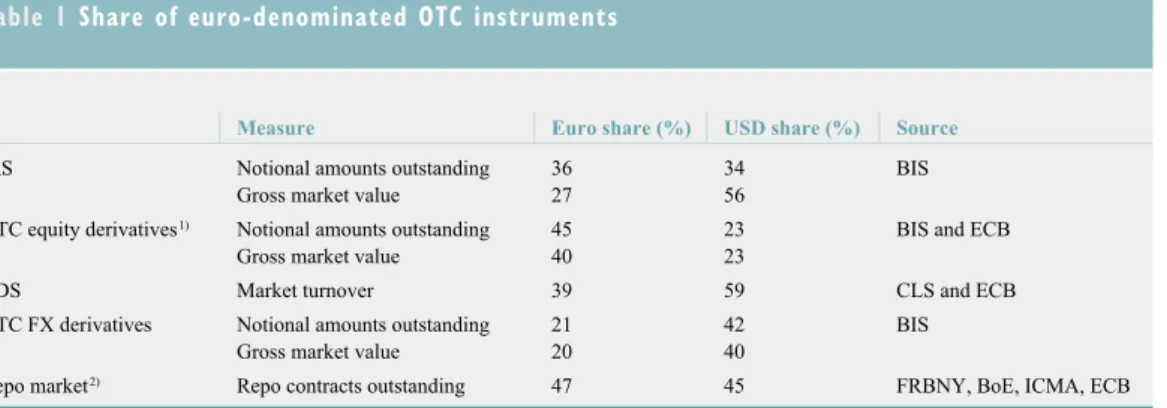
In the fi ve markets under consideration, the euro is either the predominant currency or the second most important currency after the US dollar, depending on the market and measurement used, as shown in Table 1.
INTEREST RATE SWAPS
In the market for IRS, which is by far the largest segment within the global OTC derivatives market, the euro is either the fi rst or second most commonly used currency, depending on the measure used. The BIS reports that, at end-December 2008, of the USD 328.1 trillion IRS market (in terms of notional amounts outstanding), USD 118.6 trillion (36%) was denominated in euro, compared with USD 110.4 trillion (34%) in US dollars, the second largest currency in this market. In terms of gross market value, the euro had the second-largest share, with USD 4.5 trillion (27%), compared with USD 9.3 trillion (56%) for the US dollar. The gross market value shares fl uctuated widely during the second half of 2008 owing to the doubling of the gross market value of US dollar-denominated IRS between June and December 2008.
OTC EQUITY DERIVATIVES
OTC equity derivatives are dominated by contracts on European equities, which account for 62% of all contracts in terms of notional amounts outstanding (USD 4.0 billion out of total contracts of USD 6.5 billion in US dollar
Chart 4 CDS trade terminations by TriOptima
(USD billions) 0 5 10 15 20 0 5 10 15 20 2005 2006 2007 2008 Source: TriOptima.
Chart 5 OTC global derivatives market:
gross market value
(USD billions; Dec 2008)
unallocated commodity contracts equity-linked contracts credit default swaps foreign exchange contracts non-IRS interest rate contracts interest rate swaps (IRS)
3,831 (11%) 955 (3%) 1,113 (3%) 5,652 (17%) 3,917 (12%) 16,573 (49%) 1,847 (5%) Source: BIS.
A N D P O S T - T R A D I N G I N F R A S T R U C T U R E S
equivalent amounts in December 2008). Contracts on US equities account for 23%, while contracts on Japanese equities account for 6% of all contracts.24 Given that the euro area
stock market capitalisation is about 73% of EU equity values,25 it could be assumed that the
euro-denominated share of OTC equity derivatives is also approximately 73% of total European equity derivatives, or 45% of all OTC equity derivatives transactions 26 in terms of
notional amounts outstanding.
The BIS provides data on the gross market values of OTC equity derivatives. By end-December 2008, the gross market values of OTC equity derivatives outstanding worldwide amounted to USD 1.1 trillion, of which USD 607 billion (55%) represented contracts on European equities, compared with USD 254 billion (23%) on US equities and USD 85 billion (8%) on Japanese equities. CREDIT DEFAULT SWAPS
Euro-denominated instruments play a signifi cant role in global CDS markets. In terms of currency breakdown, estimates by the Continuous Linked Settlement (CLS) system of June 2007 and ECB calculations indicate that euro-denominated instruments accounted for approximately 39% of the turnover in credit derivatives markets (of which CDS made up 88%) settled by CLS,
second only to the US dollar-denominated turnover, which accounted for 59%.
OTC FOREIGN EXCHANGE DERIVATIVES
For this market, the BIS reports that the US dollar is the predominant currency, with a 42% share in notional amounts outstanding, followed by the euro (21%), the yen (12%) and the pound sterling (6%) at end-December 2008. The currency shares remain similar when the alternative measure of gross market values is considered.
REPOS
Chart 2 compares the US, UK and euro area repo markets and shows that, by the end of 2008, the US market stood at about USD 3 trillion, compared with USD 3.2 trillion for the euro area and USD 0.54 trillion for the UK repo market (adjusting for double-counting of repos and reverse repos; see also Chart 2 above). 27
With regard to the currency breakdown of repos transacted by counterparties located in the EU,
BIS data on amounts outstanding of OTC equity-linked derivatives 24
by instrument and market, http://www.bis.org/statistics/otcder/ dt13.pdf
World Federation of Exchanges, 2007 data. 25
See footnote 23. 26
The euro-denominated repo data exclude repos transacted with 27
central banks as part of offi cial monetary policy operations.
Table 1 Share of euro-denominated OTC instruments
Measure Euro share (%) USD share (%) Source
IRS Notional amounts outstanding
Gross market value
36 27
34 56
BIS OTC equity derivatives 1) Notional amounts outstanding
Gross market value
45 40
23 23
BIS and ECB
CDS Market turnover 39 59 CLS and ECB
OTC FX derivatives Notional amounts outstanding Gross market value
21 20
42 40
BIS
Repo market 2) Repo contracts outstanding 47 45 FRBNY, BoE, ICMA, ECB
1) The euro share of OTC equity derivatives is based on a very imperfect estimate using the euro area share of EU stock market capitalisation. In general, derivatives contracts on European equities can in principle be written in non-European currencies. In the absence of better data, these are the best available estimates. In a 2001 ECB study on the euro equity markets (“The euro equity markets”, August 2001), the euro share of EU turnover of exchange-traded equity derivatives was 80%, which, while not directly comparable, is similar to our estimates for OTC equity-linked derivatives.
a survey by the International Capital Market Association (ICMA) fi nds that the euro accounts for 71% of this market, followed by the pound sterling (13%) and the US dollar (10%) 28.
3.3 SHARE OF TRANSACTIONS INVOLVING AT LEAST ONE EU COUNTERPARTY
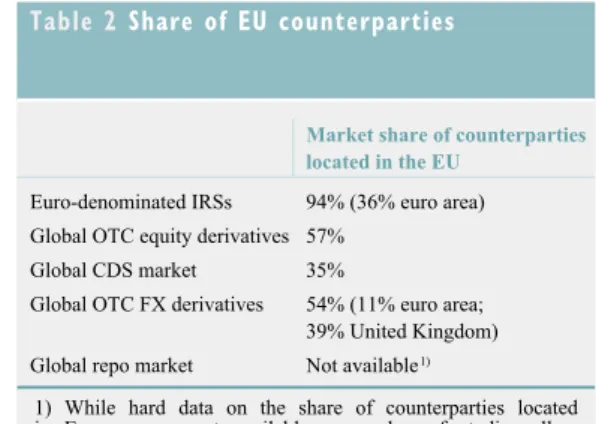
Transactions by counterparties located in the EU represent a sizeable share of the four OTC derivatives markets under consideration (with data on the geographical location of the repo market being unavailable), as summarised in Table 2.
The BIS has published market volume data
on euro-denominated OTC interest rate
derivatives, which comprise not only IRS, but also forward rate agreements and options 29,
for April 2007. During that period, the daily average turnover in these euro-denominated derivatives amounted to USD 858 billion (in USD equivalent amounts) across all countries, the majority of which was conducted by UK counterparties (USD 487 billion, or 57%), followed by counterparties located in France (USD 143 billion, or 17%) and Germany (USD 79 billion, or 9%). The total for counterparties located in a euro area country amounted to USD 308 billion, or 36%. US counterparties had a share of the euro-denominated interest rate derivatives market of only USD 24 billion, or 3% 30. Given that IRS make up 77.2% of
the euro-denominated interest rate derivatives
market in terms of notional amounts outstanding (and 86.3% in terms of gross market value), it is a reasonable approximation to assume that the share of counterparties located in Europe for the interest rate derivatives market (as reported by the BIS) is indicative of the counterparty share for the IRS component of the overall interest rate derivatives market (thus yielding the shares in Table 2 above).
For OTC equity derivatives, the market share of European counterparties amounted to 56.6% as at end-June 2007 31. By comparison, the
share of US counterparties represents only 21.2%, while Japanese counterparties have the third largest share, at 9.1%. Another indicator of the importance of European counterparties in this market is the location of leading dealer banks, which represent a signifi cant proportion of the participants in the OTC equity-linked derivatives market. Based on a 2008 interdealer ranking provided by “Risk” magazine, of the fi ve banks with the highest market share of European OTC single stock equity options, four are European.
With regard to the CDS market, an informal survey of CDS markets carried out by the Eurosystem’s Banking Supervision Committee in June 2007 indicated that contracts in which at least one of the counterparties was domiciled in the EU accounted for 35% of the global CDS market. Similarly, it can be noted that out of the ten major dealer groups which are involved in the calculation of the iTraxx and CDX indices, six are domiciled in Europe.
The OTC foreign exchange derivatives market is primarily located in the United Kingdom. 2007 BIS data show that 54% of the reported OTC foreign exchange derivatives market turnover is transacted with the involvement of at least one EU counterparty, of which 39% are
“European repo market survey”, ICMA, February 2009, reporting 28
data as at December 2008.
Measured over all currencies, more than 70% of these 29
comprise IRSs.
“Triennial Central Bank Survey”, BIS, December 2007, Table E31. 30
“Triennial Central Bank Survey”, BIS, December 2007, Table E40. 31
Table 2 Share of EU counterparties
Market share of counterparties located in the EU
Euro-denominated IRSs 94% (36% euro area) Global OTC equity derivatives 57%
Global CDS market 35%
Global OTC FX derivatives 54% (11% euro area; 39% United Kingdom) Global repo market Not available 1)
1) While hard data on the share of counterparties located in Europe were not available, a number of studies allow the conclusion that the majority of participants in the euro-denominated repo market are located in the euro area. See the main text for further explanations.
A N D P O S T - T R A D I N G I N F R A S T R U C T U R E S located in the United Kingdom. The euro area
share amounts to 11%, compared with 15% for the United States.
Direct data on the geographic breakdown of the global repo market are not available. However, participants in the euro-denominated repo market appear to be primarily located in Europe. In particular, a survey of the European repo market found that there is a high degree of concentration, with the top 20 reporting European institutions accounting for 82% of the European repo market.
4 POST-TRADING INFRASTRUCTURES
AND MARKET ARRANGEMENTS
Following the execution of a trade, a number of post-trading processes are set in motion, which can be divided into three phases: pre-clearing, clearing and settlement. A range of other services support the post-trading processes over the life cycle of a derivatives product, such as collateral management services and portfolio compression, whereby mutually offsetting trades are terminated between two counterparties. 4.1 PRE-CLEARING AND LIFE-CYCLE
MANAGEMENT
The pre-clearing phase mainly involves trade confirmation/matching services and services related to the life-cycle management of trades. Timely confi rmation is essential for the overall effectiveness of the post-trading process. The confi rmation process entails drawing up a confi rmation document that identifi es the details of a trade and any governing legal documentation, as agreed by both parties. This document represents the fi nal record of the transaction. The initial drafts of the confi rmation document are typically exchanged via fax, e-mail or an electronic confi rmation service. Either one party provides trade details and the other verifi es the information (known as trade affi rmation) or both parties submit records of the trade and verify each other’s records (known
as trade matching) 32. Timely confi rmation
services are still not suffi ciently developed (see also Section 2.3 above). By one measure, some 50% of OTC derivatives trades were, at least until very recently, still confi rmed on paper. 33 In the four years to 2005, outstanding
confi rmations of OTC derivatives transactions continued to grow, reaching 30.5 business days for non-vanilla equity derivatives in 2005 (with the exception being credit derivatives, where industry efforts reduced the number of outstanding, unconfi rmed transactions). Delays in confi rmation weaken the enforceability of a trade and hamper the ability of counterparties to net the unconfi rmed transaction against other transactions. In addition, unconfi rmed trades increase the risk that incorrect book-keeping will go undetected for some time, which leads to market or counterparty credit risk (the risk of a counterparty not fulfilling its payment obligations) being measured incorrectly.
In this context, the past few years have seen a number of important industry efforts to automate the confi rmation/matching and life-cycle management processes in order to increase effi ciency and mitigate credit and counterparty risk. The main providers of trade matching and confi rmation services for OTC derivatives are the United States-based DTCC
holding company (through its subsidiary
DTCC Deriv/Serv) and Markit, a United
Kingdom-based data, valuations and trade processing service provider, notably through its subsidiary Markit Wire (formerly SwapsWire). Consolidation in this field is ongoing, as Markit and DTCC announced in July 2008 the formation of a joint venture (to be called MarkitSERV) in September 2009, which will combine the two companies’ electronic trade processing services for OTC derivatives. This joint venture between DTCC and Markit is to be based in London and will serve all major asset classes, including credit, interest rate, equity and commodity derivatives.
New developments in clearing and settlement arrangements for 32
OTC derivatives”, BIS, March 2007.
See Markit press release of 21 July 2008 entitled “DTCC and 33
Portfolio compression has become an increasingly important issue in view of the fact that inflated OTC derivatives portfolios, containing a large number of mutually offsetting trades 34, render effective risk management more
complex. The elimination of offsetting contracts can contribute to reducing risk-weighted assets, related capital charges and counterparty credit risk. A major provider in this fi eld is TriOptima, a Swedish fi nancial technology company which offers portfolio compression services for CDS and IRS through TriReduce. TriReduce provides a tool for the mass multilateral termination of contracts, which is then legallybinding for the counterparties using the service. TriOptima also operates TriResolve, a tool to achieve cross-product portfolio reconciliation among counterparties, with a view to preventing potential disagreements related to collateral management. TriResolve matches the collateral portfolios of the participating counterparties, highlighting any valuation differences. This service also supports commitments made by major dealers and buy-side institutions participating in the Operations Management Group (OMG) to strengthen the operational infrastructures for OTC derivatives. 35
Finally, regarding collateralisation practices, the use of bilateral collateral agreements to cover outstanding positions is becoming increasingly common in the OTC derivatives markets. According to the ISDA Margin Survey 2009, the amount of collateral used for OTC derivatives was estimated at USD 4 trillion as at end-2008. The survey also reports that, by the end of 2008, 65% of OTC derivatives trades were collateralised, and 66% of credit exposures to counterparties arising from OTC derivatives were covered by collateral. While most of the collateral used takes the form of cash, initiatives are under way to facilitate the use of securities as collateral for OTC derivatives trades. For instance, since the end of 2007, Euroclear’s DerivManager has provided trade matching and daily portfolio reconciliations between counterparties to allow them to use securities to collateralise the exposures resulting from
OTC derivatives transactions. The Euroclear exposure management service for OTC derivatives complements the services offered by DTCC.
INTEREST RATE SWAPS
SwapsWire was launched in October 2002 to service the IRS market, providing an automated trade input facility linking dealers, buy-side users, electronic execution platforms and interdealer brokers. SwapsWire is involved in the trade immediately after execution and in certain post-trade events over the trade life cycle. Trades are recorded in SwapsWire right after the trade has been executed. The fi nal trade record is subsequently confi rmed by affi rmation or matching by each counterparty via SwapsWire. As a consequence, close to 100% of interdealer trades are confi rmed on the day of execution. Confi rmation on the buy side tends to be somewhat slower, with more than 70% of trades confi rmed on the trading day, and 90% by the day following the trade execution date. SwapsWire maintains a database of all trades confi rmed in the SwapsWire system. In addition, historical trades can be back-loaded into SwapsWire. As a result, participants can reconcile their database of trades to the SwapsWire records on a periodic basis, in the knowledge that their counterparty is reconciling to the same database of trades. This also facilitates confi rmation and straight-through processing (i.e. full automation) of life-cycle events, such as trade amendments, terminations, allocations, exercises, corporate actions and novations.
Since its launch, SwapsWire has expanded its coverage to 25 currencies and a range of additional product types, including interest rate options, infl ation swaps, CDSs and equity
TriOptima estimates that only 25% of the portfolio actually 34
refl ects the risk of the book, while the other 75% represents offsetting positions.
An update on the status of these commitments is provided in 35
the OMG’s letter of 2 June 2009 to the President of the Federal Reserve Bank of New York, published at: http://www.newyorkfed. org/newsevents/news/markets/2009/ ma090602.html
A N D P O S T - T R A D I N G I N F R A S T R U C T U R E S products. In May 2008, SwapsWire was
acquired by Markit, and was subsequently renamed Markit Wire.
OTC EQUITY DERIVATIVES
OTC equity derivatives are currently served by both Markit Wire and DTCC’s Deriv/SERV. However, as mentioned above, Markit and DTCC plan to form a joint venture (MarkitSERV) which will service OTC interest rate, equity and credit derivatives. The new company will comprise Markit Wire as well as other trade processing services, while DTCC will contribute its Deriv/SERV confirmation and matching service, among others. Services that will not become part of the new company include Markit’s data and valuation services and DTCC’s Trade Information Warehouse and centralised settlement and payment netting services. The joint venture will have its headquarters in London, with a second major centre of operations in New York, as well as representative offi ces in Europe and Asia. 36
CREDIT DEFAULT SWAPS
Since late 2003, DTCC’s Deriv/SERV has provided an automated trade matching and confi rmation service for CDS. The service compares the trade information received by counterparties and reports matches (or mismatches) to them in real time. 37
In November 2006, DTCC complemented its matching and confi rmation service with the establishment of the Trade Information Warehouse (TIW). The TIW provides fi rst and foremost a comprehensive trade database containing the primary record of each CDS contract and is therefore a key source of industry statistics for public authorities and markets alike. According to its own assessment, DTCC’s data warehouse stores all electronically confi rmed CDS trades and about 96% of all global CDS trades 38. In addition, the TIW
provides a central technology infrastructure that automates and standardises trade processing
and life-cycle management, with open access also to other service providers along the CDS post-trading value chain. Key functions provided in this regard include (i) payment calculations for one-time fees and coupons; (ii) multi-currency payment netting and central settlement of payments (provided together with CLS); (iii) centralised processing of credit events and (iv) novation consent, which automates the approval process when one party to a transaction assigns its position to another.
OTC FOREIGN EXCHANGE DERIVATIVES
For the foreign exchange derivatives market, SWIFTNet Accord operated by SWIFT (Society for Worldwide Interbank Financial Telecommunications) is a central matching system for confi rmation. Upon agreement of a trade, SWIFT confi rmation messages are exchanged. SWIFT enters these messages into the Accord matching service, which notifi es the counterparties in real time of matches (or of any mismatches). Accord stores the confi rmations for a week, and participants can choose to save the confi rmation information for up to ten years in SWIFT’s Long Term Archival facility.
See Markit press release of 21 July 2008 entitled “DTCC and 36
Markit to Form Strategic OTC Derivatives Partnership” and DTCC Important Notice #798 of 16 July 2009 entitled “Transfer of Deriv/SERV Confi rmation and Matching Service, the Deriv/ SERV Novation Consent Service, and the MCA Xpress Service to MarkitSERV”.
Both parties to a trade submit trade information to Deriv/SERV 37
either through a direct computer-to-computer link or through a secure web-based application. Once information has been received from both parties, Deriv/SERV automatically compares the trade information and matches (or mismatches) are reported in real time to the counterparties. If the trade details fully match, the trade is considered “confi rmed” and no further action is necessary. If there are fi elds that do not match, the system reports the fi elds that do not match and counterparties are required to submit revised data to resolve the differences. This process continues until all the trade details fully match and the status of the trade becomes confi rmed.
These fi gures were provided by DTCC at a meeting at the 38
European Commission on 20 November 2008. According to a recent estimate by the US Securities and Exchange Commission (SEC), the coverage is only 80% (see “Testimony concerning credit default swaps” by Erik Sirri, Director Division of Trading and Markets, SEC, before the House Committee on Agriculture on 15 October 2008).
For participants such as buy-side clients and corporations which cannot send the SWIFT message type used for derivatives (MT3xx), SWIFTNet Affirmations was introduced in November 2006. This service enables dealers to send trade confi rmations to these clients, who can then simply accept (or reject) the dealer’s confi rmation.
REPOS
Automated post-trading services are offered by the automated trading systems (ATS), which are used for about 28% of repo transactions in Europe. Trading via ATS implies that effi cient post-trading services such as confi rmation and matching are conducted automatically as part of the electronic platform. Moreover, ATS usually offer clearing via a central counterparty (CCP), as discussed in the next section. As such, the increased use of ATS for trading repos would also increase the potential for a greater use of centralised clearing and settlement in the repo market.
A major provider of automated trading services is BrokerTec, which represents a leading electronic interdealer platform for trading repos in Europe. In June 2009, its average outstanding daily volume of European repo products was €214.1 billion. Once repo trades are conducted on this ATS, the trade information is used for post-trading services that connect to participants’ back offi ce systems, resulting in electronic straight-through processing of the trade. Another major ATS in the European repo market is Eurex Repo, with an average daily outstanding volume of €85.3 billion in the fi rst quarter of 2009 for the euro-denominated repo market. Its euro repo market is operated by Eurex Repo GmbH, a subsidiary of Eurex Frankfurt AG. MTS Group also provides trading services for European repos and offers central counterparty clearing by Cassa di Compensazione e Garanzia, LCH. Clearnet SA and LCH.Clearnet Ltd. In January 2006, Tullett Prebon launched a new electronic trading platform for the US repo market. The Tullett Prebon Electronic Broking platform is extending its services to support EU
government bond repos for the United Kingdom, Germany and France.
4.2 CLEARING
While OTC derivatives products are still cleared predominantly through bilateral arrangements, the use of CCPs has increased in recent years. INTEREST RATE SWAPS
SwapClear is a service operated by the London-based clearing house LCH.Clearnet Ltd, and started operating in 1999. Today, SwapClear clears vanilla IRS denominated in USD, EUR, JPY and GBP with maturities of up to 30 years, as well as CHF, AUD, DKK, CAD, HKD, NOK, NZD, SEK, PLN and ZAR IRS with maturities of up to ten years. IRS trades are sent to SwapClear through either Markit Wire or SWIFT, subject to the consent of both counterparties. SwapClear currently has 25 clearing members.
As at December 2006, USD 35.5 trillion in swaps was cleared through SwapClear, representing approximately 40% of the global interdealer market in IRS.39 Given that the
interdealer market itself has approximately a 40% share of the global IRS market, this implies that SwapClear had a global market share in clearing IRS of about 16% at the time.
SwapClear has expanded its business in recent years. In June 2009, the overall size of the SwapClear portfolio was worth USD 178 trillion in terms notional amounts outstanding 40
(both sides of the cleared IRS transactions are counted), up from USD 103 trillion in October 2007 41.
“New developments in clearing and settlement arrangements for 39
OTC derivatives”, BIS, March 2007.
Slide presentation by LCH.Clearnet at a “Meeting on establishing 40
central counterparties for credit default swaps” held at the ECB on 9 July 2009.
Slide presentation by LCH.Clearnet at the joint Bank of England/ 41
ECB conference on payments and monetary and fi nancial stability of 12-13 November 2007, panel session on OTC derivatives clearing arrangements.