Experimental System for Molecular
Communication in Pipe Flow With Magnetic
Nanoparticles
Wayan Wicke, Harald Unterweger, Jens Kirchner, Lukas Brand, Arman
Ahmadzadeh, Doaa Ahmed, Vahid Jamali, Christoph Alexiou, Georg Fischer, and
Robert Schober
Abstract
In the emerging field of molecular communication (MC), testbeds are needed to validate theoretical concepts, motivate applications, and guide further modeling efforts. To this end, this paper presents a flexible and extendable in-vessel MC testbed based on superparamagnetic iron oxide nanoparticles (SPIONs) dispersed in an aqueous suspension as they are also used for drug targeting in biotechnology. The transmitter is realized by an electronic pump for injection of the SPIONs stored in a syringe via a Y-tubing-connector. A second pump generates a background flow for signal propagation in the main tube, e.g., modeling a part of a chemical reactor or a blood vessel. For signal reception, we employ a commercial susceptometer, an electronic device including a coil, through which the magnetic particles move and non-intrusively generate an electrical signal. We identify the physical mechanisms governing transmission, propagation, and reception of SPIONs as signal carriers and propose a simple two-parameter mathematical model for the system’s channel impulse response (CIR). Reliable communication is demonstrated for model-agnostic and model-based detection methods for experiments with 400 random symbols transmitted via on-off keying modulation with a1 ssymbol interval. Moreover, the proposed CIR model is shown to consistently capture the experimentally observed distance-dependent impulse response peak heights and peak decays for transmission distances from5 cm to40 cm.
I. INTRODUCTION
Molecular communication (MC) employs molecules as information carriers necessitating new models and experimental tools compared to conventional electromagnetic wave based
This work was presented in part at IEEE SPAWC 2018 [1].
communication [2]. The growing interest in this research area is due to its revolutionary applications in environments unsuited for electromagnetic waves such as biological environments, e.g., in the human body or within bacterial cultures [3], environments unfavorable due to propagation losses, e.g., liquid-filled pipes, and environments with explosive gases, e.g., fuel pipes [2], [4], [5]. Motivated by these applications, a significant body of theoretical work has been developed, see [6]–[8] for surveys of the current literature. Moreover, for practical demonstration and to gain more insight regarding relevant physical phenomena, several MC testbeds have been proposed, see [7, Section V] for an overview of recent artificial and biological MC testbeds.
These experimental systems can be categorized as either air-based [9]–[11] or liquid-based [12]–[17] depending on the physical communication medium. Air-based systems have been developed for open space transmission [12] as well as for closed air ducts [10], [11], which offer a directed information transfer at the expense of the required infrastructure. Liquid-based experimental MC systems usually require vessels and exist in different size scales ranging from microfluidics [16], [17], to small pipes [12], [14], to larger ducts [13], [15].
In this paper, we study a liquid-based MC system composed of small pipes, i.e., the environment is bounded, flow-driven, and fluid, like in blood vessels. Experimental systems studying such environments have been reported in [12], [14]. The system in [12] is based on either injecting an acid or a base into water and the detection of the medium’s pH level. The system in [14] is similar to the one in [12] in that it is based on in-vessel chemical reactions but it employs optical detection. However, those systems inherently rely on chemical reactions which complicates their analysis (see e.g., [18]) and limits their applicability because many applications require passive signaling to avoid possible interference with biological processes. Moreover, for detection, the system in [12] requires direct access to the liquid and the system in [14] requires an optically transparent tubing.
In this paper, we present a new testbed with the focus on studying flow-driven transport in simple cylindrical tube systems. To this end, it is crucial to select appropriate signaling molecules or particles [19], [20]. These signaling particles should ideally possess the following properties which the information carriers used in [12]–[14] do not have: 1) The particles should be chemically stable for safe and long-term use, i.e., they should not agglomerate and not interact with other components of the testbed, such as the respective medium. 2) A sensitive and non-intrusive detection mechanism is required since, depending on the application, physical access to the tubing may not be feasible or practical. 3) The particles should ideally be tunable
for different application needs, e.g., in their size, and have an established production mechanism for cost-efficiency.
One type of artificial particle that satisfies all of these requirements and is already well-established in biotechnology are biocompatible magnetic nanoparticles [21]. These particles can be tailored to a particular application by engineering of their size, composition, and coating [22]. Moreover, magnetic nanoparticles can be attracted by a magnet and externally visualized [21], which can help detection and supervision. Applications of magnetic nanoparticles include tissue engineering [23], biosensing [24], imaging [25], remotely stimulating cells [26], waste-water treatment [27], and drug delivery [28].
In the context of MC, the use of magnetic nanoparticles as information carriers has been considered in [29]–[32] and [33], where the benefits of attracting them towards a receiver are theoretically evaluated and the design of a wearable device for detecting them is proposed, respectively. However, an experimental MC system with magnetic nanoparticles as information carriers has only been presented in the conference version of this work [1]. Furthermore, for this testbed, the design and characterization of receiver [34]–[36] and transmitter devices [37], [38] has also been investigated.
Similar to [12]–[14], in this paper, we present a testbed for in-vessel MC. Our setup differs in that it uses specifically designed superparamagnetic iron oxide nanoparticles (SPIONs) as information carriers, which are biocompatible, clinically safe, and do not interfere with other chemical processes and thus might be attractive for applications such as monitoring of chemical reactors where particles stored in a reservoir could be released upon an event like the detection of a defect which is then communicated to a central control station for further processing. In the proposed testbed, SPIONs are injected and transported along a propagation tube by fluid flow which is established by a peristaltic pump. The propagation tube runs through the receiver where the magnetic susceptibility of the mixture of water and SPIONs within a section of the tube can be non-intrusively determined. The magnetic susceptibility measured in the tube section is proportional to the concentration of the particles within the section. This proportionality is more amenable to mathematical analysis compared to observing the pH in [3], [12], [18], which non-linearly depends on the underlying proton concentration.
The contributions of this paper can be summarized as follows:
• We present an experimental system for MC based on the flow-driven transport of SPIONs in a tube. All components of the system are described in detail which was not possible in
[1] due to space constraints.
• Extending [1], we provide a physical characterization of the system regarding the relevant effects for particle injection, propagation by flow in the tube, and reception by the suscep-tometer. In MC terms, we motivate the model of a transparent receiver and characterize the pulse shaping by the injection via an initial volume distribution [39].
• Motivated by the physical characterization, we develop a parametric model for the system’s channel impulse response (CIR) providing insight into the flow-driven transport and the receiver’s physical properties. We validate the applicability of our model by fitting its param-eters to measurement data of the CIR showing a good agreement despite the simplifications needed for analytical tractability.
• To demonstrate successful information transmission, we show that reliable detection of on-off keying (OOK) is possible for transmission distances of up to 40 cm and a symbol duration of 1 s. To this end, we propose and evaluate symbol sequence estimation by applying 1) an optimal detection rule assuming a linear pulse-amplitude modulation (PAM) model and 2) a model-agnostic heuristic detection rule based on the signal increases and decreases following symbol intervals with injections and idle times, respectively.
The rest of this paper is organized as follows. In Section II, we explain the testbed and its components as well as physical preliminaries. In Section III, we propose a simple CIR model. In Section IV, we describe the employed signal processing and detection algorithms. In Section V, we present experimental data. Finally, in Section VI we conclude the paper and provide directions for future work.
II. MAGNETICNANOPARTICLE-BASEDTESTBED
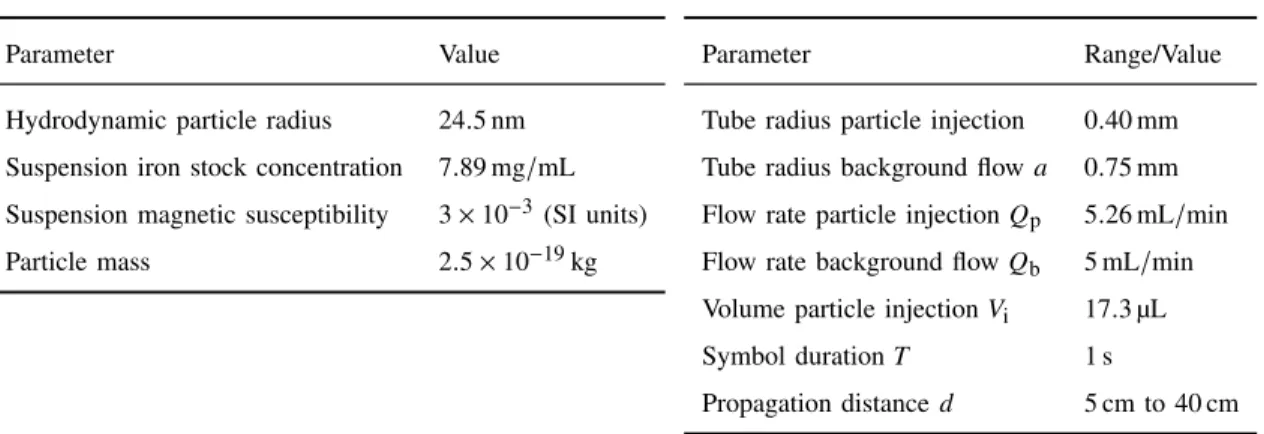
In the following, each component of the proposed MC system and its parameters are charac-terized. A representative photograph of the entire system is shown in Fig. 1a and the system parameters are summarized in Table I.
A. Testbed Components
In this subsection, we describe the physical setup of the testbed components, including the information-carrying particles, the transmitter, the propagation channel, and the receiver.
water reservoir
background flow pump susceptometer
injection pump
syringe
Y-connector
tube to waste container (a)
particle tube propagation tube
background flow tube (b) Iron oxide core diameter core-cluster diameter SPION diameter Coating (i.e. small molecules,
polymer, etc.)
(c)
Fig. 1. SPION testbed. (a) Photograph of the testbed showing the water reservoir, the background flow pump, the susceptometer, the pump used for injection, the syringe holding the suspension of SPIONs, and flexible plastic tubes connecting the components. The waste container below the table is not shown. (b) Photograph of the Y-connector with elongated SPION suspension right after injection for a slow background flow of𝑄b=1 mL/min. The injected SPION suspension is elongated by the flow profile.
(c) Schematic SPION composition consisting of iron oxide cores forming a core-cluster stabilized by a polymer.
1) Carrier: We use a specific type of magnetic nanoparticles as information carriers which are
referred to as SPIONs. There are a multitude of possibilities for producing SPIONs, including thermal, sol-gel, electrochemical, and precipitation approaches. One of the fastest, simplest, and most efficient methods to synthesize SPIONs is the coprecipitation technique in alkaline media as it was first proposed by the authors of [40], [41] in the early 1980s. The first and most crucial step of this synthesis is the precipitation of magnetite (Fe3O4) from ferric (Fe3+) and ferrous
(Fe2+) salts with a stoichiometric ratio of 2:1 (Fe3+/Fe2+) in an inert atmosphere at a basic pH: 2Fe3++Fe2+ +8OH− →Fe3O4+4H2O,
TABLE I SYSTEMPARAMETERS (a) Particle Properties
Parameter Value
Hydrodynamic particle radius 24.5 nm
Suspension iron stock concentration 7.89 mg/mL
Suspension magnetic susceptibility 3×10⁻³ (SI units)
Particle mass 2.5×10⁻¹⁹kg
(b) Testbed Settings
Parameter Range/Value Tube radius particle injection 0.40 mm
Tube radius background flow𝑎 0.75 mm
Flow rate particle injection𝑄p 5.26 mL/min
Flow rate background flow𝑄b 5 mL/min
Volume particle injection𝑉i 17.3µL
Symbol duration𝑇 1 s
Propagation distance𝑑 5 cmto40 cm
For our synthesis, we use ammonia to start the formation of the particles. Since nanoparticles in general and our SPIONs in particular are featured with a small size, they possess a large surface to volume ratio. The resulting high surface energy renders the particles thermodynamically unstable and is responsible for their tendency to minimize their energy by agglomeration. In order to avoid this behavior, a suitable stabilization mechanism is required. Generally, stabilization can be achieved by small molecules, polymers, and proteins. It is common to all of them to produce repulsion either by electrostatic, by steric, or by electrosteric means. Most colloidal dispersions possess an electric surface charge which, depending on the material and the dispersion medium, gives rise to electrostatic stabilization. However, certain tradeoffs apply for the coating of SPIONs in MC. First, the synthesis and coating has to be designed to make the particles as large as possible, in order to be able to generate a large signal for detection. However, the larger the particles, the more they are prone to sedimentation. In addition the coating material should provide the particles not only with stability against agglomeration but also render them inert against the components of the testbed. For these reasons, we used SPIONs with lauric acid as a stabilizing agent [42] (see Fig. 1c).
The particles are dispersed in an aqueous suspension and stored in a syringe, which is connected to a tube with an inner radius of 0.4 mm. The particles have a hydrodynamic radius of 24.5 nm, an iron stock concentration of 7.89 mg/mL, a susceptibility of 3×10⁻³ (dimensionless in SI units), and a concentration of approximately 4×10¹³particles/mL in aqueous suspension.
2) Transmitter: The movement of the particles through the tube is established with a computer
controlled peristaltic pump (Ismatec Reglo Digital, Germany), which can provide discrete pumping actions at a flow rate of5.26 mL/min(maximal speed), injecting a dosage volume of𝑉i=17.3µL of SPION suspension. Injection speed and volume have been manually chosen so as to minimize the injection duration for avoiding intersymbol interference (ISI) and achieving a strong signal. The end of the tube with the particles is joined via a Y-connector with another tube of radius 0.75 mm providing a background flow, see Fig. 1b. The constant background flow of water has a flow rate of 5 mL/min and is maintained by a second pump (Ismatec IPC, Germany).
Discrete pumping actions with a minimum adjustable separation of1 sare realized by a custom LabVIEW (National Instruments, Austin, Texas, USA) graphical user interface (GUI) that triggers the particle pump.
3) Propagation Channel: The flow rate in the tube channel is the sum of the rates of
the background flow and the particle injection. It is hence time-dependent and amounts to 10.26 mL/min during particle injection and 5 mL/min in the remaining time. When particles are pumped into the channel by the transmitter, then the resulting particle cloud is entrained by the flow and simultaneously diluted and elongated, see Fig. 1b.
The length of the propagation channel is variable but was set to5 cm, 10 cm,20 cm, and 40 cm for the results shown in Section V.
4) Receiver: At the end of the propagation channel, the tube runs through the air core of an
MS2G Bartington susceptometer coil (inner diameter: 10 mm, length: 20 mm, specified sensitive length: 5 mm). When the magnetic particles are within the detection range of the susceptometer, an electrical signal 𝜒(𝑡) is generated. This signal is proportional to the number of SPIONs that are within the detection range at a specific time instance. After the particles have passed through the receiver, they are collected in a waste bin together with the water from the background flow. Water has a small negative magnetic susceptibility of about −9.0×10⁻⁶ (SI units) [43, Appendix E]. Hence, the magnitude of the magnetic susceptibility of water is much smaller than that of the considered SPION suspension 𝜒ref =3×10⁻³ (SI units).
The susceptibility changes measured at the receiver were recorded by use of the software Bartsoft 4.2.1.1 (Bartington Instruments, Witney, UK) provided by the manufacturer of the susceptometer. The susceptometer is a reliable and convenient commercial device for characterizing the magnetic susceptibility of SPION suspensions in the laboratory. Nevertheless, we note that our current use case of measuring time signals with a short sampling period in the order of 0.1 sis outside of the
usual mode of operation of this device which has been designed for one-time measurements of bulk probes under stationary conditions, see [36] for the evaluation of a custom susceptometer design. Hence, care has to be taken when interpreting the measured signal as magnetic susceptibility since we operate the susceptometer outside of its specification by evaluating the output signal for a spatially varying SPION concentration over time.
B. General Considerations
In this subsection, we provide some background on the relevant physical effects affecting the measurement signals. These considerations will guide our mathematical modeling efforts in Section III.
1) Turbulent or Laminar Flow: Fluid flow can be categorized as either laminar or turbulent.
This categorization determines the appropriate mathematical model to be used. While laminar flow is prevalent in microfluidic applications, turbulent flow is encountered in macroscale ducts in the size range of several centimeter. The relevant parameter which predicts a transition from laminar to turbulent flow is the Reynolds number Re ∈R+ which is defined as [44, Chapter 3]
Re = 𝑎·𝑢0 𝜈
, (1)
where 𝑎 is the tube radius, 𝑢0 is the maximum flow velocity in the tube and can be computed as 𝑢0=2𝑢eff with the area-averaged velocity in the tube𝑢eff =𝑄b/(𝜋 𝑎2), 𝜈 is the kinematic viscosity of the liquid, and 𝑄b is the background flow rate, i.e., the total flow rate after injection. For a circular duct, a value of Re≈ 2100 is critical for the transition from laminar to turbulent flow, see [44, Chapter 3]. For the testbed parameters in Table I, we find 𝑢eff =47.2 mm/s. Thus, using the kinematic viscosity of water 𝜈 = 10−6m2/s [44, Chapter 1], we obtain Re =70.7 < 2100 and hence expect fully laminar flow. By the reasoning above, we would expect a transition to turbulent flow for an increase of the Reynolds number in (1) by a factor of 30. For example, all other parameters held equal, we would expect a transition to turbulent flow at an effective flow speed of 𝑢eff =1410 mm s−1 (𝑄b=150 mL min−1) or for a tube radius of 22.5 mm. We note that additional turbulence could also be caused by obstacles in the tube.
2) Diffusion: In general, the particle motion is governed by both diffusion and transport
diffusion compared to the transport by fluid flow over a distance of 𝑑 can be quantified by a dispersion factor 𝛼D ∈R+ which is defined as [7, Section II.B]
𝛼D = 𝑑𝐷
𝑎2
c𝑢
(2) where 𝐷 is the diffusion coefficient of the SPIONs, 𝑎c is a characteristic distance over which the flow velocity varies, here chosen as 𝑎c=𝑎/10, and 𝑢 is an effective velocity, here chosen as 𝑢 =𝑢eff. When 𝛼D 1 and 𝛼D 1, over a distance of 𝑑, flow and diffusion dominate the transport, respectively.
The diffusion coefficient can be estimated as [7, Section II]
𝐷 =
𝑘B𝑇m 𝜁
, (3)
where 𝑘B𝑇m = 4.11×10⁻²¹J is a characteristic energy with Boltzmann constant 𝑘B and the temperature of the liquid medium 𝑇m = 298 K, and 𝜁 = 6𝜋𝜂 𝑅p = 5.18×10⁻¹⁰kg s−1 is the friction coefficient. Here, 𝜂=1×10⁻³Pa sis the dynamic viscosity of the liquid medium (water) and 𝑅p=24.5 nmis the SPION radius. From (3), we estimate 𝐷 =10−11m2/s for the considered SPIONs. Hence, for the testbed parameters in Table I, we obtain 𝛼D =12×10−3 (for 𝑑=40 cm). This value is several orders of magnitude smaller than 1 and therefore the impact of diffusion is assumed to be negligible over the considered distances 𝑑 ≤ 40 cm. By the reasoning above and taking 𝛼D =1 as critical value, we would expect diffusion to have a noticeable impact for an increase of the dispersion factor by a factor of84. All other parameters held equal, this would be the case for a decrease of the effective flow velocity to 𝑢eff =0.56 mm s−1 (𝑄b=0.06 mL min−1), an increase of the distance to 𝑑 = 30 m, a smaller tube radius of 𝑎 = 0.082 mm, or a much larger diffusion coefficient of 𝐷 =8×10⁻¹⁰m2/s. We note that the diffusion coefficient could effectively increase by particle-particle interactions or turbulence [44].
3) Injection: The injected SPION suspension is in aqueous phase. Hence, after injection, a
one-phase flow is expected, rather than a two-phase flow, as would be the case for, e.g., an oily suspension in water. During injection, we have two joining flows. For an injection flow rate of 𝑄p=5.26 mL min−1 and a background flow rate of𝑄b =5 mL min−1, we have a net flow rate of 𝑄b+𝑄p = 10.26 mL min−1 during injection and a flow rate of 𝑄b = 5 mL min−1 when not injecting. This corresponds to variations of the effective flow velocity between 47.2 mm s−1 and 96.8 mm s−1. Following an injection, the increased flow velocity occurs for the injection duration of 197 ms and in principle affects the signal generated by all previous injections. By considering
the flow rates, we can estimate the injection depth from the top to the bottom of the pipe by 2𝑎·𝑄p/(𝑄p+𝑄b) [44], e.g., for 𝑄p =𝑄b we would have an injection depth of half the pipe diameter and for 𝑄p 𝑄b the injection depth would be close to 0. For the testbed parameters given in Table I, we can determine the injection depth as 0.77 mm, i.e., we expect the injected SPION suspension to reside in the upper half of the tube of radius 𝑎 =0.75 mm. In fact, the particle volume distribution after injection determines the received signal as the SPION transport is expected to be deterministic driven by the flow.
4) Gravity: Another relevant effect for the transport of particles is gravity. The gravitational
force on an individual SPION can be determined as 𝐹 = 𝑚 𝑔 = 2.5×10⁻¹⁸N where 𝑚 = 2.5×10⁻¹⁹kg is the particle mass, see Table I and 𝑔 =9.81 m/s2 is the gravitational constant [44]. The resulting drift velocity due to gravity can then be determined as 𝑢 =𝐹/𝜁 =4.7 nm s−1 [7] where 𝜁 is the friction coefficient in Section II-B2. When we consider a vertical displacement by gravity of 𝑎/10=75µm to be relevantly large, then we obtain a time duration after injection of 𝑎/10/𝑢 =4.4 h where gravity begins to matter. Since the considered CIRs have a duration of less than 1 min, we expect that the effect of gravity on an individual SPION is negligible. On the other hand, considering a time duration of 1 min as critical, gravity would begin to matter for a particle mass of 6.61×10⁻¹⁷kg which would correspond to a radius larger than 176 nm assuming the same mass density, i.e., assuming the SPION mass is proportional to 𝑅3
p.
5) Magnetic Susceptibility: Finally, we consider the receiver device and the measured received
signal. The magnetic susceptometer used as receiver is a device comprising an electromagnetic coil with an air-core used as measuring space in an electric resonance circuit. The susceptometer is designed for measuring the magnetic susceptibility of bulk material probes large enough to fill the coil (bulk magnetic susceptibility). This bulk magnetic susceptibility is proportional to the change of inductance resulting from inserting the bulk material into the coil which can be measured, e.g., by examining the resonance frequency of the coil [36]. For example, the SPION suspension used in this testbed has a bulk susceptibility of 𝜒ref and a bulk mixture of the SPION suspension with water at a ratio of 𝑐 ∈ [0,1] can be expected to yield a susceptibility of 𝜒m = 𝜒ref·𝑐. However, for locally varying concentrations as is the case for our testbed where the SPION suspension is being transported and dispersed in the water by the fluid flow, the susceptometer output does only reflect an average susceptibility.
Motivated by the above analysis, in the following section, a mathematical model is established accounting for the transport by laminar flow where the received signal is characterized by the
TX RX
𝑧 𝑦
−𝑑 −𝑙𝑧/2 𝑙𝑧/2
𝑎
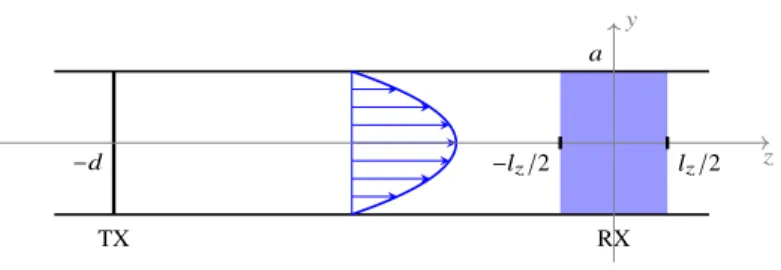
Fig. 2. Sketch of the simplified system model consisting of a straight tube with radius𝑎, shown for a (𝑧, 𝑦)-cut with transmitter
node TX concentrated at axial coordinate𝑧=−𝑑and transparent receiver node RX weighting the SPION concentration. The
laminar profile in (4) is schematically shown by velocity vectors.
injection and a spatially weighted integral of the local susceptibility. III. MATHEMATICAL SIGNALMODEL
In this section, first the modeling assumptions for the channel, transmitter, and receiver are described and then the CIR, i.e., the expected received signal for one single injection, is derived. For quick reference, a sketch of the assumed abstract system model is shown in Fig. 2.
A. Modeling Assumptions
First, we will describe the flow-driven propagation in the tube channel, then we characterize transmitter and receiver. In the following, we will use cylindrical coordinates for position 𝒙 = (𝜌, 𝜙, 𝑧), where 𝜌, 𝜙, and 𝑧are the axial distance, azimuth, and axial coordinates, respectively.
1) Channel: In general, the flow at the injection site is complicated and time-variant as alluded
to in Section II-A3. Moreover, in our testbed, the tube is not perfectly straight and is not infinite but inherently also includes the Y-connector used for injection. This leads to a complicated flow profile in general even without injections. Nevertheless, to simplify the analysis and as the deviations over distances on the order of the inner tube diameter are small, we will assume laminar flow in a straight tube of circular cross-section. In this case, the non-uniform flow velocity profile is well known to be [44]
𝑢(𝜌) =𝑢0· 1− 𝜌 2 𝑎2 , (4)
where 𝜌 is the radial distance from the central axis of the tube.
Then, the concentration develops over time and space based on the following model for flow-driven transport [7]
where 𝑐i(𝒙) is the assumed initial spatial particle distribution and 𝒆𝑧 is the unit vector in 𝑧 direction. The concentration satisfies ∭
𝑐(𝒙, 𝑡)d𝑉 =𝑉i,∀𝑡 where𝑉 is the volume of the infinite cylinder.
2) Transmitter: The transmitter is physically realized by the injection pump and the Y-shaped
tube connector, see Section II-A2. However, for modeling, we will focus on the initial particle distribution within an infinite cylinder which is created by the injection process, i.e., the volume distribution of SPIONs right after injection.
As first order approximation, we will assume that the initial distribution can be modeled as being axially concentrated at the site of injection1. With this assumption, the initial concentration
in space can be mathematically expressed as
𝑐i(𝒙) =𝑉i· 𝑓(𝜌, 𝜙) ·𝛿(𝑧+𝑑), (6)
where 𝑓(𝜌, 𝜙) is the distribution in the cross-section of the tube and 𝛿(𝑧) is the Dirac delta function. The distribution in the cross-section is normalized to ∬
𝑓(𝜌, 𝜙)d𝐴 = 1, where 𝐴 denotes the area of the tube cross-section. The transmitter is at 𝑧 = −𝑑, see Fig. 2, and the injection volume is assumed to be concentrated at position 𝑧 =−𝑑. We note that in general the initial distribution in (6) depends on the angular coordinate 𝜙. However, the received signal will not depend on the distribution over 𝜙 because of the geometrically symmetric arrangement of the receiver surrounding the tube. Therefore, in the following, we will introduce some definitions to describe the particle distribution over the radial coordinate.
a) Definitions: The radial distribution is given by
𝑓𝜌(𝜌) =
∫ 2𝜋
0
𝑓(𝜌, 𝜙)𝜌d𝜙 (7)
and its cumulative distribution function is given by 𝐹𝜌(𝜌) =
∫ 𝜌
−∞ 𝑓𝜌(𝜌˜)d ˜𝜌. For convenience, we also define an auxiliary distribution as
𝑓𝑠(𝑠) = 𝑎
2√𝑠 ·
𝑓𝜌(𝑎√𝑠) (8)
which satisfies ∫1
0 𝑓𝑠(𝑠)d𝑠=1 and where 𝑠= 𝜌2/𝑎2. The corresponding cumulative distribution function satisfies 𝐹𝑠(𝑠) =𝐹𝜌(𝑎√𝑠) according to (8).
1We note that a more accurate model could be obtained, for example, by numerical simulation of the injection process and evaluating the obtained initial volume distribution [45]. However, as this numerical simulation does not directly give theoretical insight, in this paper, we focus on a simple parametric model for the initial distribution.
b) Special Cases: Let’s consider two common models for injection as important special
cases [19]. First, for a uniform particle distribution, 𝑓(𝜌, 𝜙) = 1/(𝜋 𝑎2), we obtain 𝑓𝜌(𝜌) = 2𝜌/𝑎2,0≤ 𝜌 ≤ 𝑎 and 𝑓𝑠(𝑠) =1,0≤ 𝑠 ≤ 1. Second, for a particle distribution proportional to the flow profile in (4), 𝑓(𝜌, 𝜙) = 2 𝜋 𝑎2(1− 𝜌2 𝑎2), we obtain 𝑓𝜌(𝜌) = 4 𝑎2 𝜌· (1− 𝜌2 𝑎2) and 𝑓𝑠(𝑠)=2(1−𝑠).
c) Parametric Initial Distribution: To generalize from these two important special cases,
we propose the following distribution in 𝑠 𝑓𝑠(𝑠) =
1 𝐵(𝛼, 𝛽) ·
𝑠𝛼−1· (1−𝑠)𝛽−1 (9)
which is the Beta distribution [46] with 0 ≤ 𝑠 ≤ 1. The parameters shaping the Beta distribution are 𝛼 ≥ 1 and 𝛽 ≥ 1 and the normalization is given by 𝐵(𝛼, 𝛽) = Γ(𝛼)Γ(𝛽)
Γ(𝛼+𝛽) , where Γ(·) is the Gamma function.
The Beta distribution is limited to the range [0,1] which makes it suitable for modeling the range of parameter 𝑠. We can also recover the uniform distribution for (𝛼=1, 𝛽=1) and the distribution proportional to the flow profile for (𝛼=1, 𝛽=2), where 𝐵(1, 𝛽)=1/𝛽. Moreover, for 𝛼 ≥ 1 and 𝛽 ≥ 1, 𝑓𝑠(𝑠) is unimodal with adjustable peak position and peak width as is needed for our testbed where the SPION mass is concentrated around a certain radial position due to the injection. These properties make the Beta distribution a good candidate for modeling the initial distribution following injection for this testbed.
For future reference, by using (8), for 𝑓𝑠(𝑠) in (9), we can write the corresponding radial distribution as 𝑓𝜌(𝜌) = 2 𝑎 𝐵(𝛼, 𝛽) · 𝜌 𝑎 2𝛼−1 · 1− 𝜌 2 𝑎2 𝛽−1 . (10)
3) Receiver: The physical detection device is given by the susceptometer. Motivated by the
physical reception mechanism described in Section II-B5, we assume the following received signal model
𝜒(𝑡) = 𝜒ref·
∭
R3
𝑤(𝒙) ·𝑐(𝒙, 𝑡)d𝑉 (11)
where 𝑤(𝒙) is a weighting function which can be interpreted as a receiver window and is normalized as ∭
R3
𝑤(𝒙)d𝑉 = 1. For example, for 𝑐(𝒙, 𝑡) =1,∀𝒙, 𝑡 we have 𝜒(𝑡) = 𝜒ref. The receiver mechanism underlying (11) can be understood as a transparent receiver [39].
In the following, for simplicity, we will assume that the receiver weighting function is a rectangular window only dependent on 𝑧, leaving a three-dimensional characterization of the
weighting function for future work. Hence, for our modeling, the rectangular receiver weighting function is given as 𝑤(𝒙) = 1 𝜋 𝑎2𝑙𝑧 · rect 𝑧 𝑙𝑧 (12) where 𝑙𝑧 is the window length and rect(𝑧)=1 for |𝑧| ≤ 0.5, and rect(𝑧)=0 otherwise, i.e., the receiver is centered at axial position 𝑧 =0, see Fig. 2.
This concludes our list of modeling assumptions. As will be shown, with these assumptions, we can capture the main characteristics of the measurement signals. For example, when due to the injection more particles are concentrated close to the central axis than close to the boundary of the tube, a faster decay of the received signal over time and a larger peak can be expected due to the laminar flow profile in (4). The general CIR behavior under the given modeling assumptions is investigated in the following.
B. Channel Impulse Response
In this subsection, we use the modeling assumptions summarized in the previous subsection to derive a compact closed-form CIR expression usable for fitting measurement data. To this end, we assume the abstract system model shown in Fig. 2, where the injection is simplified to a release concentrated at 𝑧 =−𝑑 and the receiver applies a spatially-weighted integral of the particle concentration resulting from the flow-driven transport similar to [47].
1) General Case: Using (5) and (6) in (11), as shown in the Appendix, we can express the
CIR as follows ℎ(𝑡) =𝑐𝑑· 𝑑 𝑙𝑧 · 𝐹𝑠 1− 𝑑−𝑙𝑧/2 𝑢0𝑡 −𝐹𝑠 1− 𝑑+𝑙𝑧/2 𝑢0𝑡 , (13) where 𝑐𝑑 = 𝜒ref 𝑉i
𝜋 𝑎2𝑑 is a distance-dependent dimensionless scaling factor.
We note that with 𝑓𝑠(𝑠) in (9), (13) is a generalization of the solution provided in [1]. In particular, (13) reduces to [1, Eq. (5)] for 𝛼=1, 𝛽 ← 𝛽+1 and 𝑙𝑧 =𝑐𝑧. A numerical evaluation of (13) for different initial distributions is presented in Section V-A.
2) CIR Analysis: For the following analysis, for simplicity, we consider the case where 𝑑 𝑙𝑧, i.e., the case when the transmitter-receiver distance is much larger than the receiver width. Mathematically, we can employ the limit 𝑙𝑧/𝑑 →0 in (13). Then, we obtain
ℎ(𝑡) =𝑐𝑑· 𝑑 𝑢0𝑡 · 𝑓𝑠 1− 𝑑 𝑢0𝑡 , (14) with 𝑓𝑠(𝑠) in (9).
Since (14) provides a simple closed-form solution for the CIR independent of the receiver length, we will use it as our modeling function for fitting measurement results in Section V.
For convenience, we plug (9) into (14) and arrive at ℎ(𝑡) =𝑐𝑑· 1 𝐵(𝛼, 𝛽) · 1− 𝑑 𝑢0𝑡 𝛼−1 · 𝑑 𝑢0𝑡 𝛽 (15) for 𝑡 ≥ 𝑑/𝑢0and ℎ(𝑡) =0 otherwise. Interestingly, for large𝑡, ℎ(𝑡) decays as 1/𝑡𝛽. This is related to the particle fraction at 𝜌→ 𝑎 which according to (10) depends on 𝛽 but not on 𝛼.
The initial delay of the received signal, 𝑡0 =
𝑑
𝑢0
, (16)
predicted by (15), is expected, as this is the time needed for particles initially placed in the center of the tube to travel distance 𝑑, i.e., a measure for the theoretical time offset until which no signaling particle has reached the receiver yet. Moreover, we note from (15) that ℎ(𝑡0) =0 for 𝛼≠ 1 and ℎ(𝑡0) >0 for 𝛼=1, i.e., there is a jump at 𝑡 =𝑡0.
Finally, let us consider the position and the height of the peak (maximum) of the derived CIR. For 𝛼 >1, the position of the peak of the CIR in (15) can be found at
𝑡peak =𝑡0· 1+ 𝛼−1 𝛽 , (17)
by equating the time derivative of ℎ(𝑡) in (15) with zero and solving for 𝑡. Interestingly, it can be observed via (16) that for any 𝛼 and 𝛽, 𝑡peak is proportional to 𝑑. By substituting (17) in (15), the height of the peak follows as
ℎpeak =𝑐𝑑· 1 𝐵(𝛼, 𝛽) ·
(𝛼−1)𝛼−1𝛽𝛽
(𝛼+𝛽−1)𝛼+𝛽−1
, (18)
which is inversely proportional to distance 𝑑 for any combination of 𝛼 and 𝛽.
As a summary of the CIR analysis, we conclude that for any choice of 𝛼 and 𝛽, the peak height ℎpeak decays proportional to 1/𝑑 and ℎ(𝑡), for large 𝑡, decays as 1/𝑡𝛽.
3) Special Cases: Let us consider again, the two special cases of a uniform particle distribution
and that of a particle distribution proportional to the flow profile described earlier. For these two cases, we expect a decay over time proportional to1/𝑡 and 1/𝑡2, respectively, see [19, Chapter 15]. This behavior is indeed recovered for (𝛼=1, 𝛽=1) and (𝛼=1, 𝛽=2) in (15).
IV. MODULATION, CHANNELESTIMATION, ANDDETECTION
In this section, we discuss the communication and signal processing aspects of our testbed, i.e., the preprocessing of the raw data, channel estimation, and detection algorithms.
A. Data Preprocessing
Preprocessing of the data provided by the susceptometer is needed for a consistent postprocessing such as comparing with the developed CIR model and for detection. By manual examination, it turns out that the employed susceptometer delivers samples at sampling times which are not perfectly regular and the absolute time is not synchronized with the injection. For consistency, we employ a resampling by linear interpolation to 10 samples per second which corresponds to the average sampling times of the measurement data as provided by the susceptometer.
In the following, we denote the preprocessed susceptibility signal by 𝜒[𝑖] = 𝜒(𝑖Δ𝑡) where Δ𝑡 = 0.1 s is the sampling interval and 𝑖 = 0,1,2, . . .. Thereby, 𝜒(𝑡) is the underlying but inaccessible preprocessed time-continuous signal.
For time synchronization, we look for the start of the first occurrence of 10 consecutive samples surpassing a threshold chosen as one hundredth of the maximal observed signal amplitude in that measurement. This time index is labeled as 𝑖start and the received signal𝑟[𝑖] = 𝜒[𝑖−𝑖start] is then used for further processing. For future reference, the vector of received signal values is denoted by 𝒓.
B. Channel Estimation
The information to be detected is represented as follows. We assume that information is represented by a sequence 𝒂 ∈ {0,1}𝐾 of OOK symbols with𝑎[𝑘] ∈ {0,1}, 𝑘 ∈ {0,1, . . . , 𝐾−1}, where 𝐾 is the number of transmitted symbols. This series of amplitude coefficients is then modulated on pumping pulses as described in Section II-A2. For PAM detection, we assume the following basic pulse amplitude modulation model for the noise-free received signal
𝑠[𝑖;𝒂,𝒉] = 𝐾−1
∑︁
𝑘=0
𝑎[𝑘] ·ℎ[𝑖−𝑘 𝐼] (19)
where 𝑖 is the sampling index, and 𝐼 =𝑇/Δ𝑡 =10 is the oversampling factor corresponding to symbol interval 𝑇. For convenience, the vector of noise-free received signal values is denoted by 𝒔(𝒂,𝒉). In particular, 𝒉∈R𝑁 𝐼 with entries ℎ[𝑖], 𝑖 =0,1, . . . , 𝑁 𝐼−1, are the samples of the CIR which can be obtained by estimation using training data, as described in the following, and 𝑁 is the memory length measured in numbers of symbols.
For sequence estimation, we need to know the overall CIR ℎ[𝑖]. For our numerical results, we obtain this CIR by estimation based on training data sent at the start of transmission. To this end, we denote the sequence of training symbols as 𝒂t ∈ {0,1}𝐾t and the training samples of the
received signal as 𝒓t ∈R𝐾t𝐼, where 𝐾t is the length of the training sequence. In a similar manner, 𝒔(𝒂t,𝒉) denotes the vector of model transmit training signal samples. In the following, we describe two channel estimation schemes, one based on the CIR model developed in Section III-B and another one which directly estimates all samples of the CIR.
1) Model-based CIR Estimation: For estimating the model parameters, we consider the
following optimization problem ˆ
𝛼,𝛽,ˆ 𝛾ˆ =arg min 𝛼, 𝛽,𝛾 >0
k𝒓t−𝒔(𝒂t, 𝛾 ·𝒉(𝛼, 𝛽))k2, (20)
where the samples of the CIR are given as 𝒉(𝛼, 𝛽) =ℎ(𝑖Δ𝑡+𝑡0;𝛼, 𝛽), 𝑖 =0,1, . . . , 𝑁 𝐼−1. This is a non-linear least-squares optimization problem with three parameters (scaling parameter 𝛾 and model parameters 𝛼 and 𝛽). The estimated CIR is then given by 𝒉ˆ =𝛾ˆ ·𝒉(𝛼,ˆ 𝛽ˆ).
2) Direct Estimation of CIR: Directly estimating the samples of the CIR is a common strategy
for channel estimation [48]. In particular, we use a least-squares scheme solving for 𝒉: ˆ
𝒉=arg min 𝒉∈R𝑁 𝐼
k𝒓t− 𝒔(𝒂t,𝒉)k2. (21)
This is a linear least-squares optimization problem with 𝑁 𝐼 variables. Typically, 𝑁 𝐼 > 3, i.e., a larger number of variables has to be estimated compared to the parametric approach in (20). In the numerical results in Section V, we compare the performance of both methods.
C. Detection Algorithms
For detection, i.e., estimation of the transmitted bit sequence from the received signal, we consider both sequence estimation assuming the PAM structure in (19) as well as a model-agnostic heuristic detection scheme, namely increase detection.
1) Sequence Estimation: For sequence estimation, we employ the Viterbi algorithm which
solves the following optimization problem [49, Chapter 10] ˆ
𝒂i= arg min 𝒂i∈{0,1}𝐾𝑖
k𝒓−𝒔([𝒂t𝒂i],𝒉ˆ)k2, (22)
where 𝒂i is the sequence of information symbols of length 𝐾i and 𝒉ˆ can be either estimated based on our proposed model via (20) or directly via (21). We note that this criterion is optimal with respect to the error rate in case of impairment by additive white Gaussian noise [49] but is not necessarily optimal for the unknown distortions in our testbed. The performance in terms of the number of decision errors achievable with sequence estimation is evaluated in Section V.
2) Increase Detection: In the following, as a baseline for the sequence estimation described
before, we consider a simple version of the detection scheme described in [50]. In particular, this detection method does not rely on the PAM model introduced above. Instead, it is a heuristic attempt to exploit the observed characteristics of the received signal. In particular, in a given symbol interval, for a binary “1” the received signal exhibits an increase in the current symbol interval (after an appropriate delay) whereas for a binary “0” the received signal is non-increasing on average. This appears to be a convenient signal characteristic to exploit for detection when the exact channel distortions are unknown. Hence, one heuristic approach for detection is, for each symbol interval and despite the ISI, to check whether the signal is significantly increasing or not. In particular, we employ for the estimated symbol sequence 𝒂ˆ the following detection rule
ˆ 𝑎[𝑘] = 1, if 𝑟[𝑖2[𝑘]] −𝑟[𝑖1[𝑘]] > 𝜉 0, otherwise (23) where𝑖1[𝑘] =𝑘 𝐼 , 𝑘 ∈ [0, 𝐾) is the starting time of the 𝑘th symbol interval and𝑖2[𝑘] =𝑖1[𝑘] +𝐼off, where 𝐼off ∈ [0, 𝐼) is a sampling offset. Moreover, 𝜉 is the detection threshold which needs to be carefully selected to balance sensitivity to noise (if 𝜉 is too small) and a bias for detecting binary “0” (if 𝜉 is too large).
For choosing the detection parameters 𝐼off and 𝜉, there are different options. In this paper, we obtain these parameters based on peak position 𝑡peak in (17) and peak height ℎpeak in (18) of the proposed CIR equation in (15) where, for simplicity, we assume that𝛼= 𝛽=3yields a reasonable characterization of the CIR. In particular, we choose 𝜉 =ℎpeak/20 and 𝐼off =min{𝐼−1, 𝑖peak}, where 𝑖peak= d(𝑡peak−𝑡0)/Δ𝑡c with d·c denoting rounding to the closest integer value, i.e., we determine the index of the expected peak position without accounting for ISI and not exceeding the symbol interval length. We note that this detection rule can be seen as a generalization to the one employed in [9] where 𝑖1[𝑘] is fixed to the middle of the 𝑘th symbol interval and 𝑖2[𝑘] is fixed to the end of the 𝑘th symbol interval.
V. EXPERIMENTALRESULTS
In this section, we evaluate the analytical model equations in Section III and fit the parameters of the analytical model to experimental measurement data for the CIR. Then, we evaluate the performance of the proposed detection schemes. In the following, the parameter values provided in Table I apply unless indicated otherwise.
0 0.5 1 1.5 2 2.5 3 3.5 4 Time (s) 0 0.5 1 1.5 2 Scaled Susceptibility Impulse response 0 0.2 0.4 0.6 0.8 1 /a 0 0.5 1 1.5 2 2.5 3 a f ( ) Initial distribution =1 =2 =1 =1 =3 =3 =3 =3 =1 =2 =1 =1
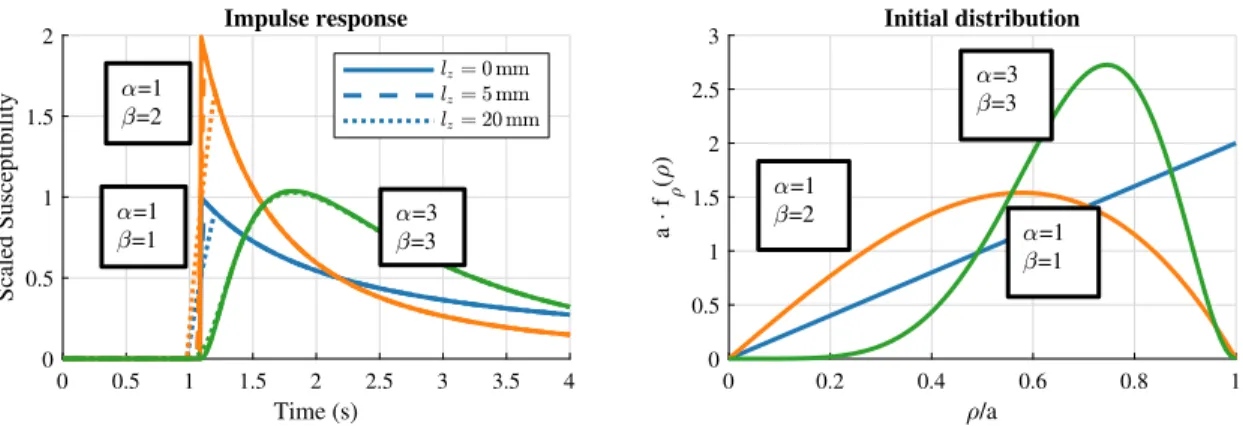
Fig. 3. Dependence of the CIR on different initial distributions. (Left) CIR for distance𝑑 =10 cmscaled with 𝑐𝑑 in (13)
for different Beta initial distribution parameters and receiver weighting function lengths. (Right) Corresponding model initial distribution 𝑓𝜌(𝜌). CIRs strongly depend on the particle distribution, e.g., higher CIR peaks and faster decays are observed when
relatively more particles are concentrated in the center of the tube rather than at the boundary (𝜌=𝑎).
A. CIR Model Evaluation
To better illustrate the properties of the proposed CIR model, we investigate the dependence of the CIR model equation (13) on the initial particle distribution as well as the impact of the weighting function lengths. To this end, in Fig. 3, we show (left) the numerical evaluation of the CIR and (right) the corresponding initial particle distributions in terms of the radial distribution 𝑓𝜌(𝜌) in (8). For each initial distribution, CIRs are shown for a receiver length of 𝑙𝑧 =20 mm corresponding to the length of the susceptometer housing (see Fig. 1a), 𝑙𝑧 =5 mm corresponding to the sensitive region specified in the manual of the susceptometer, and 𝑙𝑧 =0 mm which can be seen as an approximation and for which the closed-form expression is given in (15). For the Beta initial distribution, we consider the parameter pairs (𝛼=1, 𝛽=1) corresponding to a uniform distribution, (𝛼 =1, 𝛽 = 2) corresponding to a distribution proportional to the flow profile as introduced in Section III-A2, and (𝛼 = 3, 𝛽 = 3) which is chosen arbitrarily. For all shown CIRs, we observe an initial delay of about 1 s which is in good agreement with the starting time 𝑡0 =1.09 s in (16). More accurately, the signals start at time (𝑑−𝑙𝑧/2)/𝑢0 because the receiver weighting function is centered at 𝑧 =0 and extends to 𝑧 =−𝑙𝑧/2, see Fig. 2.
Overall, the observed CIR shapes depend strongly on the initial particle distribution but less on the receiver weighting function length. Nevertheless, the CIR shapes seem more affected by the choice of different weighting function lengths in case of the uniform distribution and the distribution proportional to the flow profile. This is in particular the case for the peak value which, in this case (𝛼=1), coincides with the signal starting time (see (17)) and can be attributed
to the significant portion of particles around 𝜌 =0, see Fig. 3 (right). This portion of particles travels in a relatively concentrated manner due to the flat flow profile around 𝜌=0, see Fig. 2. Hence, the integral over space in (11) depends more strongly on the window length. This is in contrast to the CIR for (𝛼=3, 𝛽=3) where the CIR depends on the window function length less strongly. In that case, the initial CIR increase is more smoothly and the approximate peak time occurs at 𝑡 =1.82 s via (17).
In summary, a variety of different CIR shapes can be realized by considering different initial particle distributions. However, only minor variations in the CIR shape are observed for the considered different weighting function lengths. This is especially true for the distributions with diminishing mass at 𝜌 =0that are expected for the presented testbed, see also Fig. 1b where most of the visible particle cloud resides within the upper half of the tube. Hence, in the following, the approximation of zero window length in (15) is used for fitting of the measurement data due to its mathematical simplicity. Nevertheless, the more general CIR expression in (13) might be convenient when investigating the effect of different coil lengths for a custom susceptometer.
B. Conducted Experiments
To test the applicability of our analytical model, we make the following two experiments.
a) Pulse Train: For this experiment, we transmit a fixed sequence of 15 binary “1” via
OOK with symbol durations 𝑇 = 20 s, 40 s, 60 s, and 60 s for distances of 𝑑 = 5 cm, 10 cm, 20 cm, and 40 cm such that by visual inspection no ISI is present, i.e., we interpret the observed consecutive pulses as realizations of the CIR. From this data, we can then obtain a measured average CIR and also evaluate variations of the CIR.
b) Data Transmission: For this experiment, we transmit a fixed sequence of 400 randomly
(for time synchronization, the first symbol is fixed to be a “1”) chosen binary OOK symbols with symbol duration𝑇 =1 s for distances 𝑑 =5 cm, 10 cm, 20 cm, and 40 cm, i.e., we take ISI into account. From this data, we obtain estimates of the CIR using both (20) and (21) and perform detection using both sequence estimation and increase detection.
C. CIR Estimation
In this subsection, we evaluate the channel estimation scheme as described in Section IV-B visually and in terms of the root mean square error (RMSE).
0 5 10 15 20 Time (s) 0 0.5 1 1.5 Scaled Susceptibility Impulse response 0 0.2 0.4 0.6 0.8 1 /a 0 0.5 1 1.5 2 2.5 3 a f ( ) Initial distribution
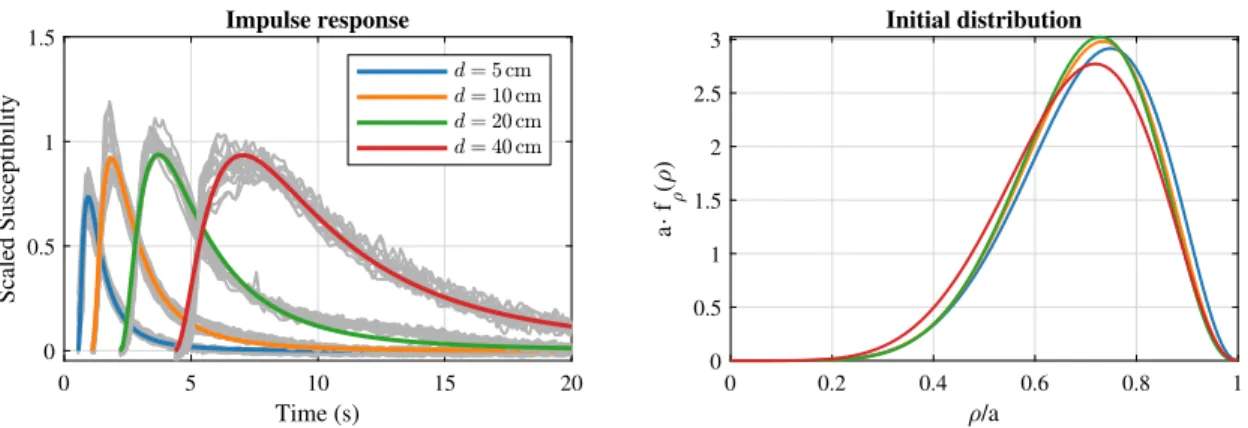
Fig. 4. Fitting of CIR model. (Left) 15 overlayed CIR realizations (gray curves) and estimated CIR model (blue, orange, green, and red curves) for distances of𝑑=5 cm, 10 cm, 20 cm, and40 cm. The CIRs are scaled by𝑐𝑑 and shifted to time𝑡0. There
is a good fit between model and measurement. (Right) Corresponding fitted initial distributions. The fitting parameters are
(𝛼=3.41, 𝛽=3.28, 𝛾=0.69),(𝛼=3.59, 𝛽=3.65, 𝛾=0.81),(𝛼=3.70, 𝛽=3.83, 𝛾=0.80),(𝛼=3.13, 𝛽=3.47, 𝛾=0.81). The
fitted initial distributions are consistent across all considered distances.
In Fig. 4, we evaluate the channel estimation based on our proposed CIR model in (20) for the pulse train experiments described in Section V-B. Thereby, we consider CIR lengths of 10, 15, 20, and 20 symbol durations (excluding the initial delay) for distances 𝑑 = 5 cm, 10 cm, 20 cm, and 40 cm. On the left hand side, for each transmission distance, we show an overlay of 15 CIR measured pulses (gray curves) as well as the estimated CIR with fitted parameters (blue, orange, green, and red curves) according to (20). For illustration, the synchronized CIRs are shifted to start consistently at time 𝑡0=𝑑/𝑢0 and all CIRs are scaled by 𝑐𝑑. On the right hand side, we show the corresponding fitted initial particle distributions.
From the CIR data (left), we can observe that the measured CIRs do not show much variation across the considered 15 realizations. Furthermore, the peak height for the scaled CIRs is similar for all considered transmission distances 𝑑 which means that the peak heights of the unscaled CIRs scale approximately as1/𝑑. Moreover, the CIRs become significantly broader for increasing distance which can be associated with increasing levels of ISI. From the fitted initial particle distributions (right), we can observe a similarity for all considered distances which is consistent with our model since the initial distribution is assumed to depend on the injection but not on the transmission distance. The initial radial particle distributions exhibit a peak around 𝜌 =0.75𝑎 and diminishing mass at 𝜌 =0 and 𝜌 =𝑎.
In summary, the derived CIR model can fit measurement data remarkably well despite the underlying simplifying assumptions and is consistent in terms of peak decay over distance and
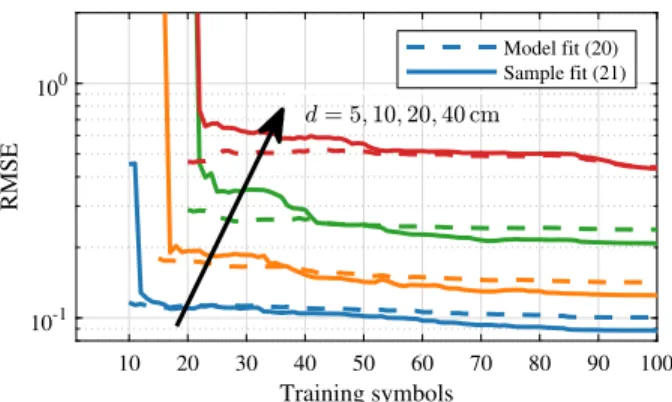
10 20 30 40 50 60 70 80 90 100 Training symbols 10-1 100 RMSE Model fit (20) Sample fit (21)
Fig. 5. Quality of channel estimation. The average RMSE per sample for the whole received signal is shown as a function of the number of training symbols used for channel estimation for distances 𝑑=5 cm, 10 cm, 20 cm, and40 cm. The received
signals are scaled by𝑐𝑑. Channel estimation by fitting of the proposed model and by fitting of all CIR samples are compared.
The CIR estimate using the proposed model is reasonably accurate for all considered numbers of training symbols.
stable in the initial particle distribution for different distances. Moreover, the measured individual CIRs are not significantly affected by noise or other distortions, i.e., the randomness of the CIR is limited for the considered operation of the testbed.
In the following, we investigate how the proposed CIR model generalizes to the data transmission experiments described in Section V-B. To this end, we perform CIR estimation on the first 𝐾t symbols and then evaluate the root mean square error (RMSE) for all 400 symbols 𝒂. The RMSE is normalized per sample and can be computed as RMSE=
√︃
|𝒓− 𝒔(𝒂, 𝛾· 𝒉)|2/400/𝑐2𝑑. Thereby, for obtaining 𝒉 both the model-based estimate (20) as well as the sample-based estimate (21) in Section IV-B are evaluated.
The corresponding results for distances 𝑑 = 5 cm, 10 cm, 20 cm, and 40 cm are shown in Fig. 5, where the RMSE for the information symbols is shown as a function of the number of training symbols used for CIR estimation. For increasing distance, we generally have larger errors and the RMSE generally decreases for more training symbols, i.e., the estimates are more accurate if the training is longer but generally worse for more ISI. This mismatch could be caused by several physical effects related to the injection or reception and is worthwhile to study in future work. The model-based estimate works reasonably well for all considered numbers of training symbols, i.e., the estimate generalizes well even for small numbers of training symbols. The sample-based estimate strongly depends on the number of training symbols and improves as the number of training symbols increases. Thereby, the model-based estimate outperforms the
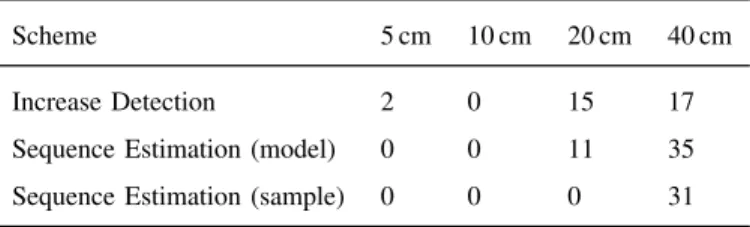
TABLE II
NUMBER OF ERRORS FOR THE LAST300DATA SYMBOLS
Scheme 5 cm 10 cm 20 cm 40 cm
Increase Detection 2 0 15 17 Sequence Estimation (model) 0 0 11 35 Sequence Estimation (sample) 0 0 0 31
sample-based estimate for smaller numbers of training symbols while the sample-based estimate can be slightly better for long training.
D. Detection
To investigate the performance of the proposed detection schemes, we apply increase detection and sequence estimation as described in Section IV for detection of the 400 OOK symbol sequence transmitted in our data transmission experiments described in Section V-B. Thereby, based on the RMSE results in Fig. 5, we choose the training as follows. On the one hand, for CIR estimation using (20), the first 𝐾t =10, 15, 20, and 20 symbols are used as training symbols, as the RMSE does not significantly decrease for longer training sequences. On the other hand, for CIR estimation using (21), the first 𝐾t =50, 75, 100, and 100 symbols are used as training symbols, as the RMSE decreases significantly for larger numbers of training symbols. The remaining 𝐾i=400−𝐾t symbols are used for evaluating the proposed detection algorithms but not for channel estimation.
The corresponding decision error results are summarized in Table II where for comparison only errors for the last 300 data symbols are reported. For distances of up to 10 cm, no or only a small number of decision errors are observed for all considered detection schemes. For a distance of 20 cm, some symbol errors are observed for both increase detection and sequence estimation with model-based CIR estimation whereas sequence estimation with sample-based CIR estimation still shows no errors. In this scenario, because of the long training sequence, the sample-based CIR estimate is accurate and hence detection benefits from the more complex sequence estimation algorithm. For a distance of 40 cm, all considered detection schemes cause decision errors whereby increase detection results in fewer errors than sequence estimation. In this case, the worse performance of sequence estimation can be attributed to the relatively large
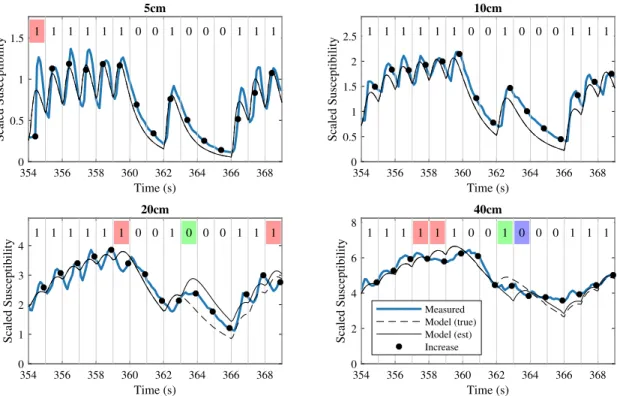
354 356 358 360 362 364 366 368 Time (s) 0 0.5 1 1.5 Scaled Susceptibility 5cm 1 1 1 1 1 1 0 0 1 0 0 0 1 1 1 354 356 358 360 362 364 366 368 Time (s) 0 0.5 1 1.5 2 2.5 Scaled Susceptibility 10cm 1 1 1 1 1 1 0 0 1 0 0 0 1 1 1 354 356 358 360 362 364 366 368 Time (s) 0 1 2 3 4 Scaled Susceptibility 20cm 1 1 1 1 1 1 0 0 1 0 0 0 1 1 1 354 356 358 360 362 364 366 368 Time (s) 0 2 4 6 8 Scaled Susceptibility 40cm 1 1 1 1 1 1 0 0 1 0 0 0 1 1 1 Measured Model (true) Model (est) Increase
Fig. 6. Frames of the received signal towards the end of transmission. Symbol intervals are separated by gray vertical lines and the transmitted bit sequence is shown as black text. Detection errors are indicated by red, blue, and green background for increase detection, sequence estimation, and both, respectively. For increase detection, the highlighted black signal points are compared with the signal value at the beginning of each symbol interval. For sequence estimation, the model PAM signal using the detected symbol sequence and the transmitted symbol sequence are shown by black solid and dashed lines, respectively. The more severe ISI for increasing distances limits the detection performance for larger distances.
CIR estimation error for larger distances, see Fig. 5. Increase detection does not rely on CIR estimation, and thus exhibits a similar number of decision errors as for a distance of 20 cm.
In summary, with any of the presented detection schemes, reliable communication with only few decision errors is possible for distances of at least up to 40 cm. Nevertheless, non-coherent detection schemes like the proposed increase detection might cope better with unknown distortions and non-linearities in cases of severe ISI as is the case for larger distances. Coherent detection schemes like the proposed sequence estimation are expected to perform well with enough training data where less training is required for the proposed model CIR. However, we note that the presented results correspond to just a single realization of the received signal for the transmission of 400 symbols and more experiments are necessary to thoroughly evaluate different detection schemes.
To visualize the model mismatch and to illustrate the detection algorithms and the error events we show excerpts of the received signal in Fig. 6 for transmission distances of 𝑑 =5 cm,
10 cm, 20 cm, and 40 cm. In particular, for all considered distances, we show the measured received signal scaled by 𝑐𝑑 for a 15 symbol time frame from 354 s to 369 s towards the end of transmission. Increase detection is visualized by the symbol interval starting times and the signal point used for detection within the interval. Sequence estimation with the model CIR is visualized by the hypothetical PAM signal using both the estimated symbol sequence as well as the true one.
Generally, as expected from the CIRs in Fig. 4, we observe increasingly less pronounced peaks and more ISI for increasing distances. The model PAM signal appears to follow the measured received signal reasonably well but the mismatch between measurement and model becomes more pronounced for larger distances (note that the y-axes are scaled differently).
The highlighted decision errors can be explained as follows. For a transmission distance of 𝑑 =5 cm, for the symbol interval starting at 354 s, a “1” to “0” error is observed for increase detection which is due to the second signal sample being not significantly larger than the signal sample at the beginning despite there being a significant peak. This can be explained by a time synchronization error, e.g., shifting the two sample points a little bit to the right the bit “1” could be correctly detected. However, this shift cannot be generally applied because all other symbols would be affected as well, e.g., for the symbol interval starting at 362 s the timing is fine. For transmission distance 20 cm, for the symbol interval starting at time 363 s, a “0” to “1” error i,s observed for both considered detection schemes. Thereby, for increase detection the error is caused by the second sample being larger than the first sample which might again be caused by small errors introduced by the susceptometer software or noise. For sequence estimation, the error can be interpreted as a "lift up" of the signal to better follow the measurement at later times, e.g., compare dashed "true" line with solid "detected" line at time 367 s. The other observed decision errors can be explained in a similar manner.
In summary, the linear PAM model with the estimated CIR is in good agreement with the measurement results. However, for larger distances, here for 40 cm, strong and potentially non-linear ISI is present. Moreover, time synchronization and improved receiver concepts constitute interesting topics for future work.
VI. CONCLUSIONS A. Summary
In this paper, we have presented a new testbed for the investigation of flow-driven MC systems as encountered in the cardiovascular system and chemical reactors. To this end, we demonstrated the applicability of SPIONs for signaling which are particles engineered to be chemically stable, to avoid agglomeration, and to not engage in reactions with surrounding molecules. Moreover, by their magnetic property, SPIONs are detectable without direct access to the tube channel. After a review of the relevant physical effects, we proposed a simple mathematical model based on laminar flow-driven particle transport, a parametric initial SPION distribution with two parameters, and a transparent receiver. Channel estimation for several measurements with and without ISI confirmed the applicability of the proposed CIR model for different transmission distances and training sequence lengths. Moreover, symbol detection schemes with and without using the CIR model were shown to enable reliable communication for example measurements. Potential applications of SPION based MC include reporting sensing results and carrying control information in industrial, microfluidic or biomedical settings, especially at locations where other forms of communication can not be employed.
B. Outlook
We highlight the following directions for future theoretical and experimental work. There are several interesting preprocessing and detection schemes that could be evaluated with this testbed including matched filtering [51], optimal coherent and non-coherent [52] as well as adaptive, learned [53], and feature-based heuristic detection schemes [54]. To this end, it will also be useful to develop further mathematical models for the received signal, including a statistical characterization of noise and other distortions, e.g., by diffusion, turbulent flow, the injection, the properties of the employed fluid, an overall non-linearity, and time-variant flow [7]. Further comprehensive measurements will help in validating these models and algorithms. These models will also help in developing novel channel estimation [48] and synchronization [55] schemes which again can be model-based to different degrees. In addition to detection, also different modulation schemes and transmission from a single transmitter to multiple receivers as well as from multiple transmitters to a single receiver could be investigated as suitable extensions of the presented point-to-point link. A better theoretical understanding will also help guiding the
hardware development. This includes the optimization of the receiver device [34], employing different pumps for better control of the injection, changing the injection mechanism, e.g., replacing the Y-connector by a needle, and testing different types of particles. Moreover, the testbed could potentially be expanded by implementing a network of ducts, changing the carrier liquid, employing magnets for particle movement control, and scaling of its size. Furthermore, particles could be additionally tagged with other chemicals. These extensions could also facilitate the use of higher-order modulation, e.g., by using different particle types, combining optical and magnetic measurements of the particles, or using different forms of injection.
APPENDIX
DERIVATION OFFLOW-DRIVENMODEL IMPULSE RESPONSE
In this appendix, we derive the model CIR in (13). For the following derivation, we assume cylindrical coordinates 𝒙 =(𝜌, 𝜙, 𝑧).
In general, from (11) and (5), the received signal due to a single release at time 𝑡 =0 can be written as
𝜒(𝑡) = 𝜒ref·
∭
R3
𝑤(𝒙) ·𝑐i(𝒙−𝑢(𝜌) ·𝑡·𝒆𝑧)d𝑉 . (24) Now, using (12) and (6) and (7), we arrive at
ℎ(𝑡) = 𝜒ref 𝑉i 𝜋 𝑎2𝑙𝑧 ∫ 𝑎 0 ∫ ∞ −∞ rect(𝑧/𝑙𝑧) · 𝑓𝜌(𝜌) ·𝛿(𝑧−𝑢(𝜌)𝑡+𝑑)d𝑧d𝜌 . (25) For convenience, we substitute 𝜌 with 𝑠 =(𝜌/𝑎)2 and use 𝑓𝑠(𝑠) in (8). Then, we obtain
ℎ(𝑡)= 𝜒ref 𝑉i 𝜋 𝑎2𝑙𝑧 ∫ 1 0 ∫ ∞ −∞ rect(𝑧/𝑙𝑧) · 𝑓𝑠(𝑠) ·𝛿(𝜑(𝑠))d𝑧d𝑠, (26) where 𝜑(𝑠) = 𝑧−𝑢˜(𝑠) ·𝑡 +𝑑 and 𝑢˜(𝑠) = 𝑢0· (1− 𝑠) which is simply obtained from (4) by substituting 𝜌 with 𝑠. Now, we use the properties of the Dirac delta function to simplify the term 𝛿(𝜑(𝑠)). To this end, we note that 𝜑(𝑠0) =0 for 𝑠0=1− (𝑧+𝑑)/(𝑢0𝑡) provided 𝑧+𝑑 <𝑢˜(𝑠) ·𝑡. Thus, we can rewrite the delta function as [56]
𝛿(𝜑(𝑠))= 1
|𝜑0(𝑠0)|
𝛿(𝑠−𝑠0), (27)
where 𝜑0(𝑠) =𝑢0𝑡. Then, using the sifting property of the Dirac delta function [56], we arrive at ℎ(𝑡) = 𝜒ref 𝑉i 𝜋 𝑎2𝑙𝑧 · 1 𝑢0𝑡 ∫ ∞ −∞ rect(𝑧/𝑙𝑧) · 𝑓𝑠 1− 𝑧+𝑑 𝑢0𝑡 d𝑧 . (28)
Finally, by straightforward integration and using the definition of 𝐹𝑠(𝑠), we arrive at (13). This concludes the proof.
REFERENCES
[1] H. Unterweger, J. Kirchner, W. Wicke, A. Ahmadzadeh, D. Ahmed, V. Jamali, C. Alexiou, G. Fischer, and R. Schober, “Experimental molecular communication testbed based on magnetic nanoparticles in duct flow,” inProc. IEEE SPAWC, Jun.
2018, pp. 1–5.
[2] T. Nakano, A. W. Eckford, and T. Haraguchi,Molecular communication. Cambridge University Press, Sep. 2013.
[3] L. Grebenstein, J. Kirchner, R. S. Peixoto, W. Zimmermann, F. Irnstorfer, W. Wicke, A. Ahmadzadeh, V. Jamali, G. Fischer, R. Weigel, A. Burkovski, and R. Schober, “Biological optical-to-chemical signal conversion interface: A small-scale modulator for molecular communications,”IEEE Trans. Nanobiosci., vol. 18, no. 1, pp. 31–42, Jan. 2019.
[4] I. F. Akyildiz, M. Pierobon, S. Balasubramaniam, and Y. Koucheryavy, “The internet of bio-nano things,”IEEE Commun. Mag., vol. 53, no. 3, pp. 32–40, Mar. 2015.
[5] W. Haselmayr, A. Springer, G. Fischer, C. Alexiou, H. Boche, P. A. Höher, F. Dressler, and R. Schober, “Integration of molecular communications into future generation wireless networks,” inProc. 6G Wireless Summit, Levi, Finland, 2019,
p. 2.
[6] N. Farsad, H. B. Yilmaz, A. Eckford, C. Chae, and W. Guo, “A comprehensive survey of recent advancements in molecular communication,”IEEE Commun. Surveys Tuts., vol. 18, no. 3, pp. 1887–1919, 3rd quart. 2016.
[7] V. Jamali, A. Ahmadzadeh, W. Wicke, A. Noel, and R. Schober, “Channel modeling for diffusive molecular communication — a tutorial review,”Proc. IEEE, vol. 107, no. 7, pp. 1256–1301, Jul. 2019.
[8] M. Kuscu, E. Dinc, B. A. Bilgin, H. Ramezani, and O. B. Akan, “Transmitter and receiver architectures for molecular communications: A survey on physical design with modulation, coding, and detection techniques,”Proc. IEEE, vol. 107,
no. 7, pp. 1302–1341, Jul. 2019.
[9] N. Farsad, W. Guo, and A. W. Eckford, “Tabletop molecular communication: Text messages through chemical signals,”
PLOS One, vol. 8, no. 12, p. e82935, Dec. 2013.
[10] S. Giannoukos, A. Marshall, S. Taylor, and J. Smith, “Molecular communication over gas stream channels using portable mass spectrometry,”J. Am. Soc. Mass Spectrom., vol. 28, no. 11, pp. 2371–2383, Nov. 2017.
[11] P. Shakya, E. Kennedy, C. Rose, and J. K. Rosenstein, “Correlated transmission and detection of concentration-modulated chemical vapor plumes,”IEEE Sensors J., vol. 18, no. 16, pp. 6504–6509, Aug. 2018.
[12] N. Farsad, D. Pan, and A. Goldsmith, “A novel experimental platform for in-vessel multi-chemical molecular communications,” in Proc. IEEE GLOBECOM, Dec. 2017, pp. 1–6.
[13] L. Khaloopour, S. V. Rouzegar, A. Azizi, A. Hosseinian, M. Farahnak-Ghazani, N. Bagheri, M. Mirmohseni, H. Arjmandi, R. Mosayebi, and M. Nasiri-Kenari, “An experimental platform for macro-scale fluidic medium molecular communication,”
IEEE Trans. Mol. Biol. Multi-Scale Commun., vol. 5, no. 3, pp. 163–175, Dec. 2019.
[14] N. Tuccitto, G. Li-Destri, G. M. L. Messina, and G. Marletta, “Reactive messengers for digital molecular communication with variable transmitter–receiver distance,”Phys. Chem. Chem. Phys., vol. 20, no. 48, pp. 30 312–30 320, Dec. 2018.
[15] I. Atthanayake, S. Esfahani, P. Denissenko, I. Guymer, P. J. Thomas, and W. Guo, “Experimental molecular communications in obstacle rich fluids,” inProc. ACM Nanocom, Reykjavik, Iceland, Sep. 2018, pp. 1–2.
[16] B.-H. Koo, H. J. Kim, J.-Y. Kwon, and C.-B. Chae, “Deep learning-based human implantable nano molecular communications,” in Proc. IEEE ICC, Jun. 2020, pp. 1–7.
[17] M. Kuscu, H. Ramezani, E. Dinc, S. Akhavan, and O. B. Akan, “Graphene-based nanoscale molecular communication receiver: Fabrication and microfluidic analysis,” Jul. 2020. [Online]. Available: https://arxiv.org/abs/2006.15470
[18] V. Jamali, N. Farsad, R. Schober, and A. Goldsmith, “Diffusive molecular communications with reactive molecules: Channel modeling and signal design,”IEEE Trans. Mol. Biol. Multi-Scale Commun., vol. 4, no. 3, pp. 171–188, Sep. 2018.