133
THE INFLUENCE OF DIFFERENT TREATMENTS OF SOIL POLLUTED
WITH CRUDE OIL ON PLANT BIOMASS
MARIANA MARINESCU, ANCA LACATUSU, EUGENIA GAMENT, M. MARINESCU,
National Research Institute for Soil Science, Agrochemistry and Environmental Protection, Bucharest, Romania, e-mail: [email protected]
Keywords: plant biomass, treatments, soil polluted, crude oil.
ABSTRACT
The aim of this research was to improve the bioremediation technology for soils that are polluted with crude oil through biostimulation, bioaugmentation and phytoremediation. The soil artificial polluted with crude oil have been treated with a natural biodegradable product and bacterial inoculum. The plant used in the greenhouse experiment is maize. In this paper is presented the influence of different treatments on plant biomass. It will be shown the influence of crude oil on plant growth (plant number/pot, plant length, leaves number and plant biomass) in a soil treated with a natural biodegradable product and inoculated with bacterial inoculum. According with the results obtained, this method could be used in field for rehabilitation and reuse in agriculture of polluted soils with crude oil.
INTRODUCTION
The development of human civilization throughout history has led to growing disruption of the natural balance and the occurrence of different types of pollution. The world depends on oil, and the use of oil as fuel has led to intensive economic development worldwide. The great need for this energy source has led to the gradual exhaustion of natural oil reserves. However, mankind will witness the results of oil consumption for centuries after its cessation. Environmental pollution with petroleum and petrochemical products has been recognized as a significant and serious problem (Alexander, 1995, 2000). Most components of oil are toxic to humans and wildlife in general, as it is easy to incorporate into the food chain. This fact has increased scientific interest in examining the distribution, fate and behaviour of oil and its derivatives in the environment (Alexander, 1995, 2000; Semple et al., 2001, 2003; Stroud et al., 2009). Oil spills in the environment cause long-term damage to aquatic and soil ecosystems, human health and natural resources.
One of the most important classes of organic pollutants in the environment is crude oil constituents of petrochemicals.Accidental oil pollution has become nowadays a common phenomenon that can cause environmental and social disasters (Burger, 1993; Burns, 1993; Pepper, 1996). Potential sources of direct pollution of soil and subsoil can be covered by tanks, separators old from wastewater treatment plants, settling basins, slurries and waste pits of tar, ramp CF loading and unloading, underground pipelines, sewerage networks, etc.
134
MATERIAL AND METHOD
The main objective of this research is testing the natural hydrocarbon absorbent named ECOSOL. To achieve data concerning the bioremediation of polluted soil with petroleum hydrocarbons was achieved a greenhouse experiment. The soil used for this experiment was a cambic chernozems. The plant used in the experiment was maize.
The experimental variants are: V1, control (unpolluted soil); V2, polluted soil with 5% crude oil; V3, polluted soil with 10% crude oil;
V4, polluted soil with 5% crude oil + 1 kg ECOSOL/m2 polluted soil;
V5, polluted soil with 5% crude oil + 1 kg ECOSOL/m2 polluted soil + bacterial inoculum;
V6, polluted soil with 5% crude oil + 2 kg ECOSOL/m2 polluted soil;
V7, polluted soil with 5% crude oil + 2 kg ECOSOL/m2 polluted soil + bacterial inoculum;
V8, polluted soil with 10% crude oil + 2 kg ECOSOL/m2 polluted soil;
V9, polluted soil with 10% crude oil + 2 kg ECOSOL/m2 polluted soil + bacterial inoculum;
V10, polluted soil with 10% crude oil + 4 kg ECOSOL/m2 polluted soil;
V11, polluted soil with 10% crude oil + 4 kg ECOSOL/m2 polluted soil + bacterial inoculum.
RESULTS AND DISCUSSIONS
Soil artificial polluted with 5 and 10% crude oil by volume, was treated with Ecosol in variant uninoculated and inoculated with selected bacteria. At the end of the first experimental year of testing, the polluted soil material was allowed to stand over the winter, when were not applied water or mixing and aerating procedures. Storage temperature was close to the exterior environment of Green House.
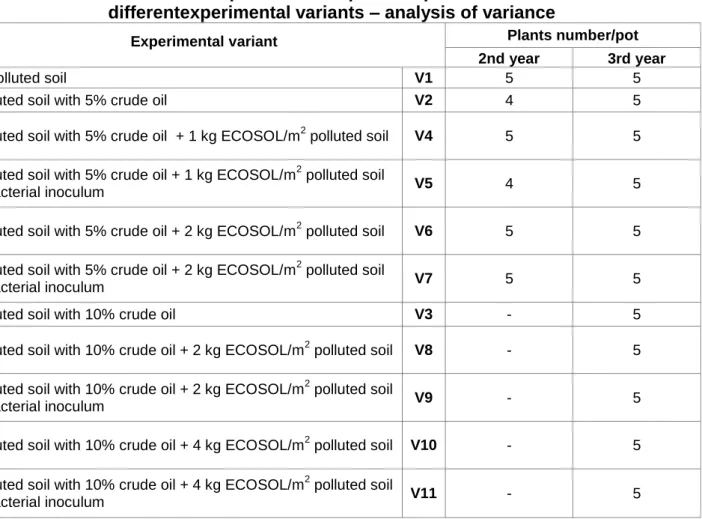
The seeding was carried out in April of the second experimental year, at a depth of 8-10 cm of 5 grains per pot. The first plants have emerged Control and in late in the experimentel pots polluted with 5% crude oil. In experimental pots with soil polluted 10% crude oil, plants do not emerged at all excessive concentration of pollutant exerting a very severe phytotoxic effect, preventing total germination.
The soil was kept in an optimal umidity state (approximately corresponding to the water capacity in the field). The beneficial effects of the applied treatments were emphasized in maize plants growth, which grew only in experimental variants polluted with 5% crude oil, best developed in experimental variantV7 with 100 g Ecosol and inoculated with selected bacteria.
In the third experimental year, the soil was homogenized before experiment reorganization. Sowing was performed in April, at a depth of 8-10 cm with a total of 5 beans in each pot. As expected, the first seedlings have emerged in control. Unlike in the previous experimental year, although the maize plants have emerged with delay in experimentalpotspolluted with crude oil at both concentrations.
The benefit effects oftreatments appliedwere foundin maizeplantsgrowth inthesecondexperimentalyear, whichcouldgrowonlyin thevariantspollutedwith5% crudeoil, thebetteroptionandinoculatedwith 0.5% (100g/pot)Ecosolwithselectedbacteria.
135
Table 1.
The evolution ofplant number/potinsoilpollutedwithcrudeoilin differentexperimental variants – analysis of variance
Experimental variant
Plants number/pot 2nd year 3rd year
unpolluted soil V1 5 5
polluted soil with 5% crude oil V2 4 5
polluted soil with 5% crude oil + 1 kg ECOSOL/m2 polluted soil V4 5 5
polluted soil with 5% crude oil + 1 kg ECOSOL/m2 polluted soil
+ bacterial inoculum V5 4 5
polluted soil with 5% crude oil + 2 kg ECOSOL/m2 polluted soil V6 5 5
polluted soil with 5% crude oil + 2 kg ECOSOL/m2 polluted soil
+ bacterial inoculum V7 5 5
polluted soil with 10% crude oil V3 - 5
polluted soil with 10% crude oil + 2 kg ECOSOL/m2 polluted soil V8 - 5
polluted soil with 10% crude oil + 2 kg ECOSOL/m2 polluted soil
+ bacterial inoculum V9 - 5
polluted soil with 10% crude oil + 4 kg ECOSOL/m2 polluted soil V10 - 5
polluted soil with 10% crude oil + 4 kg ECOSOL/m2 polluted soil
+ bacterial inoculum V11 - 5
Table 2. The evolution ofplant lengthinsoilpollutedwithcrudeoilin differentexperimental
variants – analysis of variance
Experimental variant Length (cm)
2nd year 3rd year
unpolluted soil V1 139 122
polluted soil with 5% crude oil V2 38 66
polluted soil with 5% crude oil + 1 kg ECOSOL/m2 polluted soil V4 43 80
polluted soil with 5% crude oil + 1 kg ECOSOL/m2 polluted soil
+ bacterial inoculum V5 55 83
polluted soil with 5% crude oil + 2 kg ECOSOL/m2 polluted soil V6 59 89
polluted soil with 5% crude oil + 2 kg ECOSOL/m2 polluted soil
+ bacterial inoculum V7 62 114
polluted soil with 10% crude oil V3 - 56
polluted soil with 10% crude oil + 2 kg ECOSOL/m2 polluted soil V8 - 83
polluted soil with 10% crude oil + 2 kg ECOSOL/m2 polluted soil
136
polluted soil with 10% crude oil + 4 kg ECOSOL/m2 polluted soil V10 - 88
polluted soil with 10% crude oil + 4 kg ECOSOL/m2 polluted soil
+ bacterial inoculum V11 - 112
Table 3. The evolution ofplant leaves numberinsoilpollutedwith crudeoilin
differentexperimental variants – analysis of variance
Experimental variant
Leaves number 2nd year 3rd year
unpolluted soil V1 12 14
polluted soil with 5% crude oil V2 7 8
polluted soil with 5% crude oil + 1 kg ECOSOL/m2
polluted soil V4 8 8
polluted soil with 5% crude oil + 1 kg ECOSOL/m2
polluted soil + bacterial inoculum V5 8 8
polluted soil with 5% crude oil + 2 kg ECOSOL/m2
polluted soil V6 8 8
polluted soil with 5% crude oil + 2 kg ECOSOL/m2
polluted soil + bacterial inoculum V7 8 9
polluted soil with 10% crude oil V3 - 8
polluted soil with 10% crude oil + 2 kg ECOSOL/m2
polluted soil V8 - 8
polluted soil with 10% crude oil + 2 kg ECOSOL/m2
polluted soil + bacterial inoculum V9 - 8
polluted soil with 10% crude oil + 4 kg ECOSOL/m2
polluted soil V10 - 9
polluted soil with 10% crude oil + 4 kg ECOSOL/m2
polluted soil + bacterial inoculum V11 - 9
Table 4. The evolution ofplant biomassinsoilpollutedwithcrudeoilin
differentexperimental variants – analysis of variance
Experimental variant
Biomass (g) 2nd year 3rd year
unpolluted soil V1 106 177
polluted soil with 5% crude oil V2 5 46
polluted soil with 5% crude oil + 1 kg ECOSOL/m2
polluted soil V4 6 62
polluted soil with 5% crude oil + 1 kg ECOSOL/m2
polluted soil + bacterial inoculum V5 7 64
polluted soil with 5% crude oil + 2 kg ECOSOL/m2
polluted soil V6 8 69
polluted soil with 5% crude oil + 2 kg ECOSOL/m2
polluted soil + bacterial inoculum V7 9 109
137 polluted soil with 10% crude oil + 2 kg ECOSOL/m2
polluted soil V8 - 68
polluted soil with 10% crude oil + 2 kg ECOSOL/m2
polluted soil + bacterial inoculum V9 - 72 polluted soil with 10% crude oil + 4 kg ECOSOL/m2
polluted soil V10 - 77
polluted soil with 10% crude oil + 4 kg ECOSOL/m2
polluted soil + bacterial inoculum V11 - 109
Comparison between experimental variants showed a better development of maize plants in variants with soil polluted with 5% crude oil and inoculated, the same observing also in variants of soil polluted with 10% oil and inoculated. Inoculation of soil polluted with bacteria appears to confer enhanced plant vigor of maize in combination with soil conditioning with 0.5 % and 1 % Ecosol.
Doublingthe dose ofEcosol(0.5% and 1%)added to
theexistingmaizeplantscouldflourishinconditionsof soil pollutionwith10% crudeoil.
Obviously, themoredevelopedplantsand flowersof
maizevariantsinwhichthetwotechnological,soilconditioningEcosoland inoculationwithselectedbacteria, acted synergistically.
In the experimental variants of soil polluted with 5% crude oil, biomass differences are significantly lower compared to plant biomass determined in unpolluted soil. Although uninsured statistically, biomass values gradually increase in experimental variants,from the natural attenuation to variant with0.5% Ecosol inoculated with selected bacteria. In the third experimental year and the second year of experiment with plant, differences between experimental variants polluted end significance, so that all variants undergo bioremediation process developed higher biomass values compared to that obtained with natural attenuation in the embodiment and the variant in which the soil was conditioned with 0.5 % Ecosol (100 g/pot ) and inoculated with selected bacteria generated an increase significant biomass bioremediation variants compared to the rest. The experimental variants polluted with 10% oil in the second experimental year, the first of experimentation with plant biomass was phytotoxic effect of excessive oil pollution completely preventing the plants to germinate. The following year, biomass plants in variants bioremediation was significantly higher than that of plants from variant natural attenuation and the optimal variant in which the soil was conditioned with 1% Ecosoland inoculated with selected bacteria, plant biomass was significantly higher compared to other experimental variants bioremediation. The data were correlated clear dynamics of soil pollutant disappearance.
The beneficial effects of the treatments were found in development of maize plants grown in the second experimental year, who have developed version only contaminated with 5% of oil, the more the solution and inoculated with 100 g Ecosol with selected bacteria.
Biomassplants inbioremediationvariantswas significantlyhigher thanthat
ofplantsinnaturalattenuation variants, andthe experimental
variantsconsideredoptimalinthesoilwasconditionedwithhigherEcosoldosesandinoculatedwit
h selectedbacteria, plantbiomasswas significantly higher
comparedwithotherexperimentalvariantsbioremediation. The datawerecorrelatedclearlywith the dynamicsofsoilpollutantdisappearance.
CONCLUSIONS
138
together with various physical and chemical methods. This is possible because microorganisms have enzyme systems to degrade and utilize different hydrocarbons as a source of carbon and energy. Even if the optimal conditions for microbial degradation are provided, the extent of hydrocarbon removal is strongly affected by its bioavailability and stages of weathering.
The beneficial effects of the treatments were found in development of maize plants grown in the second experimental year, who have developed in experimental variants only contaminated with 5% of oil, the more the solution and inoculated with 100 g Ecosol with selected bacteria. In the first year of experimenting with plants in pots contaminated with excessive concentration of 10% oil pollutant exercised severely phytotoxic effect, preventing total germination. In the second year experimental plant, maize plants have sprung up in crude oil contaminated pots at both concentrations of force and the enormous gap size between plants affected by oil pollution and developed a clean soil very visible. Inoculation of soil polluted with bacteria selected in combination with soil conditioning with 0.5 % and 1 % Ecosol had a beneficial effect on plant vigor of maize. Obviously, the more developed plants and flowers of maize variants in which the two technological measures act synergistically.
BIBLIOGRAPHY
1. Alexander, M., 1995 -How toxic are toxic chemicals in soil? Environmental Science and Technology, Vol. 29, No. 11, pp. 2713–2717, ISSN 0013-936X.
2. Alexander, M., 2000 -Aging, bioavailability, and overestimation of risk from environmental pollutants, Environmental Science and Technology, Vol. 34, No. 20,pp. 4259–4265, ISSN 0013-936X.
3. Burger, A.E., 1993 - Estimating the mortality of seabirds following oil spills – effects of spill volume, Marine Pollution Bulletin 26, pag. 239–248.
4. Burns, K.A., Garrity, S.D., Levings, S.C., 1996 - How many years until mangrove ecosystems recover from catastrophic oil-spills, Marine Pollution Bulletin 26, pag. 239– 248, 1993.1. Cunningham, S.D., Anderson, T.A., Schwab, A.P., Hsu, F.C., Phytoremediation of soils contaminated with organic pollutants, Advances in Agronomy 56, pag. 55–113.
5. Hutchinson, S.L., Schwab, A.P., Banks, M.K., 2001 - Bioremediation and biodegradation: phytoremediation of aged petroleum sludge: effect of irrigation techniques and scheduling, Journal of Environmental Quality 30, pag. 1516–1522.
6. Joner, E.J., Leyval, C., 2003 - Phytoremediation of organic pollutants using mycorrhizal plants: a new aspect of rhizosphere interactions, Agronomie 23, pag. 495–502.
7. Lin, Q., Mendelssohn, I.A., 1998 - The combined effects of phytoremediation and biostimulation in enhancing habitat restoration and oil degradation of petroleum contaminated wetlands, Ecological Engineering 10, pag. 263–274,.
8. Pepper, Ian L., Gerba, Charles P., Brusseau, Mark L, 1996 - Pollution Science, Academic Press.
9. Semple, K.T.; Morris, A.W.J. & Paton, G.I., 2003 -Bioavailability of hydrophobic organic contaminants in soils: fundamental concepts and techniques for analysis. EuropeanJournal of Soil Science, Vol. 54, pp. 809-818, ISSN 0022-4588.
10. Semple, K.T.; Reid, B.J. & Fermor, T.R., 2001 -Impact of composting strategies on the treatment of soils contaminated with organic pollutants. Environmental Pollution, Vol. 112, No. 2, pp. 269-283, ISSN 0269-7491.
11. Stroud, J.L.; Paton, G.I. & Semple, K.T., 2009 -Predicting the biodegradation of target hydrocarbons in the presence of mixed contaminants in soil. Chemosphere, Vol. 74, No. 4, pp. 563–567, ISSN 0045-6535