1 Directorate General Technical Airworthiness (DGTA-ADF)
Integrating System
Integrating System
Safety and Software
Safety and Software
Assurance
Assurance
Systems Certification and Integrity
Directorate of Aviation Engineering
Directorate General Technical Airworthiness
Overview
• Integration of software assurance into the
system safety program.
• Discuss different ADF paradigms for
software assurance.
• Explain application of software assurance
to missionised hazards and capability
Directorate General Technical Airworthiness (DGTA-ADF) 3
Complementary Approaches
Software Assurance
System and Software Safety
Perform functional analysis
Allocate software assurance objectives
Assign software assurance levels
Design, code and test functions to meet objectives
Identify mishaps, hazards and failure modes
Verify satisfaction of software safety requirements
Identify software contribution to hazards
Define software safety requirements to treat hazards
Safer System
Does the software satisfy the requirements?
(Did we build the product right?)
Are the requirements appropriate?
(Did we build the right product?)
Directorate General Technical Airworthiness (DGTA-ADF) 4
The Goal
• What are we trying to achieve?
– Establish a standard of proof that software
exhibits the required behaviours.
• Which means…
– What activities do I need to complete in order
to prove that my software satisfies its
Directorate General Technical Airworthiness (DGTA-ADF) 5
The Basic Concept
The more important it is that the software
should work, the more effort should be
applied to proving that it does work.
Software Assurance Paradigms in the ADF
• ARP 4754/4761 & RTCA DO-178B
– Civil Certified Aircraft
• MIL-STD-882C & RTCA DO-178B
– Military Aircraft (recent programs)
• MIL-STD-882C &
MIL-STD-498/DOD-STD-2167A
7 Directorate General Technical Airworthiness (DGTA-ADF)
ARP 4754/4761 &
ARP 4754/4761 &
RTCA DO
RTCA DO
-
-
178B
178B
Civil Certified Aircraft
Directorate General Technical Airworthiness (DGTA-ADF) 8
Applicable Standards
•
FAR 2x.1309
– Equipment, Systems and Installations
•
AC 2x.1309
– Guidance on complying with FAR 2x.1309
•
SAE ARP 4754 Certification Considerations for
Highly-Integrated or Complex Aircraft Systems
– A standard that can be used to demonstrate compliance with FAR 2x.1309
•
SAE ARP 4761 Guidelines and Methods for
Conducting the Safety Assessment Process on Civil
Airborne Systems and Equipment
– Describes the techniques that underpin ARP 4754
•
RTCA DO-178B Software Considerations in Airborne
Systems and Equipment Certification
– Describes the techniques for treating the software aspects of compliance with ARP 4754
Directorate General Technical Airworthiness (DGTA-ADF) 9
ARP 4754 System Safety Approach
ARP 4754 to DO-178B Mapping
E
No Safety Effect
D
Minor
C
Major
B
Hazardous/Severe Major
A
Catastrophic
System Development
Assurance Level
Failure Condition
Classification
Section 5.4 of ARP 4754 – Design Assurance Determination
RTCA DO-178B
Software Levels
Note:
Section 2.2.2 of DO-178B maps software levels to failure severities, but this is included only for historical reasons (DO-178B was released before ARP 4754). Section 2.2.2 of DO-178B should never be used.
Directorate General Technical Airworthiness (DGTA-ADF) 11
ARP 4754 5.4.1 Architectural Considerations
• Section 5.4.1 allows for a reduction in assurance
levels for:
–
Partitioned Designs
• Each partition assigned its own level
–
Dissimilar, Independent Designs Implementing an
Aircraft Level Function
• Two Level Bs = Level A (but can only use once in any fault tree)
–
Active/Monitor Parallel Design
• One to Level A, the other to Level C
–
Backup Parallel Design
• Primary: Level A, Backup: Level C
– Note: examples above are for Catastrophic aircraft
level failure conditions.
Directorate General Technical Airworthiness (DGTA-ADF) 12
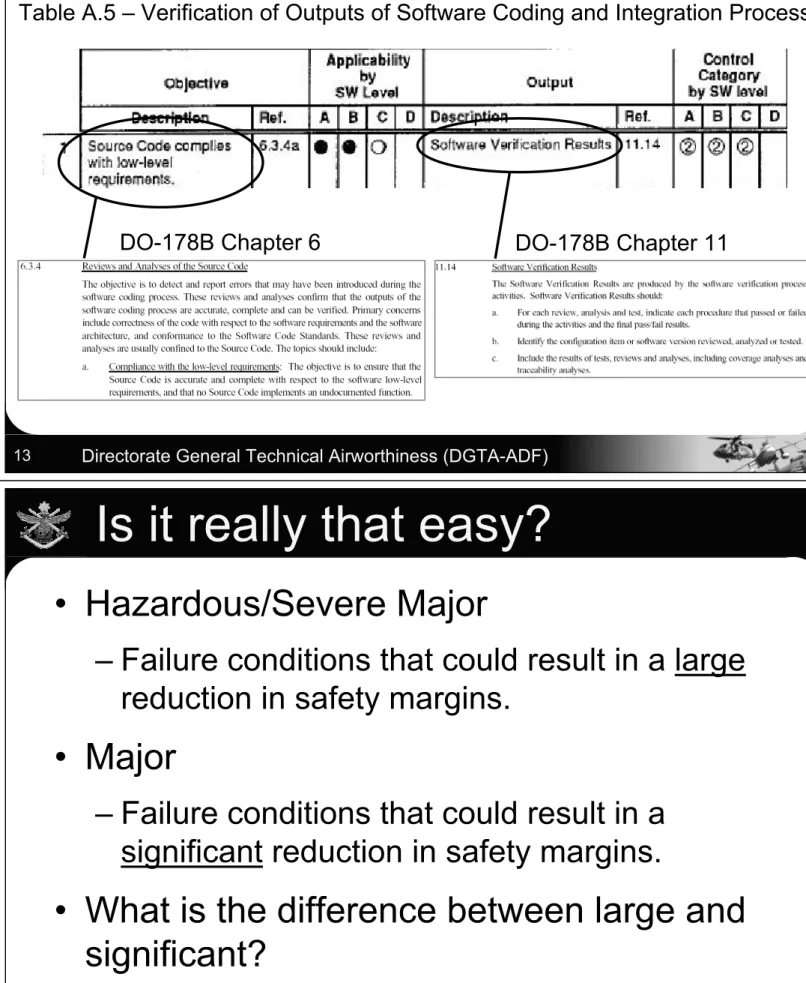
Example DO-178B
Directorate General Technical Airworthiness (DGTA-ADF) 13
DO-178B Annex A Tables
Table A.5 – Verification of Outputs of Software Coding and Integration Process
DO-178B Chapter 6 DO-178B Chapter 11
Is it really that easy?
• Hazardous/Severe Major
– Failure conditions that could result in a large
reduction in safety margins.
• Major
– Failure conditions that could result in a
significant reduction in safety margins.
• What is the difference between large and
significant?
Directorate General Technical Airworthiness (DGTA-ADF) 15
How does SCI-DGTA handle this?
• Look to FAA policy: ACs, TSOs, etc
• Best Reference: AC 23.1309-1D Appendix 1
• No published list for Part 25 (high value IP)
• Another Example: TSO-C151b TAWS
– “Software implementing the functions defined in this TSO must be developed to Level C as defined in RTCA DO-178B.”
16 Directorate General Technical Airworthiness (DGTA-ADF)
MIL
MIL
-
-
STD
STD
-
-
882C &
882C &
RTCA
RTCA
-
-
DO
DO
-
-
178B
178B
Directorate General Technical Airworthiness (DGTA-ADF) 17
Integrating Software Assurance into Military
System Safety Engineering
•
Step 1:
Functional Safety Analysis/Assessment
•
Step 2:
Categorisation of each software function
IAW Safety Integrity Level (SIL) definitions
•
Step 3:
Providing the software development
team with the required tasks for software
development and test for each SIL (i.e. process
objectives).
•
Step 4:
Implement the software development
and test tasks in accordance with the SIL
definitions.
MIL-STD-882C is Task Based
ENG Operating and Support Hazard Analysis
206
ENG System Hazard Analysis
205
ENG Subsystem Hazard Analysis
204
ENG Safety Requirements/Criteria Analysis
203
ENG Preliminary Hazard Analysis
202
ENG Preliminary Hazard List
201
MGT System Safety Progress Summary
107
MGT Hazard Tracking and Risk Resolution
106
MGT SSG/SSWG Support
105
MGT System Safety Program Review/Audits
104
MGT Integration/Management of Associate Contractors etc
103
MGT System Safety Program Plan
102
MGT System Safety Program
101
Task Type Title
Task
Directorate General Technical Airworthiness (DGTA-ADF) 19
Sample Hazard Severity Categories (MIL-STD-882C)
Less than minor injury, occupational
illness or less than minor system or
environmental damage.
IV
Negligible
Minor injury, minor occupational illness
or minor system or environmental
damage.
III
Marginal
Severe injury, severe occupational
illness, major system or environmental
damage.
II
Critical
Death, system loss or severe
environmental damage.
I
Catastrophic
Definition
Cat
Description
Directorate General Technical Airworthiness (DGTA-ADF) 20
Sample Hazard Probability Levels (MIL-STD-882C)
Unlikely to occur, but possible So unlikely it can be
assumed occurrence may not be experienced
E Improbable
Unlikely but can reasonably be expected to occur
Unlikely but possible to occur in the life of an item D
Remote
Will occur several times Likely to occur some time
in the life of an item C
Occasional
Will occur frequently Will occur several times in
the life of an item B
Probable
Continuously experienced Likely to occur frequently
A Frequent
Fleet or Inventory Specific Individual Item
Cat Description
Directorate General Technical Airworthiness (DGTA-ADF) 21
Sample Hazard Risk Index Matrix (MIL-STD-882C)
20
19
17
15
Improbable
18
16
13
10
Remote
14
11
7
4
Occasional
12
8
5
2
Probable
10
6
3
1
Frequent
NEG
MAR
CRIT
CAT
Colours link to risk acceptance authority (e.g. ADF AA, OAA, OAAR, DAR).
Likelihoods cannot be correctly assigned to software causal factors: how then does software fit into the above matrix?
Software Control Categories
DescriptionControl Category
No control of safety related functions. IV
Displays information about discrete events that require an operator to respond to prevent a hazard occurring.
IIIb
Control over hazardous systems, but operator action required to complete the task.
IIIa
Displays information that if incorrect, may lead to operator action/inaction that progressively degrades safety margins. IIb
Direct control but time for intervention by independent safety system.
IIa
Displays information that is directly and constantly relied upon. Ib
Direct control. Ia
Directorate General Technical Airworthiness (DGTA-ADF) 23
Software Hazard Risk Index
5
5
5
5
IV
4
4
4
3
III
4
4
3
2
II
4
3
2
1
I
NEG
MAR
CRIT
CAT
Control
Hazard Category
E 5 D 4 C 3 B 2 A 1 DO-178B Level SHRIAircraft hazards will mostly fall into
here… Satisfaction of assurance level is the measure of hazard
acceptability.
Directorate General Technical Airworthiness (DGTA-ADF) 24
SHRI vs. HRI
• SHRIs and HRIs are not interchangeable or
comparable.
• Consider multi-axis aircraft stability
augmentation system.
– Loss of function Catastrophic.
• Probabilistic (hardware) Failure Modes:
– High Probability (> 10-2): HRI = 1
– Low Probability (< 10-9): HRI = 15
– HRI is a measure of acceptability
• Systematic (software) Failure Modes
– Poor Software: SHRI = 1 (Catastrophic/Control Category Ia) – Good Software: SHRI = 1 (Catastrophic/Control Category Ia) – SHRI is not a measure of acceptability.
Directorate General Technical Airworthiness (DGTA-ADF) 25
Don’t Confuse Methods
• Navigation System for Large Aircraft
• ARP 4754 & DO-178B
– Loss of: Major
– Malfunction: Hazardous – Requires DO-178B Level B
• MIL-STD-882C & DO-178B
– Hazard Category: Catastrophic (CFIT)
– Control Category: IIb (Display of Information) – SHRI 2: Requires DO-178B Level B
• Incorrect
– Malfunction: Hazardous → Critical in 882C terminology – Control Category: IIb
– SHRI 3: Requires DO-178B Level C
9
9
8
MIL
MIL
-
-
STD
STD
-
-
882C &
882C &
MIL
MIL
-
-
STD
STD
-
-
498/DOD
498/DOD
-
-STD
STD
-
-
2167A
2167A
Directorate General Technical Airworthiness (DGTA-ADF) 27
MIL-STD-882C to MIL-STD-498 Mapping
5
5
5
5
IV
4
4
4
3
III
4
4
3
2
II
4
3
2
1
I
NEG
MAR
CRIT
CAT
Control
Hazard Category
?? 5 ?? 4 ?? 3 ?? 2 ?? 1 MIL-STD-498 Level SHRI MIL-STD-498 does not define varying levels ofdevelopment and verification rigour.
Directorate General Technical Airworthiness (DGTA-ADF) 28
Software Assurance Matrix
Directorate General Technical Airworthiness (DGTA-ADF) 29
From MIL-STD-882D Rev 1
Putting it All Together
Commercial Aircraft
Military Aircraft
FAR 2x.1309
MIL-STD-882C
AC 2x.1309
ARP 4754/4761
IEEE-1228 DO-178B
JSSSC SSSH DO-178B
IEEE-1228
31 Directorate General Technical Airworthiness (DGTA-ADF)
Weapons
Weapons
STANAG 4404 and
STANAG 4404 and
AOP
AOP
52
52
Directorate General Technical Airworthiness (DGTA-ADF) 32
Background
• DEOP 102 approves the following software standards:
– AOP-52
• Guidelines for the Safety and Suitability for Service of Safety Critical Computing Systems in Munitions Applications
– DEF (AUST) 5679
• The Procurement of Computer-Based Safety Critical Systems
– IEEE/EIA STD 12207
• Software Life Cycle Processes – Implementation Considerations
– RTCA/DO-178B
• Software Considerations in Airborne Systems and Equipment Certification
– STANAG 4404
• Safety Design Requirements and Guidelines for Munitions Related Safety Critical Computing Systems
– STANAG 4452
Directorate General Technical Airworthiness (DGTA-ADF) 33
STANAG 4404
• STANAG 4404 combines software safety and software
assurance considerations.
• It identifies:
– Generic software safety requirements. – Good software design practices.
– Verification benchmarks.
• Apply practices to Safety Critical Computing System
Functions (SCCSF).
– Provides guidance on which functions are likely to be SCCSFs.
• Assigns example MIL-STD-882C control categories to
weapon functions.
STANAG 4404 Requirements Applicability
F&E:Fuzes,
Electronic Arming and Safety Devices
S:Seekers
GS:Guidance Systems
T&L:Targeting and Launcher Control Systems
P&F:Pointing and Firing Cutout Systems
C&C: Command and Control Systems
Directorate General Technical Airworthiness (DGTA-ADF) 35
Using STANAG 4404
• If STANAG 4404 is to be used, there are a number of
shortfalls that should be resolved:
– STANAG 4404 was never ratified, so it doesn’t really exist.
• SCI-DGTA is aware of at least two different versions.
• You may need to apply your own configuration control, or include a copy in the contract.
– Some requirements are ambiguous.
• Example: All software testing shall be controlled by a formal test coverage analysis and document. Computer based tools shall be used to ensure that the coverage is as complete as possible. • When is coverage complete? Statement? Decision?
Condition/Decision? Exhaustive? • What is ‘as complete as possible’?
• You may need to provide clarification to some requirements.
Directorate General Technical Airworthiness (DGTA-ADF) 36
AOP-52
• AOP-52 replaced STANAG 4404 and STANAG
4452.
• Strikingly similar to the JSSSC SSSH.
• AOP-52 is a guidance document.
– It does not contain clear requirements.
– It would be very difficult, if not impossible, to apply it
under a contract.
– But, it does contain good information and practices.
Directorate General Technical Airworthiness (DGTA-ADF) 37
Using STANAG 4404 – An Example
• Consider a weapon guidance system.
• Is it a Safety Critical Computing System Function?
– Probably: see para 5.3.a
• “Any function which determines, controls, or directly influences the flight path of a munition system.”
– Annex B: A guidance system with a self destruct capability is Control Category II:
• “Software exercises control over potentially hazardous hardware systems, subsystems, or components allowing time for intervention by independent safety systems to mitigate the hazard. However, these systems by
themselves are not considered adequate.”
• Which requirements are applicable?
– See GS column of Table B-1.
Missionised Hazards
Missionised Hazards
and Capability
and Capability
Integrity
Directorate General Technical Airworthiness (DGTA-ADF) 39
The Basic Concept
The more important it is that the software
should work, the more effort should be
applied to proving that it does work.
…. except now the motivation is completion of the mission.
Directorate General Technical Airworthiness (DGTA-ADF) 40
Definitions
• Missionised Hazards
– … aircraft system hazards considered not
only within benign operating environments
but also within worst credible missionised
scenarios.
• Capability Integrity
– … functionality required for achieving
mission objectives but with limited
airworthiness impact.
Directorate General Technical Airworthiness (DGTA-ADF) 41
Missionised Hazards
• May be considered as part of the functional and
system-level hazard assessments.
– Operator input at SSWGs.
• Tracked and maintained through the hazard log.
• Requires good engineering judgement
– credible scenarios
• Examples???
– Not used very often.
Capability Integrity Definitions
•
Mission Critical
– Failure conditions would immediately raise the threat posed by external events (e.g. enemy action) to unacceptable levels and could result in loss of the aircraft.
•
Mission Serious
– Failure conditions would reduce the capability of the aircraft or the ability of the crew to cope with adverse mission conditions to the extent that there would be:
• a large reduction in mission capabilities,
• higher workload such that the flight crew could not be relied upon to perform their tasks accurately or completely, or • increased risk to aircrew and occupants.
•
Mission Degraded
Directorate General Technical Airworthiness (DGTA-ADF) 43
Software Level Assignments
No additional objectives
Mission Degraded
DO-178B Level D
Mission Serious
DO-178B Level C
Mission Critical
Software Level Assignment
Mission Failure
Categorisation
DO-178B sets objectives for developing and verifying high-integrity software. The need for high-integrity software can be driven by either safety or mission considerations.
AAP 7001.054 Section 2 Chapter 7
Directorate General Technical Airworthiness (DGTA-ADF) 44
Capability Integrity – Examples
Mission more difficult, but still possible.
Mission Degraded Data Link
Large reduction in mission
capabilities, but no direct threat to the aircraft.
Mission Serious ESM
For aircraft that operate in a more benign environment (e.g. AAR) Mission Serious
RWR/MWS/CMDS
For aircraft that operate in a hostile environment (e.g. F/A-18)
Mission Critical RWR/MWS/CMDS
Considerations Mission Failure
Categorisation Mission System
Directorate General Technical Airworthiness (DGTA-ADF) 45
Capability Integrity
• Clearly articulated in the contract
– e.g. AAR to Level C, AP-3C ESM to Level D
• Mission assumptions verified by operators
– Input at SSWGs
– Documented
• Requires good engineering judgement
– credible scenarios
Summary
• Three paradigms for integrating software
assurance into the system safety program.
– Civil: Severity of failure linked to assurance
level.
– Military: Hazard Category and Control
Category.
– Both: more safety critical
→
more effort.
• Missionised Hazards
• Capability Integrity
Directorate General Technical Airworthiness (DGTA-ADF) 47