Geosci. Model Dev., 12, 955–978, 2019 https://doi.org/10.5194/gmd-12-955-2019 © Author(s) 2019. This work is distributed under the Creative Commons Attribution 4.0 License.
A new method (M
3
Fusion v1) for combining observations and
multiple model output for an improved estimate of the global
surface ozone distribution
Kai-Lan Chang1,2,3, Owen R. Cooper2,3, J. Jason West4, Marc L. Serre4, Martin G. Schultz5, Meiyun Lin6,7,
Virginie Marécal8, Béatrice Josse8, Makoto Deushi9, Kengo Sudo10,11, Junhua Liu12,13, and Christoph A. Keller12,13,14 1National Research Council Research Associateship Program, David Skaggs Research Center, Boulder, CO, USA
2NOAA Earth System Research Laboratory, Boulder, CO, USA
3Cooperative Institute for Research in Environmental Sciences, University of Colorado, Boulder, CO, USA 4Department of Environmental Sciences & Engineering, University of North Carolina, Chapel Hill, NC, USA 5Jülich Supercomputing Centre (JSC), Forschungszentrum Jülich, Jülich, Germany
6NOAA Geophysical Fluid Dynamics Laboratory, Princeton, NJ, USA
7Program in Atmospheric and Oceanic Sciences, Princeton University, Princeton, NJ, USA 8Météo-France, Centre National de Recherches Météorologiques, Toulouse, France 9Meteorological Research Institute (MRI), Tsukuba, Japan
10Graduate School of Environmental Studies, Nagoya University, Nagoya, Japan
11Japan Agency for Marine-Earth Science and Technology (JAMSTEC), Yokosuka, Japan 12NASA Goddard Space Flight Center, Greenbelt, MD, USA
13Universities Space Research Association, Columbia, MD, USA
14John A. Paulson School of Engineering and Applied Science, Harvard University, Cambridge, MA, USA Correspondence:Kai-Lan Chang ([email protected])
Received: 19 July 2018 – Discussion started: 5 September 2018
Revised: 30 January 2019 – Accepted: 14 February 2019 – Published: 12 March 2019
Abstract. We have developed a new statistical approach (M3Fusion) for combining surface ozone observations from thousands of monitoring sites around the world with the out-put from multiple atmospheric chemistry models to produce a global surface ozone distribution with greater accuracy than can be provided by any individual model. The ozone observa-tions from 4766 monitoring sites were provided by the Tro-pospheric Ozone Assessment Report (TOAR) surface ozone database, which contains the world’s largest collection of sur-face ozone metrics. Output from six models was provided by the participants of the Chemistry-Climate Model Initia-tive (CCMI) and NASA’s Global Modeling and Assimilation Office (GMAO). We analyze the 6-month maximum of the maximum daily 8 h average ozone value (DMA8) for rel-evance to ozone health impacts. We interpolate the irregu-larly spaced observations onto a fine-resolution grid by using integrated nested Laplace approximations and compare the
1 Introduction
Tropospheric ozone is a pollutant detrimental to human health and has been associated with a range of adverse car-diovascular and respiratory health effects due to short-term and long-term exposure (World Health Organization, 2005; Jerrett et al., 2009; US Environmental Protection Agency, 2013; GBD, 2015; Turner et al., 2016; Cohen et al., 2017). Assessing the human health impacts of ozone on the global scale requires accurate exposure estimates at any given in-habited location (Shaddick et al., 2018). Due to the lim-ited availability of surface ozone observations in many re-gions of the world (Fleming et al., 2018), global atmospheric chemistry models are required to calculate surface ozone exposure. Despite continual development and improvement, global models struggle in their ability to accurately simulate ozone in all regions of the world (Young et al., 2018). The ability to accurately simulate observed ozone at a particular location also varies between models, as demonstrated by sev-eral multi-model comparisons (Stevenson et al., 2006; Young et al., 2013; Cooper et al., 2014).
A useful endeavor for producing an accurate representa-tion of the global surface ozone distriburepresenta-tion is to combine the output from many models in a way that takes advantage of the strengths of each model and minimizes the weaknesses. Such efforts have already been made for both climate and chemistry–climate models. For example, multi-model output has been combined using a parametric approach, either by as-signing an equal or optimum weight to each model (Steven-son et al., 2006; He and Xiu, 2016; Braverman et al., 2017) or by tuning the initial conditions under different scenarios or parameterizations (Cariolle and Teyssèdre, 2007; Wu et al., 2008; Young et al., 2013). These approaches often assume that individual model biases will at least partly cancel by av-eraging or weighting, according to certain measures of pre-dictive performance. Thus, the combined model product is likely to be more accurate than a single model prediction, as has been shown for multi-model combinations of past or present-day climate (Buser et al., 2009; Knutti et al., 2010; Weigel et al., 2010; Chandler, 2013).
For the case of simply averaging the output from multi-ple climate models, most studies either explicitly or implic-itly assume that every model is independent and is a random sample from a distribution, with the true climate as its un-biased mean. This implies that the average of a set of mod-els converges to the true climate as more and more modmod-els are added. This multi-model ensemble often outperforms any single model in terms of the predictive capability. Undeni-ably, when one has several dozen or hundreds of possible ensemble members, the most straightforward and efficient approach is to simply take the ensemble average, ignoring the impact of potentially erroneous outlier ensemble mem-bers. From a statistical point of view, one might argue that ruling out potentially erroneous ensemble members prior to conducting the ensemble mean would yield an even better
re-sult, especially if the overall number of ensemble members is small.
Combining model ensembles using a method more so-phisticated than the simple average is a challenge because a meaningful model evaluation can rarely be condensed into a single metric, and there is no technique that can explic-itly quantify the degree of similarity (i.e., both accuracy and precision) between two different spatial fields (Hyde et al., 2018). Indeed, Stainforth et al. (2007) concluded that any at-tempt to assign weights is, in principle, inappropriate. With a lack of appropriate criteria, the model weighting approach has not become a standard alternative to the ensemble aver-age. Accordingly, there is presently no objective criterion for combining surface ozone estimates from a model ensemble to produce a surface ozone product with improved accuracy beyond that of any ensemble member or the simple ensemble mean. The absence of such a methodology is the motivation for this paper.
This paper presents a new statistical approach (M3Fusion) for combining surface ozone output from multiple atmo-spheric chemistry models with all available surface ozone observations to produce a global surface ozone distribution with greater accuracy than the multi-model ensemble mean. As described in greater detail below, this fused surface ozone product is constructed in three steps: (1) ozone observations from all available surface ozone monitoring sites around the world are spatially interpolated to a smooth global field; (2) for each of eight continental regions of the world, six global atmospheric chemistry models are evaluated against the interpolated observed ozone field by a quadratic program-ming optimization, with the most accurate models receiving the highest weight; a locally confined spline interpolation is used at the regional boundaries to avoid unphysical step changes; (3) finally, the global ozone field derived from the polynomial equation is bias corrected but only within a lim-ited distance from available observations. The final product is based on the annual maximum of the 6-month running mean of the monthly average daily maximum 8 h average mixing ratios (DMA8), a metric that can be used to estimate human mortality due to long-term ozone exposure (Turner et al., 2016; Malley et al., 2017; Seltzer et al., 2018; Shindell et al., 2018).
im-K.-L. Chang et al.: Global surface ozone data fusion 957
pacts of ozone on human health, or vegetation, and it can also be applied to PM2.5, CO2or any other trace gas.
Section 2 provides details of the data sources and fusion process, including the techniques to register all data sources onto a common grid and the statistical model used to min-imize the difference between interpolated observations and the multi-model combination. In Sect. 3, the results of em-ploying these techniques are presented, including the map-ping accuracy, evaluation of regional model performance and the final multi-model bias correction. The paper concludes with a summary and discussion in Sect. 4.
2 Data and method
2.1 Observations and model output
1. Tropospheric Ozone Assessment Report (TOAR) surface ozone database.In this analysis, surface ozone observa-tions are used to evaluate the performance of six global atmospheric chemistry models and to also bias correct the multi-model surface ozone product. TOAR has pro-duced the world’s largest database of surface ozone met-rics based on hourly observations at over 9000 sites around the globe (Schultz et al., 2017, ozone met-rics available for download at https://doi.org/10.1594/ PANGAEA.876108). Spatial coverage is high in North America, Europe, South Korea and Japan, but much lower across the rest of the world with very low data availability across Africa, the Middle East, Russia and India. In addition to data sparseness, other challenges, such as data inhomogeneity in time and the irregu-lar spatial distribution of stations (Chang et al., 2017), make the comparison between model output and ob-servations difficult without serious statistical modeling. While satellite retrievals have been utilized by previ-ous works for quantifying the health impacts of PM2.5 (Brauer et al., 2012, 2015), satellite retrievals of tro-pospheric ozone have limited sensitivity near the sur-face and are inadequate for this analysis (Gaudel et al., 2018).
TOAR has gathered ozone observations through 2014 at most sites and has chosen 2008–2014 as a “present-day” window for more rigorous analysis. The purposes of the multi-year average are to reduce the effects of ozone in-terannual variability, which is largely driven by changes in meteorological conditions (Strode et al., 2015), and to increase the number of available sites than if we used a single year. In this analysis, we focus on the annual maximum of the 6-month running mean of the max-imum daily 8 h average (DMA8) at every site in the TOAR database. Specifically, the metric was calculated from the 6-month running mean of the monthly mean DMA8 ozone values at a given site. This metric was selected because it aligns with the ozone metric used
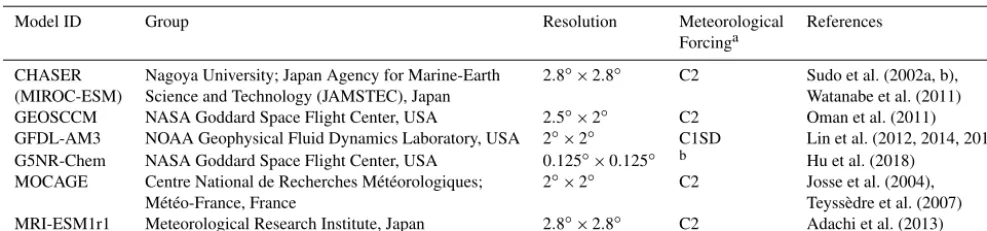
by Turner et al. (2016) to quantify the impact of long-term ozone exposure on human mortality. Hereinafter, this quantity is simply referred to as “the ozone metric”. 2. Atmospheric chemistry model simulations.We use out-put from models from phase 1 of the Chemistry-Climate Model Initiative (CCMI), downloaded from the Centre for Environmental Data Analysis (CEDA) database (http://archive.ceda.ac.uk, CEDA, 2019). We chose four models (CHASER, GEOSCCM, MOCAGE and MRI-ESM1r1) because they report hourly ozone output (Table 1). These particular simulations were part of CCMI’s REF-C2 experiment (Morgenstern et al., 2017), which follows the World Meteorological Orga-nization (2011) A1 scenario for ozone depleting sub-stances, and RCP6.0 for tropospheric ozone precur-sors, and aerosol and aerosol precursor emissions (Mor-genstern et al., 2010) for the period 1960–2100. Even though the most appropriate experiment would have been the REF-C1SD, in which the models are nudged to the reanalysis meteorology and thus best represent the past in the observations, we use output from the C2 simulation in this study, as the last year of the REF-C1SD was 2010 and would therefore not cover the most recent period where observations are available. How-ever, the NOAA Geophysical Fluid Dynamics Labora-tory (GFDL) AM3 model continued the simulation over the entire study period and was therefore selected for this analysis. In addition, we obtained output from the GEOS-5 nature run with chemistry (G5NR-Chem), pro-vided by the NASA Global Modeling and Assimilation Office (GMAO), which we included in our analysis be-cause of the model’s very fine horizontal resolution (Hu et al., 2018), but the output was only available for July 2013 to June 2014.
The output from each individual model is shown in Fig. S1 in the Supplement. Note that NASA G5NR-Chem has the finest resolution of these models; accord-ingly, we aim to produce our final product on the same 0.125◦×0.125◦grid. However, even at this resolution, the output is not street resolving and thus will not cap-ture urban-scale variability in the regions with the high-est population density.
Table 1.List of the ensemble members used in this paper.
Model ID Group Resolution Meteorological References Forcinga
CHASER Nagoya University; Japan Agency for Marine-Earth 2.8◦×2.8◦ C2 Sudo et al. (2002a, b), (MIROC-ESM) Science and Technology (JAMSTEC), Japan Watanabe et al. (2011) GEOSCCM NASA Goddard Space Flight Center, USA 2.5◦×2◦ C2 Oman et al. (2011) GFDL-AM3 NOAA Geophysical Fluid Dynamics Laboratory, USA 2◦×2◦ C1SD Lin et al. (2012, 2014, 2017) G5NR-Chem NASA Goddard Space Flight Center, USA 0.125◦×0.125◦ b Hu et al. (2018)
MOCAGE Centre National de Recherches Météorologiques; 2◦×2◦ C2 Josse et al. (2004), Météo-France, France Teyssèdre et al. (2007) MRI-ESM1r1 Meteorological Research Institute, Japan 2.8◦×2.8◦ C2 Adachi et al. (2013)
aMeteorological forcing includes coupled ocean–atmosphere (C2) and nudged to observed reanalysis meteorology (C1SD) in CCMI reference simulations (Morgenstern et al., 2017). bThe specification of forcing scenario for this special run is described by Hu et al. (2018).
on the surrogate and then project the global surface onto a common grid.
2.2 Fusion of observations and models
Following is a description of our method for fusing obser-vations and output from multiple global atmospheric chem-istry models to produce a surface ozone product with maxi-mized accuracy. This method is known as Measurement and Multi-Model Fusion (version 1), or M3Fusion (v1), and the code accompanies this paper in the Supplement. We consider a general framework of uncertainty quantification consisting of the following components (Kennedy and O’Hagan, 2001; Chang and Guillas, 2019):
observation =reality+random error;
reality =model+structured bias.
Since this equation requires matching components (observa-tions and model output) on a common grid, we use the in-terpolated observations to estimate an optimized weight for each model by a L2 norm (details are given later), which means that we expect the multi-model combination to cap-ture the general pattern of the surface ozone distribution in terms of their joint predictive capability, and the model bias is considered as a model correction term. The difference be-tween observation error and model bias is that the former term is assumed to be a normal noise with zero mean and constant variance, and the latter term is considered as a sys-tematic and structured discrepancy (Williamson et al., 2015), which will be revealed as a spatial cluster across a poorly simulated region.
Due to this study’s human health focus, we do not consider ozone above the data-sparse oceans. Above land, large ob-servational gaps are present across Africa, the Middle East, South America, and south and southeast Asia, where the spa-tial interpolation is generally too uncertain to yield a reli-able surface ozone approximation. The ozone estimates in these regions must come from either models or distant ob-servations, neither of which is ideal to solve this issue. As a compromise strategy, we fill these gaps with a weighted
model product evaluated by the interpolated ozone observa-tions. We propose the following procedure to combine model output and observations for data integration:
1. Interpolating irregularly located monitoring observa-tions to the model output grid. Kriging is a proce-dure used to statistically interpolate irregularly spaced and/or sparse observed data onto a regular and dense grid, based on a weighted average of the fitted surrogate model in the neighborhood of the grid. We assume that the global ozone distribution can be approximated by a Gaussian spatial process (GP) with a constant mean and Matérn covariance function (Stein, 2012). The GP fitting typically involves a cubic complexity and thus is computationally expensive for large spatial data sets. Therefore, several alternatives have been developed to address the largenissue by using a reduced set of data (Cressie and Johannesson, 2008; Banerjee et al., 2012; Liang et al., 2013), tapering the covariance between two grid points to zero if their distance is beyond a certain range (Furrer and Sain, 2009; Sang and Huang, 2012) and/or evaluating the covariance only through the spec-ification of a neighborhood system (also known as the Gaussian Markov random field) (Rue et al., 2009; Lind-gren et al., 2011).
K.-L. Chang et al.: Global surface ozone data fusion 959
and complex spatial field in a relatively efficient way (Rue and Held, 2005) and allows an extension for non-stationarity on the sphere (Bolin and Lindgren, 2011; Chang et al., 2015). Notably, a recent study elaborately compared dozens of spatial modeling approaches, and the results suggest that almost all of these approaches can achieve a similar performance in terms of their pre-dictive accuracy, albeit with very different computation times (Heaton et al., 2018). Therefore, we expect that the choice of spatial modeling approach is not the most crucial component in our data fusion process as long as the analysis is carried out in a rigorous way (i.e., through the statistical model selection and diagnostics). To differentiate this result from the actual observations in the TOAR database, we refer to this interpolated sur-face as the “spatially interpolated ozone”.
We carry out the statistical interpolation via the fol-lowing steps: (1) calculate the ozone metric at each TOAR site and for every year in 2008–2014; (2) per-form the statistical interpolation using all available sites with their exact coordinates and project the surface onto a 0.125◦×0.125◦ spherical grid for every year; (3) average these surfaces over the 7 years to yield an observation-based present-day ozone distribution. We expect that this aggregation will smooth out at least some of the potential uncertainties. The kriging can be seen as a nonparametric regression problem; therefore, a statistical assessment of fitted quality must be consid-ered to select the best representation to the data (Hoet-ing et al., 2006). Further details on the statistical model selection procedure are provided in Appendix A. We use a bilinear interpolation to smooth model out-put from coarser resolution to a 0.125◦×0.125◦ grid (Jun et al., 2008). The ozone metric for each model was calculated for each single grid in each year, then aver-aged over 2008–2014 (except for NASA G5NR-Chem, which was already in fine resolution, but only available for 1 year).
2. Weighting model output against spatially interpolated ozone by region.The next step is to create an intermedi-ate “multi-model composite”. We divide the global land surface into eight regions (see Fig. 1), roughly match-ing the continental outlines or major population regions. We adopt this regional approach because global models vary in their ability to simulate ozone in different re-gions of the world. Next, we regress the observations on multi-model output by a constrained least square approach within each of the eight regions. Let sg be the grid cell at resolution 0.125◦×0.125◦,y(sˆ g)be the interpolated observations and {ηk(sg);k=1, . . .,6}be the model output registered onto the same grid from the six models considered in this paper (Table 1). The optimization equation is based on a constrained least
squares approach:
minimize {αr,βr k;k=1,...,6}
X
sg∈Regionr ˆ
y(sg)−αr− 6 X
k=1
βr kηk(sg) !2
, (1)
subject to 6 X
k=1
βr k=1 and βr k≥0.,
where αr is a constant that allows adjustment to the overall (regional) underestimation or overestimation; βr k is an optimal weight for thekth model in regionr. Note that since the interpolated observations and mod-els use the same ozone metric with the same units, we constrain the weights to be positive and sum to 1 for a better physical interpretability, such that the most accu-rate models receive the higher weight. The offset term αr is aimed to adjust the overall residuals between the observation field and the multi-model composite into zero mean in each region (regardless of the spatial pat-tern); therefore, if two spatial fields share a great simi-larity in terms of their spatial curvatures, but the overall means are different, this term can fill the gap of the over-all mean difference between the two fields. The weights are optimized in terms of the squared distance between the interpolated ozone and multi-model output. A dif-ferent criterion of optimization, such as mean absolute error, can be established accordingly.
Due to the sparsity of stations in many regions, we use a predefined geometric boundary to differentiate gions. A more meaningful physical boundary (i.e., re-gions with similar chemical regimes or major features such as deserts, mountain ranges or water bodies) might be determined using a cluster analysis technique (Hyde et al., 2018), but such a step is beyond the scope of this paper.
Since we partition the global land surface into eight re-gions and evaluate the models individually, inevitably there will be disjointed boundaries between regions. The boundaries between North and South America, or between east Asia and Oceania, fall mostly in the oceans, so we do not need to adjust these regions. However, we should make an adjustment to disjointed boundaries that fall across inhabited areas (see Fig. S2 for the illustration). As an example of our method, con-sider the boundary between east Asia and Russia near 50◦N. We increase the northern boundary of east Asia to 55◦N and decrease the southern boundary of
Rus-sia to 45◦N, to create an overlapping intersection, and
merely avoid a sharp and unrealistic (geometric) tran-sition between three regions and to efficiently smooth out the discontinuity, performed in a regular spaced grid only around the geometric boundary. Any region away from the geometric boundary will not be affected by this smoothing, which should be considered as a blending of multiple models without any attempt of bias correction. It should be noted that the INLA-SPDE technique in step 1 is applied to the observations, while the smooth-ing spline is only applied to the boundaries between re-gions of the model composite, not directly involving any observations.
We adopted a regression weighting approach that only accounts for the mean spatial fields of the interpo-lated ozone and model output, rather than the underly-ing associated uncertainty. We take this approach due to the prohibitive size of high-resolution output (over 1 million output points for each model) but also due to the lack of a thorough investigation regarding the ideal method for combining models based on different sources of uncertainty. For example, the interpolation uncertainty can be quantified easily through the poste-rior distribution and considered to be related to mea-surement error (small scale) or sparse sampling across a region (large scale); however, model uncertainty is a different concept altogether that could result from input uncertainty (e.g., air pollution emissions inventories) or limitations of the transport and chemistry mechanisms within the model (Brynjarsdóttir and O’Hagan, 2014). The current interest of this study focuses on a better estimate of mean ozone exposure. Explicit quantifica-tion of different sources of model uncertainty and in-corporation of this information into the data fusion pro-cess presents another level of complexity that cannot be tackled until model uncertainties are better character-ized. Young et al. (2018) provide a current overview of chemistry–climate modeling and discuss the challenges of improving models in light of so many uncertainties. 3. Correcting multi-model bias in areas close to
observa-tions. A common practice of studying the model dis-crepancy in the spatial fields is to fit a statistical model for their differences from observations on the whole spatial domain, to see whether or not these residuals re-veal any structured spatial pattern (Jun and Stein, 2004; Sang et al., 2011). If the model adequately simulates the ozone distribution (up to a level shift and a scale factor), then there is no relevant information in these residuals. On the other hand, if the model does not properly repre-sent the local structure, then the residuals should exhibit a signal of the discrepancy in that region (Guillas et al., 2006; Williamson et al., 2015). However, in our case, the regular grid observation field is obtained from spa-tial kriging, such that in many data-sparse regions we do not actually have observed ozone, which prevents us
from correcting the model in these regions. Instead, we conduct a limited model bias correction based on the distance to the nearest monitoring station, but we ignore the differences between the multi-model composite and the interpolated observations in the sparsely monitored regions. In our approach, we only correct the output grid where there is at least one observational station within a 2◦radial distance of the grid cell in question (i.e., the distance to the nearest station is less than 2◦). We then end up using
ˆ
y(sg),if a grid cellsgis within a 2◦radial distance of the station;
αr+ 6 P
k=1
βr kηk(sg),otherwise,
to generate our high-resolution global surface ozone es-timate. Given the limited availability of observations worldwide, we were only able to apply this final bias correction to 14.4 % of the globe’s land area. We refer to the final outcome as the “fused surface ozone product”.
3 Results
3.1 Mapping and uncertainty
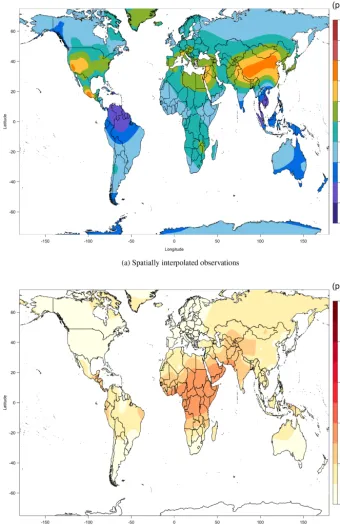
Ground-based measurements were available from 4766 sta-tions reported in the TOAR database (Schultz et al., 2017). To illustrate the spatial coverage of the database, Fig. 1 shows the ozone metric discretized to a 2◦×2◦grid (a finer resolu-tion will be too obscure for illustrative purposes), averaged over the period 2008–2014. This figure also shows our re-gionalized classification, including Africa, North America, South America, east Asia, southeast and central Asia, Eu-rope, Oceania and Russia. Note that dense station networks are found in North America, Europe and east Asia (mostly in Japan and South Korea), while monitoring sites are more widely scattered across the remaining regions. The highest average ozone levels are found at sites in China, South Korea, Japan, Taiwan, India, Greece, California and Mexico City.
K.-L. Chang et al.: Global surface ozone data fusion 961
Figure 1.TOAR observations where the monitoring locations are discretized to a 2◦×2◦grid in 2008–2014.
ideal, and instead information from models can be used to fill in the blanks.
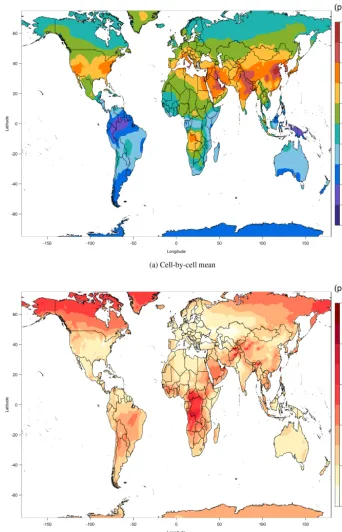
The ozone metric for each model was calculated for each individual grid cell in each year, then averaged over 2008– 2014 and registered to the common 0.125◦×0.125◦grid (ex-cept for NASA G5NR-Chem, which was already in fine res-olution, but only available for 1 year). Figure 3a shows the surface ozone metric which results from the simple ensem-ble average of the six models. It was generated from bilinear interpolation of the ozone metric on the standard output grid, by calculating the same metric for each grid cell in each year, averaging over 2008–2014 and then averaging over the six models. We refer to this product as the “multi-model mean”, and we use it to validate our final product, which should out-perform not only each individual model but also the multi-model mean.
Averaging all six models captures the large-scale varia-tions of the ozone distribution; however, many regions in northern midlatitudes and low latitudes are biased high com-pared to the observations in the TOAR database. A simple approach to address the uncertainty in the multi-model mean is to calculate the standard deviation for each grid cell from the different models, as shown in Fig. 3b. Higher model un-certainties across south Africa and the Middle East match the pattern of the interpolation uncertainty in Fig. 2b, and lower model uncertainties occur in regions with dense station net-works. These findings suggest that the multi-model mean un-certainty can also reflect the current limited understanding of surface ozone in regions with limited or no observations.
It should be noted that the spatially interpolated observa-tions are smoother in regions with fewer sites and reveal a
more detailed structure in regions with a dense station net-work. In contrast, the multi-model mean is more noisy. Even though we average across multiple years and multiple mod-els, the resulting ozone metric can still be noisy because it is calculated at each grid cell independently. In order to make maximum use of the skill of each model, we restrict the model evaluation to the regional scale in the next section. 3.2 Regional model evaluation and multi-model
composite
To evaluate the performance of each model in a given region, we calculate the mean differences over all grid cells within the region and summarize them with the root mean square er-ror (RMSE). Lety(sˆ g)be the spatially interpolated observa-tions and{ηk(sg);k=1, . . .,6}be the output corresponding to the six ensemble models considered in this paper; then, the (normalized) RMSE is given by
RMSEr k= s
P
sg∈Regionr ηk(sg)− ˆy(sg) 2
n ,
Figure 2.Estimates of spatially interpolated surface ozone distribution and associated uncertainty (half width of the 95 % credible interval from each cell).
as America and Europe. However, larger model biases can be found in Africa, and east and south Asia.
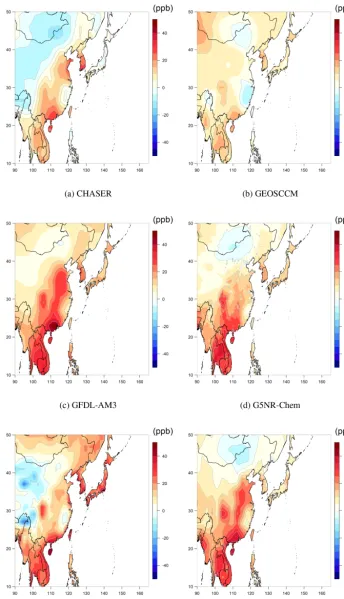
Next, we select three regions with extensive monitoring: North America, Europe and east Asia. Figure 4 shows the differences between the spatially interpolated observations
K.-L. Chang et al.: Global surface ozone data fusion 963
Figure 3.Multi-model mean and standard deviation (SD) in each grid cell from six ensemble members.
regions; in Europe (Fig. 5), the models show mild levels of overestimation across most of the region, especially for Italy. In east Asia (Fig. 6), the models show a major bias across east China and a similar bias pattern across the entire region, although the bias amplitude is smaller for GEOSCCM. How-ever, since the observations are relatively sparse in mainland
China, the large scale of these estimated biases might be an interpolation artifact.
K.-L. Chang et al.: Global surface ozone data fusion 965
K.-L. Chang et al.: Global surface ozone data fusion 967
output are not expected to match point by point. We should also expect the model to capture the general pattern of the spatial distribution, rather than a pointwise agreement.
The estimated weights from the constrained least squares (Eq. 1) are given in the second part of Table 2. Due to fixed underlying spatial structures, this approach tends to give greater weight to a single model (i.e.,≥50 %); the one which provides the best match between its spatial structure and the observational field (e.g., G5NR-Chem in North Amer-ica). Note that this approach disfavors noisy spatial structure; therefore, the algorithm gives low weights to MOCAGE, for several reasons. First, the MOCAGE ozone field has not been smoothed by interpolation since it is already produced on the MOCAGE model grid, whereas all other models are inter-polated. Secondly, MOCAGE uses a more complete tropo-spheric chemical scheme with a larger range of species (77 tropospheric species) and has generally a higher reactivity compared to most chemistry–climate models (CCMs) (Voul-garakis et al., 2013). Thus, it tends to provide more tempo-ral and spatial variability. Note that our optimization algo-rithm estimates the weights according to the similarity of the spatial structures between the interpolated surface and each model. In regions with sparse monitoring, the kriged surface can be greatly affected by a few scattered stations; therefore, we cannot use the resulting weights to evaluate the actual model performance in these regions.
The last column of Table 2 shows the averaged and com-bined RMSEs from the equal weights and the constrained weights. A reduced overall bias can be generally achieved from the constrained weights. This approach suggests that even if a model has a large mean error (e.g., GFDL-AM3), it can still be a good simulation if it produces a spatial pat-tern and curvature similar to the observation field. A con-stant offsetαrin the optimization Eq. (1) is included to re-move the overall bias over each region, such that the resid-uals from the optimization have a zero mean. On the other hand, if we do not includeαrin the equation, GFDL-AM3 will have a smaller weight in the optimization, and CHASER, GEOSCCM and G5NR-Chem will dominate most of these regions (not shown).
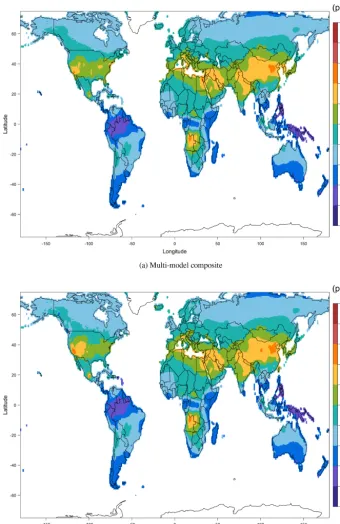
We combine all models according to the optimum weights from each region for each model. Figure 7a shows a map of the multi-model composite, a weighted blend of the six mod-els, with the weighting calculated separately for each con-tinent. Models with greater simulation skill receive higher weighting. The result reveals a systematic adjustment to the large-scale overestimation from the ensemble mean in Fig. 3a. This demonstration of a general high bias among the models argues against using the simple ensemble model mean for estimating surface ozone. However, when com-pared to the TOAR observations, the multi-model composite still has clear local biases.
3.3 Local bias correction
The last step of producing the final fused surface ozone product is to apply a bias correction to our multi-model com-posite, limited to just those areas in close proximity to ozone observations. Ideally, we would like to apply a bias correc-tion according to raw observacorrec-tions, but most stacorrec-tions are not exactly located on the model grid coordinates (even at 0.125◦×0.125◦resolution). Therefore, to carry out a statis-tical bias correction on a particular grid, we need to consider the number of nearby stations and the distance to each sta-tion. All these considerations aim to deduce a single correc-tion value on a single grid, and thus we are still faced with implementing statistical interpolation. To avoid adding an-other level of complexity, we set the final fused product to be exactly equal to the spatially interpolated ozone field within 2◦of an observation, as the spatially interpolated ozone field
has already accounted for all observations. Due to the global sparseness of observations, about 85 % of model grid cells over land were not affected by this bias correction. After bias correcting the multi-model composite grid cells within 2◦of a TOAR observation site, an immediate benefit is seen for the US, Mexico City, Italy and South Korea (see Fig. 7b).
The choice of the correction range, in this case 2◦, is a ad hoc decision; we also present results with different correction ranges in Figs. S3 and S4. When the radius of influence of the TOAR observations is increased to 5◦or more, the greatest impact is seen for the Mexico City region and eastern China. An increase of correction range is not ideal because it extrap-olates the Mexico City ozone values into the less populated regions of Mexico. Increasing the radius to 5◦or more does not improve upon the RMSE associated with 2◦. Therefore,
accepting the 2◦bias correction over other ranges is
subjec-tive.
The fused product can be evaluated in terms of spatial relation using the variogram which assumes that spatial cor-relation is not a function of absolute location but only a func-tion of distance (i.e., stafunc-tionarity). Since spatial variability and continuity from the models are the result of geophysical processes represented by mathematical equations, the vari-ogram must be customized for each field. In addition, the extremely large size of the model output prohibits us from carrying out a standard empirical variogram analysis, which requires calculating the variance of the difference between all pairwise grid cells.
K.-L. Chang et al.: Global surface ozone data fusion 969
Table 2.RMSEs (averaged errors in a given region) between spatially interpolated observations and each model, along with regionally optimized weights{βrk: forkth model in regionr}(zero weights are not displayed). Last column shows the RMSEs from equal weighted
averages or constrained weights from the multi-model composite. All the numbers are reported in units of ppb (i.e., parts per billion by volume).
Region Regional RMSE Averaged error
CHASER GEOSCCM GFDL-AM3 G5NR-Chem MOCAGE MRI-ESM1r1
Africa 6.40 8.91 12.16 12.16 10.47 14.89 10.83
N. America 10.04 8.90 11.28 9.20 24.39 8.41 12.04
S. America 7.39 7.19 10.00 8.81 10.59 8.59 8.76
E. Asia 9.12 9.42 15.89 13.33 17.68 14.40 13.31
S./C. Asia 7.68 15.11 13.36 13.38 13.37 18.41 13.55
Europe 9.14 8.41 10.75 8.20 11.88 9.66 9.67
Oceania 6.00 6.81 11.82 9.42 9.38 9.24 8.78
Russia 6.59 9.10 11.71 7.86 20.29 6.04 10.27
Region Constrained weights of the multi-model composite Composite error
αr CHASER GEOSCCM GFDL-AM3 G5NR-Chem MOCAGE MRI-ESM1r1
Africa −5.25 0.27 0.12 0.43 0.01 0.17 – 5.39
N. America −7.84 – 0.38 – 0.62 – – 4.35
S. America 2.13 0.63 0.13 – 0.24 – – 5.37
E. Asia −7.99 0.08 0.83 0.09 – – – 4.88
S./C. Asia −8.90 0.52 0.26 0.12 0.10 – – 4.95
Europe −9.91 – – 0.78 0.13 0.09 – 2.75
Oceania −2.36 0.73 – – 0.27 – – 5.76
Russia −7.15 0.21 – 0.45 0.32 0.02 – 2.04
cates the evidence of nonstationarity in the field, which is the case for SPDE, an issue that we have accounted for. The variogram peak is about 35–40◦for the models. The result is very similar for G5NR-Chem, GEOSCCM and GFDL-AM3, while CHASER and MRI-ESM show a larger variance in the spatial field. The reason is that the latter two models produce low ozone in the high-latitude region over Canada (see Fig. S1), but the former three models simulate relatively higher ozone in the same region, and this difference is re-flected by the total variance. Even though North America has one of the most extensive monitoring networks in the world, some of the remote areas (mostly in Canada) are mainly de-scribed by the model output in the final fused product. There-fore, the variogram of the fused product is likely adjusted toward the remote areas of Canada as simulated by G5NR-Chem, which provided the largest weighting in North Amer-ica).
3.4 Validation of the results
Since the raw observations are the only reliable source for validating our results, we align each model grid to observed locations for evaluating the predictive performance. The RM-SEs of the residuals from all observations in 2008–2014 are displayed in Table 3. Note that, since the global network of monitoring stations is heavily weighted by North America, Europe, South Korea and Japan, these numbers are not repre-sentative of the sparsely monitored regions. We compare the
Table 3.RMSE against TOAR observations (i.e., not interpolated ozone) from the multi-model mean (MMM), multi-model compos-ite (from fusion step 2) and the final fused product (from fusion step 3).
MMM Composite Fusion
E. Asia 14.44 5.72 4.27
Europe 11.64 5.31 4.26
N. America 12.22 4.51 2.76
Overall∗ 12.32 5.16 3.82
∗Overall category includes all available sites around the world.
fused surface ozone results to the simple multi-model mean from all six models. Our interim product, i.e., the multi-model composite, is also compared in Table 3.
since we apply the correction based on observed locations). The RMSE of approximately 5 ppb may represent the inter-annually varying meteorological influence during the years 2008–2014. If this is the case, then 5 ppb may approximate the minimal RMSE that can be achieved in a multi-year anal-ysis.
In summary, the simple multi-model mean method may perform fairly well at the continental or regional scale but does not provide an accurate representation of the subre-gional structure; this is of course a limitation on the use of coarse model resolutions. The weighting applied during the construction of the multi-model composite improved the ac-curacy but the effect could be limited, because many small-scale processes are not (yet) resolved by the models. To alle-viate the discrepancy further, a statistical method based on lo-cal observations is applied to correct the bias. The advantage of our fused surface ozone product over the simple multi-model mean can be clearly seen in Fig. 8. When interpreting the fused product, the reader should consider the following: (1) for a region with an extensive monitoring network, such as the US, a detailed bias correction can be achieved. We can utilize the observations to accurately reflect many local fea-tures (i.e., subgrid variations) as shown in the ozone pollu-tion hotspots of southern California and Mexico City. How-ever, it should be noted that this improvement is due to local bias correction instead of model weighting. (2) For regions with large observational gaps, such as South America, Africa or Russia, the spatial difference between the fused product and the multi-model mean is rather featureless, because the model weighting can only adjust the overall regional mean according to a few monitoring sites and cannot address the local variations. Filling large data gaps with the intermedi-ate multi-model composite can indeed avoid the influence of preferential sampling (Diggle et al., 2010; Shaddick and Zidek, 2014), but it is still subject to a high uncertainty due to lack of data.
4 Discussion and conclusions
In this article, we present a flexible framework to incorporate observations and multiple models for providing an improved estimate of the global surface ozone distribution. Combining multivariate spatial fields in the estimation of ozone distri-bution is an extension of both the conventional multi-model ensemble approach (i.e., simple average) and a statistical bias correction approach, and was found to improve the prediction of surface ozone. In summary, our approach has the follow-ing properties:
1. The multi-year average enables us to reduce the mete-orological influence on surface ozone. An extension of this method to time-resolved multi-annual fields can be expected to capture the interannual variability (Shad-dick and Zidek, 2015); however, such an endeavor
would be highly computationally demanding in such a fine-resolution setting.
2. The INLA-SPDE interpolation framework allows for modeling of potential nonstationarity in the spatial pro-cesses.
3. Regional model evaluation facilitates a feature selection for multiple competing atmospheric models.
4. Local bias correction of the multi-model composite only at a limited range of grid cells avoids using the spa-tially interpolated ozone field in regions associated with higher levels of uncertainty.
5. For the regions with dense monitoring networks (such as North American, Europe, South Korea and Japan), the final fused product was obtained mainly from the in-terpolation of observations; elsewhere, the final product relied on the multi-model composite through an opti-mized weight from each model.
Human health studies typically adopt a fine grid resolu-tion, such as a 0.1◦×0.1◦grid product, for matching to the gridded world population database. Even though the spatial kriging surrogate can produce the predicted value at any res-olution, the accuracy of the fused surface ozone product is still limited by the density of observations around that point and by the resolution of the global model output. Regarding future improvements, two key developments can be expected to yield a better estimation of the global surface ozone distri-bution: firstly, we can include more simulators for increased leverage. Another way to increase the estimation accuracy is to expand ozone monitoring networks across sparsely sam-pled regions (Sofen et al., 2016; Schultz et al., 2017; Weath-erhead et al., 2017).
The application of our methodology focuses on, but is not limited to, a particular ozone metric relevant for quantifying the impact of long-term ozone exposure on human health. We expect that this framework could also be applied to other ozone metrics relevant to crop production or natural vegeta-tion (Lefohn et al., 2018; Mills et al., 2018), or any other trace gas, provided adequate in situ observations are available for model evaluation.
method-K.-L. Chang et al.: Global surface ozone data fusion 971
Figure 8.Map showing result for multi-model mean minus the fused surface ozone.
ology developed by this paper can be used to improve the accuracy of model output, either for individual models or for multi-model ensembles.
Appendix A: Spatial modeling using the INLA-SPDE approach
In this paper, the aim of spatial interpolation is to use (dis-cretized) monitoring observations to build a statistical sur-rogate model for estimating the ozone distribution over the whole domain on a sphere. We assume that this ozone dis-tribution follows a Gaussian process (GP). A GP is a collec-tion of random variables such that any subset of the obser-vations has a joint Gaussian distribution. It has been widely used in many applications as a machine learning algorithm (Rasmussen and Williams, 2006). In this section, we briefly introduce the GP model with a focus on spatial kriging. The GP is a popular choice in spatial statistics because it allows modeling of fairly complicated functional forms, and it also provides a prediction and associated uncertainty at any new location. A common limitation of this interpolation is that the resulting distribution of estimated uncertainty will be lower around individual stations or within dense monitoring net-works, and higher in sparsely monitored regions.
LetY denote annvector of ozone observations measured at monitoring sitess; then a statistical model for the spatial field can be expressed asY=f (s)+ε; i.e., the model com-prises a smooth GP spatial processf (s), capturing spatial as-sociation, and an independent normal errorε, which follows a normal errorN (0, σ2). This error term can accommodate potential measurement error; on the other hand, kriging with-out measurement error is usually used for the surrogate of a deterministic model (i.e., the same input always produces the same output), also known as an emulator (e.g., Conti and O’Hagan, 2010).
The specification of a GP is through its mean function and covariance function, denoted byf (s)∼GP m(s), c(s,s0)
. To reduce computational intensity, the mean function can be assumed to be a constant m(s)=µ; thus, the resulting spatial distribution is completely defined by the covariance function. A covariance function characterizes correlations between different locations in the spatial process; it is the crucial component in a GP, as it represents our assumptions about the latent field from which we wish to build a surro-gate. Specifically, we use the Matérn covariance function, which is a flexible covariance structure and widely used in spatial statistics (Hoeting et al., 2006; Jun and Stein, 2007, 2008). With the shape parameter ν >0, the scale parame-terκ >0 and the marginal precisionτ2>0, the covariance structure can be written as
c(h)= 2
1−ν
4π κ2ντ20(ν+1)(κkhk) νK
ν(κkhk),h∈S2,
where h denotes the distance between any two locations:
h=s−s0,0is a gamma function, andKν is the modified Bessel function of the second kind of orderν >0. The scale parameterκ controls the rate of decay of the correlation be-tween two locations as distance increases. Smaller values of κ allow for longer ranges over which two sites can be
corre-lated. The smoothness parameterνcan be seen as the deter-mining behavior of the autocorrelation for observations that are separated by a small distance.
The major disadvantage of using a GP is the computational complexity, which typically involves a cubic complexity in the number of data points, usually denoted asO(n3). Several attempts have been made to reduce the computational bur-den: e.g., Cressie and Johannesson (2008), Rue et al. (2009), Banerjee et al. (2012) and Gramacy and Apley (2015). Lind-gren et al. (2011) introduced a popular approach in which the Matérn covariance can be approximated by the solution of certain stochastic partial differential equations (SPDEs). According to Lindgren et al. (2011), a GP processf (s)with Matérn covariance on a sphere is the solution of the follow-ing stationary SPDE:
(κ2−1)(ν+1)/2τf (s)=W(s),
where1is the Laplace operator andWis the Gaussian white noise. The core implication of this mathematical relationship is that an efficient algorithm for solving this SPDE can be applied to approximate the GP (Lindgren et al., 2011).
This INLA-SPDE technique also enables us to quantify the level of nonstationarity in a spatial field by employing basis function representations for bothκ and τ (i.e., these quantities are constants in a stationary field). To obtain ba-sic identifiability,κ(s)andτ (s)are taken to be positive, and their logarithm can be represented as
logκ(s)=
p X
k=1
θkκψk(s) and
logτ (s)=
p X
k=1
θkτψk(s), (A1)
where{ψk(s)} is a set of spherical harmonics. The coeffi-cients{θkκ}and{θkτ}represent local variances and correlation ranges (Bolin and Lindgren, 2011; Lindgren et al., 2011). A larger number of basis functions permits the representation of smaller local features.
We now illustrate a series of statistical model fits to select the best predictive ability of the SPDE model. To choose the maximum number of basis functions for the parametersκand τ in Eq. (A1), model selection techniques must be used. We perform the model selection based on the following criteria:
– RMSE is the measure of the overall mean difference be-tween predicted values and the observed values. – DIC (deviance information criterion) is a measure to
K.-L. Chang et al.: Global surface ozone data fusion 973
– GCV (generalized cross validation) calculates the mean residuals in a leave-one-out test. The model that mini-mizes the average predicted residuals over all the data is selected as the best model (Schneider, 2001).
We estimate nine statistical models with different numbers of basis functions, presented in Table A1. The simplest model is a stationary Matérn model (we use basis number 0 to rep-resentκandτ as constants). The best fit of all criteria occurs when the orders of the basis functions are increased from four to five. We therefore conclude that a model with five spatially varying basis functions is most appropriate for the TOAR observations.
Table A1.Summary of results from fitting nine candidate statistical models (annual average over 2008–2014).
No. basis 0 1 2 3 4 5 6 7 8
RMSE 3.82 3.17 3.18 3.23 2.90 2.52 2.76 2.76 3.44
DIC −1517 −1548 −1556 −1561 −1593 −1621 −1603 −1594 −1565
Supplement. The supplement related to this article is available online at: https://doi.org/10.5194/gmd-12-955-2019-supplement.
Author contributions. KLC, ORC, JJW and MLS contributed to conception and design. ORC and MGS contributed to the acqui-sition of data. All authors contributed to the analysis and interpre-tation of data. KLC and ORC drafted the article, while all authors helped with the revision. All authors approved the submitted and revised versions for publication.
Competing interests. The authors declare that they have no conflict of interest.
Acknowledgements. This work was funded by the NASA Health and Air Quality Applied Sciences Team (grant no. NNX16AQ80G).
Edited by: Tim Butler
Reviewed by: two anonymous referees
References
Adachi, Y., Yukimoto, S., Deushi, M., Obata, A., andTaichu. Y. Tanaka, H. N., Hosaka, M., Sakami, T., Yoshimura, H., Hirabara, M., Shindo, E., Tsujino, H., Mizuta, R., Yabu, S., Koshiro, T., Ose, T., and Kitoh, A.: Basic performance of a new earth system model of the Meteorological Research Institute (MRI-ESM1), Pap. Meteorol. Geophys, 64, 1–18, https://doi.org/10.2467/mripapers.64.1, 2013.
Anenberg, S. C., Horowitz, L. W., Tong, D. Q., and West, J. J.: An estimate of the global burden of anthropogenic ozone and fine particulate matter on premature human mortality using at-mospheric modeling, Environ. Health Persp., 118, 1189–1195, https://doi.org/10.1289/ehp.0901220, 2010.
Banerjee, A., Dunson, D. B., and Tokdar, S. T.: Efficient Gaussian process regression for large datasets, Biometrika, 100, 75–89, https://doi.org/10.1093/biomet/ass068, 2012.
Berrocal, V. J., Gelfand, A. E., and Holland, D. M.: Space-time data fusion under error in computer model output: An application to modeling air quality, Biometrics, 68, 837–848, https://doi.org/10.1111/j.1541-0420.2011.01725.x, 2012. Bolin, D. and Lindgren, F.: Spatial models generated by nested
stochastic partial differential equations, with an application to global ozone mapping, Ann. Appl. Stat., 5, 523–550, https://doi.org/10.1214/10-AOAS383, 2011.
Brauer, M., Amann, M., Burnett, R. T., Cohen, A., Dentener, F., Ezzati, M., Henderson, S. B., Krzyzanowski, M., Martin, R. V., Dingenen, R. V., van Donkelaar, A., and Thurston, G. D.: Ex-posure assessment for estimation of the global burden of disease attributable to outdoor air pollution, Environ. Sci. Technol., 46, 652–660, https://doi.org/10.1021/es2025752, 2012.
Brauer, M., Freedman, G., Frostad, J., van Donkelaar, A., Martin, R. V., Dentener, F., van Dingenen, R., Estep, K., Amini, H., Apte, J. S., Balakrishnan, K., Barregardh, L., Broday, D., Feigin, V., Ghosh, S., Hopke, P. K., Knibbs, L. D., Kokubo, Y., Liu, Y.,
Ma, S., Morawska, L., Sangrador, J. L. T., Shaddick, G., An-derson, H. R., Vos, T., Forouzanfar, M. H., Burnett, R. T., and Cohen, A.: Ambient air pollution exposure estimation for the global burden of disease 2013, Environ. Sci. Technol., 50, 79– 88, https://doi.org/10.1021/acs.est.5b03709, 2015.
Braverman, A., Chatterjee, S., Heyman, M., and Cressie, N.: Proba-bilistic evaluation of competing climate models, Adv. Stat. Clim. Meteorol. Oceanogr., 3, 93–105, https://doi.org/10.5194/ascmo-3-93-2017, 2017.
Brynjarsdóttir, J. and O’Hagan, A.: Learning about physical param-eters: The importance of model discrepancy, Inverse Probl., 30, 114007, https://doi.org/10.1088/0266-5611/30/11/114007, 2014. Buser, C. M., Künsch, H. R., Lüthi, D., Wild, M., and Schär, C.: Bayesian multi-model projection of climate: bias assump-tions and interannual variability, Clim. Dynam., 33, 849–868, https://doi.org/10.1007/s00382-009-0588-6, 2009.
Cameletti, M., Lindgren, F., Simpson, D., and Rue, H.: Spatio-temporal modeling of particulate matter concentration through the SPDE approach, AStA Adv. Stat. Anal., 97, 109–131, https://doi.org/10.1007/s10182-012-0196-3, 2013.
Cariolle, D. and Teyssèdre, H.: A revised linear ozone photochem-istry parameterization for use in transport and general circulation models: multi-annual simulations, Atmos. Chem. Phys., 7, 2183– 2196, https://doi.org/10.5194/acp-7-2183-2007, 2007.
CEDA: Centre for Environmental Data Analysis: CCMI archive, available at: http://data.ceda.ac.uk/badc/wcrp-ccmi/data/ CCMI-1/output/, last access: 28 February 2019.
Chandler, R. E.: Exploiting strength, discounting
weak-ness: combining information from multiple climate
simulators, Philos. T. R. Soc. A, 371, 20120388,
https://doi.org/10.1098/rsta.2012.0388, 2013.
Chang, K.-L. and Guillas, S.: Computer model calibration with large non-stationary spatial outputs: application to the calibra-tion of a climate model, J. Roy. Stat. Soc. C-Appl., 68, 51–78, https://doi.org/10.1111/rssc.12309, 2019.
Chang, K.-L., Guillas, S., and Fioletov, V. E.: Spatial mapping of ground-based observations of total ozone, Atmos. Meas. Tech., 8, 4487–4505, https://doi.org/10.5194/amt-8-4487-2015, 2015. Chang, K.-L., Petropavlovskikh, I., Cooper, O. R., Schultz,
M. G., and Wang, T.: Regional trend analysis of sur-face ozone observations from monitoring networks in eastern North America, Europe and East Asia, Elementa, 5, p. 50, https://doi.org/10.1525/elementa.243, 2017.
Cohen, A. J., Brauer, M., Burnett, R., Anderson, H. R., Frostad, J., Estep, K., Balakrishnan, K., Brunekreef, B., Dandona, L., Dan-dona, R., Feigin, V., Freedman, G., Hubbell, B., Jobling, A., Kan, H., Knibbs, L., Liu, Y., Martin, R., Morawska, L., III, C. A. P., Shin, H., Straif, K., Shaddick, G., Thomas, M., van Dingenen, R., van Donkelaar, A., Vos, T., Murray, C. J. L., and Forouzan-far, M. H.: Estimates and 25-year trends of the global burden of disease attributable to ambient air pollution: an analysis of data from the Global Burden of Diseases Study 2015, The Lancet, 389, 1907–1918, https://doi.org/10.1016/S0140-6736(17)30505-6, 2017.
Conti, S. and O’Hagan, A.: Bayesian emulation of complex multi-output and dynamic computer models, J. Stat. Plan. Infer., 140, 640–651, https://doi.org/10.1016/j.jspi.2009.08.006, 2010. Cooper, O. R., Parrish, D. D., Ziemke, J. R., Balashov, N. V.,
K.-L. Chang et al.: Global surface ozone data fusion 975
N. R., Lamarque, J.-F., Naik, V., Oltmans, S. J., Schwab, J., Shindell, D. T., Thompson, A. M., Thouret, V., Wang, Y., and Zbinden, R. M.: Global distribution and trends of tropospheric ozone: An observation-based review, Elementa, 2, p. 000029, https://doi.org/10.12952/journal.elementa.000029, 2014. Cressie, N. and Johannesson, G.: Fixed rank kriging for very
large spatial data sets, J. Roy. Stat. Soc. B, 70, 209–226, https://doi.org/10.1111/j.1467-9868.2007.00633.x, 2008. Diggle, P. J., Menezes, R., and Su, T.-l.: Geostatistical inference
under preferential sampling, J. Roy. Stat. Soc. C-App., 59, 191– 232, 2010.
Fleming, Z. L., Doherty, R. M., von Schneidemesser, E., Malley, C. S., Cooper, O. R., Pinto, J. P., Colette, A., Xu, X., Simp-son, D., Schultz, M. G., Lefohn, A. S., Hamad, S., Moolla, R., Solberg, S., and Feng, Z.: Tropospheric Ozone Assessment Re-port: Present-day ozone distribution and trends relevant to human health, Elementa, 6, p. 12, https://doi.org/10.1525/elementa.273, 2018.
Fuentes, M. and Raftery, A. E.: Model evaluation and spa-tial interpolation by Bayesian combination of observations with outputs from numerical models, Biometrics, 61, 36–45, https://doi.org/10.1111/j.0006-341X.2005.030821.x, 2005. Furrer, R. and Sain, S. R.: Spatial model fitting for large datasets
with applications to climate and microarray problems, Stat. Com-put., 19, 113–128, https://doi.org/10.1007/s11222-008-9075-x, 2009.
Gaudel, A., Cooper, O. R., Ancellet, G., Barret, B., Boynard, A., Burrows, J. P., Clerbaux, C., Coheur, P. F., Cuesta, J., Cuevas, E., Doniki, S., Dufour, G., Ebojie, F., Foret, G., Garcia, O., Muños, M. J. G., Hannigan, J. W., Hase, F., Huang, G., Hassler, B., Hurt-mans, D., Jaffe, D., Jones, N., Kalabokas, P., Kerridge, B., Ku-lawik, S. S., Latter, B., Leblanc, T., Flochmoën, E. L., Lin, W., Liu, J., Liu, X., Mahieu, E., McClure-Begley, A., Neu, J. L., Os-man, M., Palm, M., Petetin, H., Petropavlovskikh, I., Querel, R., Rahpoe, N., Rozanov, A., Schultz, M. G., Schwab, J., Siddans, R., Smale, D., Steinbacher, M., Tanimoto, H., Tarasick, D. W., Thouret, V., Thompson, A. M., Trickl, T., Weatherhead, E. C., Wespes, C., Worden, H. M., Vigouroux, C., Xu, X., Zeng, G., and Ziemke, J. R.: Tropospheric Ozone Assessment Report: Present-day distribution and trends of tropospheric ozone relevant to cli-mate and global atmospheric chemistry model evaluation, Ele-menta, 6, p. 39, https://doi.org/10.1525/elementa.291, 2018. GBD: Global, regional, and national comparative risk assessment of
79 behavioural, environmental and occupational, and metabolic risks or clusters of risks in 188 countries, 1990–2013: a sys-tematic analysis for the Global Burden of Disease Study 2013, The Lancet, 386, 2287–2323, https://doi.org/10.1016/S0140-6736(15)00128-2, 2015.
Gelfand, A. E. and Sahu, S. K.: Combining monitoring data and computer model output in assessing environmental exposure, in: Handbook of Applied Bayesian Analysis, Oxford University Press, Oxford, UK, 482–510, 2010.
Gotway, C. A. and Young, L. J.: Combining
incompat-ible spatial data, J. Am. Stat. Assoc., 97, 632–648,
https://doi.org/10.1198/016214502760047140, 2002.
Gramacy, R. B. and Apley, D. W.: Local Gaussian process approxi-mation for large computer experiments, J. Comput. Graph. Stat., 24, 561–578, https://doi.org/10.1080/10618600.2014.914442, 2015.
Guillas, S., Tiao, G. C., Wuebbles, D. J., and Zubrow, A.: Statistical diagnostic and correction of a chemistry-transport model for the prediction of total column ozone, Atmos. Chem. Phys., 6, 525– 537, https://doi.org/10.5194/acp-6-525-2006, 2006.
He, Y. and Xiu, D.: Numerical strategy for model correction using physical constraints, J. Comput. Phys., 313, 617–634, https://doi.org/10.1016/j.jcp.2016.02.054, 2016.
Heath, A., Manolopoulou, I., and Baio, G.: Estimating the expected value of partial perfect information in health economic evalua-tions using integrated nested Laplace approximation, Stat. Med., 35, 4264–4280, https://doi.org/10.1002/sim.6983, 2016. Heaton, M. J., Datta, A., Finley, A. O., Furrer, R., Guinness, J.,
Guhaniyogi, R., Gerber, F., Gramacy, R. B., Hammerling, D., Katzfuss, M., Lindgren, F., Nychka, D. W., Sun, F., and Zammit-Mangion, A.: A case study competition among methods for analyzing large spatial data, J. Agric. Biol. Envir. S., 1–28, https://doi.org/10.1007/s13253-018-00348-w, online first, 2018. Hoeting, J. A., Davis, R. A., Merton, A. A., and Thompson, S. E.: Model selection for geostatistical models, Ecol. Appl., 16, 87– 98, https://doi.org/10.1890/04-0576, 2006.
Hu, L., Keller, C. A., Long, M. S., Sherwen, T., Auer, B., Da Silva, A., Nielsen, J. E., Pawson, S., Thompson, M. A., Trayanov, A. L., Travis, K. R., Grange, S. K., Evans, M. J., and Jacob, D. J.: Global simulation of tropospheric chemistry at 12.5 km res-olution: performance and evaluation of the GEOS-Chem chem-ical module (v10-1) within the NASA GEOS Earth system model (GEOS-5 ESM), Geosci. Model Dev., 11, 4603–4620, https://doi.org/10.5194/gmd-11-4603-2018, 2018.
Hyde, R., Hossaini, R., and Leeson, A. A.: Cluster-based analysis of multi-model climate ensembles, Geosci. Model Dev., 11, 2033– 2048, https://doi.org/10.5194/gmd-11-2033-2018, 2018. Jerrett, M., Burnett, R. T., Pope III, C. A., Ito, K., Thurston,
G., Krewski, D., Shi, Y., Calle, E., and Thun, M.: Long-term ozone exposure and mortality, N. Engl. J. Med., 360, 1085–1095, https://doi.org/10.1056/NEJMoa0803894, 2009.
Josse, B., Simon, P., and Peuch, V.-H.: Radon global simulations with the multiscale chemistry and transport model MOCAGE,
Tellus B, 56, 339–356,
https://doi.org/10.1111/j.1600-0889.2004.00112.x, 2004.
Jun, M. and Stein, M. L.: Statistical comparison of observed and CMAQ modeled daily sulfate levels, Atmos. Environ., 38, 4427– 4436, https://doi.org/10.1016/j.atmosenv.2004.05.019, 2004. Jun, M. and Stein, M. L.: An approach to producing space–time
covariance functions on spheres, Technometrics, 49, 468–479, https://doi.org/10.1198/004017007000000155, 2007.
Jun, M. and Stein, M. L.: Nonstationary covariance
mod-els for global data, Ann. Appl. Stat., 2, 1271–1289,
https://doi.org/10.1214/08-AOAS183, 2008.
Jun, M., Knutti, R., and Nychka, D. W.: Spatial analysis to quan-tify numerical model bias and dependence: how many cli-mate models are there?, J. Am. Stat. Assoc., 103, 934–947, https://doi.org/10.1198/016214507000001265, 2008.
Kammann, E. and Wand, M. P.: Geoadditive models, J. Roy. Stat. Soc. C-App., 52, 1–18, https://doi.org/10.1111/1467-9876.00385, 2003.
Knutti, R., Furrer, R., Tebaldi, C., Cermak, J., and Meehl,
G. A.: Challenges in combining projections from
multiple climate models, J. Climate, 23, 2739–2758,
https://doi.org/10.1175/2009JCLI3361.1, 2010.
Lefohn, A. S., Malley, C. S., Smith, L., Wells, B., Hazucha, M., Simon, H., Naik, V., Mills, G., Schultz, M. G., Paoletti, E., De Marco, A., Xu, X., Zhang, L., Wang, T., Neufeld, H. S., Musselman, R. C., Tarasick, D., Brauer, M., Feng, Z., Tang, H., Kobayashi, K., Sicard, P., Solberg, S., and Gerosa, G.: Tropo-spheric ozone assessment report: Global ozone metrics for cli-mate change, human health, and crop/ecosystem research, Ele-menta, 6, p. 28, https://doi.org/10.1525/elementa.279, 2018. Liang, F., Cheng, Y., Song, Q., Park, J., and Yang, P.: A
resampling-based stochastic approximation method for analysis of large geo-statistical data, J. Am. Stat. Assoc., 108, 325–339, 2013. Lin, M., Fiore, A. M., Horowitz, L. W., Cooper, O. R., Naik,
V., Holloway, J., Johnson, B. J., Middlebrook, A. M., Olt-mans, S. J., Pollack, I. B., Ryerson, T. B., Warner, J. X., Wiedinmyer, C., Wilson, J., and Wyman, B.: Transport of Asian ozone pollution into surface air over the western United States in spring, J. Geophys. Res., 117, D00V07, https://doi.org/10.1029/2011JD016961, 2012.
Lin, M., Horowitz, L. W., Oltmans, S. J., Fiore, A. M., and Fan, S.: Tropospheric ozone trends at Mauna Loa Observatory tied to decadal climate variability, Nat. Geosci., 7, 136–143, https://doi.org/10.1038/NGEO2066, 2014.
Lin, M., Horowitz, L. W., Payton, R., Fiore, A. M., and Tonnesen, G.: US surface ozone trends and extremes from 1980 to 2014: quantifying the roles of rising Asian emissions, domestic con-trols, wildfires, and climate, Atmos. Chem. Phys., 17, 2943– 2970, https://doi.org/10.5194/acp-17-2943-2017, 2017. Lindgren, F. and Rue, H.: Bayesian spatial and
spatiotem-poral modelling with R-INLA, J. Stat. Softw., 63, 1–25, https://doi.org/10.18637/jss.v063.i19, 2015.
Lindgren, F., Rue, H., and Lindström, J.: An explicit link between Gaussian fields and Gaussian Markov random fields: the stochas-tic partial differential equation approach, J. Roy. Stat. Soc. B, 73, 423–498, https://doi.org/10.1111/j.1467-9868.2011.00777.x, 2011.
Liu, X. and Guillas, S.: Dimension reduction for Gaussian pro-cess emulation: an application to the influence of bathymetry on tsunami heights, SIAM/ASA J. Uncertain. Quantif., 5, 787–812, https://doi.org/10.1137/16M1090648, 2017.
Malley, C. S., Henze, D. K., Kuylenstierna, J. C., Vallack, H. W., Davila, Y., Anenberg, S. C., Turner, M. C., and Ashmore, M. R.: Updated global estimates of respiratory mortality in adults≥30 years of age attributable to long-term ozone exposure, Envi-ron. Health Persp., 125, 9 pp., https://doi.org/10.1289/EHP1390, 2017.
Mills, G., Pleijel, H., Malley, C. S., Sinha, B., Cooper, O. R., Schultz, M. G., Neufeld, H. S., Simpson, D., Sharps, K., Feng, Z., Gerosa, G., Harmens, H., Kobayashi, K., Saxena, P., Paoletti, E., Sinha, V., and Xu, X.: Tropospheric Ozone Assessment Report: Present-day tropospheric ozone distribu-tion and trends relevant to vegetadistribu-tion, Elementa, 6, p. 47, https://doi.org/10.1525/elementa.302, 2018.
Morgenstern, O., Giorgetta, M. A., Shibata, K., Eyring, V., Waugh, D. W., Shepherd, T. G., Akiyoshi, H., Austin, J., Baum-gaertner, A. J. G., Bekki, S., Braesicke, P., Brühl, C.,
Chip-perfield, M., Cugnet, D., Dameris, M., Dhomse, S., Frith, S. M., Garny, H., Gettelman, A., Hardiman, S. C., Hegglin, M. I., Jöckel, P., Kinnison, D. E., Lamarque, J.-F., Mancini, E., Manzini, E., Marchand, M., Michou, M., Nakamura, T., Nielsen, J. E., Olivié, D., Pitari, G., Plummer, D. A., Rozanov, E., Scinocca, J. F., Smale, D., Teyssèdre, H., Toohey, M., Tian, W., and Yamashita, Y.: Review of the formulation of present-generation stratospheric chemistry-climate models and associated external forcings, J. Geophys. Res., 115, D00M02, https://doi.org/10.1029/2009JD013728, 2010.
Morgenstern, O., Hegglin, M. I., Rozanov, E., O’Connor, F. M., Abraham, N. L., Akiyoshi, H., Archibald, A. T., Bekki, S., Butchart, N., Chipperfield, M. P., Deushi, M., Dhomse, S. S., Garcia, R. R., Hardiman, S. C., Horowitz, L. W., Jöckel, P., Josse, B., Kinnison, D., Lin, M., Mancini, E., Manyin, M. E., Marchand, M., Marécal, V., Michou, M., Oman, L. D., Pitari, G., Plummer, D. A., Revell, L. E., Saint-Martin, D., Schofield, R., Stenke, A., Stone, K., Sudo, K., Tanaka, T. Y., Tilmes, S., Yamashita, Y., Yoshida, K., and Zeng, G.: Review of the global models used within phase 1 of the Chemistry–Climate Model Initiative (CCMI), Geosci. Model Dev., 10, 639–671, https://doi.org/10.5194/gmd-10-639-2017, 2017.
NASA Center for Climate Simulation (NCCS) Dataportal: https://portal.nccs.nasa.gov/datashare/G5NR-Chem/Heracles/ 12.5km/DATA/, Curator: Bill McHale, last access: 28 February 2019.
Nguyen, H., Cressie, N., and Braverman, A.: Spatial statistical data fusion for remote sensing applications, J. Am. Stat. Assoc., 107, 1004–1018, https://doi.org/10.1080/01621459.2012.694717, 2012.
Oman, L. D., Ziemke, J. R., Douglass, A. R., Waugh, D. W., Lang, C., Rodriguez, J. M., and Nielsen, J. E.: The response of tropical tropospheric ozone to ENSO, Geophys. Res. Lett., 38, L13706, https://doi.org/10.1029/2011GL047865, 2011.
R Core Team: R: A language and environment for statistical com-puting, R Foundation for Statistical Comcom-puting, Vienna, Austria, 2013.
Rasmussen, C. E. and Williams, C. K. I.: Gaussian processes for machine learning, The MIT Press, Cambridge, MA, USA, 2006. Rue, H. and Held, L.: Gaussian Markov random fields: theory and
applications, CRC Press, New York, USA, 2005.
Rue, H., Martino, S., and Chopin, N.: Approximate Bayesian in-ference for latent Gaussian models by using integrated nested Laplace approximations, J. Roy. Stat. Soc. B, 71, 319–392, https://doi.org/10.1111/j.1467-9868.2008.00700.x, 2009. Rue, H., Riebler, A., Sørbye, S. H., Illian, J. B.,
Simp-son, D. P., and Lindgren, F. K.: Bayesian computing with INLA: a review, Annu. Rev. Stat. Appl., 4, 395–421, https://doi.org/10.1146/annurev-statistics-060116-054045, 2017. Sang, H. and Huang, J. Z.: A full scale approximation of covariance functions for large spatial data sets, J. Roy. Stat. Soc. B, 74, 111– 132, https://doi.org/10.1111/j.1467-9868.2011.01007.x, 2012. Sang, H., Jun, M., and Huang, J. Z.: Covariance approximation
for large multivariate spatial data sets with an application to multiple climate model errors, Ann. Appl. Stat., 5, 2519–2548, https://doi.org/10.1214/11-AOAS478, 2011.