New approaches to COPD
P.J. Barnes
ABSTRACT: No currently available treatments reduce the progression or suppress the inflammation of chronic obstructive pulmonary disease (COPD). However, with a better understanding of the inflammatory and destructive process, several targets have been identified, and new treatments are now in clinical development.
Several specific therapies are directed against the influx of inflammatory cells into the airways and lung parenchyma that occurs in COPD, including adhesion molecule and chemokine-directed therapy, as well as therapies to inhibit tumour necrosis factor-a. Broad spectrum anti-inflammatory drugs are also in development, and include inhibitors of phosphodiesterase-4, p38 mitogen-activated protein kinase, nuclear factor-kB and phosphoinositide-3 kinase-c. More specific approaches include antioxidants, inhibitors of inducible nitric oxide synthase, and leukotriene B4receptor antagonists. Inhibitors of epidermal growth factor receptor kinase and calcium-activated chloride channel inhibitors have the potential to inhibit mucus hypersecretion. Other therapies are targeted at the structural changes of COPD. Therapy to inhibit fibrosis is being developed against transforming growth factor-b1and protease activated receptor-2. There is also a search for serine proteinase and matrix metalloproteinase inhibitors to prevent lung destruction and the development of emphysema, as well as drugs such as retinoids that may even reverse this process.
There is the need for validated biomarkers and monitoring techniques in early clinical studies with new therapies for chronic obstructive pulmonary disease.
KEYWORDS:Adhesion molecule, anti-inflammatory, chemokine, cytokine, phosphodiesterase-4, tumour necrosis factor-a
C
hronic obstructive pulmonary disease(COPD) is a major global epidemic, which is predicted to become the third most common cause of death and most common cause of chronic disability in the world by 2020 [1]. The increase in COPD is explained by increased smoking in developing countries, the failure of developed countries to effectively stop smoking and increased survival as other causes of mortality reduce. Even if smoking cessation was effective COPD would continue to increase as disease progression would not be halted. But despite the enormous global impact of COPD there are no current therapies that prevent disease progression. However, there has recently been enormous interest in COPD by researchers and the pharmaceutical industry with progress in
understanding its cellular and molecular
mechanisms [2, 3] and in the identification of novel targets for the discovery of new therapies [4].
THE NEED FOR NOVEL THERAPIES
There have been disappointingly few therapeutic advances in the drug therapy of COPD, in contrast to the enormous advances made in
asthma management that reflect a much better understanding of the disease [5]. Rational ther-apy depends on elucidating the cellular and molecular mechanisms that may be involved. There is a particular need to develop drugs that suppress the underlying inflammatory, fibrotic and destructive processes that underlie this disease (fig. 1). Many new treatments for COPD are now in development based on logical targets revealed by a better understanding of cellular and molecular mechanisms involved in disease pathogenesis. More effective smoking cessation drugs are needed. Antagonists of specific media-tors, such as leukotriene B4 (LTB4) and chemo-kines such as interleukin-8 are in clinical trial, but may be too specific. Inhibition of tumour necrosis factor (TNF)-a is more likely to be successful, particularly in patients with systemic features. Other approaches include inhibiting proteases (elastases) such as neutrophil elastase, cathepsins or matrix metalloproteinases (MMP). Drugs with a broader spectrum of anti-inflammatory effects, such as phosphodiesterase (PDE)-4 inhibitors or inhibitors of signal transduction pathways, such as inhibitors of inhibitor of nuclear factor-kB kinase (IKK-2), p38 mitogen activated protein
CORRESPONDENCE P.J. Barnes
National Heart and Lung Institute Imperial College School of Medicine Dovehouse St
London SW3 6LY UK
Fax: 1 2073515675
E-mail: [email protected]
(MAP) kinase or phosphoinositide-3-kinase are promising. Drugs that inhibit transforming growth factor-b (TGF-b) may inhibit the fibrosis in small airways. Drugs targeted at mucus hypersecretion include inhibitors of epidermal growth factor receptors and calcium-activated chloride channels (CACC). There are also approaches to repair emphysema using retinoids (that are effective in rodent lungs) and stem cells.
COPD involves a chronic inflammation in small airways and lung parenchyma, with the involvement of neutrophils, macrophages and CD8+T-lymphocytes [2]. This inflammation is associated with fibrosis and narrowing of small airways (obstructive bronchiolitis) and with lung parenchymal destruc-tion (emphysema) due to the acdestruc-tion of various proteinases, such as neutrophil elastase and matrix metalloproteinases. The inflammation of COPD is quite different from that seen in asthma, indicating that different treatments are likely to be needed [3, 6].
The challenge of drug development
There are several reasons why drug development in COPD is challenging. Only recently has there been any research interest in the molecular and cell biology of COPD in order to identify new therapeutic targets. Animal models of COPD for early drug testing are not very satisfactory [7]. There are uncertain-ties about how to test drugs for COPD, which may require long-term studies (over 3 yrs) in relatively large numbers of patients. Many patients with COPD may have comorbidities, such as ischaemic heart disease and diabetes, which may exclude them from clinical trials of new therapies. There is little information about surrogate markers, for example
biomarkers in blood, sputum or breath, to monitor the short-term efficacy and predict the long-short-term potential of new treatments. However, progress is underway and there are several classes of drug that are now in pre-clinical and clinical development [4].
SMOKING CESSATION
Cigarette smoking is the major cause of COPD in the world and smoking cessation is the only therapeutic intervention so far shown to reduce disease progression. Nicotine addiction is the major problem and treatment should be directed at dealing with this addictive state. An important advance has been the discovery that a short course of the antidepressant bupropion is an effective adjunct for smoking cessation in patients with COPD [8]. However, the relatively poor long-term quit rate (16% at 6 months) means that more effective approaches are needed. In the future these may arise from a greater under-standing of the neural mechanisms involved in nicotine addiction, such as dopaminergic pathways in the nucleus accumbens [9] or the development of vaccines against nicotine [10].
NEW BRONCHODILATORS
Since bronchodilators are the mainstay of current management [11], a logical approach is to improve existing bronchodilators. Several once-daily inhaled b2-agonists are now in clinical development, and the once-daily inhaled anticholinergic tiotropium has recently become available in several countries [12]. Long-term studies with tiotropium bromide have demon-strated significant improvement in symptoms and improve-ment in the quality of life, as well as an unexpected reduction
Anti-inflammatory PDE4, p38 MAPK IKK-2, PI3K-y inhibitors PPAR-y agonists
Smoking cessation bupropion, nicotine inhibitors Cigarette smoke
(and other irritants)
Mediator antagonists LTB4 antagonists Chemokine inhibitors TNF inhibitors etc. Alveolar macrophages
Chemotactic factors IL-8, CXC chemokines LTB4
Neutrophil
Protease inhibitors NE, cathepsin, MMP inhibitors
Mucoregulators EGFR inhibitors, CACC inhibitors Alveolar repair
Retinoids Stem cells Fibrosis inhibitors
TGF-b inhibitors
Fibrosis Emphysema Mucus hypersecretion PROTEASES
CD8+ lymphocyte Fibroblast
Epithelial cells TGF-b CTG
FIGURE 1. Targets for COPD therapy. PDE4: phosphodiesterase-4; p38 MAPK: p38 mitogen activated protein; IKK-2: inhibitor of nuclear factor-kB kinase; PI3K-c: phosphoinositide 3 inase-gamma; PPAR-c: peroxisome proliferation activated receptor-c; TGF-b: transforming growth factor-b; CTG: connective tissue growth factor; IL-8:
interleukin-8; CXC: cysteine-X-cysteine; LTB4: leukotriene B4; TNF: tumour necrosis factor; NE: neutrophil elastase; MMP: matrix metalloproteinases; EGFR: epidermal growth
factor receptors; CACC: calcium-activated chloride channels.
in exacerbations [13]. Tiotropium is likely to have
addi-tive effects when combined with long-acting b2-agonists
making once-daily combination bronchodilator inhalers a likely development.
INFLAMMATION IN COPD
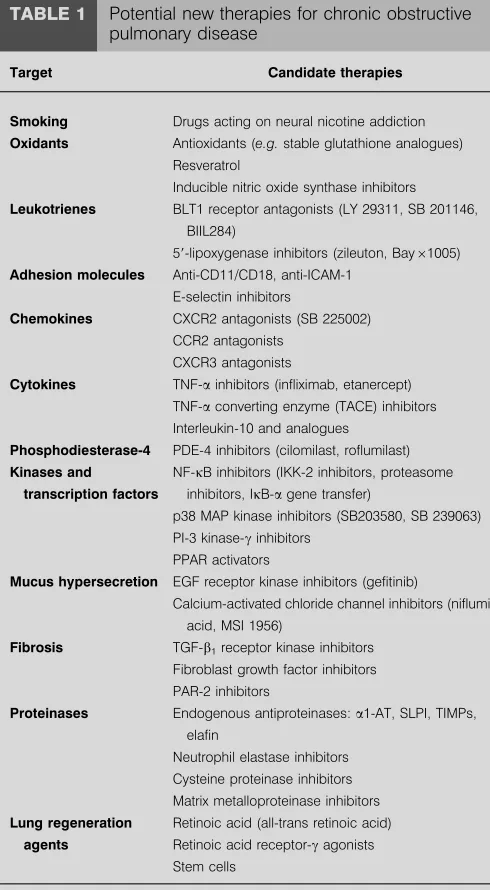
Several cells and inflammatory mediators are likely to be involved in COPD (fig. 1), as many inflammatory cells and structural cells are activated and there is an on-going inflam-matory process, even in patients who have given up smoking [2, 14]. The profile of mediators in COPD differs from that in asthma, so that different mediator antagonists are likely to be effective. Since COPD is characterised by inflammation with macrophages and neutrophils, attention has largely focused on inhibiting recruitment and activation of these cells, and on antagonism of their products (table 1). Many chemokines and cytokines have now been implicated in COPD and several are targets for the development of new therapies [15]. It is thought that inflammation then mediates excess mucus production, fibrosis and proteolysis; these processes contributing to mucus bronchitis, obstructive bronchiolitis and emphysema.
Corticosteroid resistance
Four large controlled trials of inhaled corticosteroids of 3-yr duration have demonstrated little effect on the loss of lung function that occurs in COPD, although there is a reduction in the number of exacerbations [16]. Neither inhaled nor oral corticosteroids suppress the inflammation in COPD lungs and alveolar macrophages appear to be steroid resistant [17]. There may be an active resistance to corticosteroids due to an inhibitory effect of cigarette smoke on histone deacetylation, which is required for corticosteroids to switch off inflam-matory genes [18, 19]. Based on this insight, therapeutic strategies that unlock the molecular mechanism of resistance might be possible, since drugs that increase histone deacetylase activity may resensitise cells to the effects of corticosteroids. For example, theophylline in low concentrations increases the activation of histone deacetylases (HDAC)s and increases the responsiveness to corticosteroids, at least in vitro [20, 21]. A search for other drugs that activate HDAC may be another approach. Combination inhalers of a steroid and a long-acting b2-agonist appear to be more effective than either drug alone, and it is possible that there is some molecular synergy between these drugs [22, 23]
MEDIATOR ANTAGONISTS
Suppression of the inflammatory response with anti-inflam-matory treatments is a logical approach to the treatment of COPD and may be expected to improve symptoms such as cough and mucus secretion, improve health status and reduce exacerbations. In the long-term such treatments should reduce disease progression. However, no effective anti-inflammatory therapies currently exist so it is difficult to predict what their clinical outcome will be. The easiest approach is to block the synthesis or effects of inflammatory mediators known to be generated in COPD.
Antioxidants
Oxidative stress is increased in patients with COPD [24, 25], particularly during exacerbations, and reactive oxygen species contribute to its pathophysiology [26]. This suggests that
antioxidants may be of use in the therapy of COPD. N-acetyl cysteine (NAC) provides cysteine for enhanced production of the antioxidant glutathione and has antioxidant effectsin vitro andin vivo. A systematic review of studies with oral NAC in COPD suggested a small reduction in exacerbations [27]. More effective antioxidants, including stable glutathione com-pounds, analogues of superoxide dismutase and selenium-based drugs, are now in development for clinical use [28, 29].
TABLE 1 Potential new therapies for chronic obstructive pulmonary disease
Target Candidate therapies
Smoking Drugs acting on neural nicotine addiction
Oxidants Antioxidants (e.g.stable glutathione analogues) Resveratrol
Inducible nitric oxide synthase inhibitors
Leukotrienes BLT1 receptor antagonists (LY 29311, SB 201146, BIIL284)
59-lipoxygenase inhibitors (zileuton, Bay61005)
Adhesion molecules Anti-CD11/CD18, anti-ICAM-1
E-selectin inhibitors
Chemokines CXCR2 antagonists (SB 225002)
CCR2 antagonists
CXCR3 antagonists
Cytokines TNF-ainhibitors (infliximab, etanercept)
TNF-aconverting enzyme (TACE) inhibitors Interleukin-10 and analogues
Phosphodiesterase-4 PDE-4 inhibitors (cilomilast, roflumilast)
Kinases and
transcription factors
NF-kB inhibitors (IKK-2 inhibitors, proteasome
inhibitors, IkB-agene transfer)
p38 MAP kinase inhibitors (SB203580, SB 239063) PI-3 kinase-cinhibitors
PPAR activators
Mucus hypersecretion EGF receptor kinase inhibitors (gefitinib)
Calcium-activated chloride channel inhibitors (niflumic acid, MSI 1956)
Fibrosis TGF-b1receptor kinase inhibitors
Fibroblast growth factor inhibitors
PAR-2 inhibitors
Proteinases Endogenous antiproteinases:a1-AT, SLPI, TIMPs, elafin
Neutrophil elastase inhibitors Cysteine proteinase inhibitors
Matrix metalloproteinase inhibitors
Lung regeneration
agents
Retinoic acid (all-trans retinoic acid)
Retinoic acid receptor-cagonists Stem cells
BLT1: leukotriene B4 receptor type 1; ICAM-1: intercellular adhesion
mole-cule-1; CXCR: cysteine-x-cysteine receptor; CCR: cysteine-cysteine receptor; TNF-a: tumour necrosis factor-a; PDE-4: phosphodiesterase-4; NF-kB: nuclear factor-kB; IKK: inhibitor of IkB kinase; IkB-a: inhibitor of NF-kB; MAP: mitogen
activated protein; PI-3: phosphoinositide-3; PPAR: peroxisome proliferation activated receptor; EGF: epidermal growth factor; TGF-b1: transforming
growth factor-b1; PAR: proteinase-activated receptor; a1-AT:a1-antitrypsin;
SLPI: secretory leukoprotease inhibitor; TIMP: tissue inhibitor of matrix
Resveratrol
Resveratrol is a phenolic component of red wine that has anti-inflammatory and antioxidant properties. It has a marked inhibitory effect on cytokine release from alveolar macro-phages from COPD patients that show little or no response to corticosteroids [30]. The molecular mechanism or this action is currently unknown [31], but identification of the cellular target for resveratrol may lead to the development of a novel class of anti-inflammatory compounds. Resveratrol itself has a very low oral bioavailability so related drugs or a suitable inhaled formulation will need to be developed.
Nitric oxide synthase inhibitors
Oxidative stress and increased nitric oxide release from activity of inducible nitric oxide synthase (iNOS) may result in the formation of peroxynitrite; this is a potent radical that nitrates proteins and alters their function. 3-Nitrotyrosine may indicate peroxynitrite formation and is markedly increased in sputum macrophages of patients with COPD [32]. Selective inhibitors of iNOS are now in development and one of these, a prodrug of L-N6-(1-imminoethyl)lysine gives a profound and long-lasting reduction in the concentrations of nitric oxide in exhaled breath [33].
Leukotriene inhibitors
LTB4 is a potent chemoattractant of neutrophils and is
increased in the sputum and exhaled breath of patients with COPD [34, 35]. It is probably derived from alveolar macro-phages as well as neutrophils and may be synergistic with interleukin (IL)-8. Two subtypes of receptor for LTB4 have been described; leukotriene B4receptor type 1(BLT1) receptors are expressed mainly on granulocytes and monocytes, whereas B4 receptor type 2 (BLT2) receptors are expressed on T-lymphocytes [36]. BLT1 antagonists, such as LY29311, have now been developed for the treatment of neutrophilic inflam-mation [37]. LY293111 and another antagonist, SB225002, inhibit the neutrophil chemotactic activity of sputum from COPD patients, indicating the potential clinical value of such drugs [38, 39]. Several selective BLT1 antagonists are now in development. LTB4is synthesised by 59-lipoxygenase, of which there are several inhibitors, although there have been problems in clinical development of drugs in this class because of side effects. A recent pilot study in COPD patients with a 59 -lipoxygenase inhibitor BAYx1005 showed only a modest
reduction in sputum LTB4 concentrations but no effect on
neutrophil activation markers [40].
Chemokine inhibitors
Several chemokines are involved in neutrophil chemotaxis, these being mainly chemokines of the cysteine-x-cysteine (CXC) family, and chemokine antagonists are of potential therapeutic benefit in COPD [41]. IL-8 levels are markedly elevated in the sputum of patients with COPD and are correlated with disease severity [42]. Blocking antibodies to IL-8 reduce the chemotactic response of neutrophils to sputum from COPD patients [39]. A human monoclonal antibody to IL-8 is now in clinical trials for COPD, but other CXC chemokines are also be involved in COPD. IL-8 activates neutrophilsviaa specific low affinity G-protein coupled receptor (CXCR1) coupled to activation and degranulation andviaa high affinity receptor (CXCR2), shared with other members of the CXC
family, which is important in chemotaxis. Other CXC chemokines, such as growth related oncoprotein-a, are also elevated in COPD [43] and therefore a CXCR2 antagonist is likely to be more useful than a CXCR1 antagonist, particularly as CXCR2 are also expressed on monocytes. Indeed, inhibition of monocyte chemotaxis may prevent the marked increase in macrophages found in the lungs of patients with COPD. Small molecule inhibitors of CXCR2, such as SB225002, have now been developed and are entering clinical trials [44].
CC-chemokines are also involved in COPD. There is increased expression of monocyte chemotactic protein-1 and its receptor cysteine-cysteine receptor (CCR)2 in macrophages and epithe-lial cells from COPD patients and this may play a role in recruitment of blood monocytes to the lungs of COPD patients [45]. This suggests that CCR2 antagonists may be of use and small molecule inhibitors are in clinical development.
Chemokine receptors are also important for the recruitment of CD8+T-cells, which predominate in COPD airways and lungs and might contribute to the development of emphysema. CD8+ cells show increased expression of CXCR3 and there is up-regulation of CXCR3 ligands, such as CXCL10 (IP-10), in peripheral airways of COPD patients [46]. This suggests that CXCR3 antagonists might also be useful.
Tumour necrosis factor-ainhibitors
TNF-aand soluble TNF receptor concentrations are raised in
the sputum of COPD patients [42, 47]. TNF-a augments
inflammation and induces IL-8 and other chemokines in airway cells viaactivation of the transcription factor nuclear factor-kB (NF-kB). The severe wasting in some patients with advanced COPD might be due to skeletal muscle apoptosis, resulting from increased circulating TNF-a. COPD patients with cachexia have increased release of TNF-afrom circulating leukocytes [48]. Humanised monoclonal TNF antibody (inflix-imab) and soluble TNF receptors (etanercept) that are effective in other chronic inflammatory diseases, such as rheumatoid arthritis and inflammatory bowel disease, should also be effective in COPD, particularly in patients who have systemic symptoms [49]. Trials of anti-TNF therapies in patients with
systemic features of COPD are currently underway. TNF-a
converting enzyme (TACE), which is required for the release of soluble TNF-a, may be a more attractive target as it is possible to discover small molecule TACE inhibitors, some of which are also matrix metalloproteinase inhibitors. General anti-inflammatory drugs, such as phosphodiesterase inhibitors and p38 mitogen-activated protein (MAP) kinase inhibitors, also potently inhibit TNF-aexpression.
ANTI-INFLAMMATORY APPROACHES
Adhesion molecule blockers
Recruitment of neutrophils, monocytes and cytotoxic T-cells into the lungs and respiratory tract is dependent on adhesion molecules expressed by these cells and on endothelial cells in the pulmonary and bronchial circulations. Several adhesion molecules can now be inhibited pharmacologically. For example, E-selectin on endothelial cells interacts with sialyl Lewis(x) on neutrophils. A mimic of sialyl Lewis(x), bimosia-mose (Revotar Biopharmaceuticals, Henningsdorf, Germany), blocks selectins and inhibits granulocyte adhesion, with
concerns about this therapeutic approach for a chronic disease, as an impaired neutrophilic response may increase the susceptibility to infection. The expression of macrophage associated antigen-1 (Mac-1) (CD11b/CD18) is increased on neutrophils of patients with COPD, suggesting that targeting this adhesion molecule, which is also expressed on monocytes and macrophages, might be beneficial [51].
Interleukin-10
IL-10 is a cytokine with a wide spectrum of anti-inflammatory actions. It inhibits the secretion of TNF-a and IL-8 from macrophages, and tips the balance in favour of antiproteases by decreasing the expression of matrix MMP, while increasing the expression of endogenous tissue inhibitors of MMPs. IL-10 concentrations are reduced in induced sputum from patients with COPD, so that this may be a mechanism for increasing lung inflammation [52]. IL-10 is currently in clinical trials for other chronic inflammatory diseases (inflammatory bowel disease, rheumatoid arthritis and psoriasis), including patients with steroid resistance, but IL-10 may cause haematological side effects. IL-10 may have therapeutic potential in COPD, especially if a selective activator of IL-10 receptors or unique signal transduction pathways can be developed in the future.
Phosphodiesterase-4 inhibitors
PDE4 is the predominant PDE expressed in neutrophils, CD8+ cells and macrophages, suggesting that PDE4 inhibitors would be effective in controlling inflammation in COPD [53]. Selective PDE4 inhibitors, such as cilomilast and roflumilast, are active in animal models of neutrophil inflammation. Cilomilast had promising beneficial clinical effects in a 6-week study in patients with moderate-to-severe COPD [54] and has some anti-inflammatory effects measurable in airway biopsies [55]. Roflumilast appears to be better tolerated at doses that significantly inhibit TNF-a release from peripheral blood monocytes. PDE4 inhibitors have been limited by side effects, particularly nausea and other gastrointestinal effects, but it might be possible to develop more selective inhibitors in the future that are less likely to be dose-limited by adverse effects.
Several steps may be possible to overcome the limitation of side effects. It now seems likely that vomiting is due to inhibition of a particular subtype of PDE4. At least four human PDE4 genes have been identified and each has several splice variants [56]. This raises the possibility that subtype-selective inhibitors may be developed that may preserve the anti-inflammatory effect, while having less propensity to side effects. PDE4D appears to be of particular importance in nausea and vomiting and is expressed in the chemosensitive trigger zone in the brain stem [57] and in mice deletion of the gene for PDE4D prevents a behavioural equivalent of emesis [58]. This isoenzyme appears to be less important in anti-inflammatory effects and targeted gene disruption studies in mice indicate that PDE4B is more important than PDE4D in inflammatory cells [59]. PDE4B selective inhibitors may there-fore have a greater therapeutic ratio and theoretically might be effective anti-inflammatory drugs. Cilomilast is selective for PDE4D and therefore has a propensity to cause emesis, whereas roflumilast, which is nonselective for PDE4 isoen-zymes, has a more favourable therapeutic ratio. Several other potent PDE4 inhibitors with a more favourable therapeutic
ratio are now in clinical development for COPD. Another approach is to give the PDE4 inhibitor by inhalation and some PDE4 inhibitors have a low oral bioavailability and are retained in the lung, so appear to be suitable for inhaled delivery [60].
NF-kB inhibitors
NF-kB regulates the expression of IL-8 and other chemokines, TNF-aand other inflammatory cytokines, and some MMPs. NF-kB is activated in macrophages and epithelial cells of COPD patients, particularly during exacerbations [61, 62]. There are several possible approaches to inhibition of NF-kB, including gene transfer of the inhibitor of NF-kB, inhibitors of IKK, NF-k B-inducing kinase and IkB ubiquitin ligase, which regulate the activity of NF-kB, and the development of drugs that inhibit the degradation of IkB [63]. The most promising approach may be the inhibition of IKK-2 by small molecule inhibitors, several of which are now in development [64]. A small molecule IKK-2 inhibitor suppresses the release of inflammatory cytokines and chemokines from alveolar macrophages and might be effective in COPD as alveolar macrophages are resistant to the anti-inflammatory actions of corticosteroids [17]. One concern about long-term inhibition of NF-kB is that effective inhibitors may result in immune suppression and impair host defences, since mice that lack NF-kB genes succumb to septicaemia. However, there are alternative pathways of NF-kB activationviakinases other than IKK that might be more important in inflammatory disease [65].
p38 mitogen-activated protein kinase inhibitors
MAP kinases play a key role in chronic inflammation and several complex enzyme cascades have now been defined [66]. One of these, the p38 MAP kinase pathway is activated by cellular stress and regulates the expression of inflammatory cytokines, including IL-8, TNF-a and MMPs. Small molecule inhibitors of p38 MAP kinase, such as SB 203580, SB 239063 and RWJ 67657, have been developed and these drugs have a broad range of anti-inflammatory effects [67]. SB 239063 reduces neutrophil infiltration after inhaled endotoxin and the concentrations of IL-6 and MMP-9 in the bronchoalveolar lavage fluid of rats, indicating its potential as an anti-inflammatory agent in COPD [68]. It is likely that such a broad spectrum anti-inflammatory drug will have some toxicity, but inhalation may be a feasible therapeutic approach.
Phosphoinositide 3-kinase inhibitors
Phosphoinositide (PI)-3Ks are a family of enzymes that lead to the generation of lipid second messengers that regulate a number of cellular events. A particular isoform, PI-3Kc, is involved in neutrophil recruitment and activation. Knock-out of the PI-3Kcgene results in inhibition of neutrophil migration and activation, as well as impaired T-lymphocyte and macrophage function [69]. This suggests that selective PI-3Kc inhibitors may have relevant anti-inflammatory activity in COPD and small molecule inhibitors of PI-3Kcand PI-3Kdare in development [70].
Peroxisome proliferators-actvated receptor activators
Peroxisome proliferator-activated receptors (PPARs) are a
family of ligand-activated nuclear hormone receptors
recognised subtypes PPAR-a, -cand -dare widely expressed. There is evidence that activation of PPAR-aand PPAR-dmay have anti-inflammatory and immunomodulatory effects. For example, PPAR-c agonists, such as troglitazone, inhibit the release of inflammatory cytokines from monocytes and induce apoptosis of T-lymphocytes, suggesting that they may have anti-inflammatory effects in COPD [71, 72].
DRUGS ACTING ON STRUCTURAL CELLS
Mucoregulators
Mucus hypersecretion is commonly seen in cigarette smokers, but is not necessarily associated with airflow limitation. In individuals with COPD mucus hypersecretion is associated with more rapid decline in forced expiratory volume in one second and increased frequency of exacerbations [73]. Reducing mucus hypersecretion may therefore have therapeu-tic benefit, although suppression of the normal airway mucus secretion may be detrimental. Mucolytic drugs have been used for many years to reduce mucus viscosity but these drugs do not appear to have any clinical value. Several novel approaches to inhibiting mucus hypersecretion are currently being explored [74]. Mucus hypersecretion in COPD appears to be largely driven by the neutrophil inflammatory response, so that effective anti-inflammatory treatments would be expected to reduce mucus hypersecretion [74].
Epidermal growth factor (EGF) plays a critical role in airway mucus secretion from goblet cells and submucosal glands and appears to mediate the mucus secretory response to several secretagogues, including oxidative stress, cigarette smoke and inflammatory cytokines [75]. EGF may also be responsible for the mucus hyperplasia seen in chronic bronchitis. Small molecule inhibitors of EGF receptor kinase, such as gefitinib, have now been developed for clinical use.
Another novel approach involves inhibition of CACC, which are important in mucus secretion from goblet cells. Activation of human hCLCA1 induces mucus secretion and mucus gene expression and may therefore be a target for inhibition. Small molecule inhibitors of CACC, such as niflumic acid and MSI 1956, have been developed [76]. Other approaches include inhibition of the neural mechanisms driving mucus secretion, including tachykinin receptor antagonists and potassium channel openers [77].
Fibrosis inhibition
TGF-b1 is highly expressed in airway epithelium and macro-phages of small airways in patients with COPD [78, 79]. It is a potent inducer of fibrosis, partlyviathe release of the potent fibrogenic mediator connective tissue growth factor, and may be important in inducing the fibrosis and narrowing of peripheral airways (obstructive bronchiolitis) in COPD. TGF-b1also activates MMP-9, which then further activates TGF-b1, thus providing a link between small airway fibrosis and emphysema in COPD. MMP-9 may mediate proteolysis of
TGF-b-binding protein, and this may be a mechanism for
physiological release of TGF-b1 [80]. TGF-b1 also down regulates b2-adrenoceptors [81] and impairs bronchodilator responses to b2-agonists [82]. Inhibition of TGF-b1 signalling may therefore be a useful therapeutic strategy in COPD. Small molecule antagonists that inhibit TGF-b receptor kinase or
TGF-b activated pathways are now in development [83],
although the long-term safety of such drugs might be a problem, particularly as TGF-b affects tissue repair and is a potent anti-inflammatory mediator.
Proteinase-activated receptor-2 (PAR-2) expression is wide-spread in the airways, and expression is increased in the central airways of smokers and nonsmokers [84]. PAR-2 may be involved in MMP-9 release from airway epithelial cells and proliferation of fibroblasts [85, 86]. However, a potential drawback for strategies to antagonise PAR-2 is that activation of epithelial PAR-2 causes bronchoprotection in the airways.
Antiproteases
There is compelling evidence for an imbalance between proteases that digest elastin (and other structural proteins) and antiproteases that protect against this [87]. This suggests that either inhibiting these proteolytic enzymes or increasing endogenous antiproteases may be beneficial and theoretically should prevent the progression of airflow obstruction in COPD. Considerable progress has been made in identifying the enzymes involved in elastolytic activity in emphysema and in characterising the endogenous antiproteases that counteract this activity [87]. The fact that there are so many proteinases implicated in COPD might mean that blocking a single enzyme may not have a major effect.
One approach is to give endogenous antiproteases (a
1-antitrypsin, secretory leukoprotease inhibitor, elafin, tissue inhibitors of MMP), either in recombinant form or by viral vector gene delivery [88, 89]. These approaches are unlikely to be cost effective as large amounts of protein have to be delivered and gene therapy is unlikely to provide sufficient protein.
A more promising approach is to develop small molecule inhibitors of proteases, particularly those that have elastolytic activity [90]. Small molecule inhibitors, such as ONO-5046 and FR901277, have been developed that have high potency. These drugs inhibit neutrophil elastase-induced lung injury in experimental animals, whether given by inhalation or systemi-cally and also inhibit the other serine proteinases released from neutrophils, cathepsin G and proteinase-3. Small molecule inhibitors of neutrophil elastase are in clinical development, but there is concern that neutrophil elastase may not play a critical role in emphysema and that other proteinases are more important in elastolysis. Inhibitors of elastolytic cysteine proteinases, such as cathepsins K, S and L that are released from macrophages, are also in development [91]. MMPs with elastolytic activity (such as MMP-9) may also be a target for drug development, although nonselective MMP inhibitors, such as marimastat, appear to have considerable musculoske-letal side effects [92]. It is possible that side effects could be reduced by increasing selectivity for specific MMPs or by targeting delivery to the lung parenchyma. MMP-9 is markedly over-expressed by alveolar macrophages from patients with COPD and is the major elastolytic enzyme released by these cells [93], so a selective MMP-9 inhibitor might be useful in the treatment of emphysema.
Lung regeneration
lung parenchyma, it seems unlikely that this could be reversible by drug therapy, although it might be possible to reduce the rate of progression by preventing the inflammatory and enzymatic disease process. Retinoic acid increases the number of alveoli in developing rats and, remarkably, reverses the histological and physiological changes induced by elastase treatment of adult rats [94, 95]. However, this is not observed in other species [96]. Retinoic acid activates retinoic acid receptors, which act as transcription factors to regulate the expression of many genes involved in growth and differentia-tion. The molecular mechanisms involved and whether this can be extrapolated to humans is not yet known. Several retinoic acid receptor subtype agonists have now been developed that may have a greater selectivity for this effect and therefore a lower risk of side effects. The receptor mediating the effect on alveoli appears to be the retinoic acid receptor-c[95]. A short-term trial of all-trans-retinoic acid in patients with emphysema did not show any improvement in clinical parameters [97], but a longer study is currently underway. This approach is unlikely to be successful as adult human lung, unlike rat lung, has less potential for repair after surgical resection for example.
Another approach to repairing damaged lung in emphysema is the use of stem cells to seed the lung [98]. Type 2 pneumocytes and Clara cells might be suitable for alveolar repair and this is currently an active area of research.
FUTURE DIRECTIONS
New drugs for the treatment of COPD are greatly needed. While preventing and quitting smoking is the obvious preferred approach, this has proved to be very difficult in the majority of patients. It is important to identify the genetic factors that determine why only a minority of heavy smokers develop COPD [99], and identification of genes that predispose to the development of COPD may provide novel therapeutic targets. However, it will be difficult to demonstrate the efficacy of novel treatments on the rate of decline in lung function, since this requires large studies over 3 yrs. Hence, there is a need to develop novel outcome measures and surrogate biomarkers, such as analysis of sputum parameters (cells, mediators, enzymes) or exhaled condensates (lipid mediators, reactive oxygen species) [100]. The use of imaging techniques, such as high resolution computerised tomography (CT) to measure disease progression is another promising approach as scanning resolution increases [101]. It may also be important to
more accurately define the presence of emphysema versus
small airway obstruction using CT scans, as some drugs may be more useful for preventing emphysema, whereas others may be more effective against the small airway inflammatory-fibrotic process. More research on the basic cellular and molecular mechanisms of COPD is urgently needed to aid the logical development of new therapies for this common and important disease, for which no effective preventative treat-ments currently exist.
Of the drugs currently in development phosphodiesterase-4 inhibitors, p38 mitogen activated protein kinase inhibitors and low affinity G-protein coupled receptor antagonists show particular promise as anti-inflammatory therapies over the next 5–10 yrs. It is likely that effective anti-inflammatory therapies would not only reduce exacerbations, but would also
improve symptoms and health status. In the long-term these drugs should slow the decline in lung function and prevent the considerable morbidity imposed by this common disease.
REFERENCES
1 Lopez AD, Murray CC. The global burden of disease,
1990–2020.Nat Med1998; 4: 1241–1243.
2 Barnes PJ, Shapiro SD, Pauwels RA. Chronic obstructive pulmonary disease: molecular and cellular mechanisms. Eur Respir J2003; 22: 672–688.
3 Barnes PJ. New concepts in COPD.Ann Rev Med2003; 54: 113–129.
4 Barnes PJ. New treatments for COPD. Nature Rev Drug
Disc2002; 1: 437–445.
5 Barnes PJ. Chronic obstructive pulmonary disease. New Engl J Med2000; 343: 269–280.
6 Fabbri LM, Romagnoli M, Corbetta L,et al.Differences in airway inflammation in patients with fixed airflow obstruction due to asthma or chronic obstructive
pul-monary disease. Am J Respir Crit Care Med 2003; 167:
418–424.
7 Wright JL, Churg A. Animal models of cigarette smoke-induced COPD.Chest2002; 122: 301S–306S.
8 Tashkin DP, Kanner R, Bailey W,et al.Smoking cessation in patients with chronic obstructive pulmonary disease: a double-blind, placebo controlled, randomised trial.Lancet 2001; 357: 1571–1575.
9 Dani JA. Roles of dopamine signaling in nicotine
addiction.Mol Psychiatry2003; 8: 255–256.
10 Kantak KM. Vaccines against drugs of abuse: a viable
treatment option?Drugs2003; 63: 341–352.
11 Global Initiative for Chronic Obstructive Lung Disease (GOLD): Global strategy for the diagnosis, management of chronic obstructive pulmonary disease. NHLBI/WHO Workshop Report 2003. www.goldcopd.com/workshop/ index.html. Date accessed: 1 October 2004.
12 Hansel TT, Barnes PJ. Tiotropium bromide: a novel once-daily anticholinergic bronchodilator for the treatment of COPD.Drugs Today2002; 38: 585–600.
13 Vincken W, van Noord JA, Greefhorst AP,et al.Improved health outcomes in patients with COPD during 1 yr’s treatment with tiotropium.Eur Respir J2002; 19: 209–216.
14 Rutgers SR, Postma DS, ten Hacken NH,et al.Ongoing
airway inflammation in patients with COPD who do not currently smoke.Thorax2000; 55: 12–18.
15 Barnes PJ. Cytokine modulators as novel therapies for airway disease.Eur Respir J, 2001; Suppl. 34, 67s–77s. 16 Highland KB, Strange C, Heffner JE. Long-term effects of
inhaled corticosteroids on FEV1 in patients with chronic
obstructive pulmonary disease. A meta-analysis. Ann
Intern Med2003; 138: 969–973.
17 Culpitt SV, Rogers DF, Shah P,et al.Impaired inhibition by dexamethasone of cytokine release by alveolar macrophages from patients with chronic obstructive pulmonary disease.Am J Respir Crit Care Med2003; 167: 24–31.
18 Ito K, Lim S, Caramori G, Chung KF, Barnes PJ,
inhibits glucocorticoid actions in alveolar macrophages. FASEB J2001; 15: 1100–1102.
19 Barnes PJ, Ito K, Adcock IM. A mechanism of corticoster-oid resistance in COPD: inactivation of histone deacety-lase.Lancet2004; 363: 731–733.
20 Ito K, Lim S, Caramori G,et al.A molecular mechanism of action of theophylline: Induction of histone deacetylase activity to decrease inflammatory gene expression. Proc Natl Acad Sci U S A2002; 99: 8921–8926.
21 Barnes PJ. Theophylline: new perspectives on an old
drug.Am J Respir Crit Care Med2003; 167: 813–818. 22 Szafranski W, Cukier A, Ramirez A, et al. Efficacy and
safety of budesonide/formoterol in the management of chronic obstructive pulmonary disease.Eur Respir J2003; 21: 74–81.
23 Calverley P, Pauwels R, Vestbo J, et al. Combined
salmeterol and fluticasone in the treatment of chronic obstructive pulmonary disease: a randomised controlled trial.Lancet2003; 361: 449–456.
24 Montuschi P, Collins JV, Ciabattoni G, et al.Exhaled 8-isoprostane as an in vivo biomarker of lung oxidative stress in patients with COPD and healthy smokers.Am J Respir Crit Care Med2000; 162: 1175–1177.
25 Paredi P, Kharitonov SA, Leak D, Ward S, Cramer D,
Barnes PJ. Exhaled ethane, a marker of lipid peroxida-tion, is elevated in chronic obstructive pulmonary disease.Am J Respir Crit Care Med2000; 162: 369–373.
26 MacNee W. Oxidants/antioxidants and COPD. Chest
2000; 117: Suppl. 1, 303S–317S.
27 Poole PJ, Black PN. Preventing exacerbations of chronic bronchitis and COPD: therapeutic potential of mucolytic agents.Am J Respir Med2003; 2: 367–370.
28 Cuzzocrea S, Riley DP, Caputi AP, Salvemini D.
Antioxidant therapy: a new pharmacological approach in shock, inflammation, and ischemia/reperfusion injury. Pharmacol Rev2001; 53: 135–159.
29 Chang LY, Subramaniam M, Yoder BA,et al.A catalytic antioxidant attenuates alveolar structural remodeling in bronchopulmonary dysplasia.Am J Respir Crit Care Med 2003; 167: 57–64.
30 Culpitt SV, Rogers DF, Fenwick PS,et al.Inhibition by red wine extract, resveratrol, of cytokine release by alveolar macrophages in COPD.Thorax2003; 58: 942–946.
31 Donnelly LE, Newton R, Kennedy GE, et al.
Anti-inflammatory effects of resveratrol in lung epithelial cells: molecular mechanisms.Am J Physiol Lung Cell Mol Physiol2004; 287: L774–L783.
32 Ichinose M, Sugiura H, Yamagata S, Koarai A, Shirato K. Increase in reactive nitrogen species production in
chronic obstructive pulmonary disease airways. Am J
Resp Crit Care Med2000; 160: 701–706.
33 Hansel TT, Kharitonov SA, Donnelly LE,et al.A selective inhibitor of inducible nitric oxide synthase inhibits exhaled breath nitric oxide in healthy volunteers and asthmatics.FASEB J2003; 17: 1298–1300.
34 Hill AT, Bayley D, Stockley RA. The interrelationship of sputum inflammatory markers in patients with chronic bronchitis.Am J Respir Crit Care Med1999; 160: 893–898.
35 Montuschi P, Kharitonov SA, Ciabattoni G, Barnes PJ.
Exhaled leukotrienes and prostaglandins in COPD. Thorax2003; 58: 585–588.
36 Yokomizo T, Kato K, Terawaki K, Izumi T, Shimizu T. A second leukotriene B4 receptor BLT2. A new therapeutic target in inflammation and immunological disorders. J Exp Med2000; 192: 421–432.
37 Silbaugh SA, Stengel PW, Cockerham SL, et al.
Pharmacologic actions of the second generation leuko-triene B4 receptor antagonist LY29311:in vivopulmonary studies. Naunyn Schmiedebergs Arch Pharmacol2000; 361: 397–404.
38 Crooks SW, Bayley DL, Hill SL, Stockley RA. Bronchial inflammation in acute bacterial exacerbations of chronic bronchitis: the role of leukotriene B4.Eur Respir J2000; 15: 274–280.
39 Beeh KM, Kornmann O, Buhl R, Culpitt SV,
Giembycz MA, Barnes PJ. Neutrophil chemotactic activ-ity of sputum from patients with COPD: role of
interleukin 8 and leukotriene B4. Chest 2003; 123:
1240–1247.
40 Gompertz S, Stockley RA. A randomized,
placebo-controlled trial of a leukotriene synthesis inhibitor in patients with COPD.Chest2002; 122: 289–294.
41 Panina-Bordignon P, D’Ambrosio D. Chemokines and
their receptors in asthma and chronic obstructive pulmonary disease.Curr Opin Pulm Med2003; 9: 104–110.
42 Keatings VM, Collins PD, Scott DM, Barnes PJ.
Differences in interleukin-8 and tumor necrosis factor-a in induced sputum from patients with chronic obstruc-tive pulmonary disease or asthma.Am J Respir Crit Care Med1996; 153: 530–534.
43 Traves SL, Culpitt S, Russell REK, Barnes PJ, Donnelly LE. Elevated levels of the chemokines GRO-aand MCP-1 in
sputum samples from COPD patients. Thorax 2002; 57:
590–595.
44 Hay DWP, Sarau HM. Interleukin-8 receptor antagonists
in pulmonary diseases. Curr Opin Pharmacol 2001; 1:
242–247.
45 de Boer WI, Sont JK, van Schadewijk A, Stolk J, van
Krieken JH, Hiemstra PS. Monocyte chemoattractant protein 1, interleukin 8, and chronic airways inflamma-tion in COPD.J Pathol2000; 190: 619–626.
46 Saetta M, Mariani M, Panina-Bordignon P,et al.Increased expression of the chemokine receptor CXCR3 and its ligand CXCL10 in peripheral airways of smokers with chronic obstructive pulmonary disease. Am J Respir Crit Care Med2002; 165: 1404–1409.
47 Vernooy JH, Kucukaycan M, Jacobs JA, et al.Local and systemic inflammation in patients with chronic obstruc-tive pulmonary disease: soluble tumor necrosis factor receptors are increased in sputum.Am J Respir Crit Care Med2002; 166: 1218–1224.
48 de Godoy I, Donahoe M, Calhoun WJ, Mancino J,
Rogers RM. Elevated TNF-alpha production by peri-pheral blood monocytes of weight-losing COPD patients. Am J Respir Crit Care Med1996; 153: 633–637.
49 Reimold AM. TNFa as therapeutic target: new drugs,
more applications. Curr Drug Targets Inflamm Allergy 2002; 1: 377–392.
50 Davenpeck KL, Berens KL, Dixon RA, Dupre B,
Bochner BS. Inhibition of adhesion of human neutrophils and eosinophils to P-selectin by the sialyl Lewis
adhesion in vitro. J Allergy Clin Immunol 2000; 105: 769–775.
51 Noguera A, Busquets X, Sauleda J, Villaverde JM,
MacNee W, Agusti AG. Expression of adhesion mole-cules and G proteins in circulating neutrophils in chronic obstructive pulmonary disease.Am J Respir Crit Care Med 1998; 158: 1664–1668.
52 Takanashi S, Hasegawa Y, Kanehira Y,et al. Interleukin-10 level in sputum is reduced in bronchial asthma, COPD and in smokers.Eur Respir J1999; 14: 309–314.
53 Sturton G, Fitzgerald M. Phosphodiesterase 4 inhibitors for the treatment of COPD.Chest2002; 121: 192S–196S.
54 Compton CH, Gubb J, Nieman R, et al. Cilomilast, a
selective phosphodiesterase-4 inhibitor for treatment of patients with chronic obstructive pulmonary disease: a
randomised, dose-ranging study. Lancet 2001; 358:
265–270.
55 Gamble E, Grootendorst DC, Brightling CE, et al. Anti-inflammatory effects of the phosphodiesterase 4 inhibitor cilomilast (Ariflo) in COPD. Am J Respir Crit Care Med 2003; 168: 976–982.
56 Houslay MD, Adams DR. PDE4 cAMP
phosphodies-terases: modular enzymes that orchestrate signalling cross-talk, desensitization and compartmentalization. Biochem J2003; 370: 1–18.
57 Lamontagne S, Meadows E, Luk P,et al.Localization of phosphodiesterase-4 isoforms in the medulla and nodose ganglion of the squirrel monkey. Brain Res 2001; 920: 84–96.
58 Robichaud A, Stamatiou PB, Jin SL, et al. Deletion of
phosphodiesterase 4D in mice shortens
alpha(2)-adrenoceptor-mediated anesthesia, a behavioral correlate of emesis.J Clin Invest2002; 110: 1045–1052.
59 Jin SL, Conti M. Induction of the cyclic nucleotide
phosphodiesterase PDE4B is essential for LPS-activated TNF-alpha responses.Proc Natl Acad Sci U S A2002; 99: 7628–7633.
60 Kuss H, Hoefgen N, Johanssen S, Kronbach T,
Rundfeldt C.In vivoefficacy in airway disease models of N-(3,5-dichloropyrid-4-yl)-[1-(4-fluorobenzyl)-5-hydroxy-indole-3-yl]-glyo xylic acid amide (AWD 12–281), a selective phosphodiesterase 4 inhibitor for inhaled admin-istration.J Pharmacol Exp Ther2003; 307: 373–385. 61 Di Stefano A, Caramori G, Capelli A, et al. Increased
expression of NF-kB in bronchial biopsies from smokers and patients with COPD.Eur Resp J2002; 20: 556–563.
62 Caramori G, Romagnoli M, Casolari P, et al. Nuclear
localisation of p65 in sputum macrophages but not in sputum neutrophils during COPD exacerbations.Thorax 2003; 58: 348–351.
63 Delhase M, Li N, Karin M. Kinase regulation in
inflammatory response.Nature2000; 406: 367–368. 64 Castro AC, Dang LC, Soucy F,et al.Novel IKK inhibitors:
beta-carbolines.Bioorg Med Chem Lett2003; 13: 2419–2422. 65 Nasuhara Y, Adcock IM, Catley M, Barnes PJ, Newton R. Differential IKK activation and IkBa degradation by interleukin-1b and tumor necrosis factor-a in human U937 monocytic cells: evidence for additional regulatory steps in kB-dependent transcription. J Biol Chem 1999; 274: 19965–19972.
66 Johnson GL, Lapadat R. Mitogen-activated protein kinase pathways mediated by ERK, JNK, and p38 protein kinases.Science2002; 298: 1911–1912.
67 Kumar S, Boehm J, Lee JC. p38 MAP kinases: key
signalling molecules as therapeutic targets for inflamma-tory diseases.Nat Rev Drug Discov2003; 2: 717–726.
68 Underwood DC, Osborn RR, Bochnowicz S, et al. SB
239063, a p38 MAPK inhibitor, reduces neutrophilia, inflammatory cytokines, MMP-9, and fibrosis in lung.Am J Physiol Lung Cell Mol Physiol2000; 279: L895–L902. 69 Sasaki T, Irie-Sasaki J, Jones RG, et al. Function of
PI3Kgamma in thymocyte development, T cell activation, and neutrophil migration.Science2000; 287: 1040–1046.
70 Ward S, Sotsios Y, Dowden J, Bruce I, Finan P.
Therapeutic potential of phosphoinositide 3-kinase inhi-bitors.Chem Biol2003; 10: 207–213.
71 Patel HJ, Belvisi MG, Bishop-Bailey D, Yacoub MH,
Mitchell JA. Activation of peroxisome proliferator-activated receptors in human airway smooth muscle cells has a superior anti-inflammatory profile to corticos-teroids: relevance for chronic obstructive pulmonary disease therapy.J Immunol2003; 170: 2663–2669. 72 Harris SG, Phipps RP. Induction of apoptosis in mouse T
cells upon peroxisome proliferator-activated receptor
gamma (PPAR-g) binding. Adv Exp Med Biol 2002; 507:
421–425.
73 Vestbo J. Epidemiological studies in mucus hypersecre-tion.Novartis Found Symp2002; 248: 3–12.
74 Barnes PJ. Current and future therapies for airway mucus hypersecretion.Novartis Found Symp2002; 248: 237–249. 75 Nadel JA, Burgel PR. The role of epidermal growth factor
in mucus production. Curr Opin Pharmacol 2001; 1:
254–258.
76 Zhou Y, Shapiro M, Dong Q, et al. A calcium-activated chloride channel blocker inhibits goblet cell metaplasia
and mucus overproduction. Novartis Found Symp 2002;
248: 150–165.
77 Rogers DF. Pharmacological regulation of the neuronal control of airway mucus secretion. Curr Opin Pharmacol 2002; 2: 249–255.
78 de Boer WI, van Schadewijk A, Sont JK, et al.
Transforming growth factor beta1 and recruitment of macrophages and mast cells in airways in chronic
obstructive pulmonary disease. Am J Respir Crit Care
Med1998; 158: 1951–1957.
79 Takizawa H, Tanaka M, Takami K, et al. Increased
expression of transforming growth factor-b1 in small airway epithelium from tobacco smokers and patients with chronic obstructive pulmonary disease (COPD).Am J Respir Crit Care Med2001; 163: 1476–1483.
80 Dallas SL, Rosser JL, Mundy GR, Bonewald LF.
Proteolysis of latent transforming growth factor-b (TGF-b)-binding protein-1 by osteoclasts. A cellular mechanism for release of TGF-b from bone matrix.J Biol Chem2002; 277: 21352–21360.
81 Mak JC, Rousell J, Haddad EB, Barnes PJ. Transforming growth factor-b1 inhibitsb2-adrenoceptor gene transcrip-tion. Naunyn Schmiedebergs Arch Pharmacol 2000; 362: 520–525.
82 Ishikawa T, Kume H, Kondo M, Ito Y, Yamaki K,
the heterologous desensitization of beta-adrenoceptors by transforming growth factor-b1 in tracheal smooth muscle.Clin Exp Allergy2003; 33: 808–815.
83 DaCosta BS, Major C, Laping NJ, Roberts AB. SB-505124 is a selective inhibitor of transforming growth factor-b type I receptors ALK4, ALK5, and ALK7.Mol Pharmacol 2004; 65: 744–752.
84 Miotto D, Hollenberg MD, Bunnett NW,et al.Expression of protease activated receptor-2 (PAR-2) in central airways of smokers and non-smokers. Thorax 2002; 57: 146–151.
85 Vliagoftis H, Schwingshackl A, Milne CD, et al.
Proteinase-activated receptor-2-mediated matrix
metalloproteinase-9 release from airway epithelial cells. J Allergy Clin Immunol2000; 106: 537–545.
86 Frungieri MB, Weidinger S, Meineke V, Kohn FM,
Mayerhofer A. Proliferative action of mast-cell tryptase is mediated by PAR2, COX2, prostaglandins, and PPARc: Possible relevance to human fibrotic disorders.Proc Natl Acad Sci U S A2002; 99: 15072–15077.
87 Shapiro SD, Senior RM. Matrix metalloproteinases.
Matrix degradation and more. Am J Respir Cell Mol Biol 1999; 20: 1100–1102.
88 Luisetti M, Travis J. Bioengineering: alpha 1-proteinase inhibitor site-specific mutagenesis. The prospect for improving the inhibitor.Chest1996; 110: 278S–283S.
89 Stecenko AA, Brigham KL. Gene therapy progress and
prospects: alpha-1 antitrypsin.Gene Ther2003; 10: 95–99. 90 Luisetti M, Sturani C, Sella D,et al.MR889, a neutrophil elastase inhibitor, in patients with chronic obstructive
pulmonary disease: a double-blind, randomized,
placebo-controlled clinical trial. Eur Respir J 1996; 9: 1482–1486.
91 Leung-Toung R, Li W, Tam TF, Karimian K.
Thiol-dependent enzymes and their inhibitors: a review. Curr Med Chem2002; 9: 979–1002.
92 Belvisi MG, Bottomley KM. The role of matrix metallo-proteinases (MMPs) in the pathophysiology of chronic obstructive pulmonary disease (COPD): a therapeutic role for inhibitors of MMPs?Inflamm Res2003; 52: 95–100. 93 Russell RE, Culpitt SV, DeMatos C, et al. Release and
activity of matrix metalloproteinase-9 and tissue inhibitor of metalloproteinase-1 by alveolar macrophages from patients with chronic obstructive pulmonary disease.Am J Respir Cell Mol Biol2002; 26: 602–609.
94 Massaro G, Massaro D. Retinoic acid treatment abrogates
elastase-induced pulmonary emphysema in rats. Nature
Med1997; 3: 675–677.
95 Belloni PN, Garvin L, Mao CP, Bailey-Healy I, Leaffer D. Effects of all-trans-retinoic acid in promoting alveolar repair.Chest2000; 117: 235S–241S.
96 Lucey EC, Goldstein RH, Breuer R, Rexer BN, Ong DE,
Snider GL. Retinoic acid does not affect alveolar septation in adult FVB mice with elastase-induced emphysema. Respiration2003; 70: 200–205.
97 Mao JT, Goldin JG, Dermand J,et al.A pilot study of all-trans-retinoic acid for the treatment of human emphy-sema.Am J Respir Crit Care Med2002; 165: 718–723. 98 Otto WR. Lung epithelial stem cells. J Pathol 2002; 197:
527–535.
99 Sandford AJ, Silverman EK. Chronic obstructive
pul-monary disease. 1: Susceptibility factors for COPD the
genotype-environment interaction. Thorax 2002; 57:
736–741.
100 Kharitonov SA, Barnes PJ. Exhaled markers of
pulmon-ary disease. Am J Respir Crit Care Med 2001; 163:
1693–1772.
101 Dowson LJ, Guest PJ, Stockley RA. Longitudinal changes in physiological, radiological, and health status measure-ments ina1-antitrypsin deficiency and factors associated
with decline. Am J Respir Crit Care Med 2001; 164: