Published online 2016 September 27. Research Article
The Effect of Dignity Therapy on Perceived Dignity in Patients With
Major Depression Disorder
Saeed Vaghee,
1and Abbas Heydari
1,*1Evidence- Based Care Research Center, School of Nursing and Midwifery, Mashhad University of Medical Sciences, Mashhad, Iran
*Corresponding author: Abbas Heydari, Evidence- Based Care Research Center, School of Nursing and Midwifery, Mashhad University of Medical Sciences, Mashhad, Iran. Tel: +98-5138591511, Fax: +98-5138597313, E-mail: [email protected]
Received2016 April 09;Revised2016 June 06;Accepted2016 June 11.
Abstract
Background:Because of the scarcity of studies on the effect of dignity therapy in patients with depression, and the conflicting re-sults of the available studies, it is still unclear whether dignity therapy improves perceived dignity in patients with major depression disorder.
Objectives:This study aimed to examine the effect of dignity therapy on the perceived dignity of patients with major depression disorder.
Methods:In this randomized controlled trial, 58 patients with major depression disorder were randomly separated to an interven-tion group (28 patients) and a control group (30 ones). The interveninterven-tion group received dignity therapy, according to a standard pro-tocol and the control group only received routine care. A questionnaire for examining perceived human dignity was implemented immediately before and two months after the intervention. Descriptive statistics, Fischer’s exact test, Chi square, independent sam-ples t-test, paired t-test, Mann-Whitney and Wilcoxon tests were used in data analysis.
Results:Of the 58 patients under study, 65.5% were female. No significant difference was found between the mean overall perceived dignity scores of the intervention group (100.2±6.6) and the control group (99.8±4.5) before the intervention (P = 0.78). However, two months after the intervention, the mean overall dignity scores were significantly different in the two groups (intervention group: 87.2±3.8, control group: 98.9±3.7, P < 0.001). Dignity therapy was effective on the subscales of dependency, peace of mind and social protection (P < 0.001), however, it did not affect distress signs (P = 0.10) and existential distress subscales (P = 0.09).
Conclusions:Dignity therapy can improve perceived dignity in patients with major depression disorder. Therefore, this method can be implemented to improve perceived dignity in patients with major depression.
Keywords:Dignity Therapy, Human’s Dignity, Major Depression Disorder, Clinical Trial
1. Background
Major depression disorder is one of the most common mental disorders, affecting 121 million people worldwide (1). It also is estimated that 4.1% of Iranian people have this disorder (2).
Major depression disorder comes with high levels of cognitive and performance disabilities and forces a high economic and social load on the patient, the family and so-ciety because of its direct and indirect expenses such as un-employment and efficiency reduction both in the patients and in their caregivers (3,4).
Stressful life events, especially interpersonal stresses and social rejection are the most important predicting fac-tors for the onset of major depression disorder (5). Ac-cording to psychoanalytic theories, causes of depression in adults relate to external sources such as lack of social acceptance and protection (6), which consequently result in feeling of humility and low self-value in interpersonal communication (7). In fact, depression comes with a low self-concept and subjective lack of dignity, which affects
the patient’s view of his/her abilities in the society and re-sults in dependency and disability in the control of life af-fairs (8). Therefore, nurses should deal with these patients in such a way that preserves their dignity, makes them de-velop a positive life view and feel valuable (9). However, ev-idence shows that the dignity and the rights of these pa-tients are being neglected during the hospitalization pe-riod (10). Additionally, the stigma related to mental disor-der results in a discriminative view and prejudice, which increments the disorder and decreases the patients’ life quality (11). A recent phenomenological study on the ex-perience of dignity in people with psychological illnesses showed the negative effects of social communication dis-ruption, age increment, stigma, discrimination and lone-liness on the dignity of such patients (12).
Preserving human dignity is one of the cornerstones of providing quality nursing care. Therefore, it is necessary for nurses to first understand its meaning (13).
Dignity has various definitions. In a qualitative meta-synthesis, dignity was defined as considering people’s
ues, reverence, prestige and position (13). It has also been defined as feelings, thoughts and behavior of individuals toward themself and others. The concept of dignity has four constituents including respect (i.e. self-respect, re-spect for others, rere-spect for peoples’ privacy), autonomy (i.e. having choice, giving choice, having the right and competence to make decisions), empowerment (i.e. feel-ing of befeel-ing important, self-esteem, modesty and pride), and communication (i.e. verbal or nonverbal; also in-cludes explaining and understanding information, feeling comfort and giving time to the audience) (14). Consid-ering the importance of preserving patients’ dignity (15), Chochinov et al. presented a model for ‘dignity therapy’ to improve the patients’ dignity throughout the therapy pe-riods (16). This model can be employed for all people that are experiencing high levels and long durations of stress (16). It has a story-like approach and consists of elements such as life reviewing and talking about the memories (17). This approach pursues the patient to feel that they are im-portant by focusing on the human relations improvement and love phrases (18). Hence it enhances human dignity by engaging the patient in telling his/her life story and their most important thoughts, feelings and dreams (16). This model was implemented in patients with a range of disor-ders such as chronic renal failure (19), motor neuron dis-order and their family caregivers (20) and other chronic somatic disorders (16). Furthermore, through enhancing the peoples’ abilities and feeling of self-worth, this method can be used as the antidote of depression. Studies are avail-able on the beneficial effects of dignity therapy on decreas-ing the signs of depression (21) and increasing self-esteem and independence in these patients (8). However, in a sys-tematic review, Fitchett et al. reported conflicting results about the effects of dignity therapy in patients with major depression (18).
Because of scarcity of studies on the effect of dignity therapy in patients with depression, and the conflicting re-sults of the available studies, and considering the crucial role of psychiatric nurses in enhancement of dignity of de-pressed patients, it is still unclear whether dignity therapy can improve perceived dignity in patients with major de-pression disorder.
2. Objectives
This study aimed to examine the effect of dignity ther-apy on perceived dignity of patients with major depression disorder.
3. Method
3.1. Design and Sampling
A randomized controlled clinical trial was conducted on a sample of 60 patients with major depression disor-der referred to Ibn-e-Sina Psychiatric hospital of Mashhad, Iran, from September 2015 to December 2016. The sam-ple size was estimated based on a pilot study on 20 pa-tients with major depression that were equally placed in two groups of ten people. After administering the human dignity evaluation questionnaire, two sessions of dignity therapy similar to the main study were conducted in one group, and after one month, the human dignity evalua-tion quesevalua-tionnaire was again administered to both pilot groups. The mean score in the intervention group was changed from 97.7±2.5 to 86.3±8.5, while it did not sig-nificantly change in the control group (95.3±2.3 vs. 93.6± 8.8). Using the following parameters (β= 0.15,α= 0.05,µ1= 86.3, andµ2= 93.6, S1= 8.5, and S2= 8.8, twenty-six subjects were estimated to be needed in each group. However, con-sidering the possible 15% dropouts, we recruited 30 sub-jects in each group.
The inclusion criteria consisted of willingness to par-ticipate in the study, a definite medical diagnosis of major depression disorder for more than three years, being in the age range of 18 to 60 years, having the ability to read and write in Farsi language, existence of no additional mental and somatic co-morbidity, having a stable mood (in the last 10 - 15 days of the patient’s hospitalization) confirmed by the psychiatrist, and no intention to travel or immigrate to another city for two months after hospital discharge. The exclusion criteria consisted of not following the therapy protocol, a subject’s decision to withdraw from the study, absence from even one of the dignity therapy sessions and lack of cooperation of the patient’s family, and being diag-nosed with another mental disorder during the research period.
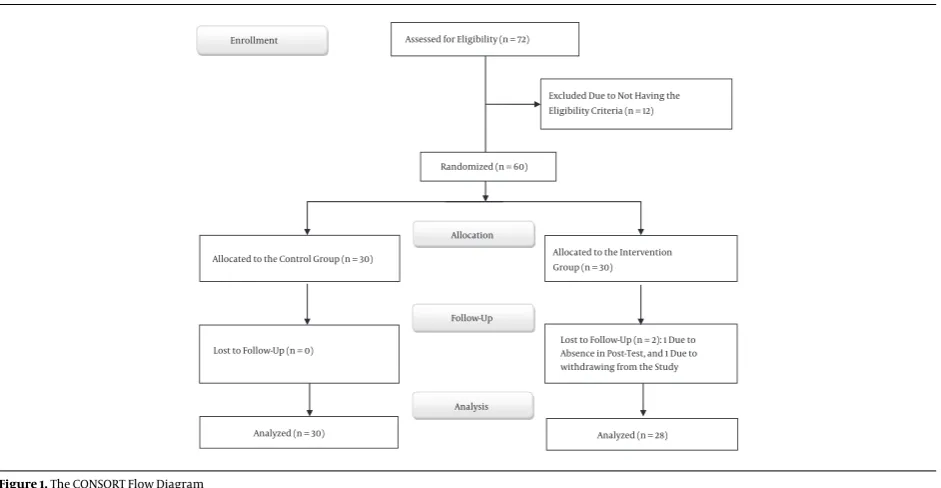
Sampling was performed consecutively among the pa-tients that had the inclusion criteria and were hospitalized at the Ibn-e-Sina hospital for one month and were in a sta-ble mood. Patients were assigned to the control or inter-vention groups using a simple random sampling method. In total, we assessed 72 patients for eligibility and recruited 60 (30 in each group). However, two patients from the dig-nity therapy group were excluded because one could not attend the posttest examination and one decided to with-draw from the dignity therapy sessions (Figure 1).
3.2. The Study Instrument
mar-Assessed for Eligibility (n = 72)
Excluded Due to Not Having the Eligibility Criteria (n = 12)
Analyzed (n = 30) Lost to Follow-Up (n = 0) Allocated to the Control Group (n = 30)
Lost to Follow-Up (n = 2): 1 Due to Absence in Post-Test, and 1 Due to withdrawing from the Study Allocated to the Intervention Group (n = 30)
Analyzed (n = 28) Allocation
Analysis Follow-Up Randomized (n = 60) Enrollment
Figure 1.The CONSORT Flow Diagram
ital status and job status). The second part of the instru-ment was the human dignity evaluation questionnaire (HDEQ). The HDEQ is composed of 25 items in five sub-scales including distress signs (five items), existential dis-tress (five items), dependency (five items), mental relax-ation (five items) and social protection (five items). All items were responded on a five-point Likert scale, ranging from one (= no problems) to five (= many problems). The total score is between 25 and 125; higher scores indicate lower levels of perceived dignity. This scale was translated to Farsi by Vaghees et al. and its validity and reliability were confirmed by ten academic members of Mashhad Univer-sity of Medical Sciences and by test-retest (correlation coef-ficient = 0.84) (20).
3.3. The Procedure
Each patient answered the questionnaire when they entered the study. To this end, a structured individual interview was conducted with each patient and the re-searcher recorded their responses on the questionnaires. All interviews were conducted by the first researcher and in the examination room of the psychiatric unit.
In the intervention group, dignity therapy was con-ducted according a standard protocol. All dignity therapy sessions were held individually for each patient. Each pa-tient in the intervention group participated in four ses-sions to complete the dignity therapy protocol. The dignity therapy protocol consisted of 12 questions, which helped patients remember their life experiences. In the first ses-sion, the structure of the dignity therapy sessions, type and
style of the questions and answers were reviewed during a 30-minute session. Then, in two 30- to 45-minute ses-sions that were held on two subsequent days, the proto-col’s questions (including 12 questions) were proposed one by one and the patient had the opportunity to answer these questions. The protocol questions were presented one by one and the patient answered each in about five minutes. The answers included remembering and telling life experi-ences focusing on aspects in which he/she has been proud or the problems that were meaningful to him/ her or a life’s period or his or her demands. The patient’s answers were recorded using a voice recorder, transcribed and edited, and then in the fourth session, the text was prepared from the patients interviews and returned to him/her as the “generating document” to be completed or revised. This was then shared with a family member or friend of the patient after the patient’s approval. The patient’s family member or his/her friend was asked to review the gen-erated document, share it with other family members or friends, try to understand the patient messages and desires and modify their conducts so that the patients desires and his/her dignity were considered.
After two months, all patients in the both groups were invited to the hospital to complete the post-test.
3.4. Ethical Considerations
6th 2015). Permission was also obtained from the author-ities of the Ibn-e-Sina Psychiatric hospital. All participants were told that they are under investigation, but they did not know the group they were assigned to. They were all also informed about the voluntary nature of their partici-pation. All patients signed a written informed consent be-fore participation, were assured of the anonymity and con-fidentiality of the data, and were also reminded that they can withdraw from the study at any time. To observe ethics, at the end of the study, two educational sessions on “major depression disorder and its signs and therapy methods” were also held for the control group.
3.5. Data Analysis
Data analysis was performed using the SPSS 11.5 soft-ware. Descriptive statistics were calculated for demo-graphic variables. Kolmogorov-Smirnov test was used to examine the normality of the Data. Fischer’s Exact test, Chi square, and independent t-test were implemented to in-vestigate the homogeneity of the qualitative and quanti-tative variables. Independent samples t-test (for normally distributed variables) and Mann-Whitney U test (for abnor-mally distributed variables) were employed for compari-son between the two groups, and paired t-test (normal dis-tribution) and Wilcoxon test (abnormal disdis-tribution) were used for inter-group comparison. Statistical significance was considered at P value < 0.05.
4. Results
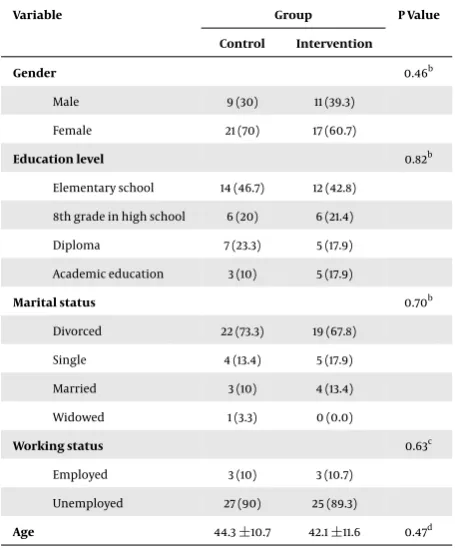
The two groups were homogeneous in terms of de-mographic variables and no significant differences were found between the two groups in terms of their gender, marital status, employment status and education level ( Ta-ble 1).
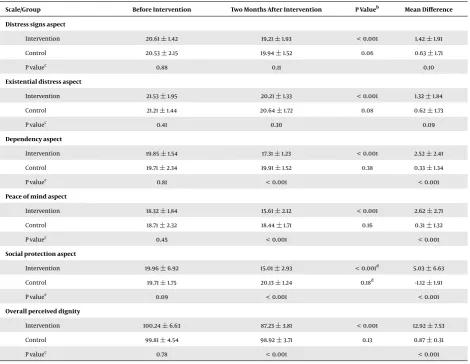
No significant difference was found between the mean overall perceived dignity scores of the intervention and the control groups before the intervention (P = 0.78). However, two months after the intervention, the mean overall dig-nity scores were significantly different in the two groups (P < 0.001), so that this score was increased in the inter-vention group while it did not change in the control group (Table 2).
Table 2also shows that before the intervention, the two groups were not significantly different with regards to their mean scores in different subscales of human dignity (P > 0.05). However, after two months, significant differ-ences were observed between the two groups in three sub-scales of dependency (P < 0.001), peace of mind (P< 0.001) and social protection (P < 0.001). Similar patterns were also observed in the mean differences of the latter three subscales.
Table 1.The Characteristics of the Patients With Major Depression Disorder in the Intervention and Control Groupsa
Variable Group P Value
Control Intervention
Gender 0.46b
Male 9 (30) 11 (39.3)
Female 21 (70) 17 (60.7)
Education level 0.82b
Elementary school 14 (46.7) 12 (42.8) 8th grade in high school 6 (20) 6 (21.4)
Diploma 7 (23.3) 5 (17.9)
Academic education 3 (10) 5 (17.9)
Marital status 0.70b
Divorced 22 (73.3) 19 (67.8)
Single 4 (13.4) 5 (17.9)
Married 3 (10) 4 (13.4)
Widowed 1 (3.3) 0 (0.0)
Working status 0.63c
Employed 3 (10) 3 (10.7)
Unemployed 27 (90) 25 (89.3)
Age 44.3±10.7 42.1±11.6 0.47d
aValues are presented as No. (%) or mean±SD. bChi-Square Test.
cFisher Exact Test. dIndependent samples t-test.
Table 2also presents the results of within-group com-parisons in the study groups. In the intervention group, significant differences were observed between the pretest and posttest mean scores not only in overall dignity scores, but also in its subscales (P < 0.001). However, no significant differences were found between the pretest and posttest mean scores in the control group.
5. Discussion
Table 2.The Comparison of Perceived Dignity and its Aspects in the Intervention and Control Groups, Before and After the Interventiona
Scale/Group Before Intervention Two Months After Intervention P Valueb Mean Difference
Distress signs aspect
Intervention 20.61±1.42 19.21±1.93 < 0.001 1.42±1.91
Control 20.53±2.15 19.94±1.52 0.06 0.63±1.71
P valuec 0.88 0.11 0.10
Existential distress aspect
Intervention 21.53±1.95 20.21±1.33 < 0.001 1.32±1.84
Control 21.21±1.44 20.64±1.72 0.08 0.62±1.73
P valuec 0.41 0.30 0.09
Dependency aspect
Intervention 19.85±1.54 17.31±1.23 < 0.001 2.52±2.41
Control 19.71±2.34 19.91±1.52 0.38 0.33±1.34
P valuec 0.81 < 0.001 < 0.001
Peace of mind aspect
Intervention 18.32±1.84 15.61±2.12 < 0.001 2.62±2.71
Control 18.71±2.32 18.44±1.71 0.16 0.31±1.32
P valuec 0.45 < 0.001 < 0.001
Social protection aspect
Intervention 19.96±6.92 15.01±2.93 < 0.001d 5.03±6.63
Control 19.71±1.75 20.13±1.24 0.18d -1.12±1.91
P valuee 0.09 < 0.001 < 0.001
Overall perceived dignity
Intervention 100.24±6.63 87.23±3.81 < 0.001 12.92±7.53
Control 99.81±4.54 98.92±3.71 0.13 0.87±0.31
P valuec 0.78 < 0.001 < 0.001
aValues are presented as mean±SD. bPaired t test.
cIndependent sample t-test. dWilcoxon test.
eMann-Whitney U test.
of depression in terminally ill patients (24). Radu et al. also reported that increasing self-esteem and autonomy could increase perceived dignity in patients with major depres-sion disorder (8).
Psychoanalytic theories, interpret depression as a re-action to loss. The depressed individual reacts to the loss severely despite the nature of the loss, because it recalls all of the patient’s fears about the losses in his/her child-hood. An unmet need in a depressed person is the need for love (6). Dignity therapy responds to this need by prepar-ing a generatprepar-ing document of the patient’s memories and dreams, which show the patient’s need of his/her loved ones. On the other hand, patients with major depression disorder (25) have low self-respect. They feel guilty and
criticize themselves even for small subjects. Usually, the individual does not easily accept what is different with his/her self-thoughts and tries to change for good (25). Dig-nity therapy schedule induces a feeling of love and be-ing important, and the generatbe-ing document, when it is read in a calm and private circumstance, facilitates an in-ternal communication in the patient and his/her inin-ternal self. It also prepares the conditions for self-thoughts about good changes and consequently enhances the patient’s perceived dignity.
therapy was implemented for patients with motor neuron disease (20) and older individuals (22). The distress signs aspect of dignity represents physical and mental sources of distress and the existential distress aspect refers to the individual’s feelings about how changes (including being valuable and the ability to perform important tasks) are seen in others views. It seems that dignity therapy imple-mented in this study could not change the circumferential distresses or others and family’s view of the patient. It ap-pears that families and friends of the patients with chronic somatic disorder can more easily understand the patient’s conditions to empathy with them. However, the entity of mental disorders together with its social stigma makes it difficult for families and friends to understand the condi-tion of patients with depression.
On the other hand, in the present study, the three as-pects of peace of mind, dependency, and social protection were improved after the intervention. It seems that dig-nity therapy can help the patient increase his/her feeling of having a target and a meaningful life by forcing them to think about the joyful and successful memories, life after death and what remains after them (21,26). Moreover, as confirmed by some previous studies (20,24) dignity ther-apy might affect the communication between patients and their caregivers that in turn improved the patients’ feel-ings of social protection.
In conclusion, this study showed that dignity therapy could improve perceived dignity in patients with major depression disorder. Hence, this short-term and unique method can be implemented to improve perceived dignity in these patients.
However, there were some limitations in this research. For instance, the patients’ individual characteristics and mental condition during pretest and posttest might affect their answers and these variables were not under the con-trol of the researchers. Second, we did not examine the changes in the patients’ signs of depression. Thus, examin-ing the effect of dignity therapy on depression, especially for those in their first days of hospitalization, is suggested.
Acknowledgments
This research was registered at the Iranian reg-istry of clinical trials and the regreg-istry number was IRCT2015112625250N1. The authors sincerely acknowledge the financial support of the Mashhad Medical University. They would also acknowledge the cooperation of the nursing and midwifery school of Mashhad and the staff of Ibn-e-Sina psychiatric Hospital of Mashhad.
Footnotes
Authors’ Contribution:Study concept and design: Saeed Vaghee and Abbas Heydari; acquisition of data: Saeed Vaghee; statistical analysis, interpretation and drafting of the manuscript: Saeed Vaghee; critical revision of the manuscript for important intellectual content: Abbas Heydari; administrative, technical, and material support: Saeed Vaghee and Abbas Heydari; study supervision: Abbas Heydari.
Financial/Support: This project was funded by the
re-search deputy of Mashhad University of Medical Sciences, Mashhad, IR Iran.
Financial Disclosure:The authors declare that they had no competing interests.
References
1. World Health Organization . Depression 2012. Available from:
http://www.who.int/mentalhealth/management/depression/ definition/en/.
2. Sadeghirad B, Haghdoost AA, Amin-Esmaeili M, Ananloo ES, Ghaeli P, Rahimi-Movaghar A, et al. Epidemiology of major depressive dis-order in iran: a systematic review and meta-analysis.Int J Prev Med.
2010;1(2):81–91. [PubMed:21566767].
3. Murray CJ, Lopez AD. Evidence-based health policy–lessons from the Global Burden of Disease Study.Science. 1996;274(5288):740–3.
[PubMed:8966556].
4. Birnbaum HG, Kessler RC, Kelley D, Ben-Hamadi R, Joish VN, Green-berg PE. Employer burden of mild, moderate, and severe ma-jor depressive disorder: mental health services utilization and costs, and work performance.Depress Anxiety. 2010;27(1):78–89. doi: 10.1002/da.20580. [PubMed:19569060].
5. Slavich GM, Irwin MR. From stress to inflammation and major de-pressive disorder: a social signal transduction theory of depression.
Psychol Bull. 2014;140(3):774–815. doi: 10.1037/a0035302. [PubMed: 24417575].
6. Kalat J. Introduction to psychology. Nelson Education; 2016. 7. Blatt SJ. Levels of object representation in anaclitic and
introjec-tive depression.Psychoanal Study Child. 1974;29:107–57. [PubMed:
4445397].
8. Radu MR, Chirita R, Borza LR, Macarie GF, Nuc G, Paziuc LC. The role of self-esteem and autonomy in improving social functioning in pa-tients with depression: A matter of dignity.Revista Romana de Bioetica.
2015;13(1):131–140.
9. Jacobs BB. Respect for human dignity: a central phenomenon to philosophically unite nursing theory and practice through con-silience of knowledge.ANS Adv Nurs Sci. 2001;24(1):17–35. [PubMed: 11554531].
10. Abbasi M, Rashidian A, Arab M, Amini H, Hoseini M. Medical Staff and Hospitalized Patients’ Attitude in Selected Psychiatric Hospi-tals in Tehran about Adaptation of Patients Rights Charter of Pa-tients with Mental Disorder [in Persian].Iran J Psychiatr Clin Psychol.
2010;16(3):172–80.
11. Hojjati H, Sharifinia H, Nazari R. The effect of blended clinical teach-ing on nursteach-ing students’ attitude toward psychiatric patients [in Per-sian].Iran J Med Educ.2011;11(3):238–44.
13. Bagheri H, Yaghmaei F, Ashktorab T. Patient dignity and related
factors: a qualitative meta-synthesis study. Knowledge Health J.
2011;6(1):49–56.
14. Griffin-Heslin VL. An analysis of the concept dignity.Accid Emerg Nurs.
2005;13(4):251–7. doi:10.1016/j.aaen.2005.09.003. [PubMed:16298291]. 15. Saxena S, Hanna F. Dignity–a fundamental principle of mental health care.Indian J Med Res.2015;142(4):355–8. doi:10.4103/0971-5916.169184.
[PubMed:26609024].
16. Chochinov HM. Dignity therapy: Final words for final days. USA: OUP; 2012.
17. Houmann LJ, Rydahl-Hansen S, Chochinov HM, Kristjanson LJ, Groen-vold M. Testing the feasibility of the Dignity Therapy interview: adaptation for the Danish culture.BMC Palliat Care. 2010;9:21. doi: 10.1186/1472-684X-9-21. [PubMed:20860786].
18. Fitchett G, Emanuel L, Handzo G, Boyken L, Wilkie DJ. Care of the hu-man spirit and the role of dignity therapy: a systematic review of dig-nity therapy research.BMC Palliat Care.2015;14:8. doi: 10.1186/s12904-015-0007-1. [PubMed:25844066].
19. Vaghee S, Mazlom S, Davoudi N, Modares Gharav M. The effect of dig-nity therapy on human digdig-nity in patients with chronic renal failure undergoing hemodialysis [in Persian].Evid Base Care.2013;3(2):63–72. 20. Bentley B, Aoun SM, O’Connor M, Breen LJ, Chochinov HM. Is dig-nity therapy feasible to enhance the end of life experience for people
with motor neurone disease and their family carers?.BMC Palliat Care.
2012;11:18. doi:10.1186/1472-684X-11-18. [PubMed:22995100].
21. Avery JD, Baez MA. Dignity therapy for major depressive disorder: a case report.J Palliat Med. 2012;15(5):509. doi:10.1089/jpm.2011.0522.
[PubMed:22577783].
22. Goddard C, Speck P, Martin P, Hall S. Dignity therapy for older peo-ple in care homes: a qualitative study of the views of residents and recipients of ’generativity’ documents.J Adv Nurs. 2013;69(1):122–32. doi:10.1111/j.1365-2648.2012.05999.x. [PubMed:22489609].
23. Holmerova I, Juraskova B, Kalvach Z, Rohanova E, Rokosova M, Vankova H. Dignity and palliative care in dementia.J Nutr Health Ag-ing.2007;11(6):489–94. [PubMed:17985065].
24. Juliao M, Oliveira F, Nunes B, Vaz Carneiro A, Barbosa A. Efficacy of dignity therapy on depression and anxiety in Portuguese terminally
ill patients: a phase II randomized controlled trial.J Palliat Med.
2014;17(6):688–95. doi:10.1089/jpm.2013.0567. [PubMed:24735024]. 25. Kushan M, Vaghee S. Psychiatric Nursing Mental Health. Tehran:
An-disherafi; 2013.