Http://www.ijetmr.com©International Journal of Engineering Technologies and Management Research [201]
A REVIEW ON ADAPTIVE FORWARDING IN NAMED DATA
NETWORKING
Rajeev Goyal *1 *1
Amity University, Gwalior, Madhya Pradesh, Indore
Abstract:
Named Data Networking (NDN) is an as of late proposed new Internet architecture. By naming information rather than location, it changes the essential system service abstraction from "transmitting packets to offered destinations" to "retrieving information of given names." This major change makes a plenitude of new opportunities as well the same number of scholarly difficulties in application advancement, system routing and sending correspondence security and protection. In this study, researchers will propose a new architecture of NDN with smart and automated forwarding information based which is more versatile and proficient.
Keywords: Named Data Networking; Forwarding Information Base; Routing Protocol.
Cite This Article: Rajeev Goyal. (2018). “A REVIEW ON ADAPTIVE FORWARDING IN
NAMED DATA NETWORKING.” International Journal of Engineering Technologies
and Management Research, 5(2:SE), 1-8. DOI: https://doi.org/10.29121/ijetmr.v5.i2.2018.645.
1. Introduction
Named data networking is one of the most recent technologies. IP-based networking architecture uses the address in the term to identify the location where data is resident. Address or location is important instead of data. In Named Data Networking data is send with the help of named or info which is the main requirement of today’s era. In NDN information exchange is made by interest packet and exchange of contents packet. In this architecture, the client directs the interest packet as a request for the looking of the information. In between, router directs them on the basis of the content name and then server replies to the client with data packets. Here in NDN replies of data packets took the similar path by interest packet used but in reverse direction. Throughout the above process, router hold state of pending interest .This information of state combined with the data and interest exchange assist NDN routers in identifying loops, see the performance of the data retrieving, as well as find the multiple paths for forwarding. While NDN is recent architecture, most of their prevailing feature has not been thoroughly planned, evaluated and studied.
2. Review of Literature
Http://www.ijetmr.com©International Journal of Engineering Technologies and Management Research [202]
endeavor to address the circulation issue with a point-to-point correspondence convention. Thusly, scientists have begun to explore new designs to oblige this rising correspondence design. Accordingly, diverse engineering plans (e.g., [6, 10, 11, 37, and 39]) have been proposed under a general system research approach called data driven systems administration.
2.1.Information Centric Networking
Information-Centric Networking (ICN) has as of late gotten huge consideration in the exploration group. ICN theory organizes a substance ("what") over its area ("where"). To understand this detachment of a substance from its area, a name based steering system is fundamental. In any case, various vital issues and difficulties identified with a name based directing are yet to be tended to keeping in mind the end goal to effectively understand a substance arranged systems administration model for the future Internet. Today's Internet exists as an interconnection of a great many Autonomous Systems (ASs) from around the world. The greatest Internet directing table contains around 4 × 10⁵ Border Gateway Protocol (BGP) [2] courses for covering around 3.8×10⁹ IPv4 addresses and 6×10⁸ hosts.
This scaling variable between IPv4 locations and BGP courses is accomplished by prefix based steering and course accumulation. Be that as it may, the quantity of addressable ICN substance is relied upon to be a few requests of greatness higher. The number of "information pieces" including sensor information, and so forth., is around on the request of 1016 [3], while Google has recorded roughly 1012 URLs [4], which would force requests of greatness adaptability prerequisite on a steering plan like BGP. The steering versatility issue in ICN is identified with how the substance is named and how between AS and intra-AS directing conventions prepare these names. Regardless of the possibility that a BGP like between AS ICN steering convention covers just the top-level areas as prefixes, it should convey around 2×10⁸ one of a kind prefix courses [5], as no conglomeration is conceivable at this level. Thus, the core of the issue lies in the way that ICN requires Internet switches to keep up a Brooding again measure of steering state, which does not appear to be conceivable with existing innovation. In any case, actually the versatility necessity will be much higher for the accompanying reasons:
1) Content names are not as aggregately as IP locations,
2) Names with same prefixes may not be promoted from adjacent system areas,
3) Directing can't rely on upon topological prefix official as substance recovery ought to be area free,
4) Confining the substance name to some type of specific configuration restricts the ease of use of the framework, lastly,
5) Supporting substance replication, reserving, and portability decreases the level of course total that can be connected, as different courses for the same substance should be kept up in the steering table.
2.2. Named Data Networking
Http://www.ijetmr.com©International Journal of Engineering Technologies and Management Research [203]
"conveying bundles to offered locations" to "recovering information of given names." NDN parcels convey information names as opposed to source and destination addresses. Information purchasers express Interests as fancied information names without indicating where the information might be found. Switches fulfill the Interests by recovering the Data, which are bound to the names by cryptographic marks, from switch stores, transitional information vaults, or unique information makers. The NDN design offers an extensive variety of advantages, incorporating worked in multicast information conveyance, in-system reserving, and in addition information is driven security. This paper concentrates on Smart sending, a one of a kind and intense element presented by NDN.
Figure 2.1
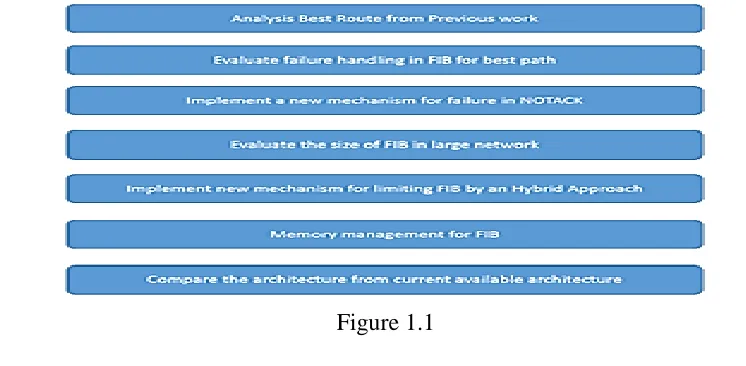
The present size of the forwarding information base is very large. It is very important to cut down or resize the Forwarding information base. Many researchers are working to minimize the size of FIB because of complexity and handling data problems. By limiting the size of FIB, memory size will be reduced and speed of searching is increased.
2.3.Adaptive Forwarding in NDN
To able to perform effective multipath forwarding the study will design a solid design of NDN’s plane of forwarding. To provide a specific system for routers to track data delivery ability is one of the design objectives, which is very important for routers in making decisions. To indicates the working status of each interface for each name prefix, the study will design a color-code mechanism. To evaluate and store the RTT for each name prefix the study will present algorithms and data structures for routers too.
Http://www.ijetmr.com©International Journal of Engineering Technologies and Management Research [204] 2.4.Find Best Route
Routers are a decisive forwarding policy, which identifies the routers forwarding Interests. Trying a single interface every time and downpour to all interfaces there is a vast spectrum of subtlety in between, with different oppositions between the overhead and delay to retrieve data. It is obvious to provide a program that can deliver packets efficiently even under adverse conditions without incurring excessive overhead. To judge router interface the study takes both routers’ information and forwarding performance into consideration, the study will offer an interface ranking mechanism. In forwarding strategy, Interests are always sent to the utmost ranked interface that has not been used before. In consideration of our design and to consider the use the forwarding plane of NDN The study will use NDN-Route. All trials for NDN will be conducted with the NDNSIM [12] simulator unless otherwise specified.
Prefix hijack will be used as a sample to illustrate the NDN-Routers’ ability to deal network problems efficiently with smart forwarding. When routers falsely announce prefixes that do not belong to them to the routing protocols, prefix hijack occurs. Which is common in today’s Internet. Whereas, IP routers cannot identify where prefix hijack occurs since they cannot distinguish hijackers’ routing announcements from normal ones. Prefix hijack stays a consistent issue in today’s Internet since end hosts have no way to inform routers when the packets are stopped getting delivered.
On the contrary, NDN-Router can deal prefix hijack at the point of the forwarding plane because forwarding plan is designed to use current working paths. A router will not switch to the provided best path immediately. In place of that, it will send an Interest to the new best path and it will switch when probing is successful, i.e., a packet is received.
2.5.Failure Handling with Smart Forwarding
Failure of thelinkis usual in computer networks. As long as the destination is still reachable in the remaining topology, every packet should be handed over to its target in the presence of unexpected failures in an ideal packet-switched network. A new acknowledgment will be proposed for interest for finding fault and notify the fault. The performance of best path of the NDN in the case of link failure will be evaluated and then the study will compare this with IP and Splicing of the path.
NDN routers can deal link failures at the forwarding plane without routing disturbance. When mechanism detects a link failure, the attached routers will tag the interface as unusable and forward all following Interests the next highest ranked interface instead. Already sent Packets to the failed link may still get lost but consumers can still retransmit the Interests to trigger path exploration by routing in the same fashion as in the prefix hijack program.
Http://www.ijetmr.com©International Journal of Engineering Technologies and Management Research [205]
analyzed with IP and Path Splicing [48].NDN-Routing provides the best packet handing over performance after link failures, as simulation results show. NDN-Routing can reach effective switching while stopping the stretch of alternative paths to less than 1.2 in more than 89% of the cases.
2.6. Limit Forwarding Information Base Size Through Hybrid Approach
The main aim of name-based routing is to link information requesters with content suppliers. The study got this via the (name-specific) aggregation points that will be got via (prefix-specific) default routes. Each router that offers content beneath a routable name advertises this name in an exceedingly Name advertising Message (NAM). Per default, NAMs travel hop-by-hop towards the aggregation point, and every intermediate router will yield the content advertising for as well as in its own routing table. Filling all FIBs will produce a whole routing path from the aggregation purpose to the information supply.
Forwarding of content can follow the regular unfinished Interests of NDN on the opposite path. Routing and forwarding are so associated with a hierarchy of network that looks like the current web with aggregation points settled at the transit tier. The study has needed names altogether FIBs, which is best-known to be not viable in ICN. The study currently reduces this demand as follows. Whole routing tables shall only be needed at the aggregation points.
Intermediate nodes are not needed to hold a full FIB, but rather aim at adapting selected entries to minimize Interest flooding. In similarity to caching content, each node separately decides regarding (a) available resources of memory for the FIB, and (b) the logic of forwarding it put on within its locality. Traffic flows can be incessantly accustomed adapt the FIB to relevant traffic patterns. For example, a node can hold additional specific info for oftentimes requested names while it could erase entries for traffic seldom seen.
3. Conclusion
The Probable outcome of our study will be a definite design of forwarding information base for NDN to construct the network robust and proficient. NDN is one of a kind of unique model of communication to retrieving data by name leads to a forwarding plane that maintains datagram state at every router. Since datagram is the one of the basic communication element in packet-switched networks, this per-hop datagram state hypothetically provides the freedom to resolve a host of current network hitches.
Also, the study will present NDN-Router, a definite forwarding plane design for NDN that uses this datagram state to provide high performance and flexibility in NDN networks. Specifically, the study design data structures and methods to collect and store forwarding performance information for NDN routers.
4. Future Works
Http://www.ijetmr.com©International Journal of Engineering Technologies and Management Research [206]
the performance of packet delivery of NDN-Router in the hostile conditions. The NDN’s Smart forwarding method can deliver exceptional performance in handling prefix hijacks and link failures.
The outcome of our study will be also a mechanism of a hybrid approach for limiting the size of FIB. The Outcome of this study is to get a simulated architecture for Automated Forwarding Information Base for Named Data Networking. Which provide a better performance and scalable simulated architecture for the NDN.
References
[1] http://www.cisco.com/en/US/products/ps6599/products_white_paper 09186a00800a4409.sht [2] http://www.scalable-networks.com.
[3] Abilene topology data. http://www.cs.utexas.edu/~yzhang/research/AbileneTM/. [4] CCNPing. http://github.com/NDN-Routing/ccnping.
[5] CCNx. http://www.ccnx.org/.
[6] COntent Mediator architecture for content-aware nETworks (COMET).http://www.cometproject.org/.
[7] Mini-CCNx. http://github.com/carlosmscabral/mn-ccnx. [8] NDN Testbed. http://named-data.net/ndn-testbed. [9] NS-3 Network Simulator. http://www.nsnam.org/.
[10] PURSUIT Internet Technology. http://www.fp7-pursuit.eu/PursuitWeb/. [11] The FP7 4WARD Project. http://www.4ward-project.eu/.
[12] Alexander Afanasyev, IlyaMoiseenko, and Lixia Zhang. ndnSIM: NDN simulator for NS-3. Technical Report NDN-0005, NDN Project, July 2012.
[13] C. Alaettinoglu, V. Jacobson, and H. Yu. Towards Milli-Second IGP Convergence. Internet Draft draft-alaettinoglu-isis-convergence-00.txt, November2000.
[14] A. Atlas. U-turn Alternates for IP/LDP Fast-Reroute. Draft-atlas-ip-local-protect-uturn-03, February 2006.
[15] B. Atlas and A. Zinin. RFC 5286: Basic Specification for IP Fast Reroute: Loop-Free Alternates. RFC 5286, 2008.
[16] Paul Baran. On Distributed Communications Networks. IEEE Transactions on Communications Systems, 12(1):1–9, March 1964.
[17] L. S. Brakmo and L. L. Peterson. TCP Vegas: End to End Congestion Avoidance on a Global Internet. IEEE J.Sel. A. Commun., 13(8):1465–1480, September 2006.
[18] S. Braun, M. Monti, M. Sifalakis, and C. Tschudin. An Empirical Study of Receiver-Based AIMD Flow-Control Strategies for CCN. In Proceedings of ICCCN, 2013.
[19] Jeff Burke, Alex Horn and Alessandro Marianantoni. Authenticated Lighting Control Using Named Data Networking. Technical Report NDN-0011, NDN Project, October 2012.
[20] Matthew Caesar, Martin Casado, TeemuKoponen, Jennifer Rexford, and Scott Shenker Dynamic Route Recomputation Considered Harmful. ACM SIGCOMM Computer Communication Review (CCR), 40(2):66–71, April 2010.
[21] G. Carofiglio, M. Gallo, and L. Muscariello. ICP: Design and evaluation of an Interest control protocol for content-centric networking. In Proceedings of IEEE INFOCOMM NOMEN Workshop, 2012.
Http://www.ijetmr.com©International Journal of Engineering Technologies and Management Research [207] [23] Giovanna Carofiglio, Massimo Gallo, and Luca Mus Cariello. Joint Hop-by-hop and
Receiver-driven Interest Control Protocol for Content-centric Networks. In Proceedings of ACM SIGCOMM ICN Workshop, 2012.
[24] Giovanna Carofiglio, Massimo Gallo, Luca Mus Cariello, and Michele Papalini. Multipath Congestion Control in Content-Centric Networks. In Proceedings of IEEE INFOCOMM NOMEN Workshop, 2013.
[25] A. Demers, S. Keshav, and S. Shenker. Analysis and Simulation of a FairQueueing Algorithm. In Proceedings of SIGCOMM, 1989.
[26] NanditaDukkipati and Nick McKeown. Why Flow-completion Time is the Right Metric for Congestion Control. SIGCOMM Comput. Commun. Rev., 36(1):59–62, January 2006.
[27] S. Floyd. Metrics for the Evaluation of Congestion Control Mechanisms. RFC 5166, 2008. [28] Sally Floyd and Van Jacobson. Random Early Detection gateways for congestion avoidance.
IEEE ACM Transactions on Networking, 1(4):397–413, 1993.
[29] Pierre Francois, Clarence Filsfils, John Evans, and Olivier Bonaventure. Achieving SubSecond IGP Convergence in Large IP Networks. ACM SIGCOMM Computer Communication Review (CCR), 35(3):35–44, July 2005.
[30] A. Ghali, G. Tsudik, and E. Uzun. Needle in a Haystack: Mitigating Content Poisoning in Named-Data Networking. In Proceedings of NDSS SENT Workshop, 2014.
[31] P. Brighten Godfrey, Igor Ganichev, Scott Shenker, and Ion Stoica. Pathletrouting. In Proceedings of ACM SIGCOMM, 2009.
[32] Sangtae Ha, Injong Rhee, and LisongXu. CUBIC: A New TCP-friendly Highspeed TCP Variant. SIGOPS Oper. Syst. Rev., 42(5):64–74, July 2008.
[33] H. Han, C.V. Hollot, D. Towsley, and Y. Chait. Synchronization of TCP Flows in Networks with Small Drop Tail Buffers. In Proceedings of IEEE CDC-ECC, 2005.
[34] T. Henderson, S. Floyd, A. Gurtov, and Y. Nishida. The New Reno Modification to TCP’s Fast Recovery Algorithm. RFC 6582, 2012.
[35] V. Jacobson. Congestion Avoidance and Control. In Proceedings of SIGCOMM, 1988.
[36] Van Jacobson, Diana K. Smetters, James D. Thornton, Michael F. Plass, Nicholas H. Briggs, and Rebecca L. Braynard. Networking Named Content. In Proceedings of ACM CoNEXT, 2009. [37] Petri Jokela, Andr´asZahemszky, Christian Esteve Rothenberg, SomayaArianfar, and
PekkaNikander. LIPSIN: line speed publish/subscribe internetworking. In Proceedings of the ACM SIGCOMM conference on data communication, 2009.
*Corresponding author.