HMAC: An Enhanced Energy Efficient Protocol Design
for Control Applications Using WSNS
Rajeswari T.
Department of CSE, Karpagam University, Coimbatore [email protected],
Abstract - In wireless sensor networks, the main objective
function is the energy consumption and the constraints are the packet reliability and delay. To reach a maximum efficiency, cross-layer interaction is a major design paradigm to exploit the complex interaction among the layers of the protocol stack. In this paper, the combination of novel protocol Breath and HMAC are proposed for control applications. The MAC layer emulates a full-duplex logical communication channel in a multi-point network. This channel may provide unicast, multicast or broadcast communication service. Breath is designed for WSNs where nodes attached to plants must transmit information via multihop routing to a sink. HMAC ensures a desired packet delivery and delay probabilities while minimizing the energy consumption of the network. HMAC exhibits a good distribution of the working load, thus ensuring a long lifetime of the network. Therefore, Breath and HMAC are the good candidate for efficient, reliable, and timely data gathering for control applications.
Key words - Wireless sensor networks, HMAC, Randomized routing, Energy consumption.
I. I
NTRODUCTIONA wireless sensor network (WSN) consists of spatially distributed autonomous sensors to monitor physical or environmental conditions, such as temperature, sound, vibration, pressure, motion or pollutants and to cooperatively pass their data through the network to a main location. The more modern networks are bi-directional, enabling also to control the activity of the sensors. The development of wireless sensor networks was motivated by military applications such as battlefield surveillance; today such networks are used in many industrial and consumer applications, such as industrial
process monitoring and control, machine health
monitoring, and so on. The WSN is built of "nodes" from a few to several hundreds or even thousands, where each node is connected to one (or sometimes several) sensors. Each sensor network node has typically several parts: a radio transceiver with an internal antenna or connection to an external antenna, a microcontroller, an electronic circuit for interfacing with the sensors and an energy source, usually a battery or an embedded form of energy harvesting. The cost of sensor nodes is similarly variable, ranging from hundreds of dollars to a few pennies, depending on the complexity of the individual sensor nodes. Size and cost constraints on sensor nodes result in corresponding constraints on resources such as energy, memory, computational speed and communications
and experience-based design practices inadequate at best. To bridge this gap and derive a correct and efficient implementation, a system-level approach has been proposed. By a system-level design for WSNs, the control algorithm designers impose a set of requirements on reliability, packet delay and energy consumption that the communication infrastructure must satisfy.
In sensor network application usually generates very light traffic on the network, this idle-listening mechanism is very inefficient and wastes significant energy. To mitigate this energy consumption of idle listening, duty cycling mechanisms have been introduced in sensor network MAC protocols. The listening period, in which the node’s radio is enabled, is divided into a SYNC period and a DATA period. During the SYNC period an independent synchronization protocol is used to synchronize the clocks of the sensor nodes, so that they can be awake simultaneously with their neighbors. During the DATA period packets from applications can be sent. Similar to IEEE 802.11,S-MAC uses the RTS/CTS
mechanism to avoid collisions between multiple
transmitting nodes, and when a node receives a data packet, it returns an ACK to the sender. Existing medium access control (MAC) layer solutions for WSNs generally aim at reducing energy waste due to channel idle listening and overhearing. In most of these solutions, per-hop latency is compromised in favor of energy efficiency, thus deteriorating end-to-end communication delay. Without considering the performance requirements at upper layers, an energy-efficient MAC solution for WSN may not be optimal from the holistic networking and applications perspective where end-to-end latency is sometimes an important consideration.
In TDMA-based MAC protocols, nodes only wake up and listen to the channel in assigned slots and then go back to sleep in other slots. Scheduled Channel Polling (SCP)-MAC does not require long preambles of LPL, and is able to operate ultralow duty cycles when traffic is light by synchronizing the channel polling times based on a common slot structure. Crankshaft is similar to SCP-MAC and specifically targeted for dense network. It employs node synchronization and offset wake-up schedules to restraint the main cause of inefficiency in dense networks. However, the throughput decreases at low traffic load due to idle slots.
proposed by combining the advantages of both a random access with contention and a TDMA without contention.3
To offer flexible quality of service to several classes of applications, the IEEE 802.15.4 standard provides optional
hybrid MAC mechanism based on its superframe
structure. Funneling-MAC mainly uses a CSMA/CA mechanism in the network except a localized TDMA algorithm of the funneling region closer to the sink. The sink node manages the TDMA scheduling of the funneling region instead of the whole sensor field.
II. P
ROBLEMD
EFINITIONS-MAC by adapting the channel duty cycle based on the traffic load to the MAC performance. T-MAC technique to partially reduce the early sleep-problem in S-MAC. RMAC extends the listen period in S-MAC so that multiple Pioneer frame packets can be accommodated to reserve the channel and set up the corresponding data transmission schedules in the sleep period within a single MAC frame time. A sensor network design is influenced by many factors which include.
A. Energy Efficiency/System Lifetime
As sensor nodes are battery-operated, protocols must be energy-efficient to maximize system life time. System life time can be measured such as the time until half of the nodes die or by application-directed metrics, such as when the network stops providing the application with the desired information about the phenomena.
B. Fault Tolerance
Some sensor nodes may fail or be blocked due to lack of
power, have physical damage or environmental
interference. The failure of sensor nodes should not affect the overall task of the sensor network. This is the reliability or fault tolerance issue. Fault tolerance is the ability to sustain sensor network functionalities without any interruption due to sensor node failures.
C. Scalability
The number of sensor nodes deployed in studying a phenomenon may be in the order of hundreds or thousands. Depending on the application, the number may reach an extreme value of millions. The new schemes must be able to work with this number of nodes.
III. P
ROTOCOLD
ESIGNI assume that packets associated to the state of the plant are transmitted to a sink, which is connected to the controller, over a multihop network of uniformly and
randomly distributed relaying nodes. No direct
communication is possible between the plant and the sink. Relay nodes forward incoming packets.
A. The Breath Protocol
The Breath protocol groups all N nodes between the cluster of nodes attached to the plant and the sink with relay clusters. Data packets can be transmitted only from a cluster to the next cluster closer to the sink. Clustered network topology is supported in networks that require energy efficiency, since transmitting data through relays consumes less energy than routing directly to the sink. In dynamic clustering method adapts the network parameters. A cluster header is selected based on the residual energy levels for clustered environments. However,the periodic selection of clustering may not be energy efficient, and does not ensure the flexibility of the network to a time-varying wireless channel environment. A simpler geographic clustering is instead used in Breath. Nodes in the forwarding region send short beacon messages when they are available to receive data packets. Beacon messages are exploited to carry information related to the control parameters of the protocol. When a node receives a beacon message with the updated number of clusters , then the node adapts to its cluster based on a rough knowledge of its location.
B.HMAC
I present a new MAC protocol, which is referred to as hybrid MAC (HMAC), which is suitable for WSNs in terms of energy efficiency, latency, and design complexity. HMAC combines channel-allocation schemes from existing contention-based and time-division multiple-access (TDMA) based MAC protocols to allow the realization of tradeoffs between different performance metrics. It uses a short slotted frame structure and a novel wakeup scheme to achieve high-energy performance, low delivery latency, and improved channel utilization. The proposed protocol (HMAC) combines energy-efficient features of the existing contention-based and time-division multiple access (TDMA)-based MAC protocols and adopts a short frame structure to expedite packet delivery. HMAC is simple and scalable since each node does not have to maintain neighborhood information. HMAC provides routing layer coarse-grained quality-of-service (QoS) support at the MAC layer. To the best of our knowledge, very few existing MAC layer works handle such QoS issues in WSNs.
C. Proposed HMAC mechanism
Unicast / Broadcast data exchange between nodes can be performed as follows:
1) Each node turns on its radio during its own wakeup slot and sleeps during all the other wakeup slots.
2) Each sender randomly picks up a data slot and announces the data slot number along with the receiver’s
node identifier via a “WAKEUP” message in the
receiver’swakeup slot.
3) Upon reception of a “WAKEUP” message, a node checks the embedded node identifier in the “WAKEUP”
message. If it is the intended receiver, then the node turns on its radio for the incoming data packet in the specified data slot; otherwise, it just sleeps. If a broadcast address is included in the “WAKEUP” message, then all nodes receiving this message should wake up in the specified data slot simultaneously.
4) If any collision occurs in a node’swakeup slot, then the node turns on its radio for a duration long enough to receive an RTS packet at the beginning of each data slot for a possible incoming data packet. If the node learns that it is the intended receiver from the received RTS message, and then it keeps the radio on to receive the data packet; otherwise, it returns to sleep in the remaining period of the data slot. This way, a node can minimize the extra energy cost under such a situation.
5) In each data slot, unicast data transmission must follow
the well-known RTS/CTS/DATA/ACK scheme in
IEEE802.11 to avoid the “hidden terminal problem,”
since two senders may choose the same data slot to send data to their receivers at the same time, and the transmissions happen to be in a common interference range.
IV. S
TATEM
ACHINED
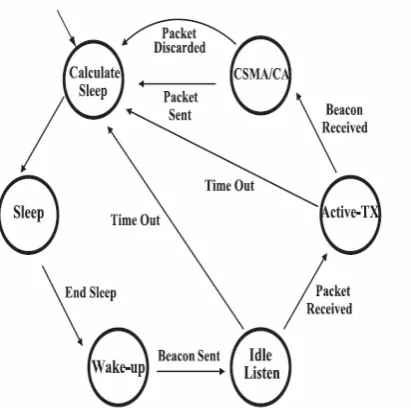
ESCRIPTIONBreath distinguishes between three node classes: edge nodes, relays, and the sink. The edge nodes wake up as soon as they sense packets generated by the plant to be controlled. Before sending packets, the edge node waits for a beacon message from the cluster of nodes closer to the edge. Upon the reception of a beacon, the node sends the packet. Consider a relay node k. Its detailed behavior is illustrated by the state machine of Fig. 1, as we describe in the following:
Fig. 1. State machine description of a relay node executing the Breath protocol.
• Calculate Sleep State: the node calculates the parameterµkfor the next sleeping time and generates an exponentially distributed random variable having average1 =µk. After this, the node goes back to the Sleep State.µk is computed such that the cumulative wake-up rate of the clusterµcis ensured.
• Sleep State: the node turns off its radio and starts a timer whose duration is an exponentially distributed random variable with average1= µk.When the timer expires, the node goes to the Wake-up State.
• Wake-up State: the node turns its beacon channel on, and broadcasts a beacon indicating its location. Then, it switches to listen to the data channel, and it goes to the Idle Listen State.
• Idle Listen State: the node starts a timer of a fixed duration that must be long enough to receive a packet. If a data packet is received, the timer is discarded, the node goes to the Active-TX State, and its radio is switched from the data channel to the beacon channel. If the timer expires before any data packet is received, the node goes to the Calculate Sleep State.
• Active-TX State: the node starts a waiting timer of a fixed duration. If the node receives the first beacon coming from a node in the forwarding region within the waiting time, it retrieves the node ID and goes to the CSMA/CA State. Otherwise, if the waiting timer is expired before receiving a beacon, the node goes to the Calculate Sleep State.
the Calculate Sleep State. If the channel is clear within the maximum number of attempts, the node transmits the data packet using an appropriate level of radio power and goes to the Calculate Sleep State. The sink node sends periodically beacon messages to the last cluster of the network to receive data packets. Such a node estimates periodically the traffic rate and the wireless channel conditions. Once the results of the optimization are achieved, they are communicated to the nodes by beacons. According to the protocol given above, the packet delivery depends on the traffic rate, the channel conditions, number of forwarding regions, and the cumulative wakeup time.
V. M
ODELLING OFT
HEP
ROTOCOLIn this section, I model the reliability, packet delay distribution, and total energy consumption of the network
A. Reliability Constraint
In this section, a data packet can be lost at a hop because of a bad wireless channel or packet collisions. The collision probability is determined by the CSMA/CA MAC. Therefore, to analyze such a behavior, we use a Markov chain. The Markov chain state is refers to the assessment of the channel state during CCA. They allow us to compute the probability of successful transmission in CSMA/CA as the probability that exactly one node transmits and n-1 are silent.
B. Delay Constraint
The delay between edge to sink is given by the sum of the delays experienced by a packet at each hop. There are two sources of delay: Time to wait before the first wake-up of a node in the next cluster: Let such a time be denoted with i for cluster i. Time to wait for clean channel: Since the Breath protocol uses CSMA/CA, a node spends a random time before sensing idle channel. Denote with "i such a time for cluster i. By summing these delays per each hop, we obtain the delay model. However, I assume that the backoff time can be approximated by a Gaussian distribution whose average is matched with the average and standard deviation of a uniformly distributed random variable.
C. Energy Consumption
The total energy consumption is the total energy for transmission and reception of data packets and is the energy consumption for wake-up, listening, and beaconing during a time T.
Fig.2 Total energy Consumption based on the number of hops.
VI. E
XPERIMENTALR
ESULTSA. Control Packets
It defines the number of Route Request Control Packets and Number of Route Reply Control Packets which is divided by the total number of control Packet Sent. The following figure shows about the number of control packets achieved from the Breath and HMAC protocol.
Fig.3 Number of control Packets achieved for both Breath and HMAC application
B. Delay
1. Simulation Time 100s
2. Topology Size 1000m x 1500m
3. Number Of Nodes 100
4. MAC Type MAC 802.11
5. Radio Propagation Model Two Ray Model
6. Radio Propagation Range 250m
7. Pause Time 0s
8. Max Speed 4m/sec-24m/sec
9. Initial Energy 100J
10. Transmit Power 0.4W
11. Receive Power 0.3W
12. Traffic Type CBR
13. CBR Rate 512 bytes x 6 per second
14. Number of Connections 50
Fig.4 Validation of average and variance of delay given by experimental results, respectively.
C. Average Active Time
VII. C
ONCLUSIONI designed and implemented Breath and HMAC protocols that are based on a system-level approach to guarantee explicitly reliability and delay requirements in wireless sensor networks for control applications. The protocol considers duty cycle, routing, MAC, and physical layers all together to maximize the network lifetime by taking into account the trade-off between energy consumption and application requirements for control applications.I developed an analytical expression of the total energy consumption of the network, as well as reliability and delay for the packet delivery. These relations allowed us to pose a mixed real-integer constrained optimization problem to optimize the number of hops in the multihop routing, the wake-up rates of the nodes, and the transmit radio power as a function of the routing, MAC, physical layer, traffic, and hardware platform. An algorithm for the dynamic and continuous adaptation of the network operations to the traffic and channel conditions, and application requirements, was proposed.
R
EFERENCESFig.5 Average Active Time based on the number of packets received
T
ABLEI S
IMULATIONP
ARAMETERS[1] P. Park, C. Fischione, A.Bonivento, K.H. Johansson, and A. Sangi ovanni-Vincentelli,“Breath: A Self-Adapting Protocol for Wireless Sensor Networks in Control and Automation,”
Proc. Fifth Ann. IEEE Comm. Soc. Conf. Sensor, Mesh and Ad Hoc Comm. and Networks (SECON’08), 2008.
[2] A. Willig, “Recent and Emerging Topics in Wireless Industrial Communication,” IEEE Trans. Industrial Informatics, vol. 4, no.2,pp. 102-124, May 2008.
[3] V.C. Gungor and G.P. Hancke,” Industrial Wireless Sensor Networks: Challenges, Design Principles, and Technical Approaches,” IEEE Trans Industrial Electronics, vol./56, no.10,pp.4258-4265, Oct. 2009
[4] Sangiovanni- Vincentelli, “Quo Vadis, SLD? Reasoning about the Trends and Challenges of System Level Design,”
Proc. IEEE,vol.95, no. 3, pp. 467- 506, Mar. 2007.
[5] J.P. Hespanha, P. Naghshtabrizi, and Y. Xu, “A Survey of Recent Results in Networked Control Systems,” Proc. IEEE, vol. 95, no. 1, pp. 138-162, Jan.2007
[6] E. Witrant, P. Park, M. Johansson, C. Fischione, and K.H. Johansson, “Predictive Control over Wireless Multi-Hop Networks,”Proc. IEEE Int’lConf. Control Applications (CCA
’07), 2007.
[7] G. Halkes and K. Langendoen, “Crankshaft: An Energy-Efficient MAC Protocol for Dense Wireless Sensor Networks,”
Proc. European Conf. wireless Sensor Networks (EWSN’07),
2007.
A
UTHOR’
SP
ROFILERajeswari. T.