Research Journal
Volume 12, No. 3, September 2018, pages 1–9
DOI: 10.12913/22998624/87026 Research Article
ANALYSIS OF TYPICAL STRUCTURES OF DYNAMIC SYSTEMS OF
MACHINING OF ELASTIC-DEFORMABLE SHAFTS WITH LOW RIGIDITY
Antoni Świć1, Arkadiusz Gola1, Dariusz Wołos1
1 Institute of Technological Systems of Information, Lublin University of Technology, Nadbystrzycka Street 36, 20-618 Lublin, Poland, e-mail: [email protected]; [email protected]; [email protected]
ABSTRACT
In the process of machining of shafts with low rigidity it is difficult to achieve the required parameters of accuracy of form and dimensions and of surface quality. Under specific conditions, low inherent rigidity and the relatively low shaft rigidity, compared to the rigid assemblies of the machine tool, cause vibrations. The paper presents a 7-level hierarchical mathematical model of the system of longitudinal turning and a mathematical model of the dynamic system of machining of shafts with low rigidity in the elastic-deformable state, taking factors interfering with and destabilising the process of shaft machining into account. For the purpose of valida
-tion of the models, a study was conducted on the conformance of the dynamic char
-acteristics of the mathematical model with the actual object. The study was realized on specially designed experimental workstation for the study of characteristics of the dynamic system of turning of elastic-deformable shafts with low rigidity. The
experiment demonstrated a high conformance of the dynamic characteristics of the
mathematical model with the actual object.
Keywords: low rigidity, manufacturing systems, experimental study, machining.
INTRODUCTION
Elastic-deformable shafts with low rigidity are more and more frequently used in various mechanisms and machines. Because of their ap-plication in aerospace industry, military, energy and shipbuilding industry, face high requirements with regard to their surface quality parameters owing to the significance of these parameters for the operational reliability of such parts [3, 8, 13]. Their machining is more complex than that of rigid shafts [6, 14]. In order to comply with the requirements, new solutions must therefore be implemented, already at the stage of design-ing technologies for producdesign-ing these parts, e.g. through proper modelling, prediction or simula-tion techniques [10, 15, 26].
The problem of machining low-rigidity shafts was widely discussed in the literature. There are
many publications concerning the problem of stability lobes [2÷23], definition of cutting con-ditions [4, 18], machining forces and error pre-diction [16,17], surface quality modelling [1, 7, 11, 19] or chatter suppression [15]. Moreover, the problem of simulation of low-rigidity part ma-chining was in the special interests of researchers [5, 9, 15]. However, it is quite difficult to find pa-pers concerning the problem of modelling of the dynamic system of turning shafts with low rigid-ity in the elastic-deformable state.
The technological system of machining of shafts with low rigidity is a systemic system [25]. The systemic category includes objects and pro-cesses composed of separate parts, elements and objects, characterised by the possibility of com-prehensive (complete) functioning. Any techno-logical system can be characterised by means of a specific set of features [26]:
• relations with the environment (in the case under consideration – with interference and the initial error of the semi-finished product); • realized functions, allowing the assurance of
specific parameters of machining accuracy in the technological process;
• structure;
• functional properties, determined by the char-acter of transmittance.
The specified set of characteristics fully cor-responds to the technological systems of machin-ing of elastic-deformable shafts with low rigidity and their mathematical models, taking into ac-count the properties of the system of control un-der steady and dynamic conditions.
The conventional methods of achieving accu-racy of machining low-rigidity shafts, based on multi-pass machining, reduced machining param-eters, steadies, and hand lapping, cause a signifi-cant lowering of efficiency, are uneconomical and inefficient, and preclude the automation of the process of machining [20, 21, 24]. This causes the necessity of developing new theoretical (e.g. suit-able models of the run of such processes, models of the dynamics of the layout and the process of turning) and practical (methods of shaft machin-ing eliminatmachin-ing the shortcommachin-ings of conventional machining methods) solutions. This paper pre-sents mathematical model of the dynamic struc-ture of machining of shafts with low rigidity in the elastic-deformable state of the system which is referred to the problem of the dynamics of the layout and the process of turning.
MATHEMATICAL MODELS OF TYPICAL
STRUCTURES OF SYSTEMS OF
MACHINING OF SHAFTS WITH LOW
RIGIDITY
As systemic objects, mathematical models of dynamic systems of machining of elastic-deform-able parts take into account important, and at the same time, various specific features of function-ing of the object of control.
The paper presents a 7-level hierarchical mathematical model of the system of longitudinal turning and a mathematical model of the dynamic system of machining of shafts with low rigidity in the elastic-deformable state, taking into account factors interfering with and destabilising the pro-cess of shaft machining.
The generalised mathematical model of the system of longitudinal turning and the
mathemat-ical model of the dynamic system are situated at level I – the highest hierarchical level (Fig. 1).
The generalised mathematical model GT(s) situated at hierarchical level ІI corresponds to the system of equations and the structural schematic presented in [18].
At hierarchical level ІІІ of the mathematical model of the dynamic system of longitudinal turn-ing of elastic-deformable shafts with low rigidity there takes place a division into two models, in the case of the first of which Kκr ≠ 0 (coefficient of effect of tool clearance angle on elastic defor-mation of shaft), κr ≠ 90° (tool clearance angle); and of the second Kκr = 0, κr = 90°. The operator transmittances GT (s), GT3(s) and the gain coef-ficients A1, A1’ and B1, B1’ taking into account Kκr [15]. At that level there are also the mathemati-cal models of the dynamic system of the process-es of oscillation grinding Gsc(s) and of external plunge grinding Gsc’(s) which can be considered as specific cases of the mathematic model of the dynamic system of turning. The corresponding relations describing plunge grinding, taking into account that in oscillation grinding Kκr = 0, Kbz = 0, mxKx = 0, Kxy = 0.
At hierarchical level IV there are the math-ematical models of the system of turning GT (s), GT1’(s), GT2(s), GT2’(s), GT3(s), differing in the val-ues of gain coefficients A1 A2,,A1’ and A2’ in the case of the dynamic system of oscillation grinding – Gsc(s), and of external plunge grinding – Gsc’(s).
Situated at hierarchical level V are the math-ematical models of the dynamic system, obtained with the omission of the effect of the closed feed-back loop being affected by coefficient mxKx<<1 and transmittance (1-e-Sτ), on the increment of the
thickness of the machined layer.
At hierarchical level VI there are partial mod-els of the dynamic system, omitting the effect of internal feedback mxKx<<1 and elastic deforma-tions relative to coordinate Z on the change in the depth of machining KbzKznz<< 1.
Situated at hierarchical level VII – the low-est one – are the partial mathematical models of the dynamic system of machining, taking into account only the effect of elastic deformations relative to coordinate Y on the increment of the thickness of machined layer (Kxy << 1) in turning, external plunge grinding and oscillation grinding – two partial models [22].
Fig. 1. Hierarchical levels MM of the dynamic system of machining of shafts with low rigidity in elastic-deform -able state
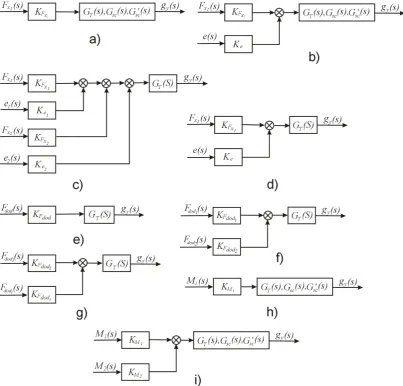
for which typical transmittances of the object of control gains coefficients relative to those effects have been determined in accordance with the re-lationships given in [20, 21], are presented in Fig. 2. In case of the dynamic system of longitudinal turning, taking into account suitable regulatory effects, one can use the structures developed for oscillation grinding – Fig. 2а, b, h, i, and of the dynamic system of longitudinal turning, taking into account suitable regulatory effects, those for oscillation grinding – Fig. 2g, i.
Therefore, mathematical models of dynamic systems – objects of control – can be classified according to the amount and quality of informa-tion adopted for the mathematical model. This al-lows the systematisation of design work and tech-nological preparation of processes, as well as the development of automatic control systems and adaptive systems.
COMPARATIVE ANALYSIS OF RESULTS
OF THEORETICAL AND EXPERIMENTAL
STUDIES OF CHARACTERISTICS OF THE
DYNAMIC SYSTEM OF MACHINING OF
ELASTIC-DEFORMABLE SHAFTS WITH
LOW RIGIDITY
Metodology of experimental study and experimental workstation
The presented analytical approach to the con-struction of the mathematical model of the dy-namic system of the process of turning of elastic-deformable shafts with low rigidity is related with the introduction of numerous reducing or simpli-fying assumptions. Validation of their correctness requires experimental studies. The objective of such a study is the estimation of the degree of conformance of the dynamic characteristics of the mathematical model with those of the actual ob-ject. The study of the dynamic characteristics of the technological processes of machining should be conducted on the basis of experiments deter-mining the responses of the object of control to typical stimuli evoked on purpose.
The simplest typical test stimulus is a step-wise change of the input signal. It is assumed that control is realized according to the channel of force-type effects or stimuli, in this case the axial tensile force generating the elastic-deformable state of the part. Machining is conducted at con-stant values of the force of machining, longitudi-nal travel, specific depth of machining and initial
value of the tensile force. With a step-wise change of the regulatory effect – tensile force, transition processes were recorded – changes of the elas-tic deformations of the machined shaft at various cross-sections of the semi-finished product. Anal-ogously, the process of transitional processes was recorded, relieving the load on the semi-finished product with the tensile force, from the maximum to the initial value, determined in each case by the geometric parameters of the part and by the machining parameters.
The conformance of the shape of the experi-mental curve relative to the curve obtained on the basis of the mathematical model can be estimated in accordance with the methodology presented in [11]. The transitional experimental characteristic is approximated by a curve corresponding to an aperiodic link. It is known that the transitional characteristic of such a link in time T1E attains the value of 0,63g0ust, where g0ust – value of the input coordinate – elastic deformation of the machined part. At specific conditions of machining in the dynamic system, the time constant T1 was calcu-lated in accordance with the relations presented in [19]. The error can be calculated from the relation:
E E T T T 1 1 1 − = δ (1)
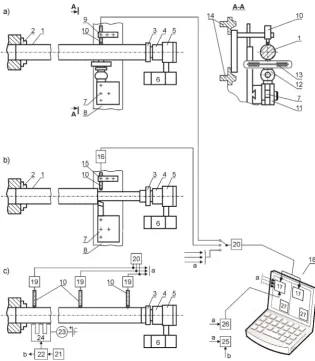
dynamometer 13. The value of axial tensile force was determined in control unit 6. The workstation was used for the study of elastic deformations of shafts with diameters d = 2 – 15 mm and length of 100, 200 and 300 mm.
Recording of transitional characteristics of the dynamic system during the turning of shafts with low rigidity (Fig. 3) was conducted with the use of sensor 10 mounted on bracket 15 which was rigidly installed on carriage 8. Shaft ma-chining was conducted by means of a cutting tool installed in tool post 7. Information on the transitional characteristics, converted by measur-ing generator 16 and analogue-digital converter (P A/C) 17 is logged in digital form in the fixed memory store of computer 18. This operation is realized analogously to oscillogram logging in an analogue oscilloscope, which allows obtaining oscillograms of any desired length.
The acquisition and estimation of frequency characteristics of the dynamic system is
possi-ble through the use of special module (Fig. 3c). Characteristics of the system (static, transitional, frequency) are necessary for the diagnostics and control of the process of machining of shafts with low rigidity.
The block of vibration recording, with the use of the PC, operates according to the follow-ing schematic. Deformations and vibrations of the dynamic system are recorded by the eddy current sensor 10, signal from which is supplied to the measuring generator 19 where it under-goes modulation and amplification. Amplified signal from the output of measuring generator 19 is supplied via special separator 20 to the in-put of the analogue-digital converter (PA/C) 17 PC and it is logged in digital form in the fixed memory of the computer. There can be more than three recording sensors. The experimental workstation includes the special separator 20 which connects the sensors to the input of PA/C in a sequential manner.
Recording of amplitude-frequency character-istics of the dynamic system is conducted accord-ing to the followaccord-ing schematic. The frequency of input effect is determined in generator 21 from which the signal, via amplifier 22, is supplied to the control winding of vibrator 24. The magnetis-ing windmagnetis-ing is supplied with direct current from the power supply. The magnetic-force effects of the vibrator are transferred onto the object, where the magnetic vibrations are converted into me-chanical vibrations. The current flowing through the winding of the electromagnetic vibrator, and its traction force at a change of frequency of the input effect are controlled by means of ammeter 23. Vibrations of the part, recorded by eddy cur-rent sensors 10 and amplified by amplifiers 19, are recorded by means of phase-sensitive volt-meter 25, to the input of which signal is supplied from power amplifier 22. The signals obtained are compared in the phase-sensitive voltmeter. The actual and the imaginary parts of the ampli-tude-frequency characteristics are determined. For recording the shift of the axis of the semi-finished product a low-pass filter 26 is installed in the workstation. Signal from sensor 10, passed through the low-pass filter 26, retains a constant component proportional to the shift of the axis of the machined part. The signal obtained is pre-sented on the computer screen or logged in its memory 18.
The amplitude-frequency characteristics are recorded with the use of the program analyser of spectra 2 and oscillograms saved in computer memory 18.
Recording eddy currents is performed with the use of a sensor, characterised by the follow-ing parameters: method of measurement – con-tactless; small dimensions – diameter 6 mm, length 30 mm; linear characteristics at slot from 2 to 2,5 mm; sensitivity 10 mV/1μm. The small size and cylindrical shape of the sensor body with external thread allow its installation in hard to access places, and also to bring it close to the
machining zone. The sensor registers changes of electromagnetic field in relation to the distance between the winding generating eddy currents and the surface of the part under study. The tech-nique of vibration recording by means of eddy currents has a significant advantage – it is practi-cally inertia-free as the rate of information flow from the converter is equal to the speed of propa-gation of electromagnetic field. The boundaries of measurement of vibrations frequency are from zero to hundreds of kHz. The range of amplitude measurement – from a micrometre to millimetres. The sensor has a measurement generator from the output of which constant voltage is taken off. A two-channel computer audio card is used as the PA/C. The logging and analysis of oscillograms is done with the use of a special program – analyser of frequency spectra.
Results of experimental study of
characteristics of dynamic system of turning of elastic-deformable shafts with low rigidity
In the study of the responses of an object to test effects it is necessary to determine the inher-ent inertia of the drive eleminher-ent of the system – the pneumatic drive. Analysis of the equation of movement of the pneumatic element shows that its dynamic properties can be approximately de-scribed by means of an operator transmittance of the aperiodic element as:
1
) (
+ ⋅ =
s T
K s
G
pr pr
pr (2)
where the equivalent time constant Tnp − depend-ing on the initial position of the piston of the pneumatic actuator equals 0,01–0,02 s. The increase of elastic deformations relative to coordinate Y was analysed in relation to the ini-tial coordinate of the object when supplying a unit step-wise signal on its input, taking into account the inertia of the actuator. The operator transmit-tance of the object is equal to:
(3)
mm, f1 = 0,2 mm/r, κr = 90°, vc = 0,33 m/s, value of initial tensile force Fx1 = 1980 N.
The values of mx= my= 0,61·106 N/m were de-termined with the use of guide-books. In the case under consideration, the elasticity coefficients of the elastic system relative to coordinate X are determined primarily by the elastic properties of the machine tool − hxx=3·10-7 m/N, and relative to coordinate Y− by the elastic properties of the
part. The calculations were performed following the 4 relations given in [20], in the case when the machining force, applied at the centre point of the part, determines the initial value of elastic defor-mations of the part gy0 = 0,11·10-3 m, h
yy = 1,2·10
-6 m/N. The values of coefficients B
0 and В are
equal to B0 = 0,18, В = 0,17.
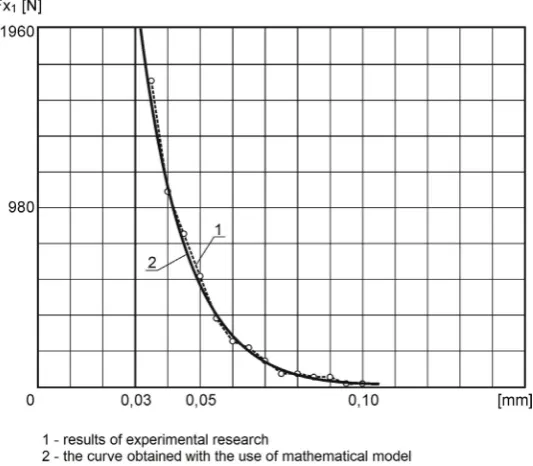
Taking into account that the values of coef-ficients B and B0 are similar, the object can be as-sumed to be a proportional element, and the tran-sitional characteristic is determined by the inertia of the actuator. As follows from the experiment carried out, in these conditions the curve of the transitional process is exponential, and the time constant equals Tpr. When applicate the initial tensile force to the end of the elastic-deformable more than three times increase of the accuracy of the machining process can be obtained (Fig. 5).
Loading a semi-finished product with a ten-sile force, causing the elastic-deformable state, is equivalent to the creation of an additional support causing an increase of the static stiffness of the part. Therefore, it can be assumed that the alignment and the fixing of semi-finished products can be realized in self-centering grips or in a spring sleeve.
CONCLUSION
Mathematical models of dynamic systems – objects of control - can be classified with relation to the amount and quality of information adopted in the mathematical model. This allows the system-Fig. 4. Experimental verification of the time con
-straints of the operator transmittance
atisation of design work and technological prepa-ration of processes, as well as the development of automatic control systems and adaptive systems.
Validation of the analytical models of the dy-namic system of the process of turning of elastic-deformable shafts with low rigidity was conducted on a specially designed experimental workstation. The study of the dynamic characteristics of tech-nological processes of machining was performed on the basis of experiments in the course of which the responses of the object of control to specially initiated typical effects were determined.
The particular results of provided experi-ments allow to draw following conclusions: • time constants in the numerator and the
de-nominator of the operator transmittance of the object have similar values,
• the transitional process at step-wise signal supplied to the input of the actuator is most frequently determined by the properties of that element,
• the elasticity coefficients of the elastic system relative to coordinate X are determined pri-marily by the elastic properties of the machine tool − hxx=3·10-7 m/N, and relative to coordi-nate Y − by the elastic properties of the shaft. Moreover, the study demonstrated that the time constants in the numerator and the denomi-nator of the operator transmittance of the object have similar values, and thus its dynamic prop-erties are similar to the propprop-erties of the propor-tional element, i.e. the transipropor-tional process at step-wise signal supplied to the input of the actuator is most frequently determined by the properties of that element. Therefore, the object can be as-sumed to be a proportional element, and the tran-sitional characteristic is determined by the iner-tia of the actuator. The experiment shows that in these conditions the curve of the transitional pro-cess is exponential, and the time constant equals Tpr. The result is that the application of tensile force to the end of the elastic-deformable shaft allows to increase the accuracy of the machining process more than three times.
REFERENCES
1. Arnaud L., Gonzalo O. Seguy, S. Jauregi H., Pei
-gne, G.: Simulation of low rigidity part machin
-ing applied to thin-walled structures. International Journal of Advanced Manufacturing Technology, Vol. 54, 2011, 479-488.
2. Bajić D., Celent L., Jozić S.: Modeling of the influ
-ence of cutting parameters on the surface roughness,
tool wear and cutting force in face milling in off-line process control. Strojniski Vestnik – Journal of Me
-chanical Engineering, Vol. 58, 2012, 673-682. 3. Bing D., Guang-Bin Y., Yan-Qi G., Xue-Mei W.,
Yu-Xin L.: Machining surface quality analysis of aluminium alloy thin-walled parts in aerospace, International Journal of Security and its Applica
-tions, Vol. 9, No. 11, 2015, 201-208.
4. Campa F. J., de Lacalle L.N.L., Urbikain G., Ruiz D.: Definition of cutting conditions for thin-to-thin milling of aerospace low rigidity parts, Proceed
-ings of the ASME International Manufacturing Science and Engineering Conference 2008, Vol. 1, 2008, 359-368.
5. Campomanes M.L., Altintas Y.: An improved time domain simulation for dynamic milling at small radial immersions. Trans ASME, Journal of Man
-ufacturing Sciences and Engineering, Vol. 125, 2003, 416-422.
6. Dies E., Perez H., Marquez J., Vizan A.: Feasibility study of in-process compensation of deformations in flexible milling, International Journal of Machine Tools and Manufacture, 2015, Vol. 94, 1-14. 7. Huang Y.A., Liu H.M., Yin Z.P., Xiong, Y.L: Com
-plex surface machining: thermo-mechanical analy
-sis for error prediction of low-rigidity workpiece. Lecture Notes in Artificial Intelligence, Vol. 5928, 2009, 666-677.
8. Izamshah R., Mo J.P.T., Ding S.: Hybrid deflection
on machining thin-walled monolithic aerospace
components, Journal of Engineering Manufacture, Vol. 226, No. 4, 2012, 592-605.
9. Li H., Shin Y.C.: A comprehensive dynamic and milling simulation model. Trans ASME, Journal of Manufacturing Sciences and Engineering, Vol. 128, 2006, 86-95.
10. Li H., Shin Y.C.: Integration of thermo-dynamic spindle and machining simulation models for a digital machining system. The International Jour
-nal of Advanced Manufacturing Technology, Vol. 40 (7-8), 2009, 648-661.
11. Lopes L.G.D., Gomes J.H.D., de Paiva, A.P. Barca, L.F. Ferriera, J.R. Balestrassi P.P.: A multivariate surface roughness modelling and optimization un
-der conditions of uncertainty. Measurement, Vol. 8, No. 46, 2013, 2555-2568.
12. Lorong P., Coffignal G., Cohen-Assouline S.: Sim
-ulation du comportement dynamique d’un systeme usinant: modelisation de l’interaction outil/matiere en presence d’une piece flexible. Mecanique and Industries, Vol. 9, 2008, 117-124.
13. Miao L. , Yu H., Cui W., Jiang H., Li Y., Wang R., Gao X.: Analysis and research of structure and pro
China; 26 September 2015 through 27 September 2015; Code 121403.
14. Mundim R.B., Borille A.V.: An approach for reducing undesired vibrations in milling of low rigidity struc
-tures, International Journal of Advanced Manufactur
-ing Technology, Vol. 88, Issue. 1, 2017, 971-983. 15. Qi H., Tian Y., Zhang D.: Machining forces predic
-tion for peripheral milling of low-rigidity
compo-nent with curved geometry, International Journal of Advanced Manufacturing Technology, Vol. 64, No. 9, 2013, 1599-1610.
16. Ratchev S., Liu S., Huang W., Becker A.A.: Mill -ing error prediction and compensation in
machin-ing of low-rigidity parts. Int J Mach Tools Manuf, Vol. 44, No. 15, 2004, 1629-1641.
17. Ryu, S. H., Lee H. S., Chu, C. N.: The form er -ror prediction in side wall machining considering
tool deflection. Int. J Mach Tools Manuf, Vol. 43, 2003, 731-737.
18. Świć A., Draczew A., Gola A: Method of achieving accuracy of thermo-mechanical treatment of low-ri
-gidity shafts. Advances in Science and Technology. Research Journal, Vol. 10, No. 29, 2016, 62-70. 19. Świć A., Gola A., Wołos D., Opielak M.:
Micro-geometry surface modelling in the process of low-rigidity elastic-deformable shafts turning, Iranian Journal of Science and Technology – Transactions of Mechanical Engineering, Vol. 41, No. 2, 2017, pp. 159-167, doi:10.1007/s40997-016-0050-4.
20. Świć A., Gola A., Control of Accuracy of Forming Elastic-Deformable Shafts with Low-Rigidity, Ad
-vances in Intelligent Systems and Computing, Vol. 620, 2018, 107-114.
21. Świć A., Wołos D., Zubrzycki J., Opielak M., Gola A., Taranenko V.: Accuracy control in the machin
-ing of low rigidity shafts, Applied Mechanics and Materials, 613, 2014, 357-367.
22. Tian L.Z., Wu J.H., Xiong Z.H., Ding H.: Active chatter suppression in turning of low-rigidity work
-piece by system matching. Lecture Notes in Artifi
-cial Intelligence, Vol. 9245, 2015, pp. 609-618. 23. Urbicain G., Olvera D., Fernández A.,
Rodríguez,A., Tabernero, I., López de Lacalle L.N.: Stability Lobes in Turning of Low Rigidity Components. Advanced Materials Research, Vol. 498, 2012, pp. 231-236.
24. Wang G., Li W.-L., Tong G., Pang C.-T., Improv
-ing the machin-ing accuracy of thin-walled parts by online measuring and allowance compensation, International Journal of Advanced Manufacturing Technology – article in press.
25. Wang X., Wang A., Ly Y.: A Variable Stiffness Anal
-ysis Model for Large Complex Thin-Walled Guide Rail, MATEC Web Conf., Vol. 77, 10002, 2016. 26. Zhang X., Yong L., Feng X.: The study of the