EDITORIAL
Biolinguistics 5.1–2: 001–009, 2011 ISSN 1450–3417 http://www.biolinguistics.eu
Biolinguistic Perspectives on Recursion:
Introduction to the Special Issue
Uli Sauerland & Andreas Trotzke
1. Introduction
Recursion is a central issue of the biolinguistic investigation of language. This special issue brings together seven new contributions on recursion from several different perspectives: theoretical syntax, neurolinguistics, language acquisition, genetics, and psycholinguistics. In this introduction, we first briefly characterize the background on recursion that the contributions share and that led to this special issue of Biolinguistics. Secondly, we situate the advances of the individual contributions in this issue against the background of studies on recursion.
The notion of recursion has played a significant role in the development of the field of linguistics and specifically of the generative approach. The concern that lead to recursion is very old: Descartes (2003 [1637]: 38) hypothesized that the crucial difference between man and animal manifests itself most clearly in the fact that an animal “never […] arranges its speech in various ways […] in order to reply appropriately to everything that may be said in its presence, as even the lowest type of man can do”. In a similar vein, and two centuries later, Wilhelm von Humboldt (1999 [1836]: 91) pointed out the human capacity to “make infinite employment of finite means” in language. Recursive rules provide one solution to the problem of accounting for an infinite number of possible sentences by means of a finite memory space. However, Descartes and Humboldt didn’t yet talk about recursion specifically, and infinity could be produced by means other than recursion. In the 1950s, Noam Chomsky developed formal language theory as a mathematically precise model of language and, using it, specified a precise role of recursion within formal models of language. In fact, recursion in one specific way proved to be essential to set apart the phrase structure models of language Chomsky proposed from the behaviorist models of language prevalent
Biolinguistics Editorial 2
at the time. Chomsky, however, didn’t use the term recursion for this notion, but defined the notion of self-embedding as follows:
(1) A language L is self-embedding (s.e.) if it contains an A
such that for some φ, ψ (φ ≠ I ≠ ψ), A ⇒ φAψ. (Chomsky 1959: 148)
The definition characterizes as self-embedding any language that contains a string A and allows the derivation from A of a string that properly contains A, that is, A is preceded and followed by two non-trivial strings. Over two papers, (Chomsky 1956, 1959) showed that the concept of self-embedding precisely sets apart context-free grammars from less complex models of grammar (specifically, finite state Markov process based models): All and only the languages produced by a context-free grammar that are self-embedding cannot be given an analysis using the less complex models.
Chomsky (1957) furthermore showed that English is self-embedding. In a nutshell, this demonstration consists of the observation that patterns such as (2) exist in English (slightly modified from Chomsky 1957: 22) and clearly satisfy the definition of self-embedding in (1).
(2) a. S ⇒ If S, then it’s true. b. S ⇒ Either S or not.
Finite state Markov chain models of language cannot capture the long-distance dependencies between if and then and either and or. Therefore, Chomsky established that behaviorist accounts of language were insufficient, whereas the phrase structure grammars Chomsky introduced could be sufficient. In this way, recursion was crucial for the development of phrase structure based approaches to language. However, subsequently recursion was not a major topic: Once phrase structures were established, recursion became part of the background. Chomsky and many other linguists proceeded to develop concrete phrase structure based grammars for specific languages.
Biolinguistics Editorial 3
rely on recursion, though possibly recursion within a finite-state grammar. Fol-lowing much of the subsequent psychological literature (e.g. Gentner et al. 2006, Friederici et al. 2006), we assume that only a grammar that can account for self-embedding languages should be called recursive, and will use the term in this restricted sense in the following.
The hypothesis of Hauser et al. and their arguments captured the imagi-nation of many researchers from different disciplines. Even though an enormous amount of progress has been made, many of the debates Hauser et al. triggered are still not resolved. This special issue takes up three major concerns that have developed since 2002. The first concern is how to test for recursion in experi-mental psychology: Since we cannot test humans on infinite sets of sentences and furthermore self-embedding in the sense of (1) is difficult for humans to process, how can recursion best be tested for? The second major concern is the role of re-cursion in linguistic theory: Is rere-cursion an integral part of any syntactic structure building or is recursion better viewed as something on top of more basic struc-ture building? Finally, the third major concern this issue addresses is the relation of recursion to the genetic and neural basis of language. Can recursion be sepa-rated from other parts of language in the genetic and neural domain?
2. Testing Recursion in Experimental Psychology
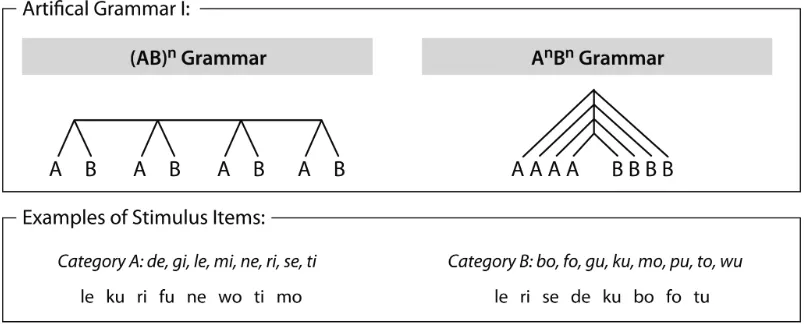
Testing recursion in experimental psychology crucially rests on the Artificial Grammar Learning (AGL) paradigm, which goes back to Reber (1967) and enables psychologists to isolate fundamental mechanisms involved in natural language syntax in sophisticated test designs. The first AGL study interpreted to be relevant for understanding syntactic recursion at the behavioral level was carried out by Fitch & Hauser (2004). They focused on the comparison between a self-embedding language and one that isn’t. The two types of structures can be illustrated with the two English sentences in (3) and (4):
(3) [The man]A [the dog]A [bit]B [comes]B.
(4) [The man]A [comes]B; [the dog]A [bit the man]B.
Biolinguistics Editorial 4
may have represented a critical juncture in the evolution of the human language faculty” (p. 380) and thus may be of direct relevance to the hypothesis suggested by Hauser et al. (2002).
However, a finite set of experimental materials such as that of Fitch & Hauser couldn’t in principle exclude all alternative explanations other than a recursive phrase structure grammar of the performance of the human subjects. For the materials of Fitch & Hauser, specifically, humans may have relied on counting rather than grammar building when processing the AnBn sequences or on additional cues specific to their stimuli. Research since has explored different experimental methods and formal grammars to more precisely pin down specific human abilities. One focus has been the fact that natural human language requires the ability to process sequences in which a consistent coupling of AB-pairs is involved (cf. Perruchet & Rey 2005, de Vries et al. 2008). To visualize, the more exact representation of our sentence (3), according to this objection, must be (5), where the pairing of particular As an Bs is marked by numbers:
(5) [The man]A1 [the dog]A2 [bit]B2 [comes]B1.
The results for formal grammars eliciting such structures have been mixed. Given several methodological issues, it is now a central concern in this field of inquiry “that the relation between artificial language studies and natural language must be clarified” (Hauser et al. 2007: 127). As a consequence, experimental methods and insights have become more differentiated. Two contributions in this issue, one by de Vries et al. and one by Poletiek, advance this agenda.
Meinou de Vries, Morten H. Christiansen, and Karl Magnus Petersson argue that research focusing only on nested dependencies like (3) cannot provide us with a complete picture of where the boundaries of human language process-sing lie. They show that crossed dependencies, another type of non-adjacent dependencies, are easier to learn than nested dependencies, if the number of dependencies exceeds two. In light of this finding, they argue that the different complexity levels formulated in the Chomsky hierarchy (cf. Chomsky 1956) and used by studies such as Fitch & Hauser (2004) and Gentner et al. (2006) are less relevant. Instead, they propose a new complexity hierarchy, which is based on the assumption that syntactic complexity is determined by (i) the number of de-pendencies that need to be resolved and (ii) the specific ordering of these dependencies.
Biolinguistics Editorial 5
3. Locating Recursion in Linguistic Theory
Syntactic theories describe generalizations at various levels of the typology of phrases. At the least specific level of the phrasal typology, any word or phrase belongs to the same type. All that can be said for this type of phrase is that two phrases can form a complex syntactic constituent, as is captured by the operation
Merge in minimalist syntax. Many syntactic generalizations, however, make refer-ence to a more articulated typology of phrases. For example, a generalization across several languages is that single words (heads) are distinguished from com-plete phrases for word order phenomena: Languages can therefore be described as either head-initial (e.g. English) or head-final (e.g. Japanese). This supports a typology of phrases that distinguishes between heads (single words) and maxi-mal projections (complete phrases). A second distinction between types of phrases is important within minimalist syntax: the distinction between phases and non-phases. Phases are special phrases that are distinct from other phrases by their intonational and semantic properties.
The debate over the appropriate typology of phrases does not directly relate to the formal notion of self-embedding as characterized in (1), since the formal notion applies to languages — not to concrete grammars. However, there exists also a natural notion of recursion that applies to specific structures in a phrase structure based syntax: A structure is recursive if there is a phrase of type X that contains as a proper part another phrase of type X. Recursion of a concrete phrase structure grammar is evidently a different notion from self-embedding as defined in (1). The link between the notions is the following: If a language is self-embedding, any phrase structure grammar must be such that some strings are analyzed as having a recursive structure. But, importantly, the notion of self-embedding never predicts which specific strings must receive a recursive anal-ysis, nor is any language that can be analyzed with phrase-structure grammar that allows some recursive structures necessarily self-embedding in the formal sense.
Biolinguistics Editorial 6
Jan-Wouter Zwart assumes a minimalist background and claims that syntactic recursion should not be defined in terms of embedding, but in terms of derivation layering. Comparing iterative and recursive procedures to build phrase structures, he argues that one cannot decide that a language is recursive by simply looking at its structures. Instead, one has to investigate the structure building procedure itself. After showing that embedding structures can also be generated without recursion, Zwart defines recursion in language as the interaction between derivation layers. He then applies these concepts to the analysis of the Amazonian language Pirahã. Everett (2005) claims that Pirahã does not exhibit recursion which has led to intense discussion on the relevance of this finding with respect to the status of recursion as a linguistic universal. According to Zwart’s approach, both complex subjects and structured lexical items imply recursion. Zwart then demonstrates, using uncontested data, that both complex subjects and structured lexical items are attested in Pirahã, and thus, he argues that the grammar of Pirahã allows for recursive structures.
Tom Roeper starts with the assumption that if variation is attested regarding what particular forms of recursion natural languages allow, then an acquisition challenge exists. In the light of acquisition evidence from adjectives, possessives, verbal compounds, and sentence complements, he outlines an acquisition path for specific forms of recursion. In particular, he distinguishes three mechanisms to build recursive structures: direct recursion, indirect recursion, and Generalized Transformations (GTs), as realized in an adaptation of Tree Adjoining Grammar. Since children first analyze adjacent identical struc-tures as direct recursion with a conjunctive reading, Roeper argues that direct recursion is the acquisition default and can thus be viewed as the first stage in the acquisition of recursive structures. Assuming that children must ‘experience’ specific forms of recursion in order to allow them in their language, he goes on to discuss several evidences that may help account for the path of how to acquire the more complex forms of both indirect recursion and recursion in the form of GTs.
4. Localizing Recursion in Cognitive Neuroscience and Genetics
The testing of human and non-human subjects regarding their capacities to pro- cess artificial language grammars inspired neuropsychological studies that ask to what extent the core computational faculty of processing hierarchical embedded structure can be segregated from other brain functions. Let us briefly look at this field of research.
Biolinguistics Editorial 7
in processing in the brain. In particular, Friederici et al. report that processing of local transitions within a finite-state grammar is subserved by the left frontal operculum, whereas a specific section of Broca’s area holds responsible for the computation of hierarchical dependencies involved in syntactic recursion within a phrase structure grammar. However, like in experimental psychology, the testing methods have been refined in subsequent studies, which is the starting point for three contributions in the present volume.
Angela D. Friederici, Jörg Bahlmann, Roland Friedrich, and Michiru Makuuchi report such refinements by reviewing recent neuroimaging experi-ments that evaluate the neural basis of processing embedded structures, which, as they argue, allows for conclusions regarding the localization of processing re-cursion in the brain. Based on numerous studies, they conclude that a special region of Broca’s area, left Brodmann area 44, is the neural correlate of computing linguistic recursion. They segregated this correlate from activation of Broca’s area due to working memory, from activation due to the processing of visual-event sequences, and from areas involved in processing hierarchically structured mathematical formulae. Friederici et al.’s cross-study review thus suggests two different computational systems in the lateral prefrontal cortex dealing with hier-archical structures, one which is domain-general and is active when processing complex hierarchies in non-language domains, and one which is domain-specific and deals with recursive language or language-like hierarchies.
Vasiliki Folia, Christian Forkstam, Martin Ingvar, Peter Hagoort, and Karl Magnus Petersson compare the brain networks engaged in processing grammaticality judgments and in processing preference judgments in an artificial grammar learning experiment. Their results show that preference and gram-maticality classification engage virtually identical brain regions. That is, the subjects also engage brain regions central to natural syntax processing when they are not explicitly instructed or receive any information concerning the existence of a grammatical rule system that underlies the presented stimuli. In addition, Folia et al. present some initial efforts to understand the genetic basis of the capa-city for artificial syntax acquisition by exploring the potential role of the CNT-NAP2 gene, which is controlled by the FOXP2 transcription factor and whose expression is enriched in frontal brain regions in humans.
Biolinguistics Editorial 8
certain threshold, they suggest the evolutionary scenario that recursion in human language has evolved due to a slowly evolving quantitative increase in the connectivity of the cortex that has suddenly crossed a critical threshold. Accordingly, syntactic recursion may have emerged in a manner entirely unrelated to the appearance of a novel piece in the neural circuitry, that is, without altering the intrinsic make-up of the network.
In addition to the seven research papers, a book review by David J. Lobina is included in this volume. Lobina reviews the recently published volume Recursion and Human Language, edited by Harry van der Hulst. We feel the review should be read in addition to the editorial to elaborate further the background for the research presented in this volume.
References
Arsenijević, Boban & Wolfram Hinzen. 2010. Recursion as a human universal and as a primitive. Biolinguistics 4, 165–173.
Chomsky, Noam. 1956. Three models for the description of language. IRE Transactions of Information Theory IT-2 3, 113–124.
Chomsky, Noam. 1957. Syntactic Structures. The Hague: Mouton.
Chomsky, Noam. 1959. On certain formal properties of grammars. Information and Control 2, 137–167.
Descartes, Réne. 2003 [1637]. Discourse on method. In Elizabeth S. Haldane & George R. Thomson (trans.), Discourse on Method and Meditations, 1–52. Mineola, NY: Dover.
de Vries, Meinou H., Padraic Monaghan, Stefan Knecht & Pienie Zwitserlood. 2008. Syntactic structure and artificial grammar learning: The learnability of embedded hierarchical structures. Cognition 107, 763–774.
Everett, Daniel L. 2005. Cultural constraints on grammar and cognition in Pirahã: Another look at the design features of human language. Current Anthro-pology 46, 621–634.
Fitch, W. Tecumseh. 2010. Three meanings of ‘recursion’: Key distinctions for bio-linguistics. In Richard K. Larson, Viviane Déprez & Hiroko Yamakido (eds.), The Evolution of Human Language: Biolinguistic Perspectives, 73–90. Cambridge: Cambridge University Press.
Fitch, W. Tecumseh & Marc D. Hauser. 2004. Computational constraints on syn-tactic processing in a nonhuman primate. Science 303, 377–380.
Friederici, Angela D., Jörg Bahlmann, Stefan Heim, Ricarda I. Schubotz & Alfred Anwander. 2006. The brain differentiates human and non-human gram-mars: Functional localization and structural connectivity. Proceedings of the National Academy of Sciences of the United States of America 103, 2458–2463. Gentner, Timothy Q., Kimberly M. Fenn, Daniel Margoliash & Howard C.
Nus-baum. 2006. Recursive syntactic pattern learning by songbirds. Nature 440, 1204–1207.
Biolinguistics Editorial 9
1579.
Hauser, Marc D., David Barner & Tim O’Donnell. 2007. Evolutionary linguistics: A new look at an old landscape. Language Learning & Development 3, 101– 132.
von Humboldt, Wilhelm. 1836/1999. The diversity of human language-structure and its influence on the mental development of mankind. In Peter Heath (trans.), Wilhelm von Humboldt: On Language, 1–287. Cambridge: Cambridge University Press.
Luuk, Erkki & Hendrik Luuk. 2011. The redundancy of recursion and infinity for natural language. Cognitive Processing 12, 1–11.
Nevins, Andrew, David Pesetsky & Cilene Rodrigues. 2009. Pirahã exception-ality: A reassessment. Language 85, 355–404.
Perruchet, Pierre & Arnaud Rey. 2005. Does the mastery of center-embedded linguistic structures distinguish humans from nonhuman primates? Psycho-nomic Bulletin & Review 12, 307–313.
Reber, Arthur S. 1967. Implicit learning of artificial grammars. Journal of Verbal Learning & Verbal Behavior 6, 855–863.
Surányi, Balázs. 2010. Toward a strongly derivational syntax. In Michael T. Putnam (ed.), Exploring Crash-Proof Grammars, 167–212. Amsterdam: John Benjamins.
Tomalin, Marcus. 2011. Syntactic structures and recursive devices: A legacy of imprecision. Journal of Logic, Language and Information, doi:10.1007/s10849-011-9141-1.
Uli Sauerland Andreas Trotzke
Zentrum für Allgemeine Sprachwissenschaft (ZAS) Universität Konstanz
Fachbereich Sprachwissenschaft
Schützenstraße 18 Universitätsstraße 10 10117 Berlin 78457 Konstanz
Germany Germany
Biolinguistics 5.1–2: 010–035, 2011
ISSN 1450–3417 http://www.biolinguistics.eu
Learning Recursion: Multiple Nested
and Crossed Dependencies
Meinou H. de Vries, Morten H. Christiansen
& Karl Magnus Petersson
Language acquisition in both natural and artificial language learning settings crucially depends on extracting information from ordered sequen-ces. A shared sequence learning mechanism is thus assumed to underlie both natural and artificial language learning. A growing body of empirical evidence is consistent with this hypothesis. By means of artificial language learning experiments, we may therefore gain more insight in this shared mechanism. In this paper, we review empirical evidence from artificial language learning and computational modeling studies, as well as natural language data, and suggest that there are two key factors that help deter-mine processing complexity in sequence learning, and thus in natural lang-uage processing. We propose that the specific ordering of non-adjacent de-pendencies (i.e. nested or crossed), as well as the number of non-adjacent dependencies to be resolved simultaneously (i.e. two or three) are important factors in gaining more insight into the boundaries of human sequence lear-ning; and thus, also in natural language processing. The implications for theories of linguistic competence are discussed.
Keywords: artificial language learning; non-adjacent dependencies; pro-cessing complexity; recursion
1. Introduction
1.1. Competence versus Empirical Observations
One must not make too much of the exact form of the competence theory in the related task of building a broader psychological theory.
(Pylyshyn 1973: 45)
Learning Recursion 11
A theory of psychological processing typically focuses on actual and measurable performance. This is the perspective taken in the current paper with respect to structured-sequence processing in general as well as human language processing. From this point of view, it is natural to view the language faculty as a neurobio-logical system. The task, then, is to characterize the representational, processing and acquisition properties of this system at the neurobiological and psycholo-gical levels. In contrast, considerable work in theoretical linguistics, such as formal language theory, has focused on describing an idealized competence, comprising the knowledge of language that a speaker/hearer supposedly has. Instead of being grounded in experimental evidence as support, competence theories are mostly supported by linguistic intuitions (Pylyshyn 1973) and abstract computational considerations. Formal language theory might therefore not be the best source of information about the boundaries of human language processing.
One well-known intuition about syntactic structure is the property of recursion, an operation that permits a finite set of rules to generate an infinite number of expressions. Empirical evidence, however, has demonstrated that people are only able to generate and process recursive constructions to a very limited extent. Yet, linguists have concluded that recursion is a fundamental, possibly innate and unique part of the human language faculty.
One may ask whether we really need a competence theory that incorpo-rates unbounded recursion (see e.g. Levelt 1974, Christiansen 1992, Petersson 2005). We stress that empirical observations about language processing mecha-nisms are more useful in the enterprise of understanding human language pro-cessing than linguistic intuitions. Thus, in this paper, the focus is on empirical observations from a diversity of experimental techniques (e.g., behavioral experi-ments, functional neuroimaging and computational modeling). More specifically, we concentrate on recursive structures involving multiple overlapping non-adjacent dependencies, the existence of which has been suggested by generative linguistics to be one of the major challenges for empirically-based approaches to language (Tallerman et al. 2009).
1.2. Non-Adjacency in Language
M.H. de Vries, M.H. Christiansen & K.M. Petersson 12
1.2.1. The Ordering of Non-Adjacent Dependencies
Across languages, non-adjacent dependencies may be instantiated in several different ways. One instantiation of non-adjacent dependencies involve nested center-embedded dependencies. Here, the dependencies are embedded within one another, exemplified in the structure A1A2A3B3B2B1, where Ai is the element that needs to be linked to element Bi. In this paper, we will refer to this type of non-adjacent dependencies as nested dependencies. Another instantiation of non-adjacent dependencies involves crossed-serial dependencies, where the dependen-cies between elements cross each other, exemplified in the structure A1A2A3B1B2B3 which we will refer to as crossed dependencies. In Figure 1, we depict both types of non-adjacency. It also demonstrates that non-adjacent dependencies are indeed exhibited differentially across languages, in this case German and Dutch, which are otherwise closely related. Note that both crossed and nested orderings can only exist if the number of dependencies is more than one; in other words: The existence of multiple dependencies is a sine qua non condition for the occurrence of crossed and nested dependencies.
Figure 1: Different ways of expressing non-adjacent dependencies in German and Dutch
1.2.2. Multiple Non-Adjacent Dependencies and the Intuition of Infinitude
lingu-Learning Recursion 13
istic competence has attracted much attention in theoretical linguistics since the 1950s. The mere existence of multiple crossed and nested dependencies may have led to an intuition of infinitude. Pullum & Scholz (2010) suggested that the notion of infinitude is due to researchers sticking to the mathematical notion that languages are sets: Since one can always think of a sentence that is longer than its precedent, and therefore the set of all sentences has to be infinite.
Infinitude then may be operationalized by the mathematical procedure of recursive definition, i.e. recursion. For example, an operation in which the same function is iteratively applied to its output (e.g., x → AxB and x → ∅ recursively defines ∅, AB, AABB, AAABBB, AAAABBBB, and so on, by rewriting or substi-tution). Both crossed and nested dependencies can be produced by unbounded, but also bounded, recursive operations. Indeed, allowing such an unbounded operation in theoretical models of natural language renders it infinitive, as it enables an infinitive number of possible sentences that can be created. However, the inference from actual syntactic phenomena observed in real sentences to the assumption of infinitude is not licensed (Pullum & Scholz 2010). Yet, the “standard argument” (terminology from Pullum & Scholz 2010) that grammars of natural language must contain recursive rule sets or recursive operators, is still prevalent among many linguists: The operation of recursion has often been portrayed as an essential and unique property of human language (Lasnik 2000, Hauser et al. 2002). For instance, Epstein & Hornstein (2004; cited in Pullum & Scholz 2010) stated the following:
This property of discrete infinity characterizes every human language; none consists of a finite set of sentences. The unchanged central goal of linguistic theory over the last fifty years has been and remains to give a precise, formal characterization of this property and then to explain how humans develop (or grow) and use discretely infinite linguistic systems.
(Epstein & Hornstein 2004; cited in Pullum & Scholz 2010: 113)
Why do so many linguists believe that grammars of natural language incor-porate unbounded recursion, one way or another, in the absence of empirical evidence thereof? The inference that natural language grammars have un-bounded recursive rules is based on a simplicity account (Lasnik 2000, Perfors et al. 2010). Indeed, a non-recursive grammar would be large if it were to generate a natural language. For example, it would require additional sets of rules for each additional depth of recursive expansion, and thus, any evaluation metric favouring shorter and simpler grammars should prefer a recursive grammar (Perfors et al. 2010). However, this is not true for neural networks (Siegelmann 1999), as was suggested in Elman (1991); see also Christiansen & Chater (1999). Here, each instantiation of a recursive construction is actually treated slightly different from each other, which is likely to be the case for sentence processing, as it unfolds in the human brain. Moreover, realistic neural networks have natural bounds on memory and processing precision (Petersson et al. 2010).
1.3. Infinitude and Empirical Data
M.H. de Vries, M.H. Christiansen & K.M. Petersson 14
discrete infinity (e.g. Chomsky 1956), early psycholinguistics devoted consider-able effort to the study of nested dependencies (i.e. constructions observed in natural language, see above for our explanation of the terminology). After a brief hiatus, recursion is once again attracting attention as a hypothesized key feature of the language faculty, with the suggestion that recursion may be the only property of core language that is both species- and domain-specific (Hauser et al. 2002). Especially the case of nested dependencies, which will be the focus of our paper, has been thoroughly investigated, mainly through artificial language learning, and primarily with the presupposition that this paradigm taps into mechanisms hypothesized to be unique to humans (e.g. Fitch & Hauser 2004, Friederici 2004, Friederici et al. 2006), as will be discussed in further detail below. However, the empirical data do not match well with a grammar that contains un-bounded recursion, in an important sense, as it would lead to serious over-generalizations, stipulating very long sentences that are never used, and in fact, has never been observed (e.g. Christiansen 1992, Perfors et al. 2010). However, this is not a problem for bounded recursive procedures, or equivalent analogues (Petersson 2005, 2008). Indeed, soon after the advent of generative grammar, it was discovered that actual human performance on such constructions was at odds with the notion of infinite recursion. Recently, cross-linguistic studies have shown that unbounded recursion is not present in at least one natural language (see Everett 2005 for his work on the Pirahã language). Crucially, Pirahã is a fully fletched human communication system, with equal expressive power as in any other human language. As Everett (2005: 631) puts it, “Pirahã most certainly has the communicative resources to express clauses that in other languages are embedded.” Thus, unbounded recursion is not a necessary component of any given language, and probably not of any processing account for human lang-uages in general.
Learning Recursion 15
We contend that it may be of greater importance to investigate our ability to process certain types of non-adjacent dependencies, such as nested and crossed dependencies. More specifically, we propose that the number (e.g., two or three) and ordering (e.g., embedded or nested) of these dependencies, as outlined above, might indicate where the empirical boundaries of human language pro-cessing lie. This is in line with Newport & Aslin (2004), who emphasized that the forms that non-adjacent dependencies take in natural language should be the focus of research:
A learning mechanism additionally capable of computing and acquiring non-adjacent dependencies, while necessary for language learning, opens a computational Pandora’s box: In order to find consistent non-adjacent regularities, such a device might have to keep track of the probabilities relating all the syllables one away, two away, three away, etc. If such a device were to keep track of regularities among many types of elements — syllables, features, phonemic segments, and the like — this problem grows exponentially. But, as noted, non-adjacent regularities in natural languages take only certain forms. The problem is finding just these forms and not becoming overwhelmed by the other possibilities.
(Newport & Aslin 2004: 129)
In the next section, we review experimental work that has tested the learnability of non-adjacent dependencies in a laboratory-based artificial language learning setting, both in humans and non-human species.
2. How Can We Test the Ability to Process Non-Adjacent Dependencies?
2.1. Mimicking Language Learning in the Lab
M.H. de Vries, M.H. Christiansen & K.M. Petersson 16
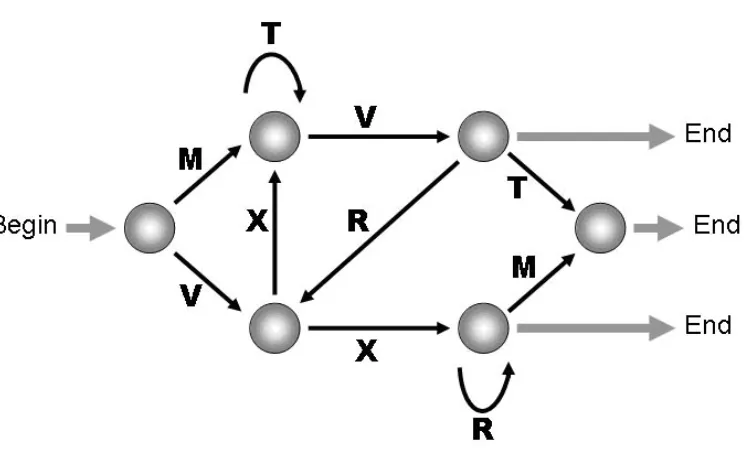
Figure 2. A finite-state grammar used to generate stimuli for artificial grammar learning tests (cf. Reber & Allen 1978).
2.2. Artificial and Natural Language Learning
The ALL paradigm has been employed widely to study different aspects of natural language learning though originally it was implemented to investigate the underlying implicit sequence learning mechanism, which is presumably shared with natural language learning (Reber 1967), as well as with other situations in which new skills have to be acquired. Indeed, skill learning crucially requires encoding, representing and production of structured sequences, and language is one excellent example of a domain where humans have to extract patterns from structured sequences in order to learn the underlying grammar (Conway & Pisoni 2008). The relation between language units, such as words, syllables and morphemes, adhere to certain sequence structures typical of language, of which crossed and nested dependencies are two examples. Determining how humans extract and use structural information from the environment is a great challenge for the cognitive neurosciences (Conway & Pisoni 2008), as is establishing the un-derlying neurobiological mechanisms of implicit sequence learning that mediates the acquisition of novel skills.
Knowl-Learning Recursion 17
ton 2002, Ullman 2004, but note the different terminology in the studies where implicit learning is sometimes referred to as procedural learning, and vice versa), which are also involved in the acquisition of grammatical regularities (Ullman 2004). More specifically, recent functional neuroimaging (e.g., Lieberman et al. 2004, Petersson et al. 2004, Forkstam et al. 2006) and brain stimulation research (Uddén et al. 2008, de Vries et al. 2010), implementing experiments based on the Reber paradigm, have identified which brain regions are involved in such a task. They have repeatedly shown that Broca’s region, an area in the brain involved in syntactic processing of natural language, is also involved in artificial grammar processing. Indeed, breakdown of syntactic processing in agrammatic aphasia is associated with impairments in AGL (Christiansen et al. 2010). This supports the hypothesis that AGL taps into implicit sequence learning, and thus provides a useful way to investigate natural language processing (cf. Petersson et al. 2004).
The underlying implicit sequence learning mechanism appears to be rather domain-general, with evidence of learning in several domains (e.g., speech-like stimuli, tone sequences, visual scenes, geometric shapes, visuomotor sequences — see Conway & Pisoni 2008 for an overview). Conway & Pisoni investigated how implicit sequence learning in different domains contributes to language processing by directly linking performance of individual participants on a non-linguistic implicit sequence learning task to performance on a spoken sentence perception task, in which participants had to predict the final word of each sentence in low and high predictability conditions. They found that, indeed, individual variability in implicit sequence learning correlated with language processing. Supportive evidence also comes from a recent study by Misyak et al. (2010a, 2010b), who found that individual differences in learning non-adjacent dependencies, assessed by a non-linguistic implicit sequence learning task, strongly correlate with the processing of natural language sentences containing complex non-adjacent dependencies.
In sum, there is substantial evidence that language acquisition and language processing in both natural and artificial settings is mediated by a more general implicit sequence learning mechanism. By implementing ALL experi-ments, we thus tap into the underlying sequence learning mechanism that also mediates natural language acquisition, and the resulting processing system. Investigating the boundaries of this mechanism will therefore add to our understanding of human language acquisition and processing. For example, the empirical finding that we cannot understand sentences with more than three dependencies, for instance, is in accord with the fact that, as yet, no study of ALL has convincingly demonstrated that humans are able to do so in a well-controlled ALL setting (we will discuss this in more detail below).
gram-M.H. de Vries, gram-M.H. Christiansen & K.M. Petersson 18
matical relations, and learning syntactic categories. Learning non-adjacent depen-dencies is yet another aspect that can, and is, being tested through ALL tasks. The usefulness of ALL paradigms is that one can design experiments capturing such key features of language. According to Gomez & Gerken, if we can isolate a specific linguistic phenomenon experimentally, we can go on to test it using a set of various manipulations. These manipulations are driven by our knowledge of natural language acquisition. Ultimately, the proof of the ALL approach will depend on the extent to which it generates new ways of understanding the mechanisms of natural language acquisition (Gomez & Gerken 2000).
2.3. Potential Pitfalls in Artificial Language Learning Settings
Before discussing how non-adjacent dependencies may be tested in a laboratory setting, we would like to stress a few potential pitfalls in ALL settings. As mentioned in the previous paragraph, a common assumption in ALL research is that when participants are exposed to sequences generated by a specific grammar and subsequently are able to distinguish new grammatical items from ungram-matical ones, then participants have in some sense “learned” the structure of the underlying grammar. This notion goes back to Reber’s original work, in which he suggested that his participants were “learning to respond to the general gramma-tical nature of the stimuli” (Reber 1967: 855).
Learning Recursion 19
2.4. Learning Non-Adjacent Dependencies in the Lab
Whereas the learning of adjacent dependencies has been shown in laboratory-based settings repeatedly, both with visual, auditory and tactile stimuli, linguistic and non-linguistic material, and in infants, adults and non-human species (e.g. Saffran et al. 1996, 1999, Aslin et al. 1998, Hauser et al. 2001, Conway & Christian-sen 2005, Perruchet & Pacton 2006, Forkstam et al. 2008, Gebhart et al. 2009), the learning of non-adjacent dependencies seems to be harder (Gebhart et al. 2009), though certainly possible to a certain extent. Gomez (2002) for instance, showed that the degree to which non-adjacent dependencies are learned depends on the relative variability of the intervening material (i.e. X in the pattern AXB, where A and B belong together), in both adults and 18-month-old infants. When X is highly invariant, that is, when X is drawn from a pool of only two alternatives, it is harder to learn the dependency between A and B than when X is drawn from a pool of 24 alternatives. In other words, the relationship between A and B stands out most when X is varied to a great degree, while keeping A and B relatively invariant. In contrast, Newport & Aslin (2004) and Onnis et al. (2005) found that the crucial factor for learning non-adjacent dependencies is rather the similarity between A and B (Perruchet & Pacton 2006).
However, different from the above mentioned studies, where participants learned to solve only one non-adjacent dependency at a time, the focus here is specifically on multiple overlapping non-adjacent dependencies, including nested dependencies, as depicted in Figure 1 for natural language, which requires more than one non-adjacent dependency being managed simultaneously. We will also discuss current findings on crossed dependencies (Figure 1), though to a limited extend, as findings on this type of structure are yet scarce. But we start by discussing recent experimental findings in both humans and non-human species that gave rise to such lively debate in the field.
2.5. Can Animals Handle Non-Adjacent Dependencies?
The finding that learning non-adjacent dependencies is considerably harder than learning adjacent dependencies has raised questions regarding the uniqueness of non-adjacent dependencies to human language processing. Hauser et al. (2001) had shown that adjacent dependencies are learnable by non-human primates (see also Heimbauer et al. 2010). Would this also be the case for non-adjacent depen-dencies?
2.5.1. Animals in Artificial Language Learning Situations
M.H. de Vries, M.H. Christiansen & K.M. Petersson 20
nested and crossed dependencies (implying processing multiple dependencies simultaneously). Indeed, Fitch & Hauser (2004) showed that cotton-top tamarin monkeys, after a short training period, fail to learn structures that exhibit nested dependencies, though in their paper, dependencies were not indexed, such that simpler strategies could have been used to solve the test for nested dependencies (see Perruchet & Rey 2005 and de Vries et al. 2008 for criticism). A recent study by Gentner et al. (2006) claimed that song birds could learn such nested dependen-cies, after extensive training. However, also here, the dependencies between the elements were not indexed, such that simpler strategies could have been used by the birds to solve the task (see Corballis 2007a and de Vries et al. 2008 for criticism). In a recent experiment (van Heijningen et al. 2009), zebra finches were tested for their ability to classify nested dependencies. Interestingly, one zebra finch (out of eight) was able to generalize the acquired syntactic structure to another stimulus set. However, additional testing showed that no strategy was involved that required processing nested dependencies. Also here, a simpler strategy was used to solve the task (van Heijningen et al. 2009). Thus, as yet, no non-human species has been shown to be able to learn nested dependencies, due to methodological flaws (as argued by Perruchet & Rey 2005, de Vries et al. 2008, Corballis 2007a; see also Liberman 2004a, 2004b, Hochmann et al. 2008).
2.5.2. Non-Adjacent Nested Dependencies in a Natural Setting
The results of these ALL experiments in non-human animals parallel those found in studies looking at nested organization in the natural behavior produced by non-human primates, which possibly indicates to what extent nested dependencies are exhibited in non-human primates (Conway & Christiansen 2001). Two interesting studies describe the way in which capuchin monkeys, chimpanzees, bonobos (Johnson-Pynn et al. 1999), and human children (Greenfield et al. 1972) use strategies to combine cups, each varying in size such that the smallest cup could fit into the one that was larger, which in turn could fit into the next largest, and so on. When instructed or encouraged to nest the cups, only human children older than 20 months were able to use a nesting strategy, in which two or more cups are combined to form a single unit, which is then placed into another cup. Interestingly, the development of the cup-nesting strategy in children has parallels to the structural development of grammar and phonology in language (Greenfield 1991). The primates, however, were limited in their ability to perform the nesting cup task and did not utilize the complex nesting strategy, in which units are embedded within other units, but only adopted simpler strategies (Johnson-Pynn et al. 1999, Conway & Christiansen 2001).
Learning Recursion 21
process crossed dependencies. In conclusion, the number of non-adjacent depen-dencies that need to be resolved simultaneously may be a decisive factor in deter-mining what is learnable to non-human species and what is not.
2.6. Processing Nested Dependencies in Humans
As in animal studies, the processing of nested dependencies in humans has been studied extensively, whereas only a few studies have focused on the processing of crossed dependencies. In the current section, we will discuss experimental findings regarding the processing of nested dependencies in humans.
Following up on the study of Fitch & Hauser (2004), Friederici et al. (2006) implemented a similar paradigm in an FMRI study. They set out to test the neural correlates of processing nested dependencies in humans. Also here, an ALL task was used. They found that the processing of sequences containing nested dependencies activated Broca’s area (BA44/45). However, participants may have distinguished grammatical from ungrammatical sequences by merely counting the number of A and B elements and checking that they matched (or not), which was referred to as a counting strategy (de Vries et al. 2008; see also Corballis 2007b). In other words, participants in Friederici et al.’s (2006) study were not required to resolve the nested dependencies, as was experimentally shown by de Vries et al. (2008). Comparing performance on testing situations without ruling out whether other strategies could have been applied is a common issue. ALL researchers should thus design their tasks carefully to be sure that participants cannot solve the task through strategies such as counting, repetition monitoring, or simply detecting an additional element that lacks a co-dependent in the sequence (as was the case in one of the violation types of Bahlmann et al. 2008). Thus, in order to be able to examine the basis for the classification perfor-mance, a careful design is required.
Although we do not doubt that humans can process nested dependencies in natural language (although to limited extent), it is difficult to mimic this in a laboratory-based setting. One potential way to ensure that participants learn nested dependencies, is to add perceptual cues to the elements that belong together, in order to promote learning the dependencies of interest (e.g., Müller et al. 2010); however, explicit problem solving may become involved as soon as the dependencies stand out too much. Nonetheless, Uddén et al. (2009) showed that implicitly learning nested dependencies might well be a matter of time: Uddén et al. successively trained their participants for nine days in a row with no evidence for explicit awareness of the relevant dependencies or the use of explicit strate-gies. Another way to improve learnability of nested dependencies has been dem-onstrated by Conway et al. (2003), who used a training paradigm that started with simpler constructions, followed by gradual increases in depth of recursive structure.
M.H. de Vries, M.H. Christiansen & K.M. Petersson 22
dependencies are learned better and faster than nested dependencies, both by German and Dutch participants, despite the fact that from the point of unboun-ded recursion, the former requires context sensitive grammars and the latter only context-free grammars. Just the opposite of what might have been predicted based on the Chomsky hierarchy. This underlines the conclusion of Bach et al. (1986), who, in a psycholinguistic study, found that processing three crossed dependencies in Dutch was relatively easier than processing three center-embedded dependencies in German (see also Figure 1). The advantage of crossed over nested dependencies disappears when the number of dependencies that need to be resolved is reduced to two.
2.7. The Difference between Two and Three
Learning Recursion 23
Figure 3: A schematic overview of our suggested levels of processing complexity. Note that each level of this hierarchy denotes a decisive factor that adds to processing complexity. Thus, it is not the case that three nested dependencies are harder to process than, say, six crossed dependencies. Instead, this figure emphasizes that the presence of more than two dependencies is a sine qua non condition for measurable differences in processing complexity between nested and crossed dependencies.
The consequence of this reasoning is that the traditional differences between context-free and context-sensitive grammars, as put forward by the Chomsky hierarchy, is less relevant for understanding the language system of the human brain (see also Uddén et al. 2009, Petersson et al. 2010). This insight is of potential importance to the many ALL researchers who view the Chomsky hierarchy as uniquely informative about the human language faculty, and subsequently base their experiments on this assumption, for instance by directly comparing acquisition performance on certain sequences with grammars from different levels of the Chomsky hierarchy (e.g. Fitch & Hauser 2004, Friederici et al. 2006; for similar criticism, see Lobina 2011). Subsequently, many of these researchers draw conclusions about the underlying knowledge structures (i.e. ‘competence’, e.g. Fitch & Hauser 2004) or operational processes (‘hierarchical processing’, e.g. Friederici et al. 2006). Instead, we suggest that the way forward is to focus on processing complexity and the different levels of complexity that sequences may take.
M.H. de Vries, M.H. Christiansen & K.M. Petersson 24
experiments, computational simulations, and ALL studies.
2.7.1. Cross-Linguistic and Psycholinguistic Support
The only study, that directly investigated complexity differences between crossed and nested dependencies in natural language processing, is that of Bach et al. (1986). They asked native German speakers to provide comprehensibility ratings of German sentences containing nested dependencies and native Dutch speakers to rate Dutch sentences containing crossed dependencies (examples are depicted in Figure 1). They found no difference in processing difficulty between crossed and nested structures when two dependencies had to be resolved. However, when sentences contained three dependencies, nested dependencies (in German) were harder to process than crossed (in Dutch).
2.7.2. Support from Computational Simulation
Christiansen & MacDonald (2009) modeled the comparative difficulty of nested versus crossed dependencies by training a Simple Recurrent Network (SRN; Elman 1990) on sentences containing such dependencies. Their simulation results demonstrated that the SRNs exhibited the same pattern of processing difficulties as humans: Crossed dependencies were found easier than nested, but only when there were three dependencies. When there were two dependencies, no quali-tative differences were found (see also Christiansen & Chater 1999 for similar results with simpler languages more akin those used in ALL).
2.7.3. Support from Artificial Language Learning Settings
Uddén et al. (2009) showed in an ALL study that Dutch participants performed better on crossed than on nested dependencies. They implemented an implicit AGL paradigm, extending the acquisition phase to nine days in a row for each participant. Their results suggested that successful performance on the two gram-mar types differed most for the longer test sequences with three dependencies, although this difference did not reach significance. The question whether the better performance on crossed dependencies is due to the participants being Dutch, and hence, familiar with such structure in their native language, or if crossed dependencies are intrinsically easier to process is not answered in this study. However, forthcoming results from our group showed that, in a combined AGL–SRT study, learning crossed dependencies is easier than nested dependen-cies, both in German and Dutch participants. We suggest that future research should focus not only on the processing differences between crossed and nested dependencies, but specifically on the processing differences between sequences with two non-adjacent dependencies and three (or more) non-adjacent dependen-cies, both in crossed and nested order.
2.7.4. Support from the Starting Small Principle
Learning Recursion 25
process than nested dependencies (if the number of dependencies exceeds two) comes from a study looking at the “starting small” principle (Elman 1993). Conway et al. (2003) showed that participants, who were being trained on nested dependencies, learn better if they are exposed gradually to an increased number of dependencies. Participants were first exposed to short sequences with only one dependency relation, then to sequences with two dependencies, followed by three dependencies. Although the benefit of starting small has not been shown for the acquisition of crossed dependencies (for which the effect may be smaller assuming that crossed dependencies are easier to learn than nested depen-dencies), this highlights toward the importance of the number of dependencies that need to be processed simultaneously. Again, this is not accounted for in terms of the Chomsky hierarchy.
2.7.5. Support from the Missing Verb Effect
The importance of distinguishing between two versus three (or more) dependencies is further underscored by studies on the so-called “the missing verb effect”. Gibson & Thomas (1999) investigated the role of memory limitations in the processing of sentences that contained three nested dependencies. They found that when deleting the second VP in a sentence (‘was cleaning every week’ in (1a)), the resulting ungrammatical sentence (1b) was rated just as acceptable as the original grammatical version in an off-line rating task. This was argued to be caused by working memory saturation.
(1) a. The apartment that the maid who the service had sent over was cleaning every week was well decorated.
b. * The apartment that the maid who the service had sent over was well decorated.
M.H. de Vries, M.H. Christiansen & K.M. Petersson 26
dependencies also exhibit the missing verb effect. Given our assumption that crossed dependencies are easier to process than nested, these structures may be less prone to the missing verb effect. In line with this, preliminary AGL–SRT results from our group suggest that this is indeed the case: It appears that the missing verb effect can be replicated in nested, but not in crossed dependencies, for both German and Dutch participants.
In conclusion, the number of dependencies that need to be processed simultaneously is an important factor in determining processing complexity. Given existing results, this difference is seen already between two and three dependencies. Natural and artificial language results (Bach et al. 1986, Uddén et al. 2009) and computational modeling results (Christiansen & Chater 1999, Chris-tiansen & MacDonald 2009) support the suggestion that, when the number of dependencies is two or less, there is no difference in processing cost between crossed and nested structures. When the number of dependencies exceeds two, crossed dependencies are found easier to process than nested. Further studies are needed to precisely establish the cross-linguistic support for this suggestion.
3. The Neural Correlates of Processing Non-Adjacent Dependencies
Several functional neuroimaging studies have compared the processing of sequences containing non-adjacent dependencies with sequences containing adja-cent dependencies (Friederici et al. 2006, Bahlmann et al. 2008) and the results show that Broca’s region is relatively more engaged in processing sequences con-taining non-adjacent dependencies. However, Broca’s region is also engaged in the processing sequences generated from a simple right-linear grammars (Peters-son et al. 2004, Forkstam et al. 2006, Peters(Peters-son et al. 2010).
3.1. Working Memory and Non-Adjacency
Learning Recursion 27
therefore be directly related to memory load. However, it is likely that to regard differences in memory load as the differentiating factor between processing non-adjacent and non-adjacent dependencies is too simplistic — and not only because the notion of working memory is still not settled upon. In contrast, it is hard to draw a sharp line, on theoretical grounds, between on-line processing memory and representational processing itself (Minsky 1967). Instead, we want to emphasize that there are presumably limitations on the on-line sequence memory available for structured sequence processing that are determined by neurobiological factors, and possibly also linguistic experience, such that experience with a specific language might affect the ease with which multiple non-adjacent depen-dencies are resolved (see also Christiansen & MacDonald 2009 for further discus-sion). Future research should elaborate on this possibility.
3.2. Disentangling Memory Effects and Complexity
In an attempt to segregate syntactic complexity and memory effects in natural language processing, Makuuchi et al. (2009) implemented an event-related fMRI study and found that distance between syntactic elements and whether or not a sentence contains nested dependencies are two separate factors. The former involved the left inferior frontal sulcus, and the latter the left pars opercularis — the posterior part of Broca’s region. Petersson et al. (2010), however, have suggested that these sub-regions are too close in space to reliably resolve with standard fMRI.
M.H. de Vries, M.H. Christiansen & K.M. Petersson 28
employed natural language material, that the reported differences are related to sentence-level syntax and not for example sentence-level semantics. In normal language processing, semantics, phonology and syntax operate in close spatial and temporal contiguity in the human brain. Therefore, the AGL paradigm has been used to create a relatively uncontaminated window onto the neurobiology of syntax (Petersson et al. 2004, 2010).
3.3. Complexity and Broca’s Region
The question remains as to why the ALL studies by Petersson et al. (2004) and Forkstam et al. (2006), also using an event-related fMRI design, revealed a firmly replicated (Uddén et al. 2008, Petersson et al. 2010) activation in Broca’s region during the processing of sequences generated from simple right-linear grammars. In these studies, there was no comparison between conditions that contained adjacent versus non-adjacent dependencies, which was the case in the studies reported by Friederici et al. (2006) and Bahlmann et al. (2008). Instead, processing of adjacent dependencies was compared against a sensorimotor decision baseline. Lacking a condition that directly compared adjacent versus non-adjacent dependencies, only one conclusion can be drawn, namely, that the activation of Broca’s region is not specific to structures that entail non-adjacent dependencies.
In sum, the mere presence of non-adjacent dependencies adds to processing complexity, as does the number of to-be-established non-adjacent dependencies. Activation in Broca’s region however cannot be specific to those situations only, as is pointed out in Petersson et al. (2010). Rather these findings, in conjunction with functional neuroimaging data from other domains requiring sequence processing (for reviews see e.g., Petersson et al. 2004, 2010), suggest that Broca’s region is a generic on-line structured sequence processor that is activated at different levels depending on processing complexity.
4. Implications for Theories of Natural Language Processing
A significant and growing body of experimental evidence from a range of experi-mental approaches (behavioral experimentation, functional neuroimaging, brain stimulation, brain lesion studies, computational modeling, etc.) reviewed here converge on the suggestion that natural and artificial language processing share underlying sequence learning mechanism(s). By conducting ALL experiments, one of the aims is to tap into this mechanism, providing additional insights in the boundaries on structured sequence processing, in general, and natural language acquisition and processing, more specifically.
in-Learning Recursion 29
put implicitly. We think one important use of ALL paradigms is to explicitly characterize these boundaries on cognition in order to provide a better under-standing of the cognitive mechanisms that enable us to extract regularities from the input, including natural language acquisition.
We agree with Lobina’s (2011) argument that a common error of ALL experiments is, as we ourselves have pointed out above, that sequence processing is often mistaken to be uniquely informative of purported underlying formal parsing operations. A crucial question is whether the distinction between com-petence and performance is helpful at this stage of scientific inquiry. We suggest that our results speak to how processing and knowledge of language are funda-mentally intertwined in a way not well-captured by traditional approaches in formal language theory. Crucially, though, our proposed levels of processing complexity in Figure 3 should not be interpreted as indicating that the human language processing system favors context-sensitive over context-free com-petence grammars. Indeed, these concepts (and the Chomsky hierarchy from which they are derived) are orthogonal to the points we make. Instead, our focus is on performance. We suggest that the sequence processing system — and thus the cognitive processes that depend on it, such as natural language — may be constrained by (i) the number of dependencies that need to be resolved, and (ii) the ordering of these dependencies. The difference between nested and crossed dependencies becomes relevant only when the number of dependencies exceeds two. This may not be specific to the language domain, but a domain-general con-straint; given that many ALL studies have been shown to be replicable with stimuli in different domains and modalities (though some differences do exist; e.g. Conway & Christiansen 2005).
To conclude, we have argued that processing complexity relating to struc-tured sequence processing may be determined by (i) the number of dependencies that need to be resolved, and (ii) the ordering of these dependencies. Considering this assumption as a point of departure, several new research questions can be explored. To do so, artificial language learning paradigms may be implemented to explore the boundaries of the sequence learning mechanism shared with natural language.
References
Aslin, Richard N., Jenny R. Saffran & Elissa L. Newport. 1998. Computation of conditional probability statistics by 8-month-old infants. Psychological Science 9, 321–324.
Bach, Emmon, Colin Brown & William Marslen-Wilson. 1986. Crossed and nested dependencies in German and Dutch: A psycholinguistic study. Language and Cognitive Processes 1, 249–262.
M.H. de Vries, M.H. Christiansen & K.M. Petersson 30
decoding self-embedded sentences. Journal of Experimental Psychology 102, 745–748.
Brown, Jamie, Aczel Balzs, Luis Jiménez, Scott B. Kaufman & Kate P. Grant. 2010. Intact implicit learning in autism spectrum conditions. The Quarterly Journal of Experimental Psychology 63, 1789–1812.
Braver, Todd S., Jonathan D. Cohen, Leigh E. Nystrom, John Jonides, Edward Smith & Douglas Noll. 1997. A parametric study of prefrontal cortex involvement of human working memory. Neuroimage 5, 49–62.
Chomsky, Noam. 1956. Three models for the description of language. IRE Trans-actions on Information Theory 2, 113–124.
Christiansen, Morten H. 1992. The (non)necessity of recursion in natural language processing. Proceedings of the 14th Annual Conference of the Cognitive Science Society, 665–670.
Christiansen, Morten H. & Nick Chater. 1999. Toward a connectionist model of recursion in human linguistic performance. Cognitive Science 23, 157–205. Christiansen, Morten H., M. Louise Kelly, Richard Shillcock & Katie Greenfield.
2010. Impaired artificial grammar learning in agrammatism. Cognition 116, 382–393.
Christiansen, Morten H. & Maryellen C. MacDonald 2009. A usage-based approach to recursion in sentence processing. Language Learning 59 (Suppl. 1), 126–161.
Cleeremans, Axel, Arnaud Destrebecqz & Maud Boyer 1998. Implicit learning: News from the front. Trends in Cognitive Sciences 2, 406–416.
Conway, Christopher M. & Morten H. Christiansen. 2001. Sequential learning in non-human primates. Trends in Cognitive Sciences 5, 539–546.
Conway, Christopher M. & Morten H. Christiansen. 2005. Modality constrained statistical learning of tactile, visual, and auditory sequences. Journal of Experimental Psychology: Learning, Memory & Cognition 31, 24–39.
Conway, Christopher M., Michelle R. Ellefson & Morten H. Christiansen. 2003. When less is less and when less is more: Starting small with staged input. Proceedings of the 25th Annual Conference of the Cognitive Science Society 270– 275.
Conway, Christopher N. & David B. Pisoni. 2008. Neurocognitive basis of implicit learning of sequential structure and its relation to language processing. Annals of the New York Academy of Sciences 1145, 113–131.
Corballis, Michael C. 2007a. Recursion, language, and starlings. Cognitive Science 31, 697–704.
Corballis, Michael C. 2007b. On phrase structure and brain responses: A com-ment on Bahlmann, Gunter, and Friederici (2006). Journal of Cognitive Neuroscience 19, 1581–1583.
Elman, Jeffrey L. 1991. Distributed representation, simple recurrent networks, and grammatical structure. Machine Learning 7, 195–225.
Elman, Jeffrey L. 1993. Learning and development in neural networks: The importance of starting small. Cognition 48, 71–99.
Epstein, Samuel David & Norbert Hornstein. 2004. The future of language (science). Language 81, 3–6.