Abousreaa A.; et al….. -631- ROLE OF SERUM INTERLEUKIN – 10 AND INTERLEUKIN -28B GENE POLYMORPHISMS IN PREDICTING TREATMENT RESPONSE OF HEPATITIS C
PATIENTS
Abousreaa Amr Kamal M.Sc, ELnmer Dena Mohammed MD, Swelam Enas Elsayed MD, *Ashour Mahmoud Abdou MD
Clinical Pathology and *Internal Medicine Departments. Faculty of Medicine, Zagazic University.
ABSTRACT
Background: Hepatitis C virus infection (HCV) is a global health problem which develops chronic hepatic diseases including liver cirrhosis and hepatocellular carcinoma. IL28B polymorphisms rs12979860 CC genotype and low serum level of interleukin10 were associated to protect the patients of HCV infection and rapid virological response (RVR) in HCV patients treated for four weeks with pegIFNα/ribavirin (IFNα/RIB).
Subjects and methods: The study was carried out on 49 Egyptian HCV patients, Patients with other types of viral hepatitis, unfavourable haematological picture & decompensated liver function including cirrhosis and Autoimmune hepatitis were excluded. Patients who responsing to IFNα/RIB after four weeks were classified as RVR (n = 18) and Non-RVR (n = 31). IL28B polymorphisms at rs12979860, the resulting genotypes are CC, CT or TT, and Serum IL10 was measured by standard sandwich enzyme-linked immune-sorbent assay technology for both groups.
Results: Il28B CC genotype was 67.4 % in responder group (RVR) 38.7% in non-responder group (non RVR)
(p= 0.01), CC genotype with serum IL10 < 80 pg/mL was 72.2% in responder group and CT/TT with serum IL10 >80 pg/mL (p= 0.00).
Conclusion: the relationship of genotype CC of IL28B at rs12979869 and the effect of IFNα/RIB to maintain the serum level of IL10 decrease and to achieve better chances to cure the HCV patients from the virus.
Key words: IL-10, IL28B, polymorphism, HCV, treatment response. Corresponding author
Abousreaa Amr Kamal Telephone: +201000089344, E- mail:[email protected]
Received: 25 October 2015
Accepted: 18 November 2015
INTRODUCTION
epatitis C virus infection (HCV) is a global health problem which develops chronic hepatic diseases including liver cirrhosis and hepatocellular carcinoma (HCC) [1]
. The treatment regimen for HCV Patients infection is subcutaneous injections of long acting pegylated interferon α (PEG – IFN) and oral ribavirin (RIB). This treatment give a sustained virological response (SVR) in only 40-50% of HCV patients [2]. Interleukin – 10 (IL – 10) is an immunoregulatory cytokine – released by B lymphocytes, macrophages and dendritic cells, and due to its immunoregulatory action, the inadequate levels of IL-10 can determine escaping of virus from immune system and give rise to persistent infections.
High levels of serum IL-10 have been related with poor response to interferon therapy [3]. IL -28 is a cytokine that plays a role in immune defence against viruses, IL-28 B polymorphism in HCV patients was found to be correlated with HCV treatment response with decrease in RNA after 4 weeks and considered as one of the most important predictor of treatment response [4].
This relation of single nucleotide polymorphism in IL -28B gene region with pegylated interferon treatment outcome raises the possibility of using IL-28B (interferon lambda) as a therapeutic agent against hepatitis C [5].
The serum level of IL10 in response to the HCV therapy and the IL28B genotype are the
Abousreaa A.; et al….. -632- most predictive coacting immunological factors in clearance from HCV infection. [3].
SUBJECTS AND METHODS
This work had been carried out in Al-Ahrar Hospital at Viral Hepatitis Treatment Center, Sharkia Governorate, clinical pathology Departments of Faculty of Medicine, Zagazig University. This study included 49 patients and all of them took the slandered therapy of ( subcutaneous injection of pegylated interferon with oral ribavirin) they were enrolled for treatment in the period from May 2012 to May 2014; they were selected according to the national treatment protocol. Patients with other types of viral hepatitis, Patients with unfavourable haematological picture & decompensated liver function including cirrhosis and autoimmune hepatitis were excluded.
Patients were considered responders for treatment if no HCV viremia detected 4 weeks after start of treatment. Patients were considered non-responders if HCV RNA were detected after 4 weeks after start of treatment. All participants were subjected to complete medical history and general and clinical examination. Body weight, , and blood pressure were measured in all subjects with standard protocols. Body mass index (BMI) was calculated. Routine investigations including laboratory investigations: from the patients files including CBC, LFT,KFT, coagulation profile, HCV Abs, HBV Ag and HIV Ag/Ab by ELISA, Quantitative polymerase chain reaction for HCV RNA and specific investigation including Real time PCR IL-28B polymorphism and Serum IL-10 by ELISA. DNA extraction and genotyping of IL28B (rs12979860)
Sample collection, DNA was extracted, purified and amplified using QIAamp DNA blood Mini Kit , Analysis & quantitation of IL-28B polymorphism at the main SNP at ( rs 12979860) using LightMix® Kit IL28B (the Roche Diagnostics LightCycler®) Multiplex PCR Kit on real-time cyclers and also EDTA
samples were collected and kept at _20 _C for 24 h until extraction of DNA. DNA quantitation and purity analysiss was done by using Nanodrop 2000 spectrophotometer (Thermo Scientific, USA). Then PCR- detection of gene polymorphism of IL28B was done.
Serum levels quantification of IL10
Using standard sandwich enzyme-linked immune-sorbent assay technology. An IL-10 specific monoclonal antibody extracted from mice coating 96-well plates. Then serial dilution of Standards and study samples were added to the wells, a biotinylated detection IL-10 specific polyclonal antibody was added subsequently and washing using the washing buffer. Avidin-Biotin-Peroxidase Complex was added and unbound conjugates were washed away with washing buffer. Then HRP substrate TMB was used to visualize HRP enzymatic reaction. TMB was catalysed by HRP and producing a blue colour which turned to yellow after addition of stop solution. Then microplate reader can read the O.D. absorbance at 450nm within 30 min after the stop solution added[6].
STATISTICAL ANALYSIS
All data were coded, checked, entered and analysed using SPSS (statistical package for social science) software version 17; SPSS program version 17 program was used for analysis of the data obtained from such study. Many quantitative values were blotted and tabled using Mean ± SD. Applying t-test to compare two normally distributed values Mann Whitney non parametric variables. Fisher’s exact test and the Chi square (X2) test are used for categorical values. Then we can using the Pearson's correlation analysis to calculate Correlation coefficients (r) by. p value was significant at <0.05 level.
RESULTS
Abousreaa A.; et al….. -633- degree, hepatic enzymes show no difference
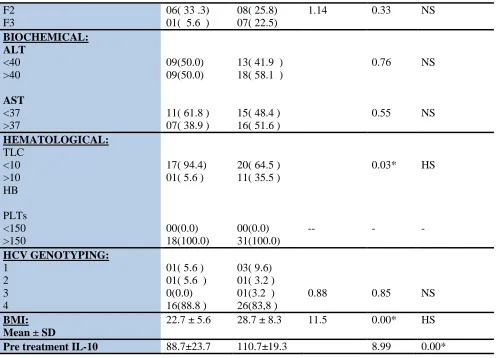
between RVR and Non-RVR outcome. However, some haematological features, BMI, IL28B CC and serum levels of IL10 were correlated to the response of treatment in the current analysis. For the frequency analysis of IL28B polymorphism in the HCV patients. This table shows the number of cases and the percent of demographic, clinical, biochemical and histological investigations of the studied populations (49) with male to female ratio 35/14, with highly significant difference between responders and non-responders in CC genotype more in responders, with highly significant difference between them in TT genotype more in non-responders and with no significant difference between them in CT genotype. Also there is highly significant difference between them regarding favourable (CC) and unfavourable (CT+TT) genotypes. CC, CT, TT were encountered in 67.4%, 22.6% and 0.0% of responders respectively and in 38.7%, 22.6% and 38.7% of non-responders respectively.
RVR occurred in 53.8 % of patients with CC genotype, 36.4 % of patients with CT genotype,
and 0% of patients with TT genotypes. Also shows that failure of response to treatment occurred in 46.2 % of patients with CC genotype, 63.6 % of patients with CT genotype, and 100 % of patients with TT genotype. Regarding to the response RVR in different IL 28B polymorphism we can divide the studied patients to two groups favourable (CC) and non-favourable groups (CT & TT).
Patients who cured from the virus within 4 weeks (RVR) showed serum levels of IL10 of median (88.7 pg/mL) which is considered lower than that in Non-SVR patients (110.7 pg/mL) (p = 0.00). Also IL-10 serum levels become lower in CC genotype patients compared to CT/TT genotypes with a significant trend (p = 0.07) (table. 2). As the outcome of response to treatment and its relation to different IL28B genotypes and IL10 serum levels, the RVR-CC genotype patients showed lower serum levels of IL-10 (72.2%) compared to the RVR-CT/TT genotypes (5.6%), also comparing to Non-RVR CC (32.3%) and to CT/TT genotypes (35.5%). In the Non-RVR patients there was no significance difference in the IL10 serum levels of CC and CT/TT genotypes.
Table.1 Aetiological, haematological, chemical and virologic characteristics of the studied patients Responder
N (%)
Non responder
total test P
CAUSE:
1- Unsterilized injection or unsterilized procedures 2- Blood transfusion history 3- Surgical history
4- Undefined
05 (27.8 )
01 (5. 6)
02 (11.1) 10 (55.5)
07 (22.6)
01 (3.2)
04 (12.9) 20 (64.5)
2.94 0.09 NS
BASAL VIRAL LOAD: >600,000
<600,000
11 (61.8) 07 (38.9)
27(87.1) 04(12.9)
3.08 0.08 NS
FIBROSIS STAGE: F0
F1
03(16.7 ) 08( 44.4)
Abousreaa A.; et al….. -634-
F2 F3
06( 33 .3) 01( 5.6 )
08( 25.8) 07( 22.5)
1.14 0.33 NS
BIOCHEMICAL: ALT
<40 >40
AST <37 >37
09(50.0) 09(50.0)
11( 61.8 ) 07( 38.9 )
13( 41.9 ) 18( 58.1 )
15( 48.4 ) 16( 51.6 )
0.76
0.55
NS
NS
HEMATOLOGICAL: TLC
<10 >10 HB
PLTs <150 >150
17( 94.4) 01( 5.6 )
00(0.0) 18(100.0)
20( 64.5 ) 11( 35.5 )
00(0.0) 31(100.0)
--
0.03*
-
HS
-
HCV GENOTYPING: 1
2 3 4
01( 5.6 ) 01( 5.6 ) 0(0.0) 16(88.8 )
03( 9.6) 01( 3.2 ) 01(3.2 ) 26(83,8 )
0.88 0.85 NS
BMI: Mean ± SD
22.7 ± 5.6 28.7 ± 8.3 11.5 0.00* HS
Pre treatment IL-10 88.7±23.7 110.7±19.3 8.99 0.00*
Table (2):- il28b polymorphism and genotypes in responder & non-responder groups (rs12979860)
GENOTYPES Responder
Number (%) 18
Non responder 31
TOTAL
(N= 49)
X2 P value
CC 14(67.4) 12(38.7) 26 8.04 .01*
CT 04(22.6) 07(22.6) 11 Fisher .73
TT 00(0.0) 12(38.7) 12 Fisher .00*
C 32 31 63 .00*
T 04 31 35
Pre-treatment serum IL 10
88.7 ± 23.7 110.7 ± 19.3 8.99 .00*
DISCUSSION
In our study rs1297860 genotype CC of IL28B was found to be significantly associated with a positive response to PEG-IFN-α and RBV in
HCV patients with genotype 4 among Egyptian patients than the other genotypes.
Abousreaa A.; et al….. -635- that the rs12979860 variation could be involved
in the innate immune response to HCV. Some other variations in IL28B, such as rs8099917, rs12980275, rs8105790, rs11881222, rs8103142, rs28416813, rs4803219 and rs7248668, have been reported to be associated with the outcomes of anti-HCV treatment [8]. A highly significant correlation between RVR and treatment was observed with the genotypes rs12979860 CC, rs8099917 TT, and rs12980275 AA.
Our thesis was concentrated on the possible association between serum level of IL-10 and HCV patient treatment response. In this study, there is a significant positive correlation between pre-treatment IL-10 serum level and (BMI), in agreement with Reuss et al. also there is a significant positive correlation between pre-treatment IL-10 serum level and viral load in agreement with Flynn et al. [9].
our study showed that there were no correlation between seum level of IL-10 and the stage of fibrosis in agreement with Imbert-Bismut et al. [10]
, who showed that IL-10 serum level had no relation to the stage of fibrosis Also, we noticed that serum level of IL-10 was significantly low in responders (116.7±5.6) compared to non-responders (138.7±13.4), in agreement with Marín-Serrano et al. [11].
In our study we found that there is a correlation of IL28B genotype and serum level of IL10 and the outcome and response of treatment of chronic HCV patients, and to understand this correlation the measurement of serum level of IL-10 at the beginning of treatment (after 4 weeks) in the patients classified by IL28B genotype into CC and CT/TT. In agree with Umemura et al. who used the same approach to study the effect of the minor allele G from IL28B with different polymorphism at rs8099917 measuring the serum level of IL10 before treatment. [3].
IN our study the obtained results showed that there were possible co-acting effect of decreased serum level of IL10 and the IL28B
genotypes related to RVR in the therapy of HCV patients. In this thesis, the responders carrying IL28B CC genotype compared to CT/TT genotypes showed low serum levels of IL-10, suggesting that this decrease in serum levels of IL-10 may be due to IFN-a/RIB therapy and can be high level in CC genotype (p = 0.02), which responds to therapy. [7]. Finally the predicted CC genotype patients produce serum levels of IL10 <80 pg/ml and have more possibility to be cured from the virus and achieve RVR. than patients with other CT/TT genotype and IL10 serum level < 80 pg/ml, and the statistical analysis was done in the study confirmed that observation with a lowest possibility of patients with CT/TT genotypes and serum level of IL10 < 80 pg/ml to achieve RVR. So that we must consider all discussed variables for calculation of a supposed negative predictive value to expect the CT/TT failure which considered as an important data to guide the physicians to start and select the suitable clinical management [12].
CONCLUSION
IL28 b polymorphism and pretreatment serum level IL-10 are significantly associated factors with the response of the treatment in Egyptian patients with HCV infection of genotype 4 as higher serum level of IL-10 is a poor prognostic marker for treatment response., HCV genotyping, and also serum IL-10 and IL28B gene must done before treatment as these variables considered as an important factors which decide we will or will not start the treatmentand also will be cost sffective and reduce side effects of treatment.
REFERENCES
1-Alter MJ: Prevention of spread of hepatitis C. Hepatology, 2002; 36: S93–S98.
Abousreaa A.; et al….. -636- infection. N Engl J Med.2009; 360:1827–
1838.
3-Umemura T, Joshita S, Yoneda S, 4-Katsuyama Y, Ichijo T, Matsumoto A, Yoshizawa K, Ota M, Tanaka E: Serum interleukin (IL)-10 and IL-12 levels and IL28B gene polymorphisms: pretreatment prediction of treatment failure in chronic hepatitis C. Antivir Ther, 2011;16:1073–80. 4-Robek MD, Boyd BS, Chisari FV: Lambda
interferon inhibits hepatitis B and C virus replication. J Virol, 2005; 79: 3851-3854. 5-Rauch A, Kutalik Z, Descombes P, Cai T,
Di Iulio J, Mueller T, Bochud M, Battegay M, Bernasconi E, Borovicka J, Colombo S, Cerny A, Dufour JF, Furrer H, Günthard HF, Heim M, Hirschel B, Malinverni R, Moradpour D, Müllhaupt B, Witteck A, Beckmann JS, Berg T, Bergmann S, Negro F, Telenti A, Bochud PY: Genetic variation in IL28B is associated with chronic hepatitis C and treatment failure: a genome-wide association study. Gastroenterology, 2010; 138 (4):1338–1345. 6-Grove, J.; Daly, A. K.; Bassendine, M. F.;
Gilvarry, E.; Day, C. P: Interleukin 10 promoter region polymorphisms and susceptibility to advanced alcoholic liver disease. Gut, 2000; 46: 540-545.
7-Thomas DL, Thio CL, Martin MP, Qi Y, Ge D, O'Huigin C, Kidd J, Kidd K, Khakoo SI, Alexander G, Goedert JJ, Kirk GD, Donfield SM, Rosen HR, Tobler LH, Busch MP, McHutchison JG, Goldstein DB, Carrington M: Genetic variation in IL28B and spontaneous
clearance of hepatitis C virus. Nature, 2009; 461: 798–801.
8-Poordad F, McCone J Jr, Bacon BR, Bruno S, Manns MP, Sulkowski MS, Jacobson IM, Reddy KR, Goodman ZD, Boparai N, DiNubile MJ, Sniukiene V, Brass CA, Albrecht JK, Bronowicki JP: :Boceprevir for untreated chronic HCV genotype 1 infection. N Engl J Med, 2012; 364: 1195-1206.
9-Flynn JK1, Dore GJ, Hellard M, Yeung B, Rawlinson WD, White PA, Kaldor JM, Lloyd AR, Ffrench RA: Early IL-10 predominant responses are associated with progression to chronic hepatitis C virus infection in injecting drug users J Viral Hepat. Jul 5.2010;
10-Imbert-Bismut F, Ratziu V, Pieroni L, Charlotte F, Benhamou Y: Biochemical markers of liver fibrosis in patients with hepatitis C virus infection: a prospective study. Lancet, 2001; 357: 1069–75.
11-Marín-Serrano E, Rodríguez-Ramos C, Díaz F, Martín-Herrera L, Girón-González JA : Modulation of the anti-inflammatory interleukin 10 and of proapoptotic IL-18 in patients with chronic hepatitis C treated with interferon alpha and ribavirin. J. Viral. Hepat., 2006; 13 (4), 230-4.