F ou@owi@c an Australian epidemic of rubella in 1940, Gregg1 first observed the association between maternal rubella and certain congenital defects. Since then, evidence for a causal relationship has ac cumulated but the true frequency of re sulting malformations has been difficult to assess. Swan et a12 estimated the risk to be nearly 100% if rubella occurred in the first few months of pregnancy. This conclusion was based on retrospective data, usually by observing malformed children whose mothers were then found to have had ru bella during pregnancy. Normal progeny were easily overlooked by this approach, thus exaggerating the apparent risk. These observations, however, stimulated a great interest in environmental factors and their possible deleterious effects on pregnancy.
PATIENT MATERIAL AND PROCEDURES
The Fetal Life Study3'4 began in 1946 to evaluate factors related to abortion, stillbirth, prematurity, infant mortality and congenital malformations. Study cases consisted of all pregnant women registered in the ante partum clinic of the Sloane Hospital for Women within
the first 14 weeks following the onset of their
last menstrual period. At their initial visit, and at all subsequent visits to the ante partum clinic, they were questioned in detail by the Study personnel regarding the events of their pregnancy. In addition, patients were re quested to call the Study office if they devel oped or were exposed to anyone with a fever, rash or specific infectious disease. Examination of the patient at the time of the illness was made if the patient came to the hospital. The services of a visiting nurse and contact with the attending physician were used to document cases in the home. If the diagnosis of rubella
was accepted, continued follow-up of these pa
tients differed in no way from that of the gen
eral Study population. The infants were exam ined carefully by a pediatrician of the Study team on the first or second day of life. Follow up visits were scheduled for 6 and 12 months of age with special emphasis on the detection of malformations. Postmortem examinations were made whenever possible in all cases of
abortion, stillbirth or infant death.
The Fetal Life Study has enrolled approxi mately 10,000 pregnant women during the past 13 years, and in 18 instances a diagnosis of rubella was recorded as having occurred
during pregnancy. Seven additional cases of
maternal rubella were included which pre sented themselves to the ante partum clinic too
late to be included in the Fetal Life Study.
However, they were followed in the same man ner. The diagnosis of rubella was made by a
physician in 18 of these 25 cases. The other seven had no physician in attendance. Four of these cases, however, had known contact with rubella or secondary cases in the family. These cases are listed in Table I. Seventeen of these women were white and eight were Negro (Cases 3, 11, 15, 16, 17, 18, 23, 25).
Exposure to rubella occurred during 95
other pregnancies which were similarly fol
lowed (Table II).
OBSERVATIONSFROM THE
FETAL LIFE STUDY
PregnanciesComplicated by Rubella
The rubella infections are timed as the gestational week of onset from the first day of the last menstrual period. It should be realized that this is not an exact measure ment of fetal age, because the relation of the menstrual cycle to conception may vary. In the first 4 weeks of pregnancy, two diag
This investigation was supported by The Fetal Life Study, Research Grant (RG-4194) from the Human
Embryology and Development Division, Public Health Service.
ADDRESS:(G.W.M.) Fetal Life Study,622 West 168th Street,New York32, New York.
PsmAmIcs, August 1960
200
PROSPECTIVE
EXPERIENCE
WITH MATERNAL RUBELLAAND
THE ASSOCIATEDCONGENITAL MALFORMATIONS
Richard H. Michaels, M.D., and Gilbert W. Mellin, M.D.
CaseL.M.P. *DiagnosisG
@ e
Iwnal Weekof RubellaCompleted
Gesta tional Week at DeliveryBirth
JVeighl (gm)SexFollow upResult15/1/57Physician1433,660F1
yrNormal live-born22/
9/55History327—FP.M.fSpontaneous
abortion31/25/51Physician519—MP.M.Spontaneous abortion43/15/55Physician524—MP.M.Spontaneous
abortion(rightlung—Q
lobes)53/17/55Physician6392,610F24
yrPatent ductus
arteriosus61/15/55Physician728—FP.M.Spontaneous
abortion78/10/55Physician7422,510M2
yrCardiac anomaly.
Microcephaly83/11/55Physician8412,470F8
yrPatent ductus
arteriosus92/12/51Physician8403,120F7
yrNormal live-born101/27/59Physician10351,520
,500M MBirthBirthNormal
live-born twin Normal live-born twin111/
3/58Physician11372,220F6 moNormal
live-born122/14/57History11422,635F14
yrNormal
live-born1312/26/46Physician12392,570F1
yrNormal live-born141/11/49History13392,850F1
yrNormal live-born1512/
5/54History15404,045MBirthNormal
live-born161/
3/58Physician17413,500F6 moNormal
live-born174/
1/56Physician18393, 225F2 yrNormal
live-born1812/
2/57Physician18393,490M6 moNormal
live-born191/18/58History18362,860F8
moNormal live-born2011/14/50Physician18403,360M1
yrNormal live-born218/
5/56Physician19388,080M24 yrNormal
live-born2211/21/57Physician23413,290M6
moNormal live-born2312/14/47History25372,530F1
yrNcrmal live-born2410/14/49History28393,080FBirthNormal
live-born258/29/47Physician32383,750M1
yrNormal live-born
TABLE I
PREGNANCIES COMPLICATED BY RUBELLA COLLECTED IN FETAL LIFE STUDY, 1946—1959
* Date of last menstrual period. t P.M.—Postmortem.
noses of rubella were reported. One infec tion occurred during the last menstrual period, and a normal infant was later de livered. The other infection in the third ges tational week was followed by a spontane ous abortion. The seven pregnancies com !@plicated by rubella in the fifth through eighth week resulted in three spontaneous abortions, three malformed live-born in fants and one normal live-born infant. Ru bella infection after the eighth week in 16 instances revealed no abnormalities in a
imited follow-up period.
Two children with malformations had a patent ductus arteriosus. In neither case was a cardiac murmur heard at birth, al though each child had three separate ex
aminations, one of which was done by a pediatrician of the Fetal Life Study. Both infants had definite heart murmurs in the second month. This is consistent with our previous findings on the development of heart murmurs.5 In each case the diagnosis was confirmed and the lesion successfully repaired at operation in Babies Hospital.
One child was microcephalic, having a
head circumferenceof 41 cm and a chest
Gesta tionoi Week of ExposureTotal
CasesNormal
.
Live bornStill
births and
Malformations Abor
tions
TABLE II
PREGNANCIES FOLLOWED IN FETAL LIFE STUDY COMPLICATED BY EXPOSURE TO RUBELLA
WITHOUT OVERT ILLNESS
ology, Carnegie Institution of Washington, Baltimore, Maryland, and one was examined
by the Department of Pathologyin Babies
Hospital. Three specimens were extremely macerated and revealed no gross malforma
tions. The remaining fetus had a right lung with only two lobes.
No therapeuticabortionsor stillbirthsoc
curred in this series of pregnancies compli cated by rubella.
Rubella Exposure
There have been reports8'7 of anomalies of the “¿rubellasyndrome― following ex posure to rubella during pregnancy, but without overt maternal rubella. Rubella in fections without rash have been expected from epidemiologic experience, and this is supported by evidence from volunteer studies.8'9 From the Fetal Life Study 95 mothers were found to have been exposed to rubella without obvious illness (Table II). How many of these mothers had had previous rubella infections could not be de termined.
In the spring of 1955 there was a high incidence of rubella in New York City. Of 653 infants born into the Study from March 1955 to March 1956, none were found to have cataracts although all live-born infants had routine ophthalmologic examinations at birth.
SUMMARY OF SELECTEDPROSPECTIVE
STUDIESIN THE LITERATURE
Criteria for Selection
A review of other prospective studies in
respectto malformationratewas made using
the following criteria:
1) The diagnosis of rubella was made and recorded before delivery.
2) The diagnosis of rubella was made by a physician in most instances.
3) At least one careful follow-up examina tion of the progeny was made in most cases.
4) The timing of maternal rubella is known by week or month of gestation for the fetal deaths, normal live-born infants and the affected offspring.
Among the published prospective studies,
1 1 —¿ —¿
2 1 —¿ 1
3 2 1 1
4 5 5 —¿
5 1 1 —¿
6 3 3 —¿
7 7 7 —¿
8 5 5 —¿
9 2 2 —¿
10 3 3 —¿
11 5 3 —¿
12 3 1 —¿
13 4 2 —¿
14 8 7 1
15 7 6 1
16 5 5 —¿
17 2 2 —¿
18 5 5 —¿
19 2 2 —¿
20 4 4 —¿
21 1 1 —¿
22 4 4 —¿
23 2 1 —¿
Anencephalic
Tr-esoph. fistula
Extra nipple
Hypospadias
Inguinal hernia Anencephalic
Absent distal pha langes of both great toes
24 1 —¿ —¿ Webbed toes, 2nd
and 3rd
25 1 1 —¿ —¿
26 3 2 —¿ Hypospadias
27 1 1 —¿ —¿
1 1
I I —¿
I I —¿
I I —¿
2 2 —¿ —¿
1 1 —¿ —¿
Total 95 81 6 9
changes in the precordial lead compatible with right ventricular enlargement.
Of the four spontaneous abortions, three were sent to the Department of Embry
30 33 34
35
Reference No.Number
of
CasesGesialionalWeek of RubellaGestational
R@alt Month of Rubella
TABLE III
CASES OMITTED FROM THE REVIEW OF THE LITERATURE ON PREGNANCIES COMPLICATED BY RUBELLA WITHIN THE FntsT 16 WEEKS
22141Stillbirth: congenital cardiac
lesion.272—1Therapeutic abortion.22152Family
lostsight of.28162Macerated
stillborn.24I62Not traced.26I62Died
age 5 weeks: certified cause pneumonia. Not examined
personally.23282Therapeutic abortion.232It)2Therapeutic
abortion.@7I—2Therapeutic
abortion.221123Missed
abortion: fetus died shortly after ru bella
infection.279—3Therapeutic
abortion.2510—1—3Lost
from study.2548—1—3Therapeutic
abortion.221134Family
lost sight of.241144At
3 years 5 months soft systolic murmur
heard. Diagnosed as “¿possiblemild grade pulmonary
stenosis.―261144Mongolism.261164Stillbirth:
no specificcausefound at necropsy.243——Therapeutic
abortion.
one'° was excluded because of the inclusion of retrospectively-collected cases. Others'@1@
were eliminated because of lack of published information pertaining to the timing of rubella and the follow-up examination of offspring. Some 17-19were not included because the diag nosis of rubella was not made by a physician
in most of the cases. Two20'2' were eliminated because the cases were included in subsequent reports.
Six reports were used in the present sum
mary.22-279 Only live-born infantsf resulting from pregnancies complicated by rubella within the first 16 weeks from the first day of
the last menstrual period were included. Our experience indicates that stillbirths in general have an unusually high incidence of malfor mations4 and many of these can be detected only at necropsy. The effect of maternal rubella on rates of abortion and stillbirths requires
more extensive and intensive investigation. Clinically, the malformation risk among live
° We wish to thank Dr. Greenberg for supplying
us with the monthly breakdown of his previously re ported cases.
t This includesneonataldeaths.
born infants is an important figure.
Cases with inadequate follow-up were also
excluded. Also one infant with mongolism26 was excluded because of the improbability of a causal relationship with maternal infec tion.28—30
In another situation, with the information available, we were not able to determine
whether the child was normal or abnormal.24
The cases omitted from this review are listed in Table III.
The reviewed cases are presented in Table IV and summarized in Table V.
Results
This combined prospective series was analyzed according to the frequency of mal formations among live-born infants result ing from pregnancies complicated by ru bella, and the number of malformations per affected child.
26252Normal23162Congenital
heart, multiple facial anomalies23162Harelip-cleft
palate, congenital heart24I62Bilateral
cataract, microcephalyFLS162Patent
ductus arteriosus22,
23, 24,
26462NormalFLS172Cardiac
anomaly, microcephaly22,
26272Normal23182Bilateral cataract24182Megalocornea
with atrophy of iris, patent ductus arteriosusFLS182Patent
ductus arteriosus22,
‘¿23,24,26,
FLS68‘2Normal2714—2Normal24193Neonatal
death. Necropsy showed cardiac defects: ab normal division of truncus arteriosus, tricuspid atresia and patent interventricular
septum.22,
23, 24, FL$10103Normal (FLS-Twins)22,
26,
FLS5II3Normal221123Neonatal
death. Died 3 days. Congenital cardiac lesions.231123Harelip-cleft
palate22, 23, 24,
FLS5123Normal2723—3Normal26I134Partial
bilateral deafness26,
FLS3134Normal22, 23, 24, 266144Normal22,
24, FIS4154Normal23,
244164Normal
TABLE IV
REVIEW OF PREGNANCIES COMPLICATED BY RUBELLA WITHIN THE FIRST 16 WEEKS RESULTING IN LIVE-BORN INFANTS
(;e.vtationai Number (If
Reference No. (‘ares Week of Rubella
Gestational Month of Rubella
Resu!t
22
22
22, 26, FLS*
26
26 26 26 25 25 25, 26
1 Bilateral cataract, microphthalmus, thromhocytopenic purpura
1 1 1 Cataract of right eye
5 1 1 Normal
1 2 1 Bilateral cataract, harsh systolic murmur over precord ium. Per hospital: “¿suggestiveof ventricular septal de fect.― Died 3 mo, cause congenital heart (lisease. No necropsy.
3 1 Bilateral cataract, microphthalmus
1 3 1 Normal
1 4 1 Patent interventricular septum, severe bilateral deafness ‘¿2 4 1 Bilateral cataract, congenital heart disease. (Twins)
4 1 Bilateral cataract, microphthalmus
3 4 1 Normal
* Fetal Life Study.
formation rate appears to decline inversely to the duration of the pregnancy at the time of the rubella infection. Among live-born
infants resulting from pregnancies compli
cated by rubella in the first 4 weeks, there
was an incidenceof 47% (8/17);in the fifth
Reference No.Gestationat
Time of Maternal Rubella1stMonth
P2nd 3rd4th1—4Weeks
5—8 9—1213—1622
23 24 25 26
27
FetalLifeStudy2/4* 0/0 0/0 3/5 3/7
0/0
0/10/3
1/4
3/6 1/8
2/4 1/4
0/12 0/14
0/5 0/2
0/2 0/9
3/4 0/50/3
0/3 0/5
—¿
1/5
—¿
0/2Total8/17
(47%)8/36
3/46
(22%) (7%)1/18(6%)
congenital heart lesions as single malforma tions weights these figures.
Table VII presents a summary of specific malformations found in live-born infants in relation to the time of maternal rubella.
DISCUSSION
The association of maternal rubella and congenital malformations is now generally accepted. However, malformation rates ranging from 7 to 70% have recenfly been re ported for the first trimester.19'2' Table V suggests that difference in incidence by month of gestation is great enough to vary first trimester rates, depending on the fre
quency distribution of the study population during this time. Clarification of this re lationship will require further prospective observations and more accurate technical definitions.
A prospective approach is fundamental in eliminating bias in case selection. Observa tions may begin either with the pregnancy which may later be complicated by rubella, or with the diagnosis of rubella which may be complicating a pregnancy. Ideally, in either event, all observations should begin before the pregnancy terminates, whether in an abortion, stillbirth or live-born in fant. If pregnancies complicated by rubella are tabulated only at term, early abortions and stillbirths will not be noted. Further more, a large number of therapeutic abor tions in a study population will also add bias, as it would tend to eliminate those in which the rubella was a definite and early complication of pregnancy. Since the attack rate of rubella during pregnancy is low, most of the published prospective observa tions have begun with the diagnosis of ru bella rather than pregnancy. Although this has been a more efficient approach, it has not provided adequate control observations of pregnancies not complicated by rubella.
Documentation of the diagnosis of rubella (the cause) and of the presence of malfor mations (the effect) is also an important consideration in evaluating the risk. A phy sician, for study purposes, diagnosing ru TABLE V
SUMMARY TABLE OF THE FREQUENCY OF MAL FORMATIONS AMONG LIVE-BORN INFANTS
RESULTING FROM PREGNANCIES COM PLICATED BY RUBELLA
* Number malformed/lolal live births.
in the thirteenth through sixteenth weeks, 6% (1/18).° In a recent review of some of
the prospective studies summarized here,
Hill26 found similar malformation rates for the first months of pregnancy. Other inves tigations have not found this trend.'9'3' However, the data are not comparable.
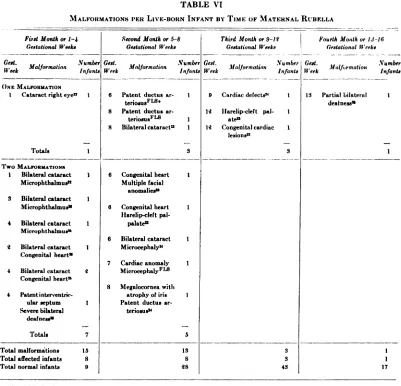
The relationship between the number and type of individual malformations and the duration of pregnancy at the time of the rubella infection is presented in Table VI. When multiple cardiac anomalies occurred, they were considered as single malforma tions. Using this approach, 32 malforma
tions were found among the 20 affected live
born children, 8 having one anomaly and 12 having two. Table VI reveals that double malformations were more commonly associ ated with early maternal rubella than were single malformations. The arbitrary classi fication of bilateral cataracts with microph thalmia as double malformations and all
* Among 5,638 live-births and neonatal deaths in
the FetalLife Study (1946-1953),7.4% of the infants
Osa MALFORMATION
1 Cataract right eye― 1
Totals 16
Patent ductua ar- 1
teriosusFLS*
8 Patent ductus ar teriosus@18 1 8 Bilateral cataract― I
39
Cardiac defects― 1
19 harelip-cleft pal- 1
ate―
12 Congenital cardiac 1 lesions―
313
Partial bilateral 1 dealness―
1Two
MALFORMATIONS 1 Bilateral cataract 1
Microphthalmus―
S Bilateral cataract 1 Microphthalmua'S
4 Bilateral cataract I Microphthalmus―
2 Bilateral cataract I
Congenital heart―
4 Bilateral cataract 2 Congenital heart―
4 Patentinterventric
ular septum I Severe bilateral
deafness―
Totals 76
Congenital heart I Multiple facial
anomalies―
6 Congenital heart I
Harelip-cleft pal
palate―
6 Bilateral cataract I
Microcephaly―
7 Cardiac anomaly I
Microcephaly9'@
8 Megalocornea with atrophy of iris 1 Patent ductus ar
teriosus3'
5Total
malformations 13 Total affected infants 8 Total normal infants 913
8 283
3 431
1 17
206 1@UBELLA
TABLE VI
MALFORMATIONS PER LIVE-BORN INFANT BY TIME OF MATERNAL RUBELLA
Fourth Month or 1d—16 Gestational Weeks
(Jest. . Number
JJ'eek Malfi)rmat,on Infants
First Month or 1—4
Geatational Weeks
SecondMonth or 5-8
Gestational Weeks
Third Month or 9-12
Gestationsil Weeks
(Jest. . Number
Week Malformation Infants (Jest.
Ireek Malformahon Number (Jest.Infants Week Malformation NumberInfants
Fetal Life Study.
bella during pregnancy is performing a dif
ferent function from the physician making a clinical diagnosis and routinely reporting
an infectious disease—asis the patient diag
nosing herself and filling out a question naire. These influences may result in either over- or under-diagnosis of rubella. In this
regard, there was an interesting patient
(not included in this series) who was en
rolled in the Fetal Life Study in 1948 and delivered a child with congenital heart dis ease and cataract. Her interview records list a minor respiratory infection in the sixth
week of gestation. Retrospectively, both the
patient and her family physician recalled a rash, but a definite diagnosis was never made. On the other hand, another study of
pregnancies complicated by rubella25 cover ing the same geographic area and similar years (1949-1955), but beginning with re ports of maternal rubella, failed to record any of the cases found in the Fetal Life
Study which began its observations with
the pregnancy.
At present the diagnosis of rubella is en tirely clinical with the occasional aid of an
epidemic situation. No specific laboratory
confirmation is yet available. In fact, the basis of viral etiology of rubella rests pri marily on studies with animals and human volunteers.8'9 Furthermore, the definite pos
sibility of clinical confusion has arisen with the discovery of other agents giving similar
1stP2nd3rd4thMonthMonthMonthMonth(1—4(5—8(9—1P2(13—16Weeks)Weeks)Weeks)Weeks)Cardiac
anomalies462—Cataracts72——Microphthalmus3———Megalocornea
withatrophy
of iris—I——Deaf nessI——IHarelip-cleft palate—11—Multiple
facial anom
alies—I——Microcephaly—2——Totals151331
of deafness following pregnancies compli cated by rubella, but few cases were diag nosed within the first year. Jackson and Fisch3' found approximately 30% of the children resulting from pregnancies in which the rubella occurred within the first 16 weeks had auditory deficits. The subtle ties of mental retardation and dental anom alies also are not obvious early in life.
Geographic and temporal influences also must be considered. There is no evidence that the teratogenic effect of the rubella virus is constant in different areas and in different years, since strains of rubella virus cannot be detected and compared. Two longitudinal studies, the present Study (1946-1959) and that reported by Green berg (1949@1955),25 were simultaneously conducted in the New York City area. In both series the year 1955 appeared out standing. Eight of our 25 cases occurred in that year; this group included 3 of the 4 spontaneous abortions and all 3 of the mal formed infants in our series. The three anomalous offspring from Greenberg's series were also from the year 1955.
Other influencing factors may be the increased accuracy of diagnosis during epi demics, or chance variation due to the small sample.
CONCLUSIONS
More complete reporting of prospectively followed pregnancies complicated by ru bella is necessary. Important factors often missing are: the date of the last menstrual period, the method of documenting the diagnosis, the gestational week of the on set of rubella rather than the trimester, the duration of the pregnancy, the birth weight of the infant, and the duration of follow-up before classifying an infant as normal or abnormal.
Control populations also must be ob served to determine the incidence of mal formations in the general population.
Objective technical means of diagnosing rubella and comparing various strains of the virus must be developed before the diagnosis can be made with certainty and TABLE VII
SPECIFIC MALFORMATION IN RELATION TO TIME OF MATERNAL RUBELLA
teroviruses have been associated with ex anthems.'2 Preliminary investigation of ECHO 9 virus infection during pregnancy, utilizing serologic techniques, indicates no increase in the risk of malformation or fetal death.33
Many malformations are discovered only
the consistency of the teratogenic effects of different strains can be established.
SUMMARY
The Fetal Life Study (1946-1959) re corded 25 instances of rubella infection dur ing pregnancy. Exposure to rubella oc curred during 95 other pregnancies. The results of these pregnancies and the follow up of the infants is reported.
A summary of other prospective studies reported in the literature is also presented. The incidence and number of malforma tions per live-born child are discussed in relation to the time of maternal rubella during pregnancy. There appeared to be a decreasing risk of malformation in live-born infants from 47% (8/17) in the first 4 weeks, 22% (8/36) in the fifth through eighth weeks, to 7% (3/46) in the ninth through twelfth weeks. Although the trend appears to be definite, the Fetal Life Study and the six other studies summarized are quite diverse and the samples are small.
It is suggested that prospective observa tions be more completely reported and con trol observations also be made. There is dire need of objective laboratory techniques for the diagnosis of rubella.
Addendum
Since our request to Dr. Greenberg for addi tional information in June, 1959, a more com plete report of his cases has appeared in the literature (Siegel, M., and Greenberg, M.: Fetal death, malformation and prematurity after ma ternal rubella. Results of a prospective study, 1949-1958. New England J. Med., 262:389, 1960).
REFERENCES
1. Gregg, N. M.: Congenital cataract follow ing german measles in the mother. Tr. Ophth. Soc. Australia, 3:35, 1941. 2. Swan, C., Tostevin, A. L., Moore, B.,
Mayo, H., and Black, C. H. B.: Con genital defects in infants following in fectious diseases during pregnancy.
With special reference to the relation ship between german measles and cata ract, deaf-mutism, heart disease and
microcephaly, and to the period of preg nancy in which the occurrence of ru
bella is followed by congenital abnor
malities. M. J. Australia, 2:201, 1943.
3. McIntosh, R., and Mellin, C. W.: Fetal life study. A cooperative obstetrical and
pediatric endeavor. Bull. Sloane Hos
pital for Women, 2:95, 1956.
4. McIntosh, R., Merritt, K. K., Richards, M. R., Samuels, M. H., and Bellows, M. T.: The incidence of congenital malforma tions: a study of 5,964 pregnancies. PEDIATRICS, 14:505, 1954.
5. Richards, M. R., Merritt, K. K., Samuels, M. H., and Langmann, A. G.: Fre
quency and significance of cardiac mur
murs in the first year of life. PEDIATRICS, 15:169, 1955.
6. Warkany, J.: Etiology of congenital mal
formations. Advances Pediat., 2:1, 1947. 7. Malmberg, N., Sterner, C., and Lundmark,
C.: Asymptomatic maternal rubella as a probable cause of embryopathy. Ann. paediat. Fenniae, 3:437, 1957.
8. Hiro, Y., and Tasaka, S.: Die Rötelnsind eine Viruskrankheit. Monatsschr. Kinderh., 75:328, 1938.
9. Krugman, S., Ward, R., Jacobs, K. G., and
Lazar, M.: Studies on rubella immuni zation. I. Demonstration of rubella with out rash. J.A.M.A., 151:285, 1953. 10. Ober, R. E., Horton, R. J. M., and Feem
ster, R. F.: Congenital defects in a year of epidemic rubella. Am. J. Pub. Health,
37:1328, 1947.
11. Aycock, W. L., and Ingalls, T. H.: Ma ternal disease as a principle in the epi demiology of congenital anomalies. Am.
J. M. Sc., 212:366,1946.
12. Fox, M. J., and Bortin, M. M.: Rubella in pregnancy causing malformations in newborn. J.A.M.A., 130:568, 1946.
13. Ingalls, T. H.: German measles and ger man measles in pregnancy. A.M.A. J.
Dis.Child.,93:555,1957.
14. Korns, R. F.: The role of environment in the production of certain congenital de fects as illustrated by the post-rubella
syndrome. Proc. Kessler Inst. Rehab.,
1:17,1953.
15. Tartakow, cited by Korns, R. F.14 16. Oxorn, H.: Rubella and pregnancy: a
study of 47 cases. Am. J. Obst. &
Gynec., 77:628, 1959.
17. Lundstrom, R.: Rubella during pregnancy:
its effects upon perinatal mortality, the -incidence of congenital abnormalities
and immaturity. A preliminary report.
Actapaediat., 41:583,1952.
ARTICLES
28. Lejeune, J., Gauthier, M., and Turpin, R.:
Génétique.Les chromosomes humains en culture de tissus. Acad. des Sc.,
Compt. Rend., 248:602, 1959.
29. Idem: Génétique.Etude des chromosomes
somatiques de neuf enfants mongoliens. Acad. des Sc. Compt. Rend., 248:1721,
1959.
30. Jacobs, P. A., Baikie, A. C., Court Brown, W. M., and Strong, J. A.: The somatic chromosomes in mongolism. Lancet, 1:710, 1959.
31. Lundstrom, R., cited by Krugman, S., and Ward, R.: Demonstration of neutraliz ing antibody in gamma globulin and
re-evaluation of the rubella problem. New England J. Med., 259:16, 1958.
32. Melnick, J. L., and Sabin, A. B.: The ECHO virus group, in Viral and Rick
ettsial Infections of Man, 3rd Ed.,
Rivers, T. M., and Horsfall, F. L., edi tors. Philadelphia, Lippincott, 1959,
p. 547.
33. Peterson, J. C.: Personal communication.
34. Dekaban, A., O'Rourke, J., and Comman,
T.: Abnormalities in offspring related to maternal rubella during pregnancy. Neurology, 8:387, 1958.
35. Jackson, A. D. M., and Fisch, L.: Deaf ness following maternal rubella. Lancet, 2:1241, 1958.
19. Lamy, M., and Seror, M. E.: Les embry opathies d'origine rubéolique. Sem. med. prof. méd.-soc.,32:1085, 1956.
20. Hill, A. B., and Galloway, T. McL.: Ma ternal rubella and congenital defects: data from National Health Insurance Records. Lancet, 1:299, 1949.
21. Ingalls, T. H., and Purshottam, N.: Fetal
risks from rubella during pregnancy. New England J. Med., 249:454, 1953. 22. Brown, C. M., and Nathan, B. J.: Maternal rubella and congenital defects. Lancet, 1:975, 1954.
23. Brawner, D. L.: Maternal rubella: results
following an epidemic. J.A.M.A. Geor gia, 44:451, 1955.
24. Pitt, D. B.: Congenital malformations and maternal rubella. M. J. Australia, 1:233, 1957.
25. Greenberg, M., Pellitteri, 0., and Barton,
J.: Frequency of defects in infants
whose mothers had rubella during preg
nacy. J.A.M.A., 165:675, 1957.
26. Hill, A. B., Doll, R., Galloway, T. McL., and Hughes, J. P. W.: Virus diseases in pregnancy and congenital defects. Brit.
J. Prey.& SocialMed.,12:1, 1958.
1960;26;200
Pediatrics
Richard H. Michaels and Gilbert W. Mellin
ASSOCIATED CONGENITAL MALFORMATIONS
PROSPECTIVE EXPERIENCE WITH MATERNAL RUBELLA AND THE
Services
Updated Information &
http://pediatrics.aappublications.org/content/26/2/200
including high resolution figures, can be found at:
Permissions & Licensing
http://www.aappublications.org/site/misc/Permissions.xhtml
entirety can be found online at:
Information about reproducing this article in parts (figures, tables) or in its
Reprints
http://www.aappublications.org/site/misc/reprints.xhtml
1960;26;200
Pediatrics
Richard H. Michaels and Gilbert W. Mellin
ASSOCIATED CONGENITAL MALFORMATIONS
PROSPECTIVE EXPERIENCE WITH MATERNAL RUBELLA AND THE
http://pediatrics.aappublications.org/content/26/2/200
the World Wide Web at:
The online version of this article, along with updated information and services, is located on
American Academy of Pediatrics. All rights reserved. Print ISSN: 1073-0397.