Journal on Today’s Ideas – Tomorrow’s Technologies, Vol. 2, No. 1, June 2014 pp. 31–39
DOI: 10.15415/jotitt.2014.21003
Development of Fly Ash based Geopolymer
behaviour of Fly Cement
P.YellaIah1, SaNJaY Kumar Sharma1, *, T.D. GuNNeShwara raO2 1research Scholar in Civil engineering, Department, NITTTr, Chandigarh.
2associate Professor, Civil engineering Department, National Institute of Technology, warangal (a.P.)
*E-mail: [email protected]
received: april 30, 2014| revised: may 30, 2014| accepted: June 24, 2014 Published online: June 30, 2014
The author(s) 2014. This article is published with open access at www.chitkara.edu.in/publications
Abstract: Geopolymer is a novel binding material produced from the reaction
of fly ash with an alkaline activator liquid; ensure durability and environmental sustainability and is emerging greener alternative to Ordinary Portland cement in the construction field. In this research, the influence of various parameters on the consistency and setting times of low-calcium fly ash-based geopolymer cement under varied heat curing temperature were investigated. Systematic trials were carried to optimise the normal consistency and setting times over a number of parameters. The consistency of the geopolymer cement does not show any variation when mixed with different combinations of alkaline activator solution; whereas the setting times were observed to be dependent on the concentration of NaOh solution, ratio of alkaline activator liquid and variation in temperature. The test results revealed that the normal consistency of the fly ash-based geopolymer paste is found to be at 28% of alkaline activator solution for all the selected mixtures. wherein, increase in concentration of NaOh solution increases setting times; increase in alkaline liquid ratio decreases setting times up to certain limits viz; increase in alkaline liquid ratio from 1.5 to 2.0, decreases setting times; further increase in alkaline liquid ratio from 2.0 to 2.5, increases setting times. The setting times were observed as decreased when the alkaline liquid ratio increased from to 2.5 to 3.0.
Keywords: Geopolymer, alkaline activator, consistency, setting times
1. IntroDuCtIon
Yellaiah, P. Sharma, S. K. rao, T. D. G.
emission. Carbon dioxide emission trading is likely to be a critical factor for the construction industry. many concrete structures have shown serious deterioration, way before their intended service life, especially those constructed in a corrosive environment [1].
The contribution of ordinary Portland cement production worldwide to greenhouse gas emission is approximately 7% of the total greenhouse gas emission to the atmosphere [2]. The production of 1 tonne ordinary Portland cement consumes 4GJ energy and produces about 1 tonne of carbon dioxide to the atmosphere [3]. about half of the carbon dioxide emissions from Portland cement production are due to calcination of limestone, while the other half are due to combustion of fossil fuel.
It is necessary to consider this with very severe regulations and limitations, since it is a major contributor to the greenhouse effect and the global warming of the planet [4]. The demand for industrial and domestic energy results in the production of a large volume of fly ash from solid coal fuel, which will increase in the world on an unprecedented scale in future. The installation of new cement plants substantially increases the CO2 emissions, and installation of coal-fired thermal power plants results in large amount of coal ashes. Therefore, fly ash should not only be disposed of safely to prevent environmental pollution, but should be treated as a valuable resource.
In 1978, Joseph Davidovits developed Inorganic polymeric materials and coined the term “Geopolymer” for it [5]. Geopolymer has the potential to replace ordinary Portland cement concrete and produce fly ash-based Geopolymer concrete with excellent physical and mechanical properties. Geopolymer is used as the binder to completely replace ordinary Portland cement in producing Geopolymer concrete. In order to produce Geopolymer, low-calcium fly ash needs to be activated by an alkaline solution to produce polymeric Si-O-al bonds. Geopolymer concrete has the potential to reduce greenhouse emissions from the concrete industry by 80% [6].
Geopolymers are novel binders manufactured by activation of a solid aluminosilicate source material with a highly alkaline activating solution and aided by ambient curing and heat curing [7]. Fly ash being by product, rich in alumina and silica, can be used as a source material for manufacture of geopolymer.
Development of Fly ash based Geopolymer behaviour of Fly Cement It is now well accepted that new binders are needed to replace Ordinary
Portland cement for enhanced environmental and durability performance. There is a need to urge to reduce carbon dioxide emissions and the fact that structures, which have been built a few decades ago with Ordinary Portland cement, are already facing disintegration problems points out the handicaps of OPC binders [9]. In fact, the number of premature cases of Ordinary Portland cement structures disintegration is overwhelming. On the other hand, the disposing of fly ash, a coal burnt by-product is an environmental issue. as a useful mineral admixture, fly ash has been widely utilised in concrete replacing Ordinary Portland cement partially all over the world [10-12].
So far, research works carried out on alkali-activated binders show that this binder is likely to have enormous potential to become an alternative to Portland cement. The present research has been dealt with the activation of Indian fly ash (conforming to Class F as per aSTm) with alkaline activator a combination of sodium hydroxide (NaOh) solution and sodium silicate (Na2SiO3) solution. These two chemicals are commercially available in India. heat curing is generally needed for fast polymerization of the system to achieve an acceptable strength within a very short period [13-15]. Thus, the mixture may be used to produce pre-cast products for practical purpose.
2. ExpErImEntAl WorK 2.1 materials
2.1.1 Fly ash
In this research, low calcium fly ash (aSTm Class F) conforming to IS 3812-1987 specifications collected from the ramagundam Super Thermal Power Station, India was utilized as the source material. The chemical composition of the fly ash was determined by X-ray Fluorescence (XrF) analysis as shown in Table 1. The silicon and aluminium oxides constitute 87.34% of the fly ash and the Si to al molar ratio is 2.07fulfilling the basic requirementsas suggested by Davidovits,that the molar ratio of Si to al of about 2 for producing cement and concrete. 65% of fly ash particles are smaller than 45 micron with the specific gravity of 2.06 and specific surface area was 440 m2 /kg (Blaine).
table 1: Chemical composition of Fly ash
elements SiO2 al2O3 Fe2O3 CaO TiO2 K2O mgO P2O5 SO3 Na2O
% by
Yellaiah, P. Sharma, S. K. rao, T. D. G.
2.1.2 Alkaline activator solution
alkaline activator solution is the mixture of Sodium hydroxide solution of specific concentration and Sodium Silicate solution in a specified ratio. In this study, the alkaline liquids used for geopolymerisation is a combination of analytical Grade Sodium hydroxide (a r Grade) of raNKem Co. in pellets form with 98% purity, supplied by avantor Performance materials India limited, Gujarat, India and Sodium Silicate Solution (Na2O = 8%, SiO2 = 26.5%, and water = 65.5% by weight) having silicate modulus=3.3, supplied by loba Chemie (laboratory reagents & Fine Chemicals), mumbai, India. Distilledwater is used for dissolving Sodium hydroxide pellets.
2.2 Experimentation
2.2.1 preparation of Alkaline Solution
analytical Grade Sodium hydroxide pellets in the required quantity were dissolved in the distilled water in order to obtain specific concentration of Sodium hydroxide solution. later, thissolution in the prescribed quantity was mixed in the Sodium Silicate solution to arrive a particular ratio among sodium silicate and sodium hydroxide solutions. Distilled water is used to avoid the effect of unknown contaminants in tap water.
2.2.2 Geopolymer paste for normal consistency
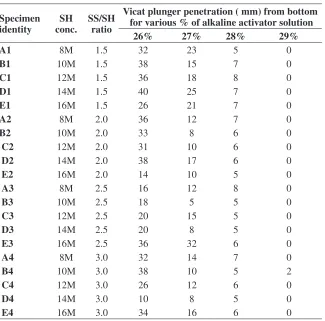
The consistency of the fly ash-based geopolymer paste is determined by preparing trial pastes with varying percentage of alkaline solution and tested until the amount of alkaline solution necessary for making up the standard consistency. The procedure was followed as per IS: 4031(Part-4) -1988 Standard for Portland cement paste duly modified by replacing the cement and water with fly ash and alkaline solution. This procedure is repeated for varied concentration of alkaline solution with different alkaline liquid ratios. experimental observations are presented in table 2.
2.2.3 Geopolymer paste for Setting times
Development of Fly ash based Geopolymer behaviour of Fly Cement
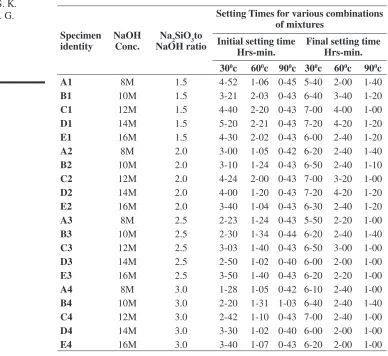
conical moulds of Vicat apparatus in two layers. each layer was tamped with a rod for 25 times. later, the filled moulds were kept into the hot air ovens for curing at specified temperature. Penetration of Vicat Plunger in the paste was measured with varying the percentage of alkaline solution. Penetration of Vicat needle in the paste was measured at regular intervals of time. For every 20 minutes interval, the specimens were taken out, placed on the Vicat apparatus and noted down the penetration of the needle. after that, the specimens were returned to the hot air ovens again. The time at which the needle fails to pierce the block beyond 5.0 ± 0.5 mm measured from the bottom of the mould is noted as initial setting time by interpolation. The final setting time of the paste was also recorded when the needle left negligible mark on the surface of the paste. These tests were repeated for various mixtures under different temperatures. The observations of setting times are shown in the table 3.
table 2: Consistency indication of various mixtures
Specimen
identity conc.SH SS/SH ratio
Vicat plunger penetration ( mm) from bottom for various % of alkaline activator solution
26% 27% 28% 29%
A1 8m 1.5 32 23 5 0
B1 10m 1.5 38 15 7 0
C1 12m 1.5 36 18 8 0
D1 14m 1.5 40 25 7 0
E1 16m 1.5 26 21 7 0
A2 8m 2.0 36 12 7 0
B2 10m 2.0 33 8 6 0
C2 12m 2.0 31 10 6 0
D2 14m 2.0 38 17 6 0
E2 16m 2.0 14 10 5 0
A3 8m 2.5 16 12 8 0
B3 10m 2.5 18 5 5 0
C3 12m 2.5 20 15 5 0
D3 14m 2.5 20 8 5 0
E3 16m 2.5 36 32 6 0
A4 8m 3.0 32 14 7 0
B4 10m 3.0 38 10 5 2
C4 12m 3.0 26 12 6 0
D4 14m 3.0 10 8 5 0
Yellaiah, P. Sharma, S. K. rao, T. D. G.
table 3: Setting times of geopolymer paste
Specimen
identity naoH Conc. naoH rationa2Sio3to
Setting times for various combinations of mixtures
Initial setting time
Hrs-min. Final setting time Hrs-min. 300c 600c 900c 300c 600c 900c
A1 8m 1.5 4-52 1-06 0-45 5-40 2-00 1-40
B1 10m 1.5 3-21 2-03 0-43 6-40 3-40 1-20
C1 12m 1.5 4-40 2-20 0-43 7-00 4-00 1-00
D1 14m 1.5 5-20 2-21 0-43 7-20 4-20 1-20
E1 16m 1.5 4-30 2-02 0-43 6-00 2-40 1-20
A2 8m 2.0 3-00 1-05 0-42 6-20 2-40 1-40
B2 10m 2.0 3-10 1-24 0-43 6-50 2-40 1-10
C2 12m 2.0 4-24 2-00 0-43 7-00 3-20 1-00
D2 14m 2.0 4-00 1-20 0-43 7-20 4-20 1-20
E2 16m 2.0 3-40 1-04 0-43 6-30 2-40 1-20
A3 8m 2.5 2-23 1-24 0-43 5-50 2-20 1-00
B3 10m 2.5 2-30 1-34 0-44 6-20 2-40 1-40
C3 12m 2.5 3-03 1-40 0-43 6-50 3-00 1-00
D3 14m 2.5 2-50 1-02 0-40 6-00 2-00 1-00
E3 16m 2.5 3-50 1-40 0-43 6-20 2-20 1-00
A4 8m 3.0 1-28 1-05 0-42 6-10 2-40 1-00
B4 10m 3.0 2-20 1-31 1-03 6-40 2-40 1-40
C4 12m 3.0 2-42 1-10 0-43 7-00 2-40 1-00
D4 14m 3.0 3-30 1-02 0-40 6-00 2-00 1-00
E4 16m 3.0 3-40 1-07 0-43 6-20 2-00 1-00
3. rESultS AnD DISCuSSIon
a total of twenty mixtures of various combinations of varied concentrations of Sodium hydroxide solution (8m, 10m, 12m, 14m, 16m) with different ratios (1.5, 2.0, 2.5, 3.0) of alkaline activator solution by weight were prepared to study the influence of various parameters on both the setting times and compressive strength under varied curing temperature of 300c, 600c, 900c.
Development of Fly ash based Geopolymer behaviour of Fly Cement
3.1 Effect of Concentration of Sodium Hydroxide Solution
The variation in concentration of NaOh solution and in alkaline activator liquid ratios has no influence on the normal consistency of geopolymer paste. On the other hand, increase in concentration of NaOh solution from 8m to 14m, increased setting times were observed in respect of the alkaline liquid ratio of 1.5; further increase in concentration from 14m to 16m has led to decrease in setting times. wherein, increase in concentration of NaOh solution from 8m to 12m, the setting times were observed to be increased with respect to the alkaline liquid ratio of 2.0, and subsequently the setting times were decreased when the concentration further increased from 12m to 16m. Increase in concentration from 8m to 16m, the setting times are observed to be decreased and increased alternatively when the alkaline liquid ratio enhanced to 2.5. moreover, increase in concentration from 8m to 10m, increased initial setting times were observed in case of the alkaline liquid ratio of 3.0; further increase in concentration from 10m to 14m, decreased initial setting times were noticed, and when the concentration increased further from 14m to 16m, increased initial setting times were observed.
3.2 Effect of the ratio of Sodium Silicate solution to Sodium Hydroxide solution
The effect of alkaline liquid ratio is observed to be no more with regard to normal consistency of the geopolymer paste; it is observed as 28% in almost all the selected mixtures. Increase in alkaline liquid ratios from 1.5 to 2.0, decrease in setting times was observed for the increased concentration of NaOh solution. later, when the alkaline liquid ratios are increased from 2.0 to 2.5; increase in setting times was noticed for 8m and 10m concentrations, decrease in setting times were observed for 12m and 14m, and increased time was observed for 16m. uponfurther increase in the alkaline liquid ratio from 2.5 to 3.0,decreased setting times were observed in all of the increased concentrations from 8m to 16m.
3.3 Effect of curing temperature
Irespect of the mixture 14m at the alkaline liquid ratio of 1.5, the maximum initial and final setting times are observed as 5h.20min and 7h.20min at 300c;
2h.20min and 4h.20 min at 600c curing temperature. whereas, at 900c, the
Yellaiah, P. Sharma, S. K. rao, T. D. G.
the initial and final setting times at 900c with very negligible deviation are
observed as nearer to 43minutes and around 1hour 20minutes respectively.
4. ConCluSIon
Based on the limited experimental study, the following conclusions are drawn. The standard consistency is not influenced with the variation in molarity •
and alkaline liquid ratios.
The setting times are dependent on the concentration of NaOh solution, •
ratio of alkaline activator liquid and variation in temperature as a whole.
The normal consistency of the fly ash-based geopolymer paste is found •
to be 28% for all the selected mixtures.
Increase in concentration of NaOh solution from 8m to 14m, increases •
setting times for the alkaline liquid ratio of 1.5; continues the same trend even for the molarity ranging from 8m to 12m in case of the alkaline liquid ratio of 2.0; further increased molarity of NaOh solution decreases setting times.
Increase in alkaline liquid ratio from 1.5 to 2.5, decreases setting times; •
further increased alkaline liquid ratio exhibits inconsistent setting times. Increase in curing temperature up to 60
• 0c decreases setting times
moderately; but, increase in temperature beyond 600c, decrease in setting
times is drastic.
rEFErEnCES
[1] mehta P.K., (1997) Durability – Critical Issues for the Future, aCI Concrete International, 19 (7): pp. 27-33.
[2] malhotra V.m., (2002b) Introduction: Sustainable Development and Concrete Technology, aCI Concrete International, 24 (7): pp. 22.
[3] mehta, P.K., (2001) Reducing the Environmental Impact of Concrete, aCI Concrete International, 23 (10): pp. 61-66.
[4] radhakrishna., renuka Devi m.V., and udayashankar B.C., (2009) Use of Fly ash in
Construction industries for Sustainable Development, Journal of environmental research and
Development 3 (4): pp. 1212.
[5] Davidovits J. Comrie D.C., Paterson J.h., and ritcey D.J., (1990) Geopolymeric Concretes for
Environmental Protection, aCI Concrete International, 12 (7): pp. 30-40.
[6] Daniel K., Sanjayan J., and Sagoe-Crentsil K., (2006) The Behaviour of Geopolymer Paste
and Concrete at Elevated Temperatures, International Conference on Pozzolan, Concrete and Geopolymer, Khon Kaen, Thailand, pp. 105 – 118.
[7] Suresh Thokchom., Dr. Partha Ghosh., and Dr. Somnath Ghosh., (2009) “Resistance of Fly
Development of Fly ash based Geopolymer behaviour of Fly Cement
[8] Dhir r.K., hubbard F.h., munday J.G.l., Jones m.r., Duerden S.l., (1988) Contribution of
PFA to concrete workability and strength development, Cem Concr res., 18(2): pp. 277–89. http://dx.doi.org/10.1016/0008-8846(88)90012-9
[9] P.T. Fernando., C.G. Joao., and J. Said., (2008) “Alkali-activated binders: A review Part
1.Historical background, terminology, reaction mechanisms and hydration products”,
Construction Building material, no. 22, pp. 1305-1314. http://dx.doi.org/10.1016/j. conbuildmat.2007.10.015
[10] P.K. meheta., (1991) “Durability of concrete: Fifty years of Progress”, aCI SP 126, V.m. malhotra, ed., pp. 1-32.
[11] V. m. malhotra., (2002) “High performance high volume fly ash concrete”, aCI Concrete International, 7(24): pp. 1-5.
[12] r.N. Tarun., (1989) “High strength concrete containing large quantities of fly ash”, aCI material Journal, pp. 111-116.
[13] D. hardjito., S.e. wallah., D.m.J. Sumajouw., and V. rangan., (2005) “Fly ash-based
geopolymer concrete”, australian Journal of Structural engineering, no. 6, pp. 1-9,
[14] D. hardjito., and V. rangan., (2005) “Development and properties of low calcium fly ash-based
geopolymer concrete”, research report GC, Faculty of engineering, Curtin university of Technology, Perth, australia, , pp. 1-130.
[15] r. matthew., and O.C. Brian., (2003) “Chemical optimisation of the compressive strength of