Copyright © The Author(s). All Rights Reserved. Published by American Research Institute for Policy Development DOI: 10.15640/ijn.v5n2a2 URL: https://doi.org/DOI: 10.15640/ijn.v5n2a2
Nurses’ Job Satisfaction in Long Term Care: The Role of Socio-Demographic and
Professional Variables
Márcia Palha, MD
1, Ana Paula Macedo, Ph.D
2.&
Clara Simães,Ph.D
3.
Abstract
Background: This study examined job satisfaction among nurses in long-term care units in order to analyze the role of sociodemographic and professional variables in this process. Methods: A cross sectional study of 48 nurses, working inlong-term care units in Portugal, was conducted using a sociodemographic and professional questionnaire, and the Portuguese version of the Nurses Job Satisfaction Rating Scale (Ferreira & Loureiro, 2012). Data analysis was performed by using descriptive and inferential statistics. Results: The study included 48 participants with a mean age of 28.0±3.90. Most participants were female (81.2%), not married (62.5%), had the graduate level (62.5%), and less than 5 years of professional experience (81.3%).Nurses showed a positive overall satisfaction with work (M = 83.35), but a negative satisfaction with benefits/rewards (M = 14.52) and with promotion (M= 18.38). Satisfaction with promotion was influenced by educational attainment level and, satisfaction with benefits/rewards was influenced by nurses’ work schedule. Female nurses and those with a higher income, reported more satisfaction with communication, and nurses with more age exhibited greater satisfaction with the chief/boss. Conclusion: Work benefits, rewards and promotion constitute crucial factors that determine job satisfaction among nurses in long-term care. Nurses’ sociodemographic and professional characteristics must be considered by organizations in the promotion of positive work environments.
Keywords: Job satisfaction, Nurses, Long-term care, Personal Satisfaction 1. Introduction
1.1. Background
Job satisfaction has been widely studied within the organization since its influence is recognized in the organization's behavior (George & Jones, 1996) and worker well-being (Spector, 1997). Its concept was defined by several authors, with emphasis being placed on several dimensions of analysis. Locke (1983) defines job satisfaction as "the pleasurable or positive emotional state resulting from the appraisal of one's job or job experiences" (p.1300). In this work, Spector (1997) characterizes this construct as an attitudinal variable and can be evaluated according to the degree to which the person likes (satisfaction) or dislikes (dissatisfaction) his work and also through different aspects related to the work. Thus, satisfaction with work is based on an evaluation process and is related to the work context.
The current economic situation, not only in Portugal but in Europe, has triggered numerous labor changes that often result in feelings of dissatisfaction. In the specific case of the nursing profession, professional satisfaction becomes paramount when analyzed from the point of view of its consequences.
1Portuguese RegisteredNurse. Rua D. José de Bragança, nº 41, 4710-382 Braga, Portugal. E-mail: [email protected]
2School of Nursing, University of Minho. Universidade do Minho, Escola Superior de Enfermagem, Campus de Gualtar,
4710-057 Braga, Portugal. Email: [email protected]
3 School of Nursing, University of Minho.Universidade do Minho, Escola Superior de Enfermagem, Campus de Gualtar,
In this context, emphasis is given to the level of absenteeism, turnover, shortage of professionals, low productivity, low efficiency and quality of services, as well as increased replacement costs (Salomé, 1999, cited by Batista, Santos, Santos, & Duarte, 2010). Teamwork and professional relations are also of added importance. Investing in the qualification of nurses often makes them the focus of attention in studies on job satisfaction, since the expectations and desired recognition, in terms of benefits and status in the organization, may not correspond to that verified. Thus, satisfaction in the work of health professionals is felt as a priority to foster a good environment in clinical practice and to guarantee the quality of care provided (Baumann, 2007).
The National Continuum of Integrated Care Network (RNCCI), approved by Dec. Law no. 101/06 of June 6, appeared in Portugal as an intermediate level of care, which articulates community and hospital care. The philosophy of RNCCI presupposes teamwork and interdisciplinary work, to provide integrated care that better respond to the overall health needs of the individual. This model places Nursing professionals as a key point of care delivery and can be determinant for motivation and professional satisfaction, which is why it is intended to address the issue in Integrated Continuing Care organizations.
Since nurses are the largest class of health professionals, it is important to analyze their degree of satisfaction at work in a context of major economic and financial changes in organizations and in the country itself. The reform that occurred in the health sector with the introduction of the RNCCI emphasized the importance of evaluating nurses' satisfaction, since it required and continues to require a continuous adaptation of professionals to new job requirements. This exploratory and descriptive study aimed to: 1) describe the levels and domains of professional satisfaction of nurses who work in the Long Term Care and Maintenance service of the continuous care units of the district of Braga; 2) to evaluate the impact of sociodemographic variables on the levels of job satisfaction; 3) to evaluate the impact of professional variables on the levels of professional satisfaction of nurses. Authorization was obtained from the Ethics Committee for Health of the Regional Health Administration of the North, as well as from each unit of continuous care (Advice No. 37/2013).
2. Methods 2.1. Study Design
We carried out an exploratory cross sectional study design, through a sociodemographic and professional questionnaire, and the Portuguese version of the Nurses Job Satisfaction Rating Scale (Ferreira & Loureiro, 2012). This study is based on the quantitative paradigm and is based on a non-experimental method.
2.2. Survey instrument: TheNurses’ Job Satisfaction Rating Scale (EASPE)
The Nurses' Job Satisfaction Rating Scale (EASPE) was developed by Ferreira and Loureiro (2012) and validated for the Portuguese population of nurses by the same authors, revealing robust psychometric characteristics in terms of validity and fidelity. The EASPE consists of 25 items, evaluated on a five-point Likert scale (1 = totally disagree to 5 = totally agree). The total score, which is a result of the sum of all items and an indicator of the level of overall satisfaction with work, can vary from a minimum value of 25 to a maximum of 125. Higher values on the total scale are indicators of greater satisfaction with work (Ferreira & Loureiro, 2012). As suggested by the authors, in this study the Global Satisfaction with Work scale (α = .82) was a composite dimension of six satisfaction subscales: a) Relationship with the Boss (α = .80); b) Benefits and Rewards (α = .73); c) Promotions (α = .72); d) Work Context (α = .68); e) Communication (α = .55); and, f) Relationship with the Team (α = .70).
2.3. Sociodemographic and professional questionnaire
The sociodemographic and professional questionnaire was specifically constructed for this study. It consisted of 12 questions of direct response, allowing the collection of demographic data (e.g., age, gender, marital status, literacy) and professionals (e.g., type of management, work link, remuneration, weekly schedule, professional experience, leadership / coordination, schedule rotation, double employment). These data allowed a characterization of the participants.
2.4. Study Setting
2.5. Study sample
The final sample resulted in a total of 48 nurses working in long-term units in the north of Portugal. In total, 56 professionals working in these health facilities were contacted, with a response rate of 86%.
2.6. Inclusion and Exclusion Criteria
Eligibility criteria were to have a Nursing Degree and to work in one of the units under study. It was an exclusion criterion the practice of Nursing practice in an international mobility situation.
2.7. Study variables
In this study, satisfaction with work was measured by EASPE (Ferreira & Loureiro, 2012) and operationalized through the six dimensions suggested by the authors was considered as a dependent variable: a) Satisfaction in the relationship with the Chief (4 questions); b) Satisfaction with Benefits and Rewards (5 questions); c) Satisfaction with Promotion (7 questions); d) Satisfaction with the Work Context (3 questions); e) Satisfaction with the Communication (4 questions); and, f) Satisfaction in the relationship with the Team (2 questions). Independent variables were grouped into sociodemographic variables (e.g., age, gender, marital status, academic qualifications) and professional variables (e.g., work status, remuneration, weekly work experience, managerial / coordination position, double employment, type of management and place of work). Given the size of the sample under study, we chose to dichotomize sociodemographic and professional variables.
2.8. Data Collection
The researcher personally contacted the nurses’ heads of the five health units under study, explaining the objectives of the research work. Subsequently, all the nurses of these units were contacted, having been clarified about the research project and its objectives and, requested to be included in the study. The participation of the nurses was voluntary, subject to informed written consent and guarantee of the confidentiality of the data. Self-report questionnaires were submitted by the researcher to each participant. Once completed, the questionnaires were returned in a sealed envelope, which, after being sealed and without any reference to the participant's external identity, was placed in a sealed envelope and delivered to the investigator.
2.9. Data Analysis
The collected data were introduced and processed in the IBM Statistical Package for the Social Sciences (version 24, SPSS, Inc., Chicago, IL). Initially, the psychometric characteristics of EASPE were studied (Ferreira & Loureiro, 2012). The internal consistency of the instrument was evaluated through the Cronbachα. Subsequently, descriptive statistics (e.g., averages, frequencies, percentages, etc.) were used to characterize the participants in terms of sociodemographic, professional and psychosocial variables. Regarding the hypothesis test, after the corollaries of normality were tested and the variables did not follow a normal distribution, the non-parametric statistic was chosen. Thus, the U-Mann Whitney test was performed to verify if there were significant differences in terms of overall satisfaction with the work between groups formed by sociodemographic and professional dichotomous variables (e.g., age, gender, marital status, literacy, type of management, employment relationship, remuneration, weekly hours, professional experience, managerial / coordination position, schedule rotation, double employment). In cases where the groups compared were more than three (e.g., workplace) the Kruskal-Wallis test was used. In the data analysis, was considered a significance level of 5% (95% CI, p <.05).
3. Results
3.1. Study Participants
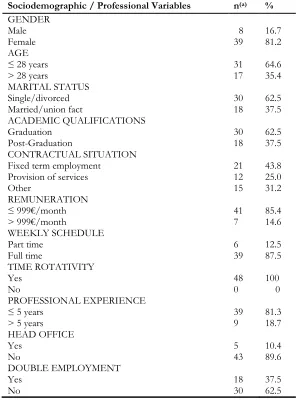
Table 1
Sociodemographic and Professional Characterization of Participants in the Total Sample (N = 48)
Sociodemographic / Professional Variables n(a) %
GENDER
Male 8 16.7
Female 39 81.2
AGE
≤ 28 years 31 64.6
> 28 years 17 35.4
MARITAL STATUS
Single/divorced 30 62.5
Married/union fact 18 37.5
ACADEMIC QUALIFICATIONS
Graduation 30 62.5
Post-Graduation 18 37.5
CONTRACTUAL SITUATION
Fixed term employment 21 43.8
Provision of services 12 25.0
Other 15 31.2
REMUNERATION
≤ 999€/month 41 85.4
> 999€/month 7 14.6
WEEKLY SCHEDULE
Part time 6 12.5
Full time 39 87.5
TIME ROTATIVITY
Yes 48 100
No 0 0
PROFESSIONAL EXPERIENCE
≤ 5 years 39 81.3
> 5 years 9 18.7
HEAD OFFICE
Yes 5 10.4
No 43 89.6
DOUBLE EMPLOYMENT
Yes 18 37.5
No 30 62.5
Note. (a) Number of valid cases.
3.2. Levels and Domains of Professional Satisfaction
The nurses in this study reported a positive global satisfaction level with work, M (EASPE) = 83.4, SD = 13.5 (range: 25-125), considering as a cut-off value 75 (Ferreira & Loureiro, 2012). As regards the mean values, observed for each dimension of satisfaction, the values in the domains Satisfaction with the Boss, M = 16.3, SD = 2.8 (range: 4-20, cutoff point 12) were positive; Satisfaction with the Work Context, M = 12.7, SD = 1.8 (range: 3-15, cutoff point 9); Satisfaction with Communication, M = 13.0, SD = 2.9 (range: 4-20, cutoff point 12); and, Team Satisfaction, M = 8.5, SD = 1.2 (range: 2-10, cutoff point 6).
However, nurses exhibited negative values in the domains Satisfaction with Benefits and Rewards, M = 14.5, SD = 2.9 (range: 5-25, cutoff point 15); and, Satisfaction with the Promotion, M = 18.4, SD = 5.4 (range: 7-35, cutoff point 21). The reference values for the cutoff points we presented were defined by the authors of the instrument (Ferreira &Loureiro, 2012).
3.3 Impact of Sociodemographic Variables on Professional Satisfaction
The hypothesis test results showed that the sociodemographic variables studied (e.g., age, gender, marital status and academic qualifications) did not have a significant influence on the overall satisfaction with nurses' work. However, there were statistically significant differences for the variables age, gender and academic qualifications in some dimensions of EASPE. Specifically, satisfaction with the Chief showed a significant influence of the variable age, Z = -2.03, p = .042, and it was verified that older nurses are the ones that report higher levels of satisfaction with the boss (Median = 18.0, M = 17.41, SD = 2.06). In addition, there was a significant influence of gender in the levels of Satisfaction with the Work Context, Z = -2.22, p = .027 and in the levels of Satisfaction with Communication, Z = -2.41, p = .016, it is observed that it is the women who exhibit the highest levels of satisfaction in these dimensions MedianContext= 13.0, MContext = 12.92, SDContext = 1.77; MedianCommunication = 14.0, MCommunication = 13.33, SDCommunication =
2.77). Finally, there were statistically significant differences in the levels of Satisfaction with Promotion as a function of the academic qualifications, Z = -2.73, p = .006, and it was verified that the nurses who only have the Degree experience higher levels of satisfaction with the promotion (Median = 21.00, M = 19.97, SD = 5.31).
Table 2
Significant results of the U-Mann Whitney test for the influence of sociodemographic variables on EASPE dimensions (N = 48)
Dimensions of
EASPE Sociodemographic variables n Median(Q25-Q75) U-Mann Whitney Z p
Satisfaction in relationship with the Chief
Age
Up to 28 years
> 28 years 31 17 16.00 (13.00-18.00) 18.00 (17.00-19.00)
170.00 -2.034 .042*
Satisfaction with the Work Context
Gender Female
Male 39 08 13.00 (12.00-14.00) 12.00 (11.00-12.50)
79.00 -2.216 .027*
Satisfaction with Communication
Gender Female
Male 39 08 14.00 (12.00-15.00) 11.00 (9.00-13.00)
72.00 -2.405 .016*
Satisfaction with Promotion
Academic qualifications Graduation
Post-Graduation 30 18 85.50 (78.00-96.00) 77.00 (71.00-88.00)
142.00 -2.732 .006*
*
Note. EASPE = Nurses' Job Satisfaction Rating Scale. (Q25-Q75) = Interquartile distance. * p<.05. ** p <.01. *** p<.001.
3.4. Impact of Professional Variables on Professional Satisfaction
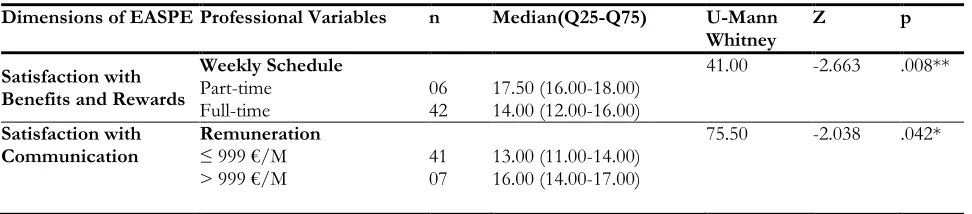
To verify the existence of significant differences in the level of work satisfaction, the U-Mann Whitney test was performed for each variable among the groups formed by the dichotomized professional variables. Table 3 shows the results obtained by the test, as well as the median and interquartile range for each constituted group.
Table 3
Significant results of the U-Mann Whitney test for the influence of the professional variables on EASPE dimensions (N = 48)
Dimensions of EASPE Professional Variables n Median(Q25-Q75) U-Mann
Whitney Z p
Satisfaction with Benefits and Rewards
Weekly Schedule Part-time
Full-time 0642 17.50 (16.00-18.00)14.00 (12.00-16.00)
41.00 -2.663 .008**
Satisfaction with
Communication Remuneration ≤ 999 €/M
> 999 €/M 41 07 13.00 (11.00-14.00) 16.00 (14.00-17.00)
75.50 -2.038 .042*
In terms of Satisfaction with Benefits and Rewards, there were statistically significant differences between groups, according to the weekly schedule, Z = -2.66, p = .008. In this regard, part-time nurses reported higher satisfaction levels in terms of benefits and rewards with work (Median = 17.5, M = 17.33, SD = 1.21).Additionally, a significant influence of remuneration was confirmed in the levels of Satisfaction with Communication, Z = -2.04, p = .042. The group of nurses who received a monthly net income of more than € 999 were those who reported higher levels of satisfaction with communication at work (Median = 16.0, M = 14.57, SD = 4.16).
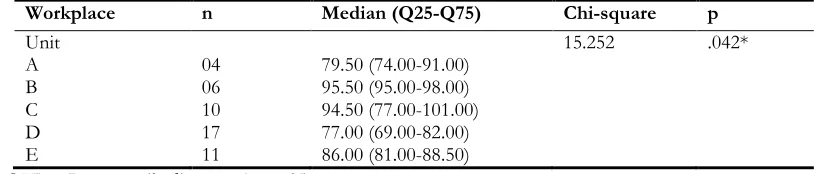
In order to verify the existence of significant differences in the overall work satisfaction among the five groups formed by the local work variable, the Kruskal-Wallis test was performed (Table 4).
Table 4
Significant results of the Kruskal-Wallis test for the influence of the workplace variable on overall satisfaction with work (N = 48)
Workplace n Median (Q25-Q75) Chi-square p
Unit A B C D E
04 06 10 17 11
79.50 (74.00-91.00) 95.50 (95.00-98.00) 94.50 (77.00-101.00) 77.00 (69.00-82.00) 86.00 (81.00-88.50)
15.252 .042*
Note. (Q25-Q75) = Interquartile distance. * p <.05.
The results of the hypothesis test indicate that the unit where the nurses perform functions significantly influence the level of overall satisfaction at work, Chi-square = 15.25, p = .042. Specifically, it was verified that nurses who reported higher levels of overall satisfaction with work were those who exercised their professional activity in unit B, Median = 95.50, M = 94.33 SD = 5.24 (range: 25-125), and in unit C, Median = 94.50, M = 91.00, SD = 12.23 (range: 25-125). The nurses who reported lower levels of job satisfaction exercised their professional activity in Unit D, presenting negative values, Median = 77.00, M = 73.9, SD = 12.72 (range: 25-125), considering as cutoff value 75 (Ferreira & Loureiro, 2012).
4. Discussion
Job satisfaction has been a primary focus of scientific research in health but has limited application in the context of continuing care (Nancarrow, 2005). This study examined the levels and domains of professional satisfaction of nurses who work in continuing care units, as well as the impact of sociodemographic and professional variables on the overall satisfaction of these professionals with work. In relation to the first objective of the study, "to describe the levels and domains of professional satisfaction of the nurses who perform functions in the long-term service and maintenance of the continuous care units of the district of Braga", it was verified that the participants presented a level of overall positive satisfaction with their work. These data are in line with the results obtained by Alves, Batista, and Pimentel (2013), in a study developed in Integrated Care Units of the northern region of Portugal, concluding that more than 70% of the nurses reported being satisfied with the work. When we report on international research, we found that in a study of mid-career caregivers (Nancarrow, 2005), high levels of job satisfaction were found, explained by the philosophy of care, professional autonomy and teamwork. However, the author pointed out that these professionals perceived the work in intermediate care, as being evaluated by the general population, as less prestigious, when compared to the work developed in hospital context. In this respect, Carr and Kazanowski (1994), in a comparative study between long-term nurses and nurses from other work contexts, found that the former had lower levels of job satisfaction, explained by the excessive workload and salary.
These last two domains are a novelty of this study, especially when compared with the data found by Ferreira and Loureiro (2012), concluding that Satisfaction with the Work Context and with the Team were the dimensions that presented higher levels of satisfaction, while Satisfaction with Benefits and Rewards, and Satisfaction with Promotion, those were responsible for lower levels of satisfaction.
Given the areas of greatest satisfaction obtained in the study, the high levels of satisfaction with the boss (chief) are indicative of a healthy relationship between the boss and the workers, which provides a pleasant environment in the workplace and a feeling of active participation of the boss in the nurses' work life. This is a fundamental aspect from Timmreck's perspective (2001), which emphasizes the importance and responsibility of middle managers in the process of promoting personal and professional growth of workers. Positive interpersonal relationships are important indicators of the work environment, having a significant impact on satisfaction with the work environment (Longo, 2009). In fact, professional satisfaction can be increased not only by positive relationships with co-workers, but also by support from the management team (Cortese, Colombo, & Ghislieri, 2010). The positive results obtained in this research show agreement with other studies (Duarte, Lapa, & Nunes, 2013) and show the team spirit and mutual support in the units under study. However, Duarte et al. (2013) concluded that nurses from long-term and maintenance units, despite being motivated to work, show difficulties in adapting to physical and psychological distress. Still, Timmreck (2001) considers that work itself is a key component of job satisfaction and argues that the very nature of health care, coupled with the fact that these professionals are highly technically trained, rarely leads them to consider work too much difficult or wanting to leave the job. This assumption can justify the high levels of satisfaction of the nurses associated to the work context in the various studies.
Finally, reflecting on the areas of low satisfaction found, namely Satisfaction with Benefits and Rewards, and Satisfaction with Promotion, their analysis requires an interpretation in the light of the current economic situation. Specifically, in recent years there has been a brutal socio-economic breakdown in the public service, characterized by a sudden suspension of incentives, a reduction in wages and an increase in the number of weekly working hours, from 35 to 40 hours, devoid of any wage increases. In this respect, it should be noted that people are not concerned about the salary of people who have a professional activity other than their own, but rather with the salary of people who have the same job, tending to dissatisfaction, when they are aware that their counterparts receive a salary higher than their own, by performing the same type of work function (Spector, 1997). In the study by Herzberg, Mausner, and Snyderman (1959), some factors were defined that define attitudes at work, among which are the recognition, the possibility of growth, progression and salary, as aspects directly related to the dimensions of Satisfaction with Benefits and Rewards, and Satisfaction with Promotion and, which may interfere with overall job satisfaction. Also, Locke (1983) considers salary, promotions, recognition and benefits as basic dimensions of job satisfaction. These situations send us to the results of this study, and the levels of dissatisfaction may be justified by the impossibility of financial stabilization in the face of future projects, by the reduction of salaries or by the lack of growth possibility, progression and promotion within the organization. Al Shamari, Paulose, Ou, and Ngwakongnw (2015) concluded that job satisfaction among nurses is strongly influenced by incentives.
However, the authors, in analyzing this question in detail, found that non-financial incentives, such as opportunities for progression and recognition for work, contributed more to job satisfaction than financial benefits. In summary, the nurses in these study present higher levels of job satisfaction than those observed in other studies, in which the same instrument was used (Ferreira & Loureiro, 2012). Nurses who work in the context of continuing care value work content and professional relationships more closely, as in other studies in different contexts (Adams & Bond, 2000; Curtis, 2007).The components in which they feel dissatisfied are directed to the pay and promotion aspect, which, according to Locke (1983), are related to the desire for growth (e.g., greater responsibility), desire for justice, desire for higher salary and, desire for social status.
In the literature in this field, there seems to be no consensus regarding the influence of sociodemographic variables on job satisfaction (Batista et al., 2010), although some studies refer to a low but stable influence (Adams & Bond, 2000). Despite the existence of some sources, research is sparse in health studies that support the results obtained in this research. In this way, the interpretation takes into account other contexts of care practice and considers the observations made by the researchers during the visit to the units, using a critical analysis.
Spector (1997) reveals that older workers have a greater power of acceptance of authority, so the values obtained in this study may be based on this premise. The nurses responsible for the units under study are mostly between 30 and 45 years of age. Thus, the differences found in the Satisfaction with the Boss dimension for the variable age can be explained by the proximity of ages and affection, by a greater sense of responsibility and maturity in this age group, or even by a greater sense of understanding on the part of the boss. At the same time, it was observed that gender influences the dimensions of Satisfaction with the Work Context and Satisfaction with Communication. As Spector (1997) points out, "relations between gender and job satisfaction have been extremely inconsistent across studies" (p.28). Some nurses described the work in geriatrics as being monotonous and routine. The personal characteristics that define the gender can be fundamental for the adaptation to the working conditions and, in this way, to mediate the levels of satisfaction with the same. Women have, in general, a greater capacity for resignation to life situations, in which work is inserted and, as such, can assume the routine as a normal aspect of work. Spector (1997) believes that work experiences between the two sexes may be different and that because women attach less importance to work than men do, conflicts affect the latter more. Thus, the values obtained in job satisfaction in the different genders can be perceived in light of the importance attributed to different aspects of work, differences in individual expectations and the degree of socialization in the same (Hodson, 1989).
Additionally, it was found that the Satisfaction with Promotion dimension is influenced by the variable academic qualifications. Locke (1983) argues that the value attributed to promotion depends on the personal ambitions and career aspirations that the individual idealizes. The fact that nurses who only have the Degree have higher levels of job satisfaction may be related to the lower expectations of these professionals, in view of the work or the opportunity to work, given the high unemployment rate. Duarte et al. (2013) found that many nurses working in Long-Term Care Units went into this area because of the lack of other options. This view is shared by Lopes (2012), who states that "the expectations that workers have about their work have a strong impact on their satisfaction: when expectations are very high, workers tend to declare themselves dissatisfied, even if working conditions are relatively good. On the contrary, workers with low expectations tend to declare themselves satisfied whatever their working conditions are "(p.12). Nurses may feel some degree of frustration when they find that despite the high level of training, the content of work remains the same, feeling that the context of continued care suppresses their opportunities for professional development and organizational progression (Fussel, McInerney, & Patterson, 2009).
The third objective of this study was to evaluate the impact of the professional variables on the levels of professional satisfaction of nurses. The results showed that part-time nurses showed greater satisfaction with benefits and rewards, and that those who received a higher salary reported greater satisfaction with the communication.
In addition, it was found that the work/care unit context influenced the level of overall satisfaction with work. In this respect, it should be noted that some organizations choose to hire part-time employees, motivated by their lack of responsibility to offer certain benefits to their employees. In this way, it would be expected that these workers presented inferior levels of satisfaction at work but, curiously, it does not always happen (Spector, 1997). The underlying causes of this discrepancy are not much explored in the literature, but they seem to be associated with the fact that most part-time nurses are in a service provision regime and as such are exempt from some fees during the first year of activity and may fall into the fallacious idea ofa greater salary. In addition, a substantial proportion of the nurses with higher income (e.g., € 999) work in a service provision regime, and therefore, having a precarious working relationship, tend to have a more distant contact with the administrative and management sectors of the organization, this aspect of the organizational relationship, which is more considered by the satisfaction dimension with communication. In this way, the identity with the organization is smaller, and the constraints felt by the remaining workers may not be mirrored in the nurses with this type of contract, hence they exhibit higher levels of satisfaction with communication.
study. In fact, several factors can lead to job dissatisfaction depending on the context/care unit. Although this study does not predict these reasons, some speculation may be woven. Baumann (2007) points out that organizational failures in terms of material and human resources lead to the progressive deterioration of health services and create professional dissatisfaction.
Regarding human resources, in a study developed by Moyle, Skinner, Rowe, and Gork (2003) with professionals working in the field of long-term care in Australia, it was found that low ratios create feelings of frustration and impotence in relation to the provision of care for the elderly. Also, safety in relation to the professional future can interfere in satisfaction levels, since the feelings of belonging and attachment to the organization may be compromised (Ferreira, 2005). In this context, Kovner et al. (2006) show that ambiguity in the organizational climate is most evident when nurses are encouraged to continue their training, but less than half receive financial incentives to do so. This situation can occur in the unit where nurses exhibit less overall satisfaction with the work (Unit D), because 41.2% of the professionals have academic qualifications superior to the Degree, being already a symbolic value. However, this investigation does not allow us to ascertain the causes for the sense of dissatisfaction. Some influential aspects of job satisfaction, such as the safety of the person in need of care, the general conditions of work and the work environment, were defined by nurses as priority conditions that lead them to think about leaving the workplace (Kovner et al., 2006). In addition to other factors, job satisfaction, burnout, and work relationships are factors that determine the intention of nurses to remain in long-term care (McGilton, Tourangeau, Kavcic, &Wodchis, 2013). Thus, it is important to develop and implement measures that encourage professionals to take pleasure in what they do, how they do it and where they do it, in order to create positive behaviors associated with job satisfaction, such as citizenship and commitment behaviors organizational structure.
4.1. Study limitations
In the Portuguese reality, there are few studies about job satisfaction applied to continuous care, contributing international research to the enrichment of this work. The low rate of collaboration of the care units denounces some fragility in the relationship between the training course and the professional career of nurses. This study is pioneering in this context, suggesting in the future a more detailed analysis of the climate and organizational culture, with a more ecological methodology.
5. Conclusion
The term job satisfaction suggests different meanings according to the author who defines it, but all converge in the same sense, that is, conceptualizing it as an evaluation process of the work, of a personal nature, that covers the affective, social and contextual facets of the work. It is a multifactor, complex and highly subjective construct (Hayes, Bonner, & Pryor, 2010), associated with motivation, which generates loyalty behaviors and organizational commitment resulting in higher productivity and lower turnover intent (Parvin&Kabir, 2011).
In the field of Nursing, the evaluation of professional satisfaction deserves special attention given its contribution to the level of quality of care provided and the quality of life in general of nurses. This study aimed to analyze the levels and domains of professional satisfaction of nurses who work in continuing care units and the influence of sociodemographic and professional variables on their overall satisfaction with work.
The results show that most nurses working in these care units have positive levels of overall satisfaction with work. These data are in line with studies in this field, indicating that more than 78% of nurses working in long-term care organizations have excellent or above-average satisfaction levels (Tourangeau, Cranley, Laschinger, &Pachis, 2010).
In short, the personal and professional growth of nurses depends, not only, on the context and opportunities to explore their potential, but also on the satisfaction, they feel for the performance of their work. Thus, the increase of satisfaction levels in the nurses' work constitutes a shared responsibility between government and organizations, capable of influencing the productivity and the quality of the care provided.
References
Adams, A., & Bond, S. (2000). Hospital nurses' job satisfaction, individual and organizational characteristics. Journal of Advanced Nursing, 32(3), 536-543.
Al Shamari, B. K., Paulose, J., Ou, C., &Ngwakongnw, E. (2015). Multifactor examination of nursing job satisfaction: A cross sectional survey in a tertiary hospital, Qatar. International Journal of Nursing, 4(1), 11-21.
Alves, L., Batista, M. G., & Pimentel, M. H. (2013). Burnout em enfermeiros dos cuidados continuados [Livro de atas]. Documento apresentado nas Primeiras Jornadas de Enfermagem da Escola Superior de Saúde do Instituto Politécnico de Bragança, Bragança, Portugal.Retrieved from
https://bibliotecadigital.ipb.pt/bitstream/10198/9128/3/Ebook%20Jornadas%20Enfermagem%202014%2011%203.p df.
Batista, V. L. D., Santos, R. M. F., Santos, P. M. F., & Duarte, J. C. (2010). Satisfação dos enfermeiros: Estudo comparativo em dois modelos de gestão hospitalar. Revista Referência,II Série(12), 57-69.
Baumann, A. (2007). Ambientes favoráveis à prática: Condições de trabalho = cuidados de qualidade. Genebra, Suíça: Conselho Internacional de Enfermeiros.
Carr, K. K., &Kazanowski, M. K. (1994). Factors affecting job satisfaction of nurses who work in long-term care. Journal of Advanced Nursing, 19, 878-883.
Cortese, C. G., Colombo, L., &Ghislieri, C. (2010). Determinants of nurses’ job satisfaction: The role of work–family conflict, job demand, emotional charge and social support. Journal of Nursing Management, 18, 35-43. Curtis, E. A. (2007). Job satisfaction: A survey of nurses in the Republic of Ireland.InternationalNursingReview, 54,
92-99.
Dec. Law n.º 101/06 de 6 de junho. Diário da República n.º 109/06 – I Série A. Ministério da Saúde e Ministério do Trabalho e da Solidariedade Social. Lisboa.
Duarte, A., Lapa, F., & Nunes, C. (2013). Unidades cuidados continuados longa duração e manutenção do algarve: Perspetivas dos profissionais algarve. Psicologia, Saúde & Doenças, 14(2), 266-271.
Ferreira, M., & Loureiro, L. (2012). EASPE – Uma escala para avaliação da satisfação no trabalho para enfermeiros. Revista de Investigação em Enfermagem, 2ª Série(1), 9-20.
Ferreira, M. M. F. (2005). Empenhamento organizacional de profissionais de saúde em hospitais com diferentes modelos de gestão. (Dissertação de Doutoramento, Escola de Economia e Gestão da Universidade do Minho, Braga, Portugal). Retrieved from http://repositorium.sdum.uminho.pt/bitstream/1822/4383/1/tese.pdf.
Fussel, B., McInerney, F., & Patterson, E. (2009). Experiences on graduate registered nurses in aged care: A case study. Comtemporany Nurse, 33(2), 210-223.
George, J. M., & Jones, G. R. (1996). Understanding and managing organizational behavior. Boston, MA: Addison-Wesley.
Hayes, B., Bonner, A., & Pryor, J. (2010). Factors contributing to nurse job satisfaction in the acute hospital setting: a review of recent literature. Journal of Nursing Management, 18, 804-814.
Herzberg, F., Mausner, B., & Snyderman, B. B. (1959). The Motivation to Work (2ª ed.). New York, NY: John Wiley & Sons.
Hodson, R. (1989). Gender differences in job satisfaction: Why aren`t women more dissatisfied?. The Sociological Quarterly, 30(3), 385-399.
Kovner, C., Brewer, C., Wu, Y.-W., Cheng, Y., & Suzuki, M. (2006). Factors associated with work satisfaction of registered nurses. Journal of Nursing Scholarship, 38(1), 71-79.
Locke, E. A. (1983). The nature and causes of job satisfaction. In M. D. Dunnette (Ed.), Handbook of industrial and organizational psychology (pp. 1297-1349). New York, NY: John Wiley & Sons.
Longo, J. (2009). The relationships between manager and peer care to registered nurses’ job satisfaction and intent to stay. InternationalJournal for HumanCaring, 13(2), 27-34.
McGilton, K. S., Tourangeau, A., Kavcic, C., &Wodchis, W. P. (2013). Determinants of regulated nurses’ intention to stay in long-term care homes. Journal of Nursing Management, 21, 771–781.
Moyle, W., Skinner, J., Rowe, G., &Gork, C. (2003). Views of job satisfactionand dissatisfaction in australian long-term care. Journal of Clinical Nursing, 12, 168-176.
Nancarrow, S. (2005). The impact of intermediate care services on job satisfaction, skills and career development opportunities. Journal of Clinical Nursing, 16, 1222-1229.
Parvin, M. M., &Kabir, M. M. N. (2011). Factors affecting employee job satisfaction of pharmaceutical sector. Australian Journal of Business and Management Research, 1(9), 113-123.
Spector, P. E. (1997). Job satisfaction: Application, assessment, causes, and consequences. Thousand Oaks, CA: Sage. Timmreck, T. C. (2001). Managing motivation and developing job satisfaction in the health care work environment.
Health Care Manager, 20(1), 42-58.