ISSN 2373-7662 (Print) 2373-7670 (Online) Copyright © The Author(s). 2014. All Rights Reserved. Published by American Research Institute for Policy Development DOI: 10.15640/ijn.v1n2a12 URL: http://dx.doi.org/DOI: 10.15640/ijn.v1n2a12
Evaluate of Effectiveness of Planned Teaching Programmer Regarding Basic Life Support (BLS) among Nursing Staff in Basra General Hospital
Sundess B. Dwood1, Hajar S. Al-Mosawi1, Abdulkareem S. Khudhair1 & Abdulameer A. Al-Mussawi1
Abstract
Background: The most important aspects in Basic Life Support are is nothing but
the airway, breathing and circulation. Failure of the circulation for three to four minutes will lead to irreversible cerebral damage. Methods: A cross sectional institutional study was conducted among the nurses the total subjects studied was 50. Organize the data in a master sheet/computer, by using the SPSS (version 19).
Results & Conclusion: Highest percentage of the sample were agingnurses group
(21-30)years, secondary school graduate, the higher percentage with mal nurse was. There is high significant association between age nurses and education for nurses and knowledge and high significant with knowledge and assessed with questions Basic Life Support and, pretest - posttest for study sample was high significant with knowledge nurses. Recommendations:1-A large - scale study can be carried out to generalize the finding. 2- A comparative study can be conducted on knowledge and skills of nurses in the other government and private hospitals
Keywords: Planned Teaching Programmer, Basic Life Support, BLS
1- Introduction
Cardiac arrest is an important acute emergency situation both in/out of the hospital set ups and carries a high level of mortality risk, however if early Basic life support (BLS) –cardio pulmonary resuscitation is initiated, the survival rate can be substantially improved, the knowledge of BLS is a major determinant in the success of resuscitation and plays a vital role in the final outcome of acute emergency situations (1).
1
Cardiac arrests and accidents are the most common emergencies with grave consequences but the high mortality associated with them can be easily prevented most of the times by some very simple maneuvers and skills (2).
Cardiac or respiratory arrests are common emergencies in adults, children and neonatal period. Resuscitation is the art of restoring life or consciousness of one apparently dead (3).
Basic life support is an essential emergency care component that should be provided for all cardiac arrest victims with no definite contraindications such as a do not attempt resuscitation order (4) .
Basic Life Support [BLS]
includes recognition of signs of sudden cardiac arrest , heart attack, and foreign- body airway obstruction , cardiopulmonary resuscitation and foreign- body, airway obstruction , cardiopulmonary resuscitation and defibrillation with an automated external defibrillator(5) ,It is very much important that every person in the community must be aware and know about BLS to save life .
Doctors, nursing and layperson should know about the BLS, as they are frequently encountering life threatening emergencies.
Cardiopulmonary resuscitation (CPR) is an important lifesaving skill taught to hospital staff throughout the world. There is a marked and rising demand for CPR training from professional healthcare groups and from public .These training programs involve considerable operational and opportunity costs and must be repeated annually for mandatory recertification(6).
2. Aim of the project: To Evaluate of Effectiveness regarding Basic Life Support among Nursing Staff in Basra General Hospital
3. Purpose
Education change is necessary to meet the demands of current health care environment. Learning objectives should focus on the best practice outcome and should emphasize what the health care provider is expected to do after the educational activity is over. Regulating agencies and consumer hold health care personnel accountable for high quality, safe patient care. Educational activities should provide the skill and knowledge that enable nurse to meet this goal. The new nursing generation needs to grow in proper and time provision of essential careto their patients. For that, school nurses are need necessary knowledge and skill by repeated training and practice between times to time.
4. Objectives
To assess the existing knowledge of (Nursing) regarding Basic Life Support.
To evaluate the effectiveness of planned teaching programmer on BLS of Nursing staff in Basra hospital. )
To find out the association between the levels of knowledge and number years of work with demographic variables.
Proposed Methodology
a) Quasi experimental study will be conducted
b) Setting – The program carried out in the AL-Basra general hospital in the medical department.
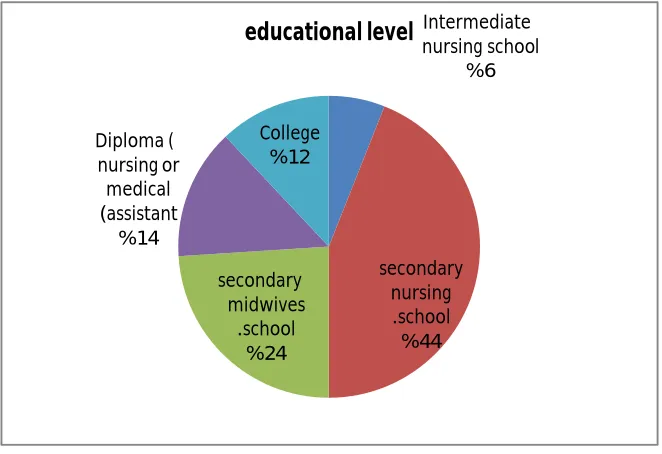
c) Population –Nurses of various deferent level education figure (1). d) Sample size – 50 nurses of various levels.
Tool and Technique
Tool will be developed by Researcher in three sections
Section I : Demographic details of the sample
Section II: Structured questionnaire on knowledge regarding Basic Life Support (BLS)
Five point Likert’s(13,15) scale to assess skill set on Basic Life Support (BLS)
Self-designed structured questionnaire will be administered to elicit Pre Basic Life Support (BLS) knowledge level of nurses working in the AL-Basra general hospital in the medical department..
Methods
By using a constructed questionnaire dependence on previous studies andrelated literature and throughout interview techniques(14).The questionnaire was designed in English and then translated into Arabic. An independent back translation was done, compared with the original questionnaire and the discrepancies were corrected, a questionnaire [30 in numbers] regarding the awareness and skills involved in BLS was used to assess the levels of awareness to BLS and its practical knowledge, the aspects focused were about the abbreviation of BLS, sequential steps in BLS, assessment and resuscitation techniques with regard to circulation, breathing, and airway in unresponsive victims of different age groups.
The paper of evaluation contains three variables the age, gender, level of knowledge and years of experience.
After that permission was taken from the institutional head before involving the staff in the programmed.
The nurses were chosen from different department from AL-Basra general hospital, male and female from different age and different level of knowledge.
Theoretical aspect was explained by expert in the field. Power point presentation was used for better visual impact on the participants. Hands on training were also given to the participants. This practical aspect was demonstrated live on normal individuals in nursing college.
The programmed carried out for five days, and in each day about two hour Pretest was conducted on 1st day and planned teaching programmer on BLS provided to the nurses on same day and we give them one hour to answer and then collect the questionnaire .After 4days post test was conducted .
Figure (1): Distribution of Level Educational Study Sample
5. Time work project: 20/2/2013-to 20/3/2014. 6. Data Analysis:
Organize the data in a master sheet/computer.By using the SPSS (version 19)
Descriptive statistics: Mean, Percentage and Standard Deviation will be used for assessing their demographic characteristics
“Chi square test” will be used to establish association between, knowledge and skill with selected demographic variables.
Inferential statistics: “t test” will be used to assess the significance of improvement in knowledge and skill
Intermediate nursing school
6 %
secondary nursing
school
. 44 %
secondary midwives school
. 24 %
Diploma ( nursing or
medical assistant
( 14 %
College
12 %
Result
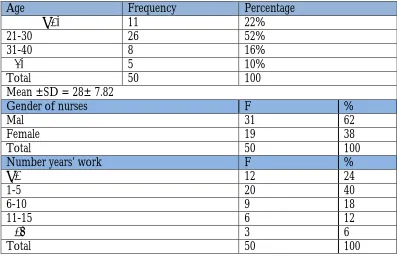
The Table (1): Distribution of (50) Nurses Age Years Old,Gender and Number Years’ Work
Age Frequency Percentage
≤20 11 22%
21-30 26 52%
31-40 8 16%
≥40 5 10%
Total 50 100
Mean ±SD = 28± 7.82
Gender of nurses F %
Mal 31 62
Female 19 38
Total 50 100
Number years’ work F %
≤1 12 24
1-5 20 40
6-10 9 18
11-15 6 12
≥16 3 6
Total 50 100
Table ( 1) shows that the highest percentage (52%) of the sample were aging nurses group (21-30 ) years , with (Mean ±SD = 28± 7.82),although the lowest percentage (10%) of the sample were aging more than (40 ) years old.
Regarding for Gender, the higher percentage (62%) for mal ,on other hand ( 38%) for female .
The Table (2): The Association between Age Nurses Andnumber Years’ Work, For (50) Nurse of Study Sample
AGE Number YEARS1 Total ( )2
df
Sig
≤1 1-5 6-10 11-15 ≥16
≤20 5 6 0 0 0 11 20.520 12 .05
21-30 3 11 8 3 1 26
31-40 2 1 1 2 2 8
≥40 2 2 0 1 0 5
Total 12 20 9 6 3 50
This table revealed that there is significant association between age nurses and number years’ work for nurses
Table (3) Distribution of (50) Study Sample According to Awareness' About the Basic Life Support for Nurses Sample
No State of questioners YE
S
% No % Mean score 1 BLS what is mean Basic life support 28 1.12 22 .44 1.56* 2 adopted CAB instead was of ABC For
commercial purpose
34 1.36 16 .32 1.68*
3 There are several things you need to do when you encounter a person in need to assistance, the first check the danger.
18 .72 32 .64 1.36
4 Check the danger- from 1 year to 8 years. 34 1.36 16 .32 1.68* 5 the people who are in need of BLS is The person
has pneumonia.
38 1.52 12 .24 1.76*
6 -" No signs of life" means, Has no pulse. 31 1.24 19 .38 1.62* 7 the is maneuver called to open the victims airway
Head lift
32 1.28 18 .36 1.64*
8 - If you expected to raise the victim will cause more damage, will you open airway .
19 .76 31 .62 1.38
9 When you should start compressions The victim has is breathing but has no pulse
27 .08 23 .46 1.54*
10 the is rate of performing chest compression - 30 per minutes
39 1.59 11 .22 1.81*
11 How deep should you compress the adult victim inch
21 .84 29 .58 1.42
12 The best location to check the pulse is By finding Radial artery
23 .92 27 .54 1.46
13 The correct compression - ventilation ratio for 1 - rescuer adult CPR is- 100 : 2
14 The recommended ratio of compression to breathing (30 :2 ) applies to-Infant
17 .68 33 .66 1.34
15 the is recommended way to determine the location point for chest compressionFind the angle of Louis and place your hand on the chest
18 .72 32 .32 1.68*
16 you do phone the emergency response number if you alone with an unresponsive adult person, After 5 cycles of CPR
34 1.36 16 .32 1.68*
17 - After you identify an unresponsive victim with no breathing , no pulse , chest compression should be initiated within , 10 seconds
10 .4 40 .8 1.2
18 should you have to make more effort and long period when you perform CPR , When the victim has myocardial infarction
23 .92 27 .54 1.46
19 should you stop during the BLS to check the pulse after 2 cycles for 5 seconds
16 .64 34 .68 1.32
20 If you are passing by and saw accident and there was a person with cardiac arrest. You Will perform the CPR for him.
32 1.28 18 .36 1.64*
21 If do not want to give artificial respiration .You can do : Perform artificial respiration by (bag mask) and chest compression
25 1 25 .5 1.5*
22 you know that your rescue breath is effective like You see the chest rise e
37 1.48 13 .26 1.74*
23 If the chest did not rise during the process of artificial respiration, Turn the person and bring him back to previous position
20 .8 30 .6 1.4
24 The following victim needs CPR?
A victim which with chest pain and indigestion
24 .96 26 .52 1.48
25 If you identify that the victim unresponsive, call for help and put the victim on his back, should you do else Open airway and give 2 breaths.
28 1.12 22 .44 1.56*
26 We do CPR, we provide, 70% than the heart was healthy.
15 .6 35 .7 1.3
27 the following abbreviation mean (AED) - Automated electrical defibrillator
22 .88 28 .56 1.44
28 Early defibrillation for adults is important because , It will "jump start " the heart
20 .8 30 .6 1.4
29 Which is the following case we should use the AED Atrial defibrillation
16 .64 34 .68 1.72*
30 Is the use of oxygen during BLS having an important Significant by 25%.
11 .44 39 .78 1.22
Table ( 3) shows that the grand mean of score was lowers than cut of point .the table also indicated that the mean score of the State of questioners was item NO,(3,8,11,12,17,18,19,23,24,26,27,28,30 ) , while non-indicated of score was item NO (1,2,4,5,6,7,9,10,13,14,15,16,20,21,22,25,29)
Table (4) Show Pretest - Posttest for Study Sample (50) High Significant with T Test Different Group
Sig (2-tailed) df
T
0000 29
-7.549
Mean±SD =−13.8 ± 10
In this table found high significant between knowledge nurses’ and per-posttest.
Discussion
The most important aspects in Basic Life Support are ABC, is nothing but the airway, breathing and circulation. Failure of the circulation for three to four minutes will lead to irreversible cerebral damage (3).
For every minute that passes after a patient goes into cardiac arrest their chance of survival decreases by seven to 10 per cent until a defibrillator arrives (Metcalfe-Smith, 2003).
A patient who has suffered sudden cardiac arrest must receive effective treatment rapidly. When delivered promptly, resuscitation can save the lives of many patients in cardiac arrest4. Basic Life Support acts to slow down the deterioration of the brain and heart until defibrillation and/or advance life support can be provided (Ruck and Erc-2000). Prompt recognition of cardiopulmonary arrest and prompt instigation of Basic Life Support can double the patient’s chance of survival (5).
(Patricia found in her study is seam finding of her study ,she is found ,the higher percentage of age nurses study simple , ranged from 19 to 47 with a mean of (25).(12)
The table (2) the association between age nurses and number years’ work ,for (50) nurse of study sample. The relation between age and years’ experience high significant
Like in privies study found ,Forty-eight (69%) of the subjects had been Nurses' care workers for age group (20-30 )years, and (54%) have been working in Saudi Arabia for 5-10 years. All thesubjects were negative ( no relation age group with years’ experience )(10)
Table ( 3) distribution of (50) study sample According to awareness' about the basic life support for nurses sample Including mast of them it is high significant with knowledge and assessed with questions Basic Life Support .
(Milena) ,she was found,the nursing knowledge retention and ability to perform /BLS increased after the inter-professional learning activity. However, the increased of education and practice activity was more beneficial to the nursing to usefrom curriculum integrating BLS knowledge and skill refreshment classes or annual BLS competence validation.(13)
Table (4) show pretest - posttest for study sample (50) high significant with T test different group.
(MsKabina,percent in her study, Comparison of pre and posttest knowledge scores of nurses analyze the difference in knowledge scores on different facts of Basic Life Support shows highly significance difference between the overall score values of pretest and posttest and area wise pre and post test score values.(10).
The finding of the study will throw light on as to how knowledge and skill in Basic Life Support (BLS) training will improve their efficiency in actual situation. will benefit from this data and utilize these findings for training the nurses in Basic Life Support (BLS) in various hospitals. This will also help hospital management and other concern to identify the training need of the nurses and plan the intervention.
We hop so cooperative between college nursing and police of hospital to improves nurse’s knowledge and skill in Basic Life Support (BLS).
Conclusion
1- Awareness of Basic Life Support (BLS) among nursing staff in Basra General Hospital is very poor and needs to be improved.
2-motivat the staff nurses and keep them updated with necessary knowledge and skills regarding Basic Life support.
3- Regular demonstration classes should be conducted for regaining knowledge and skills of staff nurses regarding Basic Life Support.
4- highest percentage of the sample were aging nurses group (21-30 ) years old , were secondary school graduate, ,higher percentage of number years’ work whit groups (1-5) years), and higher percentage with mal gander (62%).
5- The relation between age and years’ experience, high significant with knowledge and assessed with questions Basic Life Support and, pretest - posttest for study sample was high significant with knowledge nurses.
Recommendations
The current study recommends the following:
1- A large - scale study can be carried out to generalize the findings.
2- A comparative study can be conducted on knowledge and skills of nurses in the
other government and private hospitals.
3- The present study recommended it is necessary to increase special courses for
References
Asad Abbas et al. Knowledge of first aid and basic life support amongst medical students:a comparison between trained and untrained students.JPMA2011; 61:613.
Miller BF, keane C: Encyclopedia and Dictionary of medicine Nursing ,and Allied Health ,2nd ,Saunders ,Toronto ,1978 ,878 .
MokhtariNori,M J. Saghafinia.CPR Training for Nurses: How often Is It Necessary. Baqiyatallah University of Medical Sciences, Tehran, Iran.Iran Red Crescent Med J 2012; 14(2): 104-107 ©Iranian Red Crescent Medical Journal
Beak JD, Eke P, Heiss G , Madianos P ,Couper D ,Lin D et al, periodontal disease and coronary heart disease : a reappraisal of the exposure – circulation .2005 ; 112: pp19-34
Tweed WA ,Bristow G , Donne N : Resuscitation from cardiac arrest : Can Med Assoc J 1980; pp-297-300 .
Brendan Docherty . Basic life support and AED. Clinical manager Cardiology and critical car .2003 ,August ,pp 56-59 .
Tweed WA ,Briston G , Done N et al : Evaluation of hospital –based cardiac resuscitation, 1973- 77 .pp-301-304 .
World Health Organization Statistical Information System (WHOSIS).Cardiovascular Disease Statistics. Available in-http://www3.who.int/whosis/menu.cfm.
Basic life support .Free Encyclopedia .Available in –http :// Wikipedia .org .-Buck Barrett squire 2004 , perkins et al 1999 .
MsKabina Rath & MsSwarnakanti Panda,SUM Nursing College, SOA University, Bhubaneswar, India. “Evaluate the Effectiveness of Planned Teaching Programme regarding Basic Life Support (BLS) among Intern (B.Sc Nursing) Student at Selected Nursing College, Bhubaneswar, Odisha.IOSR Journal of Nursing and Health Science (IOSR-JNHS) e-ISSN: 2320–1959.p- ISSN: 2320–1940 Volume 3, Issue 1 Ver. II (Jan. 2014),
PP 16-19.
Particia josipov, .basic life support knowledge of undergrad nursing and chropraeteacticstudent ,2010.
Milena Staykova, Nursing and Paramedic Students Collaborate in CPR/BLS Simulation Activities, 2010 .Milena Staykova, Nursing and Mark Cromer, Emergency Service Linder K. H, Wenzel V, Anaesthesist ,New mechanical methods for cardiopulmonary
resuscitation(CPR), March 1997; pp- 220-30)
Cuttle, L. and Kimble, RM., First aid treatment of burn injuries, Wound Practice and Research, 2010, 6 Volume 18 Number 1 , p. 7
Likert scale assessments are recommended for use when assessing the affective domain (Gable & Wolf, 1993) and are considered reliable (Stanley & Campbell, 1963). Adriance E. MS Ed, S. Evans MAEd, BSM, RRT, RCP, Increasing awareness of professional