Iranian journal of educational Sociology
(Interdisciplinary Journal of Education)
Available online at: http://www.iase-idje.ir/
Volume 1, Number 5, August 2017
Comparison of effectiveness between smart and non-smart school regarding advancing
and developing creativity amongst female 3
rdgrade high-school students of Tehran's
District 8
Faranak Namiranian1
, Aliakbar Saif2*
, Hassan Ahadi3
, Hadi Bahrami4
1. Department of Educational Psychology, Science and Research Branch, Islamic Azad University, Tehran, Iran
2. Professor Department of Educational Psychology, Science and Research Branch, Islamic Azad University, Tehran, Iran 3. Professor Department of Educational Psychology, Science and Research Branch, Islamic Azad University, Tehran, Iran 4. Professor Department of Educational Psychology, Science and Research Branch, Islamic Azad University, Tehran, Iran
Please cite this article as: Namiranian, F. Saif, A. Ahadi,H. Bahrami,H. (2017). Comparison of effectiveness between
smart and non-smart school regarding advancing and developing creativity amongst female 3rd
grade high-school students of Tehran ,
s District 8. Iranian journal of educational Sociology, 1(5), 1-11
*Corresponding Author Email: [email protected]
Article history:
Received date: 24 April, 2017 Review date: 24 may 2017 Accepted date:25 June 2017 Printed on line: 23 August 2017
Abstract
Purpose: Smart schools are schools equipped with electronic devices and advanced technology where innovative and new way of learning is taught by processing data and communication within the context of suitable curriculum. Methodology: The basis of current research has been designed to compare the effectiveness of developing creativity between two groups of female highschoolers attending smart schools versus female students attending non-smart schools. Furthermore, all the female subjects were attending 3rd
grade which is equivalent of 11th
grade students worldwide. The method utilized in this research is the comparison evaluation type. The statistical society of research subjects included female high schoolers of Tehran’s District 8 which encompasses of 10 public schools, 6 non-public or private schools, and one smart high school, with the total population of 1020 in which 300 students were selected by classified random method as the sample group of research. The mentioned random groups were selected from all above-mentioned schools accordingly to their populations. Initially, in order to assess the level of creativity, part A of the Torrance test was given to all subjects at the beginning of the school –year. Part B of the same test was given at the conclusion of the school-year. Finding: The yielding outcome of both tests were analyzed with T test, variance method, and Schaffer's follow-up test final and total assessment and evaluation of all the results a conclusion was reached indicating that the type of smart or non-smart schools had no effect in developing and advancing creativity. Discussion: However, the dual comparison between private and public schools demonstrated a real and factual significant differences with respect to developing creativity. This fact implies that private high schools are more equipped and suited to develop creativity.
Keywords:
Smart school, Information and Communication Technology, Teaching and Learning Process, Creativity.
1. Introduction
The complexities of today’s world is so extensive that it has made any imagination of future difficult and unpredictable. Today the main issue is educator mind. Wheter the students are able to face the new challenges of ever changing world using traditional methods. Whether the kids and adolescents, trained with traditional methods are able to solve their future problems? Within Iran’s educational system, traditional methods, especially lecture, memorization, and repetition of scientific facts have always been a dominant factor in education. This method has encouraged a spirit of inaction in education and training system, and as a result thought and natural Curiosity have readily been replaced by inactive and passive conditions and tendency to imitate from others. Questioning and thinking and blind listening have been replaced by caution and blind listening. Ironically, all of this is happening while advanced thinking skills is considered to be the most fundamental item by our official educational system as the most essential and necessary element for success in contemporary world where acquiring new knowledge is ever expanding (Hassani et. al., 1393).
Today, buildup of knowledge and data capacity, rapid outdating of lessons requires constant learning and updating. Instead of, repetitive training, constant learning together with new learning techniques enables a person to become self-sufficient, independent, and creative seeker of knowledge in today’s advanced world. flourishment and manifestation of creativity and public initiative are components of growth and scientific promotion of each country is considered as infrastructure of the country. Consequently, quality of creativity flourishment and public initiative in students and youths and creativity enhancement is one of the problems which has engaged the minds of psychologist, thinkers and humanities’ experts, from ancient times. A society which is able to flourish and revive the creativity of young generation, will benefit from a considerable progress, growth, and scientific development, and reversely, at any rate that creativity is not developed, scientific, industrial and cultural stagnation must be expected for the society (Bandak et. al., 1393).
Saif (1391) has described creativity as capability of thinking about matters with new and unusual approaches, and obtaining exclusive results, and Harris (2001), says this about creativity: creativity is a capability, an attitude and a process, and in defining each adds: meaning, capability of imagining or inventing a new concept, and this can be made possible by combining, modifying, and reapplying the available ideas. Some of the creative ideas are innovative and significant, while others are simple, good and practical, which nobody thought about them before. Creativity is described as a set of characteristics and capabilities which lead to new understanding qualities of expressions and meanings, and it is the source of initiatives and innovations.
The most important concern of educational system of a country is the creation of a suitable bed for nurturing intellectual capital in a knowledge and information oriented society. Educational system needs a school which uses communication and information data and provide constant learning, and new opportunities for individuals to experience life in an information society, in a way that this technology not to be used as a tool but as infrastructure capability for education (Yazdi Khah, 1390). In Iran, as well as many developing countries research has been done on the subject. The primary pattern of smart school was adopted from United Kingdom in 1996, and countries such as Australia, Malaysia are pioneers of these types of schools. Iran, too has started the experimental scheme of smart schools in 4 high schools since 1385, which at present their number has increased. Undoubtedly, beside research, and production activities, fundamental and theoretical agendas can provide the direction of this new phenomenon to achieve educational perspective aims of 1404. It is clear that change and evolution in every case must be based on exact studies and practical surveys, and educational developments cannot be achieved readily. In short, with respect to smart schools,
organizational smart school of learning is introduced, in which a creative and capable generation in life’s arenas and capable in creating knowledge is trained (Yazdi Khah, 1390, p 27). Prior to publicizing this plan in 1404, it must be determined whether pilot schools have been successful in achieving the main objective, meaning training creative students.
Badrigargari (1387) in his research on comparison of learning effect based on group problem solving and traditional teaching over critical thinking demonstrated adaptation to ever changing world will not be possible with simple access to communication and data processing, and gaining skill in creative thinking needs planning and training. Poishman (1392) in her research has evaluated the operation of smart schools in District 16 of Tehran. she believes increase presence and partnership or parents and benefactor groups in schools and companionship of educational staff with new educational tends based on knowledge oriented society, continuation of learning process of students outside school providing associative atmosphere between students and teachers in teaching process and training human force familiar with technology similar to presented objectives was a change in smart schools. Today, the importance of suitable educational system which meets demands of individual and society is felt more than ever. Since the world which is tied to information network requires a force to know how to use technology as a tool for increased efficiency and learning and creativity. Jaschik (2010) in an article titled comparison of electronic teaching with traditional method which included findings of an over analyzed report of US educational system, on research for years 1996 till 2008 in various educational levels and over 1000 experimental studies related to online teaching, points to prominence of this method (Quoted by Poishman, 1392, P 34).
A research by Harrison ET. al. (2002) on effect of communication and data technology on education was done and it became evident that communication and data technologies have made a deeper and more effective teaching, and cause creativeness to flourish (Quoted by Poishman, 1392, P 35). Haelermans and Witte (2012) in their research titled “effect of educational innovation on operation of mid-grade schools” have discovered that process innovation, innovation of teaching chain and pedagogic leading edge have a significant relation with operation of schools.
Chang, Chuang and Bennington (2011) in a research with purpose of effect of organizational climate on innovation and creative teaching in schools concluded that working condition, organizational leadership, colleagues’ support, educational policies and lack of organizational obstacles is effective in innovating schools, and there is a significant relation between innovative personal characteristics and internal motivation with creative teaching. Baker, Rudd and Pomeroy (2001) believe teaching thinking skill is difficult and requires another type of effort, the result of their research indicated that creative teaching requires extensive time for preparedness, planning problems, and
creative and capable coaches. Research of Belski (2011) Lassig (2013) which was conducted on
engineering students, showed that students after passing creative solution classes had a significant difference on solving methods and dominance of thinking level. Fatemi, Hamidi and Rahimi (2011) have studied the effect of teaching with computer aid and teaching with traditional method on creativity of students in similar classes. Similarly, other findings indicated increase in extension and originality variances in traditionally trained students had more significance than others. Also, Afshar kohan and Assareh (1390) found out in a research that teaching creativity to teachers will increase the creativity of the students. Hossaini (1385) in a research studied the pattern of creativity growth and its function in creating innovative skilled teaching in elementary, school teachers. The outcome indicated the positive effect of teaching program. One successful method of this pattern was consideration based on emotional, cognitive. Physical, and social context in class besides thinking dimensions lead to a rapid creative teaching.
As the students had a high motivation to participate in class activity. Hosseini research (1386) showed that teaching creativity to teachers, caused increase in educational progress and creativity for
students. From his point of view, creativity is not a skill, like cooking, to be able to reach a result according to a manual. But one must aware the students of creativity process and lead them in the chosen direction. As a result, modelling is an effective role in this case.
In each of theafore mentioned research there had been some indication of effect of information and communication technology in teaching and smart making schools. In codification of “Road map of smart schools” the experiences and proceedings of 5 countries of world (Malaysia, Egypt, Australia, US, Ireland) in case of developing smart school has been studied. These countries are among the superior countries in information society, which employ data processing as an accommodator in many economic, social, and cultural cases. In this research with driving objectives for smart making schools on educational basis, evaluation of operation of smart schools of District 8 of Tehran on case of comparison of developing creativity in students of smart schools with students of non-smart schools.
2. Method
Research on type of comparison (evaluation) and equivalences of schools on basis of rate of parent’s income, level of education and social level was conducted to provide a similar input. The statistical research society, on students of 3rd
high school’s grades, from District 8 included 10 public schools, 6 private schools and a smart school with a population of about N=1020 the volume of sample was based
on Morgan table-random sampling where n=300 were selected from 3rd
high school grade high schools, precondition of 2 years training in the teaching process, and the surveyed variance (creativity) had been shaped in them.
For evaluation of creativity the Torrance test was used in which form A was used at beginning and form B was used at the end of school year. Creativity test of Torrance includes two models verbal and pectoral, and in this research the pectoral type was used. This test has 3 separate tasks. Execution of each task takes 10 minutes requiring 30 minutes in total. These forms have 4 activates as follows:
1-Making a picture with use of a shape 2- Completing defective pictures 3-Making a picture with use of parallel lines in form a 4-Making pictures with circles in form Researches by Torrance (1974) shows reliability factor of 0.75 to 0.87 in numerous periods of implementation. Reliability factor for each creativity component is calculated by Pearsonian correlation. The followings are the result: extension reliability 0.652, originality reliability 0.972, and flexibility reliability 0.972. These figures are significant at 0.01 level (Zakariayee et. al., 1387).
The final survey of this test by Peerkhaephi (1372) on sample of students, showed a reliability factor of 0.8 for the total test. The test of Torrance creative thinking has a high recognition for evaluation of creativity components including fluidity, flexibility and subjective. Therefore, Torrance tests especially pectoral form, is considered as reference test in field of creativity (Torrance, 1974, quoted by PeerKhaephi et. al., 1388).
3. Findings
Statistical analysis was done in two levels descriptive and inferential and as testing research hypothesis T test was used and in order to determine significance of mean differences between two independent groups, variance analysis and post hoc Schaffer’s follow-up test.
Table 1. Student's abundance distribution according to school type
H.school type Unit Abundance Percentage
Smart 59 23.3
Public (non-smart) 160 63.2
Private(non-smart) 34 13.4
Total 253 100.0
Table 1 shows abundance of students according to high school type 59 students from smart school and 194 students from non-smart schools (160 publics – 34 private) in total 253 persons participated in both stages and submitted flaw less answer sheet.
Table 2. Comparison of creativity grades test of Torrance a smart and non-smart high schools
Type
School Abundance
Mean Standard Deviation
Statistical Test Significance
Non-Smart 194
155.88 42.747
3.69 0.000
Smart 59
179.68 47.620
Table 3. Test results comparing means two independent group for creativity grades
Levein test for
Variance equality Means test
F Significance t
Freedom
degree Sig.
level Mean
difference Standard
Error
difference Safe distance 95%
Means difference
Down L. Up L.
Variance
equality .09
.762 -3.69
251 .000
-24.09 6.53
-36.96 -11.23
Inequality of
Variance -3.48
88.31 .001
-24.09 6.92
-37.84 -10.35
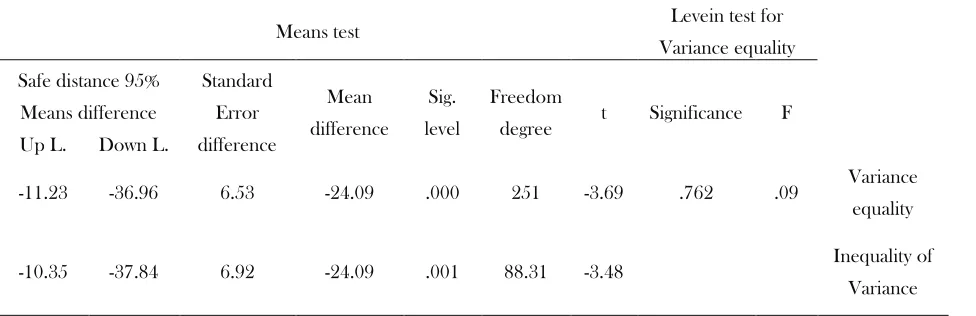
The result for table 2 and 3 shows circumstantial test for comparison of variance 0.09 and has a significance level equal to 0.762 and since sig>0.05, the assumption of equality of variances is accepted and comparison of means is bone based on equality of variances. In comparison, means of circumstantial test is equal to 3.69 times of (significance level 0.000) and as sig<0.05, it can be accepted that difference of creativity grades of Torrance tests A in smart schools and non-smart schools is significant. As a result, difference in creativity grades of Torrance A test which has been conducted in beginning of school year is significant both in smart and non-smart schools.
Table 4. Comparison of creativity Torrance B in smart and non-smart high schools
Type school Abundance Mean Deviation criterion Statistical test Significance Non –smart Smart 194 59 191.09 216.78 57.227
72.141 2.51 0.014
Table 5. Results of comparing mean test for two independent groups for creativity grade of Torrance B test
Levein test for
Variance equality Means test F Significance t Freedom degree Sig. Level Mean difference Standard Error difference Safe distance 95%
Means difference Down L. Up L. Variance equality 4.23 0.041 -2.83 251 .005 -25.69 9.07 -43.55 -7.83 Inequality of Variance -2.51 81.428 .014 -25.69 10.25 -46.08 -5.29
The result of table 4 and 5 show circumstantial test for comparison of variance 4.23 and significance level equal to 0.041 and as sig<0.05 assumption of variance equality is accepted and comparison of mean is done by assuming variance equality. In comparison of mean circumstantial test is equal to 2.51 (significance level 0.041) and since sig<0.05 it can be accepted that difference of creativity grade test Torrance B in smart schools and non-smart schools is significant consequently, difference of creativity grade test Torrance B (conducted at the end of school year) is significant both in smart and non-smart schools.
Ultimately we survey the concept of research which means comparison of creativity’s advance and development comparing difference of A-B grades.
Table 6. Comparison of smart and non-smart schools on development of creativity
Type School Number Mean Criterion Deviation Mean Standard Error Non-smart Smart 194 59 35.51 37.10 34.48 59.49 2.47 7.74
Table 7. Result of mean test for two independent groups for creativity grade difference of Torrance A and Torrance B tests
Levin test for
Variance equality Means test F Significance t Freedom degree Sig. level Mean difference Standard Error difference Safe distance 95%
Means difference Down L. Up L. Variance equality 24.8 0.000 -0.257 251 0.797 -1.59 6.19 -13.78 10.59 Inequality of Variance -0.196 70.23 0.845 -1.59 8.13 -17.81 14.63
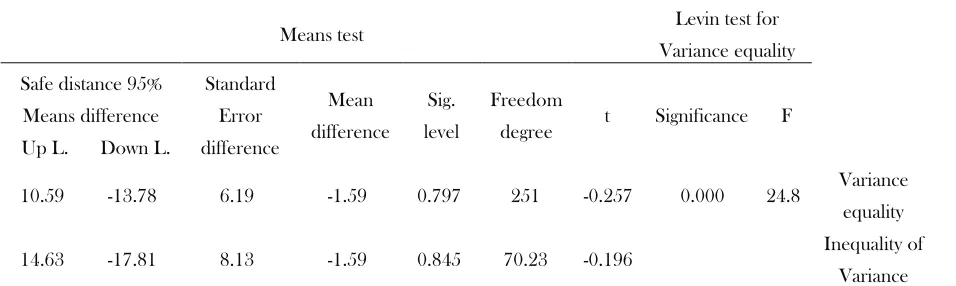
The result of tables 6 and 7 shows circumstantial F for comparison of variances 24.8 and for significance level of 0.000 as sig<0.05, therefore the assumption of equality of variances is not
confirmed and in this case circumstantial t for comparison of means is 0.196 and significance level is 0.845 and as sig>0.05, the assumption of equality of means is accepted. Therefore, the type of high school (smart or non-smart) has no effect on development rate of creativity. So, difference of creativity advance and development grades of students of smart and non-smart schools is not significant.
Comparison creativity grade Torrance A and Torrance B tests in public high schools and private high schools and smart schools.
Table 8. Comparison of creativity grade Torrance a in public, private and smart schools Sources of
change
Sum of Squares(SS.)
Degrees of Freedom(d.f)
Mean of
Squares(MS) F
Significance Level Between-group
Within-group
26813.26 483651.46
2 250
13406.63
1934.61 6.93 0.001
Total
510464.72 252
Table 9 . Comparison of grades of creativity Torrance A test in public, private and smart high schools Type
school Abundance Mean
Standard
Deviation Statistical
test Significance Private
Public Smart
160 34 59
156.26 151.94 179.68
42.47 44.49
47.62 6.93 0.001
The yielding results from tables 8 and 9 shows that amount of statistical test for test of assuming mean grade of creativity Torrance A test is equal to 6.93 and significance level is as sig<0.05, so the assumption of significance of mean difference of grades for Torrance A test is accepted, thereby, difference of mean creativity grades in Torrance A test between public, private and smart high schools is significant.
Table 10. Comparison of creativity grades of Torrance B test in public and private and smart high schools
Table 11. Comparison of creativity grades of Torrance B test in public, private and smart high schools Type
school Abundance Mean
Standard
Deviation Statistical
test Significance
Private Public Smart
160 34 59
188.45 203.53 216.78
54.72 67.35
72.14 4.88 0.008
Sources of change
Sum of Squares(SS.)
Degrees of Freedom(d.f)
Mean of
Squares(MS) F
Significance Level Between-group
Within-group
36227.05 927538.21
2 250
18113.52
3710.15 4.88 0.008
Total
963765.26 252
The result from research of table 10 and 11 shows that the amount of statistical test, for test is the assumption of equality of mean creativity grades of Torrance B equal to 4.88 and significance level of 0.008, as sig<0.05 therefore, concept of significance of difference between mean grade test of Torrance B among students of public, private and smart schools is accepted. Thereby difference mean creativity grades in Torrance B test among public, private and smart schools is significant.
Table 12. Descriptive statistic of difference of creativity Torrance A and Torrance B (B-A) in students of private, public and smart schools
Type school
Number Mean
Standard Deviation
Mean Standard
Error
Safety distance of
95% Down limit
Safety Distance of
95% Up limit Public
Private Smart
160 34 59
32.09 51.59 37.10
33.12 36.69 59.49
2.62 6.29 7.74
26.92 38.78 21.59
37.26 64.39 52.61
Total 253 35.88 41.54 2.61 30.74 41.02
Public Private Smart
*Vertical axis is mean difference
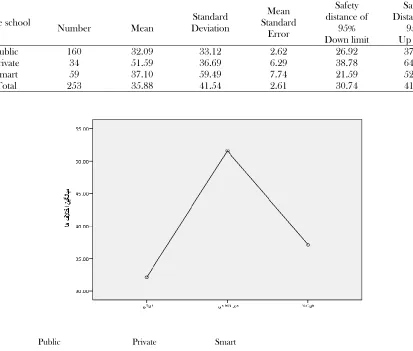
Diagram 1. Mean difference of grades of Torrance B-A tests among students of different high schools As shown in table 12 and diagram 1, it is clear that the most difference is related to students of private high schools mean of 51.59 and students of smart high schools with mean 37.1 in second place, and the least amount related to students of public schools with mean 32.01
To review the significance of these differences the ANOVA test was used. The results reflected in table13.
Table 13. Result of comparison difference in creativity grade Torrance A and Torrance B tests among smart, public and private high schools
Sources of change
Sum of Squares(SS.)
Degrees of Freedom(d.f)
Mean of
Squares(MS) F
Significance Level
Between-group 10771.22 2 5385.61
3.175 0.044
Within-group 424129.22 250 1696.52 Total
434900.44 252
Results of research shown in table 13 amount of statistical test for test assuming equality of mean difference of creativity grades of Torrance A and Torrance B is equal to 3.175 and significant level of 0.044 as sig<0.05 therefore the concept of significant difference among means is accepted. Observing the means diagram it seems that in private high school’s difference is more than two other groups for comparison and further study Scheffe's follow- up test will be used.
Table 14. Result of Scheffe's follow-up test to study mean difference Type school
Mean Difference
Standard Mean
Error Significance
Safety Distance 95% Down limit Safety Distance 95% Up limit Private Public Smart -19.499* -5.008 7.78 6.27 0.045 0.727 -38.65 -20.46 -0.34 10.44 Public Private Smart 19.499* 14.48 7.78 8.89 0.045 0.265 0.341 -7.35 38.65 36.32 Public Smart Private 5.007 -14.48 6.27 8.89 0.727 0.265 -10.44 -36.32 20.46 7.35
*Significant differences in significance level 0.05
Result from Scheffe's follow-up test in table 14 shows difference of creativity grades among public, private high school at error level is 0.05 and difference of the rest of groups is not significant.
Table 15. Result of test for 2 independent groups to compare components’ difference of creativity Torrance A, B tests Component
s Variance F
Sig. t
Deg. Of Free dom
Sig. Mean Differ . Standard Differ. error Safety Distance 95% D. L. Safety Distance 95% U. L. Extension Equality Inequality
23.45 .000
-.89 -.68 251 69.59 .369 .501 -4.01 -4.01 4.46 5.92 -12.78 -15.82 4.77 7.81 Flexibility Equality Inequality 19.25 .000 -1.13 -.91 251 73.68 .258 .365 -2.68 -2.68 2.37 2.95 -7.35 -8.55 1.98 3.19 Originality Equality
Inequality
10.49 .001
-.39 -.32 251 74.23 .694 .750 -0.35 -0.35 0.89 1.09 -2.09 -2.53 1.39 1.83
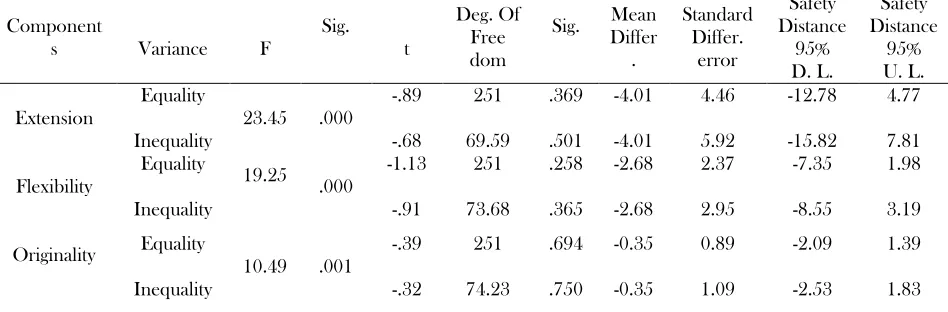
The result from research shows creativity grade difference among smart schools and non-smart schools in all the three components extension, flexibility and originality is not significant.
4. Discussion
The goal of the current research is to compare the effectiveness of developing creativity between smart and non-smart female highschoolers. The final outcome of analysis of the results demonstrated that
the type of high school has no effect on developing creativity. The result of dual comparison indicated that there is a marked difference in developing creativity among private and public schools. Furthermore, comparing the creativity components such as extension, originality, and flexibility showed no significant difference between smart or non-smart schools. However, this difference was significant between public and private schools.
In short, the results of this research demonstrated that smart schools were unsuccessful in achieving their goal of developing creativity amongst their student body. Therefore, with respect to creativity issue, there are no differences between smart and non- smart schools. The result of current research matches and is in accordance with findings by Mosalanejad and Sobhanian (1387), Badrigargari (1387), Dastghyb et. Al. (1391) Hydari, Vaziri and Adli (1392) Ahrari, FathiAzar and Badrigargari (1393), Baker, Rudd and Pomeroy (2001), Belski (2011), Lassig (2013). This means that one can reach an ounce of information by a few clicks. However, adapting with an ever changing world and successfully overcoming obstacles cannot simply be achieved by accumulation of information. Rather, it must be done with creative thinking. Skills which must be taught and developed by an updated educational system. It is noteworthy that within an education system, increased and accumulation of information is not adequate. rather a now culture and program must be in place to renew, maintain, and further creativity. This requires continual and relentless practice. Educational system and educators must rely on scientific findings to access a thorough interpretation of teaching creative and innovative learning systems, must provide situations where individually can face challenges and obstacles enabling them to use creativity to solve the issues. This goal must be achieved with total support of the educational system of the country, where as the update educators and staff are continuously get trained and are prepared with the most advanced information in order to teach the students. Therefore, it is highly recommending to update, renew and continuously train the of educators, as this is the only way to develop creativity amongst the students. New skills, available resources, access to new information and techniques, must be part -of the educational system as the foundation for advanced education.
The schedule of educator must include these subjects, in order to obtain experts among teachers to lead and obtain the final goal of an advanced educational system. cooperation between such trained educators and students will increase the effect of such a program to flourish to its maximum potential.
References
Afshar Kohan, Z. & Assare, A. (1390). Consideration of creativity teaching to teachers on creativity of first grade students in Khorasan. Ebtekar and Khalagheyat magazine, 1(2), 29-55.
Ahrari, Gh. ; Fathi Azar, E. & Badrigargari. (1393). Effect of teaching buno’s 6 hats of thoughts on tendency of critical thinking and student’s creativity. Ebtekar and khalagheyat research monthly magazine, 4(1), 159-189.
Badrigargari, R. (1387). Effect of re thinking in practice on critical thinking of student teachers. Center of teacher’s training. Doctoral Dissertation. Tabriz University.
Bandak, M.; Maleki, H.; Abbaspoor, A. & Ebrahimighavam, S. (1393). Consideration of teaching life skills on creativity of students. Ebtekar and Khalagheyat Magazine, 2(4), 189-200.
Dastghyb, S. M.; Alizade, H. & Farokhi, N. (1391). Effect of teaching positive thinking skills on creativity of female student-first grade of high school. Ebtekar and Khalagheyat Magazine, 4, 1-17.
Hassani, F.; Salibi, Zh. & Beheshte, N. (1393). Effectiveness of mixed teaching of critical thinking and creative thinking on self-learning of mid high school Qom city. Ebtekar and Khalagheyat Magazine, 4(3), 55-75.
Hossaini, A. (1385). Pattern of creativity development and its function in creating teaching skill. Noavari Amoozeshi Monthly Magazine, 5(15), 178-200.
Hossaini, A. (1386). Consideration of effect of teaching creativity of teacher’s program. Noavari Amoozeshi Monthly Magazine, 6(32), 148-167.
Hydari, M.; Vaziri, M. & Adli, F. (1392). Consideration situation of smart schools on standard base, comparison of educational function and critical student thinking. Fanavari Etelaat va ertebatat, 4(2), 149-173.
Poieshman, P. (1392). Evaluation on smart school’s function District 16 Tehran. B.S. Thesis. Azad University, Zanjan. PeerKhaephi, E.; Borjali, A.; Delavar, A. & Eskandari, H. (1388). Effect of teaching creativity on ultra-cognition
components of creative thinking of students. Garmsar Azad University Magazine, 3(2), 51-61.
Mosalanejad, L. and Sobhanian, S. (1387). Comparison of critical thinking between students of virtual and traditional educating in computer study. Steps of expansion in medical educating magazine. 2(5), 127-134.
Saif,A.A.(1391).Modern educational psychology-Psychology of learning and instruction. Tehran: Dowran publishing company.
Yazdi Khah, S. (1390). Road map of smart schools (Practice guide). Tehran’s general training and education organization IT Bachelor of Art Undersecretary of Middle Grade Teaching.
Zakariayee, M.; Saif Naraghi, M., Shariatmadari, A. & Naderi, E. (1387). Survey of storytelling, and creative performance on power of creativity and learning of 4th
grade female students of elementary school Tehran's District 5 . Research paper of free university of bojnourd. 4(16), 19-52.
Basic document of education. (1386). Education Organization of Tehran. http://www.tehranedu.com.
Baker, M., Rudd, R. & Pomeroy, C. (2001). Relationship between critical and creative thinking. Journal of Southern Agricultural Education Research,Vol. 51, No.1: 173-188.
Belski, I. (2011). TRIZ course enhances thinking and problem solving skills of engineering students. Procedia Engineering, 9, 450-460.
Chang, C. P., Chuang, H. W., & Bennington, L. (2011). Organizational climate for innovation and creative teaching in urban and rural schools. Journal of Qual-Quant, 45, 935-950.
Fatemi, M., Hamidi, F., & Rahimi, M. (2011). The comparative effect of computer-aided instruction and traditional teaching on student’s creativity in math classes. Procedia Computer Sciences, 3, 266-270.
Haelermans, C., & Witte, K. D. (2012). The role of innovations in secondary school performance-evidence from a conditional efficiency model. European Journal of Operational Research, 223, 541-549.
Harris, R. (2001). Introduction to critical thinking. Retrieved October 11, 2015, from http://www.virtualsalt.com/think/introct.htm.
Lassig, C. (2013). Approaches to creativity: How adolescents engage in the creative process. Thinking Skills and Creativity, 10, 3-12.