Theoretical and FEA Analysis of Brake Drum using Different
Materials
Karri Balark*, Dr. V. Sridhar Patnaik**
*(Mechanical Department, Visaka Technical Campus, Visakhapatnam, and Andhra Pradesh) ** (Mechanical Department, Visaka Technical Campus, Visakhapatnam, and Andhra Pradesh)
---
************************
---Abstract:
Brake drum is one of the important components of Braking system in automotive applications. Brakes of an automobile generally fail when the working stress exceeds the maximum permissible stress and excessive heating of brake drum. Heat flow changes for various brake drum configurations. Heat flow and temperature gradient along the surface are analyzed using two different materials for brake i.e. grey cast iron and aluminium alloy. Heat remained in drum without being released is key parameter for failure of brake drum. Weight of brake drum is another key parameter which is to be considered. These two parameters are satisfied by modifying the model original brake drum. This project represents the Structural and thermal analysis of Brake drum of different materials to find maximum heat flow in the brake drum. The results obtained from Finite Element Analysis (FEA) are compared with theoretical heat transfer equation values. Current methods of calculating gear contact stresses use Conductive- Convective equations, which were originally derived by taking certain assumptions.
To enable the investigation of heat transfer with FEM, one-fourth of the overall height thickness of the original brake drum model was converted into fins. The materials used in the brake drum are changed in order to find out the heat flow involved in by different materials. The project gives the heat transfer and deformations that occur by taking different material compositions to arrive at the best possible one. The study in this paper shows the design of brake drum which requires fine software skill for modeling and also for analyzing. The project aims at the minimization of contact stress as well as deformation and increase in heat flow to arrive at the best possible material. The results of the two dimensional FEM analysis from ANSYS are presented. These results were compared with the theoretical values. Both results agree very well. This indicates that the FEM model is accurate.
Keywords —Brake drum, FEM analysis, heat transfer, aluminium alloy,fins
---
************************
---I. INTRODUCTION
A drum brake uses friction caused by a set of shoes or pads that press outward against a rotating cylinder-shaped part called a brake drum. Drum brake usually means where the brake shoes moves against the inner surface of the brake drum by the action of the piston inside the wheel cylinder
which results in the reduction of the speed of the brake drum. The drum brake is used widely as the rear brake particularly for small car and motorcycle. The leading-trailing shoe design is used extensively as rear brake on passenger cars and light weight pickup trucks. Most of the front-wheel-driven vehicles use rear leading-trailing shoe brakes. Such
design provided low sensitivity to lining friction changes and has stable torque production.
II. LITERATURE REVIEW
Bako Sunday, Usman Aminu, Paul O.
Yahaya, Mohammed B. Ndaliman[1] developed
and analysed a rectangular cross-sectioned annular fin brake drum model using solid works simulation. In this it was found that the addition of fins increased the circumferential strength of brake drum and made the brake more rigid. The rate of heat transfer is lower in the original model than in the modified model.
Esmail M.A. Mokheimer[2] calculated and estimated the efficiency of fin of different profiles with different radius ratios, performance of annular fins of di erent profiles subject to locally variable heat transfer coe cient is investigated in this paper. The performance of the fin expressed in terms of fin e ciency as a function of the ambient and fin geometry parameters has been presented in the literature in the form of curves known as the fin-e cifin-ency curvfin-es for di fin-erfin-ent typfin-es of fins.
Anup Kumar and R. Sabarish[3] performed different types of analysis that can be performed on the brake drum by changing its specifications, the brake drum is a critical component that experiences high temperatures and develop thermal stresses during application of brakes. In addition, the application of shoe pressure gives rise to mechanical loads. So the analysis takes into account both the thermal stresses and mechanical stresses together
Sandhya Mirapalli, Kishore.P.S[4]placed
straight triangular fin around the engine and analysed it both theoretically and analytically by varying the fin parameters, heat transfer by convection between a surface and the fluid surrounding can be increased by attaching to the surface called fins. The heat conducting through solids, walls, or boundaries has to be continuously dissipated to the surroundings or environment to maintain the system in a steady state condition. In many engineering applications large quantities of heat needed to be dissipated from small areas. The
fins increase the effective area of a surface thereby increasing the heat transfer by convection. Rectangular fin and triangular fins are straight fins. Triangular fins are attractive, since for an equal heat transfer it requires much less volume than rectangular fin. Hence the fins have practical importance because it gives maximum heat flow per unit mass with ease of manufacture. In an air-cooled engine, rectangular and triangular fins are provided on the periphery of engine cylinder.
Gaurav Kumar, Kamal Raj Sharma,
AnkurDwivedi,Alwarsingh Yadav and
HariramPatel[5] had done experimental
investigation on Natural convection from Heated Triangular fin array with in a rectangular array, In this article an experimental investigation is made to predict the performance of heated triangular fin array within a vertically oriented and air filled rectangular enclosure. The experimental analysis is done to analyze the effects of several influencing parameters for their wide ranges; Rayleigh number, fin space and fin height for constant heat flux boundary conditions at the heated and cooled walls of the enclosure. An empirical correlation is also developed relating Nusselt number to several influencing parameters.
Narve et al[6] in their paper studied heat transfer characteristics of natural convection heat flow through vertical symmetrical triangular fin arrays.This paper deals with study of heat transfer characteristics of natural convection heat flow through vertical symmetrical triangular fin arrays. It was studied experimentally and its results were compared with equivalent rectangular fin arrays. In the experimental arrangement, spacing between fins was varies.
even be increased while reducing the mass of the fins.
D. Rambabu, R. Gopinath, U. SenthilRajan, G.B. Bhaskar[8] had performed iterative methods and found a design approach to reduce the weight of a standard brake drum, A Brake drum is specialized brake that uses the concept of friction to decelerate the vehicle speed. The deceleration is achieved by the assistance of the friction generated by a set of brake shoes or pad, when operator presses against a rotating brake drum. The material generally preferred for making the brake drum is grey cast iron or vermicular cast iron. The drum brake is highly efficient for hand brake and service brake applications. During the operation of drum brake excessive heating of brake drum may occur. This excessive heating occurs due to repeated or frequent contact of the brake shoes against the drum.
III. ANALYTICAL STUDY
To determine the relative importance of forced and natural convection, the Richardson number is defined as Ri = Gr/Re2. The Grashoff number is a dimensionless number in fluid dynamics and heat transfer which approximates the ratio of the buoyancy to viscous forces acting on the fluid. Gr = (gβ(Ts-T∞) L3)/ν2. Reynolds number is
dimensionless quantity that is used to help predict similar flow patterns in different fluid flow situations. Re = (U∞ L)/ ν. Richardson number is very less than unityNu = 0.332 (Re)0.5 (Pr)0.33.
Nusselt number Nu = f( Re, Pr),Prandtl
number Pr = (µCp)/ k ,Heat transfer rate Q =
∆T/Rth,Fourier’s law of heat conduction for
cylindrical bodies Q = (2πkL∆T)/ln(r2/ r1),Newton’s
law of cooling,Q = hA(Ts-T∞), and thermal
resistance is Rth = (Ts-T∞)/ Q.
IV. MODELLINGOFBRAKEDRUMUSING CATIAANDANSYS
The design of the brake drum, brake drum with rectangular fins and brake drum with triangular fins are shown in Fig 1 drafted in the CATIA V5R17 and the analysis is done in the ANSYS R16. The
modelling of the brake drum with and without fins was explained clearly.
Fig 1CATIA model of brake drum, brake drum with rectangular fins & triangular fins.
A. Thermal & Structural analysis using ANSYS
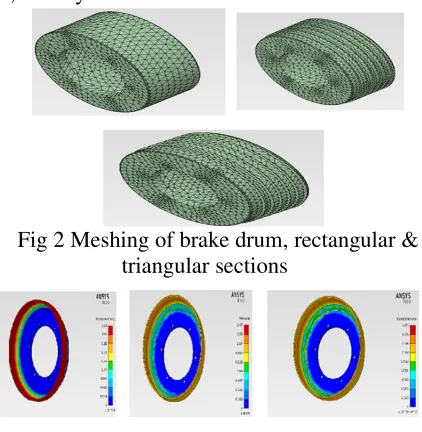
Finite element analysis shown in Fig 2 of brake drum has been done using two different materials (cast iron, aluminum), giving each of the properties of the materials such as young’s modulus, poison’s ratio, density etc.
Fig 2 Meshing of brake drum, rectangular & triangular sections
Fig 5 shows the displacement magnitude obtained by using grey cast iron as a material for brake drum. It is obtained that the displacement is maximum at the outer peripheral region and decreases at the inner surface. Displacement magnitude is obtained to be minimum at the fixed support. The maximum displacement for the brake drum without fins is 2.424*10-8 m. The maximum equivalent stress induced in the original brake drum is 1.487 * 104 Pa. The maximum equivalent strain induced in the brake drum without fins is 1.371*10
-7
.
Brake Drum with Rectangular cross-section Annular fins:
Fig 6 Equivalent stress induced in triangular brake drum using grey cast iron.
Fig 6 shows the equivalent stress induced by using grey cast iron as a material for modified brake drum. The stress depends on the pressure and force exerted on the inner surface of the brake drum. Maximum stress is obtained at the joint of hub and brake drum. The maximum equivalent stress induced in the brake drum with rectangular cross section annular fins is 1.76 * 104 Pa.
Brake Drum with Triangular cross-section Annular fins:
Fig 7 shows the equivalent stress induced by using grey cast iron
Fig 7 shows the equivalent stress induced by
using grey cast iron as a material for modified brake drum. The stress depends on the pressure and force exerted on the inner surface of the brake drum. Maximum stress is obtained at the joint of hub and brake drum. The maximum equivalent stress induced in the brake drum with triangular cross section annular fins is 1.533 * 104 Pa.
Brake drum without fins made of Aluminum 6061,
Temper t6:
Fig 8Displacement & Equivalent stress brake drum of aluminium alloy
Fig 8 shows the displacement magnitude obtained by using Aluminum as a material for brake drum. . The maximum displacement for the brake drum without fins is 3.773*10-8 m. The maximum equivalent stress induced in the original brake drum is 1.491 * 104 Pa.
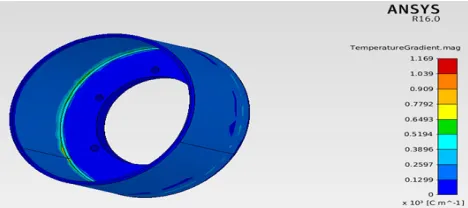
Fig 9 Temperature gradient along the surface of the brake drum of grey cast iron.
temperature gradient obtained from ANSYS is 1.169*103 C m-1.
Fig 10 Temperature variation along the triangular fins of modified brake drum.
Fig 10 shows the variation of temperature along the surface of the modified brake drum made of Grey cast iron. The minimum temperature obtained on the brake drum is 112.40 C at the backing plate. The convective heat transfer is obtained to be maximum at the outer diameter of the brake drum and further it can be increased if the brake drum is installed to the front wheel of the automobile. The variation in temperature along the rectangular fin can be clearly understood from the above figure.
Fig 11 Temperature variations along the surface of rectangular brake drum of aluminium alloy.
Fig 11 shows the variation of temperature along the surface of the modified brake drum made of Aluminium alloy. The minimum temperature obtained on the brake drum is 117.40 C at the backing plate. The convective heat transfer is obtained to be maximum at the outer diameter of the brake drum and further it can be increased if the brake drum is installed to the front wheel of the automobile. The variation in temperature along the rectangular fin can be clearly understood from the above figure.
The thermal analysis using ANSYS shows that the heat flow increases in the brake drum with finned cross section than the original brake drum and the rate of heat flow increases in the rectangular finned brake drum than the triangular finned brake drum. The static structural analysis shows the different stress, strain and displacement magnitude induced on the brake drum and the modified brake drum. The Table 1 & 2 reports the comparison of theoretical and ANSYS results of brake drum analysis.
TABLEI
HEATFLOWRESULTSFORGREYCASTIRON
Fin configuration Theoretical ANSYS %Error
Brake drum
without fin
2543.795 2479.9 2.5117
Rectangular
cross-section Annular
fins
3599.756 3405.4 5.399
Triangular
cross-section annular
fins
3077.522 3017.5 1.95
TABLEIII
HEAT FLOW RESULTS FOR ALUMINIUM 6061,TEMPER T6
Fin configuration Theoretical ANSYS %Error
Brake drum
without fin
2588.4878 2523.1 2.526
Rectangular
cross-section
Annular fins
3635.927 3491.6 3.969
Triangular
cross-section annular
fins
3103.1918 3078.4 0.798
V.RESULTS AND CONCLUSIONS
different materials is to get an increase in heat flow and reduction in weight. The use of fins gives a variation in the heat flow which improves the heat transfer rate.
The small Stress and displacement shown by the modified model indicates that the modified
model is stronger and rigid than original. The
high temperature of the outer surface of the modified model shows that more heat is transferred and dissipated from the brake drum. The use of two kinds of materials in brake drum manufacturing provides a range of heat flow values. This range of values is useful in the selection of material comparing with these two materials in different applications. From the above values the advanced materials like EN24 or EN8 material in vehicles
which are not very much powerful. By placing
fins on the outer surface of the brake drum, the amount heat flow is increased. When the criteria are maximum heat flow then it is better to go for a brake drum with rectangular cross-section annular fins and is of high conductive material. When heat flow along with weight of the brake drum is the main criteria then triangular fins on highly conductive brake drum is suitable because it
increases heat flow along with reduction in weight of brake drum.
REFERENCES
[1] Bako Sunday, Usman Aminu , Paul O. Yahaya, Mohammed B. Ndaliman , Development and analysis of Finned Brake Drum model using Solidworks Simulation, International Journal of Innovative Research in Science, Engineering and Technology Vol. 4, Issue 5, May 2015.
[2] Frank P.Incropera , Fundamentals of Heat and Mass Transfer, John Wiley and Sons.
[3] Esmail M.A. Mokheimer, Performance of annular fins with different profiles subject to variable heat transfercoefficient, International Journal of Heat and Mass Transfer 45 (2002) 3631–364.
[4] Anup Kumar and R. Sabarish, Structural and Thermal analysis of Brake Drum,Middle-East Journal of Scientific Research 20 (8): 1012-1016, 2014.
[5] Putti Srinivasa Rao, RevuVenkatesh, “Static and Transient Analysis of leaf spring using Composite material” IUP Journal of Mechanical Engineering, September-November 2015 (ISSN: 0974-6536).
[6] Sandhya Mirapalli, Kishore.P.S,Heat transfer analysis on a Triangular fin, International Journal of Engineering Trends and Technology (IJETT) – Volume 19 Number 5 – Jan 2015.
[7] Gaurav kumar, Kamal Raj Sharma, AnkurDwivedi, AlwarsinghYadav and Hariram Patel, Experimental Invesigation of Natural convection from Heated Triangular Fin array with in a rectangular array, Research India Publications, International Review of Applied Engineering Research. ISSN 2248-9967 Volume 4, Number 3 (2014), pp. 203-210.