
http://www.sciencepublishinggroup.com/j/ajece doi: 10.11648/j.ajece.20170101.12
A Multi Agent Scheme and Optimization for Big Data
Management of Sensor Networks in Smart City Management
Hui Xie
1, Shan Jiao
2, Yaqian Wang
2, Zhengying Cai
2, *1
School of Law and Public Administration, China Three Gorges University, Yichang, China 2
College of Computer and Information Technology, China Three Gorges University, Yichang, China
Email address:
*
Corresponding author
To cite this article:
Hui Xie, Shan Jiao, Yaqian Wang, Zhengying Cai. A Multi Agent Scheme and Optimization for Big Data Management of Sensor Networks in Smart City Management. American Journal of Electrical and Computer Engineering. Vol. 1, No. 1, 2017, pp. 9-17.
doi: 10.11648/j.ajece.20170101.12
Received: March 15, 2017; Accepted: March 29, 2017; Published: May 15, 2017
Abstract:
Because of complex sensor networks in smart city management, it is very difficult to optimize the data processing from all kinds of sensors. Here a multi-agent system (MAS) is made for data processing and optimization of sensor networks in smart city management. First, the sensor network in smart city management is modeled as a self-organized and decentralized agent swarm. In the MAS, each agent’s objective value is reckoned on-line and the best agent’s update rule is on the basis of proportional control concept. Second, each agent is organized by itself to herd to the prime agent in group. And when it avoids the crash between agent and the closest obstruction/agent, it moves to a moving target. Third, to analyze the MAS’s dynamics, the eigenvalue of time-varying discrete system’s analysis is made. Besides, a guideline is put forward for application on how to adjust the parameters of MAS’s. Finally, the results of the simulation verify that the proposed self-organized swarm system is effective in the capability of migration and flocking.Keywords:
Sensor Networks, Multi-Agent System, Big Data, Smart City1. Introduction
Recently smart city management gained more and more attention. Paganelli (2016) described a web of things framework for restful applications and its experimentation in a smart city [1] and a cloud-based architecture for emergency management and first responders localization in smart city environments [2]. Lanza (2016) put forward a model for managing large amounts of data generated by a smart city Internet of Things deployment [3]. Apparently there are complex sensor networks and a large number of data in smart city management. Xu (2016) made a research about energy-efficient big data storage and retrieval for wireless sensor networks with nonuniform node distribution [4]. Mohan (2016) made a model about a novel intelligent approach for predicting atherosclerotic individuals from big data for healthcare [5]. Tan (2016) rethought big data in a networked world [6]. Xhafa (2016) reviewed advanced knowledge discovery techniques from big data and cloud
computing [7]. Jose M. (2016) approached the burrows-wheeler aligner to big data technologies [8]. As a consequence, the computation time is so long and the memory it requires is so many, that it becomes impossible to get with on-line computation.
big data management and multivariate visualization of time-series sensor observation data [15]. Chang (2016) described a ReRAM-Based 4T2R nonvolatile TCAM using RC-Filtered stress-decoupled scheme for frequent-off Instant-on search engines used in the IoT and big-data processing [16]. The data processing performance of the sensor networks has an influence on the node individuals. In the domain of problem, individuals converge on the best points finally.
The multi-agent system (MAS) has got progressed through imitation of models of simplified social, i. e.: fish schooling and bird flocking. Moreover, it is on the basis of a simple concept. Muin J (2016) put forward a plan for the future of epidemiology in the era of big data and precision medicine [17]. Hiroki (2016) modeled the unsupervised data mining suitable for evolutionary and genomic studies in the era of big data [18]. H. Joel (2016) introduced practical applications point of view with future broadband access networks scanning our past with edward (Ted) [19]. Uwe (2016) evaluated cloud cover diurnal cycles in satellite data and regional climate model Simulations [20]. Krishna (2016) built materials informatics about how to go about harnessing the "Big Data" paradigm [21]. Magnus Orn (2016) conducted classification of big data with application to imaging genetics [22]. Hsu (2016) studied a novel group key transfer for big data security [23]. In the MAS, each agent tries to herd to the optimal agent in group and when it avoids the obstructions which may show in the way of formation, and then it will migrate to a moving target.
In the dissertation, a framework is put forward for self-organizing group agents’ decentralized control and which is on the basis of MAS. Thomas (2016) talked about how to use 'big data' to validate claims made in the pharmaceutical approval process [24]. Takemasa (2016) put forward a "Big Data Assimilation" toward post-petascale severe weather prediction in an overview and progress [25]. To deal with all
possible shaping and problems of collision in the configurations of self-organization is not the goal, but our attention are paid to the proposition of stable self-organizing plan and the implementation of distributed group agents.
The aim of the research is to realize global behaviors specifically, i. e.: flocking among agents, and collision avoidance which are by using ordinary local individual rules in MAS. Besides, our research not only specifically resolves the problem of the stability analysis about the MAS’s dynamics, but also puts forward a guideline on the solution to tune the parameters of MAS. The organization of this paper is as following. Section 2 discusses a multi agent model of sensor networks and optimization function of big data management. In Section 3, initial parameters, stability rule and conflicted zone of sensor networks are studied. In Section 4, an experiment is described and result is analyzed. Finally some conclusions are reached in Section 5.
2. Sensor Networks in Smart City
Management
2.1. A Multi Agent Model of Sensor Networks
Multi-agent system (MAS) is primitively exploited for offline nonlinear optimization problem. But these trials have many obvious defects. For example, to avoid making direction basing on outmoded information, the mechanism to trigger for reset is very simple. Moreover, there seems a lack to think about the problem of collision and the analysis of stability between agents. Inspired by such researches, for the dynamical environment, i. e.: self-organization of group agents and developing a steady algorithm to guarantee steady conditions about its dynamics, our keystone is to use a common concept.
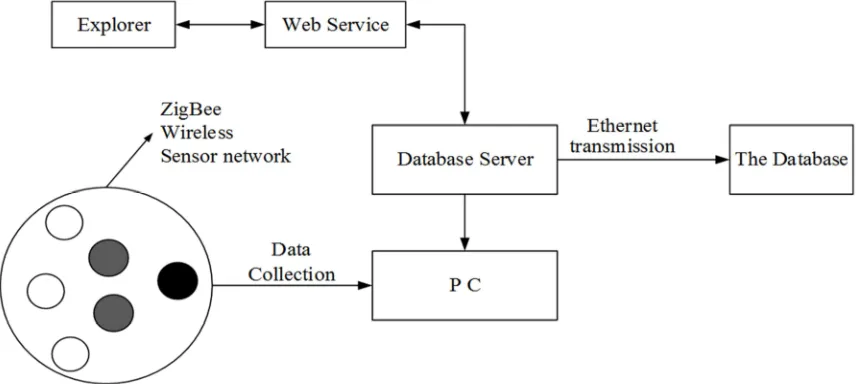
Figure 1. Multi agent system of sensor networks in smart city.
MAS comes from the social behavior’s simulation. The initial formulate of MAS regarded each granule as a potential way to solve the problem inspace of D-dimension. The k-th
In this job, i. e. the colony of insects, for group behavior, MAS is progressed in two-dimensional space. Every granule turns to an agent and θk = [θk1, θk2]D becomes the current site of agent k. And the site of each agent is signified by θ-ɸ axis position and the speed is corrected by MAS. Through the information of the velocity and position, the position of the agent is modified. Based on the optimization technique, it can be described about the above concepts as following: a group of insects optimize an objective function. Each agent realizes the optimal value and its position so far. And each agent realizes the optimal value in the group so among their own optimal valve. Furthermore, each agent makes a try to correct its position by making use of the above information.
The distance between the best agent and the target is the
objective function:
( )
( )
( )
2minΖk m =|
θ
φ m −θ
k m | (1)Where θφ=[θφ1,θφ2]D is a destination of the migration. The optimal former site (namely, the site corresponding to min1≤k≤iZk(λ)) of the k-th agent is signified and recorded as
fk=[fk1,fk2]D. The optimal agent in group (namely, the agent with min1≤k≤iZk(m) in which ϒ represents the amount of agents) is described as fα=[fα1,fα2]
D
denoted by index α.
The site change (namely, velocity) of the k-th agent is Lk=[Lk1,Lk2]D. The velocity’s concept can represent the modification. The following equation can modify each agent‘s velocity.
(
1)
3( ) ( )
(
( )
)
2( ) ( )
(
( )
)
1( )
k k k k k
L m+ =x rand fα m −
θ
m +x rand f m −θ
m +x L m (2)Where, x1 is the inertia weight, which is as following: 0<x1<1. x3 and x2 are two positive numbers, which are respectively called the cognitive parameter and social parameter. rand (): a uniform distribution of random numbers between 0 and 1.
By using (2), a certain speed which approaches to fk and fα can be reckoned. And the current site is renewed by the following equation.
(
1)
(
1)
( )
k m L mk k m
θ
+ = + +θ
(3)Eqs (3) offers the new site about the k-th agent and adds its new speed into its current site.
If any upsilon particle in the group ‘lands’ is within the goal
solution’s appointed radius, a run of MAS is considered successful. The radius depends on the accuracy of the desired solution. If the goal value (or position) varies during a MAS run’s execution in the dynamic environment, the initial MAS algorithm doesn’t have method to deal with the change, and the memories of the initial goal site still have influence on the particles. In addition, for group agents in the dynamic situation, the problem of collision avoidance between the agent and closest agent / obstacle may be thought.
2.2. Optimization Function of Big Data Management
The velocity concept can represent modification, and the following equation can signify the agent’s velocity.
(
1)
( )
1( )
2( ) ( )
(
( )
)
k k k k k
L m+ =
β
m +x L m +x rand f m −θ
m (4)Where,
( )
{
( )( ) 4 ( ) ( )( ) ( )(
(
( )( ))
)
( ) ( )3
,
k k
k
k k
m x rand m m if m f m
k
m
m x rand f m m otehrwiseφ
φ α
α
α
β θ θ θ
β θ
β
= − == −
=
(5)Where x4 is the beacon parameter.
θφ-θk in βk φ
(m) is a kind of proportional control concept, which makes the optimal group agent fast to better solution and it makes it possible to track of the moving target.
So, the new optimal group agent permits the other group agents move quickly in a new direction. On the one hand, In the absence of random circumstances, the value for βk
φ (m) or the case is higher, tracking to the moving target is faster without obstacles in open space. On the other hand, for each sample, if the random value is lower, the swarming behavior is higher to keep formation, which makes it possible to track to the moving target fast by more changes to the optimal agent when there are obstacles.
fk, fα and θφ are three knowledge forms, and they are mixed with the current of each agent velocity vector to make a decision of the next location of the agent. The optimal swarm agent turn to migration beacon by using βk
α
(m) in (5), and the βk
β
(m) in 5 assists other agents flocking to optimal group agent,
which is a concerted biological act, such as fish schools and bird flocks. So, βk(m) makes it possible that group agents possess the behavior as presented in Figure 1, which an agent follows the shortest path to consume pheromones, and other agents follow the optimal agent.
Depending on the situation, the speed can be restricted to the range ωmin to ωmax, which is a strategy to prevent the algorithm from becoming unstable.
min Lk max
ω
≺ ≺ω
(6)Where, ωmax and ωmin are respectively the maximum and minimum values of velocity Lk.
3. Modified Multi Agent System in Sensor
Networks
3.1. Initial Parameters
considered. In order to analyze the MAS’s dynamics, stability analysis is conducted basing on the time-varying discrete systems’ eigenvalue analysis. To avoid agents’ collisions, the virtual zone got developed.
To make a choice between fk and fα for the dynamic environment, as for a target which is moving, there is an assumption that the maximum velocity of the agent moves faster than the target.
A.The selection of fk
fk is the component of the evolutionary computation that occurs essentially.
-For fixed targets, fkis set to θk, if the current position’s
target value is greater than the previous best of its own target value.
-For a moving goal, fk is not significant. Because θφ is
time-varying, the former own best experience is worthless. B.The selection of fα
fα is the component on which the neighborhood has an influence, which makes agents do social behaviors.
-For a fixed goal, fα is chosen as the position of the best
agent by comparing with each agents’ optimal objective value Such as the traditional method of MAS.
-For a moving goal, fα is chosen as the position of the best
agent by comparing with each agents’ previous optimal objective value. For instance, in Table I(a), assume that in five agents θ3(m) is the position of the agent possessing the optimal objective value, which is fα=θ3(m). It is gained by comparing the other four agents’ objective values θ5(m-1)and θ1(m), θ2(m),
θ4(m-1).
Next, θ1(m), θ2(m), θ3(m-1) and θ5(m-1) are made use to find the optimal agent’s objective value for θ4(m). In fact, because θ5(m-1) and θ1(m), θ2(m) has higher objective value than fα, there is a chance to gain the optimal agent for θ4(m), by comparing θ4(m) ‘s and the fα’s objective value.
C.The relationship between the moving target and the weighting factors.
Ifthe target makes moving in the same direction and x4is elected bigger than x3, this approach becomes a sort of leader-referenced method. If the target makes moving randomly and x3 is elected bigger than x4, the optimal agentfα permits more cooperation between the agents and changes frequently.
MAS utilizes proportional control mechanisms and the mechanism of MAS. By MAS, the search process depends deeply on fα and fk. fk and fα limits the searching area. In contrast, the fk’s influence for the optimal group agent is vanished gradually by introducing the concept of proportional control. Instead, it can achieve fast search. Consequently, intensive search on optimal swarm agents in current effective areas is realized and for other group agents the dependence on the evaluation position is accomplished.
3.2. Stability Rule
If the agent is within a certain distance to the obstacle, the penalty value is added into the agent's objective function.
2
k
k k fk
λ φ
λ γ
θ θ
∈
Ζ = − +
∑
(7)Where ϒk signifies obstacles’ labels set and those obstacles are neighbors with agent k. fk
λ
is a penalty value which the agent k is granted when the obstacle λ is in the agent’s neighborhood.
1 2
c
k f k f
fλ=x
ϕ θ
λ− +x (8)Where ɸλ is obstacle λ‘s position and xf1and xf2 are penalty constants.
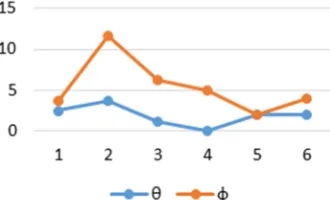
In an obstacle’s existence, through the change of the function (7), figure 2 indicates the best agent’s change. When c = 0, a penalty value which is fixed is put into practice. When c = 1, 2, ···, the penalty value is corrected to the distance’s difference between the obstacle and the agent.
Figure 2. Simulated results of penalty.
Figure 2 offers these different forms’ graphical representation. On the condition that the penalty value is fixed, it is bound to be large to make sure that there is no crash between the agent with the obstacle. If the penalty value is very large, it can force a search for a target in a feasible area, with the result no sufficient probing is performed. Optimal penalty function’s selection also relies on the obstacles’ formation. Whether the obstacle is densely or loosely positioned, the xf1’s value and xf2’s value can be chosen becomingly.
If the agent is outside the conflict zone, the system is switched again based on the primary objective function when there is no penalty function. Consequently, there is no need for an obstacle avoidance’s additional algorithm in the MAS.
The following equation can describe each agent’s velocity.
(
1)
1( )
(
( )
)
k k k k
L m+ =x L m + Ν w −
θ
m (9)Where,
( ) ( )
( ) ( ) ( )
{
2 42 3
,
, other
k
x rand x rand if m is best agent in swarm x rand x rand wise and
θ
+ +
Ν = (10)
( ) ( ) ( ) ( ) ( ) ( ) ( ) ( ) 2 4 2 4 2 3 2 3 k k k k x rand f x rand
if is best agent in group x rand x rand
k x rand f x rand f
otherwise x rand f x rand
w
φ θ θ ∂ + + + +
=
(11)some information about how each agent does not interact with each agent. However, when the wk’s fluctuation is bounded, each agent’s stability can be evaluated exactly on the basis of this model. Because that the feasible region is limited generally in the problems of global search, the wk’s fluctuation is bounded too. Thus, it can be used in MAS for the evaluation of each agent stability.
By taking βk(m) = wk −θk(m) and by using (3) and (9), it can be gotten
(
1)
( )
1( )
k k k
L m+ =N
β
m +x L m (12)Where
β
k(
m+ = −1)
x L m1 k( ) (
+ −1 N) ( )
β
k mN is a random value which is distributed in
( )
( )
{
2 4 2 30, , group
0, ,
k
x x if is best agent in
x x otherwise
θ +
+
.
If it is set as x5= max(x3, x4) and x6=x2+x5, , N is a random value which is distributed in (0, x6).
( ) ( ) ( ) ( ) 1 1 1 1 1 k k k k
L m x N L m x N
m m
β ++ − − β
=
(13)
Make following difference equation describe equation (13)
(
1)
(
( )
)
( )
,( )
0 0k m k m m
Μ + = Ρ Μ Μ = Μ (14)
Where k
k L k β
Μ and
( )
1 11x k m x
Ν
− −Ν
Ρ =
Because of Nϵ(0,x6), Pk(m) can be described as an interval matrix which is time-varying
( )
11 (( 66))0, 1 ,1
x x k m −x −x
Ρ = (15)
Then, the stability conditions for the time-varying perturbation matricesare described as Pk(m), that is keeping the perturbed system (14) stable.
If the discrete system satisfies the condition, as depicted in (14), the discrete system is within an interval matrix which is time-varying.
6≺2 1 + +1 1
x x x (16)
So the system’s equilibrium point 0 is stable asymptotically.
3.3. Conflicted Zone of Sensor Networks
Let us study the eigenvalues which is the maximum
( )
(
)
maxΙ P mk . The eigenvalues
(
)
{
2}
1 2 1 1 1
1
, 1 1 4
2
Ι Ι = + x − ±Ν Ν− −x − x (17)
which comes out as the characteristic equation’s solutions.
(
)
2
1 1 1 0.
Ι + Ν− −x Ι+ =x (18)
As described by (14), the agent’s behavior is stable asymptotically, if and only ifmax(|I1|, |I2|) < 1 in system. The
eigenvalue will be analyzed in four conditions as following, because the eigenvalues I1, I2 are function of parameters x1, x2 and x6.
When Ν≺x1+1and
(
Ν − −x1 1)
2+ −1 4x1>0, where thestability condition max
(
Ι1,Ι2)
≺1 gives(
)
{
(
)
2}
1 2 1 1 1
1
max | |,| | 1 1 4 1
2
Ι Ι = + − Ν +x Ν − −x − x ≺
(19)
Thus
(
)
21 1 4 1 1 1
x x x
Ν − − − ≺ − + Ν (20)
When (N−c1−1)2 − 4c1 > 0, the following relation can be obtained.
(
)
2(
)
21 1 4 1 1 1
x x x
Ν − − − ≺ − + Ν (21)
From the inequality above, the following relation can be gained.
0≺Ν (22)
For Ν ∈
(
0,x2+max(
x x3, 4)
)
equation (22) meets thecondition of stability.
When Ν≺1+x and1
(
Ν − −x1 1)
2−4x1≺0 , for(
)
21 1 4 1 0
x x
Ν − − − ≺ , Ν≺1+x1 Ι1 and Ι2 become complicated numbers. So, the following equation can give
(
1 2)
max Ι Ι, .
(
)
1(
1)
2 11 2
1 1 4
max , | |
2
x x x
+ − Ν ± Ν − − −
Ι Ι = (23)
(
)
2 22
1 1
1 1 4
1
1
2 2
x x
x − Ν − − +
+ − Ν
= +
≺
From the inequality above, the following relation can be gained.
1 1
x ≺ (24)
Because in equation (2)x1 is defined as 0 <x1 < 1, equation (24) meets the condition of stability.
When 1+x1≺Ν≺1+ +x1 2 x1 ,
(
)
21 1 1
1 x and x 1 4x 0
Ν≻ + Ν − − − ≻ , because
(
)
21 1 4 1 0
x x
Ν − − − ≺ means Ν≺1+ +x1 2 x1 , the region of Ν is 1+x1≺Ν≺1+ +x1 2 x1.
From the inequality above, the same condition of stability with the condition of (b) can be gotten.
1 1
So, equation (25) meets the same condition of stability with the condition.
When Ν≻1+ +x1 2 x1, Ν≻1+x and1
(
Ν − −x1 1)
2−4x1≻0 theregion of Ν is Ν≻1+ +x1 2 x1 , since
(
)
21 1 4 1 0
x x
Ν − − − ≻ means Ν≻1+ +x1 2 x1 , the
following equation can give max
(
Ι Ι1, 2)
≺1.(
)
{
(
)
2}
1 2 1 1 1
1
max , 1 1 4 1
2 x x x
Ι Ι = + − Ν − Ν − − − ≺ (26)
From the inequality above, the following relation can be gained.
0
Ν≺ (27)
Because, Ν ∈0,x2+max
(
x x3, 4)
, there is no existence of stable solutions.Using the parameter x1 and parameter x6 and on the basis of the above analysis, stability criterion of max
(
Ι Ι1 , 2)
≺1can be described as (16). For examples, x4 =1 and x1= 0.67, x2= 1, x3= 1 are elected. Because x6=2, x6=x2+max(x3, x4), which meets constraint.
Each θk converges to wkwhich is composed of the position of agents that have their own optimal experience, converges to the migration’s target position and the position of optimal agent. By tuning respectively each weighting factors x2, x3 and
x4, the above three components get weighted.
4. Simulation Examples
4.1. Problem Description
When an agent and its closest agent migrate, collision between them may happen. Therefore, another algorithm is additionally required. To avoid the agents’ conflict, the virtual zone gets developed. If θk is close to θλ enough to conflict, θk maintains a distance nφ as following
(
k) (
)
k k n k
n
λ
φ λ
θ θ
θ θ θ θ
Φ
−
= + − − (28)
Where nφ is the virtual zone’s radius, namely a desired distance between two agents’ center, and nΦ =|
θ θ
k− λ|.As the agent responses to fk and βk, the responses’ allocations between fk and βk guarantee a variety of responses. Agent only changes its behavior’s mode when fk and βk change, so adhering to the stability principle. The best agent’s main movement in βk follows the proportional control’s concept. There is no divergence in agent, because the virtual zone prohibits only the agent from bumping against the others in group. Therefore, the agent converging to target or not has nothing to do with the virtual zone.
Each agent’s knowledge of the environment and capabilities are limited. But, as a group, they can show ‘outstanding behavior.’ When there are some indirect or direct
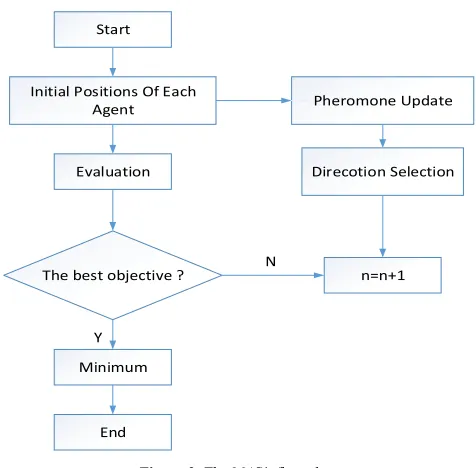
communications among agents, the result of a simple individual behavior may be an intelligent behavior in swarm. There is the MAS’s flow chart in Figure 3.
Figure 3. The MAS’s flow chart.
There is lots of flexibility by using MAS to remain a formation. There is no command that the individual agent be located in any location for alignment, because the proposed method does not make use of the alignment of members in other group explicitly. In addition, this method’s scalability is good, which easily removes or adds any number of agents.
4.2. Result Analysis
To look into the βkφ(m)’s effectiveness in (5), let us think about the MAS without βkφ(m), namely the concept of traditional MAS which the optimal agent uses βkφ(m) similarly in (5) in group as other agents. For fixed targets, in (5) if the term βkφ(m) isn’t put into use, the approach follows the concept of conventional model, even if the virtual area is used for conflict avoidance between proxies. Figures 4 and 5 respectively show the group migration of the MAS for five agent without and withβkφ(m), at t = 1.2.
Figure 4. Radar Chart Truck.
The optimal agent in group originally placed at (16.78, −9.16) where the original distance between fα and θφ is around
Start
End
Initial Positions Of Each Agent
Evaluation Direcotion Selection Pheromone Update
Minimum
The best objective ? n=n+1 N
11.4, in order to put the MAS’s example more properly. As for the condition of MAS with βkφ(m), the optimal agent comes to
θφ(10, 0) within t = 1 (100 iterations).
Figure 5. Velocity comparison (blue dot: original site of agent, orange dot: final site of agent, and grayer: settled target).
In a space which is 2-dimensiona, Figure 5 displays that θk which is located in (θk1, θk2) can’t be closer than nφ, when it flocks to agent θλ which is located in (θλ1, θλ2).
As for the condition of the MAS without βkφ(m), agents reach to θφ(10,0) at t = 3. For both conditions, the limited velocity (ωmin, ωmax) = (−0.2, 0.2) is put into use and the virtual zone is put into use in order to prevent collision from
happening among agents. In the plan, all agents reach to θφ(10,0) at t = 1.2.
In figure 6, because that the MAS withoutβkφ(m) needs longer reaching time, MAS with βkφ(m) surpasses the MAS without βkφ(m), and because of which, term βkφ(m) in the MAS makes the optimal agent in group to search faster than the case that MAS is without βkφ(m).
Figure 6. Position Comparison.
If change rate of the target doesn’t surpass the swarm’s maximum velocity, agents that use MAS can get to a moving target. Because the migration of group to moving goal is in situation of dynamic environment, it should be noted that we
can’t use the concept of conventional MAS.
The optimal agent’s fast moving to a target point makes it possible for other agents to make faster direction to a target, as shown in Table 1.
Table 1. Comparison Different Agent.
Original site of the optimal agent a b c d e
x 25.65 6.69 -7.04 -9.58 17.25
y -8.96 12.89 -1.45 6.21 -1.66
The conventional MAS 2.05 0.43 1.13 7.25 3.45
The proposed MAS 0.23 0.76 0.85 0.24 0.51
In Table I, experiments are gained from results of 20 MAS with βkφ(m) which is generated randomly, suggesting consequently that the results are not made so much change, because the parameter values of MAS happen little change.
4.3. Further Discussion
in group. That is the reason why the MAS doesn’t need specified formation and according to the given environment
all agent are self-organized, and the comparison of reference [23] is shown in Figure 7 and 8.
Figure 7. Results of reference [23].
Figures 7 shows the agents’ group migration in model of reference [23] to the moving goal in a line. If all agents get together, they maintain fixed distance from others by the action of virtual area in which nφ= 1.1 is elected. Limited
speed, (ωmin, ωmax) is (−0.2, 0.2).
Comparison of different models (t2, t4, t8 reference from [3], [5], [23] t6 is proposed model.) are shown in figure 8.
Figure 8. Comparison of different models. (t2, t4, t8 reference from [3], [5],[23] t6 is proposed model.).
In Figure 8, ten proxy simulation environments are randomly initialized at the bottom left and then they are forward to the moving target. At original time when the agents’ positions are randomly chosen, formation of swarm is loose. However, after they moved from (0, 0) to the direction of moving target, their formation has tightly changed. Apparently the proposed model takes advantages over those models in references in migration and flocking.
5. Conclusions
This paper presents a MAS-based self-organizing program for decentralized group agents. This is the first attempt of the MAS concept to adapt to the self-organization problem of sensor networks in smart city. In this scenario, MAS is proposed and studied that enables the use of conventional MAS concepts in dynamic environments. One of the major
contributions of this method is to analyze the stability of MAS model based on the eigenvalue analysis. In addition, this method presents a guidance on how to adjust the parameters of the MAS. The framework allows the agents in the group to remain flexible when they migrate as a group and avoid any obstacles.
themselves for certain task. Despite the fact that more are concerned with the cooperative behavior in the group system in 2D environment, the bottom approach can be extended to the scene in the 3D setup.
Acknowledgements
This research was supported by the National Natural Science Foundation of China (No. 71471102), and Science and Technology Research Program, Hubei Provincial Department of Education in China (Grant No. D20101203).
References
[1] Paganelli, Federica; Turchi, Stefano; Giuli, Dino. A Web of Things Framework for RESTful Applications and Its Experimentation in a Smart City, IEEE Systems Journal, 10, (2016)1412-1423.
[2] Palmieri, Francesco; Ficco, Massimo; Pardi, Silvio; et al. A cloud-based architecture for emergency management and first responders localization in smart city environments, Computers & Electrical Engineering, 56, (2016) 810-830.
[3] Lanza, Jorge; Sotres, Pablo; Sanchez, Luis; et al. Managing Large Amounts of Data Generated by a Smart City Internet of Things Deployment, International Journal on Semantic Web and Information Systems, 12, (2016) 22-42.
[4] Xu Jinhai; Guo Songtao; Xiao Bin, Energy-efficient big data storage and retrieval for wireless sensor networks with nonuniform node distribution, Concurrency and Computation-Practice&Experience, 27, (2015)5765-5779. [5] Priya Mohan; Kumar Paulraj Ranjith, A novel intelligent
approach for predicting atherosclerotic individuals from big data for healthcare, International Journal Of Production Research, 53, (2015)7517-7532.
[6] Ni Lionel M.; Tan Haoyu; Xiao Jiang, Rethinking big data in a networked world, Frontiers Of Computer Science, 10,(2016) 965-967.
[7] Xhafa;Fatos, Advanced knowledge discovery techniques from Big Data and Cloud Computing, Enterprise Information Systems, 10, (2016)945-946.
[8] Abuin, Jose M.; Pichel, Juan C.; Pena, Tomas F., Big BWA: approaching the Burrows-Wheeler aligner to Big Data technologies, Bioinformatics, 31, (2015)4003-4005.
[9] Seto Yosuke; Toda Masanori; Tamura Koichiro, Molecular phylogenetic analysis of the Drosophila immigrans species group using big sequence data, Genes & Genetic Systems, 89, (2014) 337-337.
[10] Ghosh Goldina; Banerjee Soumya; Yen Neil Y, State transition in communication under social network: An analysis using fuzzy logic and Density Based Clustering towards big data paradigm, Future Generation Computer Systems-the International Journal of Escience, 65, (2016)207-220.
[11] Onose Alexandru; Carrillo Rafael E.; Repetti Audrey, Scalable splitting algorithms for big-data interferometric imaging in the SKA era, Monthly Notices of The Royal Astronomical Society, 462, (2016)4314-4335.
[12] Walker; Tracey; Strep throat risk score brings together patient data and big data to potentially reduce unnecessary doctors' visits, Formulary, 48, (2013)378-378.
[13] Roskams Jane; Popovic Zoran, Power to the People: Addressing Big Data Challenges in Neuroscience by Creating a New Cadre of Citizen Neuroscientists, Neuron, 92, (2016)658-664.
[14] Klasen Nicole; Hilgers Alexandra; Schmidt Christoph; Optical dating of sediments in Wadi Sabra (SW Jordan), Quaternary Geochronology, 18, (2013)9-16.
[15] Li Wenwen; Wu Sheng; Song Miaomiao;A scalable cyberinfrastructure solution to support big data management and multivariate visualization of time-series sensor observation data, Earth Science Informatics, 9,(2016)449-464.
[16] Chang Meng-Fan; Huang Lie-Yue; Lin Wen-Zhang;A ReRAM-Based 4T2R Nonvolatile TCAM Using RC-Filtered Stress-Decoupled Scheme for Frequent-OFF Instant-ON Search Engines Used in IoT and Big-Data Processing, IEEE Journal of Solid-State Circuits, 15,(2016)2786-2798.
[17] Khoury Muin J, Planning for the Future of Epidemiology in the Era of Big Data and Precision Medicine, American Journal of Epidemiology, 182, (2015)977-979.
[18] Iwasaki Hiroki; Abe, Takashi; Wada, Yoshiko, Unsupervised data mining suitable for evolutionary and genomic studies in the era of big data, Genes & Genetic Systems, 89, (2014)285-285.
[19] Trussell H. Joel; Damle Vaishali, Special Issue Big Data: Practical Applications Point of View: Future Broadband Access Networks Scanning Our Past: Edward (Ted) Both, Proceedings of The Ieee, 104, (2016) 2074-2077.
[20] Pfeifroth Uwe; Hollmann Rainer; Ahrens Bodo, Cloud Cover Diurnal Cycles in Satellite Data and Regional Climate Model Simulations, Meteorologische Zeitschrift, 21, (2012)551-560. [21] Rajan K (Rajan, Krishna), Materials informatics How do we go
about harnessing the "Big Data" paradigm, Materials Today, 15, (2012)470-470.
[22] Ulfarsson Magnus Orn; Palsson, Frosti; Sigurdsson, Jakob, Classification of Big Data With Application to Imaging Genetics, Proceedings of The IEEE, 104, (2016)2137-2154. [23] Hsu Chingfang; Zeng Bing; Zhang Maoyuan, A novel group
key transfer for big data security, Applied Marhematics and Computation, 249, (2014)436-443.
[24] Wasser Thomas; Haynes Kevin; Barron John, Using 'big data' to validate claims made in the pharmaceutical approval process, Journal of Medical Economics, 18,(2015)1013-1019.

![Figure 8. Comparison of different models. (t2, t4, t8 reference from [3], [5],[23] t6 is proposed model.)](https://thumb-us.123doks.com/thumbv2/123dok_us/9898183.1977287/8.595.114.480.362.523/figure-comparison-different-models-t-reference-proposed-model.webp)
