Available Online At www.ijpret.com
INTERNATIONAL JOURNAL OF PURE AND
APPLIED RESEARCH IN ENGINEERING AND
TECHNOLOGY
A PATH FOR HORIZING YOUR INNOVATIVE WORK
WEB BLOG MINING SURVEY
KRUTIKA P. BANG1, PROF. A. B. RAUT*2,
1. M.E. First year CSE, H.V.P.M’s C.O.E.T., Amravati. S.G.B.A.University, India. 2. H.V.P.M’S, C.O.E.T., Amravati. S.G.B.A. University (MS), INDIA.
Accepted Date:
27/02/2013
Publish Date:
01/04/2013
Keywords
Web Blog,
Knowledge discovery
task,
Clustering,
Matrix Factorization,
Ranking.
Corresponding Author Ms. Krutika P. Bang
Abstract
Knowledge discovery in blogs is different from knowledge
discovery in areas such as databases or Web documents due
to blogs’ unique characteristics, which introduce additional
mining challenges. Although researchers have investigated
several techniques to address different aspects of blog
discovery, no comparisons among key knowledge discovery
techniques for blogs exist. This article examines three
prominent techniques that are frequently applied to
discovery in blogs — clustering, matrix decomposition, and
ranking. We are comparing them in terms of effectiveness in
combating present challenges and their ability to accomplish
Available Online At www.ijpret.com
INTRODUCTION
Web Blogs—commonly described as
blogs—are “frequently modified Web pages
in which dated entries are listed in reverse
chronological sequence”. Bloggers—the
people who write them—use this venue to
freely express their opinions and emotions,
making blogs increasingly popular.
Analyzing these personal entries could even
provide opportunities for governments and
companies to understand the public in a
way that was previously costly or even
unavailable. Although the blogosphere
contains a lot of useful information, the
data is noisy because blog entries are
unstructured and might cover a wide
variety of topics. By analyzing the freely
expressed opinions of bloggers via blog
mining, marketers, for example, can get
closer to customers and learn more about
their opinions on certain products,
companies, or political issues. However,
because so many blogs exist, manually
monitoring and analyzing them is a
labor-intensive and time-consuming task. In
addition, we can apply knowledge discovery
algorithms to determine why such topics
are popular and categorize them according
to blogger profiles and communities. Blog
recommendation engines, such as the one
built in to Google Reader
(www.google.com/ reader), use mined
information from diverse sources, including
blogs, to make personalized, relevant
recommendations to different individuals.
Aggregating numerous blogs that offer
diverse opinions on the same topic provides
valuable collective wisdom and can, for
instance, help individuals make a collective
judgment about a particular product that
they’re considering. Several commercial
Web sites, such as Blog pulse
(www.blogpulse.com),Technorati(www.tec
hnorati.com), are available for mining and
analyzing blog content. They provide
ser-vices that include searching blogs based on
query keywords, ranking blogs according to
popularity, and identifying trends in
keywords seen in the blogosphere.
However, because blogs are very dynamic,
we can’t easily apply traditional Web
mining techniques to them.
I. THE BLOGMININGFRAMEWORK
Blog mining is an important way for people
Available Online At www.ijpret.com
earlier, blogs are very dynamic, so it isn’t as
straight forward to apply traditional Web
mining techniques to them. However, we’ve
created a general framework for different
tasks.
This framework consists of a blog spider, a
blog parser, a blog content analyzer, a blog
network analyzer, and a blog visualizer.
Fig.1 A general blog mining framework
A. Blog Spider
Users can focus on certain types of blog
content, but they can’t monitor thousands,
much less millions, of blogs simultaneously.
However, blog spiders can simplify this task
by monitoring and downloading content
from multiple blog hosting sites. Blog
spiders are similar to standard Web page
spiders in most aspects, except that they
must be more timely. Because blogs update
frequently, a blog spider must find and
download the latest to the hour or even the
minute. However, it’s often difficult and
costly to set up a system to store and
monitor the numerous blogs online. An
alternative is to connect to popular blog
search engines such as Techno rati
(www.technorati.com), Google Blog Search
(www.blogsearch.google.com), and Blog
Pulse (www.blobpulse.com), perform a
“meta search,” and then combine the
results.
B. Blog Parser
A blog parser extracts information from
blogs, including names of people, products,
and organizations. It also includes other
patterns, such as dates, times, number
expressions, dollar amounts, email
addresses, and URLs. Developers can create
tools to extract information from blogs
based on traditional Web page word
segmentation tools such as mutual
information, decision trees, or neural
networks. However, writing conventions in
blogs differ from those found in traditional
Web pages. Bloggers often write in a
rambling and unstructured narrative style.
Available Online At www.ijpret.com
We can further analyze extracted key
phrases by using standard text mining
techniques, such as classification and
clustering. Blogs can skew positively or
negatively toward a product, depending on
their content or the bloggers’ personal
opinions. A blog analyzer associates a
phrase that expresses a positive attitude.
The blog analyzer then uses these vectors
to classify and cluster the blogs into
meaningful categories. Blog analyzers can
classify blogs that describe a new product
into three categories: positive, negative,
and neutral. They can use standard
models—support vector machines, feed
forward/back propagation neural networks,
or naïve Bayesian classifiers—to conduct
classifications. Because blogs differ from
traditional Web pages, blog analyzers can
also use other features—comment content,
blogger profiles, and links to other blogs—in
addition to term features to conduct
classifications. For clustering, blog analyzers
can group blogs into different categories
based on their features. They can measure
content similarity between blog entries
based on a similarity score such as the
cosine product between the term features
and the additional features such as those
used in classification. The blog analyzer is
also capable of analyzing the network
relationships among bloggers.
D. Blog Visualizer
A blog visualizer presents content and
network analysis results to users—for
example, the use of folders or map displays
to present classification and clustering
results so that users can explore blogs
related to their areas of interest.
Blog visualizers can display the relationships
among bloggers in two dimensions with
network display techniques. Through these
techniques, users can easily identify
relevant blogs, important communities, and
key bloggers in anet work.
II. KNOWLEDGEDISCOVERYTASK
In addition to addressing the challenges
inherent to blogs, relevant literature
indicates that knowledge discovery
techniques must accomplish particularly
challenging tasks to accurately and
effectively discover knowledge.
Available Online At www.ijpret.com
One general knowledge discovery challenge
is quickly summarizing discovered results in
a concise, easy-to-understand, intuitive
for-mat. Knowledge discovery algorithms
out-put doesn’t necessarily meet these criteria
and could be very large and convoluted. So,
researchers developed visualization
techniques to better convey these
algorithms results.
B. Identifying Authoritative and Reliable
Sources
Measuring blog participants authority is
becoming increasingly important,
particu-larly when professional application areas
are involved. Authoritative bloggers might
be experts on a particular subject or
persuasive forces that influence others.
Weighing blog posts with respect to the
author’s authority is a significant challenge
for knowledge discovery algorithms &
verifying the authenticity of data shared on
blogs. Information frequently flows from
blog to blog, making it difficult to track the
information’s origin, provenance, or
credibility. Discovery algorithms that
incorporate techniques such as pattern
mining to discover information flows
between blogs can use such patterns to give
users more reliable data.
C. Accommodating Multiple, Diverse Goals
Given the variety of uses for knowledge
discovered from blogs, a particular
discovery technique should be capable of
discovering knowledge in multiple facets.
For instance, if we can use the same
technique for topic detection and trend
analysis, this technique would be more
widely applicable to a large user base.
D. Using Structured and Unstructured Blog
Content
Tagging is a popular phenomenon in blogs.
Users tend to employ descriptive tags to
annotate the blog content they’re
interested in. In addition to mining
unstructured text in blogs, discovery
algorithms could leverage structured
information such as tags to discover social
interests, for instance.
Available Online At www.ijpret.com
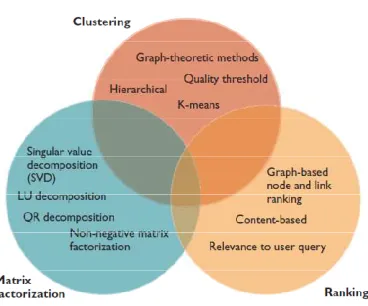
We examined three of the most popular
strategies for discovering knowledge in
blogs as shown in figure 2:
Fig 2: Strategies for knowledge discovery in
blogs.
A. Clustering
Clustering is one of the most common
machine learning techniques researchers
have applied to knowledge discovery in
blogs. Clustering assigns a set of
observations to subsets, referred to as
clusters, such that observations in the same
cluster are similar according to prespecified
criteria. Data clustering algorithms can be
hierarchical or partitional. K-means
clustering and quality threshold (QT)
clustering are both partitional clustering
algorithms. Clustering algorithms might
require users to specify the number of
clusters the algorithm should produce in
the input data set. An important step in
clustering is to select a distance measure,
which will determine how the algorithm
calculates two elements similarity. This
influences cluster shape because some
elements might be close to one another
according to one distance and farther away
according to another. Once the algorithm
has established clusters, another important
step in clustering is to determine the
membership of newly arrived data into
preexisting clusters.
Recently, co-clustering algorithms have
emerged that cluster along both rows and
columns. For example, a user might be
interested in finding similar documents and
their interplay with word clusters. When
dealing with sparse and high-dimensional
data, co clustering is scalable to large
matrices.
B. Matrix Factorization
Matrix factorization is another common
tool researcher’s use for knowledge
Available Online At www.ijpret.com
decomposing a matrix into some canonical
form. Many different matrix
decompositions exist, such as LU
decomposition (which writes a matrix as the
product of a lower triangular matrix and an
upper triangular matrix), singular value
decomposition (SVD), Cholesky
decomposition, and QR decomposition, and
each is useful for particular problems.
Finding the appropriate interpretation for
the singular vectors isn’t always easy in
practice. Finally, updating SVD results can
be difficult if the graph evolves over time.
Researchers have developed techniques,
such as the Colibri methods, to address
SVD’s challenges. However, their
effectiveness for knowledge discovery in
blogs is still undetermined.
C. Ranking
A user might choose to drive knowledge
dis-covery in blogs by specifying criteria for
ranking retrieved blog entries. Ranking
blogs is quite similar to ranking Web pages.
Page Rank and Hyper-Text Induced Topic
Selection (HITS) are two popular techniques
for Web page ranking that exploit the link
structure between such pages. These
algorithms focus on a directed graph setting
that describes resources via nodes and
hyperlinks. Link-popularity-based
algorithms, however, might not work well
for blog mining because blog pages aren’t
well linked and bloggers might try to exploit
such a system to boost their rank. This
observation has led to several new blog
ranking techniques that exploit both links
and content for ranking. A user might want
to retrieve blog entries ranked according to
opinions on a certain topic expressed in
those entries. Similarly, the influence Rank
algorithm enables blog ranking according to
how influential each one is compared to
others as well as the originality of the
opinions the blogs specify. In the context of
blogs, researchers have also explored
link-popularity-based graph algorithms that use
techniques such as random walks and
random sampling combined with ranking
for both static and dynamically changing
graphs.
IV.APPLICATIONS
A. Analysis of Public Awareness
One useful application of blog mining is to
Available Online At www.ijpret.com
An effective way to find and analyze blogs
gives companiesa better understanding of
their customers’ concerns and helps them
evaluate their image; which in turn offers
areas of improvement at an early stage for
better decision-making, particularly on
customer-related activities. Companies can
also mine blogs about a particular product.
First, the blog spider connected to hosting
sites and blog rings and downloaded the
blogs, based on their content and groups.
The blog parser processed and extracted
useful information, such as company
names, product names, and opinions. The
blog analyzer then reviewed each blog’s
content .rings focused on the product. This
finding proved traditional keyword-based
retrieval techniques to identify the bloggers
who only indicated their preference by
joining social communities but not by
blogging about it. Finally, the blog visualize
presented a high-level display with analysis
results. Bloggers with a positive, neutral, or
negative attitude toward the product were
mixed together in many blog communities.
These findings could provide useful
information for areas such as online
marketing.
B. Analysis of Online Social Activities
Bloggers have formed many communities
online. Their interests, demographics,
opinions, and beliefs make up the focus of
these communities, where they share ideas
by reading and commenting on each other’s
blogs. Unfortunately, inappropriate
messages that express hatred or extremism
can also easily circulate in blogs. By applying
network analysis, we can find these
communities and identify the roles bloggers
play—namely, leaders, followers, or
gatekeepers. We applied our framework to
identify and analyze selected set of 28 racist
hate groups (820bloggers) on Xanga, one of
the most popular blog-hosting sites. After
the blog spider collected entries on these
online hate groups’ blogs, the blog content
analyzer extracted their content and linkage
information (based on membership and
subscription information). The blog network
analyzer then performed social network
analysis on the information, and eventually
identified two large communities that
consisted of some smaller communities.
The blog visualizer generated graphical
analysis displays. By showing the structural
Available Online At www.ijpret.com
can help identify bloggers who participate
in multiple blog rings or subscribe to several
other blogs in the community. It can also
facilitate analysis for law enforcement
officers and social workers who need to
study and monitor such activities.
C. Analysis of Public Opinion
Another important blog mining applications
news monitoring. People increasingly use
blogs to supplement news distribution for
several reasons: anyone can update a blog
at any time, blogs represent the views of
different individuals without filtering
(factors such as the target audience’s
preferences or political constraints
influence mainstream media), and blogs are
interactive. Readers can easily post
comments to express their views, or they
can write their own blogs.
V. CONCLUSION
Despite the extensive recent activity on
knowledge discovery in blogs, more
research needs to occur before we have
algorithms that are scalable, accurate, and
robust, and provide interpretable results.
Blog data is no longer just numerical or
discrete. Because bloggers now express
themselves through videos, photos, and
tweets in addition to text-based posts,
algorithms must combine mining
capabilities for different social media to
effectively mine the blogosphere.
REFERENCES
1. N. Agrawal and H. Liu, “Blogosphere:
Research Issues, Tools, and Applications,”
ACM Special Interest Group on Knowledge
Discovery and Data Mining (SIGKDD)
Explorations, vol. 10, no. 1, 2008, pp. 18–
31.
2. Y-R. Lin et al., “Blog Community
Discovery and Evolution Based on Mutual
Awareness Expansion,” Proc. Conf. Web
Intelligence, ACM Press, 2007, pp. 48–56.
3. K.C. Sia et al., “Efficient Computation of
Personal Aggregate Queries on Blogs,” Proc.
Knowledge Discovery and Data Mining
Conf., ACM Press, 2008, pp. 632–640.
4. H. Qian and C.R. Scott, “Anonymity and
Self-Disclosure on Weblogs,” J.
Available Online At www.ijpret.com
5. B. Nardi et al., “Why We Blog,” Comm.
ACM, vol. 47, no. 12, 2004, pp. 41–46.
6. R. Blood, R., “How Blogging Software
Reshapes the Online Community,” Comm.
ACM, vol. 47, no. 12, 2004, pp. 53–55.
7. R. Kumar et al., “Trawling the Web for
Emerging Cyber communities,” Computer
Networks, vol. 31, nos.11–16, 1999, pp.
1481–1493.
8. S. Baker and H. Green,. “Blogs Will
Change Your Business,” Business Week, 2