EJBRAT 6(4) 2016
Volume 6
Number 4
October-December 2016
European
Journal
of Biological
Research
formerly
European Journal of Biological Research, Volume 6, Issue 4, October-December 2016 European Journal of Biological Research
ISSN 2449-8955
Editor-in-Chief Tomasz M. Karpiński
Poznań University of Medical Sciences, Poznań, Poland
Co-Editor Artur Adamczak
Institute of Natural Fibres and Medicinal Plants, Poznań, Poland
Editorial Secretary
Joanna Bródka, Poznań, Poland
Statistical Editor
Paweł Zaprawa, Lublin, Poland
Language Editor Jan Nowacki, London, UK
Scientific Editorial Board Tamara Bayanova, Apatity, Russia
Alexander Ereskovsky, Marseille, France
Agnieszka Gałuszka, Kielce, Poland
Vittorio Gentile, Naples, Italy
Stanisław Hałas, Lublin, Poland
Fadi Hage Chehade, Beirut, Lebanon
Afaf M. Hamada, Stockholm, Sweden
Sven Herzog, Tharandt, Germany
Liviu Holonec, Cluj-Napoca, Romania
Miłosz A. Huber, Lublin, Poland Shri Mohan Jain, Helsinki, Finland
Wouter Kalle, Wagga Wagga, Australia
Tomasz Klepka, Lublin, Poland
Nikolaos Labrou, Athens, Greece
Igor Loskutov, Sankt Petersburg, Russia
Ákos Máthé, Sopron, Hungary
Ahmed El-Mekabaty, Mansoura, Egypt
Artem V. Mokrushin, Apatity, Russia
Shahid M. Mukhtar, Birmingham, USA
Robert Pal, Pécs, Hungary
Amal K. Paul, Kolkata, India
Rajiv Ranjan, Narkatia Ganj, India
Antonio Tiezzi, Viterbo, Italy
Timotej Verbovšek, Ljubljana, Slovenia
Vladimir K. Zhirov, Apatity, Russia
List of Peer-Reviewers
http://www.journals.tmkarpinski.com/index.php/ejbr/pages /view/reviewers
Author Guidelines
http://www.journals.tmkarpinski.com/index.php/ejbr/about /submissions
More information
www.journals.tmkarpinski.com/index.php/ejbr
DISCLAIMER
The Publisher and Editors cannot be held responsible for errors and any consequences arising from the use of information contained in this journal; the views and opinions expressed do not necessarily reflect those of the Publisher and Editors, neither does the publication of advertisements constitute any endorsement by the Publisher and Editors of the products advertised.
Cover: http://openwalls.com/image?id=20115, Licence Creative Commons Attribution 3.0 Unported (CC BY 3.0)
Copyright: © The Author(s) 2016. European Journal of Biological Research © 2016 T.M.Karpiński. All articles and abstracts are open-access, distributed under the terms of the Creative Commons Attribution Non-Commercial 4.0 International License, which permits unrestricted, non-commercial use, distribution and reproduction in any medium, provided the work is properly cited.
Publisher and Editor's office: Tomasz M. Karpiński, Szkółkarska 88B,
European Journal of Biological Research, Volume 6, Issue 4, October-December 2016
Contents
226-241
242-253
254-259
260-266
267-274
275-286
287-292
293-298
299-309
310-316
Bioconversion of plant wastes to β-carotene by Rhodotorula glutinis KU550702 Magdy Mohamed Khalil Bagy, Mohamed Hemida Abd-Alla, Nivien Allam Nafady, Fatthy Mohamed Morsy, Ghada Abd-Elmonsef Mahmoud
Aspergillus terreus occurrence in middle of Upper Egypt, genetic variation and
production of itaconic and mevinolinic acids
Hassan A. H. Hasan, Ameer E. Elfarash, Khaled A. E. Abdrabo
Inhibition of acetylcholinesterase and cytochrome oxidase activity by chlorophyllin bait in sunlight and red light on the nervous tissue of infected/uninfected Lymnaea
acuminata
Navneet Kumar, Vinay Kumar Singh
Toxicological investigation and anti-reproductive effect of phyto-molluscicide against harmful aquatic snail
Saroj Chauhan, Ajay Singh
Allometric models for branch biomass production: assessment of rapid growth trees for bio-energy in Northern Iran
Jamshid Eslamdoust, Hormoz Sohrabi
Quantification of doxycycline hyclate in different pharmaceutical samples by UV assay
Kazi Md Mahmudul Hasan, Md. Anwarul Haque, S. M. Alamgir Kobir, Mobarak Hossain
Diversity of phylloplane microflora in certain tea cultivars of Assam, North-East India
Amarjyoti Tanti, Pranab Bhattacharyya, Prasanta Dutta, Satya Ranjan Sarmah, Mausomi Madhab, Dipimani Saikia, Anita Kachari, Rahnam Berceroyjyrwa
Immunosuppressive and cytotoxic potential of aqueous leaves extract of Thlaspi
arvense
Amit Gupta, Bharat Shinde
Keratitis induced by Allovahlkampfia spelaea in experminental rat model: a trial for treatment with ellagic acid
Enas A. M. Huseein, Fatama E. S. Anwer, Gamal H. Abed, Sary Kh. Abdel-Gahfar, Hossam El-Din M. Omar
Antioxidant profile of essential oils and extracts of cinnamon bark (Cinnamomum
cassia)
of Biological Research
European Journal of Biological Research 2016; 6 (4): 226-241
Bioconversion of plant wastes to β-carotene
by
Rhodotorula glutinis
KU550702
Magdy Mohamed Khalil Bagy, Mohamed Hemida Abd-Alla, Nivien Allam Nafady,
Fatthy Mohamed Morsy, Ghada Abd-Elmonsef Mahmoud*
Botany and Microbiology Department, Faculty of Science, Assiut University, Assiut 71516, Egypt *Corresponding author: Ghada Abd-Elmonsef Mahmoud; Tel.: 20 10711661; Fax: 20 88 2342708; E-mail: [email protected]
ABSTRACT
Microbial synthesis of β-carotene has gained more interest as an alternative to synthetic β-carotene due to easy extraction and high yield. The vitamin microbial production is mainly dependent on culture conditions and the medium compositions. In this study, the β-carotene production by the Rhodo-torula glutinis ASU6 (KU550702) was evaluated under different growth conditions and nutrient composition. Different agro-renewable wastes were tested as carbon source for R. glutinis to obtain maximum amount of β-carotene. Meanwhile, it is clear that R. glutinis could grow well on acid extract of onion peels and produced large amount of β-carotene. Initial statistical screening using a Plackett-Burman design showed temperature, incubation time, fermentation type, non-treated onion waste, KH2PO4 and L-asparagine as significantly, influencing β-carotene production. Response surface methodology was applied to determine the mutual interactions between these parameters and optimal levels for β-carotene production. The maximum value of β-carotene production was 204.29 mg/l (7.5-fold) of value observed as central point of the central composite design. All the experimental data are in good
agreement with predicted ones, confirming the responsibility of the proposed empirical model in describing β-carotene production by R. glutinis. In the whole, the outcomes of this study support the exploitation of onion peels through microbial fermentation for β-carotene production.
Keywords: β-carotene; Agro waste; RSM; Rhodotorula glutinis.
1. INTRODUCTION
Carotenoids are the colorful plant pigments of commercial interest that have important biological functions. These pigments act as vitamin A precursors which are necessary for healthy vision and cell growth, and also they have antioxidant properties [1]. Several studies have also suggested that carotenoids provide health benefits in decreasing the risk of many diseases, lowering the risk of cancer and enhancement of immune system function [2]. Cosmetic preparations containing the carotenoids were reported to be efficacious in preventing several kinds of damage resulting from oxidation and exposure to UV light [3]. Carotenoid-containing preparations are also playing an important role as feed additive. Astaxanthin is the Received: 08 August 2016; Revised submission: 08 September 2016; Accepted: 19 September 2016
Copyright: © The Author(s) 2016. European Journal of Biological Research © T.M.Karpiński 2016. This is an open access article licensed under the terms of the Creative Commons Attribution Non-Commercial 4.0 International License, which permits
European Journal of Biological Research 2016; 6 (4): 226-241 major carotenoid used for pigmentation of fishes
and salmons [4]. Beta-carotene, lycopene, and lutein are all different varieties of carotenoids.
Carotenoids production by chemical synthesis or extraction from plants is restricted by low amounts that lead in high production costs. The chemical synthesis of carotenoids cannot meet consumers' desire for natural carotenoids and generated hazardous wastes that can affect the environment. There are some problems regarding carotenoids production from plant origin due to seasonal and geographic variability that cannot be controlled. Thus leads to research towards the microbial production of carotenoids. The microbial production of carotenoids could be a better option about yields and costs, looking for the use of low-cost substrates as agro-industrials wastes [5]. This explains the increasing interest rates in production of microbial carotenoids as substitutes for synthetic carotenoids used as colorants in food [6].
Carotenogenic yeasts are a diverse group of unicellular eukaryotes, occurring in soil, fresh and marine water, on plants, animals and can be also found frequently in man-made habitats such as foods [7]. Due to its ubiquity and world-wide occurrence, these yeasts have been able to colonize a large variety of substrates as a source of nutrients and form space for their growth and metabolism [8]. Carotenogenic yeasts are well known producer of biotechnologically significant carotenoid pigments such as astaxanthin, β-carotene, torulen, torularho-din. The composition and quantity of the carotenoid pigments in numerous natural isolates of the genera Rhodotorula/Rhodosporium and Sporobolomyces/ Sporidiobolus were studied in detail [9].
Rhodotorula is a basidiomycetous yeast in the fungal family Sporidiobolaceae (Phylum Basidio-mycota) [10]. Rhodotorula is well recognized as a producer of carotenoid pigments, and has both positive and negative significance in agriculture and food industry [11]. β-carotene, torulene, and torularhodin were produced by Rhodotorula in varying proportions [12].
The significant aspect of the fermentation process in microbial vitamin production is the development of a suitable culture medium to obtain the maximum amount of vitamin. Agricultural activities and food industry generate considerable quantities of wastes which are rich in organic matter
and could constitute new materials for value added products. The valorization of agro-industrial wastes by the biotechnical processes represents an alternative solution for vitamins production [13]. Lignocellulose waste materials obtained from energy crops, wood and agricultural residues, from food and feed industry represent the most abundant global source of renewable biomass [14]. The conversion of lignocellulose wastes to useful products may ameliorate the problems they cause and will eliminate the environmental pollution.
The onion waste includes onion skins, two outer fleshy scales and roots generated during industrial peeling and undersized malformed or damaged bulbs [15]. Several works had been done on onion wastes to gain knowledge of their dietary fiber component, sulphur content, phenolic content, nutritive mineral elements and fatty acids profile of the oil [15]. Up to 65% or more of onion dry weight may be in the form of non-structural carbohydrates such as glucose, fructose, sucrose and fructooligo-saccharides [16]. Also, onion is rich in dietary fiber and flavonoids.
European Journal of Biological Research 2016; 6 (4): 226-241 of factors for desirable responses. It usually involves
an experimental design like central composite design (CCD) to suit a second-order polynomial. An equation is employed to explain the test variables, and describes the combined impact of all the test variables within the response [22].
The manuscript encompasses three objectives: firstly, isolation of the most powerful yeast strains for β-carotene production and selection the most suitable carbon sources from the tested wastes materials. A second equal aim was employed to screen the fermentation parameters that influenced β-carotene production using Plackett-Burman design. Finally, the optimization of the adequate variables was standardized using RSM.
2. MATERIALS AND METHODS
2.1. Raw materials
Ten different plant wastes (wheat straw, rice straw, maize wastes, onion wastes, date palm wastes, peanut fruit wastes, peanut leaf wastes, sugarcane wastes, potato peels and mango peels) were screened as carbon source utilized by the yeast cells for β-carotene production. The wastes were washed to remove dust, separated, dried, ground and sieved through 1-mm mesh screen. The wastes were prepared (40 g/l) by two methods. Firstly known as aqueous extracts which was prepared by heating waste (at 80 °C for 2 h with continuous stirring) with distilled water at a ratio of two parts of water to one part of waste (by weight). The mixture was filtrate then centrifuged at 20,000 x g for 10 min. to remove the cellulosic debris while the supernatant was used essentially as a carbon source [23]. Secondly known as acid extracts which the wastes were degraded to convert cellulose content into more available sugars by chemical treatments. Fifty ml of 10 % (w/v) hydrochloric acid was added to each waste (4 g) in a 250 mL conical flask. The solution was placed in water bath at 100°C for one h. After being allowed to cool, it was filtered through Whatman filter paper. Then the solution/ broth was completed to 100 mL with distilled water. The broth was adjusted to pH 4.5 with 2.5 M sodium hydroxide [24, 25]. The chemical analysis of selected plant waste (onion waste) was performed at Faculty of Agriculture, Assiut University. The
carbohydrate content of the onion waste was determined according to Fales [26] and Schlegel [27].
2.2. Yeast isolation and identification
Different yeast isolates were isolated from maize, Egyptian clover, lemon, zucchini, banana, and spinach plants grown in different localities in Assiut Governorate. The isolates were maintained on yeast malt agar (YME) slants at 4 ºC until used. All yeast isolates were screened for their ability to produce β-carotene production on the glucose fermented medium. Morphological and physiolo-gical characteristics (such as surface characteristics, presences of pseudohyphae, ascopore formation and vegetative reproduction) of the highest β-carotene isolates were determined [28]. Also, the highest β-carotene isolates were chosen for molecular identification according to the method described by Harju et al. [29]. The sequence obtained of the yeast isolates were used for a BLAST search in the EMBL/GenBank database (http://www.ncbi.nlm. nih.gov/BLAST/). Yeasts sequences were further aligned and compared with published yeast sequences using the taxonomy browser of the National Center for Biotechnology Information (NCBI; Bethesda, MD, USA) and GenBank.
2.3. Screening for β-carotene accumulation by yeast using different wastes
Modified glucose asparagine yeast medium
(GAY) was used as fermented medium for β-carotene production containing (g/l): glucose,
European Journal of Biological Research 2016; 6 (4): 226-241 of yeast spores was inoculated to 250 ml
Erlenmeyer flasks containing 50 ml sterile medium. Fermentation was carried out at 28 ± 1 °C on a rotary shaker (150 rpm) for 72 h. Biomass was collected by centrifugation at 4000 xg rpm for 15 min at room temperature and washed thoroughly with distilled water (twice) [30].
2.4. Plackett-Burman design
Plackett-Burman design was employed to screen the fermentation parameters that influenced β-carotene production with respect to their main effect and not the interaction effects between various constituents of the medium [31, 32]. The Plackett-Burman design for screening factors under investigation as well as the levels of each factor is shown in Table 1. The total number of trials to be carried out according to Plackett-Burman design is k + 1 where k is the number of variables. Each independent variable was tested at two levels, high and low, which were denoted by (+) and (−), respectively. In the present study, the eleven assigned variables were screened in twelve experiments (with one dummy variable). The number of positive signs and negative signs per trails are (k + 1)/2 and (k – 1)/2, respectively. In each column and row should contain equal number of negative and positive signs. All experiments were carried out in duplicate and the average of β-carotene yield was taken as the response.
The coefficients for the variables were determined by:
A
i=
1
N
∑
i=0 N
x
ik
i(1)
Where Ai = coefficient values, Xi = experimental yield, Ki = coded value of each variable corresponding to the respective experimental yield Xi and N = number of experiments and the predicted data is given by:
Υ
t=
∑
i=0 N
A
ik
i(2) For i = 0, a dummy level of +1 was used and the coefficient obtained was called A0. The standard error was determined as the sum of the squares of the difference between the experimental and predicted yield for each run. The estimated error is given by:
S
b=
√
S
e2N (3)
The student’s t-test was performed to determine the significance of each variable employed (t-value = coefficient/Sb). The statistics significance was evaluated using student’s t-test and P < 0.05 was taken as significant. The program Statistical QI Macros SPC software was used to analyze the experimental PB design.
Table 1. Plackett–Burman design for screening of variables for β-carotene production by Rhodotorula glutinis ASU6(KU550702).
Variable Unit Level
Low (-) Central point (0) High (+)
A: Initial pH 4 5 6
B: Temperature C° 25 30 35
C: Incubation time h 48 72 96
D: Inoculums size % 1 2 3
E: Fermentation type Static Shaking Shaking F: Onion waste (acid extract) % 0 0 + G: Onion waste (aqueous extract) gl-1 30 40 50 H: Yeast extract gl-1 0.5 1.5 2.5 I: KH2PO4 (g/l) gl-1 0.5 1.5 2.5 J: MgSO4·7H2O gl
-1 0.1 0.5 1
European Journal of Biological Research 2016; 6 (4): 226-241 2.5. RSM experimental design
Response surface methodology (RSM) was used to determine the optimum levels and the interaction amongst the significant screened variables for enhanced β-carotene production using the central composite design (CCD) [33]. The variables and its levels chosen were set based on the result of PB analysis, of which five variables were selected (temperature (X1), incubation time (X2), onion waste (X3), KH2PO4 (X4) and L-asparagine (X5). Each variable was evaluated at three coded levels (-1, 0, 1) as detailed in Table 2. The variables were set up for 56 experiments consisting of 54 experimental runs and 2 additional runs at the center point level. All the variables were taken at a central coded value (considered as zero).
The variables are coded for statistical calculation according to the following equation: xi = Xi – X0/δX (4)
Where xi is the dimensionless value of the independent variable; Xi is the real value of that independent variable; X0 is the real value of that independent variable at the center point; δX is the
step change of real value of the variable i corresponding to a variation of a unit for the dimensionless value of the variable i.
The role of each five variables, their interaction and the response to obtain the predicated β-carotene yields is explained by the following fitting quadratic polynomial equation:
Y= β0+ ∑βi xi +∑βii xi2+ ∑βijxij (5) Where Y is predicted response; β0 is a constant; βi is linear effect; βii is squared effect; βijis the cross product effect; xi and xj the levels of the independent variables. This regression equation was optimized for optimal values using Sigma XL (Version 6.12). Statistical analysis of the model was performed to evaluate the analysis of variance (ANOVA) and the quality of fit for the regression model equation was expressed as R2. Response surface plots were developed to indicate the optimum level using the fitted polynomial equations obtained by putting one of the independent variables at a constant value and changing the levels of the other four variables. The software Sigma XL (Version 6.12) was used in this investigation.
Table 2. Independent variables and their levels for central composite design (CCD). Levels of variable
Variable Symbol
+1 0 -1
35 30 25 Temperature (°C) X1
96 72 48 Incubation time (h) X2
50 40 30 Onion waste (acid extract) (g/l) X3
2.5 1.5 0.5 KH2PO4 (g/l) X4
1 0.55 0.1 L-asparagine (g/l) X5
2.6. β-carotene extraction and biomass estimation
Fermentation broth was sampled for analysis of yeast growth and β-carotene yield. Yeast cells were disintegrated using a mechanical disruption by shaking in a grinding mortar using liquid nitrogen until complete cell breakage occurred, then extracted using petroleum ether: acetone (1:1). Repeated extractions of β-carotene pigment were carried out with the above solvent until a colorless residue was obtained. The cell mass residue obtained after solvent extraction of carotenoids pigments was centrifuged at 4000 x g for 15 min,
washed thoroughly with distilled water (twice), and dried at 40 °C overnight until getting constant dry weight [34].
2.7. Analytical analysis
The standard method of estimation of β-carotene is spectrophotometric [35]. Carotenoid
European Journal of Biological Research 2016; 6 (4): 226-241 services center, Assiut University, Egypt. The color
layer of organic phase containing β-carotene was separated, filtered through a 0.22 µm membrane and analyzed by HPLC (AYounglin Autochro-3000). The HPLC analysis was performed on a reversed phase C-18 column (Vensil XBP, 250 mm×4.6 mm, 5 µm, Waters, Aela Technologies, USA) with a detection wavelength at 450 nm using Young Lin UV/Vis detector (model UV730D) with dual wavelength detection (LTD, Korea). A mobile phase was composed of methanol and acetonitrile (90:10, v/v, Merck, Darmstadt, Germany) with a flow rate of 1.5 ml min−1. β-carotene was used as an external standard eluted from the column at a retention time of 7.26 min. All data acquisition were performed on Young Lin Autochro-3000 software [37].
3. RESULTS
3.1. Isolation and identification of yeast strain
Twenty yeast isolates were recovered from different parts of maize, Egyptian clover, lemon,
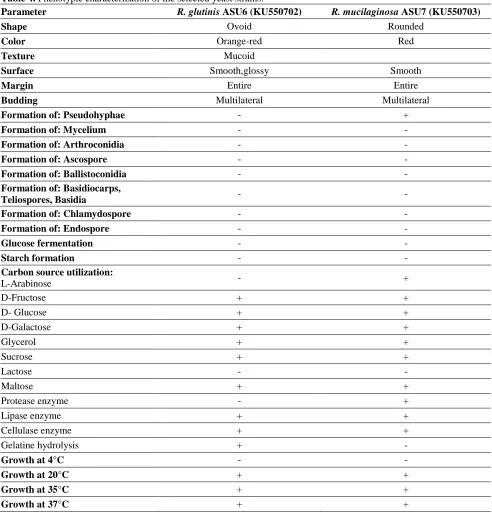
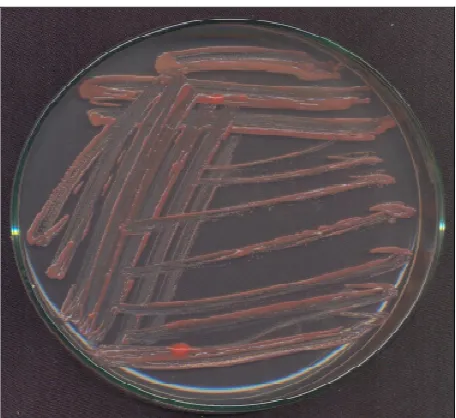
zucchini, banana, and spinach plants. The purified isolates were screened for their ability to produced β-carotene on fermented medium (Table 3). Only two isolates were selected for further characteristics based on the highest β-carotene production. The selected yeast isolates were used for molecular identification using phylogenetic analysis of 18S rRNA gene sequences. The sequence of appro-ximately 577 base pairs of yeast isolate ASU 6 has sequence with 99% similarity to Rhodotorula glutinis AUMC 7774 (JQ425397). Also, the sequen-ce of approximately 581 base pairs of yeast isolate ASU7 has sequence with 99% similarity to Rhodotorula mucilaginosa (KP223715). So, the yeast isolates were identified as Rhodotorula glutinis ASU6 (KU550702) and Rhodotorula mucilaginosa ASU7 (KU550703). Morphological and physiological characteristics of R. glutinis ASU6 (KU550702) and R. mucilaginosa ASU7 (KU550703) were determined and illustrated in Table 4. Only R. glutinis ASU6 (KU550702) was selected based on its highest β-carotene production (42.17 ± 0.4 mg/l) for further experiments (Fig. 1).
Table 3. Screening for β-carotene production on glucose fermented medium using different yeast isolates. Isolate No. Plant β-carotene
(mg/l)
Dry mass (g/l ) ASU 1 Egyptian clover 1.33 ± 0.16 0.44 ± 0.025
ASU 2 Spinach 0 0.19 ± 0.05
ASU 3 Banana 0 0.17 ± 0.02
ASU 4 Egyptian clover 0.39 ± 0.05 0.26 ± 0.02 ASU 5 Maize 8.0 ± 0.28 0.73 ± 0.06 ASU 6 Egyptian clover 42.17 ± 0.4 1.80 ± 0.09 ASU 7 Maize 40.89 ± 0.28 2.10 ± 0.048 ASU 8 Egyptian clover 20.11 ± 0.51 1.39 ± 0.029 ASU 9 Spinach 10.72 ± 0.35 1.48 ± 0.034 ASU 10 Zucchini 4.67 ± 0.44 1.09 ± 0.019 ASU 11 Maize 36.72 ± 0.35 2.27 ± 0.1 ASU 12 Spinach 18.50 ± 0.31 1.13 ± 0.014 ASU 13 Lemon 7.33 ± 0.36 0.91 ± 0.015 ASU 14 Maize 6.22 ± 0.12 0.79 ± 0.08 ASU 15 Maize 4.61 ± 0.18 0.74 ± 0.016 ASU 16 Lemon 1.22 ± 0.2 0.48 ± 0.012 ASU 17 Banana 17.61 ± 0.58 1.57 ± 0.014 ASU 18 Egyptian clover 0.56 ± 0.09 0.95 ± 0.09
ASU 19 Zucchini 0 0.70 ± 0.019
European Journal of Biological Research 2016; 6 (4): 226-241
Table 4. Phenotypic characterization of the selected yeast strains.
Parameter R. glutinis ASU6 (KU550702) R. mucilaginosa ASU7 (KU550703)
Shape Ovoid Rounded
Color Orange-red Red
Texture Mucoid
Surface Smooth,glossy Smooth
Margin Entire Entire
Budding Multilateral Multilateral
Formation of: Pseudohyphae - +
Formation of: Mycelium - -
Formation of: Arthroconidia - -
Formation of: Ascospore - -
Formation of: Ballistoconidia - - Formation of: Basidiocarps,
Teliospores, Basidia - -
Formation of: Chlamydospore - -
Formation of: Endospore - -
Glucose fermentation - -
Starch formation - -
Carbon source utilization:
L-Arabinose - +
D-Fructose + +
D- Glucose + +
D-Galactose + +
Glycerol + +
Sucrose + +
Lactose - -
Maltose + +
Protease enzyme - +
Lipase enzyme + +
Cellulase enzyme + +
Gelatine hydrolysis + -
Growth at 4°C - -
Growth at 20°C + +
Growth at 35°C + +
Growth at 37°C + +
3.2. Effect of aqueous and acid extracts of different plant residues on R. glutinis ASU6 growth and β-carotene production
The effect of aqueous and acid extracts of different plant residues on β-carotene produced by R. glutinis ASU6 (KU550702) was illustrated in Fig. 2A, B. Ten plant wastes were tested as a carbon source for the growth of R. glutinis ASU6 and β-carotene production. The results indicated that acid extracted wastes promote fungal growth
European Journal of Biological Research 2016; 6 (4): 226-241 low production of β-carotene matching 1.56, 2.44,
0.72, 4.3, 4, and 1.83 mg/l β-carotene (aqueous
extract) and 2, 5.61, 1.33, 5.06 and 8.94 mg/l β-carotene (acid extract), respectively. It is
inte-resting to note that onion peels support better growth and β-carotene yield compared to other plant wastes tested. This could be ascribed to the enrichment of onion peels with minerals and carbohydrates (Table 5). The current study clearly proved that R. glutinis ASU6 (KU550702) could grow well on onion wastes and produced a large amount of β-carotene.
Figure 1. Growth of R. glutinis ASU6 (KU550702) on YME medium.
A
B
European Journal of Biological Research 2016; 6 (4): 226-241
Table 5. Chemical analysis of onion waste extract (OWE).
Parameter Unit Value
C/N Ratio 15
Nitrogen (N) ppm 35
Phosphorus (P) ppm 9.68
Potassium (K) ppm 132
Sodium (Na) ppm 369
pH 5.5
E.C. ppm 1049.6
Total carbohydrates mg/g dry weight 553.74
3.3. Plackett-Burman design
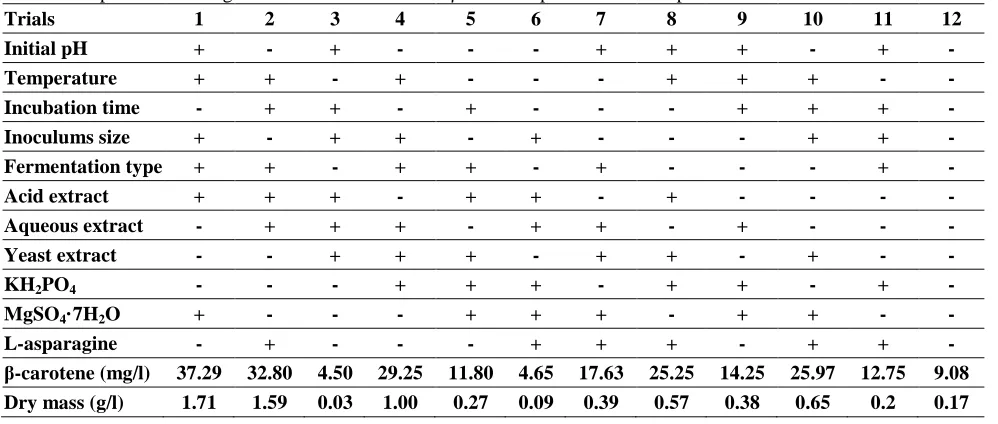
Plackett-Burman design was then employed to screen which variables have significant effects on β-carotene production. Eleven variables, including medium components and culture conditions were investigated (Table 6). All variables were taken at a central-coded value of zero, were screened in Plackett-Burman experiments. The results of the PB experimental design for 12 trials with two levels of each variable and the corresponding β-carotene concentrations were presented in table 6. The data showed that there were wide variations in β-carotene production from (4.5 to 37.3 mg/l) and
also the dry mass (0.03 to 1.7 g/l).The maximum β-carotene production rate was achieved in the
following conditions: temperature 35˚C, pH 6, incu-bation period 48 h, inoculums size 3%, acid extract onion waste material, KH2PO4 0.5 g/l, MgSO4 1 g/l, yeast extract 0.5 g/l and shaking rate at 150 rpm.
The experimental results proved that varying the initial cultivation pH of the medium between pH 4 and 6 had not significant effect on β-carotene production, while temperature had a significant effect on β-carotene production. Fermentation type showing increasing significant effect on vitamin production which indicates that equal aeration is very momentous in the fermentation process and those carotenogenesis is an aerobic process.
The effects of the variables on the response and significant levels were illustrated in Table 7. Based on the statistical analysis, some factors imposed the greatest impacts on the production of β-carotene by R. glutinis ASU6 (KU550702). These factors were identified as (B) temperature, (C) incubation time, (E) fermentation type, (F) acid onion waste extract, (I) KH2PO4 and (K)
L-aspara-gine. These variables were selected for further investigation to optimize their levels by RSM.
3.4. Optimization of medium components and culture conditions by RSM
The variables showing significant effects in the Plackett-Burman design were selected and further optimized using CCD. Also, the levels of the factors chosen were based on data of the Plackett-Burman design. A complete five factor-three-level factorial design were used to optimize the effective parameters on β-carotene production.
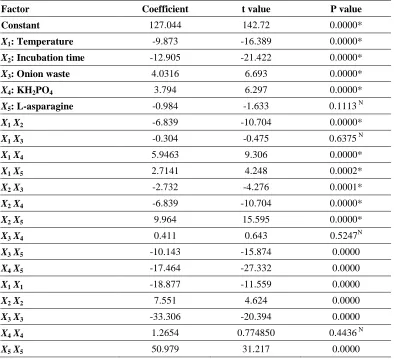
The model gave the following regression equation for the β-carotene production RSM Regression Model: β-carotene (Y) (mg/l) = (127.04) + (-9.87) * X1 + (-12.9) * X2 + (4.03) * X3 + (3.79) * X4 + (-0. 98) * X5 + (-6.84) * X1X2 + (-0.30) * X1X3 + (5.95) * X1X4 + (2.71) * X1X5 + (-2.73) * X2X3 + (-6.84) * X2X4 + (9.96) * X2X5 + (0.4) * X3X4 + (-10.14) * X3X5 + (-17.46) * X4X5 + (-18.88) * X1X1 + (7.55) * X2X2 + (-33.31) * X3X3 + (1.27) * X4X4 + (50.98) * X5X5. (6)
Where, Y a function of temperature (X1), incubation time (X2), onion waste (X3), KH2PO4 (X4) and L-asparagine (X5).
European Journal of Biological Research 2016; 6 (4): 226-241 found to be statistically significant at 95%
confidence level. However, the variable X5 and interaction term X1X3, X3X4 and X4X4 of the model were found to be not significant of which the probability value higher than (0.05).
The statistical model was checked by F-test, and the analysis of variance (ANOVA) for the response surface quadratic model is summarized in Table 9. The adjusted R2 value was 98.53 %. The Model F-value of 94.34 implies that model is highly significant with very low probability value (P < 0.0001). Also, the lack-of-fit is not signi-ficant relative to the pure error (P < 0.0001). The R2 value, being a measure of the goodness of the match of the model, indicated that the 99.07 % of the entire variation was explained by the model.
Figure 3. Comparison between β-carotene (mg/l) experimental and predicted values of the RSM model.
Table 6. Experimental design of Plackett-Burman with β-carotene production as response.
Trials 1 2 3 4 5 6 7 8 9 10 11 12 Initial pH + - + - - - + + + - + - Temperature + + - + - - - + + + - - Incubation time - + + - + - - - + + + - Inoculums size + - + + - + - - - + + - Fermentation type + + - + + - + - - - + - Acid extract + + + - + + - + - - - - Aqueous extract - + + + - + + - + - - - Yeast extract - - + + + - + + - + - - KH2PO4 - - - + + + - + + - + - MgSO4·7H2O + - - - + + + - + + - - L-asparagine - + - - - + + + - + + -
β-carotene (mg/l) 37.29 32.80 4.50 29.25 11.80 4.65 17.63 25.25 14.25 25.97 12.75 9.08 Dry mass (g/l) 1.71 1.59 0.03 1.00 0.27 0.09 0.39 0.57 0.38 0.65 0.2 0.17
Table 7. Statistical analysis of Plackett-Burman design for β-carotene production by R. glutinis. Variable Degree of
freedom
β-carotene (mg/l)
% increase (+) or decrease (-) Significance level
A - Initial pH 1 -0.31 0.98 NS
B - Temperature 1 17.4 < 0.05* C - Incubation time 1 -3.51 < 0.05* D - Inoculums size 1 0.60 0.73 NS E - Fermentation type 1 9.64 < 0.05* F - Onion waste: Acid extract 1 -3.18 < 0.05* G - Onion waste: Aqueous extract 1 1.23 0.35 NS
H - Yeast extract 1 0.59 0.75 NS
I - KH2PO4 (g/l) 1 -4.89 < 0.05* J - MgSO4.7H2O 1 -0.34 0.63 NS K - L-asparagine 1 2.148 < 0.05*
Model 12 12.51 0.00 *
European Journal of Biological Research 2016; 6 (4): 226-241
Table 8. Estimated regression coefficient, t-test and P values for optimization of β-carotene using of the central-composite design.
Factor Coefficient t value P value Constant 127.044 142.72 0.0000*
X1: Temperature -9.873 -16.389 0.0000*
X2: Incubation time -12.905 -21.422 0.0000*
X3: Onion waste 4.0316 6.693 0.0000*
X4: KH2PO4 3.794 6.297 0.0000*
X5: L-asparagine -0.984 -1.633 0.1113 N
X1 X2 -6.839 -10.704 0.0000*
X1 X3 -0.304 -0.475 0.6375
N
X1 X4 5.9463 9.306 0.0000*
X1 X5 2.7141 4.248 0.0002*
X2 X3 -2.732 -4.276 0.0001*
X2 X4 -6.839 -10.704 0.0000*
X2 X5 9.964 15.595 0.0000*
X3 X4 0.411 0.643 0.5247
N
X3 X5 -10.143 -15.874 0.0000
X4 X5 -17.464 -27.332 0.0000
X1 X1 -18.877 -11.559 0.0000
X2 X2 7.551 4.624 0.0000
X3 X3 -33.306 -20.394 0.0000
X4 X4 1.2654 0.774850 0.4436
N
X5 X5 50.979 31.217 0.0000
t - student's test, p - corresponding level of significance,* significant at p ≤0.05, N, non-significant at p≥0.05
Table 9. Analysis of variance (ANOVA) for the selected quadratic model.
Source Degree of freedom Sum of squares Mean square F-value P-value Model 20 48486 2424.3 185.56 <0.0001
Error 35 457.25 13.064
Lack of Fit 6 369.82 61.637 20.444 <0.0001 Pure Error 29 87.431 3.015
Total (Model + Error) 55 48943 889.87
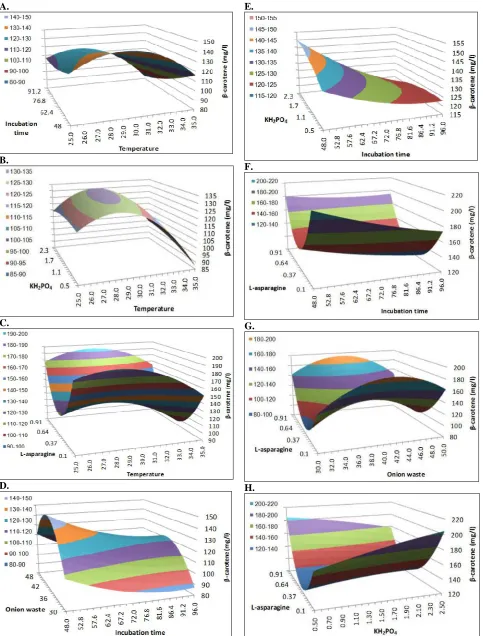
In order to determine the optimal levels of each variable for maximum β-carotene production, the three-dimensional plots were constructed by plotting the response against each of the two independent variables, while maintaining the third variable at fixed (zero) level. The response surface plots of the effects of temperature (X1), incubation time (X2), onion peels (X3), KH2PO4 (X4) and L-asparagine (X5) on β-carotene production were illustrated in Fig. 4 (A-H). The patterns of the
response surface plots indicate the nature and extent of the interactions. Additionally, from the bump of the three-dimensional plot, the optimal composition of the medium components was identified. Meanwhile, the optimal concentrations
European Journal of Biological Research 2016; 6 (4): 226-241
A.
B.
C.
D.
E.
F.
G.
H.
Figure 4. Response surface plots of β-carotene production by Rhodotorula glutinis (KU550702) showing the effect of two variables (other variables were kept at zero in coded unit): significant interaction between (A) Temperature and Incubation time (B) Temperature and KH2PO4, (C) Temperature and L-asparagine, (D) Incubation time and Onion waste,
(E) Incubation time and KH2PO4, (F) Incubation time and L-asparagine, (G) Onion waste and L-asparagine, (H) KH2PO4
European Journal of Biological Research 2016; 6 (4): 226-241 4. DISCUSSION
Yeast growth and β-carotene production by Rhodotorula glutinis ASU6 (KU550702) were largely impressed by the type of plant waste. Acid extract of onion waste represents the most efficient carbon source for β-carotene production (27.4 mg/l). Pretreatment is a mandatory step before biopro-cessing the lignocelluloses for further purposes in order to increase the digestibility of lignocelluloses structure, by increasing the bioavailability of the carbohydrates (cellulose and hemicellulose) for subsequent bioprocesses [38]. The liquid fraction of biomass from the pretreatment, which contains carbohydrates in polymeric and monomeric forms originating from the breakdown of hemicelluloses, is considered the most optimal solution. Neverthe-less, due to the rich carbohydrate composition, this waste stream has the potential to be utilized as well as a nutritional source for cultivating red yeast strains, resulting in the production of different groups of metabolites [39].
The presence of a suitable carbon source is important for carotenoid biosynthesis. Rhodotorula species have potential commercial value as a dietary source of natural carotenoids; however, the high cost of production limits the use of these yeasts. Different agro-industrial raw materials that cause rigorous environmental problems may be possibly used as low-cost carbohydrate sources, with the perspective of minimizing production cost and environmental problems [40, 41]. Various natural substrates were tested as carbon sources for carotenoid production, such as: grape must [42]; hydrolyzed mung bean waste flour [43]; sugarcane and sugar-beet molasses [44, 45]; corn syrup [46]; milk whey [41].
Rhodotorula glutinis could produce 70 mg/l β-carotene after 48-h fermentation [47], 201 µg/l after 24-h fermentation on radish brine pH 6 [37]. Sporobolomyces roseus was produced 1.23-1.56 mg/g of β-carotene on pretreated wheat straw [39]. Candida utilis was produced 0.4 mg per g (dry weight) of cells [48]. Saccharomyces cerevisiae recorded the highest β-carotene yield (50.39 mg/l) on fermentation medium supplemented with glucose (1.40 mg/l/h) [49] and the yeast dry weight was 5.9 mg/g. The carotenoid-producing yeast Xantho-phyllomyces dendrorhous was introduced and over
expressed in S. cerevisiae [50]. The current study clearly proved that R. glutinis ASU6 (KU550702) could grow well on onion wastes and produced a large amount of β-carotene.
In this study, Plackett-Burman design was then employed to screen which variables have significant effects on β-carotene production. Wide variations in β-carotene production from (4.5 to 37.3 mg/l) and also the dry mass (0.03 to 1.7 g/l). The maximum β-carotene production rate was achieved in the following conditions: temperature 35˚C, pH 6, incubation period 48 h, inoculums size 3%, acid extract onion waste material, KH2PO4 0.5 g/l, MgSO4 1 g/l, yeast extract 0.5 g/l and shaking rate at 150 rpm. Carotenoid production depends on differences between strains of the same species and is strongly influenced by the cultivation conditions [41]. The red yeast is capable to grow under a wide range of initial pH conditions from 2.5 to 9.5 and over a wide range of temperatures from 5 to 26°C [51, 52]. Temperature is another important factor affecting the performance of cells and product formation. The effect of temperature depends on the species specificity of the microorganism and often manifests itself in quantity variations of synthesized carotenoids. It was reported that lower temperatures (25°C) seemed to favor synthesis of β-carotene and torulene, whereas higher temperatures (35°C) positively influenced torularhodin synthesis by R. glutinis [41, 42]. Fermentation type showing increasing significant effect on vitamin production which indicates that equal aeration is very momentous in the fermentation process and those carotenogenesis is an aerobic process. The effect of aeration is dependent on the species of the microorganism. The reported optimal values of air flow rate and agitation are in the range 0.5-1.9 l/min and 180-900 rpm for carotenogenesis in Rhodo-torula. The aeration influenced not only the amount of carotenoids produced, but also the composition of individual pigments making up the total carotenoids. At higher aeration, the concentration of total carotenoids increased relative to the biomass and fatty acids in R. glutinis. In contrast, Sporobolo-myces roseus responds to enhance aeration by a shift from the predominant β-carotene to torulene and torularhodin [41, 53].
European Journal of Biological Research 2016; 6 (4): 226-241 and further optimized using CCD. The values of
β-carotene produced by R. glutinisASU6 (KU550 702) ranged from 85.71 to 204.29 mg/l. The optimal concentrations for enhancement the production of β-carotene by R. glutinis ASU6 (KU550702) were: onion waste 50 (g/l); yeast extract 1.5 (g/l); KH2PO4 2.5 (g/l); MgSO4·7 H2O 0.5 (g/l), L-asparagine 0.1 (g/l), incubation for 48 h at 35˚C. It was demonstrated the powerful advantage of RSM for the optimization of medium components and culture conditions to achieve vitamin production from microorganisms [54]. A face-centered central com-posite design was applied to optimize a cultivation condition for improved β-carotene production by Rhodotorula glutinis DM28 fermented radish brine as a sole substrate, yielded 2.7 g/l biomass and the maximum β-carotene of 201 µg/l after 24-h [37].
5. CONCLUSIONS
The current study proved that the possibility of utilizing onion peels as an economical source for yeast β-carotene production. The major objective of this research was the development of a statistical approach to modeling and optimization of
condi-tions and medium composition for producing β-carotene. After two optimization stages the
production increased with a 7.5-fold increase in β-carotene production (204.29 mg/l) compared to
the production of the original level (27.4 mg/l) when using: onion peels 50 (g/l); yeast extract 1.5
(g/l); KH2PO4 2.5 (g/l); MgSO4·7 H2O 0.5 (g/l), L-asparagine 0.1 (g/l), incubation for 48h at 35˚C
which indicated that using statistical experimental designs is very effective in increasing production.
AUTHORS’ CONTRIBUTION
MMKB: Supervision, revision and editing. MHA: Supervision, revision and editing. FMM: Participate in research design, revision and editing. NAN: Participate in research design, revision and editing. GAM: Designed, recorded the experimental data and wrote the research. The final manuscript has been read and approved by all authors.
TRANSPARENCY DECLARATION
The authors declare no conflicts of interest.
REFERENCES
1. Kim SW, Sco WT, Park YH. Enhanced synthesis of trisporic acids and β-carotene production in
Blakeslea trispora by addition of non-ionic
surfactant, Span 20. J Ferment Bioeng. 1997; 84: 330-332.
2. Das A, Yoon S, Lee S, Kim J, Oh D, Kim S. An update on microbial carotenoid production: application of recent metabolic engineering tools. Appl Microbiol Biotechnol. 2007; 77: 505-512. 3. Britton G, Liaaen-Jensen S, Peander H. Carotenoids.
Volume 4: Natural Functions. Basel-Boston-Berlin: Birkhäuser Verlag, 2008.
4. Nelis HJ, de Leenheer AP. Microbial sources of carotenoid pigments used in foods and feeds. J Appl Microbiol. 2008; 70(3): 181-191.
5. Mata-Gómez LC, Montañez JC, Méndez-Zavala A, Aguilar CN. Biotechnological production of carotenoids by yeasts: an overview. Micro Cell Fact. 2014; 13(1): 1.
6. Johnson EA, Schroeder WA. Microbial carotenoids. In: Fiecher A. Volume 53. Springer Verlage, Heidelberg. Adv Bioch Eng Biotech. 1995: 119-178. 7. Rosa C, Peter G. Biodiversity and ecophysiology of yeasts (The yeast handbook). Springer, Berlin, Heidelberg, New York, 2005.
8. Marova I, Breierova E, Certik M. Production of enriched biomass by carotenogenic yeasts-application of whole-cell yeast biomass to production of pigments and other lipid compounds. INTECH Open Access Publisher, 2011.
9. Yurkov AM, Vustin MM, Tyaglov BV, Maksimova IA, Sineokiy SP. Pigmented basidiomycetous yeasts are a promising source of carotenoids and ubiquinone Q 10. Microbiology. 2008; 77(1): 5-10. 10. Fell JW, Boekhout T, Fonseca A, Scorzetti G,
Statzell-Tallman A. Biodiversity and systematics of basidiomycetous yeasts as determined by large-subunit rDNA D1/D2 domain sequence analysis. Int J Syst Evol Microbiol. 2000; 50: 1351-1371. 11. Yeeh Y. Rhodotorula sp. In: Robinson RK, Batt CA,
Patel PD. (eds). Encyclopedia of food microbiology. Academic Press London, 2000: 1900-1905.
12. Frengova G, Emilina D, Dora M. Improvement of carotenoid-synthesizing yeast Rhodotorula rubra by chemical mutagenesis. Biotechnol Bioengin. 2004; 59: 99-103.
13. Makkar RS, Cameotra SS, Banat IM. Advances in utilization of renewable substrates for biosurfactant production. AMB Express. 2011; 1: 5.
14. Lin Y, Tanaka S. Ethanol fermentation from biomass resources: current state and prospect. Appl Microbiol Biotechnol. 2006; 69: 627-642.
15. Benitéz V, Molla E, Martin-Cabrejas MA, Aguilera Y, Lopez-Andreu FJ, Cools K, et al. Characterization of industrial onion wastes (Allium
cepa L): Dietary fiber and bioactive compounds.
European Journal of Biological Research 2016; 6 (4): 226-241
16. Davis F, Terry LA, Chope GA, Faul CF. Effect of extraction procedure on measured sugar concentrations in onion (Allium cepa L.) bulbs. J Agric Food Chem. 2007; 55(11): 4299-4306. 17. Naik PK. Quantification of induced roll magnetic
separation of mineral sands. Scand J Metall. 2002; 31: 367-373.
18. Naik PKS, Das SC. Extraction of manganese from low grade Nishikhal ore using pyritiferous lignite in acidic medium. Miner Metall Process. 2002; 19: 110-112.
19. Revankar MS, Lele SS. Increased production of extracellular laccase by the white rot fungus
Coriolus versicolor MTCC138. World J Microbiol
Biotechnol. 2006; 22: 921-926.
20. Azizi D, Gharabaghi M, Saeedi N. Optimization of the coal flotation procedure using the Plackett-Burman design methodology and kinetic analysis. Fuel Processing Technol. 2014; 128:111-118. 21. Deshmukh DV, Puranik PR. Application of
Plackett-Burman design to evaluate media components affecting antibacterial activity of alkaliphilic cyanobacteria isolated from Lonar Lake. Turk J Bioch. 2010; 35: 114-120.
22. Prabha MS, Divakar K, Priya JD, Selvam GP, Balasubramanian N, Gautam P. Statistical analysis of production of protease and esterase by a newly isolated Lysinibacillus fusiformis AU01: purification and application of protease in sub-culturing cell lines. Ann Microbiol. 2014; 65: 33-46.
23. Nancib A, Nancib N, Boubendir A, Boudrant J. The use of date waste for lactic acid production by a fed-batch culture using Lactobacillus casei subsp. rhamnosus. Braz J Microbiol. 2015; 46(3): 893-902. 24. Lenihan P, Orozco A, Neill EO, Ahmad MNM,
Rooney DW, Walker GM. Dilute acid hydrolysis of lignocellulosic biomass. Chem Engr J. 2010; 156(2): 395-403.
25. Bacha U, Nasir M, Khalique A, Anjum AA, Jabbar MA. Comparative assessment of various agro-industrial wastes for Saccharomyces cerevisiae biomass production and its quality evaluation as single cell protein. J Anim Plant Sci. 2011; 21(4): 844-849.
26. Fales FW. The estimation and degradation of carbohydrates by yeast cell. Biol Chem. 1951; 193: 113-118.
27. Schlegel HG. Die verwertung organischer sauren duch Chlorella in licht Planta. 1956; 117: 510-526. 28. Kurtzman CP, Fell JW. The yeasts. A taxonomic
study. 4th edn. Elsevier, Amsterdam, 2011: 77-100. 29. Harju S, Fedosyuk H, Peterson KR. Rapid isolation
of yeast genomic DNA: Bust n’ Grab. BMC Biotechnol. 2004; 4: 8.
30. Choudhari S, Singhal R. Media optimization for the production of β-carotene by Blakeslea trispora: a statistical approach. Biores Technol. 2008; 99: 722-730.
31. Plackett RL, Burman JP. The design of optimum multifactorial experiments. Biometrika. 1947; 33: 305-325.
32. Naveena BJ, Altaf M, Bhadriah K, Reddy G. Selection of medium components by Plackett-Burman design for production of (+) lactic acid by
Lactobacillus amylophilus GV6 in SSF using wheat
bran. Biores Technol. 2005; 96: 485-490.
33. Khuri AI, Cornell JA. Response surface methodology. New York: ASQC Quality press. 1978.
34. Choudhari SM, Ananthanarayan L, Singhal RS. Use of metabolic stimulators and inhibitors for enhanced production of β-carotene and lycopene by Blakeslea
trispora NRRL 2895 and 2896. Biores Technol.
2008; 99: 3166-3173.
35. Davis WB. Preparation of lycopene from tomato paste for use as a spectrophotometric standard. Anal Chem. 1949; 21: 1226-1228.
36. Nguyen AD, Kim YG, Kim SB, Kim CJ. Improved tolerance of recombinant Escherichia coli to the toxicity of crude glycerol by overexpressing trehalose biosynthetic genes (otsBA) for the production of β-carotene. Biores Technol. 2013; 143: 531-537.
37. Malisorn C, Suntornsuk W. Optimization of β -carotene production by Rhodotorula glutinis DM28 in fermented radish brine. Biores Technol. 2009; 99: 2281-2287.
38. Panagiotou G, Olsson L. Effect of compounds released during pretreatment of wheat straw on microbial growth and enzymatic hydrolysis rates. Biotechnol Bioeng. 2007; 96: 250-258.
39. Petrik S, Kádár Z, Márová I. Utilization of hydrothermally pretreated wheat straw for production of bioethanol and carotene-enriched biomass. Biores Technol. 2013; 133: 370-377. 40. Akusu Z, Eren AT. Production of carotenoids by the
isolated yeast of Rhodotorula glutinis. Biochem Eng J. 2007; 35(2): 107-113.
41. Frengova GI, Beshkova DM. Carotenoids from
Rhodotorula and Phaffia: yeasts of biotechnological
importance. J Ind Microbiol Biotechnol. 2009; 36(2): 163-180.
42. Buzzini P, Martini A. Production of carotenoids by strains of Rhodotorula glutinis cultured in raw materials of agro-industrial origin. Biores Technol. 2000; 71: 41-44.
43. Tinoi J, Rakariyatham N, Deming RL. Simplex optimization of carotenoid production by
Rhodotorula glutinis using hydrolyzed mung bean
waste flour as substrate. Process Biochem. 2005; 40(7): 2551-2557.
European Journal of Biological Research 2016; 6 (4): 226-241
45. Akusu Z, Eren AT. Carotenoids production by the yeast Rhodotorula mucilaginosa: use of agricultural wastes as a carbon source. Process Biochem. 2005; 40(9): 2985-2991.
46. Buzzini P. Batch and fed-batch carotenoid production by Rhodotorula glutinis - Debaryomyces
castellii co-cultures in corn syrup. J Appl
Microbiol. 2001; 90(5): 843-847.
47. Bhosale P, Gadre RV. Production of β-carotene by a
Rhodotorula glutinis mutant in sea water medium.
Biores Technol. 2001; 76: 53-55.
48. MiuraY, Kondo K, Saito T, Shimada H, Fraser PD, Misawa N. Production of the carotenoids lycopene, b-carotene, and astaxanthin in the food yeast
Candida utilis. Appl Environ Microbiol. 1998;
64(4): 1226-1229.
49. Luo H, Niua Y, Duana C, Sub H, Yana G. A pH control strategy for increased β-carotene production during batch fermentation by recombinant industrial wine yeast. Process Biochem. 2013; 48: 195-200. 50. Verwaal R, Wang J, Meijnen J, Visser H, Sandmann
G, van den Berg JA, van Ooyen AJ. High-level production of beta-carotene in Saccharomyces
cerevisiae by successive transformation with
carotenogenic genes from Xanthophyllomyces dendrorhous. Appl Environ Microbiol. 2007;
73(13): 4342-4350.
51. Latha B, Jeevaratnam K, Murali HS, Manja KS. Influence of growth factors on carotenoid pigmentation of Rhodotorula glutinis DFR-PDY from natural source. Ind J Biotechnol. 2005; 4: 353-357.
52. Libkind DM, Gadanho M, Broock V, Sampaio JP. Studies on the heterogeneity of the carotenogenic yeast Rhodotorula mucilaginosa from Patagonia, Argentina. J Basic Microbiol. 2008; 48(2): 93-98. 53. Davoli P, Mierau V, Weber RWS. Carotenoids and
fatty acids in red yeasts Sporobolomyces roseus and
Rhodotorula glutinis. Appl Biochem Microb. 2004;
40(4): 392-397.
54. Nafady NA, Bagy MMK, Abd-Alla MH, Morsy FM, Mahmoud GA. Improvement of medium components for high riboflavin production by
Aspergillus terreus using response surface
of Biological Research
European Journal of Biological Research 2016; 6 (4): 242-253
Aspergillus terreus
occurrence in middle of Upper
Egypt, genetic variation and production of itaconic
and mevinolinic acids
Hassan A. H. Hasan
1, Ameer E. Elfarash
2, Khaled A. E. Abdrabo
1*
1
Botany and Microbiology Department, Faculty of Science, Assiut University, Assiut, Egypt
2
Genetic Department, Faculty of Agriculture, Assiut University, Assiut, Egypt *Corresponding author: Khaled A. E. Abdrabo; E-mail: [email protected]
ABSTRACT
Several isolates of Aspergillus terreus were identified and isolated as fungal flora from sixty-four out of seventy screened sources in middle of Upper Egypt. A. terreus was common in plant roots (dill, geranium and petunia) and soil cultivated with plants (basil, bougainvillea, fababean and wheat). Class of cultivated soil comprised the highest prevalence percentage (46%) of A. terreus followed by plant roots (30%). Soil cultivated with basil represented the main source of A. terreus prevalence (15%) and sesame seeds represented the highest occurrence. According to the potentiality of different A. terreus isolates for mevinolinic acid yield, 105 isolates (out of 152 isolates) were producers. They were grouped into 4 categories according to their production level of itaconic (IA) and mevinolinic (MA). The isolates that higher producers of IA were lower producers of MA and Vice versa, compared to A. terreus FRR 5360. Only one isolate (ATWD 136) had ability to produce both acids in higher level than FRR 5360 strain. The isolates that contain cadA (IA gene) are containing lovB (MA gene) and vice versa. This confirms that itaconic acid genomic region is directly linked to mevinolinic acid gene cluster. RAPD-PCR indicated
that the isolates were genetically distinct and differed from each other.
Keywords: A. terreus; cadA; Itaconic; lovB; Mevinolinic; RAPD-PCR.
1. INTRODUCTION
Middle of Upper Egypt (Assiut and Sohag governorates), located between 26° and 28°N latitude in Northeast of African continent, have been considered to be among the oldest cities on Earth, where no rainfall during the year. Aspergillus terreus belongs to Aspergillus section Terrei [1]; is a common soil saprophyte [2]. Strains of this cosmopolitan species are frequently isolated from desert and grassland soils and compost heaps, and as contaminants of plant products like stored corn, barley and peanuts [3]. Aspergillus terreus is widely used in the industrial production of important chemical compounds. Some strains of A. terreus are unique in producing both itaconic and mevinolinic acids, because they contain the 2 gene clusters of the acids. Aspergillus terreus was known to be the best species for itaconic [4-5] and mevinolinic acids [6-7] production among the different fungal species studied.
Received: 20 August 2016; Revised submission: 22 September 2016; Accepted: 29 September 2016
Copyright: © The Author(s) 2016. European Journal of Biological Research © T.M.Karpiński 2016. This is an open access article licensed under the terms of the Creative Commons Attribution Non-Commercial 4.0 International License, which permits
European Journal of Biological Research 2016; 6 (4): 242-253
In the A. terreus genome, the itaconic acid gene cluster "cadA gene" is located close to the mevinolinic acid gene cluster "LNKS gene"[8]. Interestingly this itaconic acid genomic region is directly linked to lovastatin gene cluster [9], suggesting that a link between both pathways, which are apparently specific for A. terreus. Bhargavi et al. [10] reported that the lack of lovastatin production may be due to the absence of lovastatin encoding DNA sequences that are identical or homologous to lovastatin gene present in lovastatin producing organism.
However, A. terreus was known to be the best species for itaconic and mevinolinic acids production among the different fungal species studied, but there were no comprehensive studies about the ability of Egyptian isolates from diverse sources in middle of Upper Egypt, for itaconic (IA) and mevinolinic (MA) acids production. The objective of our study was collecting 70 different sources for isolation of A. terreus, screening for their IA and MA production, presence of the main responsible related cadA and lovB genes and genetic fingerprinting compared to A. terreus FRR 5360.
2. MATERIALS AND METHODS
2.1. Isolation and identification of A. terreus from different sources
Seventy different sources were collected in this investigation from Assiut and Sohag cities (middle of Upper Egypt) during 2014 (Table, 2). The dilution-plate method described by Johnson and Curl, [11] was employed for isolation of A. terreus on two types of culture media (Glucose-Czapek’s agar and Malt extract agar). Amphotericin B (66 mg/l) was added to sterile medium after autoclaving as fungicide to avoid other fungal genera than A. terreus [12]. The developing A. terreus colonies were examined microscopically, counted and identified according to Raper and Fennell [13] and Samson et al. [14]. Confirmation study by assaying mevinolinic acid was done according to Lingappa et al. [15].
2.2. Screening for mevinolinic acid production
A total of one hundred and fifty-two isolates of A. terreus were screened for mevinolinic acid potentialities. The strain of A. terreus FRR 5360 (Obtained from FRR culture collection at CSIRO Animal, Food and Health sciences, Australia) that represents the parent strain of mevinolinic acid was used as standard (reference) strain. Lactose based medium (LBM) was used for mevinolinic acid production according to Lopez et al. [16] with some modification which containing lactose, 20; yeast extract, 8; KH2PO4, l.5; MgSO4.7H2O, 1.5; NaCl, 0.4; ZnSO4,0.001; FeSO4, 0.002; CuSO4, 0.004 g in liter of distilled water and pH was adjusted at pH 6.0. Surface cultivation process was carried out in 100 mL Erlenmeyer flask containing 20 mL media. Each flask was inoculated with one mL spore suspension and incubated at 30˚C for 12 d. At the end of incubation period, each flask (medium and mycelia) was acidified to pH 3.0 by using 1M HCl and then extracted with addition of equal volume of ethyl acetate according to Samiee et al. [6]. The organic phase was separated and concentrated. TLC was used for screening of MA production. The plates were developed in a solvent system of cyclohexane: acetone: chloroform (15:5:4, v/v/v). Each spot was scrapped, dissolved in 5 mL of methanol, vortex, centrifuged and the supernatant was measured spectrophotometrically at 238 nm and the concentration was determined based on standard curve of pure lovastatin according to the method described by Lingappa et al. [15].
2.3. Screening for itaconic acid production
European Journal of Biological Research 2016; 6 (4): 242-253
35⁰C for 7 d. The itaconic acid production was
determined spectrophotometerically at 385 nm according to Hartford [17] and confirmed by Friedkin bromination method. The produced itaconic acid concentrations were then determined from standard graph of pure itaconic acid.
2.4. PCR amplification
The PCR was used not only to screen the presence of cadA and lovB genes, but also to perform the RAPD-PCR analyses with primers listed in Table 1. Firstly, the DNA isolation was performed according to Saghai-Maroof et al. [18] then used for PCR. RAPD-PCR was used to study genetic differences (Genetic fingerprinting) between the isolates of A. terreus using four random Oligonucleotide primer sequences.
The polymerase chain reaction was carried out in a cycler Sensoquest Gradient (Germany). The reaction was conducted in a final volume of 25 µL containing: 1× concentrated PCR buffer (containing 20 mM Tris-HCl, pH 8.4, 1.5 mM MgCl2, and 50 mM KCl), 100 nM primers, 0.2 mM dNTP mix, 1 U Taq polymerase (Thermo Scientific, Fisher Scientific - USA) and 3 µL of DNA solution. The optimized temperature and time profile of the PCR
reaction was as follows: Initial denaturation: 94°C, 5 min; 30 cycles with the following step cycle profile: denaturation 94°C, 30 s; annealing (30-59°C), 30 s; extension 72°C, 1 min; final extension 72°C, 5 min.
PCR products were separated by electro-phoresis in 1% agarose gel in TAE buffer 1× concentrated and stained with Ethidium Bromide (0.5 µg/mL). The PCR product was calibrated using SmartLadder (Eurogentec) which covers a range of DNA fragment ranging in size between 200 bp and 10,000 bp to determine the molecular weights of the amplicons. Gels were visualized and photographed.
Agarose gel photos were analyzed by the Gene Profiler 4.03 software to record the presence (1) or the absence (0) of the bands (results are not shown). After, The MVSP software (Multi-Variate Statistical Package) was used to find out the genetic similarities using the Dice coefficient of similarity of Nei and Li [19]. Results were then represented as a dendrogram for allover primers.
2.5. Statistical analysis of the results
The data obtained were statistically analyzed for standard deviation using EXCEL by one-way ANOVA.
Table 1. Used primer for cadA and lovB genes amplification and random primers for RAPD-PCR analyses.
Primers Tm
Detection of cadA gene cadA-Fw (CTGTTGCAGCAGCCATGACC)
cadA-Rv GCCGTTGTTCAAGAGGTCCG) 59
Detection of lovB gene lovB-Fw (GCCTTCCAGACTGTCATCGG)
lovB-Rv (TGGAACAGGGTGGTCTGCTC). 59
RAPD-PCR analyses
r1302.1 (5'-GGAAATCGTG -3'), OPP-2 (5'-TCGGCACGAC-3'), OPM-13 (5'-GGTGGTTAAC-3') r34 (5'-GTCACCGGA -3')
30 30 30 30
3. RESULTS AND DISCUSSION
Several isolates of A. terreus were identified and isolated as fungal flora from seventy various sources collected from Assiut and Sohag cities (middle of Upper Egypt). They were isolated from media contain Amphotericin B fungicide that avoid other fungal genera than A. terreus according
to Dannaoui et al. [12]. The developing colonies were re-grown on glucose-Czapek's agar and malt extract agar for macromorphological observations and examined microscopically according to Raper and Fennell [13] and Samson et al. [14]. The other species belong to Aspergillus section Terrei (if found) were not counted or isolated.