Available Online at www.ijpret.com 833
INTERNATIONAL JOURNAL OF PURE AND
APPLIED RESEARCH IN ENGINEERING AND
TECHNOLOGY
A PATH FOR HORIZING YOUR INNOVATIVE WORK
A SYSTEM TO FILTER UNWANTED MESSAGES FROM OSN USER WALLS
SHALAKHA POTDARStudent (ME), CSE Department, Government College of Engineering, Aurangabad. Accepted Date: 05/03/2015; Published Date: 01/05/2015
Abstract: OSN (Online Social Network) is most popular in today’s rich communication world. One fundamental issue in today’s Online Social Networks (OSNs) is to give users the ability to control the messages posted on their own private space to avoid that unwanted content is displayed. Up to now, OSNs provided very little support to this requirement. To fill all the gap, we propose a system allowing OSN users to have a direct control on the messages posted on their walls. The aim of the present work is therefore to propose and experimentally evaluate an automated system, called Filtered Wall (FW), able to filter unwanted messages from OSN user walls. This can be achieved through a flexible rule based system that allows users to customize the filtering criteria to be applied to their walls and a machine learning based soft classifier which automatically produces membership labels in support of content based filtering.
Keywords: OSN (Online Social Network), Content Based Filtering, Filtered Wall Architecture, Short Text classifiers, Blacklists.
Corresponding Author: MISS. SHALAKHA POTDAR
Access Online On:
www.ijpret.com
How to Cite This Article:
Shalakha Potdar, IJPRET, 2015; Volume 3 (9): 833-840
Available Online at www.ijpret.com 834 INTRODUCTION
Today in the internet world the most popular medium to communicate share and distribute any information on On-line Social Network sites. As the usage of OSN is spreading rapidly and widely, there is need to develop more security mechanism to prevent unwanted messages on user walls. The user receives all messages posted by the users he follows due to lack of classification of filtering tools. By filtering out unwanted messages, the filtering tools give users the ability to automatically control the messages written on their own walls. OSNs eg. Facebook, allows to choose who is permitted to insert message in their walls but no content – based preferences are available and hence it is not possible to prevent unwanted messages. The aim of the present work is to design and evaluate system which provides content-based message filtering for OSNs. This filtering can be achieved through Machine Learning (ML) text categorization technique. ML text categories automatically assign with each short text a set of categories based on its contents.
I.RELATED WORK
The main contribution of this paper is the design of a system providing customizable content based message filtering for OSN, based on ML techniques our work has relationships both with the state of art in content-based filtering as well as with the field of policy-based personalization for OSNs. Therefore survey of literature in both these fields is done here.
A. Content Based Filtering
Available Online at www.ijpret.com 835 B. Policy Based Personalization Of OSN Contents
A classification method has been proposed to categorize short text messages in order to avoid overwhelming users of microblogging services by raw data. The user can view only certain types of content based on his/her interest as system described associates a set of categories depending on the contents. In contrast Golbeck and Kuter propose an application called Film Trust, which exploits OSN trust relationships and provenance information to personalize access to the website. However, such system do not provide a filtering policy layer by which the user can use the result of the classification process to decide how and to which extent filtering out unwanted information. Our filtering policy language permits the settings of FR, according to a variety of criteria that do not consider only the result of classification process but also the relationships of the wall owner with other OSN users as well as information on the user profile. Furthermore, our system provides an opportunity of customization to the filtering procedure as it is matched by a flexible mechanism for BL administration.
Our work also takes inspiration from many access control models and related policy languages and enforcement mechanism that have been proposed so far for OSNs as filtering shares many similarities with access control. As we are dealing with filtering out unwanted text instead of with access control which is one of the key elements of our system is the accessibility of a description for the message contents to be exploited by the filtering method. Our policy language has some associations with the policy structures that have been so far proposed to support the specification and enforcement of policies expressed in terms of constraints on the machine understandable resource descriptions provided by Semantic Web language.
II.FILTERED WALL ARCHITECTURE
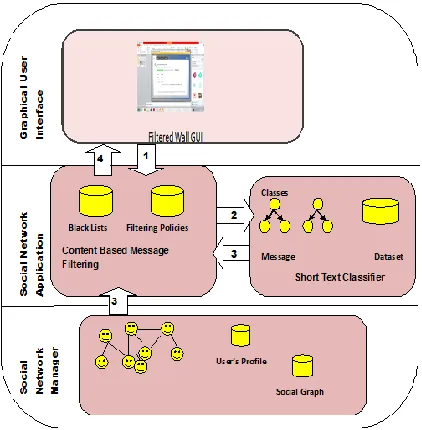
The architecture in support of OSN is a three tier structure as shown in above figure. These three layers are
A) Social Network Manager (SNM)
B) Social Network Application (SNA)
Available Online at www.ijpret.com 836 Fig. 1. Architecture of Filtered Wall
A) Social Network Manager (SNM)
This layer provides the essential OSN functionalities. It also maintains all the data regarding to the user profile. After maintenance and administration of all users data is provided for second layer for applying Filtering Rule (FR) and Black List (BL)
B) Social Network Application (SNA)
In this layer Content Based Message Filtering (CMBF) and Short Text Classifier is composed. This is very important layer for the message categorization according to its CMBF filtering. Black list is also maintained for the user who sends frequently bad words in message.
C) Graphical User Interface (GUI)
GUI is the third layer which provides Graphical User Interface to the user who wants to post his message as a input. Here Filtering Rules (FR) are used to filter the unwanted messages and provide Black List (BL) for the user who are temporally prevented to publish messages on user’s wall. As graphically described in Fig. 1 the path pursued by a message, this can be summarized as follows:
Available Online at www.ijpret.com 837 2. A ML- based text classifier extracts metadata from the content of the message.
3. FW uses metadata provided by the classifier, mutually with data exhorted from the social graph and user’s profiles, to implement the filtering and BL rules
4. Depending on the result of the previous step, the message will be available or filtered by FW.
III. SHORT TEXT CLASSIFIER
Established techniques used for text classification work well on datasets with large documents such as newswires corpora but suffer when the documents in the corpus are very less. In this context, critical aspects are the definition of a set of characterizing and discriminant features allowing the representation of underlying concepts and the collection of a complete and consistent set of supervised examples. The aim of our study is designing and evaluating various representation techniques in combination with a neural learning strategy to semantically categorize short texts. From a ML point of view ,we approach the task by defining a hierarchical two-level strategy assuming that it is better to identify and eliminate “neutral” sentences ,then classify “non-neutral” sentences by the class of interest instead of doing everything in one step.
IV. BLACKLIST AND MANAGEMENT FILTERING RULES
In this section, we will see the rules adopted for filtering out unwanted messages. Here we consider three main concerns that in our evaluation should influence the filtering assessment.
A) Filtering Rules
A filtering rule FR is a tuple (author, creatorSpec, contentSpec, action) where,
author is the user who recognizes the rule,
creatorSpec is creator’s specification,
contentSpec is Boolean expression defined on content constraints of the form (C, ml), where C is a class of the first or second level and ml is the minimum membership level threshold required class C to make the constraint satisfied,
Available Online at www.ijpret.com 838 and on the wall owner approaches. We suggest the wall owner to choose whether to block or notify messages originating from a user whose profile does not match against the wall owner FRs because of missing attributes.
B) Black Lists
The next component of our system is a BL mechanism to avoid messages from undesired creators, autonomous from their substances. BLs are directly managed by the system which should be able to decide who are the users retention in the BL is finished. BL rules are not defined by the SNMP; hence, they are not meant as common high level directives to be applied to the whole society. Rather, we decide to let the walls owners to specify BL rules regulating who has to be prohibited from their walls and for how long. Consequently, a user might be eliminated from a wall.
A BL rule is a tuple (author, creatorSpec, creatorBehaviour, T), where
Author is the OSN user who set the rule, ie a wall owner,
creatorSpec is a creator requirement,
creatorBehaviour consist of two components: RFblocked and minBanned,
RFblocked=(RF, mode ,window) is defined such that
RF= #bMessages/#tMessages,
where #tMessages is the total number of messages that each OSN user identified by creatorSpec has tried to publish in the author wall (Mode = myWall) or in all the OSN walls (mode= SN);
whereas #bMessages is the number of messages among those in #tMessages that have been blocked;
- window is the time interval of formation of those messages that have to be considered for RFcomputation;
Available Online at www.ijpret.com 839 T denotes the time period the users identified by creatorSpec and creatorBehavior have to
be banned from author wall.
V.CONCLUSION
In this paper, we have presented a system to filter undesired messages from OSN walls. The system here exploits a ML soft classifier to enforce customizable content-dependent Filter Rules. The flexibility of the system in terms of filtering options is improved through the management of BLs. We would like to mention that the system proposed in this paper represents just the core set of functionalities needed to provide a sophisticated tool for OSN message filtering. The proposed system may experience problems similar to those encountered in the specification of OSN privacy settings. We plan to study the development of a related GUI and a set of related tools to make easier Black List (BL) and Filter Rule (FR) specification, as usability is an important requirement for such kind of applications. Furthermore, we plan to study strategies and techniques limiting the inferences that a user can do on the enforced filtering rules with the aim of bypassing the filtering system, such as for example randomly notifying a message that should rather be blocked or detecting modifications to profile attributes that have been made for the only purpose of defeating the filtering system.
VI. REFERENCES
1. Boykin, P.O., Roy Chowdhury, V. P.: Leveraging social networks to fight spam. IEEE Computer Magazine 38, 61–67 (2005).
2. Measuring semantic similarity between words using web search engines. In WWW '07: Proceedings of the 16th international 757{766, New York, NY, USA, 2007. ACM.
3. A. Adomavicius and G. Tuzhilin, “Toward the Next Generation of Recommender Systems: A
Survey of the State-of-the-Art and Possible Extensions,” IEEE Trans. Knowledge and Data Eng., vol. 17, no. 6, pp.734-749, June 2005.
4. F. Sebastiani, “Machine learning in automated text categorization,” ACM Computing Surveys, vol. 34, no. 1, pp. 1–47, 2002.
5. M. Chau and H. Chen, “A Machine Learning Approach to Web Page Filtering Using Content
and Structure Analysis,” Decision Support Systems, vol. 44, no. 2, pp. 482-494, 2008.
Available Online at www.ijpret.com 840 7. R.J. Mooney and L. Roy, “Content-Based Book Recommending Using Learning for Text Categorization,” Proc. Fifth ACM Conf. Digital Libraries, pp. 195-204, 2000.
8. S. Pollock, “A rule-based message filtering system,” ACM Transactions on Office Information Systems, vol. 6, no. 3, pp. 232–254, 1988.
9. P. E. Baclace, “Competitive agents for information filtering,” Communications of the ACM, vol. 35, no. 12, p. 50, 1992.