Available Online at www.ijpret.com 340
INTERNATIONAL JOURNAL OF PURE AND
APPLIED RESEARCH IN ENGINEERING AND
TECHNOLOGY
A PATH FOR HORIZING YOUR INNOVATIVE WORK
MOTION ESTIMATION USING PHASE CORRELATION FOR ADAPTIVE EARLY
SEARCH TERMINATION
PROF P. A BHALGE, MISS. SHEETAL S. CHAVHAN 1. Asst. Professor, Dept. of Computer Science and Engg, Babasaheb Naik College of Engg Pusad (INDIA).
2. M.E Second year Student, Dept. of Computer Science and Engg, Babasaheb Naik college of engg pusad (INDIA)
Accepted Date: 05/03/2015; Published Date: 01/05/2015
\
Abstract: This paper work explores the data reuse properties of full search block-matching (FSBM) for motion estimation (ME) and associated Hardware as well as memory bandwidth necessities .An Adaptive Block Size Phase Correlation Motion Estimation with a smart Adaptive Early Termination technique is planned and implemented in this paper. In frames with regions of moving car or motion of car ,displacement occur, two adjacent rows tend to show a reduced degree of statistical dependency when compared to progressive frames in. In this case, it may be more efficient to compress each field separately. With its routine efficiency and complexity ABSPC-ME is compared to that of the original phase correlation (PC) and Exhaustive techniques (AT).The PC measures the motion directly from the phase correlation illustration it gives a more accurate and robust estimate of the motion vector (MV).The difficulty of the encoder and computational cost are also decreased.
Keywords: Fast motion estimation, Phase correlation, H.264/AVC, pixel domain motion estimation, Early search termination technique
Corresponding Author: PROF P. A BHALGE
Access Online On:
www.ijpret.com
How to Cite This Article:
P. A. Bhalge, IJPRET, 2015; Volume 3 (9): 340-346
Available Online at www.ijpret.com 341 INTRODUCTION
Motion-compensated transform coding has been adopted by all of the accessible international standards related to video coding, such as the ISO- MPEG series and the ITU-T H.26x series as well as the latest H.264/AVC. The main study of the H.264/AVC standardization effort may improve compression performance and provision of a “network-friendly” video representation addressing conversational like (video telephony and non-conversational likes storage and broadcast applications. [1].For a video coding system, Motion Estimation (ME) can remove temporal redundancy within frames so that a high compression ratio can be achieved. The most commonly used ME scheme in video coding is the FSBM Algorithm. Although it provides the best quality amongst various ME algorithms, is straightforward and has been successfully implemented on VLSI chips. Its computational complexity is very high, i.e. O(N2) for a NxN block. Recently, several fast algorithms have been proposed to reduce the number of computations of FSBM [2]. However, these algorithms require several sequential steps to even find suboptimal estimates.
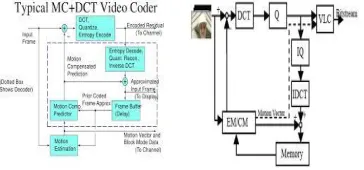
Available Online at www.ijpret.com 342 Figure 1-Coder structures: (a) DCT-ME coder (b) Frequency domain coder
In this case, a Transformed Domain Motion Estimation (TDME) will be used. The main advantage of the structure given in Fig.1 (b) is that it increases the throughput due to the removal of both DCT and IDCT from the loop, also it decreases the computational complexity required for motion estimation technique. These advantages make PC more suitable for real time applications. In this paper, we focus on decreasing the computational complexity required for ME process by applying both Adaptive Block Size Phase Correlation Motion Estimation (ABSPC-ME) technique which is an accurate and fast MV estimator and Adaptive Early Search Termination (AEST) technique on the Phase Correlation Motion Estimation (PCME) Structure. Fine Estimation is achieved by applying Half Pixel PC-ME technique with a slight increase in complexity. Section II presents an overview of PC technique; section III introduces an improvement of the original PC algorithm using several techniques.
II. PHASE CORRELATION TECHNIQUE
Phase correlation technique is a frequency domain motion estimation method that makes use of the shift property of the Fourier transform [5]. According to this property, a shift in the temporal domain is equivalent to a phase shift in the frequency domain. Phase correlation is based on the evaluation of the maximum phase of the Cross Power Spectrum (CPS) between a pair of co-sited rectangular blocks ft-1 and ft of identical dimensions belonging to consecutive frames or fields of a moving sequence sampled at t-1, t. The co-ordinates (kmax, lmax) of the maximum real value in the phase correlation matrix can be used as the horizontal and vertical components.
III. AN IMPROVEMENT OF PHASE CORRELATIONALGORITHM
Available Online at www.ijpret.com 343 A. Adaptive Early Search Termination Technique (AEST):
In many applications such as video telephony, there is little motion between adjacent frames generally, the larger the used threshold Ts, the lower the computational cost, and the poorer the video quality. To adaptively and accurately classify the stationary blocks in the video sequence,. Hence, a large percentage of zero motion blocks are encountered in such type of video sequences.
1) Deciding the Stationary Threshold Value (Ts):
To estimate the value of the threshold (Ts), a comprehensive study is applied over 300 frames for different video sequences. First, the stationary blocks are classified and their selection error is stored. In this work we use the sum of absolute difference (SAD) as a measurement to determine the selection error. Next we categorize the SAD values into three different categories as follows: (i) Low SAD field, (ii) Medium SAD field;, and finally (iii) High SAD field; . The threshold valuesL1, L2, and L3 are chosen after exhaustive experiments on 10video sequences each of length 300 frames. The threshold values according to the second step of the AEST algorithm explained in the next sub-section.
2) Adapting the Threshold Value (Ts):
It will be adaptively assigned a category threshold corresponding to the dominate category and this is every first P frame in the Group of Pictures (GOP) where percentage of error in SAD values will be very small. A 2-D Motion Activity Matrix (MAM) will be generated with every first Pframein GOP. The SAD values of all the stationary blocks in the current P frame with reference to the previous frame will be stored in MAM. These values are then categorized into the three categories L1, L2 and L3. Ts is the threshold value of the dominate category with the highest count of SADs. The parameter λ is used to accelerator slow down the coding process. If we increase the value of λ, the ME process will be accelerated and, consequently, both the complexity and the video quality will decrease. ε is a constant parameter that is empirically set to zero. Those
B. Adaptive Block Size Phase Correlation Technique (ABSPC):
Available Online at www.ijpret.com 344
reference blocks in order to obtain accurate motion estimation. From this notion, we divide the Motion Activity Field (MAF) into three categories: small MAF, medium MAF, and high MAF. Since H.264 encoder [1] uses variable size block matching (VSBM), the blocks have higher probability to contain homogeneous information. A high homogeneity block is a block having the same motion field or in general has higher probability of having only one object in it. Therefore MVs of adjacent blocks have high correlation, so they can be used to predict the MV for the current block. The predicted value for the current block is called the predicted MV (PMV). Due to the fact that, the video sequence is highly correlated in both the spatial and temporal domains, we will use the spatial correlation represented by the PMV as a center point for the selected reference block in the reference frame. This PMV will be used to decide the category of MAF as follows: (i) if PMV _ C1, the MAF is small, (ii) if C1<PMV _ C2, the MAF is medium and finally (iii) if PMV _ C2, then the MAF is high. The threshold valuesC1, C2 are estimated experimentally. The size of both the current and the reference blocks depend mainly upon the category of the MAF which is decided by the PMV as mentioned before. Block sizes; 16x16, 24x24, and 32x32 were used for small, medium and high MAF respectively based on simulations. The more the accuracy of the PMV is, the selected reference block will be more accurate and consequently, both the selected block size and the estimated MV will be more accurate.
We put forward the following approach to get better the accuracy of motion vector prediction
Smart Modified Average PMV
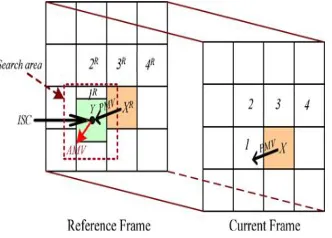
As seen in Fig.3, block 2 in the current frame is also taken into consideration when predicting the MV of block x for more improvement in the accuracy of the estimated MVs. The average of the MVs for the four adjacent macro blocks is calculated and used as the initial PMV according to the following equation:
PMV_int = (MV1+MV2+MV3+ MV4)/4
Available Online at www.ijpret.com 345 Figure 3: Smart Modified Average PMV technique
C. Two Candidates Selection Technique
Phase Correlation technique performs well if there is only one moving object inside the block. In this case, after filling the blocks we can easily find the maximum value in the cross correlation field which corresponding to the actual MV for that block. The problem will appear if we have several moving objects in the block at which there will be several peaks in the Cross Correlation Field (CCF). Represents the CCF for a block having two moving objects. In this case we have to find a method for selecting the best peak in CCR. From our exhaustive simulations, we found that, choosing the most significant two peaks will be satisfied to give a very accurate MV. The two blocks corresponding to the selected 2 peaks in the phase correlation map will be compared with the current block by calculating their SAD values. Then select the best block match corresponding to the lowest SAD value.
D. Half Pixel Phase Correlation Motion Estimation
In this technique, we use the best match integer MV obtained from the phase correlation map to estimate the possible half pixel offset. In many practical encoder implementations, sub-pixel ME is achieved by straightforward extensions to the baseline integer-pixel block matching algorithm. This is primarily done through the use of bilinear interpolation. Interpolation in the data domain (pixel domain) is also applicable in frequency domain ME methods such as phase correlation. The main key for the success of this method is to find an accurate interpolation technique ([6]).
E. Edge detection (ED) technique
Available Online at www.ijpret.com 346
The main disadvantage of using ED is that it removes all low frequencies in the video sequence. This disadvantage will not affect the performance of our proposed algorithm since we remove the low frequency parts in an earlier stage using AEST technique.
V. CONCLUSION
This paper presents a novel fast ME algorithm, Adaptiveearly Search phase correlation technique. As MV field has heavy correlation, the propose algorithm takes the advantage of MV correlation information. By exploiting higher distribution of MVs in the horizontal and vertical directions and the spatial inter-block correlation. A great improving in both the computational complexity and the performance will obtain in this work using both ABSPC and AEST techniques. Therefore, ABSPC and AEST techniques efficient and robust ME algorithm for real-time video coding applications.
VI. REFERENCES
1. T. Wiegand, G. J. Sullivan, G. Bjntegaard, and A. Luthra, "Overview of the H.264/AVC video coding standard," pp.560-576, July 2003.
2. Jen-Chieh Tuan, Tian-Sheuan Chang” On the Data Reuse and Memory Bandwidth Analysis for Full-Search Block-Matching VLSI Architecture “g, Member, IEEE, and Chein-Wei Jen VOL. 12, NO. 1, JANUARY 2002.
3. C. D. Kughlin and D. C. Hines, "The phase correlation image alignment method," Proc. IEEE Intl.,pp. 163–165, Sept. 1975.
4. C.C. Lin, Y. Lin, and H.J. Hsieh, "Multi-direction search algorithm for block motion estimation in H.264/AVC," vol. 3, pp.88-99, 2009.
5. Ibrahim Aksu, Fatih Ildiz, and Jeff B. Burl, "A Comparison Of The Performance Of Image Motion Analysis Algorithms Operating On Low Signal To Noise Ratio Images," Proc. IEEE Intl. Midwest Symposium on Circuits and Systems, Monterey, CA, Vol.1, pp. 158 – 161, May 1991.