Original Paper
Iran J Neurol 2016; 15(4): 183-188
Developing Azeri aphasia
screening test and preliminary
validity and reliability
Sousan Salehi1, Ali Jahan2, Najva Mousavi3, Mazyar Hashemilar4, Zohreh Razaghi5, Maryam Moghadam-Salimi3
1
Department of Speech Therapy, School of Rehabilitation, Tehran University of Medical Sciences, Tehran, Iran 2
Department of Speech Therapy, School of Rehabilitation, Tabriz University of Medical Sciences, Tabriz, Iran
3Department of Psychology, School of Education and Psychology, University of Tabriz, Tabriz, Iran 4
Department of Neurology, School of Medicine, Tabriz University of Medical Sciences, Tabriz, Iran
5
Endocrine Research Center, Tabriz University of Medical Sciences, Tabriz, Iran
Keywords
Screening Test; Aphasia; Azeri Language; Brain Injury; Iran
Abstract
Background: As there is no standard aphasia screening tool for Azeri language yet, the aim of this study was to develop an aphasia screening test with acceptable validity and reliability.
Methods: The present study was conducted in two phases. In the first phase, by literature search, the screening test was designed and to obtain validity it was peer reviewed by expert panel. After collecting experts’ ratings and comments, appropriate modifications were applied. For test-retest reliability in the second phase, edited test was administered in 32 patients with brain injuries, then the retest was performed two weeks later.
Results: The developed test had eight subscales including: A) picture description, B) syntax, C) linguistic reasoning, D) descriptive naming, E) perception of minimal pairs, F) comprehensive vocabulary, G) expressive vocabulary, H) verbal
fluency. Each section had five questions except verbal fluency which had 3 items. Content validity ratio (CVR) according to Lawshe’s approach, was 82% for the whole test. Intraclass correlation for all subscales were more than 0.8. Cronbach’s alpha coefficient for internal reliability was 0.901.
Conclusion: This aphasia screening test seems to have acceptable psychometric properties. This test can probably be used in clinical setting by specialists.
Introduction
Aphasia is an acquired neurogenic language disorder.1 Stroke is the most common cause of
aphasia.2 Aphasia incidence and prevalence is
often estimated based on the incidence and prevalence of stroke.3 The incidence of ischemic
stroke in Iranian population was reported to be 43.2 cases per 100,000 person-year. Frequency of aphasia among people who have experienced stroke is 33.3%.4
Aphasia screening measures are commonly concise. These tests are helpful in the early stages of recovery, when the patient still cannot complete long aphasia tests.5 There are several widely used
Iranian Journal
of Neurology
tools for screening aphasia in other languages, some of them are being described as follows:
Aphasia Language Performance Scale (ALPS): this tool includes four aspects of language (listening, speaking, reading, and writing) and each aspect has ten-item scale that their difficulty
is gradually increased.6 ALPS is comprehensive in
aspects of language but it has limitations for use in research projects.7
Acute Aphasia Screening Protocol (AASP): this
test has four sub-scales including
attention/orientation to communication (five items), auditory comprehension (15 items), expressive abilities (20 items), and conversational style (four items). Although it is short and easily can be done in clinical setting but it has subjective
rating system in some sub-scales.8
Bedside Evaluation and Screening Test for Aphasia: this tool assesses language ability in three communicative modalities including
auditory comprehension, speaking, and reading.9
It ignores writing which is an important modality in aphasia assessment in English language.
Frenchay Aphasia Screening Test (FAST): it evaluates language in four language areas of comprehension, verbal expression, reading, and writing. Although this test is the most widely used screening tool,8 but it has limitations. It only
applies visual materials, then any visual deficits such as neglect has adverse impact on patient’s score.10
Mississippi Aphasia Screening Test (MAST): MAST includes nine subscales comprising of naming, automatic speech, repetition, yes/no accuracy, object recognition, following verbal instructions, reading instructions, verbal fluency, and writing/spelling to dictation. It measures
receptive and expressive language.11
Language Aphasia Screening Test (LAST): this test has two main indexes, receptive and expressive. Receptive index includes naming, repetition and automatic speech; expressive index
includes recognition and verbal instructions.12
Mini-Mental State Examination (MMSE), Raven’s Colored Progressive Matrices (RCPM), and Sheffield Screening Test (SST) are short tests easily implemented, so can be suitable as
screening tool13 but none of them is
comprehensive language assessment. In Iran, MAST has recently been translated with
cross-cultural adaptation for Persian language.14
The lack of valid and reliable test for clinical
diagnosis and practice is a worldwide problem.15
These tests are needed for early detection and intervention. Early detection of language impairments and synergy between intervention and neuroplasticity can maximize the benefits of treatment.13
Nevertheless, there is no Azeri Turkish aphasia screening test yet whereas we require a valid and reliable test in accordance with Azeri Turkish language structure and culture for clinical and research application. Azeri language in Iran do not have reading and writing, which can be considered as the most important feature of this language in developing the test. Then, the purpose of present study was developing the screening test of aphasia for Azeri speakers in Iranian population by minimizing limitations in other screening tests and obtaining preliminary validity and reliability as the first step toward standardization.
Materials and Methods
Development of the test
The first section of this study was creating a new test for aphasia screening in Azeri language. Textbooks in linguistics and, language disorders and available screening tests for aphasia were reviewed. In general view, a suitable aphasia test should compromise content expression and comprehension (semantics), form (phonology,
morphology and syntax) and pragmatic.2 With
respect to these guides and other literature, eight important domains of language were selected as follows:
1) Picture description (content production): this sub-test helps to assess the semantic and syntactic abilities by evaluating the retrieval of content and function words, and the arrangement
of words in the sentence (grammar).16
2) Syntax: syntactic processing is damaged in
fluent aphasia.17 Additionally, asyntactic
comprehension is one of the high level processing
problems in aphasia.2 Asyntactic comprehension,
negative forms, and prepositions are included in this part.
3) Verbal reasoning (pragmatic): in view of the fact that screening test should be sensitive to subtle deficit in cognition and communication, verbal reasoning was selected as part of the test. Verbal reasoning is higher level function that integrate several processes.18
verbal description. This task is sensitive to left lobe injuries.19 It needs language comprehension
and word retrieval ability without visual processing involvement.
5) Minimal pairs (phonology): this task taps the auditory input processing without oral production. It can illustrate any problem in auditory analysis level.20
6) Receptive vocabulary (single word comprehension): a basic task which assesses semantic input at single word level. Single word comprehension is not seriously disrupted in mild
aphasia.21 Accordingly, Low frequency words
were used in various semantic categories in the developed test to rise probability of error.
7) Expressive vocabulary (picture naming): it is reported that there is deficits in picture naming in
all types of aphasia.22 Similar to receptive
vocabulary, low frequency words in different semantic categories were included.
8) Verbal fluency (semantic verbal fluency by naming animals): Verbal fluency refer to the number of words which is produced in one minute in specific semantic category; it can be included in aphasia assessment tests.23
As Iranian branch of Azeri language does not have writing form and is an oral language, then our screening test was not designed to include reading and writing parts. As mentioned before, the developed test had eight subscales, each subscale had five items except verbal fluency.
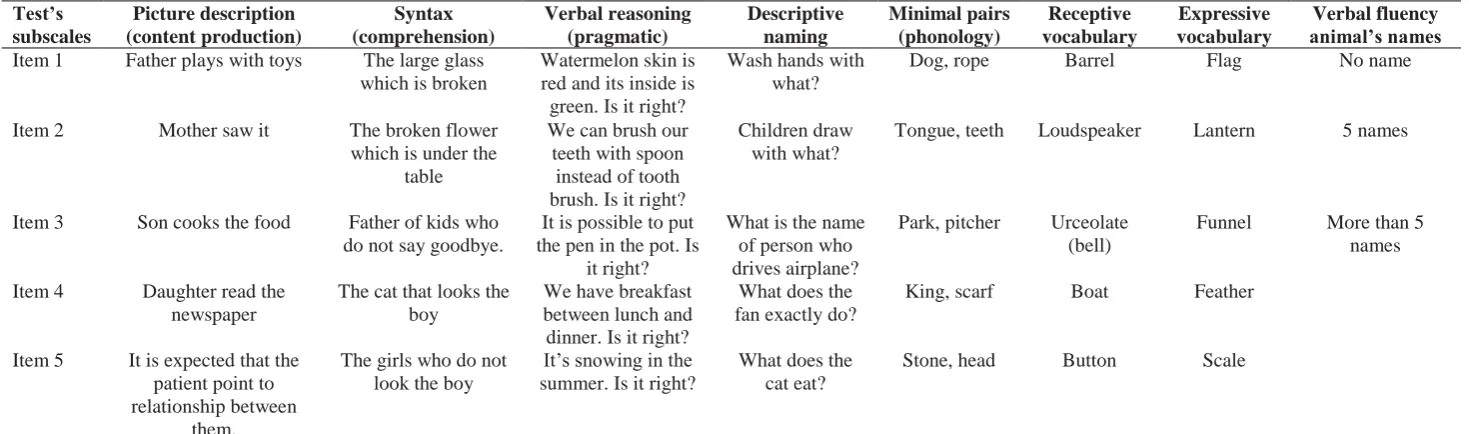
Scoring system was 0 or 1 for each item (correct or incorrect answer); then range of score of each part was 0 to 5 except verbal fluency which had a score range of 0-3 (Table 1).
Validity
At the second phase, content validity was determined. First, all the items were included in a questionnaire to verify their relevancy to the content and structure of the test. Then, the sheet with written explanation of our investigation was given to experts including nine experienced speech language pathologists and one linguist. Afterwards, according to expert’s opinions the test’s materials were modified or unacceptable items were deleted. Finally, ultimate form was obtained (appendix 1). Lawshe’s approach was used for determining content validity ratio (CVR) in quantitative way.24
Reliability
The reliability was obtained by test-retest and internal consistency evaluation. The test was
administered in brain injury and stroke patients who were at risk of aphasia according to neurologist’s diagnosis, who were in the early stage of their injury or stroke. Participants included 32 brain injury and stroke patients, 11 female and 21 male with a mean age of 64 years [range: 43-86 and Standard deviation (SD) = 10.0[, who were referred to Imam Reza and Razi Hospitals in Tabriz, Iran. All of them were under medication and were native Azeri speakers. Informed consent was taken according to ethical committee of Tabriz University of Medical Sciences. Participants were assessed for the second time after two weeks.
Results
The patients’ scores are shown in each subscale in table 2. Content validity coefficients were calculated for each item in subscales; there were totally 38 items. Content validity coefficient was 40% for four items, 62% for eight items, 80% for seventeen items and 100% for nine items. Since the acceptable CVR is 62%, four items which had CVR less than 62% were modified. Then, the average of the rest of the items was calculated as the content validity indicator. Thus, the whole content validity coefficient was obtained as 82%.
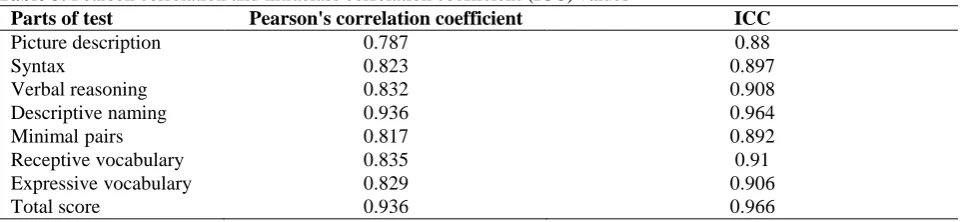
In the second phase of the study, intraclass correlation coefficient (ICC) was calculated for each subscale. Pearson's correlation coefficients of subscales are also presented in table 3.
As for verbal fluency, it was analyzed by the Spearmen's correlation coefficient. The coefficient of 0.899 was obtained for verbal fluency which is well above 0.7. The ICC for this subscale was 0.928.
High Pearson's correlation coefficient between test-retest scores as well as high ICC (above 0.75) showed the acceptable level of test-retest
reliability.25 Cronbach's alpha was used to
determine internal consistency of the test. For eight subscales, Cronbach' alpha was obtained as 0.91, indicating a high reliability for Azeri aphasia screening test.
Discussion
An attempt was made to develop a valid and reliable test which encompasses important
language domains in multimodality. In
Table 1. The subscales and items
Test’s subscales
Picture description (content production)
Syntax (comprehension)
Verbal reasoning (pragmatic)
Descriptive naming
Minimal pairs (phonology)
Receptive vocabulary
Expressive vocabulary
Verbal fluency animal’s names
Item 1 Father plays with toys The large glass
which is broken
Watermelon skin is red and its inside is green. Is it right?
Wash hands with what?
Dog, rope Barrel Flag No name
Item 2 Mother saw it The broken flower
which is under the table
We can brush our teeth with spoon
instead of tooth brush. Is it right?
Children draw with what?
Tongue, teeth Loudspeaker Lantern 5 names
Item 3 Son cooks the food Father of kids who
do not say goodbye.
It is possible to put the pen in the pot. Is
it right?
What is the name of person who drives airplane?
Park, pitcher Urceolate
(bell)
Funnel More than 5
names
Item 4 Daughter read the
newspaper
The cat that looks the boy
We have breakfast between lunch and dinner. Is it right?
What does the fan exactly do?
King, scarf Boat Feather
Item 5 It is expected that the
patient point to relationship between
them.
The girls who do not look the boy
It’s snowing in the summer. Is it right?
What does the cat eat?
Stone, head Button Scale
Table 2. Descriptive statistics of scores in various subscales of test
Descriptive statistics of scores Subscales
Minimum Maximum Mean ± SD
Picture description (content production) 0 4 1.85 ± 1.79
Syntax (comprehension) 0 5 2.62 ± 1.63
Verbal reasoning (pragmatics) 0 5 3.32 ± 1.82
Descriptive naming 0 5 2.45 ± 2.19
Minimal pairs (phonology) 0 5 2.77 ± 1.74
Receptive vocabulary 0 5 3.72 ± 1.57
Expressive vocabulary 0 5 2.35 ± 1.70
Verbal fluency Animal’s names
0 2 0.87 ± 0.82
Table 3. Pearson correlation and intraclass correlation coefficient (ICC) values
Parts of test Pearson's correlation coefficient ICC
Picture description 0.787 0.88
Syntax 0.823 0.897
Verbal reasoning 0.832 0.908
Descriptive naming 0.936 0.964
Minimal pairs 0.817 0.892
Receptive vocabulary 0.835 0.91
Expressive vocabulary 0.829 0.906
Total score 0.936 0.966
ICC: Intraclass correlation coefficient
other items, stimulus was visual and it is suitable for patients who has auditory deficit. As mentioned, all language domains including phonology, syntax, semantic and pragmatic were presented in various items. Patient response had two main categories, expressive and receptive, which is similar to screening tests like LAST and FAST. The developed test did not have reading and writing subscales, because of special Azeri Turkish feature, which is a verbal language. The highest score in intraclass correlation in eight subscale was descriptive naming, then verbal fluency, receptive vocabulary, and verbal reasoning. All of these items were present in auditory modality. After these four items, there was expressive vocabulary, picture description, syntax, and finally minimal pairs. These items were presented visually.
Inter-item correlation was utilized to specify the internal reliability. It was the highest in all items for descriptive naming item, then verbal
fluency, verbal reasoning and receptive
vocabulary, expressive vocabulary, syntax,
minimal pairs, and picture description,
respectively. This is nearly similar to intraclass correlation. Thus the first four items that all of them were auditory (descriptive naming, verbal fluency, verbal reasoning, and receptive vocabulary) were appropriate for aphasia screening. In the next four items, minimal pairs and picture description, were not proper to this evaluation. Minimal pairs was not in reviewed aphasia screening tests for assessing phonology. However, the expressive vocabulary (picture naming) and syntax sub-tests were apparently more suitable for screening aphasia.
Test-retest reliability was a common approach in determining test reliability. The reliability coefficient for ALPS was reported from 0.83 to 0.94 for aphasic patients; retest was
from 3 to 5 weeks after the beginning test.26 For
AASP, another aphasia screening test, test-retest
greater than 0.7 was reported.27 Reliability
coefficient ranged from 0.93 to 0.99 for all subscales of Bedsides Evaluation and Screening Test of Aphasia.9 Criterion validity and
test-retest reliability to FAST was reported 0.96 and
0.97, respectively.10 There was not any report on
reliability of MAST.12 Interrater reliability was
obtained for LAST instead of test-retest reliability, thus we cannot compare it with our results. Our aphasia screening test had a 0.93 test-retest reliability, suggesting that the developed test has high temporal stability. It seems acceptable compared to the reliability of other screening test.
ICC of LAST was 0.96, indicating good internal validity and Chronbach’s alpha was 0.88,
indicating good internal cohesion.13 Total CVR of
the developed test was 0.82 according to Lawshe’s content validity table which is acceptable compared to other tests (> 0.62). Therefore, the content validity of this test seems to be appropriate. In this study, we did not calculate criterion validity.
Conclusion
The results of this preliminary study suggested that the developed aphasia screening test for Turkish Azeri language had similar validity and reliability to other screening test in other languages. It seems this test has acceptable psychometric values and it can be used in clinic and research for early diagnosis of aphasia. For further investigation, it is recommended that other types of validity and reliability should be calculated and the test also can be performed in normal population to obtain norm scores of the test.
Conflict of Interests
Acknowledgments
This research was supported by a grant from Clinical Psychiatric Research Center for Sousan Salehi in Tabriz University of Medical Sciences. We wish to thank to staff of Razi Hospital, patients, Ms. Nazari and Ms. Hamidnezhad for their participation in data collection.
How to cite this article: Salehi S, Jahan A, Mousavi N, Hashemilar M, Razaghi Z, Moghadam-Salimi M. Developing Azeri aphasia screening test and preliminary validity and reliability. Iran J Neurol 2016; 15(4): 183-8.
References
1. Murdoch BE. Acquired speech and language disorders. 2nd ed. New York,
NY: John Wiley & Sons; 2010. p. 48. 2. Chapey R. Language intervention
strategies in aphasia and related neurogenic communication disorders. Philadelphia, PA: Wolters Kluwer Health/Lippincott Williams & Wilkins; 2008. p. 47-334.
3. Damico JS, Müller N, Ball MJ. The handbook of language and speech disorders. New York, NY: John Wiley & Sons, 2010. p. 318.
4. Ghandehari K, Moud ZI. Incidence and etiology of ischemic stroke in Persian young adults. Acta Neurol Scand 2006; 113(2): 121-4.
5. El Hachioui H, Visch-Brink EG, de Lau LM, van de Sandt-Koenderman MW, Nouwens F, Koudstaal PJ, et al. Screening tests for aphasia in patients with stroke: a systematic review. J Neurol 2016. 6. Golden CJ, Goldstein C, Incagnoli TM.
Clinical application of neuropsychological test batteries. New York, NY: Springer Science & Business Media; 2013. p. 353.
7. Lezak MD. Neuropsychological assessment. New York, NY: Oxford University Press, USA; 1995. p. 525. 8. Salter K, Jutai J, Foley N, Hellings C,
Teasell R. Identification of aphasia post stroke: a review of screening assessment tools. Brain Inj 2006; 20(6): 559-68. 9. Spreen O, Risser AH. Assessment of
aphasia. New York, NY: Oxford University Press, USA; 2003. p. 54. 10. Enderby PM, Wood VA, Wade DT,
Hewer RL. The frenchay aphasia screening test: a short, simple test for aphasia appropriate for non-specialists.
Int Rehabil Med 1987; 8(4): 166-70. 11. Nakase-Thompson R, Manning E, Sherer
M, Yablon SA, Gontkovsky SL, Vickery C. Brief assessment of severe language impairments: initial validation of the Mississippi aphasia screening test. Brain Inj 2005; 19(9): 685-91.
12. Flamand-Roze C, Falissard B, Roze E, Maintigneux L, Beziz J, Chacon A, et al. Validation of a new language screening tool for patients with acute stroke: the Language Screening Test (LAST). Stroke 2011; 42(5): 1224-9.
13. Blake H, McKinney M, Treece K, Lee E, Lincoln NB. An evaluation of screening measures for cognitive impairment after stroke. Age Ageing 2002; 31(6): 451-6. 14. Khatoonabadi AR, Nakhostin-Ansari N,
Piran A, Tahmasian H. Development, cross-cultural adaptation, and validation of the Persian Mississippi Aphasia Screening Test in patients with post-stroke aphasia. Iran J Neurol 2015; 14(2): 101-7.
15. Ivanova MV, Hallowell B. A tutorial on aphasia test development in any language: Key substantive and psychometric considerations. Aphasiology 2013; 27(8): 891-920. 16. Gordon JK. Measuring the lexical
semantics of picture description in aphasia. Aphasiology 2008; 22(7-8): 839-52. 17. Newhart M, Trupe LA, Gomez Y,
Cloutman L, Molitoris JJ, Davis C, et al. Asyntactic comprehension, working memory, and acute ischemia in Broca's area versus angular gyrus. Cortex 2012; 48(10): 1288-97.
18. MacDonald S, Johnson CJ. Assessment of subtle cognitive-communication deficits following acquired brain injury:
A normative study of the Functional Assessment of Verbal Reasoning and Executive Strategies (FAVRES). Brain Inj 2005; 19(11): 895-902.
19. Loring DW, Meador KJ, Lee GP. Effects of temporal lobectomy on generative fluency and other language functions. Arch Clin Neuropsychol 1994; 9(3): 229-38. 20. Papathanasiou I, Coppens P, Potagas C.
Aphasia and related neurogenic communication disorders. Burlington, MA: Jones & Bartlett Publishers; 2016. p. 157. 21. Moineau S, Dronkers NF, Bates E.
Exploring the processing continuum of single-word comprehension in aphasia. J Speech Lang Hear Res 2005; 48(4): 884-96. 22. Kohn SE, Goodglass H. Picture-naming
in aphasia. Brain Lang 1985; 24(2): 266-83.
23. Benson DF, Ardila A. Aphasia: A clinical perspective. New York, MY: Oxford University Press; 1996. p. 101.
24. Polit DF, Beck CT, Owen SV. Is the CVI an acceptable indicator of content validity? Appraisal and recommendations. Res Nurs Health 2007; 30(4): 459-67.
25. Van Ness PH, Towle VR, Juthani-Mehta M. Testing measurement reliability in older populations: methods for informed discrimination in instrument selection and application. J Aging Health 2008; 20(2): 183-97.
26. Skenes LL, McCauley RJ. Psychometric review of nine aphasia tests. J Commun Disord 1985; 18(6): 461-74.