Zagazig University Medical Journal
www.zumj.journals.ekb.eg
September 2019 Volume 25 Issue 5 www.zumj.journals.ekb.eg 773
Original article
The Age, Creatinine and Ejection fraction (ACEF_ Score as Predictor of Acute
Kidney Injury in Patients Undergoing Primary versus Elective Percutaneous
Coronary Intervention
Tarek Ahmed Naguib , Mohammad Mustafa Al-Daydammony , Alaa Elsayed Salama, Mohammed Abd Elkawy Eid*
Cardiology department, Faculty of medicine, Zagazig University , Egypt
*Corresponding Author: Mohammed Abd Elkawy Eid cardiology resident.
Submit Date 2019-03-14 Revise Date 2019-05-04 Accept Date 2019-05-09
ABSTRACT
Background_ Age, creatinine and ejection fraction (ACEF) score has been established as a predictor of clinical outcomes in patients undergoing primary Percutaneous Coronary Intervention. Its utility in patients undergoing elective percutaneous coronary intervention is yet unexplored.
AIM OF WORK__This study aims to investigate the risk factors associated with Acute Kidney Injury development in patients with ST segment Elevation undergoing primary PCI or with Coronary Artery Disease undergoing elective PCI.We investigates the applicability of ACEF score on patients undergoing elective PCI
Patients and Methods__ calculating ACEF score for 80 patients divided into two groups: group I will include 40 patients for primary PCI and group II will include 40 patients for elective PCI with fixation of type (meglumine- ioxitalamate) and amount (≤300 ml) of the contrast used .
Results__ 8 patients from 80 had AKI; 4 patients from each group .There was no significant difference between both groups regarding smoking, history of diabetes mellitus, hypertension, dyslipidemia and family history of IHD in primary PCI group versus elective PCI group.
Conclusion__ A fully pre-procedural risk prediction model would be useful to facilitate precautionary measures for patients at a high risk of Contrast Induced Nephropathy. ACEF risk score incorporate only 3 variables, which may make it more acceptable for clinical use, because of its simplicity.ACEF score can be used to predict AKI in patients undergoing primary PCI as well as elective PCI.
Keywords: ACEF score, acute kidney injury, percutaneous coronary intervention, acute myocardial infarction, chronic kidney disease, ischemic heart disease.
INTRODUCTION
ontrast-induced nephropathy (CIN) occurs
more frequently after primary
percutaneous coronary intervention (PPCI) in patients with ST-segment elevation myocardial infarction (STEMI). CIN incidence has been reported to be as high as 28%. Furthermore, CIN is strongly associated with late renal and
cardiovascular adverse events [1]. Acute kidney
September 2019 Volume 25 Issue 5 www.zumj.journals.ekb.eg 774 OR Urine volume <0.5 ml/kg/h for 6 hour
[2].Primary Percutaneous Coronary
Intervention (PCI) is defined as angioplasty and/or stenting without prior or concomitant fibrinolytic therapy, and is the preferred therapeutic option when it can be performed by an experienced team[3].Elective PCI is defined as all procedures that were not urgent/emergent, that is, PCI not within 24 hrs. Of MI, and
excluding patients with shock and
hemodynamic instability. Elective PCI can be performed safely without intra-aortic balloon pump (IABP) or cardiopulmonary support (CPS) in most circumstances. Most patients can be safely discharged from the hospital within 24 h after an uncomplicated elective PCI[4]. The advanced age, depressed EF and increased serum creatinine are independent predictors of AKI development after PCI. The individual patient risk can be assessed by calculating the ACEF score, which is based on clinical information. Calculation of ACEF according to (Ranucci at al. (2009)): age/EF (%) +1 is added if creatinine was ≥2[5].
AIM OF WORK
This study aims to investigate the risk factors
associated with Acute Kidney Injury
development in patients with ST segment Elevation undergoing primary PCI or with Coronary Artery Disease undergoing elective PCI.We investigates the applicability of ACEF score on patients undergoing elective PCI
PATIENTS AND METHODS
Written informed consent was obtained from all participants and the study was approved by the research ethical committee of Faculty of Medicine, Zagazig University. The work has been carried out in accordance with The Code of Ethics of the World Medical Association (Declaration of Helsinki) for studies involving humans
Study population__ This study is a prospective
observation studyconducted from January 2017
to October 2018 and included 80 patients from the National Heart Institute and cardiology department of Zigzag University undergoing primary or elective percutaneous coronary
interventiondivided into two groups first group
include 40 patients undergoing primary percutaneous coronary intervention and the second group include 40 patients undergoing elective percutaneous coronary intervention. Methods__History taking including
(co-morbidity–drug intake).Clinical examination.
Kidney function test (creatinine) daily.
Measurement of serum creatinine on admission, 6 hours after the procedure, every day for the following 3 days, and at discharge from the CCU. Wall motion abnormalities and left ventricular ejection fraction would be assessed with echocardiography in all subjects using a GE Vivid 9 Ultrasound Machine (Echo Pac; GE
Vingmed, Horten, Norway) before PCI. Group
I patients will undergo primary PCI and group II patients will undergo elective PCI with fixed type (meglumine- ioxitalamate) and amount (≤300 ml) of contrast material (7)Calculation of ACEF according to (Ranucci at al. (2009)): age/EF(%) + 1 is added if creatinine was ≥2. Inclusion criteria__All patients who will present with typical cardiac chest pain suspecting ACS not responsive to nitrates , with or without ECG changes consistent with myocardial ischemia or acute myocardial infarction (STEMI) planned for primary
percutaneous coronary intervention and
patients with Coronary Artery Disease planned for elective percutaneous coronary intervention.
Exclusion criteria__1.Patients on chronic peritoneal or hemodialysis treatment
2. Patients who have allergy to contrast material 3. Patients who receive contrast in last week ACEF Score and Analysis__ The ACEF score was calculated according to the following formula: ACEF=age/left ventricular ejection fraction+1 is added if creatinine was ≥ 2.It is
score to predict AKI after PCI. Low risk ACEF
score ˂1.027, Moderate Risk ACEF score
1.027-1.277, High Risk ACEF score ˃1.277.
(5).
September 2019 Volume 25 Issue 5 www.zumj.journals.ekb.eg 775 or an absolute increase in serum creatinine of
0.5 mg/dl from baseline value, at 48 hours following the exposure to procedure.
Statistical analysis__The collected data were analyzed by computer using Statistical Package of Social Services version 24 (SPSS) (Armonk, NY ,USA ,IBM. corp.), Data were represented in tables and graphs, Continuous Quantitative variables e.g. age were expressed as the mean ± SD , and categorical qualitative variables were expressed as absolute frequencies (number) & relative frequencies (percentage). Suitable statistical tests of significance were used after
checking data for normality. The results were considered statistically significant when the significant probability was less than 0.05 (P < 0.05). P-value < 0.001 was considered highly statistically significant (HS), and P-value ≥ 0.05 was considered statistically insignificant (NS).
RESULTS
The current study was done to investigate the risk of developing acute kidney injury in patients undergoing primary and elective percutaneous coronary intervention, it included 80 patients (63 male and 17 female), the study subjects were allocated into 2 groups
according to percutaneous coronary
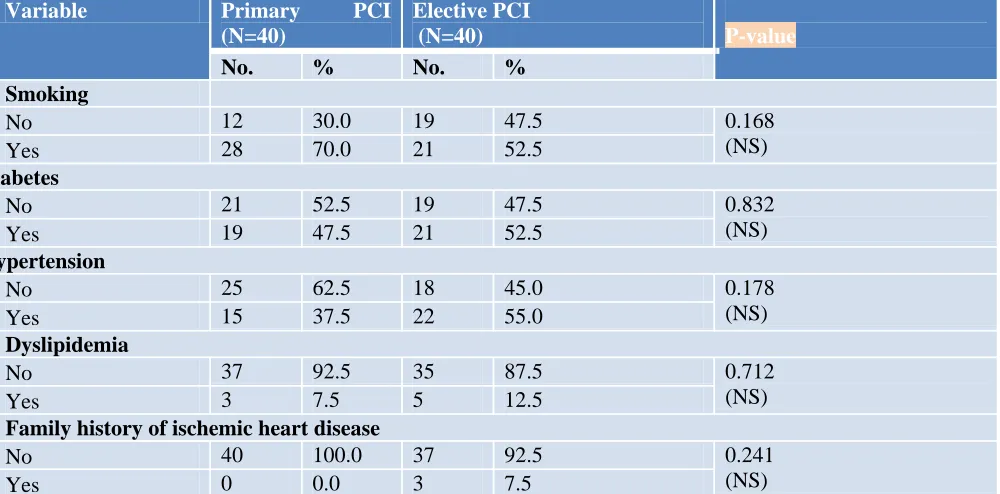
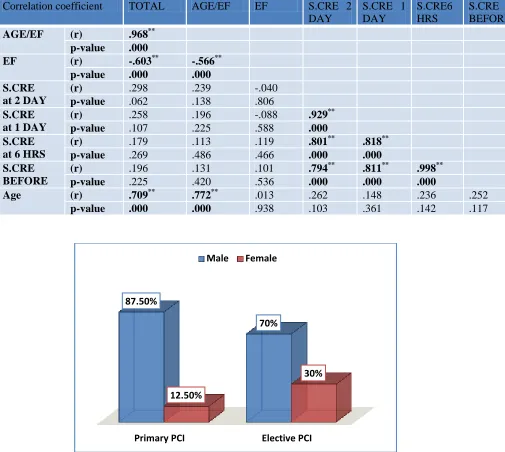
intervention into primary PCI and elective PCI, mean of age among the studied primary PCI is 53.8 ± 10.08 years old, with a range from 31 to 78 years old and 87.5% of them are males. While age of the studied Elective PCI was 56.85 ± 10.26 years old, with a range from 31 to 80 years old and 70% of them are males, there was no statistically significant difference between both groups regarding age and sex distribution,, as illustrated in table (1) and figure (1).There was no significant difference between both groups regarding smoking and history of diabetes mellitus, hypertension, dyslipidemia and family history of IHD with percentage (70%, 47%,37.5%,7.5% &zero%) respectively in primary PCI group versus
(52.5%, 52.5%,55%,12.5% & 7.5%)
respectively in elective PCI group as illustrated in table(2) and figure (2).Ejection fraction was statistically higher in elective PCI group than primary PCI with range(32-60) in primary PCI
and range (30-75) in elective PCI , 10% of the studied patients in both groups developed
contrast induced nephropathy with no
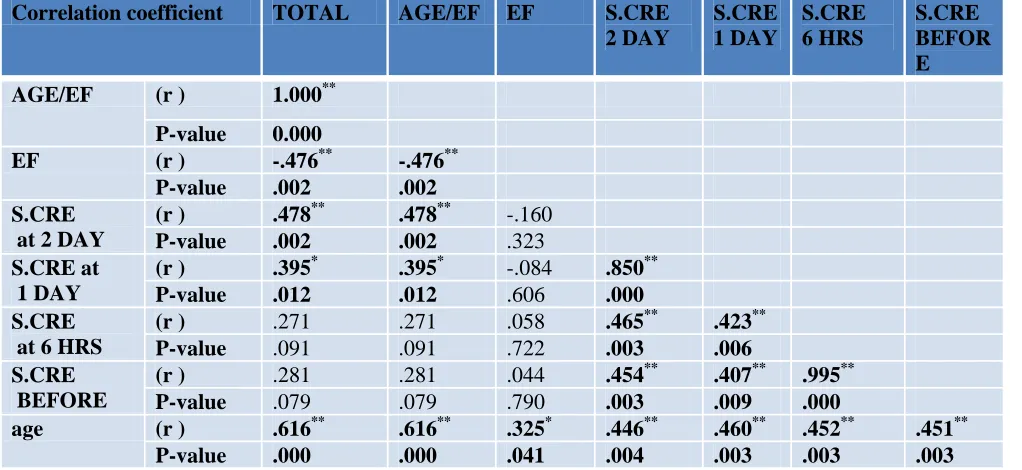
significant difference as illustrated in Table (3). Total ACEF was statistically higher in primary PCI group than elective PCI, in 2.5% of primary PCI serum creatinine level increased more than 2 mg/dl with no statistical difference between both groups as illustrated in Table (4). There was significant positive correlation between age of patient and Total ACEF and age/EF and serum creatinine level before PCI and after PCI, there was significant negative correlation between Ejection fraction and total ACEF and age/EF(r =-.476, -.476 and P-value < 0.05) respectively among the studied elective
PCI group as in table (5).Regarding serum
September 2019 Volume 25 Issue 5 www.zumj.journals.ekb.eg 776 Table (1): Socio-demographic characteristics of the studied groups
Item Primary PCI
(N=40)
Elective PCI
(N=40)
P-value
No. % No. %
Age (years)
Mean ± SD 53.8 ± 10.08 56.85 ± 10.26 0.216
(NS)
(Range) (31 – 78) (31– 80)
Sex
Male 35 87.5% 28 70% 0.099
(NS)
Female 5 12.5% 12 30%
Table (2): History of smoking and comorbidities among the studied groups.
Variable Primary PCI
(N=40)
Elective PCI
(N=40) P-value
No. % No. %
Smoking
No 12 30.0 19 47.5 0.168
(NS)
Yes 28 70.0 21 52.5
Diabetes
No 21 52.5 19 47.5 0.832
(NS)
Yes 19 47.5 21 52.5
Hypertension
No 25 62.5 18 45.0 0.178
(NS)
Yes 15 37.5 22 55.0
Dyslipidemia
No 37 92.5 35 87.5 0.712
(NS)
Yes 3 7.5 5 12.5
Family history of ischemic heart disease
No 40 100.0 37 92.5 0.241
(NS)
Yes 0 0.0 3 7.5
Table (3): Contrast induced nephropathy and Ejection fraction after PCI among the studied groups
Item Primary PCI
(N=40)
Elective PCI (N=40)
P-value
No. % No. %
Ejection fraction
Mean ± SD 45.83 ± 7.11 58.78 ± 10.13 0.000*
(HS) (Range) (32 – 60) (30–75)
CIN
No 36 90% 36 90% 1.000
(NS)
September 2019 Volume 25 Issue 5 www.zumj.journals.ekb.eg 777 Table (4): The ACEF Score before PCI among the studied groups
Item Primary PCI (N=40) Elective PCI (N=40)
P- value
No. % No. %
Age/EF
Mean ± SD 1.20 ± 0.29 0.997 ± 0.27 0.000*
(HS)
(Range) (0.59 – 1.95) (0.5–1.93)
Total ACEF
Mean ± SD 1.22 ± 0.37 0.997 ± 0.273 0.000*
(HS)
(Range) (0.59 – 2.21) (0.5–1.93)
If serum creatinine >2
No 39 97.5 40 100.0 1.000
(NS)
Yes 1 2.5 0 0.0
Table (5): correlation matrix between ACEF score and serum creatinine among the studied elective PCI group.
Correlation coefficient TOTAL AGE/EF EF S.CRE 2 DAY
S.CRE 1 DAY
S.CRE 6 HRS
S.CRE BEFOR E AGE/EF (r ) 1.000**
P-value 0.000
EF (r ) -.476** -.476**
P-value .002 .002 S.CRE
at 2 DAY
(r ) .478** .478** -.160 P-value .002 .002 .323 S.CRE at
1 DAY
(r ) .395* .395* -.084 .850** P-value .012 .012 .606 .000 S.CRE
at 6 HRS
(r ) .271 .271 .058 .465** .423** P-value .091 .091 .722 .003 .006 S.CRE
BEFORE
(r ) .281 .281 .044 .454** .407** .995** P-value .079 .079 .790 .003 .009 .000
September 2019 Volume 25 Issue 5 www.zumj.journals.ekb.eg 778 Table (6): correlation matrix between ACEF score and serum creatinine among the studied primary PCI group.
Correlation coefficient TOTAL AGE/EF EF S.CRE 2 DAY
S.CRE 1 DAY
S.CRE6 HRS
S.CRE BEFORE AGE/EF (r) .968**
p-value .000
EF (r) -.603** -.566** p-value .000 .000 S.CRE
at 2 DAY
(r) .298 .239 -.040
p-value .062 .138 .806 S.CRE
at 1 DAY
(r) .258 .196 -.088 .929**
p-value .107 .225 .588 .000 S.CRE
at 6 HRS
(r) .179 .113 .119 .801** .818**
p-value .269 .486 .466 .000 .000
S.CRE BEFORE
(r) .196 .131 .101 .794** .811** .998**
p-value .225 .420 .536 .000 .000 .000
Age (r) .709** .772** .013 .262 .148 .236 .252
p-value .000 .000 .938 .103 .361 .142 .117
Figure 1.Bar chart for comparison of sex among the studied groups
DISCUSSION
Contrast-induced nephropathy (CIN) is an acute kidney injury that follows intravascular administration of radio-opaque contrast media (CM) in susceptible individuals. It remains responsible for a third of all hospital-acquired acute kidney injury (AKI) and affects between 1% and 2% of the general population [8].In primary PCI group , Our study showed that there was highly significant relation between
1- age and level of ACEF score
Our study showed that there was positive correlation between the age and ACEF score level when the mean age was 42.33 ±
7.76(31 – 57) the ACEF score was low
(<1.027),when the mean age was 45.88 ± 7.71
(43 – 71) the ACEF score was moderate (from
1.027 to 1.277) and when the mean age was 56.86± 7.93(45 -78) the ACEF score was high (>1.277 ) with p value (.0000) and this was concordant with (Ando et al., 2013) [2], who studied 481 patients that referred to the
Primary PCI Elective PCI
87.50%
70%
12.50%
30%
September 2019 Volume 25 Issue 5 www.zumj.journals.ekb.eg 779 Coronary Care Unit(CCU) of the University
Hospital of Messina from January 2008 to June2011 for primary PCI in the course of STEMI , in being the advanced age is independent predictors of AKI development after primary PCI for STEMI as p value was (<.001) .
2- EF and total ACEF
Our study showed that there was negative correlation between Ejection fraction and total ACEF EF (r =-.603, -.566) respectively and this was concordant with (Ando et al., 2013) [2],who studied 481 patients that referred to the Coronary Care Unit (CCU) of the University Hospital of Messina from January 2008 to June2011 for primary PCI in the course of STEMI, in being EF is independent predictors of AKI development after primary PCI for STEMI with p value (.001).
3- Serum creatinine and total ACEF
Our study showed that there was significant strong positive correlation between creatine level before PCI and after PCI, the higher creatinine level before, the higher creatinine level after PCI (p=0.000) and this was concordant with (Ando et al., 2013) [2], who studied 481 patients that referred to the Coronary Care Unit(CCU) of the University Hospital of Messina from January 2008 to June2011 for primary PCI in the course of
STEMI ,in being serum creatinine is
independent predictors of AKI development after primary PCI for STEMI with p value (<.001) . In primary PCI group , Our study showed that there was no significant relation between ACEF score and the other risk factors in the form of DM with p value (0.661) , hypertension with p value (0.159),dyslipidemia with p value (0.555) , smoking with p value (0.079) sex with p value (0.314) and this was
concordant with (Andoet al., 2013)(2) that
show there was no significance with ACEF and other risk factors like DM with p value (0.02) , Hypertension with p value (0.01) , dyslipidemia with p value (1.0) , smoking with p value (0.02) sex with p value (0.64) .
In elective PCI group , Our study showed that there was highly significant relation between :
1- age and level of ACEF score
Our study showed that there was positive correlation between the age and ACEF score level when the mean age was52.43 ± 9.02
(31 – 67) the ACEF score was low
(<1.027),when the mean age was 63.08 ±
9.23(47 – 80)the ACEF score was moderate
(from 1.027 to 1.277)and when the mean age was 62± 9.05(52 -73) the ACEF score was high (>1.277) with p value (.004) and this was
[9],concordant with (Wykrzykowska et al.,
2011) who studied 1208 who represented to CCU with Acute Coronary Syndrome , in being the advanced age is independent predictors of AKI development after elective PCI as p value is (<.001) .
2- EF and total ACEF
Our study showed that there was negative correlation between Ejection fraction and total ACEFEF((r =-.476 and -.476) respectively and this was concordant with (Wykrzykowska et al., 2011) [9] , who studied 1208 who represented to CCU with Acute Coronary Syndrome , in being the advanced age is independent predictors of AKI development after elective PCI as p value is (<.001) .
3- Serum creatinine and total ACEF
September 2019 Volume 25 Issue 5 www.zumj.journals.ekb.eg 780
4- Our study showed that there was no significant
relation between ACEF score and smoking as p value was (.727) and hypertension as p value was (.844) which was disconcordant with (Wykrzykowska et al., 2011) [9] , who studied 1208 who represented to CCU with Acute Coronary Syndrome ,that reported smoking and hypertension had significant relation with ACEF score with p value (<.001) for both and this may be for the large number of patients taken in the study .
In elective PCI group , Our study showed that there was no significant relation between ACEF score and the other risk factors in the form of DM with p value (.600) ,dyslipidemia with p value (.509) and sex with p value (.588) and this was concordant with (Wykrzykowska et al., 2011) [9], who studied 1208 who represented to CCU with Acute Coronary Syndrome ,that showed that there was no significant relation between ACEF score and the other risk factor DM, Dyslipidemia, sex with p value (0.008 ,0.019,0.009 ) respectively . In comparison with the two groups elective and primary PCI , Our study showed that there was no significant difference between both groups regarding smoking and history of diabetes mellitus, hypertension, dyslipidemia and family history of IHD and this was concordant with (Wykrzykowska et al., 2011) [9] , who studied 1208 who represented to CCU with Acute Coronary Syndrome that showed that ACEF score may be a simple way to stratify risk of events in patients treated with percutaneous coronary intervention with respect to mortality and risk of myocardial infarction and this proved that ACEF score can be used in elective PCI like primary PCI .
CONCLUSION
A fully pre-procedural risk prediction model would be useful to facilitate precautionary measures for patients at a high risk of CIN. The ACEF include LVEF. However, ACEF risk score incorporate only 3 variables, which may make it more acceptable for clinical use, because of its simplicity.ACEF score can be used to predict acute kidney injury in patients
undergoing primary PCI as well as elective PCI.
Limitations of the study
1. Relatively small sample size of this study. 2. Different operators with variable skills
3. Although all our patients effectively underwent contrast media exposure. we cannot exclude the possibility that other factors, such as hemodynamic instability, might have contributed, at least in part, to renal impairment and influenced the clinical outcome of our patients. Indeed, in addition to contrast agent
volume, other factors reflecting
cardio-circulatory impairment, such as anterior AMI, longer time to reperfusion were independently related to the development of renal dysfunction.
RECOMMENDATION
This study recommends risk stratification before treating patients with myocardial
revascularization as identification and
intervention for patients undergoing PCI who are at high risk of CIN are crucial to improve clinical outcomes. This study recommends starting hydration before and after PCI, as well as an optimized choice of contrast medium, for the prevention of CIN. On the other hand, renal function should always be monitored in patients with AMI after catheterization, even in patients with GFR >60 mL/min/1.73 m.
Declaration of interest
The authors report no conflicts of interest. The authors alone are responsible for the content and writing of the paper.
Funding information None declared
REFERENCES
(1) Kurnik, B. R., Allgren, R. L., Genter, F. C., Solomon, R. J., Bates, E. R., & Weisberg, L. S. (1998). Prospective study of atrial natriuretic peptide for the prevention of radiocontrast-induced nephropathy. AJKD; 31(4): 674-680.
September 2019 Volume 25 Issue 5 www.zumj.journals.ekb.eg 781 (3) Spaulding, C., Henry, P., Teiger, E., Beatt, K.,
Bramucci, E., Carrié, D., ... & Varenne, O. (2006). Sirolimus-eluting versus uncoated stents in acute myocardial infarction. NEJM, 355(11), 1093-1104.
(4) Peterson, E. D., Dai, D., DeLong, E. R., Brennan, J. M., Singh, M., Rao, S. V., ... & Krone, R. J. (2010). Contemporary mortality risk prediction for percutaneous coronary intervention: results from 588,398 procedures in the National Cardiovascular Data Registry. JACC, 55(18), 1923-1932.
(5) Ranucci M, Castelvecchio S, Menicanti L, Frigiola A, Pelissero G. Risk of assessing mortality risk in elective cardiac operations: age, creatinine, ejection fraction, and the law of parsimony. Circulation 2009;119:3053–61. (6) Stacul, F., van der Molen, A. J., Reimer, P.,
Webb, J. A., Thomsen, H. S., Morcos, S. K., & Heinz-Peer, G. (2011). Contrast induced nephropathy: updated ESUR contrast media safety committee guidelines. European radiology; 21(12): 2527-2541.
(7) Brown, J. R., Robb, J. F., Block, C. A., Schoolwerth, A. C., Kaplan, A. V., O'connor, G. T., & Malenka, D. J. (2010). Does safe dosing of
iodinated contrast prevent contrast-induced acute kidney injury?. Circulation: Cardiovascular Interventions, CIRCINTERVENTIONS-109.
(8) Nash, K., Hafeez, A., & Hou, S. (2002).
Hospital-acquired renal
insufficiency. AJKD; 39(5): 930-936.
(9) Wykrzykowska, J. J., Garg, S., Onuma, Y., de Vries, T., Goedhart, D., Morel, M. A., & Klauss, V. (2011). Value of age, creatinine, and ejection fraction (ACEF score) in assessing risk in patients undergoing percutaneous coronary interventions in the ‘All-Comers’ LEADERS trial. Circulation: Cardiovascular Interventions, CIRCINTERVENTIONS-110.
(10) Singhal, G., Pathak, V., & Kumar, M. (2017). Incidence of contrast induced acute kidney injury in patients undergoing percutaneous coronary intervention in North Indian population. JICC; 7(4): 143-148.
(11) Dziewierz, A., Siudak, Z., Rakowski, T.,
Zasada, W., Krzanowska, K., & Dudek, D. (2017). The ACEF (age, creatinine, ejection fraction) score predicts ischemic and bleeding outcomes of patients with acute coronary syndromes treated conservatively. Advances in Interventional Cardiology; 13(2): 160.
To Cite This Article: Naguib TA , Al-Daydammony MM, Salama AE, Eid MA.The Age, Creatinine and Ejection fraction (ACEF_ Score as Predictor of Acute Kidney Injury in Patients Undergoing Primary versus Elective Percutaneous Coronary Intervention.ZUMJ 2019;25(5);773-781. DOi: 10.21608/zumj.2019.10231.10870.