Organized by C.O.E.T, Akola. Available Online at www.ijpret.com86
INTERNATIONAL JOURNAL OF PURE AND
APPLIED RESEARCH IN ENGINEERING AND
TECHNOLOGY
A PATH FOR HORIZING YOUR INNOVATIVE WORK
SEISMIC ANALYSIS AND COMPARISON OF RCC BUILDING WITH VARIOUS
SUBSTRUCTURES
MR. PANKAJ. J. GUDHE1, DR. ABHINANDAN R. GUPTA2
1. M. E (II year) Struct Engg., C.O.E.T, Akola. 2. Guide & M.E Coordinator, C.O.E.T, Akola
Accepted Date: 12/03/2016; Published Date: 02/04/2016
Abstract: The primary goal for seismic-resistant design of ordinary structures is to prevent collapse and loss of life. Thanks to extensive experimental, theoretical and computational research, engineers are able to design wide array of structures capable of withstanding numerous cycles of inelastic deformation during strong earthquakes with minimal probability of collapse. However, this approach, while providing a high degree of life safety, is expected to result in substantial structural and nonstructural damage. The economic and social impacts of this anticipated damage could be far-reaching and profound; and likely contrary to the basic principles of sustainable development increasingly advocated by many owners, architects and policymakers. However, a range of quantitative tools, such as performance based evaluation, and advanced structural system concepts, can easily extend current earthquake engineering design practices consistent with and supportive of emerging trends related to sustainable design. This paper discusses some of the underlying issues and highlights several approaches to achieve structural systems that are more sustainable.
Keywords: Sustainable design, Seismic isolation, Rocking foundations, Self-centering structures
Corresponding Author: MR. PANKAJ. J. GUDHE
Co Author: DR. ABHINANDAN R. GUPTA
Access Online On:
www.ijpret.com
How to Cite This Article:
Pankaj J. Gudhe, IJPRET, 2016; Volume 4 (8): 86-99
PAPER-QR CODE
SPECIAL ISSUE FOR
NATIONAL LEVEL CONFERENCE
"RENEWABLE ENERGY
Organized by C.O.E.T, Akola. Available Online at www.ijpret.com87
INTRODUCTION
Many seismologists have said that "earthquakes don't kill people, buildings do". This is because most deaths from earthquakes are caused by buildings or other human construction falling down during an earthquake.
losses from natural disasters have increased economic losses is largely due to two reasons: (1) population density is increasing worldwide and densely populated large cities continue to grow in areas of high hazard; (2) at the same time population density is increasing, standards of living have increased, resulting in huge increases in the concentration of property values. Regions that were formerly shunned because of their high hazard potential are now heavily populated.
An earthquake is the rapid relative displacement of the rock on either side of a fracture, or fault, in the interior of the solid earth. The energy released by a sudden slip along a fault plane produces seismic waves that radiate outward in all directions from the initial point of rupture and that cause the ground to shake at the earth’s surface. The area over which these seismic waves propagate is primarily a function of the amount of total energy released and the characteristics of the underlying rocks in the region.
A large ductility capacity is generally required of structures located in regions of high seismicity to ensure economical designs with adequate protection against collapse. For a design level or larger earthquake, this approach results in significant damage to structural and other elements, and permanent offsets -- damage that
Organized by C.O.E.T, Akola. Available Online at www.ijpret.com88 achieved. While this approach provides a powerful quantitative tool for assessing a particular structure, and for comparing the likely performance of alternative structural concepts, performance-based engineering as currently used is more of an evaluation technique than a coherent design strategy. Similar problems are encountered in the planning of critical infrastructure systems and the architectural design of individual structures.
LITERATURE REVIEW:
Organized by C.O.E.T, Akola. Available Online at www.ijpret.com89 structure to remain elastic, and each reduces post-earthquake residual displacements and damages due to drift and acceleration.
DETAIL CONCEPT
SEISMIC ISOLATION
Organized by C.O.E.T, Akola. Available Online at www.ijpret.com90
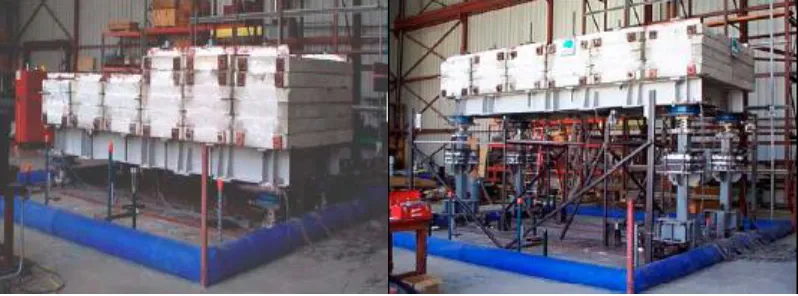
Fig. 1 Shaking Test specimen of simple supported bridge with different substructure stiffness.
Overall, good performance was noted for all of the isolated systems studied. It has been noted that the design of isolated buildings and bridges can be problematic due to the apparent over conservativeness of some design provisions, but also because of challenges encountered when designing isolated systems to resist intense near-field ground motions. Various efforts to make design procedures more transparent, based on performance-base engineering concepts, are underway worldwide. To resist large near-fault ground shaking, relatively large and strong isolators are often necessitated to control displacements and maintain isolator stability. In these cases, isolators may not act effectively, especially for small events, and require relatively large design forces and trigger excessive accelerations in the superstructure
5[Morgan and Mahin, 2007]. Thus, efforts are underway to improve isolation for small events,
limit displacements for larger events, and reduce floor accelerations.
Organized by C.O.E.T, Akola. Available Online at www.ijpret.com91
Fig. 2 Triple pendulum slider and test specimen
This device has three independent pendulum mechanisms (Fig. 2). By strategically selecting friction coefficients for each mechanism, hysteretic characteristics can be optimized for occasional, rare and very rare events. Tests (Fig. 2) and analyses demonstrate that the devices can be designed to achieve about the same isolator displacements for a large event, but with smaller drifts and accelerations in the superstructure and with a far greater degree of isolation during smaller events
Organized by C.O.E.T, Akola. Available Online at www.ijpret.com92
ROCKING FOUNDATIONS
Most structures are designed to have a fixed base. For example, conventional bridge structures residing on competent soil are typically designed with rectangular spread footings proportioned to allow for a fixed base Fig. 2 Triple pendulum slider and test specimen response. This generally leads to inelastic behavior at or near the column to footing interface during design level earthquakes. This mode of behavior dissipates input energy, but results in damage to the column and potential permanent lateral displacements. By permitting the bridge piers to rock or uplift on the supporting soil introduces other modes of nonlinearity (rocking) and energy dissipation (soil inelasticity). Explicit consideration of rocking as an acceptable mode of response can reduce the required footing sizes. Also, the simultaneous rocking of a properly designed foundation and flexural deformation of the supported column appears to eliminate, or substantially reduce, damage in the column and residual displacements in a bridge with moderate to long fundamental periods following a major earthquake. Of the three approaches discussed in this paper, rocking of bridge foundations relies the most on conventional design and construction methodologies. Many previous studies have investigated the benefits of allowing a column and footing system to uplift (e.g., 7[Chopra and Yim, 1985; Housner, 1963]). Analytic studies of bridge column response to one horizontal earthquake component have illustrated the combined effects of rocking and column flexural displacements 8[Alameddine and Imbsen, 2002; Kawashima and Hosoiri, 2003]). Recent earthquake simulator tests
9[Sakellaraki et al, 2005] on small-scale steel columns subjected to unidirectional excitation
have also demonstrated the feasibility and benefit of the rocking mechanism in resisting seismic effects. Because of the potential economic and performance benefits of using rocking in new construction, and the desirability of developing reliable analysis procedures for evaluating existing bridge structures, a series of experimental and analytical investigations has begun at UC Berkeley and UC Davis with funding from Caltrans. These studies focus on developing guidelines for the design of bridge piers foundations allowed to uplift during severe earthquakes. The work at UC Berkeley focuses on development of design procedures, and validating these via more refined structural analyses and earthquake shaking table tests of moderate-scale models of reinforced concrete bridge columns under multidirectional earthquake excitations. The work at UC Davis focuses on validating this work through a series of geotechnical centrifuge tests. Consideration is limited to
Organized by C.O.E.T, Akola. Available Online at www.ijpret.com93
Fig. 4 Simplified analytic model, UC Berkeley shaking table tests and UC Davis centrifuge tests used to study rocking foundations.
For the shaking table model, a series of tests examine the effect of one, two and three components of excitation for a simple 1:4.5-scale column on a spread foundation supported on a 50 mm thick neoprene (Duro-60) pad. This pad highly idealizes the soil beneath the footing. The column has a diameter of 410 mm, a longitudinal reinforcement ratio of 1.2%, and spiral reinforcement. Tests have been carried out with columns having a footing width of 3 and 5 times the column width (Dc) and having gravity loads equal to 3% and 10% of Ag f’c.
Organized by C.O.E.T, Akola. Available Online at www.ijpret.com94
Fig. 5 Peak displacements for five combinations of Los Gatos records (35%g)
Several models were developed for predicting uplift and rocking behavior using the computational framework Open Sees 10[2003]. The baseline model is a lumped mass fiber column resting on an elastic footing and nonlinear vertical springs. In addition, full 3D finite element models and a generalized bending, rocking and sliding plastic hinge model were also developed 11[Kutter et al, 2006]. Good correlation between computed and test results was achieved for both types of numerical models. Experimental and analytical investigations indicate that this rocking mechanism provides a viable means of resisting earthquake effects. Except for short period structures, column displacements were similar to or smaller than would be expected for comparable elastic or yielding pier with a fixed foundation, and the column showed no signs of damage and re-centered following the end of the ground shaking. For cases where column yielding occurred, the damage and permanent displacements are greatly reduced. It is recognized that rocking of spread footings may not be possible in many important situations (e.g., poor soil conditions). In such cases, development of special foundation details that permit rocking on pile-supported foundations may be feasible. Extension of these concepts to braced frame buildings is currently under investigation.
3.3. SELF-CENTERING REINFORCED CONCRETE COLUMN SYSTEMS
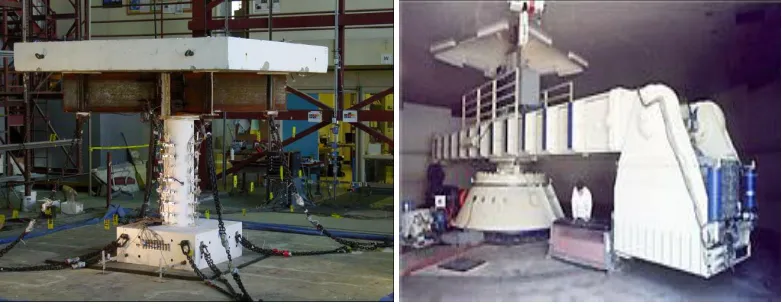
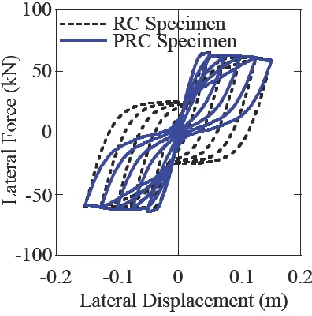
Organized by C.O.E.T, Akola. Available Online at www.ijpret.com95 these columns 12[Jeong and Mahin, 2007; Sakai and Mahin, 2004; Sakai et al, 2006] is to reduce the amount of longitudinal reinforcement needed for a conventional ductile design 13[Caltrans, 1998] by about half, but to add unbonded post-tensioning strands and adjust the amount of transverse confinement such that the envelop of stiffness and strength under loading conditions is similar to that used for a conventional ductile column. However, under unloading, the columns exhibit a characteristic hourglass or center-oriented hysteretic loop shape. This can be seen in Fig. 6. Six nearly identical columns have been tested to date 14[Sakai et al, 2006]. The baseline ductile column is shown in Fig. 7(a), whereas a corresponding self-centering column is shown in Fig. 7(b). In Specimens PRC and PRC-2 all of the mild reinforcement is fully bonded to the surrounding concrete. In PRC-U, the mild rebar are debonded locally over a length of 2Dc in the plastic hinge region to help reduce steel strain concentrations. In Specimen PRC-U2, the rebars are also debonded, but the level of post-tensioning is increased by about Fig. 5 Peak displacements for five combinations of Los Gatos records (35%g)
Fig. 6 Comparison of hysteretic loops 75% to try to improve re-centering tendencies.
Organized by C.O.E.T, Akola. Available Online at www.ijpret.com96
Fig. 7 Cross sections considered for self-centering column investigation
As expected, the conventional column proved to be quite ductile (with ductility demands in excess of 12 during the maximum considered event), but permanent lateral displacements developed during the design and maximum level events, requiring a premature termination of the tests (see Fig. 8(a)), at the end of the maximum level tests where the permanent lateral displacements were more than 10% of the column height. Even at the design level event (displacement ductility of 7.5) the permanent lateral displacement in the ductile column is more than 1%, which would be problematic for continued traffic flow (Fig. 9(a)). In contrast, the basic self centering column at the Design Level excitation had the same or smaller peak displacements, but the permanent offset was very small (Figs. 8(b) and 9(b)).
Organized by C.O.E.T, Akola. Available Online at www.ijpret.com97 the need for post-earthquake repair, and remains plumb enough to avoid reduced traffic flow. Extension of these concepts to the design of concrete cores in building structures is currently under investigation. A series of numerical simulations has been undertaken to evaluate and improve analytical models and assess the cost and performance of self-centering systems [Jeong and Mahin, 2007; Lee and Billington, 2006]. Design guidelines for self-centering columns have been developed [Jeong and Mahin, 2007; Sakai et al 2006].
(a) Specimen RC (b) Specimen PRC
Fig. 8 Residual displacements of specimens after maximum level test
Fig. 9 Response of Test Specimens to Los Gatos Records from 1989 Loma Prieta Earthquak.
CONCLUDING REMARKS
post-Organized by C.O.E.T, Akola. Available Online at www.ijpret.com98 earthquake repairs and impair operability, structural engineers can achieve designs that are durable, dependable, and economical in terms of initial construction cost and the potential losses that might occur in the event of a damaging earthquake. As such, these approaches address the basic principles articulated by sustainable design. Additional research is needed to refine these concepts, especially with regards to (1) reducing cost and increasing speed of construction, (2) reducing the societal and ecological impacts of construction, (3) and refining concepts such as those presented herein and developing more generally applicable design guidelines. In addition, these design approaches require study to assess reliably the ability of the structure to withstand future seismic events. While typical visible forms of damage may not develop, some forms of damage are hidden (e.g., compaction of soil yielding beneath foundations), dynamic characteristics may have changed, and the remaining ability to dissipate energy may be reduced due to low cycle fatigue. Similarly, the deformed shape of structures designed in using these concepts may differ from conventional fixed base structures, requiring special consideration for the design of architectural, mechanical, electrical and plumbing elements. Experimental research is an essential aspect of developing such new structural concepts, not only to improve understanding of their behavior and to validate numerical models, but also to provide a critical proof of concept.
REFERANCES:
1. Brundtland, G. (1987). Report of the World Commission on Environment and Development:
Our Common Future, United Nations.
2. Kren, A. (2006). Personal communication.
3. AASHTO (1999). "Guide Specifications for Seismic Isolation Design", American Association of State Highway and Transportation Officials, Washington, D.C.
4. Anderson, E. (2003). “Performance-Based Design of Seismically Isolated Bridges,” Doctoral
Thesis, University of California, Berkeley, CA, 881 pp.
5. Morgan, T. and Mahin, S. (2007). “Enhancing the performance capabilities of seismically isolated buildings using multi-stage friction pendulum sliding bearings,” Proceedings, World Forum on Smart Materials and Smart Structures Technology (SMSST ’07), Chongqing & Nanjing, China.
Organized by C.O.E.T, Akola. Available Online at www.ijpret.com99 7. Chopra, A. K. and Yim, C. (1985). “Simplified Earthquake Analysis of Structures with Foundation Uplift.” Structural Engr., ASCE, 111:4.
8. Alameddine, F., and Imbsen, R.A. (2002). “Rocking of Bridge Piers Under Earthquake Loading.” Proceedings, Third National Seismic Conference & Workshop on Bridges and Highways.
9. Open Sees Development Team (1998-2003). “OpenSees: open system for the earthquake engineering simulations” http://opensees.berkeley.edu/.
10. Kutter, B., Jeremic, B., Stephen Mahin, S., Ugalde, J., Gajan, S., and Hu, G. (2006). “Seismic Energy Dissipation by Foundation Rocking for Bridge SFS Systems,” Proceedings, Fifth National Bridge Seismic Conference, San Francisco, CA.
11. Jeong, H. and Mahin, S. (2007). “Evaluation of Self-Centering Reinforced Concrete Columns by Shaking Table Tests and Numerical Simulations,” PEER Report, University of California, Berkeley, CA.
12. Caltrans (1998). Seismic Design Criteria, version 1.1, Calif. Dept. of Transportation, Sacramento, CA.
![Fig. 3 Interstory drift ratio and floor spectral acceleration for isolated structures with TPS and conventional bearings and buckling restrained braced frames (BRBF) [Morgan et al, 2007]](https://thumb-us.123doks.com/thumbv2/123dok_us/8709888.1740767/6.612.121.494.77.311/interstory-spectral-acceleration-isolated-structures-conventional-bearings-restrained.webp)