R E S E A R C H
Open Access
A case control study investigating the effects of
levels of physical activity at work as a risk factor
for prostate cancer
Glenn W Doolan
1,5*, Geza Benke
1, Graham G Giles
1,2,3, Gianluca Severi
2,3and Timo Kauppinen
4Abstract
Background:A potential risk factor for prostate cancer is occupational physical activity. The occupational aetiology of prostate cancer remains unclear. The purpose of this research was to examine associations between the level of exposure to various measures of physical activity at work and the risk of Prostate Cancer.
Methods:Using the Finnish Job Exposure Matrix and the occupational history of 1,436 cases and 1,349 matched controls from an Australian case control study; we investigated five related exposure variables considered to be risk factors by comparing odds ratios.
Results:Modestly increasing odds ratios were detected with increasing levels ofworkloadbut there was no difference in this trend between moderate and high grade tumours. In regard to occupationalphysical workloadno statistically significant association was observed overall but an increasing trend with level of exposure was observed for high grade compared with moderate grade tumours.
Conclusion:Bothworkloadandphysical workloadmerit further investigation, particularly for the latter in relation to grade of tumour.
Keywords:Manual handling of burdens, Occupational exposure, Physical activity, Physical workloads, Prostate cancer, Risk factors, Finish job exposure matrix
Background
Many past studies have investigated various occupational chemical and physical agents as likely causes of prostate cancer [1]. When investigating the causes of death after the diagnosis of prostate cancer it has also been previ-ously found that men with low to moderate grade pros-tate cancer had a similar rate of death to men without prostate cancer [2]. There are very few well established risk factors of prostate cancer especially those that are potentially modifiable risk factors [3]. Therefore the ra-tionale for this study is to investigate the likely associ-ation of some modifiable occupassoci-ational risk factors and prostate cancer. Previous reported studies investigating the role that physical activity plays in the occupational
environment, have described physical activity by various metrics [4,5]. Ricciardi provided a model for the concept of Sedentarismthat included attributes such as expend-ing less than 10% daily energy in the performance of moderate and high-intensity activities in which the metabolic rate increases at least four times from base-line, or not engaging in physical activities five or more times per week or no leisure activity or no physical ac-tivity for up to 3hrs per week that increases the meta-bolic rate by four times from base [4]. In relation to Leisure Time Physical Activity (LTPA), Kirk found that those employed in occupations demanding long work hours and low Occupational Physical Activity (OPA) are at higher risk of inactivity.
Some authors [6] have demonstrated that men who participated in regular LTPA reduced their risk for clin-ical prostate cancer and in the workplace concluded that physical activity at work was also beneficial in reducing the risk of prostate cancer [7-10]. However, Bairati et al.
* Correspondence:[email protected] 1
Department of Epidemiology & Preventive Medicine, Monash University, The Alfred Centre, The Alfred, Commercial Road, Melbourne, Victoria 3004, Australia
5Permanent Address: P.O. Box 276, Trafalgar, Victoria 3824, Australia
Full list of author information is available at the end of the article
suggested that socio-economic status was a probable confounder [10]. In two systematic reviews, it was found that few studies demonstrate a protective role of OPA, even though high levels of OPA and LTPA together seemed to reduce the risk of advanced prostate cancers [11,12]. A further review concluded there was inconsist-ent evidence for an inverse association between OPA and prostate cancer [13]. Recently, a meta-analysis [14] found no clear evidence for an association between job strain and the risk of prostate cancer in relation to OPA. Discacciati et al., adds another dimension to the overall picture by concluding that obesity may have a dual effect on PCa by a decreased risk of low grade PCa and an in-creased risk of high grade PCa [15].
In contra distinction, a positive association was re-ported [3] between prostate cancer risk and the highest category of workplace physical activity, which is the op-posite of what has been reported by most other studies [7-10] of physical activity and prostate cancer.
Our aim was to investigate whether an association existed between occupational physical activity exposures (assessed using FINJEM ) and prostate cancer, and, in order to address issues of possible detection bias, also to inspect whether such associations differed by grade of tumour. Occupational studies using job exposure matri-ces (JEMs) have reported some associations with pros-tate cancer risk, but these have not consistently been replicated by other studies [16]. Although leisure time physical activity may be a limitation and potential cause of bias due to misclassification, there is no reason to suggest that the profile of the cases are different to the controls. This article specifically discusses the reported OPA in men in relation to prostate cancer using the demographic profile of the sample and the odds ratios found in relation to five exposure variables (that are pos-sible risk factors) measuring different forms of work-place physical activity, rather than LTPA. In this study we have used the term ‘occupational exposure’ to in-clude both ergonomic and psychological variables.
Methods
Giles et al. [17] has reported on the Australian Prostate Cancer study elsewhere. Briefly, population based cancer registries in Melbourne, Sydney and Perth were utilized to recruit a random sample of 2,528 cases with prostate cancer diagnosed at age 39–80 and 3,125 controls which were considered eligible at the time of selection. For the purposes of this analysis the number of participants was reduced due to factors such as no access to patient re-cords, refusal of controls, insufficient English skills, or moved address. Further analysis was restricted to 1,495 (65%) cases with prostate cancer diagnosed at age 39–70 and 1423 (46%) controls aged between 40 and 70 years. The final analysis for which there was sufficient information
regarding occupational work histories included 1,436 cases (96%) and 1,349 (94%) controls, aged between 39 and 70 years.
Participants were also asked to complete a Lifetime Calender of residence and employment in order to prompt more complete answers when responding to the study questionnaires. The controls were matched through fre-quency based matching with age and were free of prostate cancer upon recruitment. Recruitment was stratified by age and all men under the age of 60 years were invited to participate. Initially, random samples of 50% of men aged 60–64 and 25% of men aged 65–70 were selected, with the proportions varying overtime to fit interview quotas.
Cases recruited in Melbourne, Sydney and Perth, Australia were diagnosed in the study period and noti-fied to the population-based cancer registries with a histopathologically-confirmed diagnosis of adenocarce-noma of the prostate, and excluded tumours that were well-differentiated (defined as low grade tumours, that is, those with a Gleason score of less than five).
A major concern with prostate cancer is the diagnostic staging and whether any occupational exposures are associ-ated with medium or high grade cancers. One approach to overcoming concerns regarding the inclusion of clinically unimportant tumours as cases is to select cases who are di-agnosed in the study period and notified to the population-based cancer registries with a histopathologically confirmed diagnosis of adenocarcenoma of the prostate, excluding mours that are well-differentiated (defined as low grade tu-mours i.e. those with a Gleason score less than five). This has been addressed in this study.
The self-reported data from the calendar and ques-tionnaires that related to occupation were collated to-gether with date-of-birth, location, children and their gender, and school/occupation and linked with other clinical data variables from study such as smoking, alco-hol consumption and physical activity at work. This data was has been shown to be both valid and reliable in other analysis [17].
This further analysis of Giles et al. original study [17] was undertaken using de-identified data and is covered by the AVCC Institutional Ethics Committee permission (1992) from the Anti-Cancer Council of Victoria, and per-mission from the Chief Investigator of theRisk Factors for Prostate Cancer Case–control Study (2004).
Exposure assessment
FINJEM is coded for 311 classes of occupation, according to the Finnish occupation coding classification. The expos-ure is measexpos-ured in line with the method described by Kauppinen at al. [19]. Each job or employment episode of the participants in this study was coded according to the Finnish occupation coding classification and a FINJEM code number (O-Code) was allocated. The coding facili-tated the linkage between the occupational activity expo-sures and prostate cancer status. As an example of this linkage please see Table 1 for a list of the three top occu-pations with the highest levels of exposures for each ex-posure variable. It is noted that this list should be treated cautiously as quite a few men had more than one occupa-tion during the course of their working life.
Each exposure variable has a specific definition and value and exposure is characterised by the proportion of exposed workers (P) and the mean level of exposure (L) and is given asP × Lfor each occupation. Cumulative ex-posure was calculated by P × L × Years exposed in the various exposed jobs reported by the participant. Occupa-tional exposures that did not exceed the non-occupaOccupa-tional background level were omitted for example, background radiation levels).
The cumulative exposure for the exposed participants was calculated in tertiles and quartiles. In the model used it included occupational exposure variable plus age, family history and the SEIFA index of economic resources, which is a measure of socio-economic disadvantage, first pro-duced by the Australian Bureau of Statistics [20] following the 1971 census. Only occupational cumulative exposures from our model are presented in the results as it takes into account the level of economic and social disadvan-tage within the sample, as well as age and family history confounders.
The exposure variables
We investigated three exposure variables; manual hand-ling of burdens, physical workloads, sedentary work, and two created variables of cumulative activity-over-time and workload by comparing odds ratios in tertiles and quartiles through analysis by binary logistic regression. Moderate and high grade tumours were compared using polytomous regression. Themanual handling of burdens consists of lifting, and carrying of heavy burdens, and is an essential feature of the everyday work tasks. Physical workloads consist of tasks where the whole body is
exerted by dynamic muscular work.Sedentary work con-sists of work done in seated posture [19]. Also, one of the variables were created, total cumulative activity-over-time is calculated by adding an individual’s total scores over their disclosed working life so that some comparison could be undertaken in regard to working in high to low activity jobs for a prolonged period. The psy-chological exposure variableWorkloadis a measurement of the overall psychological impact of perceived occupa-tional load over the years of employment. If a subject considers they have been stressed from a high workload over the majority of their working history, it might indi-cate that, as a stressor, this could have a long-term harmful outcome.Workloadis defined as a psychological factor in FINJEM [19] and is derived from the demand to work under tight schedules and time pressure, and to adjust conflicting demands from others subjective perceptions.
Results
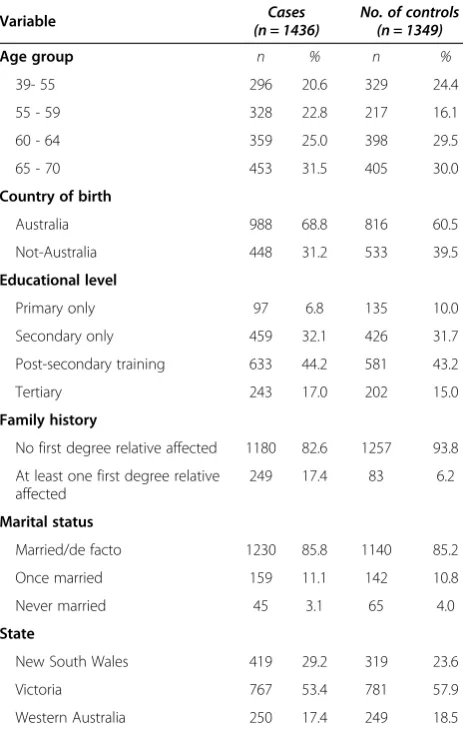
The profile of the sample in Table 2 shows the ages of the participants were relatively evenly spread between cases and controls. In the 65–70 year age group, this group was slightly larger and consistent with the ex-pected occurrence and diagnosis with the control group having the greater number of participants below the age of 55 years.
There were ten percent more Australian born cases than controls. Educationally both groups were closely matched, but numerically the control group had a higher number of men with lower educational attainment. In regard to family history, cases had an 11.2% greater dif-ference of at least one first degree relative being affected by prostate cancer. Marital status had a similar spread in both groups.
Table 3 shows the results of the binary logistic regres-sion for the five exposure variables, manual handling of burdens, sedentary work, workload, cumulative activity-over-time and physical workloads. None of the three ergonomic factors, manual handling of burdens, physical workload and sedentary work were associated with pros-tate cancer risk, nor was the calculated variable of cu-mulative activity-over-time. The psychological variable ofworkloadwhich measures the worker’s perceptions in relation to an occupational lifetime of high workload
Table 1 A list of top three occupations with the highest levels of exposures for each exposure variable for men with high grade tumours
Manual handling of burdens Sedentary work Physical workload Total cumulative activity-over-time Work load
Cabinet maker Taxi driver Meat worker Meat worker Editor
Meat worker Truck driver Cabinet maker Sailor Travel consultant
activity was the only statistically significant association and it showed a positive relationship with PCa risk.
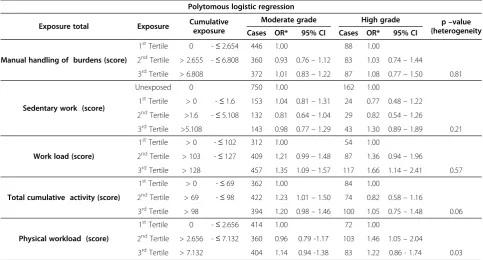
Table 4 describes the results of thePolytomous Logistic Regressioncomparing the associations between moderate and high grade prostate cancers for each of the exposures. No associations were observed for manual handling of Burdens or for Sedentary Work for either moderate or high grade prostate tumour risk.
For total cumulative activity a significant trend in in-creasing risk was observed for moderate grade but not high grade tumours (heterogeneity p = 0.06). For work-load, both moderate and high grade tumours were posi-tively associated with increasing exposure but were not significantly different in this regard. For physical work-load, a statistically significant trend was observed with increasing levels of exposure but only for high grade tumour risk (heterogeneity p = 0.03).
In this study there were 16,331 reported jobs, provid-ing good variability in job histories for application of FINJEM [21]. The occupational exposure OR’s across all
of the variables did not vary substantially from the ad-justment models for age, family history and SEIFA Index of Economic Resources in both the binary and polyto-mous logistic regressions.
Discussion
This study has found that workloadis modestly associ-ated with an increased risk of prostate cancer and for both moderate and high grade tumours. This is at odds with the findings of Heikkilä et al. [14] that work related psychological stress is unlikely to be an important factor for prostate cancer. We also found cumulative activity-over-timeto be modestly associated with prostate cancer risk and showed a small trend with the moderate grade tumours. However, total cumulative activity-over-time appears to have a stronger association with the higher grade tumours. These results suggest that the greater the physical activity in the work place over a long period of time the greater the likelihood of the development of high grade prostate cancer.
In comparison with other studies, our finding regard-ingtotal cumulative activity-over-timeis contrary to the findings of Bairati [10] where physical activity in the job had an inverse relationship with prostate cancer and they concluded that physical activity was beneficial. Bair-ati also found that sedentary/light work had a positive association with prostate cancer whereas our findings showed no associations or trends in regard to prostate cancer. The current analysis also does not support the earlier findings by Ricciardi [4] and Kirk & Rhodes [5] in relation to the combination of OPA and LPTA reduce the risk of advanced prostate cancers. It should be noted that Bairati’s study did not use a Job Exposure Matrix, but instead coded the data related to occupational activ-ity using the five levels of physical activactiv-ity described by the US Department of Labor.
The major strengths of our study are its sample size and the stratification of the subjects to reflect the population of men with and without prostate cancer. With the three main sites we are confident that the study may be generalizable to the population of men in Australia [21].
In Australia, the treatment of Prostate Cancer is very limited outside state capitals, so our sampling frame is unlikely to be a limitation and has not been compro-mised due to unrepresentative case ascertainment, even though we recruited cases and controls from three major metropolitan centres of the three selected states. The use of FINJEM in Australia has previously been found to be acceptable for various exposures when compared with expert assessment [18].
The principal weakness of our study is the use of a Job Exposure Matrices (JEMs) that can lead to non-differential misclassification of exposure [22], and we would expect non-differential misclassification to have occurred. This will
Table 2 Demographic description of characteristics of cases and controls
Variable Cases
(n = 1436) No. of controls(n = 1349)
Age group n % n %
39- 55 296 20.6 329 24.4
55 - 59 328 22.8 217 16.1
60 - 64 359 25.0 398 29.5
65 - 70 453 31.5 405 30.0
Country of birth
Australia 988 68.8 816 60.5
Not-Australia 448 31.2 533 39.5
Educational level
Primary only 97 6.8 135 10.0
Secondary only 459 32.1 426 31.7
Post-secondary training 633 44.2 581 43.2
Tertiary 243 17.0 202 15.0
Family history
No first degree relative affected 1180 82.6 1257 93.8
At least one first degree relative affected
249 17.4 83 6.2
Marital status
Married/de facto 1230 85.8 1140 85.2
Once married 159 11.1 142 10.8
Never married 45 3.1 65 4.0
State
New South Wales 419 29.2 319 23.6
Victoria 767 53.4 781 57.9
Table 3 Cumulative occupational exposures for prostate cancer by binary logistic regression
Binary logistic regression
Exposure total Exposure Cumulative
exposure Controls Cases OR* 95% CI p for trend (unadjusted model)
Manual handling of burdens (score)
1stTertile 0 -≤2.654 472 534 1.00
2ndTertile > 2.655 -≤6.808 440 443 0.96 0.79–1.15
3rdTertile > 6.808 437 459 1.01 0.84–1.22
Continuous 1349 1436 0.82
Sedentary work (score)
Unexposed 0 843 912 1.00
1stTertile >0 –≤1.6 158 177 0.96 0.78–1.25
2ndTertile >1.6 -≤5.108 180 161 0.78 0.62- 0.99
3rdTertile >5.108 168 186 1.02 0.81- 1.29
Continuous 1349 1436 0.94
Work load (score)
1stTertile > 0 -≤102 426 366 1.00
2ndTertile > 103 -≤127 466 496 1.20 0.99–1.46
3rdTertile > 128 457 574 1.34 1.09–1.65
Continuous 1349 1436 0.001
Total cumulative activity (score)
1stTertile > 0 -≤69 442 446 1.00
2ndTertile > 69 -≤98 455 496 1.16 0.95–1.40
3rdTertile > 98 452 494 1.19 0.97–1.46
Continuous 1349 1436 0.11
Physical workload (score)
1stTertile 0 -≤2.656 456 486 1.00
2ndTertile > 2.656 -≤7.132 448 463 1.06 0.87–1.28
3rdTertile > 7.132 445 487 1.15 0.95 -1.40
Continuous 1349 1436 0.13
*Odds ratios (OR) and associated 95% confidence intervals (95% CI) adjusted for Age, Family History and SEIFA Index of Economic Resources.
Table 4 Cumulative occupational exposures for prostate cancer by polytomous logistic regression
Polytomous logistic regression
Exposure total Exposure Cumulative exposure
Moderate grade High grade p–value {heterogeneity Cases OR* 95% CI Cases OR* 95% CI
Manual handling of burdens (score)
1stTertile 0 -≤2.654 446 1.00 88 1.00
2ndTertile > 2.655 -≤6.808 360 0.93 0.76–1.12 83 1.03 0.74–1.44
3rdTertile > 6.808 372 1.01 0.83–1.22 87 1.08 0.77–1.50 0.81
Sedentary work (score)
Unexposed 0 750 1.00 162 1.00
1stTertile > 0 -≤1.6 153 1.04 0.81–1.31 24 0.77 0.48–1.22
2ndTertile >1.6 -≤5.108 132 0.81 0.64–1.04 29 0.82 0.54–1.26
3rdTertile >5.108 143 0.98 0.77–1.29 43 1.30 0.89–1.89 0.21
Work load (score)
1stTertile > 0 -≤102 312 1.00 54 1.00
2ndTertile > 103 -≤127 409 1.21 0.99–1.48 87 1.36 0.94–1.96
3rdTertile > 128 457 1.35 1.09–1.57 117 1.66 1.14–2.41 0.57
Total cumulative activity (score)
1stTertile > 0 -≤69 362 1.00 84 1.00
2ndTertile > 69 -≤98 422 1.23 1.01–1.50 74 0.82 0.58–1.16
3rdTertile > 98 394 1.20 0.98–1.46 100 1.05 0.75–1.48 0.06
Physical workload (score)
1stTertile 0 -≤2.656 414 1.00 72 1.00
2ndTertile > 2.656 -≤7.132 360 0.96 0.79 -1.17 103 1.46 1.05–2.04
3rdTertile > 7.132 404 1.14 0.94 -1.38 83 1.22 0.86 - 1.74 0.03
almost certainly have led to a bias towards null-effect (OR = 1). Multiple hypothesis testing may produce chance positive results, but we did not find anything significant in this regard. The advantage of using a JEM is that it does not rely on self-reported exposure by subjects potentially leading to differential exposure bias from then cases, which is particularly important for more subjective expos-ure indices such as workload. Being an objective measexpos-ure of OPA it overcomes the problem of criterion validity of questionnaires [23]. A second limitation is in not having access to BMI’s for the cases and controls, in order to con-firm or deny other researchers conclusions [15].
Finally, there would seem to be two contradictory re-sults. Firstly thatmanual handling of burdenswhich dis-played a slight trend with high grade tumours did not show an association with total prostate cancer. However, Physical workloads did show a small association with total prostate cancer but no association with either mod-erate or high grade tumours. Therefore there is insuffi-cient evidence to support any causal relationship and it must be concluded that OPA is unlikely to be beneficial in relation to protecting against PCa, even though other studies have suggested that the combination of OPA and LTPA strongly reduced risk [11,12].
Conclusions
Our findings are in line with other authors recommenda-tions that suggest further research might be merited in re-gard to workload and physical workload and prostate cancer risk. We recognize, however, that our findings may point to another more definable psychological agent related to stress in the workplace. Given the modest nature of the associa-tions we describe, we provide little evidence to support any causal relationship and conclude that OPA is not proven to be beneficial in relation to protecting against prostate cancer.
Consent
A written informed consent was obtained from all par-ticipating participants in the original study and this fur-ther analysis was undertaken on de-identified data.
Competing interests
The authors declare that they have no conflict of interests.
Authors’contributions
GD participated in the design of this investigation, the acquisition of journal articles, analysis and interpretation of data, the drafting of the manuscript and giving the final approval of the version to be published. GB participated in the design of this investigation, in revising the manuscript critically and for important intellectual content, and giving final approval of the version to be published. GG participated in the design of this investigation, the critical revision of the manuscript for important intellectual content, the drafting of the manuscript and giving final approval of the version to be published. GS consulted on the analysis and interpretation of data and giving final approval of the version to be published. TK participated in the design of this investigation, in revising the manuscript critically and for important intellectual content, and giving final approval of the version to be published. All authors read and approved the final manuscript.
Funding statement
The authors received no financial support for the research and/or authorship of this article. The original study of which this further analysis is based was funded by grants from the National Health and Medical Research Council (940394, 991129) and was further supported by funding from Tattersall’s and The Whitten Foundation as well as infrastructure provided by The Cancer Council Victoria.
Author details
1
Department of Epidemiology & Preventive Medicine, Monash University, The Alfred Centre, The Alfred, Commercial Road, Melbourne, Victoria 3004, Australia.2Cancer Epidemiology Centre, Cancer Council Victoria, 615 St. Kilda Road, Melbourne, Victoria 3004, Australia.3Centre for Genetic Epidemiology, University of Melbourne, 200 Berkeley Street, Carlton, Victoria 3053, Australia. 4Finnish Institute of Occupational Health, Topeliuksenkatu 41aA, FIN-00250
Helsinki, Finland.5Permanent Address: P.O. Box 276, Trafalgar, Victoria 3824, Australia.
Received: 14 January 2014 Accepted: 25 July 2014 Published: 7 August 2014
References
1. Ilic M, Vlajinac H, Marinkovic J:Case–control study of risk factors for prostate cancer.Br J Cancer1996,74:1682–1686.
2. Ketchandji M, Kuo YF, Shahinian V, Goodwin JS:Cause of death in older men after the diagnosis of prostate cancer.J Am Geriatr Soc2009,57:24–30. 3. Sass-Kortsak AM, Purdham JT, Kreiger N, Darlington G, Lightfoot NE, Sass K:
Occupational risk factors for prostate cancer.Am J Ind Med2007, 50:568–576.
4. Ricciardi R:Sedentarism: a concept analysis.Nurs Forum2005,40:79–87. 5. Kirk MA, Rhodes RE:Occupation correlates of adults’participation in
leisure-time physical activity: a systematic review.Am J Prev Med2011, 40(4):476–485.
6. Barnard R, Shan-Leung P, Aronson WJ, Cohen P, Golding LA:A mechanism to explain how regular exercise might reduce the risk for clinical prostate cancer.Eur J Cancer Prev2007,16:415–421.
7. Lagiou A, Samoli E, Georgila C, Minaki P, Barbouni A, Tzonou A, Trichopoulos D, Lagiou P:Occupational physical activity in relation with prostate cancer and benign prostatic hyperplasia.Eur J Cancer Prev2008, 17:336–339.
8. Strom SS, Yamamura Y, Flores-Sandoval FN, Pettaway CA, Lopez DS: Prostate cancer in Mexican-Americans: identification of risk factors. Prostate2008,68:563–570.
9. Krishnadasan A, Kennedy N, Zhao Y, Morgenstern H, Ritz B:Nested case– control study of occupational physical activity and prostate cancer among workers using a job exposure matrix.Cancer Causes Control2008, 19:107–114.
10. Bairati I, Larouche R, Meyer F, Moore L, Fradet Y:Lifetime occupational physical activity and incidental prostate cancer (Canada).Cancer Causes Control2000,11:759–764.
11. Anzuini F, Battistella A, Izzotti A:A Physical activity and cancer prevention: a review of current evidence and biological mechanisms.J Prev Med Hyg 2011,52(4):174–180.
12. Liu YP, Hu FL, Li DD, Wong F, ZHU L, Chen WY, Ge J, An R, Zhao Y:Does physical activity reduce the risk of prostate cancer? A systematic review and meta-analysis.Eur Urol2001,60:1029–1044.
13. Doolan G, Benke G, Giles GG:An update on occupation and prostate cancer.Asian Pac J Cancer Prev2014,15:501–516.
14. Heikkilä K, Nyberg S, Thorell T, Alfredsson L, Bjorner JB, Bonenfant S, Borritz M, Bouillon K, Burr H, Dragano N, Geuskens GA, Goldberg M, Hamer M, Hooftman WE, Houtman IL, Joensuu M, Knutsson A, Koskenvuo M, Koskinen A, Kouvonen A, Madsen IE, Magnusson Hanson LL, Marmot MG, Nielsen ML, Nordin M, Oksanen T, Pentti J, Salo P, Rugulies R, Steptoe A,et al:Work stress and risk of cancer: meta-analysis of 5700 incident cancer events in 116,000 European men and women.BMJ2013,346:165.
15. Discacciati A, Orsini N, Wolk A:Body mass index and incidence of localized and advanced prostate cancer–a dose–response meta-analysis of prospective studies.Ann Oncol2012,23(7):1665–1671.
17. Giles GG, Severi G, McCready MR, English DR, Johnson W, Hopper JL, Boyle P:Smoking and prostate cancer: findings from an Australian case– control study.Ann Oncol2001,12:761–765.
18. Benke G, Sim M, Fritschi L, Aldred G, Forbes A, Kauppinen T:Comparison of occupational exposure using three different methods: hygiene panel, job exposure matrix (JEM), and self reports.Appl Occup Environ Hyg2001, 16:84–91.
19. Kauppinen T, Toikkanen J, Pukkala E:From cross-tabulations to multipurpose exposure information systems: a new job-exposure matrix.Am J Ind Med 1998,33:409–417.
20. ABS:An Introduction to Socio-Economic Indexes for Areas (SEIFA) Australia 2006 (Preliminary).InAustralian Bureau of Statistics.Canberra, Australia: Commonwealth of Australia; 2006.
21. Breslow NE, Day NE:Statistical methods in cancer research: Vol II - The design and anallysis of cohort studies.Lyon, France: IARC Scientific Publications; 1987:82–297.
22. Bouyer J, Dardenne J, Hemon D:Performance of odds ratios obtained with a job-exposure matrix and individual exposure assessment with special reference to misclassification errors.Scand J Work Environ Health 1995,21:265–271.
23. Kwak L, Proper KI, Hagstömer M, Sjöström M:The repeatability and validity of questionnaires assessing occupational physical activity-a systematic review.Scand J Work Environ Health2011,37(1):6–29.
doi:10.1186/1476-069X-13-64
Cite this article as:Doolanet al.:A case control study investigating the effects of levels of physical activity at work as a risk factor for prostate cancer.Environmental Health201413:64.
Submit your next manuscript to BioMed Central and take full advantage of:
• Convenient online submission
• Thorough peer review
• No space constraints or color figure charges
• Immediate publication on acceptance
• Inclusion in PubMed, CAS, Scopus and Google Scholar
• Research which is freely available for redistribution