105 *Corresponding author
Email address: [email protected]
Optimizing locomotive body structures using imperialist competitive
algorithm
Mahdi Ghamamia, Masoud Shariat Panahib,* and Maryam Rezaeic
a
M. Sc. Student of Mechanical Engineering,faculty of engineering, University of Tehran, Tehran, Iran
b
Department of Mechanical Engineering,faculty of engineering, University of Tehran, Tehran, Iran
c
Department of MAPNA Locomotive Research and Development, Karaj, Iran
Article info: Abstract
In today's design, system complexity and increasing demand for safer, more efficient and less costly systems have created new challenges in science and engineering. Locomotives are products which are designed according to market order and technical needs of customers. Accordingly, targets of companies, especially designers and manufacturers of locomotives, have always been on the path of progress and seek to offer products with higher technology than other competitors. Quality of body structures is based on indicators such as natural frequency, displacement, fatigue life and maximum stress. Natural frequency of various components of the system and their adaption to each other are important for avoiding the phenomenon of resonance. In this study, body structures of ER24 locomotive (Iran Safir Locomotive) was studied. A combination of imperialist competitive algorithm (ICA) and artificial neural network was proposed to find optimal weight of structures while natural frequencies were in the determined range. Optimization of locomotive's structure was performed with an emphasis on maintaining locomotive abilities in static and dynamic fields. The results indicated that use of optimization techniques in the design process was a powerful and effective tool for identifying and improving main dynamic characteristics of structures and also optimizing performance in stress, noise and vibration fields. Received: 19/06/2013
Accepted: 07/12/2013
Online: 03/03/2014
Keywords:
Locomotive,
Artificial neural network, Natural frequency Optimization,
Imperialist competitive algorithm (ICA).
1. Introduction
Since cities are growing and people are becoming more busy, transport systems need to be improved. Vehicle manufacturers are making investment to raise travelling speed, increase passenger capacity of vehicles and provide better passenger comfort. Using
advanced lightweight structures for vehicle design, structural dynamics in connection with vehicle running dynamics is becoming increasingly important [1].
106
engineers to use new development methods. Virtual prototyping computer tools have made considerable progress in recent years. Moreover, this process has been used widely for modelling and simulating dynamic motion of complex vehicle systems. Working with virtual prototyping technology has shown the potential for improving the product development process [2].
Unwanted vibrations are detrimental to the performance of dynamical systems. In addition to causing trouble for proper functioning of the system, reducing life of the structure is its fault. Vibrations in the vehicles with internal combustion engines have great importance similar to locomotives, which must be also considered. On the other hand, this factor is very important because working conditions are different from the defined standards of design and production.
In the past, designing was based on experience and expensive laboratory tests. Analytical methods were sometime impossible or very difficult. However, demand for new designs along with considering aspects such as lighter weight, less fuel consumption, safer and economic aspects, recyclability and availability of parts has not been not reduced. Therefore, various studies have been done in this context, the most important of which on modal analysis and optimization methods of locomotives can be mentioned as follows: static and dynamic analyses were performed on the G16 locomotive chassis for its optimization By Kymasy and partovi [3]. Important connections of locomotive chassis were found and changed in order to increase structural stiffness and several other suggestions for improving natural frequency.
Subik and hey [4] used modeling and simulation for improving stability, accident and rolling resistance of the vehicle structure. Modal analysis techniques were used for this purpose. The results of simulation and modal testing indicated the relationship between both methods. After verifying the results, cross-section was also changed. The results showed an increase in natural frequency and improvement of dynamic properties.
2. Modal analysis
Vibration and acoustical behaviors of a mechanical structure are determined by its dynamic characteristics. This dynamic behavior is typically described using a linear system model. The system inputs are forces (loads) and its outputs are the resulting displacements or accelerations. The system poles usually occur in complex conjugate pairs, corresponding to structural vibration modes.
The poles' imaginary part is related to the resonance frequency and real part to damping. Structural damping is typically very low (a few percent of critical damping). The system'ss eigenvectors, expressed on the basis of structural coordinates, correspond to characteristic vibration patterns or “mode shapes”. System identification from input-output measurements yields the modal model parameters. This approach is now a standard part of mechanical product engineering process.
Free motion of a mechanical structure is governed by a partial differential equation. By applying discretization techniques, such as finite-element method, vibration behavior can be expressed as in Eq. (1).
M
x
C
x
K
x
0
(1)
where { } ϵ R is a vector of generalized displacements and M, C and K are mass, damping and stiffness matrices, respectively. The linear mechanical systems considered here are such that M is symmetric and positive definite while K is symmetric and positive semidefinite. Solution of these equations leads to an eigenvalue problem that is solved in terms of the modal paramters [5].
107 part is connected to the damping. Structural
damping is typically very low (a few percent of the critical damping); hence, this damping is usually expressed as a ratio with respect to critical damping.
Modal representation of a mechanical structure can be analytically determined if a lumped mass-spring system is concerned. In the general case of a continuous structure, numerical approximation is made by means of finite element model (FEM), discretizing the structure in a finite number of physical coordinates.
This research was done using computer software of Hyper mesh, MD Nastran and Matlab. The numerical results were compared with the experimental (MAPNA) ones. The advanced finite element model was used in modal analysis, which caused significant increase in analysis time. Mass normalization method was used to obtain eigenvalues and natural frequencies. An advanced finite element model consisting of plates with different thicknesses was used as well. The body structure was modelled in as much detail as possible. In this case, the model was similar to real structures and there was no simplification.
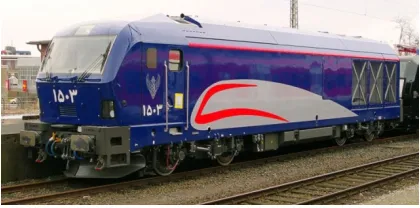
Frequency of 0 to 30 Hz was studied in the modal analysis. Up to the frequency of 30 Hz, three different elastic (structural) mode shapes existed. The mode shape with the lowest frequency showed a torsion of the car body structure. At higher frequencies, lateral, vertical bending and local mode shapes of the car body existed. The locomotive and finite element model of body structure with sheet thickness are given in the figures 1 and 2 and Table 1.
Fig. 1. ER 24 locomotives.
Fig. 2.Body structure's finite element model (b).
Table 1. Sheet thickness (body structures).
Boundary conditions were free-free. Depending on the boundary condition, the first six natural frequencies were equal to zero. The first non-zero natural frequency was the seventh mode. Natural frequencies and mode shapes can be used to measure compliance [6]. Natural frequencies and mode shapes obtained from finite element analysis and modal testing are shown in Table 2 and Fig. 3.
Table 2.Natural frequency and the mode shape.
mode Mode shape (Hz) (Hz) %
#7 1st torsion 7.8 7.87 % 0.89
#8 1st lateral 19.2 19.43 % 1.1
#9 1st bending 24.9 25.53 % 2.53
Natural frequency (finite element model)
Natural frequency (experimental modal analyses)
% =Difference between natural frequencies
(percent)
108
(a)
(b)
(c)
Fig. 3. First torsional (a) lateral (b) and bending (c)
mode.
Acceptable error between results of the finite element analysis and experimental analyses was assumed as three percent. The optimization process began after ensuring accuracy of the finite element model. Optimization process required an objective function for its optimization. In order to optimize the objective function, optimization algorithm acquired values in each of the iterations. Since the request objective function value and its constraints by the finite element model led to wasting time, in order to speed up data retrieval, artificial neural network was used as a substitute to finite element model.
3. Artificial neural network
The current interest in artificial neural networks is largely a result of their ability to
mimic natural intelligence [7]. Artificial neural networks are composed of a set of artificial neurons, a simple model of a biological neuron, which is arranged on a set of layers. One of the most important characteristics of neural networks is learning. Artificial neural networks have two operation modes: training mode and normal mode.
In the training mode, adjustable parameters of networks are modified. In the normal mode, the trained networks are applied for simulating the outputs [8].
Locomotive body structure was composed of 13 different thickness levels; 8 effective thickness of body structure were considered design variables. Artificial neural network was designed with eight neurons in the input layer (thickness of each sheet) and 4 neurons in the output layer (3 first non-zero natural frequency and body structures mass). Using finite element software, 145 data were generated that include sheet thickness, natural frequency and body structures mass.
80 % of the data was considered for network training and the remaining data were used to test the trained network. As seen from the trained neural network, estimates of natural frequency and mass of the body structure had acceptable error.
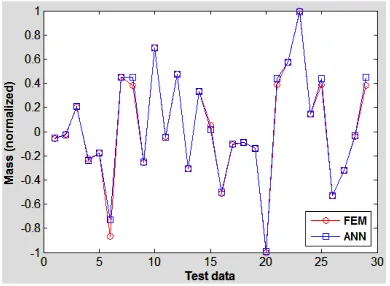
Average error of neural networks was 2.23% and network estimates of mass and natural frequencies had precision of about 97%. Output of the trained neural network and finite element model for the test data is given in Fig. 4.
Fig. 4. Output of artificial neural network (ANN)
109 Mass of body structure as an objective function
was considered for minimizing. Natural frequency could be used as equality constraints. The optimization problem for minimizing mass of the body structure was done by changing the sheet thickness of the body structure by preserving natural frequencies. Neural network predicted natural frequencies and mass.
Knowing the neural network weights and activation function neurons, output of the neural network could be expressed based on its input by an explicit mathematical relationship. The activation function of network's neurons was sigmoid (logsig) and the trained neural network had two layers. So, output of the trained neural network could be defined using mathematical relationships, as shown in Eq. (2).
([ ][ ][ 1])
] 2 [ ] [ ( 1 1 1 bias Input Iw bias M Lw e M e Output
(2)
There are many algorithms for solving unconstrained optimization problems. Also, there are several ways for converting the constrained optimization problem into unconstrained optimization problem, the most common of which is penalty function method. A constrained optimization problem can be expressed as Eq. (3), where h(x) is equality constraint and g(x) is inequality constraint [9].
(3)
00 min i k i j i x h x g x f
Objective function of optimization problems is a criterion for comparing different designs and choosing the best plan. Minimizing the objective function should not adversely affect behavior and performance of the optimization problem and conversion
of
constrained optimization problem into unconstrainedoptimization problem. The exterior penalty function is defined in Eq. (4).
x r
p
x
f r
x
( , ):
min
(4)
m j j n ii x h x
g x p 1 2 1 2 , 0 max
Φ(x, r) is secondary objective function or artificial objective function, f(x) is main objective function and r is penalty function coefficient. Penalty function coefficient is usually constant and has a large value. Using a constant and large value for the penalty function coefficient makes it easier to study in the search space.
4. Optimization
An optimum designed structure is selected by considering the variables such as cost or weight of the structure after all the design constraints are satisfied. Determining optimum design is performed by considering and minimizing cost or weight function of the structures as objective functions. Choosing the design variables from a set of available values, various numerical optimization methods can be selected to evaluate optimal solution of optimization problems. In the present paper, imperialist competitive algorithm (ICA) was used to solve the optimization problems. Optimization can be easily described as finding an argument x, the relevant cost of which f (x) is and it has been extensively used in many different situations such as industrial planning, resource allocation, scheduling and pattern recognition.
ICA is an algorithm which was introduced for the first time by Atashpaz-Gargari and Lucas in 2007 [10] and, inspired by imperialistic competition, was used for optimizing. This method has considerable relevance to several engineering applications [11].
110
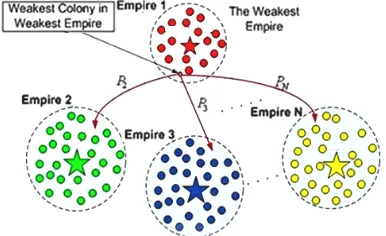
forms the basis of the proposed evolutionary algorithm. During this competition, weak empires collapse and powerful ones take possession of their colonies. Imperialistic competition hopefully converges to a state, in which only one empire exists and its colonies are in the same position and have the same cost as the imperialist.
The goal of optimization algorithms is to find an optimal solution in terms of the problem variables (optimization variables). Therefore, an array of variable values that must be optimized is formed.
Fig. 5. Illustration of imperialist of competitive
algorithm.
In genetic algorithm terminology, this array is called ‘‘chromosome’’; but, in this paper, the term ‘‘country’’ was used for this array. The working principle of ICA is shown in Fig. 5.
5. ICA result
Optimization process began with 50 countries which were randomly distributed in the search types. The maximum number of iterations was 100 iterations.
If the distance between two iteration improvements in the objective function was less than a certain value (0.01), optimization process would be stoppedand the best answer of the last iteration was the optimal answer. In addition to this stop condition, if no improvement was found in the objective function after 5 iterations, optimization process would be stopped. In order to achieve higher efficiency of the algorithm, several stopping criteria were used. Optimizing the objective
function per number of iteration is shown in Fig. 6.
Fig. 6. The best answers in each iteration of ICA.
Optimization process was performed by the algorithm in 26 iterations and, after this iteration, better results were not obtained. After ending the optimization process, thickness of the optimal sheets offered by the algorithm was applied to the finite element model. The purpose of the best cost in Fig. 6 was mass and error of natural frequency. As a result, the lower this quantity (best cost), the less the mass of locomotive body structure would be. Weight of body structures in original state was 14600 kg and it was 13890.1 kg in optimized state. The results in Table 3 indicate a 4.8% decrease in the body structure weight.
Table 3. Mass and natural frequency (original and
optimized models).
Weight torsion lateral bending
Original 14600 kg 7.87 19.43 25.53
Optimized 13890.1 kg 7.88 19.42 25.54
111
Fig. 7. FRF of the original and optimized models
proposed by the ICA.
In order to evaluate efficiency of competitive colonial algorithms, the optimization problem was optimized by another optimization algorithm. For this purpose, genetic algorithms (GA) were used.
Optimization process by genetic algorithm began with 20 chromosomes which were randomly distributed in the search space. Crossover rate was 0.8, mutation rate was equal to 0.01, migration rate was equal to 0.2 and, in each update of initial generation, ten percent (two chromosomes) of the previous generations (best members of its generation) was directly transferred to the next generation (elitism count) [12].
The maximum number of iterations was 100 iterations and, if the distance between two iterations, improvement in the objective function, was less than a certain value (0.01), optimization process would be abandoned. In addition to this stop condition, if no improvement occurred in the objective function after 5 iterations, the optimization process would be abandoned. Optimizing the objective function per number of iteration is shown in Fig. 8 and FRF graph for the basic and optimized models by genetic algorithm is given in Fig. 9.
By comparing results of the optimization algorithms, it was seen that mass of the body structure was reduced and the natural frequencies were satisfied by both algorithms. Genetic algorithm with lower complexity and simpler mechanism of competition in each iteration needed more iteration to achieve the optimal solution while imperialist competitive
algorithm with two types of competition (competition among colonies in each empire and competition between empires) converged to the optimal point with higher speed and less iteration.
Fig. 8. The best answers in each iteration of GA.
Fig. 9. FRF of the original and optimized models
proposed by the GA [12].
6. Conclusions
The purpose of this research was to find economical and effective ways for improving efficiency through reducing body structure weight and maintaining body structure's natural frequency.
112
algorithm with more iteration. Less iteration was equal to less cost and computation time, which was important for huge search space optimization. The results presented by this algorithm showed that the algorithm was successful in achieving the targets.
The imperialist competitive algorithm is a new method, which has great abilities to cope with different types of optimization problems. However, it is still in its infancy and intensive studies are needed to improve its performance.
References
[1] A. Stribersky, S. Steidl, H. Müller and B. Rath, “On dynamic analyses of rail vehicles with electronically controlled suspensions”, Proc. of 14th IAVSD Int. Symposium, Ann Arbor, Usa, pp. 614-628, (1996).
[2] A. Stribersky, W. Rulka, H. Netter and A. Haigermoser, “Modeling and simulation of advanced rail vehicles”. Proc. of 8th IFAC/IFIP/IFORS Int. Symposium “Transportation Systems”, Chania, Greece, pp.476-481, (1997). [3] A. Keymasi and M. Partovi, Static and
Dynamic Analysis of G-16 Locomotive and study of possibility to optimize, Msc thesis, Iran University of Scince & Technology, Tehran, Iran, (2006). [4] A. Subic and J. He, “Improving bus
rollover design through modal analysis”, Intl J. Crashworthiness, Vol. 2, No. 2, pp. 139-152, (1997).
[5] J. He and Z. F. Fu, Modal Analysis, first
ed., Butterworth - Heinemann Publication, Oxford, pp.103-127, (2001).
[6] Nastran Advanced Dynamic Analysis User's Guide, MacNeal-Schwendler, Los Angeles, pp. 83-95, (2010).
[7] P. D. Wasserman, Advanced methods in neural computing, Van Nostrand Reinhold, New York, pp. 56-84, (1993). [8] P. D. Wasserman, Neural computing
theory and practice, Van Nostrand Reinhold, New York, pp. 78-96, (1989). [9] M. Shahidi poor, “Optimization (Theory
and Application)”, S. S. Rao, New age international, pp. 323–355, (1996). [10] E. Atashpaz–Gargari and C. Lucas,
“Imperialist competitive algorithm: an algorithm for optimization inspired by imperialistic competition”, “IEEE
Congress on Evolutionary
Computation”, Singapore, 4661-4667, (2007).
[11] C. Lucas, Z. Nasiri–Gheidari and F. Tootoonchian, “Application of an imperialist competitive algorithm to the design of a linear induction motor”, journal of Energy Convers Manage, Vol. 51, No. 7, pp. 1407-1411, (2010). [12] M. Ghamami, M. S. Panahi, M. Rezaei