ISSN 0975-928X
Research Article
Gene action of yield and yield contributing characters in chilli (
Capsicum
annum
L.)
V.C. Navhale, V.V. Dalvi, M.M. Wakode, S.G. Bhave and J.P. Devmore
Department of Agriculture Botany, Dr. B. S. K. K. V., Dapoli - 415 712, Dist. Ratnagiri Email: [email protected]
(Received: 25 Mar 2014; Accepted: 11 Aug 2014)
Abstract
Gene action of yield and yield contributing traits in Chilli (Capsicum annuum L.) was studied in three selected crosses, involving four parents, including their F1's, F2's and first back crosses generations. The six generations of these crosses were
evaluated during summer, Rabi 2012 for days to first flowering, days to first picking, plant height (cm), number of branches per plant, fruit length (cm), fruit diameter (mm), number of seed per fruit, number of fruits per plant (green), green fruit yield per plant (g), number of fruits per plant (dry), dry fruit yield per plant(g), days to last picking and capsaicin content (%). The data generated was subjected to test epistasis and six generation mean analysis. It was found that, all the types of gene action i.e. additive, dominance and interaction components were found to be play a major role in their inheritance. The importance of additive, dominant and epistatic interactions suggested the use of recurrent selection, reciprocal recurrent selection, diallel selective mating scheme or bi-parental mating system for improvement of these traits, while the heterosis breeding is recommended for the crosses where complimentary epistasis was observed. Taking in to account the complex behavior of genes in these traits, modified bulk selection is recommended for varietal improvement of chilli in these crosses, in which the selection is performed after attaining the homozygosity.
Key words
Chilli, generation mean, Gene action, yield components.
Introduction
Chilli (Capsicum annum L.) is an important commercial crop in India grown for its green fruits as a vegetable and dry form as a spice. It belongs to family Solanaceae (2n=24), which has about 90 genera and 2000 species. In this genera, Capsicum annum, C. baccatum, C. Chinese, C. frutescens and
C. pubescens are commonly recognized as domesticated species, while approximately 20 wild species have been documented. Chilli is mainly cultivated in tropical and sub-tropical countries
viz., India, Africa, Japan, Mexico, Turkey, USA etc. The domestication of chilli first occurred in Central America, most likely in Mexico, with secondary centers in Guatemala and Bulgaria (Salvador, 2002). Chilli was introduced to Europe by Columbus in 15th century and spread to rest of the globe. In 17th century, Portuguese introduced it into India. Chilli (Capsicum annum L.) is the second largest commodity in spice crop after black pepper (Piper nigrum L.) in the international trade. In India, the area under chilli during year 2012, was 8.05 lakh ha with 12.76 lakh tones production and the average dry chilli yield of 1.58 t/ha (Anonymous, 2012). Andhra Pradesh, Karnataka, Maharashtra, Orissa and Tamil Nadu are the major chilli growing areas and contribute for the majority of the total area under chilli cultivation. Maharashtra had 99.5 thousand hectare area under chilli with production of 45.60 thousand tones (Anonymous, 2012). The major chilli growing districts in Maharashtra are Nagpur, Nasik,
Ahmednagar, Solapur, Aurangabad, Nanded and Amravati. To improve chilli crop both quantitative and qualitative breeding program should be based on sound genetic knowledge. Various biometrical approaches have been developed to decipher the genetic architecture and inheritance of different characters related to yield. Generation mean analysis is one such approach which provides information about nature and magnitude of gene actions involved. The present study was carried out to investigate genetics of fruit yield per plant and its contributing traits through generation mean analysis.
Material and Methods
The field experiment was carried out at Department of Botany Farm, College of Agriculture, Dr. Balasaheb Sawant Konkan Krishi Vidyapeeth, Dapoli. Three crosses were generated using one female viz. Konkan kirti and three male lines i.e., DPL-C-5, AKC-08-95-05 and Parbhani Tejas during Rabi 2011. The parents were selfed and the seed were collected. The parents and F0 seed were
sown in kharif 2012 to raise parental and F1
generation. The F1 plants were selfed as well as
backcrossed with both the parents to obtain the F2
generation and B1 and B2 generation. Thus for
evaluation, seeds of P1, P2, F1, F2, B1and B2
ISSN 0975-928X
http://sites.google.com/site/ejplantbreeding 730
2012 and transplanted in the field on December, 2012. In Rabi 2012, 29 treatments consisting of 5 parents, 6 F1s, 6 F2s, 6 B1s and 6 B2s were planted
in randomized block design with three replications. The spacing of 60 cm between row to row and 45 cm between plant to plant was adopted. Two lines each with twelve plants for parents and F1s, fives
lines each of twelve plants for F2 and three lines
each with twelve plants for B1 and B2s were
planted. The net experimental plot size was 45.6 m. x 17 m. FYM @ 15 t/ha was mixed at the time of field preparation. The chemical fertilizers, N:P:K @ 150:50:50 kg/ha were applied in form of urea, single super phosphate and murate of potash. The complete dose of phosphorus, potash and half dose of nitrogen was applied at the time of transplanting and remaining dose of nitrogen was applied in two splits, 30 and 60 days after transplanting.
Results and Discussion:
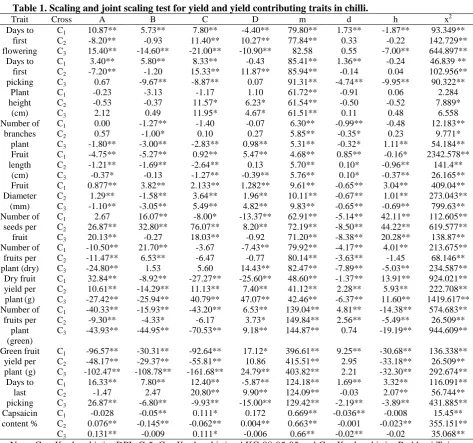
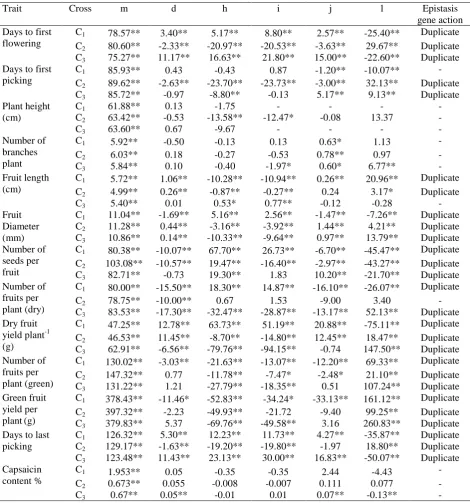
Days to first Flowering: The performances of different generations of the selected three crosses are presented in Table 1 and 2. The significance of scaling test (Mather, 1949) and Cavalli’s (1952) joint scaling test revealed that additive-dominance model was inadequate for the crosses in respect of days to first flowering. Due to significance of these tests the three parameter model was extended to Heyman (1958) six parameter model. The estimates of best fit six parameter model were indicated the significance of all the parameters i. e. m’, ‘d’, ‘h’, ‘i', ‘j’, and ‘l’ indicating presence of additive, dominance and epistasis gene action and interaction in these crosses. The opposite sign of estimates of ‘h’ and ‘l’ recorded for all the crosses indicate duplicate gene action. The results of the present investigation are in complete agreement with the earlier results obtained by Patel et al.(2003) and Singh and Chaudhari (2005).
Days to first Picking: The scaling test and joint scaling test were significant indicating the inadequacy of additive dominance model. Besides significant mean in six parameter model, ‘m’ and ‘h’ i.e. mean and dominance gene action was significant in cross 2 and 3, where as ‘d’ was significant in cross 2. The additive x additive interactions were significant in cross 2, additive x dominant and dominant x dominant gene action significant in all crosses. Duplicate epistasis was recorded in cross 2 and 3 (significant ‘h’ and ‘l’ components with opposite signs). The significance of additive x additive, additive x dominant and dominant x dominant gene action indicated the presence of ‘i’, ‘j’ and ‘l’ type of interaction. The lower value of the ‘j’ indicated its lesser importance in governing the trait. The higher values of ‘i’ and ‘l’ and lower values of ‘j’ interaction are in line with the earlier findings of
Patel et al. (2003( and Hasanuzzaman and Faruq Golam (2011).
Plant Height:The scaling test result of plant height indicated that only scale C and D test was significant for cross 2 and 3. The joint scaling test ‘m’ scale was significant in all the crosses, ‘d’ and ‘h’ scale was non-significant for all the crosses. The significant chi-square value for cross 2 confirmed the result of Mathers Scaling test, indicating the need for extending 3 parameters models, additive-dominance model to six parameter model for estimating epistatic component. The remaining crosses i.e. 1 and 3 failed to attain the significant chi-square values indicating the competence of additive dominance model. Hence 3 parameter model of Jinks and Jones (1958) was used for estimate of the ‘m’, ‘d’, and ‘h’ component in these cross. The estimate of ‘m’ was significant in all the three crosses, while dominant component ‘h’ significant in cross 2. The six parameter model used in cross 2 indicated that ‘m’ component was significant, where as ‘h’ dominant and additive x additive component were significant. The absence of significant scaling test, joint scaling test and dominant gene action and presence of additive gene action were also reported by Somashekhar et al. (2010) and Mohite patil (2011). The significance of ‘j’ interaction, while significance of additive x additive gene interaction were confirmed by the report from Patel et al.
(2003).
Number of branches per plant:All the scaling tests joint scaling test and were significant for all the crosses confirmed inadequacy of additive-dominance model. In six parameters model mean of all crosses were significant. In cross 3 additive x additive (‘i’), dominant x dominant (‘l’) type of interaction recorded significant, while additive x dominant (‘j’) gene interaction was significant for all crosses, which is in conformity with the reports from Patel et al. (2003) and Singh and Chaudhari (2005).
ISSN 0975-928X
gene action recorded in cross 1 and 2. The presence of significant and higher magnitude of additive x additive and dominant x dominant and lower magnitude for additive x dominant were observed in the study which is in fully agreement with earlier reports by Singh and Chaudhari (2005).
Fruit Diameter (cm): The scaling test and joint scaling test results of fruit diameter showed the presence of non addive model. The estimates of six parameter model recorded the significant mean effects. The additive and dominant gene actions were significant in all crosses. But the magnitude of dominant gene action was recorded higher than the additive one. In epistatic gene interaction, additive x additive, additive x dominant and dominant x dominant gene interaction for all the crosses were significant, observed duplicate gene action for all crosses (opposite sign of ‘h’ and ‘l’) were recorded. These results are in complete agreement with the results reported by Ridwan and Knavei (1990) and Mohite patil (2011).
Number of seeds per fruits: The scaling test and joint scaling test were significant for all the crosses. The estimates of mean (m) in all the crosses were significant, while additive gene action recorded significance for cross 1 and 2. The dominant gene action observed significant for all the crosses. Additive x additive non-allelic gene interaction was significant for the crosses 1 and 2 while additive x dominant as well as dominant x dominant type of interaction was recorded significance for all the crosses. Similarly ‘i’ and ‘l’ were recorded opposite sign irrespective of their significance which indicated the presence of duplicate epistasis for these crosses. The estimates of significant additive and dominant gene action were involved in the inheritance of number of seeds per fruits. The larger magnitude of dominant gene action was recorded in present investigation. The results can be confirmed by the findings Patel et al. (2003( and Mohite patil (2011).
Number of fruits per plant (dry): The scaling tests and joint scaling test were significant, which indicated the presence of non-allelic gene interaction for inheritance of this character. The mean and additive parameters were recorded the significance for all the crosses and except for dominant parameter in cross 2. These results are in conformity with the results obtained by Hasanuzzaman and Faruq Golam (2011). In epistatic gene interactions, additive x additive, additive x dominance and dominant x dominant interactions were significant for cross 1 and 3. In these crosses, ‘h’ and ‘l’ recorded opposite a sign which was the result of duplicate non allelic interaction. The higher magnitude of dominant x dominant type of interaction was observed in most
of the cases in present study which is confirmed by the earlier work reported by Somashekhar et al. (2010).
Dry fruit yield per plant:Dry fruit yield per plant, scaling tests and joint scaling test showed the presence of non additive gene action. The mean, additive and dominant parameter in all the crosses recorded significance. In epistatic gene interactions additive x additive and dominant x dominant type was significant in all crosses, while additive x dominant in cross 1 and 2. In all crosses ‘h’ and ‘l’ and ‘i’ and ‘l’ values recorded opposite signs which was the result of duplicate inter-allelic interaction. The results can be confirmed by the findings of Hasanuzzaman and Faruq Golam (2011).
Number of fruits per plant (green):The scaling test and joint scaling test showed the presence of non additive gene action. Among the epistatic gene interaction, additive x additive and dominant x dominant gene action were significant for all the crosses, while additive x dominant gene interaction was non-significant in only cross 3. In all crosses ‘h’ and ‘l’ values were recorded opposite signs, which was the result of duplicate inter-allelic interaction. The presence of duplicate h and ‘l’ has apposite sign was also recorded the results in close conformity with the report Patel et al. (2003).
Green fruit yield per plant (g):The scaling test and joint scaling test confirm the presence of non additive gene action. The mean and dominant gene effects were significant for all the crosses while additive component was significant for cross 1. In gene interactions additive x additive was significant for crosses 1 and 3, while additive x dominant recorded significance for cross1. The dominant x dominant (j) recorded significance in all crosses. In all crosses ‘h’ and ‘l’ were recorded opposite signs, which was the result of duplicate inter-allelic interaction. The scaling tests for last picking of six crosses, scaling test was recorded significance for the crosses 1and 3. The scaling test C and D were significant in cross 2. The ‘m’,‘d’, ‘h’ and χ2
values were recorded significance for joint scaling test and confirmed the results of Mather’s scaling tests, therefore indicated the necessity of extending three parameter model to six parameter.
ISSN 0975-928X
http://sites.google.com/site/ejplantbreeding 732
reported by Singh and Chaudhari (2005), and Hasanuzzaman and Faruq Golam (2011).
Capsaicin content (%): In scaling test and joint scaling test indicated the presence of non additive gene action. The mean values recorded significant in all the crosses, additive parameter was significant in cross3 , while none of the cross was significant in dominant parameter. In gene interaction additive x dominant and dominant x dominant parameter observed significant in cross 3. None of the crosses showed the gene interaction which is in conformity with the reports from Dhall and Hundal (2012) as well as Singh and Chaudhari (2005).
From the fore going discussion, it can be concluded that, all the types of gene action i.e. additive, dominance and interaction components were found to be play a major role in their inheritance. The importance of additive, dominant and epistatic interactions suggested the use of recurrent selection, reciprocal recurrent selection, diallel selective mating scheme or bi-parental mating system for improvement of these traits, while the heterosis breeding is recommended for the crosses where complimentary epistasis was observed. Taking in to account the complex behavior of genes in these traits, modified bulk selection is recommended for varietal improvement of chilli in these crosses, in which the selection is performed after attaining the homozygosity.
References
Anonymous. 2012. Indian Horticultural Database.
http://nhb.gov.in/statistics/area-production-statistics.html
*Cavalli, L.L. 1952. An analysis of linkage in quantitative genetics. In: Quantitative inheritance. Eds: C.R. Rieve and C.H. Waddington, HMSO, London, pp. 135-144 Dhall, R.K. and Hundal, J.S. 2012 Genetic analysis of
capsaicin content of dry ripe fruits in chilli (Capsicum annum L.). J. Res., 42 (1): 38-42. Hasanuzzaman, M. and Golam, F. 2011 Gene actions
involved in yield and yield contributing traits of chilli (Capsicum annum L.). Australian J. Crop Sci,.5(13): 1868-1875.
Hayman, B.I. 1958. The separation of epistasis from additive and dominance variation in generation means. Heredity, 12: 371-391.
Jinks, J.L. and Jones, R.M. 1958. Estimation of components of heterosis. Genet.,43: 223-24. Mather, K. 1949. Biometrical Genetics. Mathuen and Co.
Ltd. London.
Mohite patil, D.P. 2011. Heterosis, Combining ability and inbreeding depression in Chilli (Capsicum Annum L.). Ph.D. Thesis, Dr. B.S. K. K. V., Dapoli (MS).
Patel, J.A., Patel, M.J., Acharya, R.R., Bhanvadia, A.S. and Bhalala, M.K. 2003. Hybrid vigor, gene action and combining ability in chilli(Capsicum annumL.) hybrids involving
male sterile lines. Indian J. Genet., 64 (1): 81-82.
Ridwan, S. and Knavei, D.E.1990. Association of pedicel length and diameter with Fruit length and diameter and ease of fruit detachment in pepper. J. Amer. Soc. Hort.Sci., 115 (4): 677-681.
Salvador, M.H.2002. Genetic resources of chilli (Capsicum spp.) in Mexico. Proc. Of the 16th Int. Pepper Conf., Tampico, Tamaulips, Mexico, November, pp. 10.
Singh, A.K. and Chaudhary, B.R. 2005. Combining ability and generation mean analysis in Capsicum. Indian J. Genet.,65(2): 151-152. Somashekhar, S.A., Patil and Salimath. 2010 Estimation
ISSN 0975-928X
Table 1. Scaling and joint scaling test for yield and yield contributing traits in chilli.
Trait Cross A B C D m d h x2
Days to first flowering
C1 10.87** 5.73** 7.80** -4.40** 79.80** 1.73** -1.87** 93.349**
C2 -8.20** -0.93 11.40** 10.27** 77.84** 0.33 -0.22 142.729**
C3 15.40** -14.60** -21.00** -10.90** 82.58 0.55 -7.00** 644.897**
Days to first picking
C1 3.40** 5.80** 8.33** -0.43 85.41** 1.36** -0.24 46.839 **
C2 -7.20** -1.20 15.33** 11.87** 85.94** -0.14 0.04 102.956**
C3 0.67 -9.67** -8.87** 0.07 91.31** -4.74** -9.95** 90.322**
Plant height
(cm)
C1 -0.23 -3.13 -1.17 1.10 61.72** -0.91 0.06 2.284
C2 -0.53 -0.37 11.57* 6.23* 61.54** -0.50 -0.52 7.889*
C3 2.12 0.49 11.95* 4.67* 61.51** 0.11 0.48 6.558
Number of branches
plant
C1 0.00 -1.27** -1.40 -0.07 6.30** -0.99** -0.48 12.183**
C2 0.57 -1.00* 0.10 0.27 5.85** -0.35* 0.23 9.771*
C3 -1.80** -3.00** -2.83** 0.98** 5.31** -0.32* 1.11** 54.184**
Fruit length
(cm)
C1 -4.75** -5.27** 0.92** 5.47** 4.68** 0.85** -0.16* 2342.578**
C2 -1.21** -1.69** -2.64** 0.13 5.70** 0.10* -0.96** 141.4**
C3 -0.37* -0.13 -1.27** -0.39** 5.76** 0.10* -0.37** 26.165**
Fruit Diameter
(mm)
C1 0.877** 3.82** 2.133** 1.282** 9.61** -0.65** 3.04** 409.04**
C2 1.29** -1.58** 3.64** 1.96** 10.11** -0.67** 1.01** 273.043**
C3 -1.10** -3.05** 5.49** 4.82** 9.83** -0.65** -0.69** 799.63**
Number of seeds per
fruit
C1 2.67 16.07** -8.00* -13.37** 62.91** -5.14** 42.11** 112.605**
C2 26.87** 32.80** 76.07** 8.20** 72.19** -8.50** 44.22** 619.577**
C3 20.13** -0.27 18.03** -0.92 71.20** -8.38** 20.28** 138.87**
Number of fruits per plant (dry)
C1 -10.50** 21.70** -3.67 -7.43** 79.92** -4.17** 4.01** 213.675**
C2 -11.47** 6.53** -6.47 -0.77 80.14** -3.63** -1.45 68.146**
C3 -24.80** 1.53 5.60 14.43** 82.47** -7.89** -5.03** 234.587**
Dry fruit yield per plant(g)
C1 32.84** -8.92** -27.27** -25.60** 48.60** -1.37** 13.91** 924.021**
C2 10.61** -14.29** 11.13** 7.40** 41.12** 2.28** 5.93** 222.708**
C3 -27.42** -25.94** 40.79** 47.07** 42.46** -6.37** 11.60** 1419.617**
Number of fruits per
plant (green)
C1 -40.33** -15.93** -43.20** 6.53** 139.04** 4.81** -14.38** 574.683**
C2 -9.30** -4.33* -6.17 3.73* 149.84** 2.56** -5.49** 26.509**
C3 -43.93** -44.95** -70.53** 9.18** 144.87** 0.74 -19.19** 944.609**
Green fruit yield per plant (g)
C1 -96.57** -30.31** -92.64** 17.12* 396.61** 9.25** -30.68** 136.338**
C2 -48.17** -29.37** -55.81** 10.86 415.51** 2.95 -33.18** 26.509**
C3 -102.47** -108.78** -161.68** 24.79** 403.82** 2.21 -32.30** 292.674**
Days to last picking
C1 16.33** 7.80** 12.40** -5.87** 124.18** 1.69** 3.32** 116.091**
C2 -1.47 2.47 20.80** 9.90** 124.09** -0.03 2.07** 56.744**
C3 26.87** -6.80** -9.93** -15.00** 129.42** -2.19** -3.89** 431.885**
Capsaicin content %
C1 -0.028 -0.05** 0.111* 0.172 0.669** -0.036** -0.008 15.45**
C2 0.076** -0.145** -0.062** 0.004** 0.663** -0.001 -0.023** 355.151**
C3 0.131** -0.009 0.111* -0.006 0.66** -0.02** -0.02 35.068**
Note: C1 = Konkan kirti x DPL-C-5, C2= Konkan kirti x AKC-08-95-05 and C3= Konkan kirti x Parbhani Tejas,
ISSN 0975-928X
http://sites.google.com/site/ejplantbreeding
734
Table 2. Estimates of gene effects for yield and yield contributing traits in chilli using six parameter model
Trait Cross m d h i j l Epistasis
gene action Days to first
flowering
C1 78.57** 3.40** 5.17** 8.80** 2.57** -25.40** Duplicate
C2 80.60** -2.33** -20.97** -20.53** -3.63** 29.67** Duplicate
C3 75.27** 11.17** 16.63** 21.80** 15.00** -22.60** Duplicate
Days to first picking
C1 85.93** 0.43 -0.43 0.87 -1.20** -10.07** -
C2 89.62** -2.63** -23.70** -23.73** -3.00** 32.13** Duplicate
C3 85.72** -0.97 -8.80** -0.13 5.17** 9.13** Duplicate
Plant height (cm)
C1 61.88** 0.13 -1.75 - - - -
C2 63.42** -0.53 -13.58** -12.47* -0.08 13.37 -
C3 63.60** 0.67 -9.67 - - - -
Number of branches plant
C1 5.92** -0.50 -0.13 0.13 0.63* 1.13 -
C2 6.03** 0.18 -0.27 -0.53 0.78** 0.97 -
C3 5.84** 0.10 -0.40 -1.97* 0.60* 6.77** -
Fruit length (cm)
C1 5.72** 1.06** -10.28** -10.94** 0.26** 20.96** Duplicate
C2 4.99** 0.26** -0.87** -0.27** 0.24 3.17* Duplicate
C3 5.40** 0.01 0.53* 0.77** -0.12 -0.28 -
Fruit Diameter (mm)
C1 11.04** -1.69** 5.16** 2.56** -1.47** -7.26** Duplicate
C2 11.28** 0.44** -3.16** -3.92** 1.44** 4.21** Duplicate
C3 10.86** 0.14** -10.33** -9.64** 0.97** 13.79** Duplicate
Number of seeds per fruit
C1 80.38** -10.07** 67.70** 26.73** -6.70** -45.47** Duplicate
C2 103.08** -10.57** 19.47** -16.40** -2.97** -43.27** Duplicate
C3 82.71** -0.73 19.30** 1.83 10.20** -21.70** Duplicate
Number of fruits per plant (dry)
C1 80.00** -15.50** 18.30** 14.87** -16.10** -26.07** Duplicate
C2 78.75** -10.00** 0.67 1.53 -9.00 3.40 -
C3 83.53** -17.30** -32.47** -28.87** -13.17** 52.13** Duplicate
Dry fruit yield plant-1 (g)
C1 47.25** 12.78** 63.73** 51.19** 20.88** -75.11** Duplicate
C2 46.53** 11.45** -8.70** -14.80** 12.45** 18.47** Duplicate
C3 62.91** -6.56** -79.76** -94.15** -0.74 147.50** Duplicate
Number of fruits per plant (green)
C1 130.02** -3.03** -21.63** -13.07** -12.20** 69.33** Duplicate
C2 147.32** 0.77 -11.78** -7.47* -2.48* 21.10** Duplicate
C3 131.22** 1.21 -27.79** -18.35** 0.51 107.24** Duplicate
Green fruit yield per plant(g)
C1 378.43** -11.46* -52.83** -34.24* -33.13** 161.12** Duplicate
C2 397.32** -2.23 -49.93** -21.72 -9.40 99.25** Duplicate
C3 379.83** 5.37 -69.76** -49.58** 3.16 260.83** Duplicate
Days to last picking
C1 126.32** 5.30** 12.23** 11.73** 4.27** -35.87** Duplicate
C2 129.17** -1.63** -19.20** -19.80** -1.97 18.80** Duplicate
C3 123.48** 11.43** 23.13** 30.00** 16.83** -50.07** Duplicate
Capsaicin content %
C1 1.953** 0.05 -0.35 -0.35 2.44 -4.43 -
C2 0.673** 0.055 -0.008 -0.007 0.111 0.077 -
C3 0.67** 0.05** -0.01 0.01 0.07** -0.13** -
Note: C1 = Konkan kirti x DPL-C-5, C2= Konkan kirti x AKC-08-95-05 and C3= Konkan kirti x Parbhani