University of New Orleans University of New Orleans
ScholarWorks@UNO
ScholarWorks@UNO
University of New Orleans Theses and
Dissertations Dissertations and Theses
5-15-2009
A Model for Regional Technology-Based Economic Development
A Model for Regional Technology-Based Economic Development
Robert SavoieUniversity of New Orleans
Follow this and additional works at: https://scholarworks.uno.edu/td
Recommended Citation Recommended Citation
Savoie, Robert, "A Model for Regional Technology-Based Economic Development" (2009). University of New Orleans Theses and Dissertations. 907.
https://scholarworks.uno.edu/td/907
This Dissertation is protected by copyright and/or related rights. It has been brought to you by ScholarWorks@UNO with permission from the rights-holder(s). You are free to use this Dissertation in any way that is permitted by the copyright and related rights legislation that applies to your use. For other uses you need to obtain permission from the rights-holder(s) directly, unless additional rights are indicated by a Creative Commons license in the record and/ or on the work itself.
A Model for Regional Technology-Based Economic Development
A Dissertation
Submitted to the Graduate Faculty of the University of New Orleans in partial fulfillment of the requirements for the degree of
Doctor of Philosophy In
Engineering and Applied Science
by
Robert A. “Bobby” Savoie
B.S. Louisiana State University, 1980 M.B.A. Loyola University, 1981
ii
Acknowledgement
The Author would like to acknowledge and thank his doctoral committee and advisors for their time, guidance and invaluable advice:
Dr. Russell Trahan, Dean, College of Engineering
Dr. James Logan, Dean, College of Business Administration
Dr. Mahdi Aldelguerfi, Department Chair, Computer Science
Dr. Jay Hunt, Adjunct Professor of Engineering Management
Mr. Will Lannes, Professor Emeritus
Ms. Dinah Payne, Engineering Management Chair and Advisor
The Author is also honored by the incredible individuals, many of which are considered good friends; who were kind enough to be interviewed for this work.
The Honorable Sandy Baruah, Assistant Secretary of Commerce for Economic Development, CEO of EDA
Mr. Robert Fudickar, Technology Industry Director, Louisiana Department of Economic Development
Mr. Kevin Pollard, President - GlobalSolveTM Management (Venture Capital)
Dr. Vijay Gopu, Professor, University of New Orleans (India)
The Honorable Stephen Moret, Secretary, Louisiana Economic Development
Dr. Timothy Ryan, Chancellor, University of New Orleans (Professor of Economies)
Ms. Eileen Walker, Chief Executive Officer, Association of University Research Parks (AURP)
Ms. Jackie Kerby-Moore, Executive Director, Sandia Science & Technology Park
Dr. Michel Bernasconi, CERAM School of Business, Sophia Antipolis, France
Mr. Jacques Masboungi, Deputy Managing Director of Sophia Antipolis Development Corporation
iii
The Honorable Michael Olivier, Regional President, Americas for Future Pipe Industries, Former Secretary of LED
Mr. Ashton Ryan, Jr., President and CEO, FirsTrust Corporation and its subsidiary First Bank and Trust, Venture Capital
The Honorable Pete Wilson – Governor of California, 1991- 1999
iv
Dedication
Finally, the author wishes to dedicate this work and thank certain special people without whose support this effort would never have been completed.
First, his long-time (17 yrs) Executive Assistant, Joy Stuart
Second, his wife and life-long best friend, Lori Savoie
Third, his children, for their support and understanding
Mallory K. Savoie, a Junior at Southern Methodist University
Matthew F. Savoie, a Senior at Isidore Newman School
William R. Savoie, a 6th grader at Isidore Newman School
v
Table of Contents
List of Figures and Tables... viii
Abstract ... ix
CHAPTER 1 ... 1
Introduction ... 1
CHAPTER 2 ... 10
Hypothesis ... 10
2.1 Research issues that comprise the Hypothesis ... 11
2.2 Review of Existing Scholarship/Historiography ... 13
CHAPTER 3 ... 16
Methodology – Systems Engineering Approach ... 16
CHAPTER 4 ... 21
Core Issue/Analysis of Hypothesis ... 21
4.1 Definitions: Economies Can be Self-Refueling, in Equilibrium or Depreciating ... 21
CHAPTER 5 ... 30
Lessons Learned from Specific Regions and Models ... 30
5.1 Silicon Valley, California, U. S. ... 31
5.2 Massachusetts Route 128, U. S. ... 33
5.3 Huntsville, Alabama, U. S. ... 35
5.4 Sophia Antipolis, France ... 38
5.5 Southern India ... 39
5.6 Ireland ... 41
5.7 Research Triangle Park, North Carolina, U. S. ... 43
5.8 Additional Economic Regions of Interest ... 43
CHAPTER 6 ... 49
Understanding the Factors through Analogies ... 49
6.1 Ecosystem ... 49
6.2 Ancient Rome ... 50
6.3 Corporate Development ... 53
vi
CHAPTER 7 ... 63
Initial Discussion of Factors that Affect the Advancement ... 63
of a Regional Technology-Based Economy ... 63
7.1 Factor 1: Environmental Variables ... 65
7.2 Factor 2: Inflow Variables ... 66
7.3 Factor 3: Attitudinal Variables ... 68
7.4 Factor 4: Leadership and Policy Variables ... 70
7.5 Factor 5: Knowledge Variables ... 72
7.6 Factor 6: Social Variables ... 74
CHAPTER 8 ... 77
Constructing a Model That Can Be Continuously Improved ... 77
CHAPTER 9 ... 80
Empirical Expert Interviews, Lessons, Conclusions and Structuring the Model ... 80
9.1 The Subjects ... 80
9.2 Leadership ... 85
9.2.1 Political Leadership ... 85
9.2.2 Private Sector Leadership ... 86
9.2.3 The Governance Model ... 87
9.2.4 The Synthesis: Public Leadership, Private Leadership and the Appropriate Governance Model ... 89
9.3 Knowledge-based or Mass Job Creation Economic Development ... 90
9.3.1 Knowledge-based Economic Development ... 93
9.3.2 Mass Job Creation Economic Development ... 93
9.3.3 Choosing the Right Approach ... 95
9.4 Lessons Learned and Anecdotal Findings from Expert Empirical Interviews ... 98
9.5 Analysis of Factors and Variables ... 134
9.6 Modeling the Factors and Variables in a Decision Analysis ... 139
CHAPTER 10 ... 145
Future work: Redefining Factors and Producing a Model that can Learn from Continuous Application ... 145
1.0 Staged Approach to Research and Engineering ... 145
vii
Works Cited ... 147
Bibliography ... 152
APPENDIX A ... 156
Interview Questions ... 156
APPENDIX B ... 166
Biographies of Interviewees ... 166
APPENDIX C ... 190
Dissertation Interview Questionnaire – Sandy Baruah 02/11/2009 ... 190
Dissertation Interview Questionnaire – Bob Fudickar 02/16/2009 ... 220
Dissertation Interview Questionnaire – Kevin Pollard 02/18/2009 ... 255
Dissertation Interview Questionnaire – Vijaya Gopu 02/18/2009 ... 306
Dissertation Interview Questionnaire – Steven Moret 02/25/2009 ... 336
Dissertation Interview Questionnaire – Tim Ryan 02/26/2009 ... 362
Dissertation Interview Questionnaire – Eileen Walker 03/04/2009 ... 403
Dissertation Interview Questionnaire – Jackie Kerby Moore 03/05/2009 ... 432
Dissertation Interview Questionnaire – Michel Bernasconi 03/09/2009 ... 481
Dissertation Interview Questionnaire – Jacques Masboungi 03/09/2009 ... 517
Dissertation Interview Questionnaire - David O’Flynn 03/10./2009 ... 541
Dissertation Interview Questionnaire – Mike Oliver 03/13/2009 ... 548
Dissertation Interview Questionnaire – Ashton Ryan 03/18/2009 ... 576
Dissertation Interview Questionnaire – Pete Wilson 03/22/2009 ... 607
Dissertation Interview Questionnaire – Michael Hecht 03/25/2009 ... 631
APPENDIX D ... 657
Scoring of Factors and Variables Obtained in Oral Interviews ... 657
viii
List of Figures and Tables
Figure 2.1: Statements of Hypothesis……….12
Table 3.1: Systems Engineering as Defined by Bahill and Dean………..17
Figure 3.1: Systems Engineering Process………...19
Figure 4.1: Representation of a Self-refueling Regional Economy………22
Figure 4.2: Representation of a Regional Economy in Equilibrium………..24
Figure 4.3: Representation of a Depreciating Regional Economy……….25
Table 6.1: Hamm's "Ongoing Talent Transformation" Model……….58
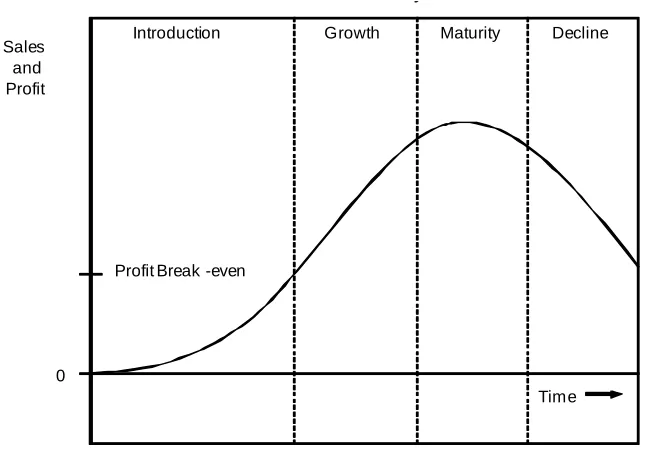
Figure 6.1: Product Development Life Cycle………59
Figure 6.2: Impact of a Series of Product Development Life Cycles on a Regional Economy………60
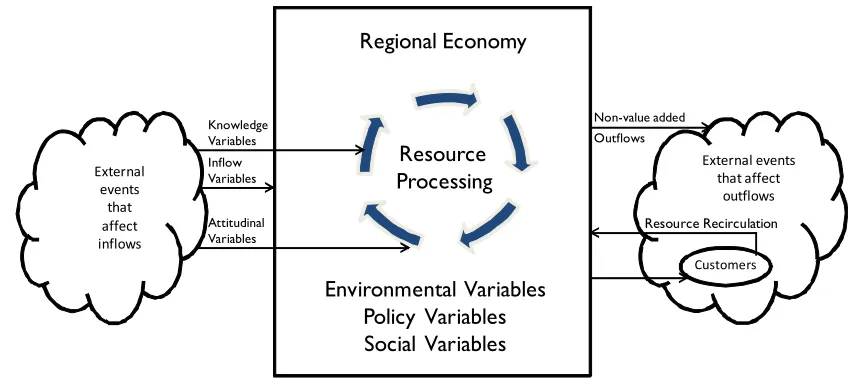
Figure 7.1: Initial Model………...65
Table 7.1 Factor 1: Evironmental Variables and Characteristics………66
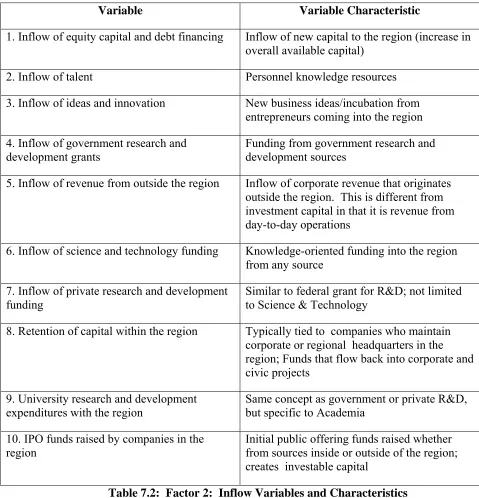
Table 7.2 Factor 2: Inflow Variables and Characteristics………...67
Table 7.3 Factor 3: Attitudinal Variables and Characteristics………69
Table 7.3.1 Skill Sets and Descriptions………...70
Table 7.4 Factor 4: Leadership and Policy Variables and Characteristics………….71
Table 7.5 Factor 5: Knowledge Variables and Characteristics………..73
Table 7.6 Factor 6: Social Variables and Characteristics………..75
Table 9.2 Emprical Expert Interviews and Pertinent Background Information……82
Table 9.5.1 Social, Economic and Educational Infrastructure Improvement……..107
Figure 9.6.1 Model for Pursuing Technology-Based Economic Development…..141
ix
Abstract
Technology-based economic development has been a highly sought-after objective for
regions in developed and developing countries alike. The wealth created by regional
knowledge-based economies like Silicon Valley is an attractive outcome. Without understanding
cluster-based economic strategy, the different types of technology-cluster-based economic development
approaches, the factors that dictate success or failure, and how those factors interrelate within a
particular region, then the probability of success is minimal at best.
Economic Development is a process and hence lends itself to a Systems Engineering
approach, which was chosen as the methodology for analyzing and designing a better model for
studying regions around the world to identify Factors that were both common and key to
successful regional development. Each region was viewed as a system with inputs and outputs.
The challenge in developing a useful system model is the development of the required Factors
and Processes to be used. In the development of the model most of the Factors are internal to the
system, but many may be affected by external events. The weighting (importance) of these
Factors is the topic of much debate. To develop a baseline of Factors the Delphi method was
used. Fortunately, a number of world-wide experts agreed to participate in one on one interviews
to analyze these Factors, which in itself added a great deal to the body of knowledge of economic
development beyond just the Factors. One obvious result was the essentially unanimous opinion
of the group that leadership was the most important factor. A less obvious outcome, but one of
equal importance was that there are two classes of regional economic development: one for mass
job creation and another for the creation of a knowledge-based regional economy. Often regions
undertake economic development without understanding this significant difference. While the
x
advance which goal is being pursued, which is also one of the critical outcomes of strong
leadership.
While all indications are that this model is a major improvement over current approaches,
because this is a new approach until this research is followed by additional interviews, and by
applying the model to actual regional technology-based economic development environments it’s
validity remains unproven.
1
CHAPTER 1
Introduction
Most municipalities, from mid-sized towns to large cities, expend both effort and funds
seeking economic development and job growth. While there are many creative strategies
employed to achieve these ends, most simply end up competing with other similar regions based
on a traditional series of economic development strategies and indicators. In an attempt to show
near-term results, many municipalities use top-down strategies such as attracting a “new”
employer to the area, usually with broad incentives, and sometimes at the expense of local
businesses and taxpayers (Blakely, 2002), (Bingham, 1993). Many municipalities and political
leaders are so concerned about brain-drain that they miss the opportunity for “brain-circulation”
(Saxenian, New Argonauts) – the return of educated, experienced natives who can grow new
businesses. Some leaders concentrate on their area’s core competencies, which may range from
blue collar mechanics to international shipping, to the exclusion of the greater upside potential of
technology-based entrepreneurship. These top-down strategies typically result in a municipality
capturing its own slice of an ever decreasing pie that it can retain only so long as it continues to
offer low-cost strategies to corporate decision makers. The efforts made by municipalities and
local developmental regions are typically focused on intra-state and inter-state competition that
stresses a low-cost and high-return environment for business attraction (Bingham, 1993). These
strategies, if they succeed at all, can result in disconnected industries or corporations that are
non-synergistic for future economic development. This is a self-defeating cycle that cements the
already stagnant positions of second-tier cities and regions (Shapira and Youtie, 2008).
Many economic development organizations in the United States (U. S.), whether they are
2
– clean, non-polluting, well-paying, knowledge-based, technology jobs. However, governmental
and quasi-governmental organizations that attempt to impact economic development typically
fail to fully recognize or appreciate the totality of factors that can positively or negatively impact
technology-based economic development in a global economy (Baruah interview and Fudickar
interview). This is due, in part, to the pressure placed on these organizations to generate
short-term results based on the existing workforce and economic environment; further increasing the
pressure for these organizations is the ever-present risk of discontinuation of the organization’s
funding. But it is also due in part to a lack of understanding of how the many economic
development variables that affect long-term economic health and progression of a local or
regional economy interact in a global economy (Olivier interview).
The economic cluster model defined by Dr. Michael Porter from Harvard University
(Porter, Harvard Business Review, 1998) is still the most broadly utilized approach to initiating
regional technology-based economic development (U.S. Office of Technology Policy,
Department of Commerce, 2000), (Woodward, Clusters, Competitiveness). But identifying and
creating clusters, even ones that have a natural affiliation with a particular region, is but one of
many steps necessary to yield successful growth of a regional technology sector. It is the
identification and successful implementation of the other enabling factors that dictates whether
or not a regional technology-based economy will grow (Wooldgridge, 2005), (Woodward,
Porter’s Cluster Strategy), (Lee, 2000).
Technology-based regional economic development is also not just a “western”
phenomenon. When many people think of successful regional economies they think in terms of
3
However, in his book “The Post-American World” (Zakaria, 2008), Fareed Zakaria points out
that the West “acquired its distinctive character around the eighth or ninth century, but became
modern only around the eighteenth century (page 74). Becoming a modern society is about
industrialization, urbanization and rising levels of literacy, education and wealth (page 74).” To
many people in modern western society, non-western countries may seem strange. But many of
these non-western regions have enjoyed extraordinary success as regional technology-based
economies without becoming truly “western” especially regions in Japan and India. Japan, for
example, is more technologically advanced than most western nations, but is not truly “western.”
“If wealth did not Westernize Japan, the argument goes, it will not Westernize the rest (Zakaria,
2008, page 74).” The point is that economic regions have enjoyed great success in
technology-based job expansion without following a truly western model. Clearly then, the factors that drive
technology-based economic development are not just those which are apparent in western
cultures. The success of “India’s Silicon Valley,” Dubai (the United Arab Emirates), and Saudi
Arabia’s “Economic Cities” are but three examples of non-western regions that have succeeded
in technology-based economic development (Singh, 2002), (Hamm, 2007), (www.sagia.gov.sa),
(Pollard interview). As will be shown in Chapter 5, contrasting these regions with similarly
successful regions in western countries offers excellent lessons on the factors that affect
technology-based economic development.
The real question of this dissertation research is “how do we create a technology-based
economy, whether as a small part of a larger economic base or as the leading economic growth
factor for a specific city or region?” There are many examples of successful development of a
technology-based economy. In the United States, Silicon Valley is of course the prime example,
4
Internationally, Bangalore (India), Limerick (Ireland), Sophia Antipolis (France) and Dubai
(UAE) are a few regions that warrant further analysis. Additionally, there are many others that
some consider successes, such as the Cummins Research Park in Huntsville, Alabama. But are
these really successes? If the government spending at Redstone Arsenal and the NASA Marshall
Space Flight Center were discontinued would Huntsville, Alabama still have a technology
economy or would it revert economically to a second-tier region?
Many articles have been written about individual municipalities, regions and facilities, or
even specific aspects of technology creation or technology-based economic development
(Blakely, 2002), (Bingham, 1993), (U.S. Office of Technology Policy, Department of
Commerce, 2000), (U.S. Office of Technology, Department of State, 2001). However, the key to
understanding how to create a technology-based economy lies in understanding two concepts.
(1) Defining and understanding the concept of “success.”
(2) Understanding the complex interaction of quantitative and qualitative (affective)
variables that made Silicon Valley, Research Triangle Park, Limerick, Sophia
Antipolis, Bangalore and many other such regions successful to one degree or
another.
A thorough understanding of these concepts requires an examination of those regions before they
existed as centers of technology to determine what happened to create the initial concept and
how the first steps towards technology-based economic growth were initiated. It is critical to
understand how these regions eventually reached the point at which economic growth became
5
as to be self-refueling (Jacobs, 2000). For example, it would be immensely instructive to
ascertain when and why the leaders of Limerick, Ireland, an historically agricultural economy,
determined that Limerick and, subsequently, all of Ireland, would become the Information
Technology (IT) access point for Europe. Further, it would be interesting to dissect its progress
from an agricultural economy to an epicenter of more than 25,000 IT jobs into elemental
questions, steps and decisions(Hughes, 1997). It would be equally instructive, if not more so, to
analyze Ireland’s performance in light of the current global economic crisis, which has yielded
thousands of job losses in the same technology fields that started Ireland’s ascent. If the same is
done for numerous real success stories as well as perceived success stories, it should be possible
to isolate the key success factors and the variables that affect success, and build a model of how
to create a technology-based regional economy.
1. 1 THIS DOCUMENT: A LITERARY GUIDE
This document represents a foray into the questions presented above. There are ten
chapters included, all with very precise purposes in discovering the best ways to create a
self-refueling, mature economic region. Chapter 1, the Introduction, briefly sets forth the ideas
spurring the development of the research questions. In this chapter, the definition of the concept
of success, as well as the understanding of success, is presented as being imperative actions to
understanding and creating an environment of successful economic development. Further,
Chapter 1 suggests that another source of aid in the understanding of this research is the study of
the complex interaction of quantitative and qualitative (affective) variables that have made
6
Chapter Two, The Hypothesis sets forth the hypothesis of this research. Simply
presented, this dissertation presents and analyses the hypothesis that the development of
technology-based regional economies can be analyzed and modeled on the basis of a finite set of
common factors and variables found in each economy. A study of these factors and variables
can yield predictable bifurcations that will propel economies into the various phases of existence
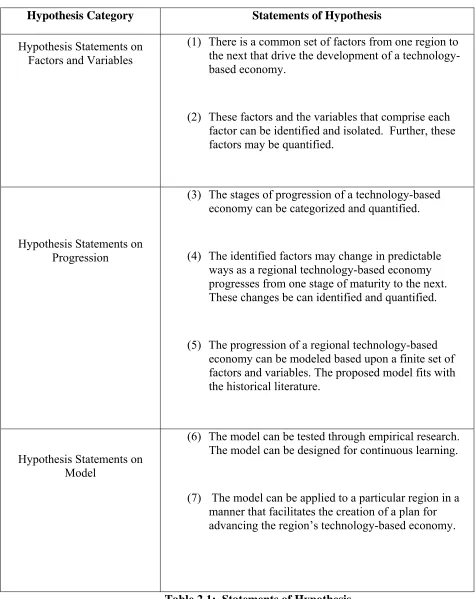
and, ultimately, success or failure. Chapter 2 provides seven hypothesis statements, based on
three categories: factors and variables, phase progression and the effectiveness of the model
designed in this research.
“Methodology – Systems Engineering Approach” is the title of Chapter 3. In this
chapter, the author describes and explains his use of the Systems Engineering Approach to create
his model. This process contains seven steps, the first five of which describe the development of
the model: the statement of the problem, the investigation of alternatives, the modeling of the
system, the integration of the elements of the system, the initiation of the system. The final two
stages of the Systems Engineering Approach as it is used in this research are the performance
assessment of the system and the continuous evaluation and re-evaluation of the system to check
that it is working properly.
Chapter 4, “Core Issue/Analysis of Hypothesis,” provides basic definitions of concepts
vital to the understanding of this research. Economies can be “mature,” “adolescent,” or
“neophyte” in the developmental life cycle; economies may also be self-refueling, stagnant or
depreciating in their current stage of the life cycle. Armed with a thorough understanding of
7
of economic development in terms of both phase of development and nature of economic
development can begin in earnest.
“Lessons Learned from Specific Regions and Models” are presented in Chapter 5. Seven
specific regions were chosen for an in-depth review of their economies and the strategies that
proved successful or not, in the progression of time. The author had opportunity to visit these
cities, as well as doing a thorough job of literature review to aid in his understanding of these
unique economies. These areas in the United States (U. S.), heavily studied, are: Silicon Valley,
California, Massachusetts Route 128 in Massachusetts, Huntsville, Alabama and Research
Triangle Park in North Carolina. Internationally, the areas of Sophia Antipolis, France, Southern
India and Ireland were studied. Other areas of interest, though less intense, were Albuquerque,
New Mexico, both Phoenix and Tuscan in Arizona, the U. S. State of North Dakota and Saudi
Arabia’s Economic Cities Initiatives. Finally, the author quickly presented information on the
Scandinavian Model, as well. These geographic locations were all chosen to present specific
environments designed to aid in the development and understanding of the factors and variables
used in the model designed and presented here to help predict economic development health.
Chapter 6, “Understanding the Factors through Analogies,” presented four analogies
deemed to be useful in understanding economic development: why it is successful for some
economies and yet less successful for others. The Ecosystem model, the Ancient Rome model,
the model of Corporate Development and the Product Development Lifecycle were all compared
and lessons utilized in the development of the research undertaken in this dissertation. Study of
these models have all added knowledge to the determination of what factors and variables are
8
“Initial Discussion of Factors that Affect the Advancement of a Regional
Technology-Based Economy,” Chapter 7 is a complete description of the factors and variables used in the
model to help predict economic success. There are six factors: environmental, inflow,
attitudinal, leadership and policy, knowledge and social factors. Each of these factors is
comprised of a set of variables which further define the factors. Factor 1, Environmental
Variables, includes elements related to quality of life in an area, support for technology
initiatives and a talented, well-educated workforce. Inflow Variables include inflow of equity
capital and debt financing, as well as inflow of talent and the associated ideas and innovation.
Factor 3, Attitudinal Variables, represents tolerance for entrepreneurial risk, responsiveness to
innovative investors and an entrepreneurial focus of the population. A business friendly tax
structure, tax breaks for research and development and State and local support for workforce
development are example of variables to be found in the fourth factor, Leadership and Policy.
Knowledge Variables, Factor 5, include variables like the depth of technology initiatives and
targets and technology commercialization support. Finally, the Social Variables of Factor 6,
include, among other things, the culture of collaboration, of change and the development of a
collective identity.
Chapter 8, “Constructing a Model That Can be Continuously Improved,” presents
information on artificial neural networks. The processes of process flow, learning and
adaptability are critical to the successful process of economic development: these are the
processes inherent to a good artificial neural network. The intent of Chapter 8 is to suggest that
the combination of a systems engineering approach and a neural networking approach is a
combination that provides a mathematical model for quantifying and optimizing qualitative,
9
The chapter presenting the in-depth findings drawn from the subjects interviewed is
Chapter 9, “Empirical Expert Interviews, Lessons, Conclusions and Structuring the Model.”
Section 9.2 is a comprehensive listing of all subjects who were interviewed, as well as past and
current affiliations, etc. Section 9.3 is a discourse on leadership as identified and defined by the
interviewees, as synthesized by the author. Further interviewee insights are provided in Section
9.4: on the subject of knowledge-based or mass job creation economic development. Arguably
the most important section of this research is Section 9.5: “Lessons Learned and Anecdotal
Findings from Expert Empirical Interviews.” In this section, 13 interviewees’ thoughts are
reported and analyzed, in light of the elements of this research: the phase of economic
development in existence in a region, the nature of the economic health of the region (i.e.,
self-refueling or depreciating), the product life cycle, etc. Finally, in Section 9.6 the analysis of the
factors and variables is presented.
Chapter 10 is a recitation of future work in the area that can be anticipated to be
necessary based on the findings of Chapter 9. A chief limitation is that the research is limited to
only a few (relatively speaking) geographic regions, out of the many, many regions in need of
economic development. Further, the research is based in large part on qualitative research:
future research would greatly benefit by the quantitative analysis of the validity of the factors
10
CHAPTER 2
Hypothesis
Introduction
Chapter 2 of this dissertation presents the hypothesis that is the basis of the qualitative
and quantitative empirical research presented in Chapter 9. The hypothesis concerns the factors
and variables that impact, positively or negatively, the development and continuation of a
technology-based regional economy. Specific research issues have been formulated and are
presented here, as well. Finally, this chapter outlines briefly the existing scholarship which bears
directly on all elements of the hypothesis.
Hypothesis
This dissertation presents and analyzes the hypothesis that the development of
technology-based regional economies can be analyzed and modeled based on a finite set of
common factors. These factors and the variables that comprise each can be affected to yield
predictable bifurcations that can cause a regional technology-based economy to progress from
one developmental phase to the next. As seminally defined by this research and described more
fully in Chapter 4, technology-based regional economies can be generally categorized according
to their developmental phase of economic maturity as “mature,” “adolescent”, or “neophyte”
based on their relative status against these same factors. Within each category, economies can be
self-refueling, stagnant or depreciating at each stage; these concepts are also defined fully in
11
The type of technology that can serve as the cornerstone of regional growth may differ
from one region to the next based on the natural genesis of the region. Further, the relative
impact and importance of these factors and variables may vary depending upon the nature of the
region and the technological basis of the economy. These factors can be placed in a systems
process model that can be used to evaluate and categorize the technology-based economy of a
region. This model can never be completely accurate or “finished,” as economic factors are too
fluid and will vary in importance between regions. Therefore, the model must “learn” from
continuous input and refinement. An open-source model such as an artificial neural network can
be used to facilitate and “teach” the model. By properly bounding a regional technology-based
economy and thoroughly evaluating that economy against these factors, a plan can be developed
for the progression of a regional technology-based economy from one developmental phase to
the next.
2.1
Research Issues that Comprise the Hypothesis
There are seven elements of this research for which information is sought. These
elements may be subdivided into three categories, relating to the factors/variables, the economic
progression of the region and the model developed to test the hypothesis itself. The first
category includes questions relating to factors and variables within each factor that would affect
the success of technology-based economic efforts. The second category relates to questions
relating to the stages of the economic progression of such economies. Finally, research is
envisioned which will address the issues surrounding the model developed here and its use in
12
Hypothesis Category Statements of Hypothesis
Hypothesis Statements on Factors and Variables
(1) There is a common set of factors from one region to the next that drive the development of a technology-based economy.
(2) These factors and the variables that comprise each factor can be identified and isolated. Further, these factors may be quantified.
Hypothesis Statements on Progression
(3) The stages of progression of a technology-based economy can be categorized and quantified.
(4) The identified factors may change in predictable ways as a regional technology-based economy progresses from one stage of maturity to the next. These changes be can identified and quantified.
(5) The progression of a regional technology-based economy can be modeled based upon a finite set of factors and variables. The proposed model fits with the historical literature.
Hypothesis Statements on Model
(6) The model can be tested through empirical research. The model can be designed for continuous learning.
(7) The model can be applied to a particular region in a manner that facilitates the creation of a plan for advancing the region’s technology-based economy.
13
2.2
Review of Existing Scholarship/Historiography
While there is no scholarship directly on point with this research, there are a number of
books and articles that are very instructive. The development of a regional technology-based
economy requires the existence of certain enabling conditions, influences and inputs, as well as
the existence of needed infrastructure. To that end, U.S. Government and State agencies
collects a series of metrics important to “high-tech” economies, including:
• “A Resource Guide for Technology-based Economic Development; Positioning
Universities as Drivers; Fostering Entrepreneurship; Increasing Access to Capital;
U.S. Economic Development Administration”
• “Partners on a mission: Federal Laboratory Practices Contributing to Economic
Development, Office of Technology Policy, U.S. Department of Commerce”
• “Drivers for a Successful Technology-based Economy: Benchmarking
Washington’s Performance, A Technology Alliance Report”
These metrics are specifically focused on the U.S. and are limited to existing activities.
Similarly, and of more importance to this effort, the August, 2006, volume of the Economic
Development Administration (EDA) of the U. S. Department of Commerce published “A
Resource Guide for Technology-based Economic Development – Positioning Universities as
Drivers, Fostering Entrepreneurship, Increasing Access to Capital” (USDC EDA, 2006) that
was set forth as a primer for “economic development practitioners in their efforts to accelerate
transition of technology-based economies”, (U.S. Economic Development Administration, page
14
While these publications are valuable, they are insufficient to fully describe the variables
that affect the growth and expansion of a technology-based regional economy. Thus an
additional, excellent source of information and insight, particularly when considering knowledge
variables, is the work of Dr. Phillip Shapira and Dr. Jan Youtie in the School of Public Policy at
Georgia Institute of Technology. Their paper “Learning to Innovate: Building Regional
Technology Development Learning Networks in Midsized Cities” (European Planning Studies,
2008) provides excellent input on both the role of Universities in technology-based economic
development and the descriptions of a neophyte technology region.
There was also an excellent article from Dr. Suleiman K. Kassicieh from the Anderson
School of management at the University of New Mexico published by IEEE Xplore in 2005
titled “Statistical Analysis of variables Affecting Technology-based Economic Development”
(Kassicieh, 2005). Dr. Kassicieh’s article does not try to explain through empirical research why
certain variables (factors) are present in technology-based regional economies or to create a
predictive model, nor does it attempt to gauge the relative impact of individual variables. It
does, however, provide an excellent framework for the statistical significance of the presence of
various factors that were shown by a literature review to exist in certain regional technology
economies. This is an extremely useful and important data set in studying technology-based
economic development, and offers a good reference point for the expert interviews conducted as
described in Chapter 9, particularly in determining the relative importance or “weight” of
15
Conclusion
This chapter of this work has presented the basis research questions ultimately answered
by the empirical research reported in Chapter 9: are there identifiable factors and variables that
can aid in the understanding of what makes an economy a candidate to be a successful
technology-based one? Further, can the progression of an economy towards or away from a
technology-base be predicted? Finally, this chapter suggests the hypothesis that models may be
developed that can add value to the understanding of what makes an economy a successful
candidate to develop a technology base.
Chapter 2 also provides a brief review of existing scholarship of these issues. This
review has revealed that, while there is interest in this area of study, there is no research,
empirical or not, that has developed or utilized a specific model to determine what factors may
be of impact on the progression of an economy relative to its technological base. Thus, the
research done for this dissertation should be a catalyst for new understanding of what makes for
16
CHAPTER 3
Methodology – Systems Engineering Approach
Introduction
In Chapter 3, the methodology of this research is presented. The methodology chosen is
one of Systems Engineering. Systems Engineering offers an excellent framework for the
systematic analysis of the factors that affect regional technology-based economic development.
Further, viewing a regional economy as a “system” with inputs, processes and outputs allows for
the quantification and modeling of factors that impact the performance of the system. If the
factors and their impact (positive and negative) on the functioning of the system can be identified
and quantified through both quantitative and qualitative means, then a mathematical process
model can be derived.
Systems Engineering
Systems Engineering as a structural process originated in the 1940s with Bell Telephone
(Bahill, 2007), (Thompson, 2003) and was subsequently refined and applied to complex
engineering projects primarily by the Department of Defense and NASA. Derek Hitchins,
former President of the International Council on Systems Engineering (INCOSE), defined
Systems Engineering as “the art and science of creating optimal solution systems to complex
issues and problems (INCOSE Delaware Valley Chapter, University of Pennsylvania, September
19, 2000).” It is in this context that Systems Engineering was chosen to provide a structured
approach for defining a technology-based regional economic development model. According to
17
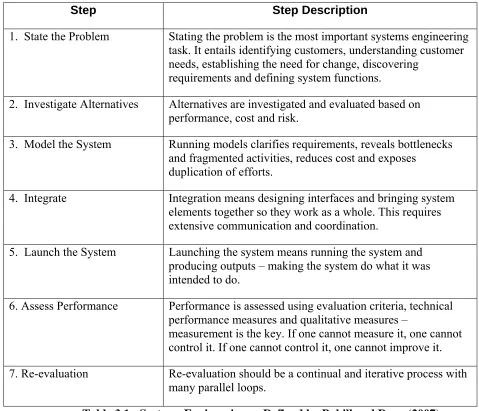
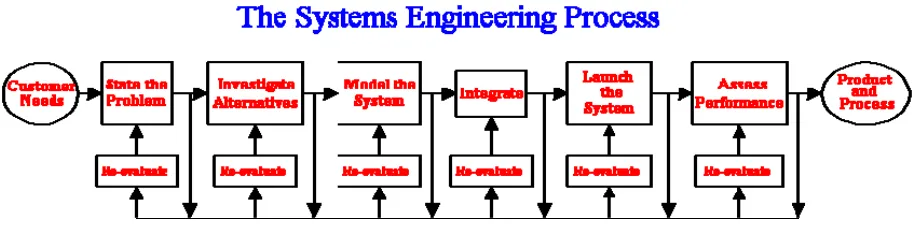
in Figure 3.1, can be defined as a seven step process. Table 3.1 is a representation of the steps
and a description of each step in the Systems Engineering process used to help develop the
model upon which this research is based.
Step Step Description
1. State the Problem Stating the problem is the most important systems engineering task. It entails identifying customers, understanding customer needs, establishing the need for change, discovering
requirements and defining system functions.
2. Investigate Alternatives Alternatives are investigated and evaluated based on performance, cost and risk.
3. Model the System Running models clarifies requirements, reveals bottlenecks and fragmented activities, reduces cost and exposes
duplication of efforts.
4. Integrate Integration means designing interfaces and bringing system elements together so they work as a whole. This requires extensive communication and coordination.
5. Launch the System Launching the system means running the system and producing outputs – making the system do what it was intended to do.
6. Assess Performance Performance is assessed using evaluation criteria, technical performance measures and qualitative measures –
measurement is the key. If one cannot measure it, one cannot control it. If one cannot control it, one cannot improve it.
7. Re-evaluation Re-evaluation should be a continual and iterative process with many parallel loops.
Table 3.1: Systems Engineering as Defined by Bahill and Dean (2007)
The steps described in Table 3.1 can be modified to provide a structured approach using
the same Systems Engineering principals to guide the development of a model for creating a
regional technology-based economy as described below. The first step in the process is to the
18
desired, stakeholders, requirements and system functions. The second step is closely related to
the first one: it is the identification of the elements of the hypothesis, or the statements to be
investigated, questions to be answered and results to be achieved.
The investigation of the elements of the hypothesis, the third step in the Systems
Engineering Process as defined here, is no more than a literature review. This step is comprised
of a comprehensive analysis of the existing scholarship in the area of technology-based
economic development. An analysis of current academic writing and hypotheses is completed;
an evaluation of “real-time” data on economic growth of the regions studied and of the economy
as a whole is made. Finally, step 3 includes the interview of leading scholars and professionals
in the field of technology-based economic development.
The fourth step in the process is to define the model attributes, factors and variables that
impact the model. In this step the model begins to come together. The processes that comprise
the system are identified along with the factors that impact those processes, as well as the
inflows to the system and outflows from the system.
The creation of an initial process model is the next step in the process. The data and
information collected provides for completion of the initial model and base lining of both the
hypothesis and the model. While the 4th step is still one of discovery, step 5 is one of creation or
construction of the systems/model itself for future analysis, testing and applications.
The validation of the model against existing technology-based regional economies using
empirical research is the sixth step in the process. Validating the model requires capturing
19
original research to follow the developmental steps of certain economic regions from the
inception of the idea that they will be a technology-based economy to their current economic
status, as a mature, adolescent or neophyte technology-based economy. This is based initially
upon direct observation, using interview techniques to quantify affective data. These
observations serve as inputs to refine the model and help it to “learn.”
The last steps of the process are to further refine the model and then apply the model to
one or more representative regions. The final steps constitute an ongoing process that is
discussed in Chapter 10. Each time the model is applied, it should continue to learn and be
refined. To facilitate continuous improvement, the model should be developed as an open source
application and made available to other researchers.
Figure 3.1: Systems Engineering Process
Conclusion
In summary, Chapter 3 has provided a description of the model upon which the empirical
20
identify, quantitatively factors and variables that will aid in the understanding of what makes an
economic region a success on the basis of its technology. The academic frameworks of Bahill
and Dean (2007), which also drew upon data from the previous publication by Bahill and Gissing
(1998) provide a solid foundation of a systems engineering approach that is admirably suited to
use in the testing of the hypothesis of this research. Further, the author has developed a Process
Model for Regional Technology-Based Economic Development on the basis of the systems
21
CHAPTER 4
Core Issue/Analysis of Hypothesis
Introduction
Analyzing technology-based regional economies paints a picture of varying degrees of
success that can be likened to the stages of growth from childhood to adulthood. Many regions,
states and/or municipalities have tried to develop technology-based economies. The initial
literature research indicates that regional technology-based economies can be segregated into
three primary categories of development or success – mature, adolescent, and neophyte. Most
regions set out to reach the stage of having a mature, self-refueling technology-based economy,
but few have actually succeeded in achieving that level, including many that are perceived to be
major successes. This chapter presents basic definitional issues on the level of maturity of an
economic region and on the nature of the technology base of the economic region.
Key Definitions
4.1 Definitions: Economies Can be Self-Refueling, in Equilibrium or
Depreciating
Before defining the stages of relative maturity of technology-based regional economies,
there are three key definitions that need to be defined: self-refueling, equilibrium and
depreciating. A self-refueling technology-based regional economy is one that can maintain itself
and continuously earn new “fuel” (imports), irrespective of the loss of a single business, product
or industry (Jacobs, 2000). Just as a living organism must self-refuel in order to survive, an
22
prosper (Jacobs, 2000). In this case, the fuel of a technology-based economy takes the form of
cash, knowledge, skills, investment capital, natural resources, raw materials, etc. (Bingham,
1993), (Blakely, 2002), (Jacobs, 2001, page 95), just as food and water are the fuel for a living
organism. These resources must be earned by value-added processes. When these value-added
processes are developed in a regional technology economy to the extent that the growth and
diversification of new businesses is incubated through a process of import stretching and import
replacement, the economy can be thought of as self-refueling (Jacobs, 2000), (Saxenian, 1999).
It is critical that both processes of import replacement and import stretching be present for an
economy to become self-refueling. Within the context of a model, a self-refueling regional
economy is represented conceptually in Figure 4.1. In a self-refueling regional economy, the
sum of the inflows is greater than the sum of the outflows, thereby causing the regional economy
to expand, much in the same way as a balloon expands as the amount of air flowing into the
balloon exceeds the sum of all of the air lost by outflow.
Self – Refueling Economy
Resource Processing Regional Economy Environmental Variables Policy Variables Social Variables External events that affect inflows
External events that affect
outflows Customers Resource Recirculation Non-value added Outflows Knowledge Variables Inflow Variables Attitudinal Variables
23
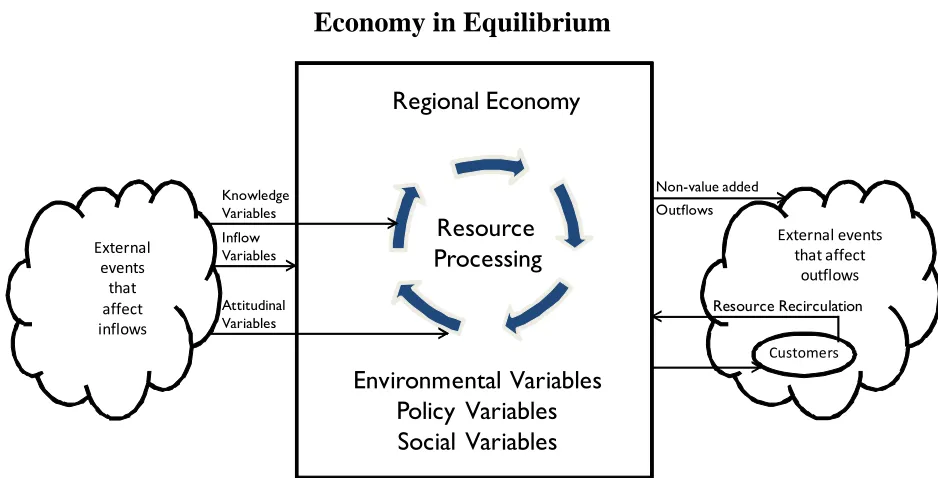
Clearly, not all economies are self-refueling. Many localities and regional economies,
regardless of their developmental phase, fall into the category of technology-based economies in
equilibrium (See Figure 4.2). Equilibrium can occur in an economic region of any size, age or
even traditional strength. Technology-based economies in equilibrium are not by nature
self-refueling and can begin depreciating.
These areas may have many excellent attributes and may even have a moderately strong
traditional economic base and some technology-oriented businesses. However, such regions fail
in one or more of the six primary factors and many of the variables within each factor category
identified as important in the hypothesis tested by this research. The region’s technology-based
economy may not yet have “gotten off the ground” or it may have simply stopped expanding and
become sluggish, inert or even dormant. For example, one region identified in this study has a
long tradition of being one of the world’s leading cities and has many attractive attributes.
However, the region fails both the knowledge and attitudinal factors and has weaknesses in some
variables and the factors associated with them. These areas can still become self-refueling and
progress through the various maturity phases of economic development if they address these
weaknesses. Unfortunately, the root causes of any regional economic phases often go
24
Economy in Equilibrium
Resource Processing Regional Economy
Environmental Variables Policy Variables Social Variables
External events
that affect inflows
External events that affect
outflows
Customers
Resource Recirculation Non-value added
Outflows Knowledge
Variables Inflow Variables
Attitudinal Variables
Sum of Inflows + Value Added Processes = Outflows
Figure 4.2: Representation of a Regional Economy in Equilibrium
Finally, a regional economy that has not only stopped expanding, but has actually started
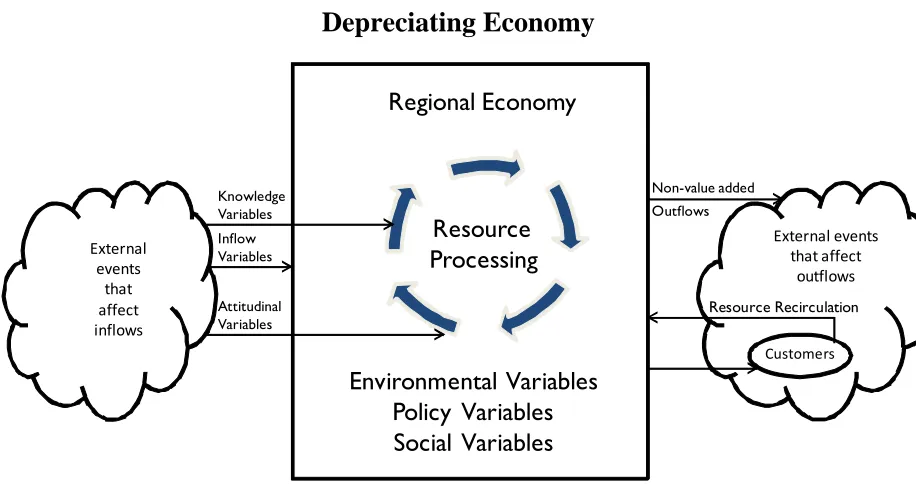
to shrink can be thought of as depreciating (Figure 4.3). In this case, the outflows exceed the
inflows so the economy shrinks in the same manner as a deflating balloon. This is the same
process as depreciation of an asset, a corporation or even a national economy as a whole. It is
based on the Factors and processes that impact the model. Depreciating economies are not
“doomed” to extinction. By altering the Factors and/or improving the processes, even a
25
Depreciating Economy
Resource Processing Regional Economy Environmental Variables Policy Variables Social Variables External events that affect inflowsExternal events that affect
outflows Customers Resource Recirculation Non-value added Outflows Knowledge Variables Inflow Variables Attitudinal Variables
Sum of Inflows + Value Added Processes < Outflows Figure 4.3: Representation of a Depreciating Regional Economy
4.2 Definitions: Mature, Adolescent and Neophyte Economic Status
Having a firm understanding of what self-refueling, balanced or depreciating economies
are, the discussion now moves to the definitions of the types of economic life-cycles a region can
be in with regard to their technology base. There are three distinct stages in the economic
life-cycle of any region: an economy could be a mature economy, an adolescent one or neophyte
economy.
Mature
Economic
Status
A self-refueling economy with sufficient diversification and dynamic stability to support
continued economic health and expansion constitutes a mature economy. The ultimate goal for
technology-based economies is to reach a point at which the economy is mature enough to
26
survive as a viable economic engine (U.S. Economic Development Administration, Department
of Commerce, 2006). Silicon Valley and Massachusetts’ Route 128 in the U. S. and Sophia
Antipolis, France may have set out on the road to self-refueling economic maturity as a result of
government supported research (Lee, et.al.,2000), (Saxenian, 1999), but are now far beyond their
dependency on the government or any other single source of economic stimulus to ensure
continued viability. The same may be true for the economies of Bangalore, India and the
Research Triangle Park in North Carolina in the U. S., as well as other U.S. and international
regions (Global Province) (IC2 Institute).
This economic security may not be the case, however, for less mature economic regions
such as Huntsville in the U. S. and Dubai in the UAE. Through time, mature regional
technology-based economies have gone through revealing cycles of relative success and failure.
These cycles can be described in terms of self-refueling periods and periods of depreciation. A
mature economy must be innovative and open to change if it is to remain viable and
self-refueling, otherwise it may begin to depreciate.
Adolescent
Economic
Status
Regions that have a strong base of technology-oriented companies and jobs, but which
are highly dependent upon a single source or a small group of highly portable primary sources
for sustaining those technology jobs are considered adolescent technology economies.
Huntsville, Alabama in the U. S. may be a good example of an adolescent technology economy
(Souder. 1993), (Huntsville Chamber of Commerce). Huntsville boasts the Cummings Research
Park that supports the Redstone Arsenal and NASA Marshall Space Flight Center. Together,
27
However, if the Redstone Arsenal and the Marshall Space Flight Center were to be removed as
economic movers in the region, the technology economy of Huntsville could fall apart even
during its continuing economic diversification.
Thus, Huntsville has not yet grown to the stature of a sufficiently diversified and
self-refueling technology economy so as to have a chance to survive independent of government
spending. The same is true for Albuquerque, New Mexico with its reliance on the Sandia
National Laboratories and the Air Force Reconnaissance Laboratory (Jackie Kerby-Moore
interview). Similarly, while Dubai has been an extraordinary 21st century example of economic
growth in a region not normally known as a technology-based economy (Pollard interview), it
enjoys enormous support from an investment by governmental sources. If this support system is
removed, Dubai may cease to grow (Pollard interview).
Too many regions try to become what they are not by force fitting technology enterprises
into a mold of what they think the Silicon Valley economic model is. It fails just as surely as a
wet-weather agricultural crop fails in the dessert. The resources needed to feed the crop are not
present naturally so the crop dies without intervention. An unnatural economy dies in the same
way. Silicon Valley developed over decades and did so naturally. When today’s regional
economies try to create the “next” anything and try to do so – a few months or even a few years
– or by attempting to force-fit a particular technology into the region, they typically fail.
Adolescent and even neophyte regional technology-based economies must supplement and build
upon their natural strengths in concert with strategies to address the variables delineated herein in
order to progress to the next level of economic maturity. Many areas in the United States that
28
Neophyte
Economic
Status
Neophyte regions are those areas that have a decent economic base, possibly including
technology-oriented work and businesses, but have not yet successfully developed or
implemented a growth model to create a viable, self-refueling technology-based regional
economy by building on that base (Schultz, 2004), (Shapira, 2008). Usually this is due to either
a lack of focus or funding, or because other economic interests take priority (Siegel, 2001). It is
also possible that the various governmental or quasi-governmental entities that are responsible
for economic development are not sufficiently knowledgeable of the strategies they can
implement to build a technology-based economic model (Schultz, 2004), (Siegel and Waxman,
2001). Georgia’s “second region” Centers for Innovation initiative is a possible example of a
neophyte technology-based economic development initiative (Shapira, 2008). The lessons to be
learned from the early stages of Sophia Antipolis, France are particularly instructive for neophyte
regions (Quere and Coutures, 2002), (see Chapter 5).
Conclusion
In sum, Chapter 4 presents the core issues regarding an analysis of the hypothesis under
consideration. In doing so, the concepts of mature, adolescent and neophyte economic
development have been discussed. Further, integrated into this discussion of economic
development is a discussion on the issues of the types of technology-based economies that may
exist in conjunction with mature, adolescent, or neophyte economies. Technology-based
economies may be defined as being self-refueling, in equilibrium or in depreciation. It is the
29
characteristics that is the subject of Chapter 5 and constitutes a large portion of the lessons
30
CHAPTER 5
Lessons Learned from Specific Regions and Models
Introduction
The variables that affect the progression of regional technology-based economic
development can be identified and characterized by studying the collective experience of the
regions around the world that have undertaken such efforts intentionally or not. There are
lessons to be learned, both positive and negative, from each region. This chapter addresses many
such regions, but it represents just the tip of the iceberg of what can ultimately be learned.
Much has been written about the success of Silicon Valley and many regions have
attempted to recreate Silicon’s Valley success (Graham, 2006), (Gregory, 2007), (Hamilton,
1997), (Saxenian, Motoyama and Quan, 2002) and (Saxenian, 2006). But the ability to quantify
the factors that led to the establishment, growth and long-term “staying power” of Silicon Valley
remains elusive. Much as wave resonance can, with the right frequency, pitch and amplitude,
yield extraordinary outcomes (think rogue wave or a bridge collapse), in Silicon Valley, the right
mix of quantitative and qualitative factors yielded explosive results. It is worthy to note that on a
much smaller scale Huntsville, Alabama achieved a similarly impressive outcome in the
aerospace field thanks to Werner Von Braun and scientists from NASA (Ward, 2005), (Souder,
Schoening, 1993), but could not reach beyond that to create a diversified economy. Similarly,
regions such as Sophia Antipolis, France, which is widely considered an international success
story for the stimulation of a knowledge economy, have found various levels of success
(Innovations Champion Network, 2004), (Koch, 2007). (Quere and Coutures, 2002).
31
region (Quere and Coutures, 2002). Using these considerations as a backdrop, this chapter
explores the lessons to be drawn from literature on several key regional technology-based
economies around the world, and sets the stage for the broader lessons derived from the
empirical interviews described in Chapter 9.
5.1 Silicon Valley, California, U. S.
Of the many books and papers written about Silicon Valley, for the purpose of this study
the most useful are “The Silicon Valley Edge” (Lee, et. Al., 2000) and “Regional Advantage:
Culture and Competition in Silicon Valley and Route 128” (Saxenian, 2006) and “The New
Argonauts: Regional Advantage in a Global Economy” (Saxenian, 2006). As stated in the
Silicon Valley Edge”, (Lee, Miller, Hancock, Rowen, 2000) what sets Silicon Valley apart is not
the technologies discovered here, but the companies created in the region that develop, market,
and exploit these technologies. In other words, the Silicon Valley story is predominantly one of
the developments of technology and its market applications by firms – especially by start-ups.
The results of this technological development and application is that new companies were able to
focus on new technologies for new wealth creation. Like a natural habitat for flora and fauna, the
habitat of Silicon Valley is one in which all the resources high-tech entrepreneurial firms need to
survive and thrive have grown organically over time. Silicon Valley’s habitat includes people,
firms, and institutions – their networks and modes of interaction. And like a natural habitat, it is
marked by complex, dynamic, interdependent relationships. (Lee, et.al., 2000, page 3). The
factors that can be drawn from this quote and the research of its authors include environmental,
policy, attitudinal, knowledge and social variables. The authors go on to identify ten specific
32 • Favorable “rules of the game”
• Knowledge intensity
• A high-quality and mobile work force
• A climate that rewards risk-taking and tolerates failure
• Open business environment
• Results – oriented meritocracy
• Universities and research institutions that interact with industry
• Collaborations among business, government and non-profit organizations
• High quality of life
• A specialized business infrastructure
Any of these factors would be major breakthroughs in most other regions, but in Silicon
Valley, they fed on each other with extraordinary efficiency. Silicon Valley was the prototype
for many of the key factors that drive regional technology-based economic development
including clusters, sharing of talent and ideas, social networks, university-industry collaboration,
leveraging government investments, access to capital, flexible organizational structures and
many more. But the leaders of Silicon Valley also took innovation to a new level. No one was
solely concerned with creative technology; nor was this dynamic and organic environment
simply focused on the mass job creation associated therewith. The whole structure and purpose
of this phenomenon of Silicon Valley was about a constant and consistent cycle of innovation
and wealth creation, similar to the product development life-cycle analogy described in Chapter
3.
In her books “Regional Advantage: Culture and Competition in Silicon Valley and Route
33
(Saxenian, 1996), AnnaLee Saxenian discusses in-depth the importance of education, “brain
recirculation,” social networks, entrepreneurial culture, collective learning, horizontal
communications, university collaboration and a supportive infrastructure in the development of
the “Silicon Valley way.” Dr. Saxenian goes on to describe the process of industrial
specialization and fragmentation – the building of companies that then spawn new start-ups – as
a cornerstone of regional diversification. It is this diversification that stabilized Silicon Valley’s
regional economy such that the failure or removal of a single company or single source of
economic growth would not jeopardize the region’s economy. Silicon Valley became a truly
self-generating, self-refueling, mature regional technology-based economy.
5.2 Massachusetts Route 128, U. S.
According to Dr. Saxenian, Silicon Valley progressed beyond “the Massachusetts
Miracle,” the economy that developed in the area around Massachusetts Route 128, in large part
because of its progressive corporate approaches and agile business processes.
Notwithstanding the organizational innovations of firms like DEC and its imitators, most Route 128 firms continued to rely on a formal, vertical structure, more conservative and top-down management styles, and significantly greater formality in the workplace, dress, communication patterns, and attitudes toward authority than those located in Silicon Valley. In short, Route 128’s technology firms remained stable, formal, and centralized organizations compared with the loosely linked confederations of engineering teams in emerging Silicon Valley (Saxenian, Regional Advantage, page 78).
While there was and is a fundamental difference between the two areas in the organic
nature of the areas, it should be noted that Route 128 firms employed more than twice as many
workers in the electronic components sectors as Silicon Valley firms in 1959. In 1975, these
positions had reversed: employment in Silicon Valley had tripled to more than double that of
34
further. In an interesting side note as will be noted later in this publication, it was other regions
that could take advantage of low cost of labor (rate arbitrage) and virtually free education such as
Bangalore and Ireland that Route 128 had relied upon that ultimately became the new threat in
the 21st century.
In this review of what geographic areas have been successful mature self-refueling
economies, it is inappropriate to give short shrift to Route 128. Although Route 128 failed to
maintain its initial lead over Silicon Valley, it was still one of the original models for
technology-based economic development. There are lessons to be learned from the “race”
between Silicon Valley and Route 128, including the limits of an independent firm-based
industrial system in an environment of technological and market volatility. While the Route 128
system provided the stability that is critical in an environment of volume markets and
price-based competition (Saxenian, 1999), it was inadequate for the accelerating pace of technological
and market change in semiconductors (U.S. Office of Technology Policy, Department of State,
2001). But Route 128 also offered one of the first lessons on the importance of cooperation with
academia and inflow of government funding (especially in engineering, science, information
technology and R&D) to regional technology-based economic development (The Brookings
Institute, 2007). Route 128 remains today an outstanding example of a mature knowledge-based
economy (The Brookings Institute, 2007).
Another lesson to be learned from Massachusetts is the failure of its gateway cities,
Massachusetts’s traditional mill communities, like New Bedford, Fall River, Brockton,
35
“Lessons Learned and an Agenda for Renewal” (2007), a joint project of MassINC and
the Metropolitan Policy Program at the Brookings Institutions, describes an environment wherein
Massachusetts Route 128 and many other areas of the commonwealth enjoyed one of the most
successful economic transitions to a knowledge economy, while these trends effectively
bypassed and wholly ignored the gateway cities, which actually fell further and further behind.
The gateway cities lagged in education, opportunities, jobs and most of the factors that made the
other aspects of the commonwealth successful. This same pattern has repeated itself in many
regions of Massachusetts as well as other states. It is apparent that without clear political and
economic leadership whose aim is shared prosperity across the state, prosperity for one sector
need not benefit all.
5.3 Huntsville, Alabama, U. S.
Much can be learned from the economic development history of Huntsville, Alabama.