journal homepage: http://jac.ut.ac.ir
Constructing Graceful Graphs with Caterpillars
Christian Barrientos
∗1and Sarah Minion
†21,2Department of Mathematics, Clayton State University, Morrow, Georgia 30260, USA.
ABSTRACT ARTICLE INFO
A graceful labeling of a graph Gof size n is an injective assignment of integers from {0,1, . . . , n} to the vertices of G, such that when each edge of G has assigned a weight, given by the absolute difference of the labels of its end vertices, the set of weights is {1,2, . . . , n}. If a graceful labeling f of a bipartite graph G assigns the smaller labels to one of the two stable sets of G, thenf
is called anα-labeling andGis said to be anα-graph. A tree is a caterpillar if the deletion of all its leaves results in a path. In this work we study graceful labelings of the disjoint union of a cycle and a caterpillar. We present necessary conditions for this union to be graceful and, in the case where the cycle has even size, to be an α -graph. In addition, we present a new family of graceful trees constructed using α-labeled caterpillars.
Article history:
Received 5, June 2016
Received in revised form 8, September 2016
Accepted 3 November 2016 Available online 25, December 2016
Keyword: graceful labeling, caterpillar, graceful trees .
AMS subject Classification: 05C78.
1
Introduction
LetGbe a graph of ordermand sizen, wheren+1≥m. A functionf is agraceful labeling
ofGiff is an injection fromV(G) to the set{0,1, . . . , n}such that when each edgeuv of
G has assigned the weight |f(u)−f(v)|, the resulting weights form the set {1,2, . . . , n}.
∗Email: chr [email protected] †Email: [email protected]
A graph that admits a graceful labeling is said to begraceful. Letf be a graceful labeling of a bipartite graph G; if there exists an integer λ such that f(u) ≤ λ < f(v) for every
uv ∈ E(G) with f(u) < f(v), then f is called an α-labeling and G is an α-graph. The number λ is called the boundary value of f.
It is well-known that not all graphs are graceful. This fact motivated Golomb [10] to introduce the concept of gracefulness. The gracefulness of a graph G of size n, denoted bygrac(G), is the smallest positive integer k for which it is possible to label the vertices of G with distinct elements from the set {0,1, . . . , k} in such a way that distinct edges have distinct weights. A graph G is graceful is grac(G) = n. Golomb suggested that the main questions in this area are to determine the relationship between grac(G) and
n, identifying families of graphs for which grac(G) =n, grac(G)> n, and to find better bounds for grac(G)−n.
The smallest graph, in order and size that is not graceful, is the disjoint union of the cycle C3 and the path P2. In this case, grac(C3 ∪P2) = 5, this value is obtained with the labeling (0,2,5)(3,4). Frucht and Salinas [6] studied the gracefulness of graphs of the form Cm ∪Pn, they proved that C4 ∪Pn is graceful for every n ≥ 3, in addition, they
conjectured that Cm∪Pn is graceful if m+n ≥7. Choudum and Kishore [4] proved this
conjecture for every m ≥ 5 and n ≥ (m + 5)/2. In [7], Frucht proved that C3 ∪Pn is
graceful whenever n ≥ 4. The conjecture was completely proved by Traetta [16]. Note that the graph C3 ∪P2 can also be seen as C3 ∪K1,1; Choudum and Kishore [5] proved thatCm∪K1,n is graceful for everym≥7 andn≥1. Barrientos [2] proved thatC6∪K1,n
is graceful if and only if n is odd or n= 2,4, and thatC5∪K1,n is not graceful for every
n ≥2. Seoud and Youssef [14] proved that neither C3∪K1,n nor C4∪K1,n (in this case
n 6= 2) are graceful. Thus, the gracefulness of Cm ∪G has been completely determined
when G is a path or a star of sizen.
In this paper we analyze this problem from a more general perspective, here we study graceful labelings of graphs of the form Cr∪Gn where Gn is a caterpillar of size n. We
provide sufficient conditions on the structure ofGnto obtain a graceful labeling ofCr∪Gn
when r is odd and an α-labeling when r is even.
In Section 2, we present all the existing results required to prove our conclusions. In Section 3 we show how to constuct the desired labelings of Cr∪Gn. In Section 4 we use
α-labeled caterpillars of even size to construct new α-trees.
In this work we follow the notation and terminology used in [3] and [9].
2
Preliminary Results
Recall that everyα-graph is bipartite. LetGbe a graph of sizenand letfbe anα-labeling of G with boundary value λ. Let A and B be the stable sets of V(G), without loss of generality, we assume that A={v ∈V(G) :f(v) ≤λ} and B ={v ∈ V(G) : f(v)> λ}. When a positive constant d is added to every vertex in B, the set of induced weights is
independently by Maheo and Thuiller [11] and Slater [15]. Note that when an α-labeling of a tree of size n is transformed into a d-graceful labeling, the set formed by the labels assigned is {0,1, . . . , λ} ∪ {d+λ+ 1, d+λ+ 2, . . . , d+n}.
Let G be a graph of order m and size n, and let f be a graceful labeling of G. When a constant c is added to every vertex label in G, the set of weights induced by this new labeling is the same, that is,{1,2, . . . , n}; the set of labels used are{c+l1, c+l2, . . . , c+lm}
where the li’s are the labels originally assigned by f.
Modifying the permissable vertex labels and/or the weights of a graceful labeling, Rosa [13] introduced the concept of ˆρ-labelings. An injective function f :V(G)→ {0,1, . . . , n+ 1}
is called a ˆρ-labeling if the set of induced weights is either {1,2, . . . , n− 1, n + 1} or
{1,2, . . . , n}. Frucht [8] used the term nearly graceful to refer to the ˆρ-labeling of Rosa. The following two theorems are due to Rosa [12], we use them together with Theorem 3 to prove the results in the coming sections. We do not prove them but we provide the corresponding labelings.
Theorem 2.1. If m≡0,3(mod 4), then the cycle Cm is graceful.
Let V(Cm) ={v1, v2, . . . , vm} and E(Cm) = {vivi+1 : 1 ≤ i ≤ m}, the addition is taken modulo m. The graceful labeling of Cm is given by
f(vi) =
(i−1)/2 if i is odd,
m−(i−2)/2 if i is even, 2≤i≤ dm/2e, m−(i/2) if i is even,dm/2e< i≤m.
Note that when m≡0(mod 4),f is an α-labeling with boundary value λ=m/2−1 and that the number 3m/4 is not a label ofCm. Whenm ≡3(mod 4), the number (3m−1)/4
is not a label of Cm.
Theorem 2.2. If a tree T of size n is a path or a caterpillar, then there exists an α -labeling of T.
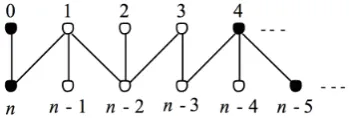
For the sake of completeness we present in Figure 1, the labeling scheme given by Rosa. We must observe that the label 0 can be assigned to any of the four vertices highlighted in the figure.
Figure 1: Rosa’s α-labeling scheme for a caterpillar
When m ≡ 1,2(mod 4), the cycle Cm is not graceful [12]. In the following theorem,
Theorem 2.3. The cycle Cm is nearly graceful, with weights1,2, . . . , m−1, m+ 1 if and
only if m≡1,2(mod 4).
The labeling given below is the complementary labeling of the one provided in [1].
f(vi) =
m+ 1 if i= 1,
m−(i−1)/2 if i is odd, 3≤i≤ b(m−3)/2c, m−(i+ 1)/2 if i is odd, dm/2e ≤i≤m,
(i−2)/2 if i is even.
Note that when m ≡2(mod 4), f is a bipartite labeling with boundary value λ = (m−
2)/2, that is, the vertices in A receive the labels 0,1, . . . , λ, while the vertices in B get the labels λ+ 1, λ+ 2, . . . ,(m+ 2)/4,(m+ 10)/4,(m+ 14)/4, . . . , m−1, and m+ 1. We must also observe that when m = 6, the numbers 5 and 6 are not labels of C6; for
m≥10, the numbers (m+6)/4 andmare not labels ofCm. Similarly, whenm ≡1(mod 4)
the numbers (3m+ 1)/4 and m are not labels of Cm.
Therefore, when m ≡ 0,3(mod 4), grac(Cm) = m, and grac(Cm) = m+ 1 when m ≡
1,2(mod 4).
3
Graceful Labeling of
C
r∪
G
nIn this section we construct graceful and α-labelings of graphs of the formCr∪Gn, using
the labelings introduced in Section 2. Since the labeling ofCr depends on the congruence
modulo 4 of r, we analyze two cases based on the gracefulness ofCr.
Let Gn be a caterpillar of size n with stable sets A and B, where |A| = a and |B| = b.
From this point, we assume that all caterpillars have been labeled using Rosa’sα-labeling in such a way that the vertex labeled 0 is in A.
Letmbe a positive integer. Suppose r = 4m+i, where i∈ {−1,0}. We denote byGi the
family of all caterpillars of size n≥m+ 2 such that the vertex u ofA labeled a−m−1, is adjacent to a leaf v. In the next theorem, we prove that whenGn ∈ Gi, C4m+i∪Gn is
a graceful graph when i=−1 and is anα-graph wheni= 0.
Theorem 3.1. If Gn∈ Gi, then C4m+i∪Gn is a graceful graph when i=−1 and it is an
α-graph when i= 0.
Proof. Suppose thatC4m+ihas been labeled using the labeling in Theorem 1. Add to every
vertex label of C4m+i the constant a. The new labeling of C4m+i uses all the numbers in {a, a+ 1, . . . , a+ 4m+i}except a+ 3m+i, and induces the weights 1,2, . . . ,4m+i. Let u be the vertex of Gn adjacent to the leaf v. The α-labeling of G0n = Gn−uv is
transformed into a (4m + 1 + i)-graceful labeling by adding the constant 4m + 1 +i
to every vertex label in B0 = B − {v}. The labels in G0n form the set {0,1, . . . , a−
1} ∪ {a + 4m+ 1 +i, a + 4m+ 2 +i, . . . ,4m+n +i}, and the weights form the set
{4m+ 2 +i,4m+ 3 +i, . . . ,4m+n+i}. By assigning the labela+ 3m+i to the vertex
is graceful. Moreover, the labeling of C4m ∪Gn is an α-labeling with boundary value
λ= 2m+a−2.
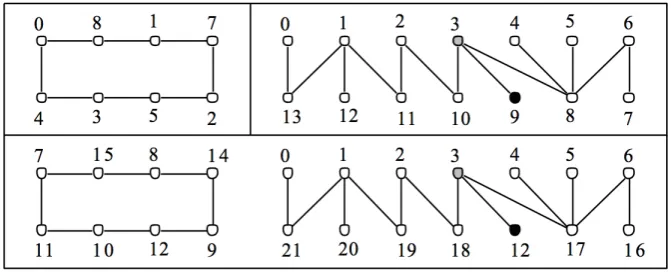
In Figure 2 we show an example for a graph C8 ∪G13, exhibiting the inital labelings of each component and the final labeling; the vertices u and v are highlighted.
Figure 2: α-labeling of C8∪G13.
Now we analyze the case where r = 4m +i, i ∈ {1,2}. Let Gi be the family of all
caterpillars of size n ≥ m + 2 such that the vertices u1 and u2 of A, labeled a− m and a−2, respectively, are adjacent to the leaves v1 and v2. Note that when m = 2,
a−m=a−2, that is, the vertexuinA, labeled a−2, is adjacent to the leavesv1 and v2. In the next theorem, we show that when Gn ∈ Gi, C4m+i∪Gn is a graceful graph when
i= 1 and it is an α-graph when i= 2.
Theorem 3.2. If Gn ∈ Gi, then C4m+i∪Gn is a graceful graph when i= 1 and it is an
α-graph when i= 2.
Proof. Suppose that C4m+i has been labeled using the labeling in Theorem 3. Add to
every vertex label of C4m+i the constant a. The new labeling of C4m+i uses the labels in
the set{a, a+ 1, . . . , a+ 4m+ 1 +i} − {a+ 3m+i, a+ 4m+i}, and induces the weights 1,2, . . . ,4m−1 +i, and 4m+ 1 +i.
Letu1 and u2 be the vertices ofGn adjacent to the leavesv1 and v2, respectively. Recall that when m = 2, u1 = u2. The α-labeling of G0n = Gn−u1v1 −u2v2 is transformed into a (4m+ 2 +i)-graceful labeling by adding the constant 4m+ 2 +i to each vertex label in B0 = B − {v1, v2}. The labels used on G0n form the set {0,1, . . . , a− 1} ∪ {a + 4m + 2 + i, a + 4m + 3 + i, . . . ,4m +n +i} and the set of induced weights is
{4m+ 3 +i,4m+ 4 +i, . . . ,4m+n+i}. The verticesv1 andv2 are labeleda+ 3m+iand
a+ 4m+i, respectively. This implies that the edges u1v1 and u2v2 have weights 4m+i and 4m+ 2 +i. Therefore, C4m+i∪Gn is graceful. Moreover, the labeling of C4m+2∪Gn
is, indeed, anα-labeling with boundary value λ= 2m+a.
Figure 3: Graceful labeling of C13∪G12.
Theorem 3.3. Ifi∈ {−1,0,1,2}andGn ∈ Gi, thenC4m+i∪Gnis graceful. Furthermore,
if i is even, C4m+i∪Gn is an α-graph.
The families of caterpillars used in these results are quite robust, however not all cater-pillars are included in these families. Therefore, it is an open problem to determine the gracefulness of Cr∪Gn for all the caterpillars that are not in these families.
4
A New Contruction of
α
-Trees
Let G be the family of all caterpillars G such that |A|=|B|+ 1, where A and B are the stable sets of V(G) and A contains the vertices of maximum eccentricity.
Let G1, G2, . . . , G2t ∈ G be caterpillars of size n. For each i ∈ {1,2, . . . ,2t}, let ui, vi ∈
V(Gi) such thatdist(ui, vi) =diam(Gi). For everyi∈ {1,2, . . . , t}, the caterpillar Γi, of
size 2n when i = 1 and size 2n+ 1 when i > 1 is constructed, via vertex amalgamation, identifying the vertices vi and ut+i; and for i > 1, attaching to xi a pendant vertex
yi, where xi is the vertex of Γi that results of the vertex amalgamation. For all i ∈ {1,2, . . . , t−1}, the treeH, of size 2t(n+ 1)−2, is obtained by connecting with an edge, the vertex xi of Γi to the vertex yi+1 of Γi+1. Note that Γi ∈ G and xi ∈ A. Let H be
the family of all trees constructed in this manner, way claim that if H ∈ H, thenH is an
α-tree.
Theorem 4.1. If H ∈ H, then H is an α-tree.
Proof. For each 1≤i≤t, let fi be the α-labeling of Γi, obtained using Theorem 2, that
assign the label 0 to the vertex ui. Thus, the vertex xi has label |A| −1, and the vertex
yi has label n+|A|when i≥2. All these labelings have boundary value λ=n. Letgi be
the labeling of Γi defined by
gi(v) =
(
fi(v) + (i−1)(n+ 1) if fi(v)≤n,
fi(v) + (i−1)(n+ 1) + (t−i)(2n+ 2) if fi(v)> n.
Note thatgi is in fact a ((t−i)(2n+ 2))-graceful labeling of Γi shifted (i−1)(n+ 1) units.
2, . . . ,(t−i)(2n+ 2) +τi} where τi = 2n when i = 1 and τi = 2n+ 1 otherwise. Since
minWi−1−maxWi = 2 when i≥2, we have that t
[
i=1
Wi ={1,2, . . . ,2t(n+ 1)−2} − {(t+ 1−i)(2n+ 2) : 2≤i≤t}.
The labels used on Γi form the set Pi∪Qi where
Pi ={(i−1)(n+ 1),(i−1)(n+ 1) + 1, . . . ,(i−1)(n+ 1) +n}
and
Qi ={(i−1)(n+ 1) + (t−i)(2n+ 2) +n+ 1,(i−1)(n+ 1)+
(t−i)(2n+ 2) +n+ 2, . . . ,(i−1)(n+ 1) + (t−i)(2n+ 2) +τi}.
Since minPi−maxPi+1 = 1 and minQi−maxQi+1 = 1, we get that
P =
t
[
i=1
Pi ={0,1, . . . , t(n+ 1)−1}
and
Q=
t
[
i=1
Qi ={t(n+ 1), t(n+ 1) + 1, . . . ,2t(n+ 1)−2}.
Hence, we have assigned injectively the labels 0,1, . . . ,2t(n + 1)− 2 to the vertices of
St
i=1Γi.
Now we turn our attention to the vertices xi and yi. For every 1 ≤ i ≤ t, the vertex
xi in Γi has label |A| −1 + (i−1)(n+ 1) and for every 2 ≤ i ≤ t, the vertex yi in Γi
has label n+|A|+ (i−1)(n+ 1) + (t −i)(2n + 2). Thus, the edge xi−1yi in H, for
2≤i ≤t, has weight (t+ 1−i)(2n+ 2). Hence, the weights of these edges form the set
{(t+ 1−i)(2n+ 2) : 2≤i≤t}.
Then, the weights induced on the edges of H are 1,2, . . . ,2t(n+ 1)−2. Since V(H) =
St
i=1V(Γi) andE(H) =
St
i=1E(Γi)∪ {xi−1yi : 2≤i≤t}, we have that H is anα-graph; the boundary value of the labeling of H is λ=t(n+ 1)−1.
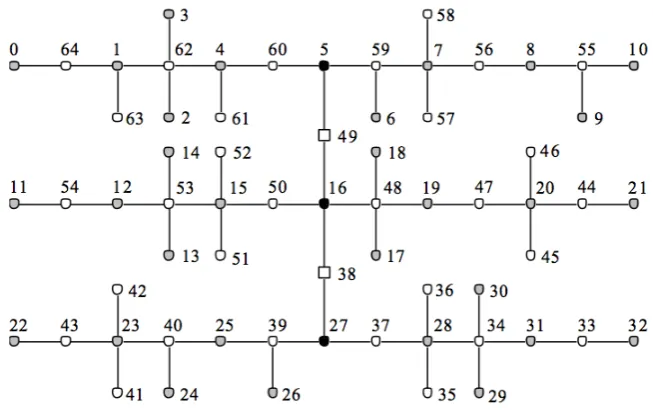
In Figure 4 we show an example of this construction for a tree of size 64 formed by six caterpillars of size 10 and diameter 6. The vertices xi are highlighted and the vertices yi
are represented by a small square.
We can see the potential of this construction, for example, by considering the fact that there are ten caterpillars of size 10 in G, two of them are symmetric. Each of the non-symmetric caterpillars have two α-labelings (using Theorem 2), therefore there are 18
Figure 4: α-labeling of a tree H.
we have 18t possibilities.
References
[1] C. Barrientos, Graceful labelings of cyclic snakes,Ars Combin., 60(2001), 85-96. [2] C. Barrientos, The gracefulness of unions of cycles and complete bipartite graphs, J.
Combin. Math., 52(2005), 69-78.
[3] G. Chartrand and L. Lesniak,Graphs & Digraphs 2nd ed., Wadsworth & Brooks/Cole (1986).
[4] S.A. Choudum and S.P.M. Kishore, Graceful labellings of the union of paths and cycles, Discrete Math., 206(1999), 105-117.
[5] S.A. Choudum and S.P.M. Kishore, Graceful labelling of the union of cycles and stars, unpublished.
[6] R. Frucht and L.C. Salinas, Graceful numbering of snakes with constraints on the first label, Ars Combin.,20(1985), B, 143-157.
[7] R. Frucht, On mutually graceful and pseudograceful labelings of trees,Scientia Series A, 4(1990/1991), 31-43.
[9] J. A. Gallian, A dynamic survey of graph labeling, Electronic J. Combin. 18(2015) #DS6.
[10] S.W. Gollomb, How to number a graph, Graph Theory and Computing, R.C. Read, ed., Academic Press, New York (1972), 23-37.
[11] M. Maheo and H. Thuillier, On d-graceful graphs, Ars Combin., 13(1982), 181-192.
[12] A. Rosa, On certain valuations of the vertices of a graph,Theory of Graphs (Internat. Symp., Rome, July 1966), Gordon and Breach, 1967, 349-355.
[13] A. Rosa, Cyclic Steiner triple systems and labeling of triangular cacti, Sientia,
1(1988), 87-95.
[14] M.A. Seoud and M.Z. Youssef, New families of graceful disconnected graphs, Ars Combin.,57(2000), 233-245.
[15] P. J. Slater, On k-graceful graphs. Proceedings of the Thirteenth Southeastern Con-ference on Combinatorics, Graph Theory and Computing (Boca Raton, Fla., 1982)
(1982), vol. 36, 53-57.