in the population sciences published by the Max Planck Institute for Demographic Research Konrad-Zuse Str. 1, D-18057 Rostock · GERMANY www.demographic-research.org
DEMOGRAPHIC RESEARCH
VOLUME 25, ARTICLE 11, PAGES 371-406
PUBLISHED 5 AUGUST 2011
http://www.demographic-research.org/Volumes/Vol25/11/ DOI: 10.4054/DemRes.2011.25.11
Research Article
Towards an integrated approach for the
analysis of gender equity in policies
supporting paid work and
care responsibilities
Chiara Saraceno
Wolfgang Keck
This publication is part of the proposed Special Collection "Intergenerational family ties in Europe: Multiple linkages between individuals, families and social contexts", edited by Pearl Dykstra.
© 2011 Chiara Saraceno & Wolfgang Keck.
This open-access work is published under the terms of the Creative Commons Attribution NonCommercial License 2.0 Germany, which permits use, reproduction & distribution in any medium for non-commercial purposes, provided the original author(s) and source are given credit.
1 Introduction 372 2 Background literature, theoretical framework, and research
questions 372
3 Methods and data 376
4 Empirical analysis 377
4.1 Gender and childcare responsibilities 377 4.2 Leave options for fathers 382 4.3 Gender-specific assumptions in support for care of the frail elderly 385 4.4 How gendered are the measures of financial support for families? 388 4.5 Acknowledging the gender division of labour and care work in the
pension system 389
5 Discussion and conclusion 392
References 397
Towards an integrated approach for the analysis of gender equity
in policies supporting paid work and care responsibilities
Chiara Saraceno1
Wolfgang Keck2
Abstract
This paper aims to develop a conceptual framework for analysing the degree to which public policies support gender equity in paid work and care. Combining the distinction between commodification and decommodification and the distinction between defamilialisation, supported familialism, and familialism by default our study identifies a number of relevant policies, ranging from services, leave entitlements, income support measures, and fiscal instruments to forms of acknowledgement of care work in pension systems. Although our main objective is conceptual, we offer a comparative overview of these policies for all of the EU countries, plus Norway. Thus, we provide a preliminary typology of policy approaches.
1. Introduction
Interest in the way policies promote or hinder gender equity in the family and on the labour market is hardly new. Most studies have, however, considered only a small set of policies, or even just one policy, rather than looking at the interactions between different policies that intervene in the same area. In this paper, by using an intergenerational responsibilities perspective, and by looking at both financial and care responsibilities, we aim to develop and test a conceptual framework that will enable us to take an integrated approach to assessing gender equity that encompasses a variety of policy measures and spheres.
We are aware that policies are only one part of the overall gender equity (or inequity) system. They interact with the labour market, family and gender cultures, and country-specific forms of class inequality (e.g., Cooke 2011, Crompton and Lyonette 2007; Lewis, Campbell, and Huerta 2008; McDonald 2009, Orloff 2009a). The relationship between these different contextual dimensions is neither one of pure causality nor one of pure autonomy. Nonetheless, since policies—regardless of their partiality—are structuring factors in the context-specific system of the resources and constraints within which individuals, households, and families develop their strategies, we seek to identify the implicit and explicit assumptions concerning gender-specific arrangements that shape the way policies directly or indirectly regulate responsibilities and obligations within families, and between families and the state.
2. Background literature, theoretical framework, and research
questions
acknowledge the value of care work by providing both time and financial compensation for care giving, and c) support and incentivise men to share care responsibilities.
The dual earner/dual carer model has three obvious limitations, quite apart from the fact that it is not a normatively universal model (e.g., Lewis, Campbell, and Huerta 2008; Orloff 2009b). First, it presupposes that there are good jobs for all, so that working for pay is worthwhile in practice. Second, it is based on the assumption that the dual responsibilities of earning and caring are always shared by a couple. In reality, however, many individuals with earning and caring duties actually shoulder them alone, or at least not within a couple relationship. Therefore, from a gender-equity perspective, policies should be evaluated not only on the basis of whether and to what degree they encourage sharing within a couple; but also on whether they allow individuals, and particularly women, to set up their own households without being dependent on a partner (Hobson 1994; also see Orloff 1993), or, following O’Connor, Orloff and Shaver (1999), without being totally dependent on the state. It should be noted, however, that Bäckman and Ferrarini (2010) found that dual earner policies also indirectly support lone parents/mothers, protecting them and their children from poverty more efficiently than policies that support a traditional gender division of labour. Third, the conceptualisations of this model focus only on the care needs of (small) children, ignoring the fact that care needs (and the gender division of responsibilities around them) do not stop at early childhood. They are, rather, continuous and recurrent over the life course. And in ageing societies, they may again become particularly intense in the second half of life, when adults’ parents become frail. Research has shown that, in all countries, including those with the highest provision of services, the family, and within it women, are the main care providers for both children and the frail elderly, with or without the help of social services (Arber and Ginn 1995; Johansson, Sundström, and Hassing 2003, Kramer and Kipnis 1995; Sarkisian and Gerstel 2004). Recent policy developments, such as the offer of payments for care instead of services, may, depending on the design, further increase the responsibilities of the family and of women within the family (Ungerson 2004; Ungerson and Yeandly 2007).
In light of these analyses and debates, three dimensions of policies appear particularly relevant in shaping the institutional context in which men and women in families negotiate the division of responsibilities. Developing Orloff’s (1993) original suggestion, they may be conceptualised as being at the intersection of two parallel divides: commodification/decommodification (Esping-Andersen 1990, 1999) and familialism by default/supported familialism/defamilialisation (Leitner 2003; Saraceno 1997, 2000, 2010; Saraceno and Keck 2010).
Defamilialisation—i.e., independence from family support for the satisfaction of one’s own needs—may occur both through the market and through the welfare state, again with different consequences, particularly for social class inequalities. Furthermore, as Orloff (1993) and others have pointed out, in order to gain access to decommodification via the welfare state (e.g., to a personal old-age pension or maternity leave), women need to be able to enter and remain in the labour market; i.e., to be commodified. This, in turn, requires that the goods (care, housework) they provide within the family and for family members—i.e., in a familialised framework—are not only shared with other family members, but are partly outsourced, either to the market or to the welfare state.
The dimensions emerging from this complex interplay that are particularly relevant from the perspective of gender equality are:
a) The degree to which policies allow women with family responsibilities to remain in the labour market, thus being independent of another person’s income, regardless of their care responsibilities; that is, the degree to which they allow women to be both “commodified” and “defamilialised” in their ability to provide for themselves, through, for example, the provision of services (defamilialised decommodification of care work) and paid leave entitlements (decommodified supported familialism); b) The degree to which policies acknowledge caring for dependent family members
(children, dependent adults, frail elderly relatives) as an activity giving entitlement to financial support in its own right (decommodified supported familialism), through, for example, care leaves and allowances, and care-linked contributions towards old-age pensions; and
c) The degree to which policies support men’s uptake of care responsibilities; for example, whether fathers are entitled to parental leave and whether there is a reserved quota for them (decommodified supported familialism for men).
The first dimension in principle should also include positive actions, working hours policies, family-friendly enterprise policies, etc. (e.g., Den Dulk 1999, 2001). Within the limits of this paper, however, we can address neither the role of other public policies, such as anti-discrimination and positive-action measures, nor that of private, company-driven policies.
2009; Van der Lippe et al. 2010). When the period of leave is long, employees are encouraged to take extended breaks from the workplace, thus weakening their ability to keep pace with changing job conditions. When the period of leave is too short, mothers may be forced to return to work earlier than they prefer or believe is healthy for their infant, thus making it difficult for them to balance work and care responsibilities. The opportunity to take leave may also have varying effects on women holding different positions in the labour market. Some studies have shown that having access to a (too) short period of leave can reduce fertility among the better educated, while it increases the likelihood that less educated women with low paid jobs will not return to the labour market (Esping-Andersen 2009; Waldfogel, Higuchi, and Abe 1999). A reverse effect may occur in the case of long but unpaid or low paid periods of leave. Mothers in a well-off household may be able to afford to take leave, while mothers in less affluent households may not.3 Of course, whether a period of leave is seen as “too long” or “too short” depends to a large extent on the cultural and socioeconomic context. The UNICEF report “The child care transition” (2008), which is based on existing knowledge and research findings, sets the length of optimal leave—from the perspective of the child’s well-being—at one year with at least 50% of earnings.
Incentives for fathers to share childcare have been introduced very recently in most countries. Data on the use of time (see Aliaga 2006; Gershuny and Sullivan 2003) suggest that, in countries where they have been in place since the 1970s, such as Norway and Sweden (Leira 2006), fathers do take over a greater share of childcare responsibilities, but, unlike mothers, without reducing their paid working time in the medium or long term. Furthermore, in these countries (and in Denmark), the partial closing of the gender gap in family childcare seems to be more a consequence of partial defamilialisation through services than of a substantial gender rebalancing within the household. Public policies thus appear to be a crucial instrument for gender equity, more because they relieve mothers of part of “their” tasks (i.e., through decommodified defamilialisation of childcare) than because they incentivise fathers to take on a larger share. However, according to Sullivan et al. (2009), who compare Sweden, Norway, and the United Kingdom, incentives to take a (comparatively long) leave seem to have a
long-term impact on caring behaviour. In particular, in Sweden, where parental leave
can be taken up to the child’s eighth birthday, fathers take about the same amount as in Norway (where all leave must be taken within the first year), and more than in the UK (where there is no reserved quota for fathers and there is no payment). But Swedish fathers take leave in a less concentrated form than in Norway. This results in a higher availability of fathers to care for their children, even beyond the leave period.
3 An issue we do not address here is the fact that many working parents are not entitled to parental leave at all
We focus in our analysis both on policies concerning the presence of young children and on policies addressing the financial and (non-health) care needs of the old. We also consider the implications of fiscal policies, as well as the design of income transfers to families and of pensions for the gender division of responsibilities, as suggested by various authors (e.g., Bäckman and Ferrarini 2010; Dingeldey 2001; Sainsbury 1996). Finally, unlike most recent studies that have focused on parental leave as the key policy for assessing the degree of gender egalitarianism (or gender equity) of parental policies (e.g., O’Brien 2009; Ray, Gornick, and Schmitt 2010), we focus not only on individual policies, but also on their interaction and combination.
Our aim is not to construct yet another welfare state typology. Such an endeavour would fail to provide reliable results, given the multiplicity and complexity of the policies involved and of their interaction, which render the “technical” decisions implicit in any typologising exercise even more arbitrary than when only very few policies are considered (see Scruggs and Allan 2008). Moreover, constricting complexity in a typology would lead us to hide precisely that which we wish to elucidate: the country-specific policy rationales with regard to the various distinct dimensions delineated above. These rationales may differ not only across countries, but also within countries, depending on the specific dimension and policy involved. Instead, we aim to conceptually clarify the gender dimension of the policies we analyse, and to empirically detect commonalities, differences, and even inconsistencies; not only across, but within national policy frameworks. Our work is intended to provide both a theoretical and an empirical basis for future in-depth analyses on a smaller number of countries.
3. Methods and data
We use the Multilinks Database on Intergenerational Policy Indicators (see Keck, Hessel, and Saraceno 2009)4, which covers a variety of policy areas and legal norms that shape the responsibilities of the generations to support each other either financially, or by providing care – to analyse a range of policy measures that represent the three policy dimensions described above (defamilialisation, decommodification, supported familialisation) and their interactions. Building on previous work (Saraceno and Keck 2010), we first look at how policies assign responsibility for caring and income security
4 Also see http://multilinks-database.wzb.eu/ (last accessed 16 April 2011). The database has been constructed
to the family and/or to the state. We then look at whether patterns of public support (or lack thereof) for intergenerational responsibilities contribute to crystallising or, on the contrary, to redefining the gender division of labour and responsibilities. We focus on policy outputs; that is, on entitlements to and patterns of public support. We thus assess the “theoretical,” not the actual impact on gender equity. In order to determine the actual impact, we need to look at outcomes. Yet these are the result not only of policies, but also of the interplay between policies, social norms, social and individual values, labour market conditions, and general patterns of social inequality. In order to assess the specific impact of policies on outcomes within country-specific contexts, in-depth case studies, necessarily dealing with a smaller number of countries, are required.
For reasons of space, we concentrate in the analysis only on a selection of policies. For decommodification via supported familialisation and its gender specificity, we consider the following: length of and compensation during parental leave, and how the use of leave by either parent is regulated; payments for care to be used by family carers, either because of the absence of regulation or because the regulation specifically stipulates that a family carer may receive some payment without being formally hired; leaves for workers with care responsibilities for a non-child family member; contributions towards old-age pensions during caring periods; child benefits that, depending on their design, may or may not constitute a disincentive for having a second earner in the family; forms of taxation that benefit financially asymmetrical married couples; and survivor pensions. This last measure is particularly important for women, especially those in the older cohorts, since they are less likely than men to have access to a work-linked old-age pension.5
For the decommodified defamilialisation of caring needs, we look at the following: coverage rates by publicly financed childcare services (focusing on children under age three, since this is where cross-country differences are greatest), and coverage rates by publicly financed home and institutional care services for the frail old.
4. Empirical analysis
4.1 Gender and childcare responsibilities
Mothers’ and fathers’ life course paths are clearly differentiated following the birth of children, and, in particular, during the initial years after childbirth (Lalive and Zweimüller 2005; Waldfogel, Higuchi, and Abe 1999). Fathers – regardless of the age
5 For reasons of space, but also because of a lack of good comparable data on all EU countries, we do not
or number of children – have higher employment rates than childless men of the same age. The opposite is the case for women, although to a varying degree, depending on the country. However, whereas for mothers a large range of studies show that having children decreases labour market participation, the evidence for the assumptions that men increase working time or employment in response to becoming a father is less clear (for opposing views, see, for example, Bielenski, Bosch, and Wagner 2002; Cooke 2011). There is, however, clear evidence that (full-time) employed men are more likely than non-employed men to become fathers (Blome, Keck, and Alber 2009).
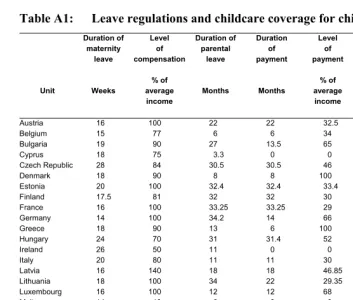
From the perspective of mothers’ labour force participation, leave entitlements and services must be considered jointly. Furthermore, not just the duration of the parental leave, but also the level of compensation during the leave is important. In some countries, periods of parental leave may be long, but with little or no payment; in others, payment is reduced after a given period, and so forth. To obviate this difficulty, the concept of “effective parental leave” has been developed, which weighs the duration of leave against the duration and level of compensation (Plantenga and Remery 2005; Ray, Gornick, and Schmitt 2010; Saraceno and Keck 2010; UNICEF 2008).6 With regard to childcare, since we are interested in the degree to which childcare responsibilities are shared by the state, we consider only public (or publicly financed) childcare coverage rates (Figure 1). In order to combine the two forms of support, coverage rates for children aged 0-2 are measured in weeks. More precisely, we calculated, given the country’s coverage rate, how many weeks a child could attend public childcare if all children were enrolled. If, for example, the coverage rate of a country is 30%, the available time period for each child in the population under age three would be 46.8 weeks (156 weeks / 100 * 30). We are aware, of course, that in reality there are children who attend full-time while others do not attend at all, that the proportion of working mothers differs across countries, and that not all parents are entitled to maternity and parental leave; and, finally, that the two time measures – those of leave entitlements and of childcare – are not fully homogenous. However, this exercise provides us with a rough measure of the degree to which there is public responsibility for childcare, either in the form of services or of leave entitlements.
6 The measure of effective parental leave has two important limitations. First, it results in an equalisation of
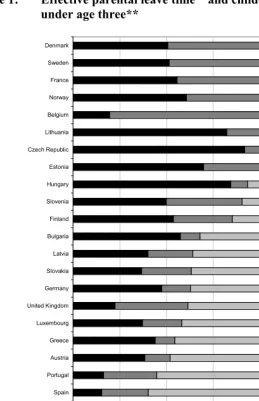
Figure 1: Effective parental leave time * and childcare coverage for children under age three**
0 26 52 78 104 130 156 Poland
Ireland Netherlands Cyprus Italy Spain Portugal Austria Greece Luxembourg United Kingdom Germany Slovakia Latvia Bulgaria Finland Slovenia Hungary Estonia Czech Republic Lithuania Belgium Norway France Sweden Denmark
weeks
Effective parental leave Coverage 0-3 Early care gap
Source: Multilinks Database, own calculations.
Notes: * Including the portion of leave reserved for mothers after childbirth, which in most but not all countries is often a separate kind of leave, usually defined as maternity leave.
Overall, the longest effective leave periods are found in some of the former communist countries of Bulgaria, the Czech Republic, Hungary, Lithuania, and Estonia; followed at a distance by France, Finland, and Norway. The shortest effective leave periods are found in Belgium, Cyprus, Ireland, Italy, the Netherlands, Poland, Portugal, Spain, and the United Kingdom. Public childcare provision covers over 33% of children aged 0-2 in the Scandinavian countries and in Belgium and France. Childcare coverage remains low in Austria, Bulgaria, the Czech Republic, Germany, Greece, Hungary, Italy, Luxembourg, and Poland.
Combining the two measures, we find that no country provides comprehensive publicly supported care coverage throughout a child’s first three years. The gap between the end of paid leave and the availability of childcare is smallest in Denmark, Sweden, Norway, Belgium, and France. In these countries, public policies generally support the employment of parents/mothers with a small child, showing coherence and continuity in their instruments, although they suggest a different timing and balance between supported familialisation and (partial) defamilialisation. To a lesser degree, and with a bias towards supported familialism, the Czech Republic, Lithuania, and Estonia also show a small care gap over the first three years of a child’s life. By contrast, there is a substantial gap for the under-threes in Ireland, Italy, Spain, Portugal, Cyprus, the United Kingdom, and the Netherlands; and this gap is only slightly smaller in the other countries (also see Saraceno and Keck 2010).
Figure 2: Childcare time use among children aged 0-2 attending a childcare facility (2006) 0 10 20 30 40 50 60 70 80 90 100 Net herlands United Kingdom Au
stria Ger
manyCyprus Spa in Ireland Lux emb ourg Belgi um Gree ce Fran
ce Italy Swede
n
Hungar y
PolandFinlan d Estoni a Latvia Slov enia Denm ark Portugal Pe rc e n ta g e of chil dr en at te nding each ti m e bracket
under 14 hours 15-30 hours over 30 hours
Note: The results are not weighted because in some countries no population weights are given for children born in 2006.
Source: EU-SILC 2006, authors’ calculations.
4.2 Leave options for fathers
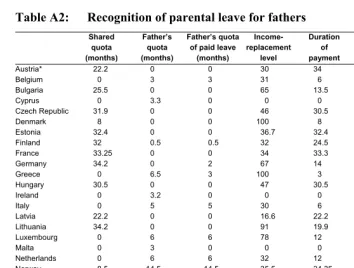
Assessing the gender equity of parental leave is not a self-evident process. While differing with respect to the specific technical measurements used, O’Brien (2009) and Ray, Gornick, and Schmitt (2010) assess the degree of gender equity on the basis of the extent to which non-transferable leave rights and benefits are granted to men as well as to women, on the one hand; and of the nature and incentives for male uptake, on the other. From the point of view of this approach, gender neutrality and the lack of a specific allocation of leave time to either parent would count as less gender-equal than a 50-50 division of leave time between the two parents. But in McDonald’s view (2009), the reverse is true; in particular, any specific allocation of time to fathers is perceived here as gender-specific, while neutrality and free use are not. We share O’Brien’s and Ray, Gornick and Schmitt’s position. We believe that gender neutrality and the open use of leave time will really be a matter of choice – with no impact on gender equity – only when men and women as parents and employers consider it normal that fathers also want and should be able to take time off to care intensively for a small child. Until then, fathers’ quotas are analogous to positive actions geared towards supporting women’s presence in the labour market, and are thus an equalisation measure. In addition to a reserved quota for fathers, the level of compensation also matters for fathers’ uptake of parental leave. On the basis of existing research, the UNICEF (2008) study sets this at around 60% or more of lost earnings.7
Figure 3 shows a) how much of the total parental leave is specifically reserved for fathers; and b) what share of the total leave fathers might theoretically take (in addition to, or without the reserved quota) is compensated at 60% or more of individual monthly earnings.8 This measure is different from that of effective leave, since it looks at the portion that is actually compensated at a given level. We believe that the actual level of payment is likely to be a crucial factor in a father’s decision to take leave. Countries may be divided into three groups. The first group offers well paid leave for several months, which can be shared between parents. It includes the Nordic and some Eastern European countries, as well as Germany since the 2007 reform. Finland, Germany, Norway, and Sweden reserve a portion of the well paid leave time only for fathers. Luxembourg is close to this group, as the overall leave time theoretically open to
7 Two other measures may encourage fathers to contribute to caring: paternity leave and flexible use of leave
time. Paternity leave is available in many but not all countries, Usually this leave is restricted to 15 days maximum around the time of childbirth, and therefore may not affect the gendered division of caring. Flexible use of parental leave allows both mothers and fathers to stretch out its duration so as to meet the needs of children over a longer time span, while reducing the length of time spent away from work for each period of leave taken.
fathers is somewhat shorter (six months maximum), while the income replacement is high, at 68% (in 2005).
The second group is made up of countries that reserve a set amount of the parental leave for fathers, but – as for mothers – with no or only little income replacement. This group includes the Mediterranean countries of Cyprus, Greece, Italy, Malta, and Portugal (but not Spain); as well as Ireland, the United Kingdom, Belgium, and the Netherlands. Variations in the length of leave reserved for fathers are small. Cyprus, Ireland, Malta, and the United Kingdom do not offer any compensation, while the other countries offer around 30% income replacement.
The last group includes countries that have neither a reserved quota for fathers, nor a good level of compensation (not included in Figure 3), and therefore lack both of what empirical studies have found to be the two prerequisites for incentivising fathers to take at least a portion of the leave. In particular, Poland and Spain provide income support during parental leave only on a means-tested basis. The other countries in this group offer very low compensation.
Figure 3: Reserved quota for fathers and total length of leave granted to fathers and paid at 60% of earnings or more (2009)
0 2 4 6 8 10 12 14 16 18 20
Belgium Malta Portugal United Kingdom Ireland Cyprus Italy Netherlands Greece Finland Luxembourg Norway Lithuania Denmark Slovenia Estonia Germany Sweden Bulgaria Hungary
Months
Reserved quota father high paid leave time eligible for fathers
Note: Austria, the Czech Republic, France, Latvia, Poland, Romania, Slovakia, and Spain neither offer a period of well paid leave, nor set a quota for fathers, and therefore are not shown in the figure. In Austria, however, the payment of the childcare allowance may be prolonged by six months up to a maximum of 36 months if the father shares part of the leave time. The total length of p rental leave (24 months) is not, however, affected. a
4.3 Gender-specific assumptions in support for care of the frail elderly
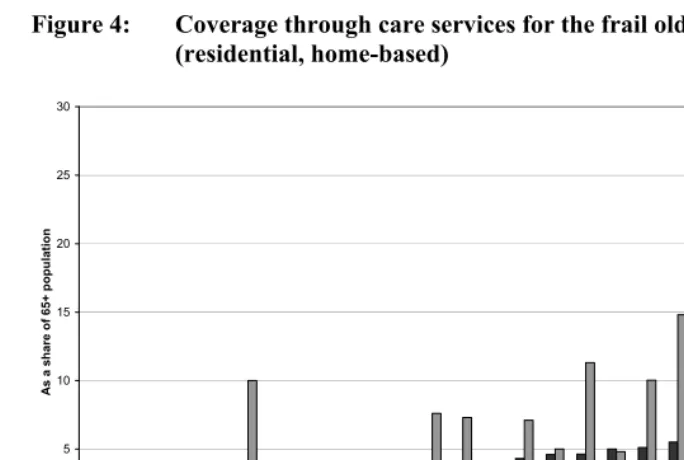
Since families are the main providers of care, not only for children but also for the frail old, the generosity and design of long-term care policies are crucial in defining the responsibilities of families, and, particularly given the prevalent gender division of labour, of women within them. What is decisive from this perspective is the availability and affordability of publicly supported long-term care services; that is, the degree of decommodified defamilialisation of care. Research has shown, in fact, that while the number of family members who provide care does not differ substantially across countries, care intensity does. Intensity is lower in service-rich than in service-poor countries (Daatland and Herlofson 2004; Haberkern and Szydlik 2008). Public services thus relieve (especially poorer) family carers, who are mainly women, of some of the care work.
Figure 4: Coverage through care services for the frail old (residential, home-based) 0 5 10 15 20 25 30 Rom ania Bulga ria Lithu ania Greec e Polan d Esto nia Slova kia Italy
Latvi a Hung ary Spain Czec h Re
public Portu gal Slov enia Germ any Irela nd Malt a Lux emb
urg UK Aus tria Franc e Belgiu m Finla nd Swe den Nether lands Denm ark Norwa y As a s hare
of 65+ p
opu
la
ti
on
Residential care Home based care
Source: Multilinks Database; Saraceno and Keck 2010.
familialism with weakly decommodified defamilialisation. In Austria, Belgium, Finland, Germany, Lithuania, Italy, Poland, Portugal, Slovenia, and the United Kingdom, the care allowance is paid to care recipients, who can use it as they (or their family) wish. In this case, supported familialism is one of the possible outcomes, in which a family member provides care, either in exchange for some financial compensation or for free. The allowance may, however, be used to buy care services on the informal (often migrant) market, thus achieving a degree of commodified defamilialisation. According to observers, this is what happens, for example, in Italy, where the allowance is often used to pay a so-called badante (e.g. Bettio et al. 2006, Naldini and Saraceno 2008). Germany allows beneficiaries to choose between publicly financed services and cash payments. Here, supported familialism and defamilialisation seem to be balanced. However, data on the uptake of cash allowances or services suggest that supported familialism (with or without commodified defamilialisation) is dominant in Germany (Statistisches Bundesamt 2009).
Table 1: Cash-for-care payments
Cash-for-care payments Countries
No Greece
Yes, unbound Austria, Belgium, Bulgaria, Estonia, Finland, Germany, Lithuania, Italy, Poland, Portugal, Slovenia, United Kingdom, Spain
Yes, formally bound, predominantly for professional service usage
Cyprus, Czech Republic, France, Hungary, Ireland, Latvia, Luxembourg, Malta, Netherlands, Norway, Romania, Slovakia, Spain
Yes, formally bound, but only to pay family carers
Bulgaria, Cyprus, Czech Republic, Denmark, Estonia, Hungary, Ireland, Slovakia,
Malta; Sweden
Note: National informants report that, in Spain, such allowances should in principle be used to pay for services, but since the supply of services is still meagre, a degree of discretion is tolerated. The same seems to apply in Portugal. Latvia and Estonia do not have a national law. Care benefits depend on regulations at the municipal level. In Cyprus, the Czech Republic, Ireland and Slovakia, both payments for services and payments to family carers are available. These countries are shown in two rows in the table and are marked with italics. In Denmark and Sweden, municipalities may formally employ a family carer of working age if (s)he is willing to care for a dependent family member, particularly if services are not available. This is rarely the case in practice because of the substantial provision of professional services (see Figure 3 above).
Source: European Union 2010; Multilinks Database.
Only in Greece, which is also one of the countries with the lowest level of service coverage in this field, are there no care allowances. This country, therefore, represents the extreme case of familialism by default in this field, since it relies heavily on the availability of family, and particularly women’s, solidarity.
(Rauch 2007, Saraceno 2010). In order to account for all of these very important dimensions, however, in-depth studies on a smaller number of countries are necessary.
The traditional instrument of supported familialism in the case of childcare, leave for the carers, is also provided in most European countries for caring for a dependent person, but it is far less generous in terms of length and compensation. Unfortunately, in the available international sources (e.g. Council of Europe 2011) information is missing for several countries, and we have not yet been able to collect it through national informants. Available information in any case shows that there is a great heterogeneity both in entitlements and in the types of leave available. In Belgium, Italy, and the Netherlands, both short paid leaves and longer, partly paid leaves of several months are available. Germany, Austria, and Portugal also offer both leave options, but these are in general unpaid.9 In Sweden, two months of paid leave is available if a family member is seriously ill, but no short-term leave is available. Other countries, such as Bulgaria, the Czech Republic, Poland, Slovakia, and Slovenia, only offer short-term paid leave (5-36 days per year). In the United Kingdom, there is no statutory leave, but the family directive stipulates that employers must allow employees to take unpaid leave in cases of family emergency. Some countries, like Cyprus or Latvia, do not offer a statutory care leave at all. In general, in all countries where such an option exists, little or no compensation is provided for taking a long leave. This reduces the uptake of leave, particularly among low income households, or when the potential carer is also the main or only breadwinner. Furthermore, analogously to what happens for parental leave, unpaid or low paid leave entitlements discourage men from taking leave.
4.4 How gendered are the measures of financial support for families?
Child allowances, which are intended to lower the cost of supporting children, are in principle gender-neutral if they are universal and not income-tested on a household basis. On the other hand, they may encourage the gender division of responsibilities with regard to earning and caring when they are income-tested by household, particularly when potential or actual earnings are very asymmetrical within the couple, or when the second income is too low to offset the value of benefits. A strict household income test for child allowances is applied in Poland and Spain. Other countries – Belgium, Bulgaria, Cyprus, the Czech Republic, Poland, Portugal, and Slovenia – gradually reduce the child allowance as the parents’ income increases, but a considerable amount is also paid to parents with average incomes. In Italy, there is a dual household income test: at least 70% of total household income must be earned in
9 In Portugal, payment is provided for employees in the public sector. In Austria, financial compensation is
waged work (the self-employed are excluded), and both the entitlement to and the amount of the allowance are defined in relation to household income and size.
Tax systems deal with unequal combinations of earnings between partners differently. Three approaches can be identified. The first is individualised taxation without any consideration of partners’ earnings. This is the approach found in Cyprus, Finland, Greece, Hungary, Latvia, Lithuania, Norway, Slovenia, Sweden, and the United Kingdom. In these cases, the tax debt is calculated independent of marital status or a spouse’s income. Whether there is an income differential between partners does not matter for the overall tax debt. There is no support for a (male) breadwinner/(female) family-carer model. The second is individual taxation with tax allowances or tax credits for the main earner when the spouse has no or a very low income. This is the case in Austria, Denmark, Estonia, Ireland, Italy, Luxembourg, Slovakia, Spain, and the Netherlands. Indirect public financial support for a gender imbalance in earnings (and thus indirect support for a gender division of responsibilities) is only provided up to a certain income threshold for the partner with lower earnings. In this case, an increase in the income of the low or non-earning partner would be counterbalanced by a loss of tax benefits for the higher-earning partner, thus devaluing the earnings of the lower income partner. The third approach is joint taxation, either of the couple or the household. This has been adopted by Belgium, the Czech Republic, France, Germany, Ireland, Luxembourg, Malta, Poland, and Portugal. A couple-based joint taxation equalises the tax burden between the earners in the family. A household-based taxation (as in the French family quotient) divides the overall household income between all of the household members on the basis of a coefficient. In progressive tax systems, both forms of joint taxation may create substantial savings in the total amount of taxes owed, as well as in the amount of taxes owed individually by the higher earner if one of the partners earns considerably less than the other (and also, in the household-based system, if the household is large). However, an income increase on the part of the partner with lower or no earnings disproportionally increases the total amount of taxes due, which again devalues any additional earnings by the lower earning partner, who is usually the woman.
4.5 Acknowledging the gender division of labour and care work in the pension system
their contributions, either because the principle of equivalence is strengthened within the public pension schemes or because a larger part of the overall pension will be based on second-tier occupational and private pension plans, for which claims are predominantly based on contributions (Holzmann, MacKellar, and Rutkowski 2003). According to some authors, this will further reinforce the already existing gender inequalities in the pension system, since women have more interruptions in their work histories and flatter careers, given their family obligations, and will therefore be less able to build up contributions (Ginn and Arber 1999; Ginn, Street, and Arber 2001). These developments may be cushioned to some extent by various policy measures, including basic universal old-age pensions independent of work and contributory history, income-tested social assistance pensions for those who are not entitled to a contributions-based pension, non-contributory equivalents for caring periods, and survivor pension benefits.
These measures follow different rationales in general, and specifically with regard to gender arrangements. Basic universal pensions are both a means of decommodification and of defamilialisation of financial needs in old age, the degree of which depends, of course, on generosity. Minimum social assistance pensions are also a means of both decommodification and defamilialisation, but only for the poor. Non-contributory equivalents in the public pension scheme may acknowledge the periods spent caring for children or for an adult while the carer was of working age (Anderson and Meyer 2006), thus decommodifying (i.e., delinking from the work history) a portion of the contributions. By increasing the pension wealth of family carers, these contributory equivalents also strengthen the financial autonomy of family carers in old age, thus contributing to their financial defamilialisation. These contributory equivalents may be additive, and serve to top-up employment-linked pension contributions; or they may be substitutive, and reward non-employment (Frericks, Maier, and De Graaf 2007). There is wide cross-country variation not only in the presence of such contributory equivalents, but also in the amount credited for the same activity (e.g., having had a child).
direct pension beneficiary, in the name of individual entitlement and of women’s financial autonomy. Nonetheless, women continue to shoulder most of the unpaid family work, and on average suffer a caring penalty in their individual pension wealth. In addition to the survivor pension, most countries also regulate how pension rights should be divided between the couple in case of divorce. Usually the non-earning or lower earning partner is entitled to a portion of the present or future pension, based on the duration of the marriage/legal partnership. The underlying logic for this entitlement is the same as that for the survivor pension: marriage/legal partnership builds up expectations and responsibilities, and in many cases is based on a gendered division of labour, which asymmetrically affects the financial resources of partners and their economic vulnerability to the end of marriage/legal partnership.10
The synthesis in Table 2 provides a rough picture of how past family care giving is acknowledged in old age, using the two indicators of survivor pensions and non-contributory equivalents for periods of time spent care giving in the pension system. For the latter, given the presence of a high degree of variation in generosity, entitlement rules, and so on, we restrict our analysis to the availability of such non-contributory pension claims for care giving. We are aware that more sophisticated measures are needed.
Table 2: Survivor pensions and acknowledgement of care giving periods in pension schemes
Acknowledgement of care in pension claims Modes of survivor benefits Pension benefits for childcare and
elderly care
Pension benefits for
childcare only No acknowledgement
Income-related 60% and more Austria, Belgium, Luxembourg, Poland, Slovakia
Cyprus, Hungary, Italy, Portugal
Income-related less than 60% Czech Republic, Germany, Norway Estonia, France, Greece, Latvia, Spain
Malta
Flat-rate payment Ireland, Lithuania, United Kingdom (Netherlands)
No permanent payment Sweden Denmark
Notes: 1) Data for Bulgaria, Finland, Romania, and Slovenia are missing. 2) In Cyprus and Hungary, survivor pensions are only granted to widows.
3) In several countries, the survivor’s own income is taken into account. In these cases, the table presents the highest rate available.
Source: Multilinks Data Base.
10 It should be noted that legal unions that differ from marriage do not in all countries entitle the partner to a
In most European countries, there are both survivor benefits and the acknowledgement of care giving periods, at least with regard to childcare. Austria, Belgium, Luxembourg, Poland, and Slovakia are the most generous in this respect. In these countries, the need for income security in old age through individual pension contributions is reduced in couples with a main breadwinner, provided the couple has lasted “until death did them apart.” Most of the Southern, Eastern, and Central European countries, as well as Norway, offer a similar package. However, Greece falls behind due to its low survivor pension level (only 35% of the original pension, down from a starting 50%, three years after the death of the spouse). Malta does not account at all for child or adult care giving periods. Lithuania, the United Kingdom, and Ireland provide only a flat-rate payment to the surviving partner; but all three do acknowledge time spent providing care for both children and adults. Denmark and Sweden follow an individualistic approach. In both these countries, there are no permanent survivor benefits, and only Sweden acknowledges childcare as creating an entitlement to additional benefits. In these countries, old-age security for both men and women is heavily based on individually paid work-related entitlements on top of a relatively low universal basic pension. In the Netherlands, married and unmarried (including same-sex) partners share a couple-based basic pension. Survivor pensions and recognition of care giving periods may be part of the second-tier occupational pensions.
Mention should also be made of the lower retirement age for women, which was the norm in most countries until a few years ago, and now remains in only a few countries. This highly gender-specific measure has been defended from at least two different perspectives: as a form of acknowledgement of the dual burden experienced by working women, and as a means of “freeing” women so they can take care of their, usually older, husbands and frail parents and parents-in-law (Franco 2002). Whatever the reasons for this age difference, the effect has been to further reduce the pension wealth of women. This trade-off may appear fair as long as women also have access to the pension of a spouse. But for women who do not, having to retire early may result in greater economic vulnerability in old age.
5. Discussion and conclusion
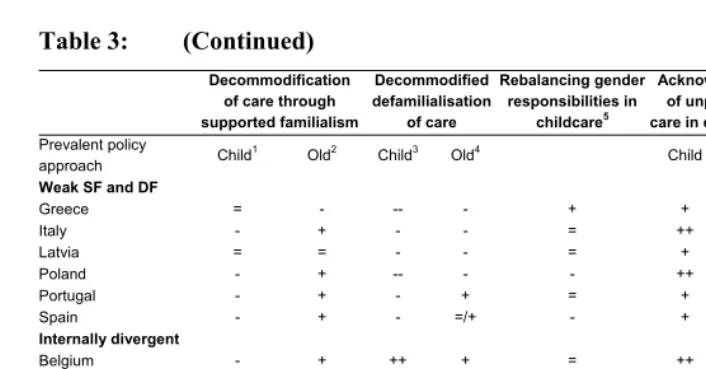
differ in one or more policy, and some countries lie on the boundaries of two different approaches. Furthermore, a substantial number of countries appear to be so internally heterogeneous that allocating them to one or the other approach would be highly misleading. Thus, in seeking to understand the country-specific resources and constraints for achieving both gender equity and the acknowledgement of care needs and care work, it is more useful to look specifically at each country along the various dimensions. In Table 3, we have summarised the main policy dimensions we have considered here, grouping the countries which appear to be more similar, but without deleting their differences.11
The first policy approach which emerges with a fair degree of clarity is a mix between supported familialism and decommodified defamilialisation in the case of childcare, and decommodified defamilialisation in the case of care for the elderly. This approach is present in Denmark, Norway, and Sweden. It clearly supports a dual breadwinner model, as well as the principle of individual financial autonomy for both sexes. Explicit support for a rebalancing of the gender responsibilities in care giving is also present in this approach, except in Denmark. In these countries, however, there is little acknowledgement of unpaid family work through contributions towards a pension, survivor pensions, leave for elderly care, or cash-for-care allowances.
Table 3: Country-specific policy approaches at the cross road of familialism/ defamilialisation and commodification/decommodification
Decommodification of care through supported familialism
Decommodified defamilialisation
of care
Rebalancing gender responsibilities in
childcare5
Acknowledgement of unpaid family care in contributions
Fiscal support for male breadwinner
household 6
Prevalent policy
approach Child
1 Old2 Child3 Old4 Child Old
Strong DF+ weak SF
Denmark + - ++ ++ = - - +
Norway + = + ++ + + - -
Sweden + - ++ + + + - -
Strong SF+ weak DF
Austria = + -- + - ++ ++ +
Czech Republic ++ + -- + - + + ++
Germany = + - + + + + ++
Estonia + + = + = + - +
Hungary ++ + -- - = + - -
Lithuania ++ + - - = + + -
Luxembourg = = - = ++ ++ ++ ++
Slovakia - + - - - ++ ++ +
11 Because of data gaps, we are not able to assess all EU countries. Bulgaria, Cyprus, Malta, and Romania are
Table 3: (Continued)
Decommodification of care through supported familialism Decommodified defamilialisation of care Rebalancing gender responsibilities in childcare5 Acknowledgement of unpaid family care in contributions
Fiscal support for male breadwinner
household 6
Prevalent policy
approach Child
1 Old2 Child3 Old4 Child Old
Weak SF and DF
Greece = - -- - + + - -
Italy - + - - = ++ - +
Latvia = = - - = + - -
Poland - + -- - - ++ ++ ++
Portugal - + - + = + - ++
Spain - + - =/+ - + - +
Internally divergent
Belgium - + ++ + = ++ ++ ++
Finland + + = + = m m -
France + = ++ + - + - ++
Ireland -- + - = = + + ++
Netherlands - = - ++ + - - +
Slovenia + + = - = m m -
United -Kingdom - + = + = + + +
Notes: DF= Defamilialisation; SF= Supported Familialism
1 The value ++ is assigned when the effective leave is 72 weeks or over, + when it is between 52 and 71 weeks, = when it is between 26 and 51 weeks, - when it is between 15 and 25 weeks, and -- when it is below 15 weeks.
2 The value + is assigned when there is a care giving allowance that can be used freely or is specifically aimed at compensating a family member, - when no care allowance is available, and = when a care allowance is mainly provided to pay for professional services, but may also be used to contract (employ) family members who provide care.
3 The value ++ is assigned when coverage is 61% and over, + when it is between 40% and 60%, = when it is between 30% and 39%, - when it is between 15% and 29%, and -- when it is below 15%.
4 The value ++ is assigned when coverage through services (directly or through allowances targeted to buy services) is 20% or above, + when coverage reaches 10% but is below 20, and – when coverage is below 10%.
5 The value ++ is assigned when the reserved quota for fathers reaches six months and is paid at 60% or over of lost wages, and + when the well paid quota reaches two months, but is below six months. The value = is assigned when the leave is well paid, but there is no reserved quota (or the quota is very short, as in the case of Finland); or when the reserved quota is substantial, but the parental leave is compensated at a low rate. The value – is assigned when there is neither a reserved quota nor good compensation for the parental leave.
6 the value ++ is assigned in case of income splitting, + when there are tax deductions for the financially dependent spouse, and - when there is individual taxation without recognition of the spouses’ income situation.
expires, which makes it difficult in practice for mothers to return to work. Incentives for fathers to share a portion of parental leave are usually lacking or weak, with the exception of Luxembourg and post-2007 Germany. Defamilialisation of care for the frail old is also reduced, and preference is given to supported familialism through cash-for-care payments and care leave entitlements. The negative trade-off in old age for women between earning and care giving is, however, partly compensated by survivor pensions and by non-contributory equivalents for periods spent caring for both children and the frail old.
The third approach is taken by countries that give a large amount of room to familialism by default, since decommodification, through either supported familialism or defamilialisation, is weak. This approach does not actively support women’s financial autonomy, while offering limited protection from the financial costs of the gender division of labour. Greece, Latvia, Italy, and Poland—albeit in varying combinations—display this pattern most clearly. Poland has one of the shortest effective leaves, but also one of the lowest levels of childcare and elderly care coverage through services. It also offers no incentives for a gender rebalancing of childcare. Greece and Latvia provide a medium-range effective leave, and Greece also offers comparatively strong incentives for fathers, but few other measures that support care needs, either in the form of supported familialism or of decommodified defamilialisation. These two countries offer a weak level of support for caring for children through contributory equivalents, but the survivor’s pension is low. Italy has a less generous parental leave and weaker incentives for fathers, while having a low rate of decommodified defamilialisation for both children and the old. While in Poland the taxation and child benefit systems consistently disadvantage women’s earnings at the lower end of the income scale, in Italy and Spain there is a contradiction between individualisation at the level of taxation and the household income test for child benefits. Portugal, notwithstanding its comparatively high women’s employment rate, has a short effective leave, coupled with a low provision of childcare services and a fiscal system that supports asymmetrical couples. Within this group of countries, Spain and Portugal are the most dynamic, since in recent years they have attempted to raise the degree of defamilisation in the case of the frail elderly through payments for purchasing care services.
these countries in its elderly care policies. France also recognises care giving periods in the pension scheme (only for children, as in Sweden), but only as an alternative to work-related contributions, which is, indirectly, a way of defining caring as an alternative to being in paid work. Furthermore, the French fiscal system strongly supports asymmetrical couples. In the Netherlands, financial support and public long-term care provision for the frail old take the first approach, while childcare measures (parental leaves and care services for children under age three) are more closely linked to the second approach. Belgium is a special case. With regard to taxation, acknowledgement of care giving in pension schemes, survivor pensions, and elderly care, it is close to the second approach. In the case of childcare, however, Belgium appears to be even more defamilialised than the Scandinavian countries. Childcare coverage is comparatively high, while paid parental leave is short. Finland, Ireland, Slovenia, and the United Kingdom occupy an intermediate position on all or most policy measures.
The ambivalence and apparent contradictions found in many countries are not surprising, and not only because of the specific histories of the different policies and the relevant actors behind them. Norms and behaviours concerning the gender division of labour have started changing only fairly recently in many countries, affecting social policy frameworks that were more or less ready to integrate the demands emerging from these changes, particularly in times of budget constraints. As Bonoli (2007) observed, not only the institutional frameworks and their interest groups, but also the timing of change matters.
References
Aisenbrey, S., Evertsson, M., and Grunow, D. (2009). Is there a career penalty for mother's time out? A comparison of Germany, Sweden and the United States. Social Forces 88(2): 573-606. doi:10.1353/sof.0.0252.
Aliaga, C. (2006). How is the time of women and men distributed in Europe? Statistics in Focus 4: 1-11.
Anderson, K.M., and Meyer, T. (2006). New social risks and pension reforms in Germany and Sweden. The politics of pension rights for childcare. In: Armingeon, K. and Bonoli, G. (eds.). The Politics of Post-Industrial Welfare States. London: Routledge: 171-191.
Arber, S. and Ginn, J. (1995). Gender differences in the relationship between paid employment and informal care. Work Employment and Society 9(3): 445-471.
doi:10.1177/095001709593002.
Bäckman, O. and Ferrarini, T. (2010). Combating child poverty? A multilevel assessment of family policy institutions and child poverty in 21 old and new welfare states. Journal of Social Policy 39(2): 275-296. doi:10.1017/ S0047279409990456.
Bettio, F., Simonazzi, A., and Villa, P. (2006). Change in care regimes and female migration: The “Care Drain” in the mediterranean. Journal of European Social Policy 16(3): 271-285. doi:10.1177/0958928706065598.
Bielenksi, H., Bosch, G., and Wagner, A. (2002). Working time preferences in sixteen European countries. Dublin, Ireland: European Foundation for the Improvement of Living and Working Conditions.
Bird, K. (2003). Reconciling work and the family. The impact of parental leave policies and occupation on the female life course. Frankfurt a.M.: Peter Lang.
Blome, A., Keck, W., and Alber, J. (2009). Family and the welfare state. Cheltenham: Edward Elgar.
Bonoli, G. (2007). Time matters. Post industrialization, new social risks and welfare state adaptation in advanced industrial democracies. Comparative Political Studies 40(5): 495-520. doi:10.1177/0010414005285755.
Council of Europe (2011). Council of Europe Family Policy Database. Current leave arrangements/time off for people caring for elderly/disabled or other adult dependent persons. http://www.coe.int/t/dg3/familypolicy/Source/3_3_5%20 Leave%20to%20care%20for%20adult%20depandants.pdf (access date: April 26, 2011).
Crompton, R. and Lyonette, C. (2007). Occupational class, country and the domestic division of labour. In: Crompton, R., Lewis, S., and Lyonette, C. (eds.). Women, men, work and family in Europe. Houndmills: Palgrave Macmillan: 116-132. Daatland, S.O. and Herlofson, K. (2004). Families, welfare states, and ageing. Family
solidarity in a European perspective. Oslo: Norsk institutt for forskning om oppvekst, velferd og aldring (NOVA-rapport 7-2004).
Den Dulk, L. (1999). Employers and parental leave: A comparative analysis. In: Moss, P. and Deven, F. (eds.). Parental leave. Progress or pitfall? The Hague, Brussels: NIDI/CBGS Publications: 227-247.
Den Dulk, L. (2001). Work-family arrangements in organisations: A cross-national study in the Netherlands, Italy, the United Kingdom and Sweden. Amsterdam: Rozenberg Publishers.
Dingeldey, I. (2001). European tax systems and their impact on family employment patterns. Journal of Social Policy 30(4): 653-672. doi:10.1017/ S0047279401006420.
Esping-Andersen, G. (1990). The three worlds of welfare capitalism. Princeton: Princeton University Press.
Esping-Andersen, G. (1999). Social foundation of postindustrial economies. Oxford: Oxford University Press. doi:10.1093/0198742002.001.0001.
Esping-Andersen, G. (2009). Incomplete revolution: Adapting welfare states to women's new roles. Cambridge: Polity Press.
EU-SILC (2006). European Union Statistics on Income and Living Conditions: Survey 2006. Luxembourg, Statistical Office of the European Union (eurostat).
European Commission (2004). Development of a methodology for the collection of harmonised statistics on childcare. Luxembourg: Office for Official Publications of the European Communities.
European Union (2010). Social protection systems in Member States – MISSOC [electronic source]. Brusses: European Union. http://www.nondiscrimination-eu.info/MISSOC2010/home.jsp.
Franco, D. (2002). Italy: A never-ending pension reform. In: Feldstein, M. and Siebert, H. (eds.). Social security pension reform in Europe. Chicago/London: The University of Chicago Press: 211-262.
Frericks, P., Maier, R., and De Graaf, W. (2007). Male norms and female rectifications: The influence of care credits on gender pension gaps in France and Germany. In: Frericks, P. (ed.). Setting rights. Resource flows, life-course norms and the dynamics of citizenship in European pension systems. Utrecht: University of Utrecht: 101-135.
Gershuny, J. and Sullivan, O. (2003). Time use, gender, and public policy regimes. Social Politics 10(2): 205-228. doi:10.1093/sp/jxg012.
Gerson, K. (2009). The Unfinished Revolution. Oxford: Oxford University Press. Ginn, J. and Arber, S. (1999). Changing patterns of pension inequality: From public to
private sources. Ageing & Society 19(3): 319-342. doi:10.1017/S0144686X99 007333.
Ginn, J., Street, D., and Arber, S. (eds.) (2001). Women, work and pensions. Buckingham, Philadelphia: Open University Press.
Gornick, J.C. and Meyers, M.K. (2009). Institutions that support gender equality in parenthood and employment. In: Gornick, J.C. and Meyers, M.K. (eds.). Gender equality. London: Verso: 3-66.
Haberkern, K. and Szydlik, M. (2008). Pflege der Eltern - Ein europäischer Vergleich. Kölner Zeitschrift für Soziologie und Sozialpsychologie 60(1): 78-101.
doi:10.1007/s11577-008-0004-y.
Hobson, B. (1994). Solo mothers, policy regimes and the logics of gender. In: Sainsbury, D. (ed.). Gendering welfare state. London: Sage: 170-187.
Hochschild, A. (1989). The second shift: Working parents and the revolution at home. London: Piatkus.
Holzmann, R., MacKellar, L., and Rutkowski, M. (2003). Accelerating the European pension reform agenda: Need, progress, and conceptual Underpinnings. In: Holzmann, R., Orenstein, M., and Rutkowski, M. (eds.). Pension reform in Europe: Process and progress. Washington: The World Bank: 1-46.
Johansson, L., Sundström, G., and Hassing, L.B. (2003). State provision down, offspring's up: The reversed substitution of old-age care in Sweden. Ageing & Society 23(2): 269-280. doi:10.1017/S0144686X02001071.
Keck, W., Hessel, P., and Saraceno, C. (2009). Multilinks Database on Intergenerational Policy Indicators Methodological Report. Berlin: Social Science Research Center (WZB).
Knijn, T. and Kremer, M. (1997). Gender and the caring dimension of welfare states: Toward inclusive citizenship. Social Politics 4(3): 328-361.
Knijn, T. and Ostner, I. (2008). The meaning of children in Dutch and German family policy. In: Leira, A. and Saraceno, C. (eds). Childhood: Changing contexts. Bingley: Emerald: 81-114.
Kramer, B.J. and Kipnis, S. (1995). Eldercare and work-role conflict: Toward an understanding of gender differences in caregiver burden. The Gerontologist 35(3): 340-348. doi:10.1093/geront/35.3.340.
Lalive, R. and Zweimüller, J. (2005). Does parental leave affect fertility and return-to-work? Evidence from a “true natural experiment”. Bonn: Institut für die Zukunft der Arbeit (IZA Discussion Paper No. 1613).
Lamura, G., Döhner, H., and Kofahl, C. (2008). Family carers of older people in Europe. Münster: LIT-Verlag.
Leira, A. (2006). Parenthood change and policy reforms in Scandinavia. 1970s-2000s. In: Ellingsaeter, A. and Leira, A. (eds.). Politicising parenthood in Scandinavia. Gender relations in welfare states. Bristol: Policy Press: 27-52.
Leitner, S. (2003). Varieties of familialism. The caring function of the family in comparative perspective. European Societies 5(4): 353-375. doi:10.1080/146166 9032000127642.
Lewis, J. (2009). Work-family balance, gender and policy. Cheltenham: Edward Elgar. Lewis, J., Campbell, M., and Huerta, C. (2008). Patterns of paid and unpaid work in
Western Europe: Gender, commodification, preferences and the implications for policy. Journal of European Social Policy 18(1): 21-37. doi:10.1177/0958928 707084450.
Multilinks Data Base (2011) http://multilinks-database.wzb.eu/ (last accessed April 16, 2011).
Naldini, M. and Saraceno, C. (2008). Social and family policies in Italy: Not totally frozen but far from structural reforms. Social Policy & Administration 42(7): 733-748. doi:10.1111/j.1467-9515.2008.00635.x.
O'Brien, M. (2009). Fathers, parental leave policies, and infant quality of life: International perspectives and policy impact. The Annals of American Academy of Political and Social Sciences 624(1): 190-213. doi:10.1177/00027162 09334349.
O'Connor, J., Orloff, A.S., and Shaver, S. (1999). States, markets, and families: Gender, liberalism, and social policy in Australia, Canada, Great Britain, and the United
States. Cambridge: Cambridge University Press. doi:10.1017/CBO97805
11597114.
OECD (2005). Long-term care for older people. Paris: Organisation for Economic Co-operation and Development.
Orloff, A.S. (1993). Gender and the social rights of citizenship: The comparative analysis of gender relations and welfare state. American Sociological Review 58(3): 303-328. doi:10.2307/2095903.
Orloff, A.S. (2009a). Gendering the comparative analysis of welfare states: An unfinished agenda. Sociological Theory 27(3): 317-343. doi:10.1111/j.1467-9558.2009.01350.x.
Orloff, A.S. (2009b). Should feminists aim for gender symmetry? Why a dual-earner/dual-caregiver society is not every feminist's utopia. In: Gornick, J.C., and Meyer, M.K. (eds.). Gender equality. Transforming family divisions of labor. New York: Verso: 129-160.
Pacolet, J., Bouten, R., Lanoye, H., and Versieck, K. (2000). Social protection for dependency in old age. Aldershot: Ashgate.
Plantenga, J., and Remery, C. (2005). Reconciliation of work and private life: A comparative review of thirty European countries. Luxembourg: Office for Official Publications of the European Communities (EGGSIE Report).
Ray, R., Gornick, J.C., and Schmitt, J. (2010). Who cares? Assessing generosity and gender equality in parental leave policy designs in 21 countries. Journal of European Social Policy 20(3): 196-216. doi:10.1177/0958928710364434.
Sainsbury, D. (1996). Gender, equality and welfare states. Cambridge: Cambridge University Press. doi:10.1017/CBO9780511520921.
Saraceno, C. (1997). Family change, family policies and the restructuring of welfare. In: OECD (ed.). Family, market and community. Social Policy Studies No. 21. Paris: Organisation for Economic Co-operation and Development: 81-100. Saraceno, C. (2000). Gendered policies: Family obligations and social policies in
Europe. In: Boje, T.P. and Leira, A. (eds.). Gender, welfare state and the market. London: Routledge: 135-156.
Saraceno, C. (2010). Social inequalities in facing old-age dependency: A bi-generational perspective. Journal of European Social Policy 20(1): 32-44.
doi:10.1177/0958928709352540.
Saraceno, C. and Keck, W. (2010). Can we identify intergenerational policy regimes in Europe? European Societies 12(5): 675-696. (first published on June 25, 2010).
doi:10.1080/14616696.2010.483006.
Sarkisian, N. and Gerstel, N. (2004). Explaining the gender gap in help to parents: The importance of employment. Journal of Marriage and Family 66(2): 431-451.
doi:10.1111/j.1741-3737.2004.00030.x.
Scruggs, L. and Allan, J. (2008). Welfare-state decommodification in 18 OECD countries: A replication and revision. Journal of European Social Policy 16(1): 55-72. doi:10.1177/0958928706059833.
Skevik, A. (2005). Women’s citizenship in the time of activation. The case of lone mothers in “need-based” welfare states. Social Politics 12(1): 42-66.
Statistisches Bundesamt (2009). Pflegestatistik 2007. Pflege im Rahmen der Pflegeversicherung. 2. Bericht: Ländervergleich - Pflegebedürftige. Wiesbaden: Statistisches Bundesamt.
Theobald, H. (2008). Care policies, care labor market and inequality: Sweden, Germany and Italy in comparison. Berliner Journal für Soziologie 18(2): 257-281.
doi:10.1007/s11609-008-0018-3.
Ungerson, C. (2004). Whose empowerment and independence? A cross-national perspective on cash-for-care programmes in four European countries. Ageing and Society 24(2): 189-212. doi:10.1017/S0144686X03001508
Ungerson, C. and Yeandly, S. (2007). Cash for care systems in developed welfare states. Basingstoke: Palgrave Macmillan.
UNICEF (2008). The child care transition. Florence: UNICEF Innocenti Research Centre.
Van der Lippe, T., de Ruijter, J., de Ruijter, E., and Raub, W. (2010). Persistent inequalities in time use between men and women: A detailed look at the influence of economic circumstances, policies and culture. European Sociological Review 27(2): 164-179. (Advance Access published January 19th 2010). doi:10.1093/esr/jcp066.
Appendix
Table A1: Leave regulations and childcare coverage for children aged 0-2
Duration of maternity leave Level of compensation Duration of parental leave Duration of payment Level of payment Effective parental leave Coverage rate for children aged 0-2 Unit Weeks % of average income Months Months % of average income Weeks weighted by income-replacement level Share of children aged 0-2
Austria 16 100 22 22 32.5 40.0 14.0
Belgium 15 77 6 6 34 20.4 96.7
Bulgaria 19 90 27 13.5 65 59.8 10.9
Cyprus 18 75 3.3 0 0 12.0 27.6
Czech Republic 28 84 30.5 30.5 46 95.5 12.5
Denmark 18 90 8 8 100 52.8 87.4
Estonia 20 100 32.4 32.4 33.4 72.7 34.3
Finland 17.5 81 32 32 30 55.9 32.8
France 16 100 33.25 33.25 29 57.9 67.1
Germany 14 100 34.2 14 66 49.4 15.9
Greece 18 90 13 6 100 45.7 10.9
Hungary 24 70 31 31.4 52 87.8 9.4
Ireland 26 50 11 0 0 9.1 23.4
Italy 20 80 11 11 30 30.3 17.5
Latvia 16 140 18 18 46.85 41.7 25.0
Lithuania 18 100 34 22 29.35 85.6 28.1
Luxembourg 16 100 12 12 68 38.7 21.8
Malta 14 19 6 0 0 2.7 :
Netherlands 16 100 12 12 0 16.0 22.6
Norway 9 100 34.5 10.5 80 63.1 57.7
Poland 18 100 36 0 0 18.0 3.1
Portugal 16 100 6 6 25 17.0 29.6
Romania 18 119 21.9 21.9 30 50.0 : Slovakia 28 55 30.9 30.9 17 38.2 27.6
Slovenia 15 100 8.5 8.5 100 52.0 42.1
Spain 16 100 34.5 0 0 16.0 25.9
Sweden 8.6 78 16 12 69 53.5 77.7
United Kingdom 39 90 6 0 0 23.4 40.6