LEARNING AND TALENT DEVELOPMENT: A REVIEW IN
CONTEXT
Dr Eno A Maycock
Senior Lecturer, Department of Organisation, Relationship and Behaviour, Faculty of Business,
Environment and Society, Coventry University, Coventry, UK
Olakunle Akinwale Ikuomola
Research Candidate, Coventry University, Coventry,
UK
Introduction
Most organisations‘ executives agreed that learning and talent development (L&TD) is a concept that has become paramount to organisational success (Kim and McLean 2012; Cook and Macaulay 2009). However, there are drawbacks in its implementation. One of the reasons is lack of clarity on what organisations define as talent, its scope and the overall goals of L&TD.
This paper is important because talent makes a vital contribution to overall organisational performance (Collings and Mellahi 2009). However, this ‗talent‘ is scarce (Kim and McLean 2012). This is exemplified in a study of 40 global companies which revealed lack of talent in organisations to take up the strategic leadership positions. Consequently, this has inhibited the business growth (Collings and Mellahi 2009). Therefore, organisations have to devise strategies to attract and enhance talent. Moreover, as a result of increasing organisational competitiveness, restructuring and globalisation, there has been a continuous need to align L&TD activities to strategic business objectives (Garavan et al. 2012). Also, many organisations are changing their HRM practices to adjust to the post- recession world that has caused complexity in the market place (Dries et al. 2012). In response to this, organisations need strategies to thrive and to survive. One of such is selection, development and deployment of workforce that is willing to engage in continuous learning (Dries et al. 2012). However, it remains unclear whether organisations should focus more on selection or development of talent (Briscoe and Hall 1999).
The investment in L&TD has been justified as a source of competitive advantage (Garavan et al. 2012). Lepak and Snell (1999) established the relative advantage of organisations developing it workforce internally. However, Garavan et al. (2012) concluded that external talent acquisition strategy has proven to be unsuccessful in the long run with many organisations. Consequently, organisations have to invest in employee development to pursue the strategic objectives of the organisation. In doing this, individual needs, learning styles and current work strategies need to be considered.
This paper draws insights from research literature in examining the trends, issues and factors influencing learning and talent development. The alignment of L&TD to organisational strategic approach and the benefits of L&TD are also considered. This paper makes a business case for organisations to implement L&TD strategy. Drawing on relevant organisational examples, it critically examines the range of L&TD
ABSTRACT:
Despite the increasing need for Learning and Talent Development (L&TD) in organisations, there is growing confusion about its meaning in theory and practice. This article explores and provides insights into the variations on the inconsistencies of the concept, definitions and approach to L&TD. Drawing insights from a number of discreet literatures, this review proposed an integrative approach to L&TD. The study analysed why talent development is crucial for organisational success whether in boom or bust. The constraints faced by organisations in implementing L&TD strategy were discussed. Drawing on practical examples, the paper examines the L&TD interventions available to organisations and factors influencing them. This study will aid L&TD practitioners in engaging with some issues faced regarding the management and development of talent in the workplace. Finally, future areas for research were highlighted and proposals were made for effective L&TD.methods available to organisations and factors influencing them. Finally, recommendations were made for successful L&TD practices.
The definition and approach to Learning & Training and Development (L &TD)
A generally accepted definition and scope of learning and talent development is lacking. Some researchers treat the subject as synonymous to HRM and the questions of what talent means and how organisations should manage talent are still subject of debate (Collings and Mellahi 2009). According to the definition provided by Garavan et al. (2012:6), talent development ‗‗focuses on the planning, selection and implementation of development strategies for the entire talent pool to ensure that the organisation has both the current and future supply of talent to meet strategic objectives and that development activities are aligned with organisational talent processes‘‘. Talent management and talent development is a term that has been used interchangeably (Lewis and Heckman 2006) in much of the literature, although talent development is seen as a component of talent management process (Garavan et al. 2012) and few academic papers focuses on talent development. Talent management (TM) is not a new concept (Kim and McLean 2012), Farndale et al. (2010) suggest it was
introduced around 1990s and became popular with McKinsey‘ survey of War for Talent in 1997. Talent
Management has been described as: ‗‘human capital management, employee relationship management or workforce management‘‘ (Oakes 2006:21) and it is increasingly being discussed (Garavan et al. 2012).
Oakes observed that for most, talent management refers to ‗‘the concept of bringing together - in a unified technology platform – the functions of recruitment, selection and assessment, learning and development, performance management, workforce planning, compensation and other HR related functions‘‘ (Oakes 2006:21, Lockwood 2006). This definition fails to make clear the distinction between talent management and HR management. Cook and Macaulay (2009:36) defined it as ‗‘the strategies and practices needed to identify, develop, attract and retain skilled workers of value to an organisation‘‘. This definition however, concentrated on the ‗‘skilled workers‘‘ and not all employees. This implies a selected group will be focused on and developed, and they will be promoted above their colleagues. The impact of this on other employees may be disengagement. On the other hand, Garavan et al. (2012) argued that talent development involves with the planning, selection and the development of talents to meet organisational strategic objectives. Comparing the two concepts therefore, revealed some similarities in scope.
The concept of ‘Talent’ isdefined differently in various organisations (Howe et. al.1998, Tansley et al.
2007, and Tansley 2011) and this determines how organisations respond to it. ‗Talent equals competence [able to do the job] times commitment [willing to do the job] times contribution [finding meaning and purpose in their work]‘ (Ulrich 2007:3). Talent is also defined as ‗superior mastery of systematically developed abilities or skills‘ (Gagne 2000:67) and ‗sum of a person's abilities‘ (Michaels et al. 2001: xii). The implication of variation in meaning means talent can mean whatever organisations want it to mean (Gallardo-Gallardo et al. 2013). For example, some organisations will include all categories of employee in their talent definition, while others will focus on selected few.
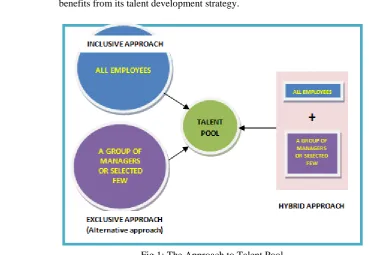
Consequently, Sumardi and Othman (2009) identified two approaches to talent development:
a. Exclusive approach – this involves selecting a group of managers for special attention and
b. The alternative approach – this is more inclusive, focusing on developing all managers, Iles et al.
(2010) however, identified this as an exclusive approach that target talent for key positions.
IIes et al. (2010) also suggested an inclusive approach that focuses on developing all potential employees; (fig 1) this gives highest benefits to organisations in the long run (Pruis 2011). The hybrid approach suggested by Van der Sluis and Van De Bunt – Kokhuis (2009) however has the advantage of combining the two approaches to reap the maximum benefit. The following references are case studies to illustrate theoretical description above. The exclusive approach adopted by Somerfield Ltd (Cook and Macaulay 2009) helped them develop a pool of new managers. However, if the development of talent only focuses on managers, employees may not have opportunity to be promoted to leadership positions. A more inclusive approach was adopted in Electrolux Ltd, where all employees are seen as talents (Cook and Macaulay 2009). Cook and Macaulay (2009) suggest that not only the high potential groups should be developed. Single focus on few that are chosen, developed, rewarded and promoted could lead to de-motivation and underperformance of other employees. To overcome the shortcomings of this approaches, NHS adopted the hybrid approach which identifies different categories of employees for development (Cook and Macaulay 2009).
The following prepositions are therefore put forward:
P1. Talent can mean whatever organisations want it to mean.
P3. Organisations that focus on developing all categories of workers tend to reap maximum benefits from its talent development strategy.
Fig 1: The Approach to Talent Pool
Business case for learning & talent development
Talent development is a long term, integrated process which is used to keep the organisation healthy and innovative (Pruis 2011). The survivals of organisations therefore, depend on their innovations in process, products and organisational management (Neal and Sonsino 2012). Ketter (2010) suggests talent development is necessary because organisations compete in new marketplace with less resource.
L&TD help improve employees‘ retention and motivation (Cook and Macaulay 2009). Cook and Macaulay (2009) argued that in time of recession, when retention is necessary, the talent that has been developed will take the company forward. For instance, 38% of US companies focus on developing their workforce during recession (Bettinger & Brown 2009). It is therefore a proactive strategy for organisations to survive the impending scarcity of specialists, skilled and talented workers. L&TD is therefore preparing employees for current and future success (Potential .com 2012). It puts the organisation at competitive advantage, improved operational efficiency, and helps in employee retention. Stewart and Rigg (2010) argued that L&TD should be used to support organisational strategic objectives as organisations develop employees through learning. Consequently, L&TD contributes to organisational competitive advantage and plays a strategic HRD role.
P4: Talent remain invaluable resources to organisations especially in term of recession.
P5. Talent development if fully harnessed becomes a strategic resource for organisational competitive
advantage.
2009), but only 49% of UK businesses were really implementing talent development programmes. This shows that despite the increasing emphasis on the concept, it is still under implemented in organisations. This gap is a challenge for L&TD and HR professionals to tap the benefits for their organisational effectiveness.
However, a survey in 2010 revealed ‗‘many employees have no aspiration to assume leadership role within their organisation‘‘ (Ketter 2010:36). This report cited the fact that many leaders has failed; for instance the case of ethical issues with News Corporation scandal (involving Rupert Murdoch) and the management of BP oil crisis has eroded trust in leadership. Consequently, a continuous trend will mean there will be no succession plans in organisations. A measure by CEOs to address this is through greater transparency. There is greater debate therefore about whether ‗ethics‘ can be taught. Steve Arneson (founder of Arneson Leadership Consulting) agreed that ‗‘integrity and honesty are hard things to teach in leadership development classes‘‘ (Ketter 2010:36). However, the purpose of learning and talent development is not for the primary purpose of leadership and succession; the product innovation in an organisation is not usually from the top but from the employees.
P6. The development of talent is dependent on organisation‘s ability to provide a culture that
creates talent.
P7. The talents of the organisation are tasked with the role of producing innovations that put the
organisation at a competitive advantage.
Learning in organisation
Learning is reflected in knowledge, skills and insights (Clifford 2007). The CEO of Giunti Labs – Fabrizio Cardinali argued that because of competitions, organisations should make effort not only to identify the best talent but to deliver the right type of learning content in time and when it is needed (Little 2010). Consequently, organisations need to remain competitive and cannot ignore the development of diverse talent within the organisation. In doing this however, organisations have to consider the individual needs of employees because employees learn differently. The Kolb, Honey and Mumford learning cycle models (fig 2) provide theories on how individual learn. The implication of the model is that organisations cannot assume one learning programme for all its talent. However, designing different strategies to accommodate all talent is expensive. The organisation‘s strategic objective and direction will therefore help to develop a cost effective strategy to L&TD.
Fig 2: The learning cycle (Adapted: Harrison 2009)
Little (2010) identifies some issues with learning as:
1. The alignment of learning and development to strategic business needs
2. The diversification of learning delivery options – organisations have to get the right type of learning for
its workforce otherwise it will amount to wasting time, money and resources.
3. The interdependence of work and learning and that the two cannot be separated.
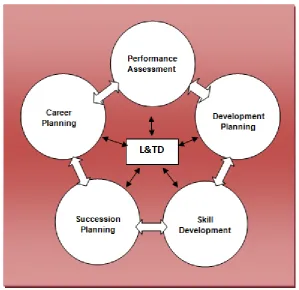
The implication of these issues to organisation means a more holistic approach to L&TD that involves individualised and personalised learning system which align the individual achievements to organisational goals. Thus, Christensen (2006:167) proposed these key components for successive learning and talent development (fig. 3): ‗Performance assessment
a. Development planning
b. Skill Development
c. Succession planning
Concrete experience
Active experimentation
Reflective observation
d. Career planning‘
Figure 3: Key components for L&TD (Adapted: Christensen 2005:167)
However, for the model above to be successful, employees and managers should be partners in L&TD and focus must be on building capabilities on the job that align with business strategy.
P8. It is not enough for organisations to identify talent; the talent must be given the right mix of
learning to produce positive results.
Organisational needs and levels of learning
The organisational L&TD focuses on organisational needs such as succession planning (Lawler 2008), achievement of business objectives, enhancement of leadership, and development of talent (Garavan et al.2012). CIPD (2009) recommended that organisations should develop it workforce to stand in difficult times and meet current and future challenges.
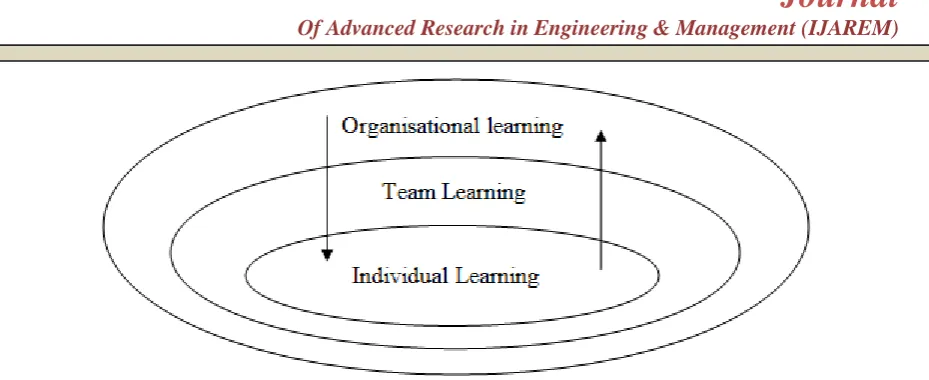
Three types of learning in organisations are (fig 4):
Individual Learning: includes formal (structured) and informal (unstructured) learning (Marsick and Watkins 2001).
Team Learning: essential to create synergy in organisational learning environment (Senge 1997).
Fig 4: Levels of learning Adapted (Eraut and Hirsh 2007:2)
Talent and learning development thus require investment by organisations, but with the recession, organisations are cutting cost (Neal and Sonsino 2012, CIPD 2012). This implies the enabled transformation that L&TD will bring to an organisation is limited for lack of required funding. However, organisations will have to weigh the benefits of developing talent and opportunity cost to allocate necessary budget for L&TD.
P9. The learning programmes in organisations are tailored to achieve specific organisational
objectives.
The relationship of L&TD with corporate strategy
The strategic position of an organisation may include: cost leadership, focus and differentiation. This underpins the investment in its HR development (Pettinger 2002). Recent practises suggest that as part of the corporate strategy, organisations‘ chief executives are taking L&TD as priority (Neal and Sonsino 2012). However, the role of L&TD should still partly rest with the HR practitioners because they are in better position to align and build the original capabilities and human resources to achieve the growth which is the primary focus of CEOs.
L&TD should not be seen as an end in itself. Peter Cappellin (cited in Sharda 2012:145) postulates that ‗‘ It exists to support the organisation‘s overall objectives, which in business essentially amount to making money‘‘. This implies that organisations should incorporate L&TD into its strategy and not treat it as separate goal to pursue. The alignment will help organisations use its scarce resources more effectively for marketplace differentiation and positioning. Sharda (2012) argued that L&TD will eradicate cases of wastage through fragmentation and duplication of talent management efforts. Consequently, L&TD are deployed to assist organisation in its strategic objectives which include growth, innovation, globalisation, diversification, mergers and acquisition (Lockwood 2006).
Little (2010:392) identified L&TD to deal with:
1. ‗Workforce planning
2. Workforce acquisition
3. Performance management
4. Career development
5. Succession planning
6. Learning management and
7. Compensation management‘
All these have influence on the corporate strategy of the organisation. The corporate objective for organisations therefore, is to excel in the above seven areas which will translate to organisational effectiveness.
L&TD interventions
Training: Organisations favour training courses because they are viewed as cost effective, can be easily planned into the week and highly visible (Clifford and Thorpe 2007). Staff like them because training is familiar to them and attending a course is relatively easy (Clifford and Thorpe 2007). Managers love training because it gives them opportunity to develop their team with little effort from their part and managers can choose from a wide range of courses to suit their need.
Effectiveness of training
Trainings are effective when used to:
1. train lots of people
2. give factual, knowledge and skilled based learning
3. update on system, policies and procedures such as change in legislature
4. deliver a lot of knowledge within a short time
5. learn such skills such as assertiveness, negotiation and interviewing skills which can be developed later
in practice
6. develop groups into different learning styles
However, trainings are not answers to all learning needs. Most training relies on fictitious case studies rather than real life workplace examples (Turner 2006). This makes retention and application difficult because workplace environment is different to training environment. Training will also not be suitable to: enhance existing knowledge, improve processes and procedures, demonstrate a set of values and attitude, alter or analyse behaviour, and transfer learning to workplace (Clifford and Thorpe 2007). Although knowledge gained in training are practised in class, the real learning is at workplace to put them in practice and internalise them. This will be most effective with adequate support and feedback.
On the job learning: There are various categories of ‗On the job learning‘. They include: secondment,
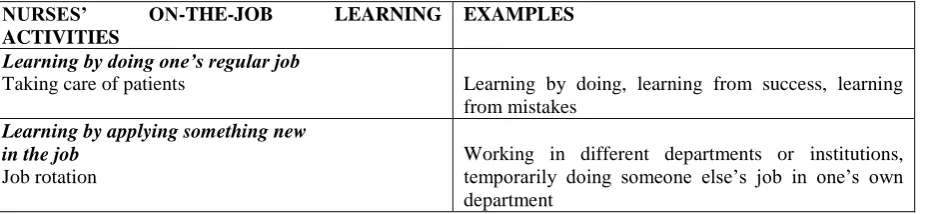
apprenticeship, delegation, projects job rotation, shadowing and temporary promotion. All these take place in the workplace making it relevant to the need of individual and organisation. On the job learning is cost effective and can be delivered when needed (Clifford and Thorpe 2007). However, learning outcomes may not be achieved because most often they are unplanned and unstructured (Berings and Gelissen 2008). Table 1 shows excerpt of on the job training for a nurse.
NURSES’ ON-THE-JOB LEARNING ACTIVITIES
EXAMPLES
Learning by doing one’s regular job
Taking care of patients Learning by doing, learning from success, learning
from mistakes
Learning by applying something new in the job
Job rotation
Working in different departments or institutions, temporarily doing someone else‘s job in one‘s own department
Table I. Classification of nurses‘ on-the-job learning activities (Berings and Gelissen 2008:452)
Group learning: This type of learning may not be primarily set up as a learning programme (Clifford and Thorpe 2007). They include discussion boards, networking events, trade exhibitions and professional institutes. This type of learning brings individuals that have common interest together to share ideas on a wide range of workplace practices. However, personal development plans will be difficult with this type of learning.
Individual learning: There are various individual learning methods within workplace environment. They include:
Coaching
Executive coaching
E-Learning
Mentoring
Distance Learning
The advantage of individual learning methods over training for instance, is that they can be customised to meet individual needs and they can be less expensive because they use internal resources (Clifford and Thorpe 2007). Also, learning is more convenient because they are delivered in a place and time suitable to the learner and the organisation. However, some of these methods like e-learning and distance learning need the learner to be self motivated to achieve learning outcomes.
For the purpose of this review, coaching, mentoring and e-learning will be further discussed.
E-Learning: E-Learning has been efficient in helping employee to be competent in day to day workplace role (Baldwin-Evans 2004). It helps to develop skills, learn new knowledge both for workplace and personal development, career development and accreditation. E-learning is flexible and convenient as employee can learn at various locations and time provided they have access to computer and internet. Employee can focus to learn specific skills needed. For instance, FedEx‘s strategy provides hundreds of free online courses for its employees to develop their skills (Potential.com 2012). Also at Digital, Hewlett Packard, Oracle, Silicon Graphics, and UBS, learners choose from a selection of information and educational materials made available according to situations and needs (McCluskey 1996). In addition, E-learning has proved effective in providing basic training for large group of people, for instance, it is used in MICROS to train its 50,000 employees (McCluskey 1996). However, this method requires learners and trainers to develop appropriate skills to choose the right content and material. Moreover, lack of time to complete courses, fear of technology and lack of understanding about how e-learning works are also some of its barriers.
Mentoring: Mentoring refers to activities and relationship that exist between those that are regarded as role models who possess the traits and behaviour needed to facilitate the professional development of a protégé (Hunt and Michael 1983, Byrne et al. 2008). It involves the mentor who is usually more experienced passing knowledge and skills to the protégé, with the effect of optimizing career progress. A mentor can be co-worker, supervisor or manager in workplace. Mentoring is a vital development tool that provides opportunity to develop technical supports, respect and power for use of organisation as mentors help less experienced employees for development (Hunt and Michael 1983). Therefore, mentoring helps in increasing productivity, efficiency and transfer of leadership skills within workplace and ensures talent pipeline are filled in organisation (Abbajay n.d.).
However, successful mentoring requires certain characteristics. The mentor must have the willingness and desire to develop and help others through sharing of experience with protégées. Also, learning attitude, commitment, time and energy are necessary for successful mentoring relationship (Abbajay n.d.). On the other hand, protégées must be proactive (Byrne et al. 2008), open to learning and committed to expanding their capabilities. They must also be willing to ask for help and experiment what they‘ve learnt at workplace. Consequently, mentoring is a joint venture. There is need for effective communication and agreements on issues such as confidentiality, feedback, goals accountability, meetings and response time to manage mentoring successfully.
Many factors are limiting and affecting the use of mentoring in organisations. These factors include lack of informal opportunities to develop appropriate relationship, the diverse work structure due to downsizing and outsourcing, participative work arrangements, and autonomous teams (Byrne et al. 2008) and finding the right mentor. Byrne et al. (2008) explained that these factors have caused unorthodox career paths that make mentoring weak and infeasible. The followings are organisational examples of mentoring:
The development of local indigenous talent (engineers) in Brunei is done by mentoring at Shell
Leadership capability is developed in The Civil Service Public Sector leader‘s scheme that allows a
mentor to a particular civil servant. However, in Sony this is done by executives.
At BAE first year graduates are given a mentor as part of their training programme (Clutterbuck 2004,
CIPD 2009).
Coaching: Coaching involves equipping people with all they need to develop themselves and become more effective (Petterson and Hicks 1995). Coaching was primarily used as a technique to improve employees‘ task performance especially those with low performance. But more recently, it has become a means of facilitating
learningand moving employees from excellent performance to peak performance (Feldman and Lankau 2005).
coaches to support employees in new roles while Orange draws on internal coaches to support and develop employees in their career development (CIPD 2007). Using internal coaches is necessary when quick intervention is desired and detailed knowledge of organisational culture is vital. However, internal coaches need to be trained. For instance, companies like Motorola and Chrysler run multi-day training programs for coaches (Feldman 2001). One limiting factor of internal coaches however is that mostly, managers are reluctant to release potential coaches from their normal work. In employing external coaches however, their credential and references need to be thoroughly checked to get the right coaches (Thach and Heinselman 1999).
The distinctive characteristic of coaching from mentoring (discussed above) is that: the relationship in coaching which usually occur at midcareer rather than early career are more formal and structured, therefore the development of close, personal bonds are limited (Sperry 1993). Also, coaching relationships are usually shorter in duration lasting for about 6-18 months and are formally contracted rather than informally developed (Feldman and Lankau 2005). Moreover, while mentors can be from the same organization, coaches are usually from outside the organisation (Feldman 2001).
Case study: Google
There is no one ‘fit all’ method for L&TD. Organisation should consider a mix of methods. Google is an example of an organisation that adopts a holistic approach to its L&TD. Google boosts employee performance through training and leadership programmes. One third of its 33100 employees went through in-house programmes. Google uses project rotations, learning from failures, and invitation of external speakers like Al Gore and Lady Gaga to speak to employees to develop staff (Sullivan 2013). In 2010 Google created GoogleEDU (Walker 2012) and spent $171.5billion to enhance its L&TD (Fletcher 2007). Google uses 70/20/10 model. This means 70% of employee’s time is spent on defined job role, 20% on personal development that benefits the company, and 10% of time to develop new business ideas and projects (Fletcher 2007). Google practises on the job learning: individual employees work on projects and if successful, this is developed into model to be put into practise. Also, training classes are targeted on employees’ work areas such as engineering, sales and career stage. There are also special classes for managers to learn the skills of ‘subtle influence’. Clear self-directed continuous learning and ability to adapt are key employees’ competencies (Sullivan 2013). Google asks what employees want and allows contributions on what type of classes they want and the content of such classes. In conclusion, the company created work that fit employees’ talent and attract top talents into the organisation. Google’s L&TD strategy has helped develop, implement and grow the business (Lawler III 2014).
Factors influencing learning and talent development policy and strategy in practice
There are many factors influencing L&TD. Some of these factors are discussed below.Budget: Talent development is costly and requires long term planning. For instance, Wal- Mart‘s implementation of a new HR development cost millions of dollars (Bersin 2007). The availability of money will determine how organisations implement L&TD strategy. Recession is also a factor that influences how organisation spends its money. The lack of financial and human resources will affect L&TD. There should be budget in terms of money to invest and adequate number of HRD professionals to execute L&TD strategy. CIPD (2012) reported that due to the economic circumstances, significant number of organisations have faced decreases in L&TD budgets. However, the economic uncertainty may increase the need for organisations to invest more in L&TD to retain its talent needed for survival.
The Learning and delivery method: Whitney (2006) for instance, identified flaws in delivery methods of L&TD strategy in Wal-Mart. If the method of identification and delivery is wrong, it will be waste of organisation‘s scarce resources. Also, according to Kolb, Honey and Mumford learning models, individuals learn differently and this has to be considered in designing and delivery of L&TD strategy. Consequently, employees‘ willingness to learn is crucial.
knowledge is seen as tool for competitive advantage (McCluskey 1996). This strategic focus helps in pursuing learning culture within the workplace.
The senior management: Successful L&TD policies require total support and buy-in by the senior management. This is crucial so that funds can be released, key decisions made without delay, and difficulties to implementation easily removed. For instance, L&TD at HSBC was enhanced by the involvement of the CEO (Cook and Macaulay 2009).The CEO‘s involvement also helps to communicate the values of the organisation to all employees. Leadership is important to provide a supportive environment and reinforce learning (Ihsaan et al. 2013). Top management commitment to give direction, authority and resources influenced the L&TD initiatives (Sambrook 2002). They therefore act as provider and supporter of L&TD. Consequently, when the organisational strategic objectives include the development of L&TD, the implementation of such strategy is influenced by the extent of commitment of leadership to the vision.
The role of Line managers / L&TD professionals: The role of learning and talent development professionals is to integrate learning and development into business strategy. Often, the role of managing talent lies with talent management specialists or the HR departments (Cook and Macaulay 2009). The understanding of talent, resources and support available to them therefore influenced the implementation of L&TD policies. Abu-Mansor (2012) argued that there has been an increase in training provided to line managers over the years to help them function well in their roles. This is because of much HRD functions including L&TD delegated to line managers. Therefore, managers play important role in encouraging employees to continuously develop themselves. Also, Saddley-Smith et al. (2000) argued that most managers are becoming mentors in the workplace. Consequently, the effectiveness of managers in performing this role influences the outcomes of L&TD interventions.
External Support and Technology: The development of the right technology to support the implementation of
L&TD strategy is necessary. Organisations also need experienced consulting partners to deliver a 3600 solution
approach to L&TD strategy. This however depends on level of consultation, scope, resources and strategic direction of the organisation. The external consultants bring in their expertise and culture of learning to client‘s organisation. The extent to which consultants provide knowledge, training and support and interaction between the external consultants and the organisation therefore influence the effectiveness of any L&TD initiatives.
Motivation: The success of learning is dependent on learners‘ self-motivation (McCluskey 1996). Lack of motivation has been identified as one of the major factors affecting the effectiveness of L&TD in workplace (Sambrook 2002). This lack of motivation can be explained by:
1. Lack of incentives and reward for learning
2. Lack of confidence to learn
3. Lack of time due to work pressure
However, active participation of employee in learning, and managerial involvement and support will enhance L&TD. For instance, at Hewlett Packard, employees take responsibility for their own development (McCluskey 1996). There is always a yearly evaluation that is used in providing individual training and development plan. The training department then
propose appropriate training based on the plans; however employees are encouraged to take initiatives and see training as their own personal responsibility (McCluskey 1996).
Government policies:L&TD may be influenced in a bid for organisations to comply with government policies. In Malaysia for instance, the human resources development Act 1992 requires organisations to contribute 1% of equivalent of their monthly payroll to HRD fund – a fund used to promote training. This has helped in providing quality training and accountability in Malaysia (Hashim 2001).
Conclusion and recommendations
The aim of investing in L&TD is positive return on investment (Collings and Mellahi 2009); it is proposed that organisations that apply L&TD effectively will improve performance. However, organisations have to overcome the limiting factors of funding and availability of talent. Talent development will not solve the entire organisational problem (Stewart 2008), but it has been seen as a long term investment into the future and survival of the organisation. Though talent is scarce and recession has made some organisations to put talent development to the backside, it is still needed by every organisation. Effective L&TD strategy calls for strong support from the leadership and the alignment to the organisational corporate objectives. Organisations will be well positioned for long term growth if L&TD strategy is well implemented. Therefore, organisations should take a holistic approach to L&TD for business effectiveness.
A universally acceptable definition of strategic L&TD and scope need to be further researched. Further research is also required on how to develop inflow of talent that is cost effective, the development of best mix of learning programmes for talent development, and the role line managers and HR practitioner should play in L&TD. Finally, more research is required on the impact of L&TD on business outcomes.
The following recommendations are made for effective L&TD implementation. Learning and talent development professionals should help organisations and leaders create culture that stimulates employees to be innovative. They should also review from time to time, the organisational talent management strategy and put them into practice. Business executives have to pursue learning and talent development agenda with the same rigour they implement other factors such as capital, technology and brand development. Pushing learning and talent development to the backside will negatively affect the overall organisational effectiveness. For L&TD to be effective there is no one-size fits all approach. However, the wide range of L&TD methods need to be considered to determine its suitability. The inclusive, rather than exclusive talent development approach should be used. This ensures maximum use of talent and places organisation in strategic competitive advantage position. Organisations should focus on their strategic objective to develop talent. The specific goals of the organisation should determine its approach to talent development. The culture of the organisation must allow learning experience to be put into practise – remove bottle necks and reinforce the values of learning. To do this, a sustainable process to support development should be in place. Adequate budget should also be allocated to L&TD to drive innovations.
REFERENCES
[1]. Abbajay, M. (n.d.) ‗The Working Life: The Importance of Workplace Mentors‘ [online]
available from< http://www.careerstonegroup.com/z-media/wp-mentoring.pdf>[06 April 2014]
[2]. Abbasi, S. (2014) ‗Corporate Training Lessons from Ben Horowitz, Facebook and
Twitter‘[online] available
from<https://www.udemy.com/organizations/blog/2014/03/14/corporate-training-lessons-from-ben-horowitz-facebook-and-twitter/>[06 April 2014]
[3]. Abu Mansor, N.N., Saidi, M.I., Mohamed, A., and Idris, N. (2012) ‗Organizational Factors in Learning
and Development Initiatives‘. Procedia - Social and Behavioral Sciences 40 565 – 570
[4]. Baldwin-Evans, K. (2006) ‗Key steps to implementing a successful blended learning strategy‘. Industrial
and Commercial Training 38(3), 156-163
[5]. Berings, M., Poell, R. and Gelissen (2008) ‗On-the-job learning in the nursing Profession: Developing
and validating a classification of learning activities and learning themes‘. Personnel Review 37(4),
442-459
[6]. Bersin, J. (2007) 'The Emergence of Talent-Driven Learning'. Chief Learning Officer 6 (8), 10-10
[7]. Bettinger, J. and Brown, S. L. (2009) 'The Talent Vacuum—Keeping Your Best Talent in a Downturn'.
AACE International Transactions, Dev.04.1-Dev.04.11
[8]. Boston Consulting Group (2007) The Future of HR: Key Challenges Through 2015 [online] available
from < https://www.bcg.com> [02 February 2014]
[9]. Briscoe, J.P. and Hall, D.T. (1999) ‗Grooming and picking leaders using competency frameworks: do
they work? An alternative approach and new guidelines for practice‘. Organizational Dynamics 28 (4),
37-52
[10]. Byrne, Z. S., Bryan, J.D and Chiaburu, D.S. (2008) ‗Alternatives to traditional mentoring in fostering
career success‘. Journal of Vocational Behavior 72, 429–442
[11]. Christensen, R. (2005) Roadmap to Strategic HR: Turning a Great Idea into a Business Reality. Saranac
[12]. CIPD (2009) ‗Mentoring – CIPD Factsheet‘ [online] available from <http://www.cipd.co.uk/hr resources/factsheets/coaching-mentoring.aspx > [06 April 2014]
[13]. CIPD (2007) ‗Coaching in organisations‘ [online] available from
<http://www.cipd.co.uk/hrresources/research/coaching-organisations.aspx > [06 April 2014]
[14]. CIPD (2012) Annual Survey Report 2012: Learning and Talent Development [online] available from
<http://www.cipd.co.uk/hr-resources/survey-reports/learning-talent-development-2012.aspx> [02February 2014]
[15]. CIPD (2012) ‗Learning and Talent Development: Annual Survey Report 2012‘ [online] available from
<www.cipd.co.uk/research/_learning-talent-development/> [06 April 2014]
[16]. Clifford, J. (2007) WorkplaceLearning and Development. London: Kogan page Limited
[17]. Clifford, J. and Thorpe, S. (2007) ‗More ways than one . . . exploring the use of different learning
methods in organizations‘. Industrial and Commercial Training 39(5), 267-271
[18]. Clutterbuck, D. (2004) Everyone needs a mentor: fostering talent in your organisation. 4th ed. London:
Chartered Institute of Personnel and Development
[19]. Collings, D. G. and Mellahi, K. (2009) 'Strategic Talent Management: A Review and Research Agenda'.
Human Resource Management Review 19 (4), 304-313
[20]. Cook, S. and Macaulay, S. (2009) 'Talent Management: Key Questions for Learning and Development'.
Training Journal, 37- 41
[21]. Donaldson, S., Ensher, E. A. and Grant-Vallone, E. J. (2000) ‗Longitudinal examination of mentoring
relationships on organizational commitment and citizenship behaviour‘. Journal of Career Development
26, 233-249
[22]. Dries, N., Vantilborgh, T., and Pepermans, R. (2012) 'The Role of Learning Agility and Career Variety in
the Identification and Development of High Potential Employees'. Personnel Review 41 (3), 340-358
[23]. Eraut, M. and Hirsh, W. (2007) ‗The Significance of Workplace Learning for Individuals, Groups and
Organisations‘. SKOPE Monograph 9, 1-97
[24]. Farndale, E., Scullion, H., and Sparrow, P. (2010) 'The Role of the Corporate HR Function in Global
Talent Management'. Journal of World Business 45 (2), 161-168
[25]. Feldman, D. C. (2001) 'Career Coaching: What HR Professionals and Managers Need to Know'. Human
Resource Planning 24 (2), 26-35
[26]. Feldman, D. C. and Lankau, M.J. (2005) ‗Executive Coaching: A Review and Agenda for Future
Research‘. Journal of Management 31 (6), 829-848
[27]. Fletcher, S. (2007) ‗Google recruiting and developing top talent‘ [online] available from
<http://www.trainingzone.co.uk/topic/strategy/google-recruiting-and-developing-top-talent->[06 April
2014]
[28]. Gagné, F. (2000) ‗Understanding the complex choreography of talent development through
DMGT-Based analysis‘. In Heller K.A. (Ed.), International handbook of giftedness and talent (2nd ed.). Oxford:
Elsevier.
[29]. Gallardo-Gallardo, E., Dries N. and González-Cruz T.F.(2013) ‗What is the meaning of ‗talent‘ in the
world of work?‘. Human Resource Management Review 23 290–300
[30]. Garavan, T. N., Carbery, R., and Rock, A. (2012) 'Mapping Talent Development: Definition, Scope and
Architecture'. European Journal of Training & Development 36 (1), 5-24
[31]. Garavan, T.N., Hogan, C. and Cahir-O‘Donnell, A. (2009) Developing Managers and Leaders:
Perspectives, Debates and Practices in Ireland. Dublin: Gill and Macmillan
[32]. Gunasekaran, A., McNeil, R. D. And Shaul, D. (2002) ‗E-learning: research and applications‘. Industrial
and Commercial Training 34 (2), 44-53
[33]. Harrison R. (2009) Learning and development. London: Chartered Institute of Personnel and
Development
[34]. Hashim, J. (2001) ‗Training Evaluation: Clients‘ Roles‘. Journal of European Industrial Training 25 (7),
374-379
[35]. Hernandez, B.E. (2012) ‗Google Makes Employees Go to GoogleEDU‘ [online] available from
<http://www.nbcbayarea.com/blogs/press-here/Google-Makes-Employees-Go-to-GoogleEDU- 161405265.html> [06 April 2014]
[36]. Hindle, J. (2005) ‗HR Outsourcing in Operation: Critical Success Factors‘. Human Resource
[37]. Howe, M.J.A., Davidson, J.W. and Sloboda, J.A. (1998) ‗Innate Talents: Reality or myth‘. Behavioral and Brain Sciences 21(3), 399-442.
[38]. Hunt, D. M. and Michael, C. (1983) 'Mentorship: A Career Training and Development Tool'. Academy of
Management Review 8 (3), 475-485
[39]. Ihsaan, M., Yousaf, J., Majeed, A. and Sohaib, M. (2013) ‗Measuring the Levels of Learning in
Organizations: A Comparative Study of Food Sector of Pakistan‘. International Journal of
Organizational learning and Change 1(1), 64-74
[40]. Iles, P., Chuai, X. and Preece, D. (2010) ‗Talent management in multinational companies in Beijing:
definitions, differences and drivers‘. Journal of World Business 45 (2), 179-89.
[41]. Jones, A. M., and Hendry, C. (1992) The learning organization: A review of literature and practice. UK:
University of Warwick, Centre for Corporate Strategy and Change
[42]. Ketter, P. (2010) '2010: Six Trends that Will Change Workplace Learning Forever'. Training and
development 64 (12), 34-40
[43]. Kim, S. and McLean, G. N. (2012) 'Global Talent Management: Necessity, Challenges, and the Roles of
HRD'. Advances in Developing Human Resources 14 (4), 566-585
[44]. Lawler III (2014) ‗What Should HR Leaders Focus On In 2014?‘ [online] available from
<http://www.forbes.com/sites/edwardlawler/2014/01/15/what-should-hr-leaders-focus-on-in-2014/> [06 April 2014]
[45]. Lepak, D.P. and Snell, S.A. (1999) ‗The human resource architecture: toward a theory of human capital
allocation and development‘. The Academy of Management Review 24(1), 3-48
[46]. Little, B. (2010) 'Talent Management and its Technological Partners'. Industrial & Commercial Training
42 (7), 389-393
[47]. Lockwood, N. R. (2006) 'Talent Management: Driver for Organizational Success'. HR Magazine 51 (6),
1-11
[48]. Marsick, V. J. and Watkins, K.E. (2001) ‗Informal and incidental learning: New directions for adult and
continuing education‘ [online] available from<onlinelibrary.wiley.com>(89), 25-34 [06 April 2014]
[49]. McCluskey, A. (1996) ‗Learning technologies in companies and administrations in Switzerland‘ [online]
available from< http://tecfa.unige.ch/tecfa/publicat/peraya-papers/ocde/ocde14.htm>[06 April 2014]
[50]. Meyer, A. D. (1982) ‗Adapting to environmental jolts‘. Administrative science quarterly 22(4), 515-537
[51]. Michaels, E., Handfield-Jones, H., and Axelrod, B. (2001) The war for talent. Boston: Harvard Business
School Press.
[52]. Neal, A. and Sonsino, D. (2012) 'Seven Career-Limiting Myths for Talent Management Pros'. Training
and development 66 (8), 70-72
[53]. Oakes, K. (2006) 'The Emergence of Talent Management'. Training and development 60 (4), 21-23
[54]. Peterson, D. B., and Hicks, M. D. (1995) The leader as coach: Strategies for coaching and developing
others. Minneapolis, MN: Personnel Decisions
[55]. Pettinger R. (2002) Mastering employee development. Basingstoke: Palgrave
[56]. Potential.com (2012) ‗SME Evolution Program Fall 2012 – Talent Development‘ [online] available
from<http://www.potential.com> [06 April 2014]
[57]. Pruis, E. (2011) 'The Five Key Principles for Talent Development'. Industrial & Commercial Training 43
(4), 206-216
[58]. Sadler- Smith, E., Down, S. and Lean, J. (2000) ‗Modern learning methods: rhetoric and reality‘.
Personnel Review 29(4), 474- 490
[59]. Sambrook, S. (2002) ‗Factors Influencing Learning in Work: a comparison of two research projects
(European- and United Kingdom-based)‘. European Educational Research Journal, 1(3), 522-537
[60]. Sar, R. (2012) 'Managing Talent at Lupin Limited: Case Analysis I'. Vikalpa: The Journal for Decision
Makers 37 (3), 145-150
[61]. Senge, P. M. (1997) ‗The fifth discipline: Measuring Business Excellence‘. Emerald Insight 1(3), 46-51
[62]. Sharda, K. (2012) 'Managing Talent at Lupin Limited'. Vikalpa: The Journal for Decision Makers 37 (3),
129-144
[63]. Sperry, L. (1993) ‗Working with executives: Consulting, counseling, and coaching‘. Individual
Psychology 49(2), 257-266
[64]. Stewart J. (2008) ‗Developing skills through talent management‘ SSDA Catalyst 6, 1–14
[65]. Stewart, J. and Rigg, C. (2010) Learning and Talent Development. London: CIPD
[67]. analytics to reinvest HR‘ [online] available from< http://www.ere.net/2013/02/25/how-google-became-the-3-most-valuable-firm-by-using-people-analytics-to-reinvent-hr/>[[06 April 2014]
[68]. Sumardi, W. A. and Othman, R. (2010) 'The Three Faces of Talent Management in Malaysia'.
International Journal of Business Research 10 (1), 181-185
[69]. Tansley C. (2011) ‗What do we mean by the term ―talent‖ in talent management?‘. Industrial and
Commercial Training 43 (50), 266 – 274
[70]. Tansley, C., Harris, L., Stewart, J. and Turner, P. (2007) Talent Management: Strategies, Policies and
Practices. London: Chartered Institute of Personnel and Development
[71]. Thach, L. and Heinselmati, T. (1999) ‗Executive Coaching Defined‘. Training and Development 53,
34-39
[72]. Turner, E. (2006) ‗Learning that lasts‘. Industrial and Commercial Training 38(3), 137-42
[73]. Ulrich, D. (2007) ‗The talent trifecta‘. Workforce Management 86 (15), 32-33
[74]. Van Der Sluis, L. and Van De Bunt-Kokhuis, S. (Eds) (2009) Competing for Talent. Assen: Van Gorcum
[75]. Vaiman V.,Scullion H. and Collings D. (2012) ‗Talent management decision making‘. Management
Decision 50 (5), 925-941
[76]. Walker. J, (2012) ‗School's in Session at Google‘ [online] available from
<http://online.wsj.com/news/articles/SB10001424052702303410404577466852658514144>[06 April
2014]
[77]. Whitney, K. (2006) 'Wal-Mart: Rebuilding Learning, One Box at a Time'. Chief Learning Officer 5 (10),
28-31
[78]. Whitney, K. (2005) 'Banco Popular: Connecting a Workforce to Learning'. Chief Learning Officer 4 (6),